






1. Introduction
The lower decay rate  $\rho$ of a decreasing null sequence
 $(x_n)$ is given by
 \begin{equation}
\rho = \liminf_{n \to \infty} \frac{x_{n+1}}{x_n}.
\end{equation}
Evidently,  $\rho \in [0,1]$. When
 $\rho \in (0,1]$, we say that
 $(x_n)$ has a positive lower decay rate. It was proved independently by Eigen and Falconer [Reference Eigen2, Reference Falconer4] that if
 $\rho = 1$, then there exists a set
 $E$ of positive Lebesgue measure such that
 $
\{n \in \mathbb{N} : ax_n+b \notin E\}
$ is nonempty for any
 $a \neq 0$ and
 $b \in \mathbb{R}$. This relates to the well-known question posed by Erdős [Reference Erdös3]:
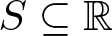
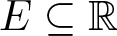
Given an infinite set  $S$ of real numbers, is there a set
 $E \subseteq \mathbb{R}$ of positive Lebesgue measure such that
 $\{x \in S : ax+b \notin E\}$ is nonempty for all
 $a,b \in \mathbb{R}$?
This is known as the Erdős similarity problem. Erdős was motivated by a classical result of Steinhaus [Reference Steinhaus10] for finite sets, to which the answer to the above question is negative. In [Reference Svetic11], the term Erdős set was coined for any set  $S$ for which the answer to the above question is positive. A set that is not Erdős is known as a universal set; see, e.g., [Reference Kolountzakis6, Reference Parrish and Rosenblatt9]. Steinhaus’ result implies that finite sets are not Erdős. Any unbounded or dense set
 $S$ is Erdős, since one may take
 $E$ to be a Cantor-type set of positive Lebesgue measure. It is still unknown whether there exists an infinite set that is not Erdős (equivalently, universal). An analogue of the problem in topological spaces is considered by [Reference Gallagher, Lai and Weber5], while a more recent result involving the construction of special Cantor-type sets can be found in [Reference Kolountzakis7].
In the spirit of this problem, we introduce the following notion: a set  $S \subseteq \mathbb{R}$ is almost Erdős if, for every
 $\varepsilon \gt 0$, there exists a set
 $E \subseteq \mathbb{R}$ of positive Lebesgue measure such that
 $
\{x \in S : ax+b \notin E\}
$ is nonempty for all
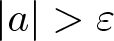
 $|a| \gt \varepsilon$ and
 $b \in \mathbb{R}$. If
 $S$ is almost Erdős, then so is any
 $S'$ containing
 $S$; the closure of an almost Erdős set is still almost Erdős, and any affine translation of an almost Erdős set is again almost Erdős. Consequently, it suffices to restrict attention to decreasing null sequences. Building on Falconer’s work [Reference Falconer4], we show that whenever
 $\rho \gt 1/2$, the sequence
 $(x_n)$ is an almost Erdős set (Theorem 1). The argument may also be extended to sequences
 $(x_n)$ with positive decay rate
 $\rho \leq 1/2$; however, in this case, we are only able to construct compact sets
 $E_+$ and
 $E_-$ of positive measure with the property that
 $E_+$ misses any copy of
 $(x_n)$ whenever
 $b, |a| \gt \varepsilon$, while
 $E_-$ misses any copy of
 $(x_n)$ whenever
 $-b, |a| \gt \varepsilon$ (Theorem 2).
Moreover, we show that if  $(x_n)_{n \in \mathbb{N}}$ is a decreasing null sequence with
 $\rho \gt 1/2$, then there exists a set
 $E$ of positive Hausdorff dimension such that
 $
\{n \in \mathbb{N} : ax_n+b \notin E\}
$ is infinite for all
 $a \neq 0$ and
 $b \in \mathbb{R}$ (Theorem 3). We conclude with some corollaries concerning translates of sequences
 $(x_n)$ by a real number
 $b$.
2. Almost Erdös sequences
Theorem 1 Let  $(x_n)_{n \in \mathbb{N}}$ be a decreasing null sequence with
 $\rho \gt 1/2$. Then, for every
 $\varepsilon \gt 0$, there exists a set
 $E \subseteq \mathbb{R}$ of positive measure such that
 $
\{n \in \mathbb{N} : ax_n+b \notin E\}
$ is nonempty for all
 $|a| \gt \varepsilon$ and
 $b \in \mathbb{R}$. Moreover, the measure of
 $E$ is uniformly bounded away from zero.
Proof. Let  $\rho \gt 1/2$. Then there exists
 $N \in \mathbb{N}$,
 $N \geq 3$, such that
 \begin{equation*}
\rho \gt \frac{1}{2} + \frac{1}{N}.
\end{equation*}
Let  $(r_k)$ be a decreasing null sequence such that
 $r_1 \lt 1/2$ is sufficiently small. Then, for every
 $k \in \mathbb{N}$ and
 $b \in [0,r_k]$, we have
 \begin{equation}
\frac{r_k/N+b}{r_k+b}
\leq \frac{r_k/N+r_k}{r_k+r_k}
= \frac{1}{2N}+\frac{1}{2} \lt \frac{1}{N}+\frac{1}{2} \lt \rho-r_k \lt \frac{x_{n+1}}{x_n}
\quad \text{for all } n \geq n_{k}.
\end{equation}
The inequalities in (2) imply that, for  $b \in [0,r_k]$, the intervals
 \begin{equation*}
\frac{1}{x_n}\,(r_k/N+b,\, r_k+b)
\quad \text{and} \quad
\frac{1}{x_{n+1}}\,(r_k/N+b,\, r_k+b)
\end{equation*}
overlap for all  $n \geq n_k$. Consequently, the interval
 $(r_k/N+b,\infty)/x_{n_{k}}$ is entirely contained in the complement of the set
 \begin{equation}
\bigcap_{n \geq n_{k}} \frac{1}{x_n}\,(E_k+b),
\quad \text{where } E_k = \bigcup_{j \in \mathbb{Z}} [j r_k,\, j r_k + r_k/N]
\quad \text{for all } k \in \mathbb{N},
\end{equation}
and therefore
 \begin{equation}
\bigcap_{n \geq n_{k}} \frac{1}{x_n}\,(E_k+b)
\subseteq (-\infty,\, r_k/N+b]/x_{n_{k}}.
\end{equation}
On the other hand, for  $b \in [0,r_k]$ we have
 \begin{align*}
\frac{r_k-b}{2r_k-r_k/N-b}
&\leq \frac{r_k}{2r_k-r_k/N} \\
&= \frac{1}{2-1/N} \lt \frac{1}{2}+\frac{1}{2N} \lt \rho-r_k \lt \frac{x_{n+1}}{x_n}
\quad \text{for all } n \geq n_{k},
\end{align*}
implying that the intervals
 \begin{equation*}
\frac{1}{x_n}\,(-2r_k+r_k/N+b,\, -r_k+b)
\quad \text{and} \quad
\frac{1}{x_{n+1}}\,(-2r_k+r_k/N+b,\, -r_k+b)
\end{equation*}
overlap for all  $n \geq n_k$. Therefore, the interval
 $(-\infty,\,-r_k+b)/x_{n_{k}}$ is entirely contained in the complement of the set (3), and so
 \begin{equation}
\bigcap_{n \geq n_{k}} \frac{1}{x_n}\,(E_k+b)
\subseteq [-r_k+b,\,\infty)/x_{n_{k}}.
\end{equation}
Together with (4), we obtain
 \begin{equation}
\bigcap_{n \geq n_{k}} \frac{1}{x_n}\,(E_k+b)
\subseteq [-r_k,\, 2r_k]/x_{n_{k}}
\quad \text{for all } k \in \mathbb{N}.
\end{equation}
By periodicity of  $E_k$, (6) holds for all
 $b \in \mathbb{R}$.
Now let  $\varepsilon \gt 0$. We may choose
 $(r_k)$ so that
 $(r_k/x_{n_k})$ is itself a null sequence. Then there exists
 $k_{\varepsilon} \in \mathbb{N}$ such that
 $r_{k} \lt \varepsilon x_{n_{k}}/2$ for every
 $k \geq k_{\varepsilon}$. Consequently,
 \begin{equation}
\bigcap_{n \geq n_{k}} \frac{1}{x_n}\,(E_k+b)
\subseteq [-\varepsilon,\, \varepsilon]
\quad \text{for all } k \geq k_{\varepsilon}.
\end{equation}
This implies that, for any  $|a| \gt \varepsilon$, there exists
 $n \geq n_{k}$ such that
 $a x_n-b \notin E_k$ whenever
 $k \geq k_{\varepsilon}$. Taking
 $k=k_{\varepsilon}$ and letting
 $E=E_{k_{\varepsilon}}$ yields the candidate set. Finally, we estimate the measure of
 $E$. Let
 $\lambda$ denote the Lebesgue measure on
 $\mathbb{R}$. Then
 \begin{align*}
\lambda(E)
= \lambda(E_{k_{\varepsilon}})
\geq \lambda(E_{k_{\varepsilon}} \cap [0,1])
\geq \frac{r_{k_{\varepsilon}}}{N}
\left\lfloor \frac{1}{r_{k_{\varepsilon}}} \right\rfloor \gt \frac{r_{k_{\varepsilon}}}{N}
\Big(\frac{1}{r_{k_{\varepsilon}}}-1\Big)
\geq \frac{1}{N}-\frac{r_{1}}{N} \gt \frac{1}{2N},
\end{align*}
since  $r_1 \lt 1/2$. Thus, the set
 $E$ has a measure uniformly bounded away from zero.
Theorem 2 Let  $(x_n)_{n \in \mathbb{N}}$ be a decreasing null sequence with
 $\rho \gt 0$. If
 $\rho \leq 1/2$, then, for every
 $\varepsilon \gt 0$, there exist sets
 $E_1, E_2 \subseteq \mathbb{R}$ of positive measure such that
 \begin{equation*}
\{n \in \mathbb{N} : a x_n + b \notin E_1\} \text{is nonempty for all } b \gt \varepsilon,\, |a| \gt \varepsilon,
\end{equation*}
and
 \begin{equation*}
\{n \in \mathbb{N} : a x_n + b \notin E_2\} \text{is nonempty for all } b \lt -\varepsilon,\, |a| \gt \varepsilon.
\end{equation*}
Moreover, the measures of the sets  $E_1$ and
 $E_2$ are uniformly bounded away from zero.
Proof. Let  $\rho \leq 1/2$. Then there exists
 $N \geq 3$,
 $N \in \mathbb{N}$, such that
 \begin{equation*}
\frac{1}{N} \lt \rho \leq \frac{1}{N-1}.
\end{equation*}
W.l.o.g., take  $(r_k)$ such that
 $r_k \lt N\rho - 1$ for all
 $k \in \mathbb{N}$. For every
 $k \in \mathbb{N}$ and
 $b \in [0,r_k]$, we have
 \begin{align*}
\frac{(N\rho - 1 - r_k)r_k + b}{Nr_k + b}
\leq \frac{N\rho - r_k}{N+1} \lt \rho - \frac{r_k}{N+1} \lt \frac{x_{n+1}}{x_n}, \quad \text{for all } n \geq n_k.
\end{align*}
Consequently, for  $b \in [0,r_k]$, the intervals
 \begin{equation*}
\frac{1}{x_n}((N\rho-1-r_k)r_k+b,\, Nr_k+b)
\quad \text{and} \quad
\frac{1}{x_{n+1}}((N\rho-1-r_k)r_k+b,\, Nr_k+b)
\end{equation*}
overlap for all  $n \ge n_k$. Thus, the interval
 $((N\rho-1-r_k)r_k+b, \infty)/x_{n_k}$ is contained in the complement of the set
 \begin{equation*}
\bigcap_{n \ge n_k} \frac{1}{x_n}\,(E^1_k+b),
\end{equation*}
where
 \begin{equation}
E^1_k = [0, (N\rho-1-r_k)r_k] \cup \bigcup_{j \ge N} [j r_k,\, j r_k + (N\rho-1-r_k)r_k], \quad \text{for all } k \in \mathbb{N}.
\end{equation}
Because  $\inf E^1_k = 0$ for all
 $k \in \mathbb{N}$, together with the inclusion
 \begin{equation*}
\bigcap_{n \ge n_k} \frac{1}{x_n}\,(E^1_k+b) \subseteq (-\infty, (N\rho-1-r_k)r_k+b]/x_{n_k},
\end{equation*}
it follows that
 \begin{equation}
\bigcap_{n \ge n_k} \frac{1}{x_n}\,(E^1_k+b)
\subseteq [0, (N\rho-1-r_k)r_k+b]/x_{n_k}
\subseteq [0, (N\rho-r_k)r_k]/x_{n_k}, \quad \text{for all } k \in \mathbb{N}
\end{equation}
for all  $b \in [0,r_k]$.
Now let  $b \ge N r_k$. Then, from (8), it follows that
 $E^1_k + b \subseteq E^1_k + \widehat b$, where
 $b \equiv \widehat b \mod r_k$. Consequently, in view of (9), we have
 \begin{equation}
\bigcap_{n \ge n_k} \frac{1}{x_n}\,(E^1_k+b) \subseteq [0, (N\rho-r_k)r_k]/x_{n_k}, \quad \text{for all } k \in \mathbb{N},
\end{equation}
for all  $b \in [0,r_k] \cup [Nr_k, \infty)$.
Now let  $\varepsilon \gt 0$. Again, we may choose
 $(r_k)$ so that
 $(r_k / x_{n_k})$ is itself a null sequence. Then, there exists
 $k_\varepsilon \in \mathbb{N}$ such that
 $N r_k \lt \varepsilon x_{n_k}$ for every
 $k \ge k_\varepsilon$. Hence, for all
 $b \gt \varepsilon \gt \varepsilon x_{n_k} \gt N r_k$, we haveFootnote *
 \begin{equation*}
\bigcap_{n \ge n_k} \frac{1}{x_n}\,(E^1_k+b) \subseteq [0, \varepsilon], \quad \text{for all } k \ge k_\varepsilon.
\end{equation*}
This implies that, for any  $|a| \gt \varepsilon$, there exists
 $n \ge n_k$ such that
 $a x_n - b \notin E_k$ whenever
 $k \ge k_\varepsilon$. Denote
 $E_1 = E^1_{k_\varepsilon}$. Then, similar calculations show that
 \begin{align*}
\lambda(E_1) = \lambda(E^1_{k_\varepsilon}) &\ge \lambda(E^1_{k_\varepsilon} \cap [0,1]) \\
&\ge (N\rho-1-r_{k_\varepsilon}) r_{k_\varepsilon} \left\lfloor \frac{1-N r_{k_\varepsilon}}{r_{k_\varepsilon}} \right\rfloor \\
& \gt (N\rho-1-r_1)(1-r_1(N+1)) \gt \frac{1}{3} (N\rho-1),
\end{align*}
by letting  $r_1 \lt (N\rho-1)/(N+1)$.
Now we show the existence of  $E_2$. Note that, for all
 $b \in [0,r_k]$, the inequalities
 \begin{align*}
\frac{-r_k+b}{-2Nr_k+(N\rho-1-r_k)r_k+b}
\leq \frac{-r_k}{-2Nr_k+(N\rho-1-r_k)r_k}
\leq \frac{1}{N} - \frac{r_k}{N} \lt \rho - \frac{r_k}{N} \lt \frac{x_{n+1}}{x_n}
\end{align*}
hold for all  $n \ge n_k$.
Therefore, for  $b \in [0,r_k]$, the intervals
 \begin{equation*}
\frac{1}{x_n}(-2Nr_k+(N\rho-1-r_k)r_k+b,\, -r_k+b)
\quad \text{and} \quad
\frac{1}{x_{n+1}}(-2Nr_k+(N\rho-1-r_k)r_k+b,\, -r_k+b)
\end{equation*}
overlap for all  $n \ge n_k$. Consequently, the interval
 $(-\infty, -r_k+b)/x_{n_k}$ is contained in the complement of the set
 \begin{equation*}
\bigcap_{n \ge n_k} \frac{1}{x_n}\,(E^2_k+b),
\end{equation*}
where
 \begin{equation}
E^2_k = [-r_k, -r_k + (N\rho-1-r_k)r_k]
\cup \bigcup_{j \le -2N} [j r_k,\, j r_k + (N\rho-1-r_k)r_k],
\quad \text{for all } k \in \mathbb{N}.
\end{equation}
Because  $\sup E^2_k \le 0$ for all
 $k \in \mathbb{N}$, together with the inclusion
 \begin{equation*}
\bigcap_{n \ge n_k} \frac{1}{x_n}\,(E^2_k+b) \subseteq [-r_k+b, \infty)/x_{n_k},
\end{equation*}
it follows that
 \begin{equation}
\bigcap_{n \ge n_k} \frac{1}{x_n}\,(E^2_k+b)
\subseteq [-r_k+b, 0]/x_{n_k}
\subseteq [-r_k, 0]/x_{n_k},
\quad \text{for all } k \in \mathbb{N},
\end{equation}
for all  $b \in [0,r_k]$.
Now, let  $b \le -2Nr_k$. Then, from (11), it follows that
 $E^2_k+b \subseteq E^2_k+\widehat b$, where
 $b \equiv \widehat b \mod (-r_k)$. In view of (12), we obtain
 \begin{equation}
\bigcap_{n \ge n_k} \frac{1}{x_n}\,(E^2_k+b) \subseteq [-r_k, 0]/x_{n_k},
\quad \text{for all } k \in \mathbb{N},
\end{equation}
for all  $b \in [0,r_k] \cup (-\infty, -2Nr_k]$.
Avoiding repetitions, for any  $\varepsilon \gt 0$, there exists
 $k_\varepsilon \in \mathbb{N}$ such that, for
 $b \lt -\varepsilon$, we have
 \begin{equation*}
\bigcap_{n \ge n_k} \frac{1}{x_n}\,(E^2_k+b) \subseteq [-\varepsilon, 0], \quad \text{for all } k \ge k_\varepsilon.
\end{equation*}
Thus, for any  $|a| \gt \varepsilon$, there exists
 $n \ge n_k$ such that
 $a x_n - b \notin E_k$ whenever
 $k \ge k_\varepsilon$. Denote
 $E_2 = E^2_{k_\varepsilon}$. Then, similarly as for
 $E_1$, we have
 \begin{align*}
\lambda(E_2) = \lambda(E^2_{k_\varepsilon}) &\ge \lambda(E^2_{k_\varepsilon} \cap [-1,0]) \\
&\ge (N\rho-1-r_{k_\varepsilon}) r_{k_\varepsilon}
\left\lfloor \frac{1-2N r_{k_\varepsilon}}{r_{k_\varepsilon}} \right\rfloor \\
&\ge (N\rho-1-r_1)(1 - r_1(2N+1)) \gt \frac{1}{3}(N\rho-1),
\end{align*}
by letting  $r_1 \lt (N\rho-1)/(2N+1)$.
In particular, the sets  $E_1$ and
 $E_2$ have measures uniformly bounded away from zero.
3. A set of positive Hausdorff dimension avoiding copies of a null sequence
Theorem 3 Let  $(x_n)_{n \in \mathbb{N}}$ be a decreasing null sequence with
 $\rho \gt 1/2$. Then, there exists a set
 $E \subseteq \mathbb{R}$ of positive Hausdorff dimension such that
 \begin{equation*}
\{n \in \mathbb{N} : a x_n + b \notin E\} \text{is infinite for all } a \neq 0 \text{and } b \in \mathbb{R}.
\end{equation*}
Proof. The inequalities in (2) still hold for all  $n \ge n_m$, for any fixed
 $m$, that is, by replacing
 $r_k$ with
 $r_m$ in
 $\rho - r_k$. This gives us the freedom to choose any null sequence
 $(r_k)$, independent of whether
 $(r_k / x_{n_k})$ is a null sequence or not. Then, inclusion (6) still holds with
 $x_{n_k}$ replaced by
 $x_{n_m}$.
Considering  $E_k$ restricted to the interval
 $[0,1]$ and taking the intersection with respect to
 $k \ge 1$ yields
 \begin{equation*}
\bigcap_{n \ge n_m} \frac{1}{x_n} (E+b) \subseteq \{0\}, \quad \text{where } E = \bigcap_{k \ge 1} E_k.
\end{equation*}
Consequently, for every  $a \neq 0$ and
 $b \in \mathbb{R}$, there exists
 $n \ge n_m$ such that
 \begin{equation*}
a x_n - b \notin E.
\end{equation*}
By moving along the subsequence  $\{n_m\}$, we obtain that
 \begin{equation*}
a x_n - b \notin E \quad \text{infinitely often.}
\end{equation*}
For  $n \ge 1$, let
 \begin{equation*}
D_n = \bigcap_{k \le n} E_k.
\end{equation*}
Then  $E \subseteq D_n$ for every
 $n \ge 1$, so any cover (open or closed) for
 $D_n$ is also a cover for
 $E$.
Now, choose the null sequence  $r_k = N/(N+1)^k$ for
 $k \in \mathbb{N}$ with
 $N\in \mathbb N, \, N\geq 3$. The set
 $D_n$ consists of disjoint closed intervals of length
 $1/(N+1)^n$, and there are
 \begin{align*}
\Big(\Big\lfloor \frac{r_{n-1}}{N r_n} \Big\rfloor + 1\Big)
\Big(\Big\lfloor \frac{r_{n-2}}{N r_{n-1}} \Big\rfloor + 1\Big)
\cdots
\Big(\Big\lfloor \frac{r_1}{N r_2} \Big\rfloor + 1\Big)
\Big(\Big\lfloor \frac{1}{r_1} \Big\rfloor + 1\Big)
= 2^n
\end{align*}
such intervals.
Given a set  $U \subseteq \mathbb{R}$, let
 $|U| = \sup\{|x-y| : x, y \in U\}$. For
 $s, t \gt 0$ and
 $V \subseteq \mathbb{R}$, denote
 \begin{equation*}
H^s_t(V) = \inf \Big\{\sum_{n \ge 1} |U_n|^s : |U_n| \le t, \; V \subseteq \bigcup_{n \ge 1} U_n \Big\}.
\end{equation*}
Then,
 \begin{equation*}
H^s_{r_n}(E) \le H^s_{r_n}(D_n) \le 2^n \Big(\frac{r_n}{N}\Big)^s = 2^n \Big(\frac{1}{N+1}\Big)^{s n}.
\end{equation*}
For the choice  $s = \log 2 / \log (N+1)$, we obtain
 \begin{equation*}H^s(E) := \lim_{n \to \infty} H^s_{r_n}(E) \le 1.\end{equation*}
Next, we show that  $H^s(E) \gt 0$. It suffices to show that, for some
 $\alpha \gt 0$, it holds
 \begin{equation*}
\sum_{n \ge 1} |U_n|^s \ge \alpha, \quad \text{for any cover } \{U_n\} \text{of } E.
\end{equation*}
W.l.o.g., we may assume that each  $U_n$ is a closed interval. Because
 $E$ is compact, we may assume the cover
 $\{U_n\}$ is finite. For each
 $U_n$, let
 $k \in \mathbb{N}$ be such that
 \begin{equation*}
\frac{1}{(N+1)^{k+1}} = \frac{r_{k+1}}{N} \le |U_n| \lt \frac{r_k}{N} = \frac{1}{(N+1)^k}.
\end{equation*}
Then  $U_n$ intersects
 $D_k$ in at most one of its subintervals, since the intervals are of width
 $r_k / N$ and are separated by a distance of
 $r_k (1 - 1/N)$. Next,
 $U_n$ intersects
 $D_{k+1}$ in at most two intervals, since each subinterval of
 $D_k$ contains at most two subintervals of
 $D_{k+1}$. Inductively, for every
 $j \ge k$, the interval
 $U_n$ intersects
 $D_j$ in at most
 $2^{j-k}$ subintervals. Note that
 \begin{equation*}
2^{j-k} = 2^j (N+1)^{-s k} \le 2^j (N+1)^s |U_n|^s.
\end{equation*}
We take  $j$ large enough so that
 $(N+1)^{-(j+1)} \le |U_n|$ for all
 $U_n$. Any interval
 $I$ of
 $D_j$ contains a nested sequence of subintervals
 \begin{equation*}
I \supseteq I_1 \supseteq I_2 \supseteq \dots,
\end{equation*}
where  $I_m$ is a subinterval of
 $D_{j+m}$ inside
 $I$. Since
 $r_k \to 0$, the lengths shrink to zero, so
 $\bigcap_m I_m$ is nonempty and contained in
 $E$. Therefore, any cover
 $\{U_n\}$ must intersect all
 $2^j$ intervals of
 $D_j$; otherwise, it would miss a point in
 $E$.
We write  $j = j_n + k_n$ for each
 $U_n$, then
 \begin{equation*}
2^j \le \sum_n 2^{j_n} = \sum_n 2^{j - k_n} \le \sum_n 2^j (N+1)^s |U_n|^s,
\end{equation*}
implying
 \begin{equation*}
\sum_n |U_n|^s \ge \frac{1}{(N+1)^s} = \frac{1}{2}.
\end{equation*}
Remark 4. The set  $E$ in Theorem 3 has positive Hausdorff dimension
 \begin{equation*}
s = \frac{\log 2}{\log(N+1)}
\end{equation*}
and Hausdorff measure at least  $1/2$.
4. Some corollaries
Corollary 5. Let  $(x_n)_{n \in \mathbb{N}}$ be a decreasing null sequence with
 $\rho \gt 1/2$. Then there exists a set
 $E \subset \mathbb{R}$ of positive measure such that, for all
 $b \in \mathbb{R}$, the set
 $x_n + b \notin E$ is nonempty.
Proof. This follows from Theorem 1 by taking  $\varepsilon \lt 1$ and
 $a = 1$.
An analogous corollary holds as well for decreasing null sequences with  $0 \lt \rho \le 1/2$.
Corollary 6. Let  $(x_n)_{n \in \mathbb{N}}$ be a decreasing null sequence with
 $0 \lt \rho \le 1/2$. Then, for every
 $\varepsilon \in (0,1)$, there exist sets
 $E_1, E_2 \subset \mathbb{R}$ of positive measure such that
 \begin{equation*}
x_n + b \notin E_1 \text{is nonempty for all } b \gt \varepsilon,
\end{equation*}
and
 \begin{equation*}
x_n + b \notin E_2 \text{is nonempty for all } b \lt -\varepsilon.
\end{equation*}
Proof. This follows from Theorem 2 by taking  $\varepsilon \lt 1$ and
 $a = 1$.
Corollary 5 relates to [Reference Borwein and Ditor1, Theorem 1(ii), Borwein–Ditor]. Borwein and Ditor showed that there exists a set  $E$ of positive measure and a null sequence
 $(x_n)$ such that, for each
 $b \in \mathbb{R}$,
 $x_n + b \notin E$ infinitely often. Corollary 5 also relates to [Reference Komjáth8, Theorem 3, P. Komjáth], where it is proved that for any null sequence
 $(x_n)$ and
 $\varepsilon \gt 0$, there exists a set
 $E \subset [0,1]$ of measure
 $\lambda(E) \gt 1 - \varepsilon$ such that, if
 $b \in [0,1]$, then
 $x_n + b \notin E$ infinitely often.
Acknowledgement
I am grateful to the anonymous referee for carefully reading the manuscript and for their helpful comments.



