1. Introduction
From an economic perspective, the existence value of a species is the utility that people derive from knowing of the existence of that species (Krutilla, Reference Krutilla1967). For the quantification of existence values, contingent valuation (CV) and choice experiment (CE) are often used. This quantification has been subject to severe criticism in the literature. For example, it is difficult to separate existence values from other economic value categories (Walsh et al., Reference Walsh, Loomis and Gillman1984; Loomis, Reference Loomis1988). Evidence also suggests that embedding effects (Kahneman and Knetsch, Reference Kahneman and Knetsch1992) may occur. One set of embedding effects occurs when respondents cite a token value in a stated preference interview in order to ‘purchase moral satisfaction’ which does not reflect any utility of the good itself (‘warm glow of giving’). Furthermore, survey respondents may have moral principles regarding their responsibility to rescue endangered species (Sagoff, Reference Sagoff2004; Ojea and Loreiro, Reference Ojea and Loreiro2007). People who believe that extinction is wrong may simply be willing to pay a fair share to rescue a species.
Much of the debate on the economic quantification of existence values has been conducted in the context of CV. In this paper, we apply a CE to address value separation, embedding or warm glow and ‘ethical’ motivations. We exemplify our application by valuing an inconspicuous, currently non-endangered moss endemic to Chile's sub-Antarctic region. The design isolates existence value by requiring respondents to make simultaneous tradeoffs between moss existence value and five other biodiversity-related values and income changes. We directly address insensitivity to scope by using degrees of extinction risks and discuss the implications for a potential insensitivity for species numbers. With respect to ethical motivations that can lead to protest responses, we predominantly use a willingness-to-accept (WTA) design of the payment vehicle and include a level with an increased risk of moss extinction. Thus, respondents were effectively trading higher moss extinction risks against financial benefits. In addition, we operationalized our strategy via a planning-related CE, addressing existence value within realistic, locally important environmental planning.
In the context of biodiversity, few studies have used the CE method to quantify existence values and to deal with the problems cited above (McVittie and Moran, Reference McVittie and Moran2010; Wattage et al., Reference Wattage, Glenn, Mardle, Van Rensburg, Grehan and Foley2011). These studies, however, were not designed to solve the problems inherent in the economic quantification of the existence value of species. Differing from the studies of McVittie and Moran, (Reference McVittie and Moran2010) and Wattage et al., (Reference Wattage, Glenn, Mardle, Van Rensburg, Grehan and Foley2011), Jacobsen et al., (Reference Jacobsen, Boiesen, Thorsen and Strange2008) address the problem of embedding by valuing endangered species. They argue that CEs are a better tool than CV for passing tests of sensitivity to scope. No CE study was found that assessed value separation and ethical motivations in the context of economic existence values; consistent with Jacobsen et al., (Reference Jacobsen, Boiesen, Thorsen and Strange2008), only issues of embedding were assessed.
Compared with CV studies, we argue that CEs provide an improved approach to deal with the problems. With CEs, it is possible to include several biodiversity values simultaneously. Including several values improves value separation by requiring respondents to engage in direct tradeoffs between the concerned value categories. Moreover, because an artificially isolated – and in this form ethically problematic – willingness-to-pay (WTP) or WTA question is avoided, the rate of protest responses (rejection of the choice task) may be lower than in CV studies (Bateman et al., Reference Bateman, Carson, Day, Hanemann, Hanley, Hett, Jones-Lee, Loomes, Mourato, Özdemiroglu, Pearce, Sugden and Swanson2002: 276; Barkmann et al., Reference Barkmann, Glenk, Keil, Leemhuis, Dietrich, Gerold and Marggraf2008). In addition, recent studies (e.g., Jacobsen et al., Reference Jacobsen, Boiesen, Thorsen and Strange2008) claim that internal evidence of scope sensitivity is a stronger test in CEs than in CV, because there is a greater difference in the complexity facing the respondent in a CE and the typical kinds of CV questions used in many embedding analyses. In CEs, people are asked to respond to often quite complex choice sets, where the levels of several attributes are varied across alternatives. Thus, it is much more difficult for a respondent to check his or her internal consistency in choices.
2. Description of the study site, respondents and the valued species
Navarino Island is located at the extreme south of America in Chile's XII region and harbours one of the globe's few non-fragmented temperate forest ecosystems (Rozzi et al., Reference Rozzi, Massardo and Anderson2004). Navarino's human population is about 2,000 inhabitants. Hostelling and fuel wood are important economic activities that have a strong interaction with biological diversity (Rozzi et al., Reference Rozzi, Massardo and Anderson2004).
The social map of Navarino is complex and includes: the indigenous Yaghan community; permanent residents, some with European ties; rotating Navy personnel with their families; and public employees. Our study focused on the permanent and economically active population of Navarino (N=1, 328).Footnote 1
We assessed existence value by using an inconspicuous, currently not endangered moss species endemic to the sub-Antarctic region of Chile. One such endemic species is Tayloria mirabilis (figure 1), which inhabits the forests of Navarino Island. No moss species is known that is strictly endemic to Navarino Island. The forests of Navarino constitute an important portion of the habitat for mosses endemic to the Magellanic sub-Antarctic forests, however.
An inconspicuous moss endemic to sub-Antarctic Patagonia (T. mirabilis)

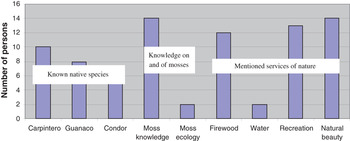
For the successful utilization of an endemic moss species as a CE attribute operationalizing existence value, it is necessary that respondents know what mosses are, but they should not be able to attribute any specific direct use or indirect use value to it. To test this, 54 qualitative interviews were carried out with local residents to identify pre-theoretic cognitions on nature and the human–nature relation (Barkmann et al., Reference Barkmann, Cerda and Marggraf2005). Fourteen interviews were immediately transcribed and analysed (figure 2). The attention and knowledge of the respondents was focused on a small number of species and ecosystem services with direct links to human utilization. No respondent mentioned mosses spontaneously as a known or preferred type of plant. On the other hand, all respondents stated that they knew that mosses existed on the island when explicitly asked. The results of the 14 interviews were cross-checked with the other 40 interviews. This cross-check supported the notion that residents are sufficiently aware of the mosses on the island without ascribing any specific direct or indirect use value to them.
Example from a subsample of the images of nature analysis (n=14)

3. Choice experiment design: description of attributes and their levels
3.1. Construction of the moss attribute to assess existence value
We presented respondents with a moss species (figure 1) explained as endemic to the sub-Antarctic region. Three measures were taken to address embedding effects and warm glow issues. First, three attribute levels on varying degrees of extinction risk were designed. Thus, we use the flexibility of the CE method to cast the attribute into a form that allows standard tests of sensitivity to scope.
Second, to minimize warm glow, case study respondents were well acquainted with tradeoff structures between conservation, socio-economic development and public funds, with public funds directly influencing resident income via transport and tax subsidies for living on a remote Chilean island. Strategies to reduce warm glow suggest that more effort needs to be made to challenge people preferences, encouraging respondents to attend to different levels of quantitative information and ranking exercises (Bateman et al., Reference Bateman, Carson, Day, Hanemann, Hanley, Hett, Jones-Lee, Loomes, Mourato, Özdemiroglu, Pearce, Sugden and Swanson2002; Kanninen, Reference Kanninen2010).
We took several measures to sufficiently isolate existence value from other value categories potentially associated with the moss species. As mentioned, we first checked in a pre-study that respondents did not spontaneously associate any substantial direct or indirect use value to it (figure 2). Second, we included three other attributes in the CE, which refer to species aesthetics, the ethno-cultural value of a species, and the ecological insurance value of species richness. Thus, respondents interested in these value categories were confronted with much more direct ways to express their preferences for such attributes than opting for a reduction in moss extinction risk. Third, we included qualitative questions asking specifically whether and why respondents do or do not care about the continued existence of an inconspicuous moss species on Navarino Island. These qualitative statements were used to define a subsample of respondents with an explicit existence value motivation. At least for this subsample, an efficient isolation was expected to be achieved.
Finally, we designed a CE attribute that describes the qualitatively differing extinction probabilities of a moss species endemic to the sub-Antarctic forests of southern Chile. For species such as Tayloria mirabilis, the forests of Navarino constitute an important fraction of their habitat. Consequently, we told respondents that the moss species featured in the CE relies on its habitat on Navarino Island for its continued survival. Large-scale development projects or forest operations can affect its habitat in Navarino and thus may result in increased extinction risks. We explained to respondents that small protected areas on Navarino reduce these extinction risks.
The attribute had three levels: (i) an increased probability of extinction because of habitat destruction, (ii) a low probability of extinction (current situation), and (iii) a very low probability of extinction because of specific habitat protection measures. This quantification is certainly not sufficiently specific to be used as an input for models of habitat quality or even for spatial population dynamics with which actual extinction risks could be approximated. However, for the purpose of the study, the employed quantification appears sufficient.
In the explanation of the attribute we had to minimize the risk that respondents perceive the habitat protection measures suggested in the third attribute level either as an impediment to local economic development or as an additional protection for other species, ecosystems or ecosystem services. Thus, we pointed out that the protected sites are ‘small’ only and that they directly protect only the moss habitat. In Appendix 1, we reproduce part of the explanation of the attribute and its levels in an English translation.
3.2. Construction of the other related attributes
• Change to landscape due to impact of tourism infrastructure. The changes to the landscape were represented by levels of infrastructure operationalized by numbers and types of cabins or hotels and trails or roads.
• Access restrictions to nature for economic activities and nature conservation. This attribute was split-sampled with either access restrictions for conservation purposes or for economic development interests. Access restrictions were in fact quite likely, as concessions of several thousand hectares in size on the west coast of Navarino had been granted for hotel enterprises.
• Possibility to see the most favoured animals. We included the woodpecker (Magellanic woodpecker), the condor (Andean condor) and the guanaco (Lama guanicoe), because these are the most preferred species of the residents of Navarino (figure 2). A change in the aesthetic services of these animals is realistic, as current activities related to forest issues and a predicted increase in tourism could affect their habitats.
• Continued visits of the hummingbirds (Sephanoides sephanoides). The hummingbird plays a very important role in old Yaghan histories (Rozzi et al., Reference Rozzi, Massardo and Anderson2004). The hummingbirds are occasional visitors to Navarino and their habitat is susceptible to damage from different economic development activities.
• Health, resistance and vigour of nature indicated by species richness. With this attribute we introduced a long-term perspective into the valuation exercise (Yachi and Loreau, Reference Yachi and Loreau1999). The levels were operationalized by using the number of species present on the island at the time of the study. For example, if an extreme development scenario results in the likely long-term loss of one-quarter or one-half of the island's native species, it was assumed to result in substantial losses of ecosystem health.
• Payment vehicle. WTA appeared to be more appropriate than WTP. In the pre-study interviews, the subjective entitlement prompted some respondents to protest the proposition that they should pay for maintaining the environmental status quo, including open access for leisure activities. Thus, we used a change in income mainly operationalized via increases in monthly income, as many realistic choice options imply a deterioration of the ecological status quo. An assessment of how realistic it would be for residents to use changes in income as a payment vehicle showed the feasibility of this format. Furthermore, the WTA issue has advantages: a ‘warm glow of giving’ effect (Kahneman and Knetsch, Reference Kahneman and Knetsch1992) is expected to be diminished because the CE did not imply a voluntary contribution to the protection of species.
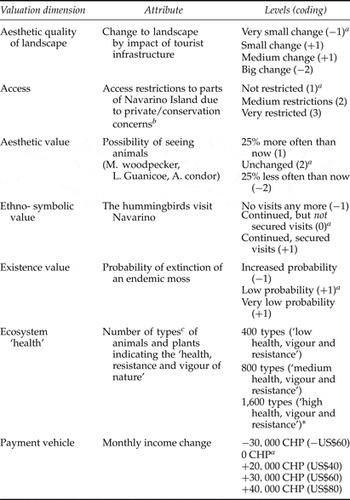
We included three levels with increases in income – i.e., the WTA compensation versus one level with decrease in income, because some combinations resulted in biodiversity improvements. In table 1, we show the attributes and their levels.
Attributes and levels used in choice experiment

Notes: 500 CHP~US$1 at the time of the study.
aStatus quo level.
bA split sample differentiating access restrictions due to private interests versus conservation projects.
cIn the questionnaire, we used ‘types’ (tipos) instead of the technical term ‘species’ (especies) to reduce the cognitive burden of the respondents.
For the main study, we generated a reduced orthogonal main effects design (Louviere et al., Reference Louviere, Hensher and Swait2000). In total, 32 different options were obtained. These options were combined into choice sets with options A and B as well as one status quo option (Appendix 2). The options were assigned to four blocks of eight choice sets each. One of the blocks was randomly assigned to each respondent. The experimental design was guided primarily by concerns of overall plausibility to respondents.
A pilot study (N=45) was conducted during April and May 2004, scoring zero protest responses. The main survey was conducted with face-to-face interviews by the first author and two well-trained Chilean university students from January to April 2005. Although teachers and navy personnel could be sampled systematically, we had to apply snowball sampling for all other resident groups, aiming for a balanced coverage of the main permanent resident groups according to national census data (INE, 2002). Finally, 235 local residents (from a total population of 1,328 permanent residents) were interviewed.
4. Theoretical model and empirical approach
4.1. Theoretical model
Statistical models derived from random utility theory (McFadden, Reference McFadden and Zarembka1973) predict choice behaviour as a function of the attributes that characterize potential choice options. Through an analysis of the choice patterns among the options, the relative influence of attributes on the choices can be inferred, and marginal economic values for an increase or decrease in statistically significant attributes can be calculated (Bateman et al., Reference Bateman, Carson, Day, Hanemann, Hanley, Hett, Jones-Lee, Loomes, Mourato, Özdemiroglu, Pearce, Sugden and Swanson2002).
The utility function can be separated into an observable component V in and an unobservable (error) component ɛin:
 $$U_{in} = V_{in} + \varepsilon_{in}$$
where U in is the total utility of option i for individual n. The probability (Pr) that individual n will choose option i over option j within the complete choice set C is given by:
 $${\rm Pr}_{in} = {\rm Pr} \lpar V_{in} + \varepsilon_{in} \gt V_{jn} + \varepsilon_{jn}\comma \; \, \hbox{all } j \epsilon C\rpar$$
If a deterministic utility component V 1 is hypothesized to be a linear function of attribute Z 1 itself, plus an interaction term of the attribute Z 1 with an individually varying socio-demographic variable A, V 1 can be expressed as:
 $$V_{1} \lpar Z_{1}\comma \; A\rpar = c_{A} Z_{1} A + c_{1} Z_{1}$$
where c A is the utility coefficient of the interaction term (Barkmann et al., Reference Barkmann, Glenk, Handi, Sundawati, Witte, Marggraf, Tscharntke, Leuschner, Zeller, Guhardja and Bidin2007). In the econometrically estimated utility models, a positive coefficient c indicates a positive influence of the respective term on choices and thus on utility. To reduce the collinearity between the interaction term and the non-interacted attribute term, the socio-demographic variable A can be standardized before being multiplied by Z 1. The vector of the utility coefficient is usually estimated with maximum likelihood estimation techniques. Usually, the estimated choice models include an alternative specific constant (ASC) that picks up systematic differences in choice patterns between the three choice cards.
4.2. Empirical approach: nested logit model
For the analysis of the CE data, preliminary analyses revealed a risk of violation of the independence from irrelevant alternatives (IIA) assumption necessary for the application of the (simpler) conditional logit model. These analyses were conducted using the Hausman test of the IIA assumption (for details, see Hausman and McFadden, Reference Hausman and McFadden1984). Thus, we used nested logit models (NL) that partially relax the IIA assumption (Hensher et al., Reference Hensher, Rose and Greene2005: 518). An eligible NL model structure was identified. Note that we did not use the NL model to actually approximate a ‘nested’ choice process (e.g., first decide whether the ‘buy nothing’ option is better than the offered options; if not, choose among the offered options). Instead, we used the NL procedure to account for systematically differing error variances between the choice cards that can lead to IIA violations (see Hensher et al., Reference Hensher, Rose and Greene2005: 418). The inclusive value (IV) of the degenerated branch was set to 1.0 (Hensher et al., Reference Hensher, Rose and Greene2005: 570). Scale parameters were normalized at the lowest level (RU1; Hensher et al., Reference Hensher, Rose and Greene2005: 538). We selected the best fitting tree structure with an IV value between 0 and 1 (Hensher et al., Reference Hensher, Rose and Greene2005: 494).
For the model construction, we used the coding shown in table 1. Surprisingly, no effect of the landscape attribute on choices could be detected in the data analysis when a linear coding of the attribute levels was applied. A detailed analysis of the influence of the single levels by dummy coding indicated that the lowest and the highest attribute levels were less preferred than the intermediate levels. These results present a quadratic pattern that can be approximated by orthogonal polynomial coding (Louviere et al., Reference Louviere, Hensher and Swait2000: 268), representing an inverted parabolic utility function. Thus, we recoded the single levels, assuming an inverted parabolic utility curve. To highlight the strongly negative effect of the substantial changes level, we did not use the pure form of orthogonal polynomial coding (−1, +1, +1, −1) but placed an additional penalty on the substantial change level (resulting codes: −1; +1; +1; −2).
For the existence value attribute on the probability of extinction of an endemic moss, an inspection of preferences for the single attribute levels also revealed a non-linear pattern. While an increased probability of extinction generated a substantial WTA requirement, utility for the presently ‘low’ probability of extinction did not differ from the utility for an improved level of ‘very low’ probability.
An ASC was coded 1 for the non-status quo options A and B and 0 for the status quo option. Seven socio-economic variables (age, sex, income, number of children, years of education, time on the island, planned duration of stay) were heuristically introduced into NL models as interaction terms with the ASC to test for influences on choice. Only education was significant, and it was included in the reported NL models. A weighting factor for each respondent was included in the quantitative CE analysis to account for remaining sampling bias with respect to the occupational data of the last Chilean census for Navarino Island.
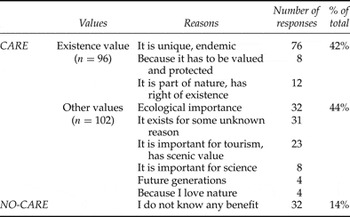
From responses to the open question regarding motivations for valuing moss existence, two general categories were formed: Care and No-care. Care indicates that the respondent stated that s/he cares about the probability of moss extinction. No-care indicates that s/he does not. From those who did care, two sub-categories emerged. If statements use an existence value argumentation, the respondent was assigned to an existence value group, and if not, the respondent was assigned to a residual ‘other values’ group (table 2). For classification, priority was given to spontaneous answers. We estimate two CE models: one for the entire sample (table 3, model (a)) and one for the existence value group (table 3, model (b)).
Statements about the probability of extinction of an endemic moss (n = 230)

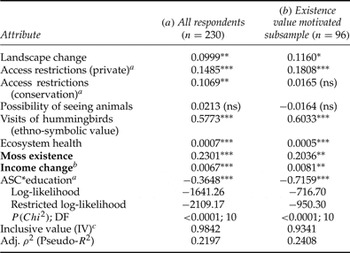
Nested logit models

Notes: Nested logit models based on 230 respondents with 8 choices each: n=8*230 = 1840 observations.
***, significant at p ≤ 0.001; **, significant at p ≤ 0.01; *, significant at p ≤ 0.05.
aRaw coefficients multiplied with the sample means.
bCost coefficient for 1,000 CHP/year/respondent.
cAll IV statistics are highly significantly different from 0.
(ns), not significant; DF, degrees of freedom.
5. Results
From a total of 235 participants, two respondents quit the interview because they perceived the interview to be too pro-environmental. Three respondents lacked sufficient understanding of the CE procedure. Analyses are based on the remaining 230 respondents.
5.1. Existence value motivations
A concern for moss existence was expressed by 198 respondents (86 per cent; table 2). In all, 102 respondents stated reasons that were not interpreted to be an expression of an existence value motivation. Ninety-six statements indicated an existence value motivation. We also included statements such as ‘it is unique, endemic’ because this is close to what Krutilla, (Reference Krutilla1967) had in mind when arguing that irreversibility and uniqueness were both essential components of existence value.
Of these 96 respondents, 43 respondents chose the level with the increased risk of moss extinction at least once. Forty-four more respondents never chose the increased risk level, but they did choose the status quo over the reduced extinction risk at least once. Only nine respondents never ‘traded off’ moss extinction risks.
5.2. Nested logit model estimations
Table 3 shows that model (a) is significant (p < 0.0001) with an adjusted Pseudo-R 2 (no coefficients) value of 0.2197. With the exception of the possibility of seeing three animals, all included terms are significant at p ≤ 0.05. The coefficient of the moss existence value term is highly significant and positive as expected. Model (b), constructed from the existence value group, is similar to model (a). In particular, the utility coefficient of the moss existence attribute is only slightly lower and is only highly significant instead of most highly significant.
5.3. Marginal willingness to accept compensation
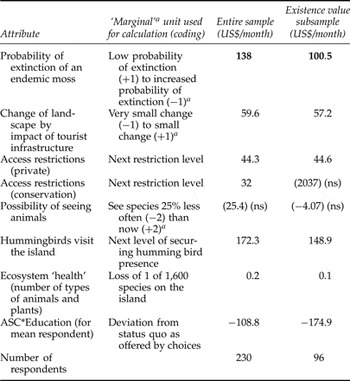
Table 4 compares the marginal WTA values for both models. Marginal WTA values for the probability of moss extinction are ~69,000 CHP/month (US$136) for the total sample and ~50,000 CHP/month (US$100) for the respondents with existence value motivation. Using the WTA/WTP ratio of 2.8 that was previously derived from the same data set, equivalent WTP values of ~25,000 CHP/month (US$50) and ~18,000 CHP/month (US$36) are found. These values are close to the median WTA/WTP ratio of 3.2 found in an extensive meta-analysis of stated preference studies (Sayman and Önçüler, Reference Sayman and Önçüler2005).
Implicit prices (WTA)

Notes: (ns), not significant.
aBecause the non-linear, inverted U-shape coding results in changing marginal WTA values, the ‘marginal’ step used for the calculation is explicitly given. In both cases, the step represents a change from a status quo level to an adjacent attribute level; parentheses note cases in which the coefficient of the biodiversity attribute was not significant.
6. Discussion of major findings
We focus the discussion on the applied questions of: (i) whether we were able to sufficiently isolate the existence value of the obscure moss species from other potential value components; (ii) whether we found a way to adequately represent the influence of ethically motivated choices; and (iii) whether we were able to discuss the remaining embedding or warm glow effects.
(i) Were we able to sufficiently isolate the existence value of the obscure moss species from other potential value components?
Any monetary figure for an existence value may include use or indirect use components that are not apparent to the analyst. Our pre-study showed that such value components are hardly associated with the inconspicuous sub-Antarctic moss selected in our study. Thus, it is unlikely that such value components substantially influenced respondent choices. Moreover, the inclusion of numerous additional value components at the species level as attributes in the CE provided respondents with ample opportunity to express their preferences for these value components more directly.
Nevertheless, when specifically asked why respondents cared for the existence of the moss species, 44 per cent of respondents cited use or indirect use value categories. On the other hand, the explanations of 42 per cent of the respondents were dominated by existence value motivations to justify their care for moss existence. For this subsample, average WTP was about 18,000 CHP/month/resident (US$36) versus 25,000 CHP/month (US$50) for the entire sample. This difference appears to suggest that the existence value figure for the entire sample may slightly overestimate preferences because some additional value components may have played a role. Similarly, Richardson and Loomis, (Reference Richardson and Loomis2009) found that the Total Economic Value of a species is sensitive to the kind of values of a species (non-use only or both use and non-use). Nonetheless, even for the subsample with the best value isolation, only a slightly smaller mean WTP was documented.
Interestingly, table 3 shows that (with the exception of ‘Access restriction for private concerns’) all WTA values are lower for the existence value subsample if they are compared with the entire sample. Thus, the economic commitment to the conservation of biological diversity appears generally higher for citizens with predominant use and indirect use motivations.
(ii) Did we find a way to adequately represent the influence of ethically motivated choices?
Ninety-six respondents predominantly cited existence value as the reason why they value the moss. These respondents made several CE choices from which we calculated preferences for accepting further risks to the existence of an endemic moss. Thus, our existence value figure does not (and does not presume to) capture the intrinsic value intuition of any respondent justifying his or her choices on categorical ethical species existence grounds. However, the existence value figure reflects the monetary implications of the stated choices, even of those respondents who predominantly cite existence value motivations themselves.
We predominantly used a WTA design of the payment vehicle and included a level with an increased risk of moss extinction. Thus, respondents were effectively trading higher moss extinction risks against financial benefits. Differing from traditional CV studies, however, the embarrassingly direct question ‘Are you willing to accept X Chilean Pesos in order to be fine with further threatening the existence of this endemic moss?’ was avoided. Such a question is extremely artificial and does not consider typical discourse patterns on nature conservation and development. In contrast, case study respondents were well acquainted with tradeoff structures between conservation, socio-economic development and public funds, with public funds directly influencing resident income via transport and tax subsidies for living on a remote Chilean island. Consequently, we did not encounter a single protest response that was motivated by ethical concerns regarding the dominating WTA compensation format of the survey or of other CE attributes. In fact, the only two protest responses that we encountered came from respondents who considered the entire study to be too ‘pro-environmental’.
Of the 96 respondents predominantly citing existence value motivations, 87 made tradeoffs to the disadvantage of moss existence. Only nine respondents never did so. Such a choice strategy does not involve protesting against the valuation interview but may be an expression of lexicographic preferences with regard to existence values. The quantitative influence of such respondents was low in our study, however.
From this perspective, previously reported problems encountered in CV studies appear as specific methodological artefacts rather than as expressions of a fundamental methodological problem of stated preference techniques. Meyerhoff and Liebe, (Reference Meyerhoff and Liebe2008) show that lower rates of protest responses in CEs as compared with CV studies on biological diversity are not guaranteed. As in CEs conducted in Germany and rural Indonesia (Barkmann et al., Reference Barkmann, Glenk, Keil, Leemhuis, Dietrich, Gerold and Marggraf2008; Rajmis et al., Reference Rajmis, Barkmann and Marggraf2009), we attribute very low rates of protect responses to an ecosystem service approach to valuation instrument construction. Thus, we do not present ecological structures or processes to respondents but rather focus attribute construction on the benefits that respondents are likely to obtain from biological diversity or ecological systems.
(iii) Were we able to discuss the remaining embedding or warm glow effects?
The answers to qualitative questions on reasons for valuing the moss, as well as the answers to debriefing questions on how the choices were made, did not indicate any warm glow motivation. While this motivation may have been hidden by respondents in order to comply with assumed interviewer instructions, reports from studies using the CV method indicate that respondents feel free to report warm glow behaviour (Nunes and Schokkaert, Reference Nunes and Schokkaert2003; Lienhoop and Fischer, Reference Lienhoop and Fischer2009). Nevertheless, our econometric results show only a partial sensitivity of respondent choices to the scope of the existence value attribute protection levels.Footnote 2 The analysis of dummy coding the levels shows that the best level of protection (very low extinction risk) is not valued substantially higher than the status quo level (low extinction risk). However, moving to an ‘increased’ extinction risk is clearly rejected. To leave the moss at the status quo level of protection implies a risk of extinction for the species. Fuelwood extraction is an area of the most dynamic development on the island that could affect the biological diversity of the place. The results would thus indicate that we do not have a strong warm glow effect. In such a case, one would expect that the highest level of protection generates a utility substantially higher than the levels that leave the species at risk of extinction. More finely graduated levels may shed further light on this effect in a similar fashion to exactly quantified extinction risks (e.g., extinction risk in 100 years).
Thirdly, because of the already substantial length of the entire survey instrument and the complexity of the multi-attribute CE, we were not able to include further tests of scope or embedding effects. In particular, we did not attempt to ascertain whether an increase in extinction risks for more than one obscure species would result in higher preference statements. Thus, the question remains empirically open whether the preferences estimated refer to the existence value of one or more species. Given the relatively high preferences against a deterioration of the status quo in relation to income, severe embedding may occur.
7. Conclusions
We documented popular support for a single species protection including ethically motivated existence values. Our design based on varying degrees of extinction risk avoided a strong effect of warm glow. Furthermore, with tradeoff structures between conservation, socio-economic development and public funds influencing resident income, no protest responses motivated by ethical concerns were encountered.
The quantitative estimation of existence values remains a complex procedure, however, requiring specifically adapted valuation strategies. Advances relative to established standard methodology of CV may be observed in the use of CEs that: (i) offer realistic policy tradeoffs focussing on respondent benefits (the ecosystem service approach) while avoiding direct, often offensive WTP questions; (ii) include several biodiversity values simultaneously, thus improving value separation by requiring respondents to engage in direct tradeoffs between the concerned value categories; and (iii) enable the direct quantification of (some) embedding effects as well as the identification of potential cases of lexicographic preferences. Additionally, open questions that provide respondents with the opportunity to explain their choices should be included in the valuation interview.
Although the focus of this paper is largely applied, some policy implications should be briefly outlined. The results of our study show that conservation scientists and planners may be ill advised to eschew the results of stated preference studies which often document substantial popular support for biodiversity protection including ethically motivated existence values. In addition, generally definitions of non-use values preclude the direct users of the resource from holding non-use values such as existence values. In this case, however, we observe that local residents, who are direct users, derive utility by protecting inconspicuous endemic species by not using the species as a resource. The evidence for existence values can have important policy implications, especially in developing countries, as people may have a positive WTP for protecting the biodiversity of the areas where they live, despite not using this resource at all. In this sense, this study may contribute to showing the significance of non-use values to nationals of the less-developed and developing countries. In countries such as Chile, such values are likely to become more important as the living standards improve. In this sense, the dynamic of existence value in developing countries should be addressed in future research, as determinants underlying existence values may change over time by changing government policy and economic conditions.
Finally, based on our results, we believe that stated preference methods, such as CE, provide useful information about individual preferences which complement biological research, contributing to the design of policy measures that aim at sustainable use of biological resources. Further research and interdisciplinary work is still necessary to capture the value of biological diversity.
Appendix 1: Explanation of the existence value attribute and its levels
‘Scientists call a moss that lives only in this zone “endemic moss”. “Endemic” means that the moss only exists in one place of the world. If eventually one of the endemic mosses disappeared from Navarino, which is an important part of its habitat, the probability that the moss disappears from the whole Subanctarctic zone increases. Because this moss is endemic to this zone, it would mean that it would disappear from the entire world and would go completely extinct. […] Imagine two cases: First, some activities on the island of Navarino destroy, by accident, all places where the moss lives. Thus, the moss loses an important part of its life space. Consequently, the moss can go extinct easily from its entire place of life in the Subanctarctic zone. The probability of extinction would increase. […]
Second, a few small areas are established on Navarino to protect specifically the life spaces of the moss. Then, in spite of some current development activities (e.g. fuel wood extraction), the moss continues to exist in all its life spaces on the island. Under these circumstances, the probability that the endemic moss goes extinct is very low because its important life places would be better protected than now of accidental damages.’
Appendix 2: Example of a choice set