


Introduction
SARS-CoV-2 virus pandemic has had an impact on all the healthcare services, especially cancer services around the world. Key areas affected have been the prioritisation and selection of patients for surgery, neoadjuvant/adjuvant systemic anti-cancer treatment and radiotherapy in order to minimise the risk of exposure and contagion of the SARS-CoV-2 (SARS-CoV-2) virus. Based on local/national and International clinical guidelines, Reference Coles, Aristei and Bliss1–Reference Chan, Sim and Ow4 we incorporated the ultrahypofractionated regime of 26Gy/5 fractions along with the moderate hypofractionated dose fractionation 40Gy/15 fractions over 3 weeks as part of local adjuvant breast radiotherapy treatment (RT) protocol for eligible patients during SARS-CoV-2 virus pandemic at University Hospital Birmingham, NHS Trust. This was in keeping with the fast-forward trial protocol. Reference Brunt, Haviland and Wheatley5
We conducted a local study to assess the real-life experience of patients undergoing ultrahypofractionated schedule and compare feasibility and toxicity as compared to the fast-forward trial during the COVID − 19 pandemic.
Materials and Method
This was a single-institution, retrospective, qualitative cohort study. From March 23 2020 to May 31 2020, a total of 211 patients with early-stage breast cancer were treated with adjuvant RT, out of which 85 patients received the hypofractionated dose of 26Gy/5 fractions +/− boost as per fast-forward protocol. Patient data were accessed through the clinical records by the members of the clinical team in accordance with data protection regulations.
Patients included in this study were those with T1-T3, node-negative/positive, M0 breast cancer who either had neoadjuvant chemotherapy plus surgery (breast-conserving surgery/mastectomy +/− breast reconstruction) or primary surgery followed by adjuvant chemotherapy/endocrine treatment (ET) and adjuvant RT (26Gy in 5 fractions). The tumour histology included the histological subtype, tumour grade, oestrogen (ER), progesterone (PR) and HER 2 receptor status, pathological nodal status and presence/absence of lymphovascular space invasion (LVSI).
Radiotherapy dose to whole breast/chest wall was 26Gy in 5 fractions (#) with the breast boost doses of 10Gy/5 fractions, 14Gy/5 fractions or 16Gy/8 fractions where applicable. In some cases, a hypofractionation boost schedule was adopted based on RCR consensus guidelines 2019 6 (a boost dose of 16Gy in 8# is equivalent to hypofractionated dose of 13·35 Gy in 5# of 2·67 Gy), the numbers were small, and most commonly used boost schedule was 16Gy Gy in 8# or 10Gy in 5#.
Patient assessment was initially carried out through telephone consultation during RT and at 2 weeks post-treatment by the specialist radiographers. If any issues were reported by patients, they were brought back for face to face review. Patients were then reviewed in clinic at 8–12 weeks following completion of radiotherapy. Skin toxicity was graded as per RTOG Criteria (based on description by the patient).
Results
Patient demographics, tumour characteristics and treatment received
A total of 211 patients with early-stage breast cancer were treated with adjuvant RT from March 23 2020 to May 31 2020. Out of these, 85 patients were treated with 26Gy/5 fractions +/− boost radiotherapy. These patients were identified, and their side effects secondary to treatment were recorded during treatment, at 6 weeks and 20 weeks post-RT.
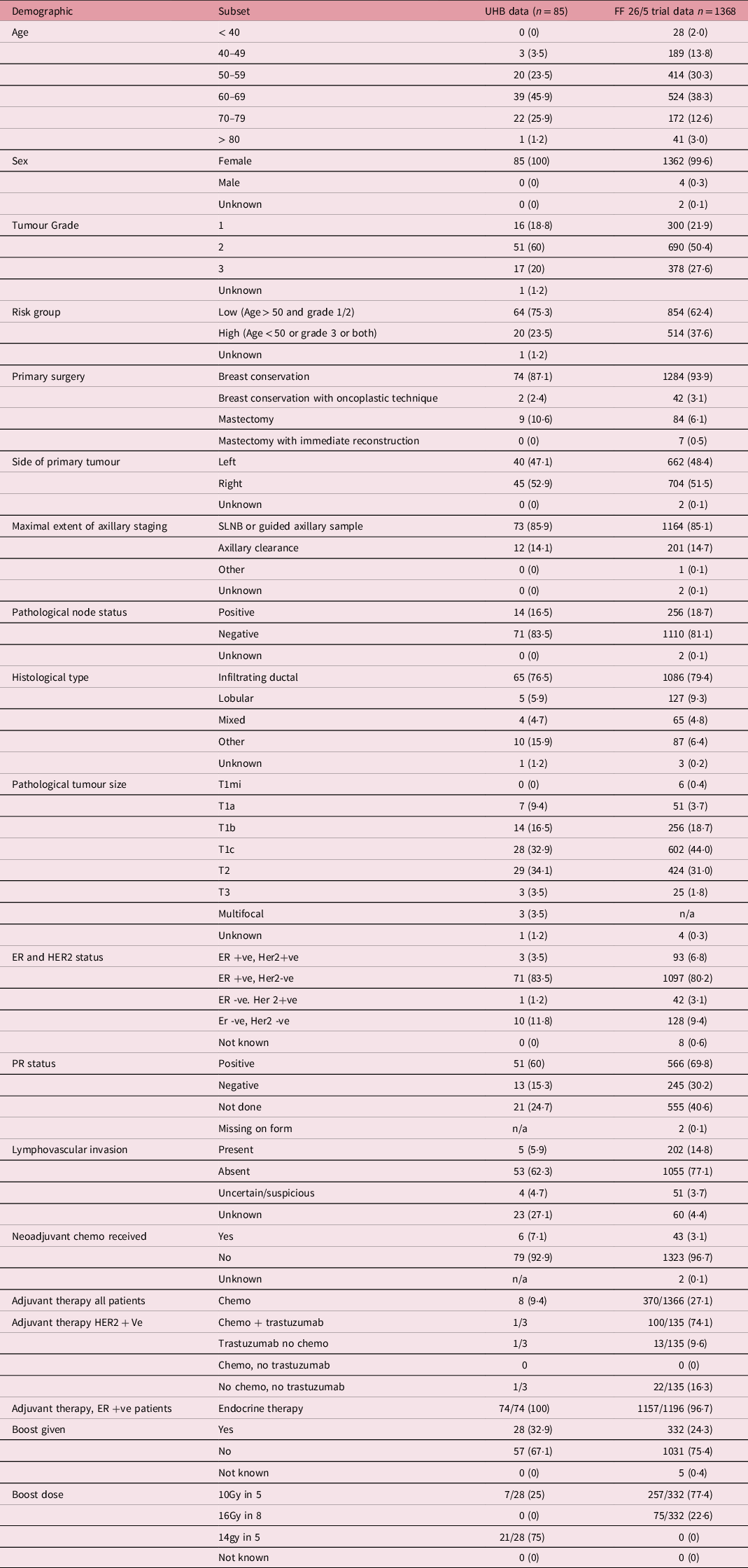
All 85 patients were females. Mean age was 64, and age range was from 40–80.
47·1% had left-sided and 52·9% had right-sided cancer.
76·5% had infiltrating ductal type cancer, 5·9% had lobular, and 4·7% had mixed type tumour histology. 15·9% of patients had other tumour histology, and 1·2% was unknown. 18·8% were grade 1 tumours, 60% were grade 2, and 20% were grade 3 tumours. 1·2% were unknown grade. 16·5% had node-positive disease, and 83·5% had node-negative disease. 58·8% had T1 disease, 34·1% were T2, 3·5% were T3, 3·5% had multifocal disease and 1·2% unknown.
7·1% of patients received neoadjuvant chemotherapy, and 9·4% had adjuvant chemotherapy. All of the hormone-positive patients received adjuvant ET. All patients had post-op RT. 32·9% (28/85) of these patients received a boost.
Discussion
Adjuvant breast RT has a well-established role in preventing loco-regional recurrence in early-stage breast cancer patients. Reference Darby and McGale7,Reference McGale and Taylor8 Historically in the UK, the conventional dose for breast radiotherapy (RT) was 50Gy in 25 fractions, 2Gy/fraction given over 5 weeks. This was used in a prospective randomised controlled trial (RCT) conducted by Fisher et al from 1976 to 1984. Reference Fisher, Anderson and Bryant9 The standard of care was changed by the START B trial. Reference Bentzen and Agrawal10 This was a RCT which recruited 2215 women with T1-3a N0 M0 breast cancer randomised to 2 arms; 50Gy in 25 fractions (2Gy/fraction) versus 40Gy in 15 fractions (2·67Gy/fraction) of RT. The loco-regional recurrence rate after 5 years in the 40Gy arm was 2·2% compared to 3·3% in the 50Gy arm; moreover, the rates of long-term adverse effects were lower in the hypofractionated arm.
Further, hypofractionated regimens were compared to this dose in the FAST trial. Reference Agrawal and Alhasso11 In this RCT, a total of 915 women with early-stage node-negative breast cancer post-complete microscopic tumour resection were randomised to 3 arms; 50Gy/25 fractions, 28.Gy/5 fractions (once weekly, 5·7Gy/fraction) and 30Gy/5 fractions (once weekly, 6Gy/fraction). The primary outcome was photographic breast appearance. At 3-year follow-up, the outcomes were comparable in the 28·5 Gy and 50Gy arm and milder than 30Gy arm.
Fast-forward was a non-inferiority RCT which looked at more hypofractionated regimes. The 5-year efficacy and late tissue toxicity data were published in April 2020. It concluded that 26Gy/5 fractions was non-inferior to 40Gy/15 fractions in achieving loco-regional control and is also safe in terms of late tissue effects. Reference Brunt, Haviland and Wheatley5
Impact of SARS-CoV-2 virus on breast cancer management
Like other healthcare services, SARS-CoV-2 virus has had an impact on cancer services across the globe, affecting prioritisation of patients for neoadjuvant and surgical treatment of cancer patients. The European Breast Cancer Research Association of Surgical Trialists Group did an international survey on the changes brought about by the SARS-CoV-2 virus pandemic in the management of breast cancer patients. According to this, out of the 48·9% of centres that reported a change in their radiotherapy schedules, 7·4% of the centres used ultrahypofractionated schedules (5 fractions). Reference Gasparri, Gentilini and Lueftner12
A set of International Guidelines published by Coles et al in March 2020 also suggested the use of ultra/moderate hypofractionated regimes for adjuvant breast radiotherapy where applicable along with other changes in indications for surgery, neoadjuvant and adjuvant chemotherapy/ET. Reference Coles, Aristei and Bliss1 These were also the recommendations of other institutions’ guidelines local to UK as well and some countries abroad. Reference Manoj Gowda, Kabeer and Jafferbhoy2–Reference Chan, Sim and Ow4
Based on these guidelines, University Hospital Birmingham NHS Trust included the ultrahypofractionated regime along with the standard moderate hypofractionated breast schedules for suitable patients. Offering the 5 fraction treatment reduced 630 visits to the Radiotherapy Department thereby reducing the footprint and potential of SARS-CoV-2 virus exposure and transmission to staff and patients while at the same time ensuring that patients were not being disadvantaged in their cancer treatment during the outbreak of the SARS-CoV-2 virus pandemic.
Careful discussion was undertaken within clinicians group and with patients who were under-represented in the fast-forward trial subgroups. This included those who were younger than 50 years of age with high-risk pathology. These patients were continued to be offered standard fractionation unless they were keen on the 5 fraction schedule and made an informed choice. All patients were given the opportunity to have a discussion of the fast-forward trial schedule and some chose to decline 5 fraction schedule in favour of standard fractionation. At our centre, we managed to continue to offer radiotherapy to all eligible patients, and although all efforts were made to reduce the footfall to minimise patient and staff SARS-CoV-2 virus exposure, we ensured that all patients still had the chance to make an informed choice.
As illustrated in Table 1, patient demographics and tumour characteristics observed in our study cohort were comparable to the ones observed in the fast-forward trial. The slight difference being, there were no male patients and patients < 40 years of age in the UHB cohort, and the percentage of patients in the 60–69 year age range was higher. The percentage of patients in low- and high-risk categories was similar. In terms of histological subtypes, tumour size, nodal and ER/PR and HER2 status, the statistics were also congruous. In terms of the breast boost dose, the trial did not include 14Gy/5 fractions dose which was offered to some patients at our centre as per the RCR guidelines 2019 6 but overall our data also showed less radiotherapy boost offered as per national consensus guidelines and ongoing SARS-CoV-2 virus pandemic.
Patient demographics, tumour characteristics and treatment received in comparison to fast-forward trial cohort

Acute and post-RT skin toxicity:
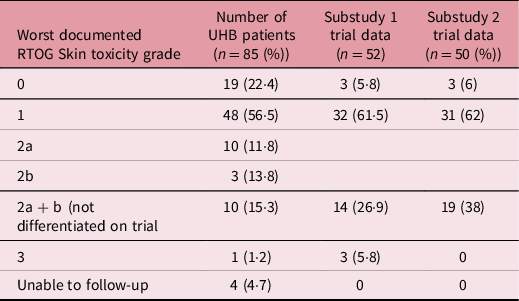
Out of the 85 patients treated with hypofractionated RT, 22·4% did not report any skin toxicity post-treatment (RTOG Criteria 0). 56·5% of patients reported RTOG Grade 1, 15·3% had RTOG Grade 2 (11·8% had RTOG Grade 2a and 3·8% had Grade 2b skin changes) and 1·2% reported RTOG Grade 3 skin toxicity. 4·7% of the patients could not be contacted for follow-up as depicted in Table 2.
Skin toxicity reported in comparison to fast-forward cohort

Data were taken from https://www.ncbi.nlm.nih.gov/pmc/articles/PMC4998960/
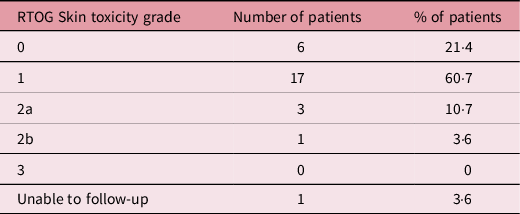
Out of the 28 patients who received a breast boost, 21·4% did not report any skin changes (RTOG Grade 0). 60·7% reported Grade 1 skin toxicity. Both Grade 2a was reported in 10·7% of patients and 2b skin toxicity was reported by 3·6% as illustrated in Table 3.
RTOG skin toxicity grade reported by patients who received additional breast boost

In terms of post-RT skin toxicity, a greater proportion of patients reported no toxicity in the UHB patient cohort as compared to the trial results and the number of Grade 2/3 toxicities reported were also low. Locally, it became apparent though that acute skin reactions following 5 fractions of radiotherapy became more pronounced at 3-week mark as opposed to the 2-week mark with the 15 fraction regime. We have thus amended our local protocols; radiographer follow-up now occurs at 3 weeks following radiotherapy completion for the patients completing 5 fractions and remains at 2 weeks for 15 fractions.
The demand on the service during the pandemic continues to be challenging, including the need to reduce the risk of exposure of infection to patient and staff group; however, our breast oncology group felt that caution needs to be exercised in widely adopting the five fraction schedule for all patients in the absence of follow-up data beyond 5 years due to reasons as outlined below.
Firstly, the adoption of 5 fraction data is currently largely being based on a single study with follow-up of patients presented to be just over five years. Often, breast cancer survivors live much longer than five years and relapses occur later.
Secondly, although the quality of the fast-forward is graded as high by a recently published meta-analysis by Thomson DJ et al. in IJROBP 2020 Reference Thompson, Yom and Saeed13 , late responding tissues generally tend to accumulate damage beyond 5 years as reported by earlier breast trials. These include development of late tissue toxicity not only in the breast but also the heart tissue, along with a higher risk of secondary malignancy given the young age of the treated population. Therefore, careful consideration should be given before adopting ultrahypofractionation as a standard fractionation beyond the pandemic. Informed consent when counselling patients remains the key aspect in choosing dose fractionation.
In addition, some population groups are under-represented in the fast-forward trial, that is patients under 50 years of age, high-risk disease, lymph node-positive group, post-mastectomy, grade 3 and neoadjuvant chemotherapy; therefore, adopting the 5 fraction regimen for all comers of breast cancer presentation should be exercised with great caution. Ideally, we feel that younger patients at high risk of breast cancer relapse based on their tumour biology should be offered standard fractionation until more randomised evidence with longer follow-up comes to light.
Conclusion
The non-inferiority and safety of 26Gy/5 fractions in comparison to the standard 40Gy/15 fractions of adjuvant RT in early-stage breast cancer has been established in light of the fast-forward trial results. The aim of our study was to assess the feasibility and comparable toxicity of the ultrahypofractionated regime as a real-world experience. Based on our study results, it is concluded that offering 1 week of radiotherapy is not only convenient for the patients in reducing the number of hospital visits during the SARS-CoV-2 virus pandemic but also safe in terms of acute post-RT related skin toxicity. We however noticed that the peak of acute side effects was appearing a week later in the 5# schedule and in light of that extended the follow-up period for this patient cohort while the extent of toxicity remained similar to 15#. The reduced hospital visits not only helped in containing the exposure of the patients and staff to the SARS-CoV-2 virus but also helpful in efficient use of Radiotherapy Department resources.
While we are going through the repeated waves of the SARS-CoV-2 virus pandemic, all efforts are being focused on continuation of cancer treatments as best as we can to ensure best patient outcomes. We should be careful in widely adopting any new intervention strategies in haste. Hypofractionation schedules should be discussed and offered to the patients as long as they fulfil the criteria and understand the limitations of the study as well as accelerated peer review processes in the face of the pandemic.
There is paucity of published evidence at present as to how national and international oncology community has adopted the hypofractionated schedule. Based on current literature search, our study is the first one to present the acute toxicity with real-life outcome data of hypofractionation schedules in comparison to the fast-forward trial which although is reassuringly comparable has highlighted a very crucial observation of the need to support patients beyond the two weeks post-completion of radiotherapy. Later, development of acute skin toxicity (3–4 weeks versus 2weeks) and the incorporation of altered follow-up for toxicity monitoring for these patients have not only provided more support for these patients at the time of the pandemic but also aimed to take the pressure off the general practitioners. We aim to follow these patients for long-term survival, local control and late toxicity.