Introduction
As conceived traditionally, psychological debriefing (debriefing) is a psychological crisis intervention delivered in the early aftermath of an event in a single group session in which participants share their experiences and reactions, reconstruct the event, and discuss coping strategies.Reference Mitchell and Everly 1 , Reference Mitchell and Everly 2 The aim of debriefing is to provide education about common reactions to stressful events, facilitate resilience and personal growth, and foster “help-seeking” behavior, if needed.Reference Regel 3 Unfortunately, the understanding, formulation, and implementation of debriefing have become highly variable and confusing because of inconsistent application of the term.Reference Hawker, Durkin and Hawker 4 , Reference Tuckey 5 Some use the term to refer to a clearly-defined intervention while others appear to classify almost any early, post-disaster contact as debriefing.Reference Chemtob 6 Debriefing was developed originally as a group intervention for first responders and has been extended for use with a variety of adult victim populations. Debriefing also has been used with children, but relatively little empirical research has investigated the benefits of the intervention in children.Reference Stallard and Salter 7 With the goal of examining the status of the evidence base for the use of debriefing in children, this report summarizes the controversy surrounding its use and analyzes the available empirical research on debriefing in children.
Traditional Group Debriefing
As described originally, the expressed purposes of group debriefing were to provide opportunities to: (1) assess group members for psychological distress informally; (2) mitigate acute distress, if possible; and (3) facilitate access to the next level of care, if indicated.Reference Mitchell and Everly 2 The foundational Mitchell model of debriefing uses a “cognitive-emotional-cognitive framework” for progression through the group process.Reference Mitchell and Everly 1 A model described by DyregrovReference Dyregrov 8 is similar, but it places more emphasis on reactions and on the participant decision making.Reference Rose and Tehrani 9 The developers of traditional group debriefing recommended that participation be voluntary,Reference Everly, Hamilton, Tyiska and Ellers 10 and DyregrovReference Dyregrov 11 recommended that group membership be homogeneous with regard to exposure to traumatic events to reduce the potential for vicarious traumatization. Moreover, both Mitchell (and his colleagues)Reference Mitchell and Everly 2 , Reference Mitchell 12 and DyregrovReference Dyregrov 11 emphasized that group debriefing should be led by only those who have received adequate training in the theory and practice of the progression of the intervention through the series of preordained phases. As part of a comprehensive approach to managing acute traumatizing events, group debriefing was not viewed traditionally as a “stand-alone” intervention, but rather it was to constitute one component of an integrated continuum of care.Reference Mitchell and Everly 2 , Reference Dyregrov 8 Indeed, Mitchell’s groupReference Mitchell and Everly 2 , Reference Everly, Hamilton, Tyiska and Ellers 10 , Reference Mitchell 12 promoted follow-up and access to further services as part of their protocols, and they stipulated clearly that group debriefing was not intended as clinical treatment or as a substitute for clinical treatment.Reference Mitchell and Everly 1
The Debriefing Controversy
For years, debriefing was utilized widely in critical incident and disaster response, despite little empirical support for its effectiveness. The studies that emerged gradually sparked a debate about debriefing that has been raging for over a decade. Previous reviews have outlined the finer points of the debate.Reference Tuckey 5 , Reference Rose, Bisson, Churchill and Wessely 13 Systematic reviews have failed to find significant differences between debriefing and non-intervention control groups in symptoms of posttraumatic stress disorder (PTSD) in adult samples.Reference Rose, Bisson, Churchill and Wessely 13 , Reference Bisson, McFarlane, Rose, Ruzek and Watson 14 In their Cochrane review, Rose and colleaguesReference Rose, Bisson, Churchill and Wessely 13 analyzed 15 trials which examined single-session, individual debriefings delivered to adults (participants aged 16 years and older) within one month of their traumatic experience. The methodological quality of the studies varied. The results revealed that single-session, individual debriefing did not prevent the onset of PTSD or decrease psychological distress, depression, or anxiety relative to controls. Several studies using individual debriefing have reported that debriefed participants fared worse in long-term follow-up than did participants who were not debriefed.Reference Bisson, Jenkins, Alexander and Bannister 15 - Reference Mayou, Ehlers and Hobbs 17 Sijbrandij and colleaguesReference Sijbrandij, Olff, Reitsma, Carlier and Gerson 18 found that participants with two or more hyper-arousal symptoms at baseline, who participated in an emotional debriefing intervention (debriefing based on the MitchellReference Mitchell 12 model without psychoeducation), showed more PTSD symptoms six weeks after the intervention than participants in the control group who received no intervention. The suggestion that debriefing may interfere adversely with the natural healing process has culminated in cautions against its use,Reference Rose, Bisson, Churchill and Wessely 13 , Reference Litz, Gray, Bryant and Adler 19 , Reference Raphael 20 and even labeling the intervention as potentially harmful,Reference Lilienfeld 21 despite methodological concerns in some of the studies.Reference Tuckey 5 , Reference Dyregrov and Regel 22
It is noteworthy that the studies showing iatrogenic effects of debriefing are rooted in research focused on individual debriefingReference Rose, Bisson, Churchill and Wessely 13 , Reference McFarlane 23 rather than debriefing used with groups, as prescribed originally. Outcome studies of group debriefing have demonstrated benefit.Reference Hawker, Durkin and Hawker 4 , Reference Tuckey 5 , Reference Everly and Mitchell 24 For example, studies of military personnel, which used group debriefing similar to the traditional model of debriefing developed by Mitchell and Everly,Reference Mitchell and Everly 1 found no evidence of post-intervention distress and reported promising results.Reference Adler, Bliese, McGurk, Hoge and Castro 25 , Reference Deahl, Srinivasan, Jones, Neblett and Jolly 26 A meta-analysis found support for group debriefing in alleviating distress in emergency workers.Reference Everly, Boyle and Lating 27 In a recent, randomized controlled trial comparing three intervention conditions used with emergency services personnel, group debriefing was not associated with declines in PTSD symptoms, but there was no evidence of adverse outcome, and the intervention was associated with less alcohol use and improved quality of life.Reference Tuckey and Scott 28
Justification and Rationale for the Current Study
Despite numerous publications on the use of debriefing in children and adolescents, this age group has not been addressed adequately within the debriefing debate. The 2009 Cochrane review omitted studies specifically addressing children, and thus, recommendations regarding children and adolescents were absent in the conclusions.Reference Rose, Bisson, Churchill and Wessely 13 In Practice Guidelines for the Treatment of PTSD for the International Society for Traumatic Stress Studies (Deerfield, Illinois USA), Foa and colleaguesReference Foa, Keane, Friedman and Cohen 29 identified minimal evidence for the effectiveness of acute interventions for children delivered in the first six weeks after trauma exposure. With respect to debriefing in particular, Foa and colleaguesReference Foa, Keane, Friedman and Cohen 29 noted that studies have combined debriefing with other interventions, but reported that the evidence suggested that debriefing could not prevent the development of PTSD, or other anxiety disorders, and declined to recommend it. Acknowledging the controversy in the field about the use of individual debriefing in adults and the paucity of empirical work on debriefing in children, the recent Practice Parameter on Disaster Preparedness published by the American Academy of Child and Adolescent Psychiatry (Washington DC, USA) recommended caution in the use of the intervention with children.Reference Pfefferbaum and Shaw 30 The current review, exclusively focusing on empirical debriefing studies with children and adolescents, had as its goal to examine the status of the evidence for this intervention, to consider child-specific issues such as developmental level and the role of parents and caregivers in interventions with children, and to address concerns regarding the use of debriefing in children raised in the context of adult studies.
Methods
No Institutional Review Board approval was necessary for this literature review as no human subjects were involved in the study.
The Literature Search and Compilation of Studies
The child debriefing literature was identified through a systematic search of the following bibliographic databases: EBM Reviews (EBSCO Information Services; Ipswich, Massachusetts USA), EMBASE (Elsevier; Amsterdam, Netherlands), ERIC (Institute of Education Sciences, US Department of Education; Washington DC, USA), Medline (Medline Industries, Inc; Mundelein, Illinois USA), Ovid (Ovid Technologies; New York, New York USA), PILOTS (ProQuest; Ann Arbor, Michigan USA), PubMed (National Center for Biotechnology Information; Bethesda, Maryland USA), and PsycINFO (American Psychological Association; Washington DC, USA). The search, conducted in the spring of 2014, was limited to English language sources and confined to materials on children and adolescents, aged 0 to 18 years. No time limit was placed on date of publication. Search terms were broad to capture as much literature as possible—debrief, debriefing, and psychological debriefing—without regard for context (eg, accidents, disasters, political conflict, terrorism, or war). A total of 713 unduplicated references were identified. Titles and abstracts were reviewed to select publications describing scientific studies and clinical reports. Reference sections of these publications, as well as other literature known to the authors that was not generated by the search, were used to locate additional materials. Review of these materials generated 187 publications for more thorough examination; this assessment yielded a total of 91 references on debriefing in children and adolescents. Of these, 15 described empirical studies.
Inclusion criteria for studies selected for analysis were: (1) assessed individuals 18 years of age or younger and presented the results obtained from these participants; (2) measured psychological outcomes on participants; and (3) used statistical methods to test for the effectiveness of the debriefing sessions on the measured psychological outcomes. Of the 15 empirical studies identified, six were removed because they failed to present data on children clearly,Reference Cremniter, Crocq and Louville 31 , Reference Dyregrov and Gjestad 32 to report data on effectiveness,Reference Dobryakov and Nikolskaya 33 , Reference Webb 34 or to conduct statistical analyses of the effectiveness data.Reference Casswell 35 , Reference Morgan and White 36 Thus, nine publications were included in the final analyses.Reference Poijula, Dyregrov, Wahlberg and Jokelainen 37 - Reference Zehnder, Meuli and Landolt 45 The publications by Poijula, Dyregrov, Wahlberg, and JokelainenReference Poijula, Dyregrov, Wahlberg and Jokelainen 37 and by Poijula, Wahlberg, and DyregrovReference Poijula, Wahlberg and Dyregrov 38 reported findings of the same intervention conducted in secondary schools in Finland where a series of students had committed suicide. Likewise, the publications by YuleReference Yule 43 and by Yule and UdwinReference Yule and Udwin 44 described the same debriefing study conducted with school children who survived a maritime disaster. Hence, a total of seven debriefing studies were analyzed in this review.
Criteria Used in the Analysis of Empirical Studies
The analysis of studies examined methodological elements proposed specifically for debriefing studies by Kenardy and CarrReference Kenardy and Carr 46 and by TuckeyReference Tuckey 5 who identified shortcomings that plague the debriefing literature. As with experimental research in general, Kenardy and CarrReference Kenardy and Carr 46 and TuckeyReference Tuckey 5 recommended the use of a randomized, controlled design when assessing debriefing. The use of a control group allows the investigator to determine that positive outcomes are not merely the result of natural recovery, while random assignment of study participants to intervention conditions assures that groups are balanced with respect to factors that may be associated with the effectiveness of the intervention. These authors also called for greater clarity in terminology as it pertains to, for example, the use and description of the interventionReference Tuckey 5 and of the populations studied.Reference Kenardy and Carr 46 Specific to trauma intervention research, TuckeyReference Tuckey 5 noted the importance of distinguishing the nature of the trauma and exposure as well as aspects of the intervention delivery (eg, training of the providers, treatment integrity, individual or group approach, and timing). Both Kenardy and CarrReference Kenardy and Carr 46 and TuckeyReference Tuckey 5 recommended using reliable and valid outcome measures that fit the stated goals of the intervention and tracking outcomes over time. Kenardy and CarrReference Kenardy and Carr 46 also recommended that both subjective self-report and objective assessment by a blind rater be used. TuckeyReference Tuckey 5 encouraged reporting response rates and attrition for the study and the use of multiple follow-up assessments.
Results
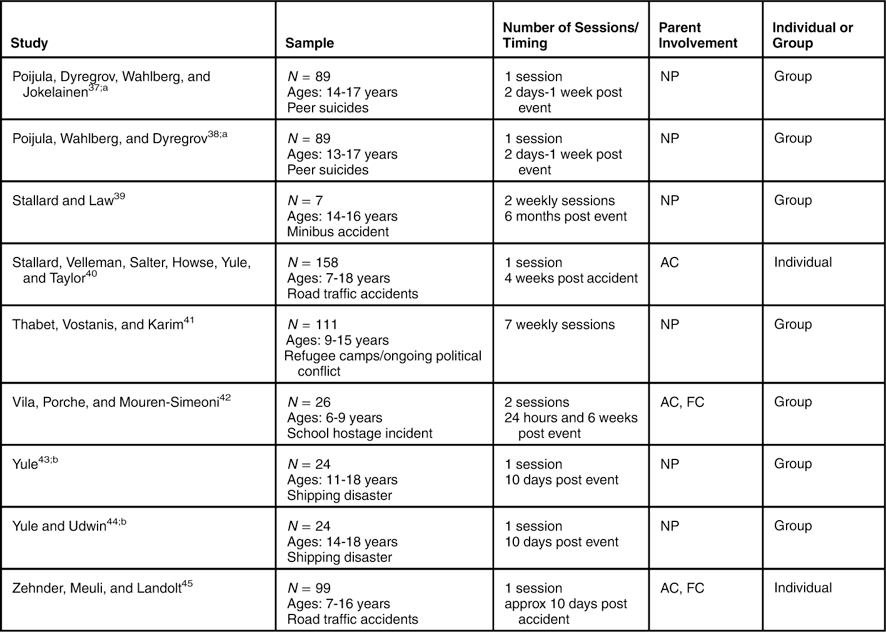
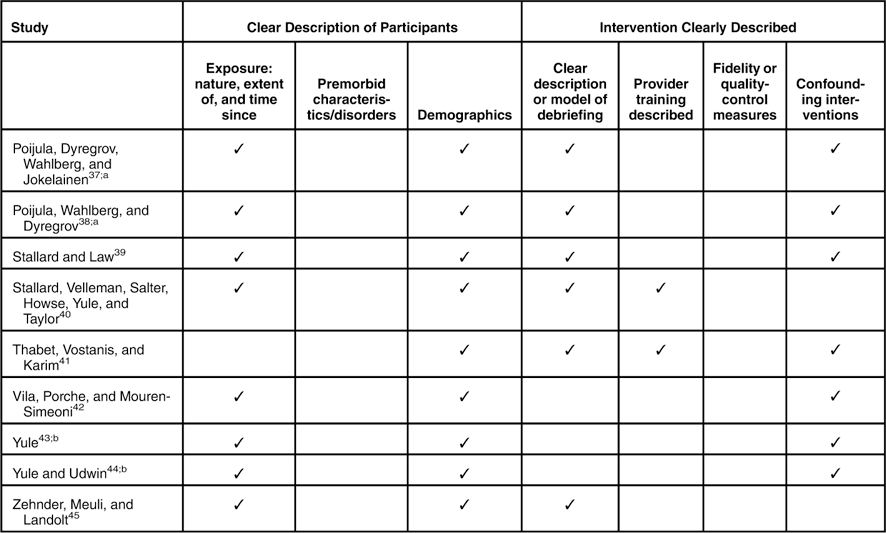
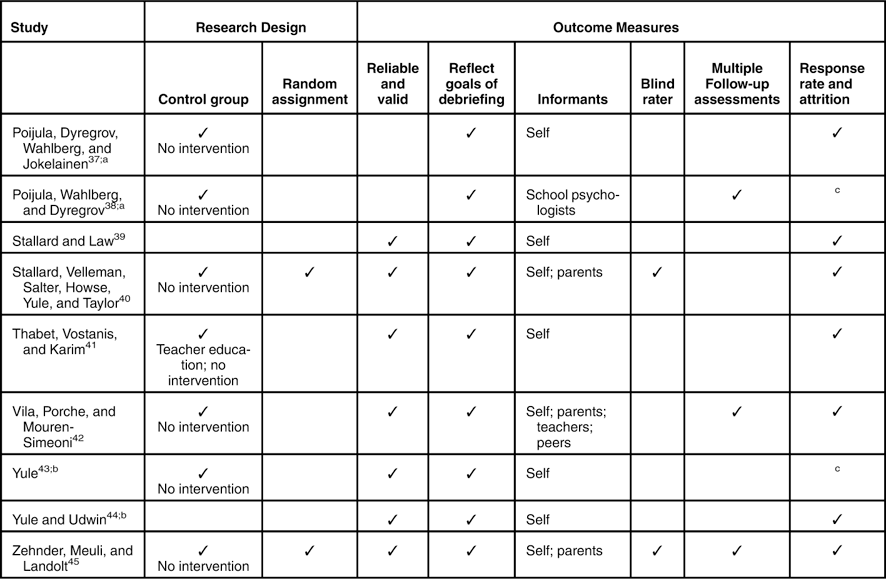
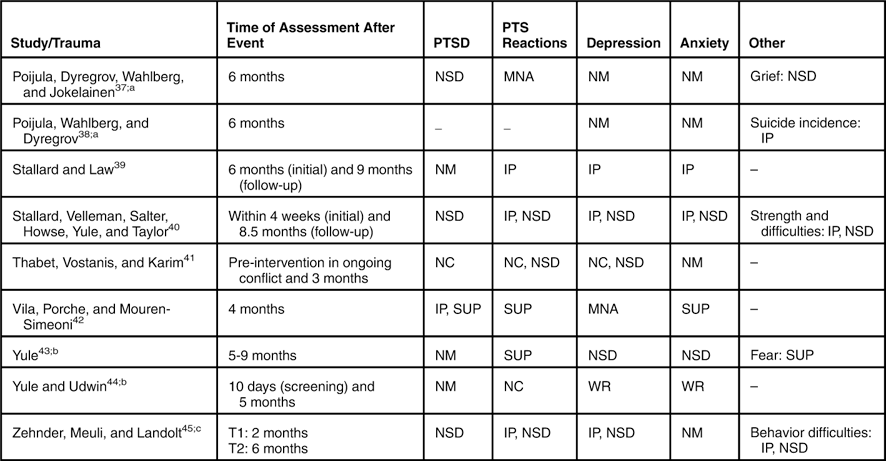
The results of the analysis considered the description of study participants, characteristics of the debriefing interventions and intervention delivery, the study instruments, the research design, and intervention outcomes. Table 1 presents information on the study samples, interventions, and intervention delivery. Table 2 and Table 3 summarize methodological aspects of the intervention studies. Table 4 presents outcome data for the studies.
Descriptions of the Studies Included in this Review

Abbreviations: AC, parent provided assessment information only; FC, involvement so the parent could help the child; NP, no parent involvement.
a Poijula, Dyregrov, Wahlberg, and JokelainenReference Poijula, Dyregrov, Wahlberg and Jokelainen 37 and Poijula, Wahlberg, and DyregrovReference Poijula, Wahlberg and Dyregrov 38 reported the results of the same study.
b YuleReference Yule 43 and Yule and UdwinReference Yule and Udwin 44 reported the results of the same study.
Methodological Features of the Studies Included in this Review: Description of Participants and the Intervention

a Poijula, Dyregrov, Wahlberg, and JokelainenReference Poijula, Dyregrov, Wahlberg and Jokelainen 37 and Poijula, Wahlberg, and DyregrovReference Poijula, Wahlberg and Dyregrov 38 reported the results of the same study.
b YuleReference Yule 43 and Yule and UdwinReference Yule and Udwin 44 reported the results of the same study.
Methodological Features of the Studies Included in this Review: Research Design and Outcome Measures

a Poijula, Dyregrov, Wahlberg, and JokelainenReference Poijula, Dyregrov, Wahlberg and Jokelainen 37 and Poijula, Wahlberg, and DyregrovReference Poijula, Wahlberg and Dyregrov 38 reported the results of the same study.
b YuleReference Yule 43 and Yule and UdwinReference Yule and Udwin 44 reported the results of the same study. Yule & Udwin (1991)Reference Yule and Udwin 44 presented the study as a non-controlled trial.
c The methodological feature was present but reported in the other publication of the same study included in this review.
Effect of Debriefing on Psychological Outcomes in the Studies Included in this Review

Abbreviations: IP, pre-treatment to post-treatment improvement in outcome in the intervention group; MNA, outcome measured but effect of intervention on outcome not assessed; NC, no significant change in outcome after treatment in the intervention; NM, outcome not measured; NSD, no significant difference between intervention and control; PTS, posttraumatic stress; PTSD, posttraumatic stress disorder; SUP, intervention superior to control; WR, pre-treatment to post-treatment worsening of outcome in the intervention group.
a Poijula, Dyregrov, Wahlberg, and JokelainenReference Poijula, Dyregrov, Wahlberg and Jokelainen 37 and Poijula, Wahlberg, and DyregrovReference Poijula, Wahlberg and Dyregrov 38 reported the results of the same study.
b YuleReference Yule 43 and Yule and UdwinReference Yule and Udwin 44 reported the results of the same study.
c Subgroup analyses found the intervention more effective than the control condition (standard medical care) in reducing depression symptoms and behavior difficulties in participants aged 7-11 years, but not in participants aged 12-16 years.
Participant Characteristics and Sample Size
All studies described the trauma and participants whose ages ranged from 6 years to 18 years. Debriefing groups appeared to be homogeneous with respect to event exposure. Six of the seven studies included only children who had been exposed to the traumatic event, while one study selected only children who had moderate to severe symptoms of PTSD with no significant difference in symptom levels in the three groups studied at the time of first assessment.Reference Thabet, Vostanis and Karim 41 Zehnder and colleaguesReference Zehnder, Meuli and Landolt 45 used maternal report to create a score for life events that occurred during the year prior to the traumatic incident (motor-vehicle accident), and for the six months after the incident, documenting no significant difference in the intervention and control groups. No study described premorbid conditions. The sample size and other details related to the participants and the interventions are presented in Table 1. Table 2 summarizes the descriptions of study participants and interventions.
The Interventions and Intervention Delivery
Three of the debriefing interventions studiedReference Poijula, Wahlberg and Dyregrov 38 , Reference Stallard, Velleman, Salter, Howse, Yule and Taylor 40 , Reference Thabet, Vostanis and Karim 41 were modeled after the work of Mitchell and EverlyReference Mitchell and Everly 1 , Reference Mitchell 12 and/or Dyregrov.Reference Dyregrov 8 Four of the studies offered a single debriefing session,Reference Poijula, Dyregrov, Wahlberg and Jokelainen 37 , Reference Poijula, Wahlberg and Dyregrov 38 , Reference Stallard, Velleman, Salter, Howse, Yule and Taylor 40 , Reference Yule 43 - Reference Zehnder, Meuli and Landolt 45 two offered two sessions (at weekly intervals in one studyReference Stallard and Law 39 and after six weeks in one studyReference Vila, Porche and Mouren-Simeoni 42 ), and one offered seven weekly sessions.Reference Thabet, Vostanis and Karim 41 In five of the seven included studies, debriefing was offered to participants in group sessions.Reference Poijula, Dyregrov, Wahlberg and Jokelainen 37 - Reference Stallard and Law 39 , Reference Thabet, Vostanis and Karim 41 - Reference Yule and Udwin 44 The size of the groups varied from sevenReference Stallard and Law 39 to 31Reference Thabet, Vostanis and Karim 41 participants. In most studies, debriefing was delivered in the first 10 days,Reference Poijula, Dyregrov, Wahlberg and Jokelainen 37 , Reference Poijula, Wahlberg and Dyregrov 38 , Reference Vila, Porche and Mouren-Simeoni 42 - Reference Zehnder, Meuli and Landolt 45 with a range of delivery from one dayReference Vila, Porche and Mouren-Simeoni 42 to six months.Reference Stallard and Law 39 Thabet and colleaguesReference Thabet, Vostanis and Karim 41 conducted their work over a 6-month period in the Gaza Strip (Palestine) in the context of ongoing political conflict. Parents were involved in three studies to provide assessment information about their childReference Stallard, Velleman, Salter, Howse, Yule and Taylor 40 , Reference Vila, Porche and Mouren-Simeoni 42 , Reference Zehnder, Meuli and Landolt 45 and/or to help their childReference Vila, Porche and Mouren-Simeoni 42 , Reference Zehnder, Meuli and Landolt 45 (Table 1).
Although two publicationsReference Stallard, Velleman, Salter, Howse, Yule and Taylor 40 , Reference Thabet, Vostanis and Karim 41 briefly mentioned training, none of the studies documented the specific type of training, if any, the providers received. No studies reported treatment fidelity or quality-control data (Table 2).
Individual versus Group Administration
Five studies examined debriefing delivered to children in groupsReference Poijula, Dyregrov, Wahlberg and Jokelainen 37 - Reference Stallard and Law 39 , Reference Thabet, Vostanis and Karim 41 - Reference Yule and Udwin 44 while two used individual debriefing.Reference Stallard, Velleman, Salter, Howse, Yule and Taylor 40 , Reference Zehnder, Meuli and Landolt 45 Among studies of debriefing delivered in groups of children, Vila and colleaguesReference Vila, Porche and Mouren-Simeoni 42 and YuleReference Yule 43 found superiority of debriefing over the control for PTSD and posttraumatic stress reactions, respectively, while Thabet and colleaguesReference Thabet, Vostanis and Karim 41 found no significant difference in posttraumatic stress symptoms between the intervention and two control groups (teacher psychoeducation and no intervention). Poijula, Dyregrov, Wahlberg, and JokelainenReference Poijula, Dyregrov, Wahlberg and Jokelainen 37 found no significant difference between group debriefing and no intervention for PTSD following a series of student suicides in Finland. There was no significant difference between the intervention and control groups in PTSD, posttraumatic stress symptoms, or depression in either of the two studies using individual debriefingReference Stallard, Velleman, Salter, Howse, Yule and Taylor 40 , Reference Zehnder, Meuli and Landolt 45 (Table 1 and Table 4).
Other Interventions
In the two studies in which debriefing was delivered to children individually,Reference Stallard, Velleman, Salter, Howse, Yule and Taylor 40 , Reference Zehnder, Meuli and Landolt 45 participants were motor-vehicle accident victims recruited in hospital settings while receiving routine medical care. Additional psychological intervention was available and/or recommended along with debriefing in all five of the group debriefing studiesReference Poijula, Dyregrov, Wahlberg and Jokelainen 37 - Reference Stallard and Law 39 , Reference Thabet, Vostanis and Karim 41 - Reference Yule and Udwin 44 (Table 2). For instance, the same day as the traumatic event, in addition to debriefing, Poijula and colleaguesReference Poijula, Dyregrov, Wahlberg and Jokelainen 37 , Reference Poijula, Wahlberg and Dyregrov 38 delivered a “First Talk-Through” session designed as a conversational meeting aimed at providing early emotional support to individuals exposed to a critical incident. Children included in the study by YuleReference Yule 43 received two group cognitive behavioral therapy sessions in addition to the initial debriefing session. Additional individual therapeutic interventions also were delivered to children diagnosed with psychiatric disorders in the study conducted by Vila and colleagues.Reference Vila, Porche and Mouren-Simeoni 42
In three of the group debriefing studies, the additional interventions were delivered to some of the participants before the assessment of the effectiveness of the debriefing session.Reference Poijula, Dyregrov, Wahlberg and Jokelainen 37 , Reference Poijula, Wahlberg and Dyregrov 38 , Reference Vila, Porche and Mouren-Simeoni 42 , Reference Yule 43 Stallard and LawReference Stallard and Law 39 reported that one participant in their study received individual treatment before the debriefing sessions, and that all participants were offered individual help; however, except for the one who received prior treatment, none of the participants accepted the offer. Thabet and colleaguesReference Thabet, Vostanis and Karim 41 referred children in the two active conditions (debriefing and teacher education control group) who experienced serious problems to specialist services following the completion of the intervention. After the follow-up assessment, children in the inactive control group were offered crisis interventionReference Thabet, Vostanis and Karim 41 (Table 2).
Instruments and Outcomes
Outcomes were measured with well-established tools, but only three papers reported reliability with the study sample.Reference Poijula, Dyregrov, Wahlberg and Jokelainen 37 , Reference Stallard, Velleman, Salter, Howse, Yule and Taylor 40 , Reference Zehnder, Meuli and Landolt 45 The Impact of Event Scale,Reference Horowitz, Wilner and Alvarez 47 used in five studies,Reference Poijula, Dyregrov, Wahlberg and Jokelainen 37 , Reference Stallard and Law 39 , Reference Stallard, Velleman, Salter, Howse, Yule and Taylor 40 , Reference Vila, Porche and Mouren-Simeoni 42 - Reference Yule and Udwin 44 was the most frequently used instrument to assess posttraumatic stress symptoms while two tools were used to measure depression: the Birleson Depression InventoryReference Birleson 48 , Reference Birleson, Hudson, Buchanan and Wolff 49 was used in three studiesReference Stallard and Law 39 , Reference Stallard, Velleman, Salter, Howse, Yule and Taylor 40 , Reference Yule 43 , Reference Yule and Udwin 44 and the Child Depression IndexReference Kovacs 50 was used in two studies.Reference Thabet, Vostanis and Karim 41 , Reference Zehnder, Meuli and Landolt 45 ThreeReference Stallard and Law 39 , Reference Stallard, Velleman, Salter, Howse, Yule and Taylor 40 , Reference Yule 43 , Reference Yule and Udwin 44 of the four studies which measured anxiety symptoms used the Revised Children’s Manifest Anxiety Scale.Reference Reynolds and Richmond 51
The papers were mixed with respect to how well the instruments fit the stated study goals. Some studies identified specific goals, such as reducing the risk of PTSD and grief,Reference Poijula, Dyregrov, Wahlberg and Jokelainen 37 reducing PTSD and depressive symptoms,Reference Thabet, Vostanis and Karim 41 reducing psychological reactions,Reference Stallard, Velleman, Salter, Howse, Yule and Taylor 40 or preventing future psychological symptoms;Reference Zehnder, Meuli and Landolt 45 others reported goals that did not relate directly to outcome measures, such as allowing participants to share their experiences and reactionsReference Stallard and Law 39 , Reference Yule and Udwin 44 and/or normalizing reactions.Reference Yule and Udwin 44 One study did not state goals.Reference Vila, Porche and Mouren-Simeoni 42
Research Design
Table 3 summarizes the methodological elements present in each study. All but one studyReference Stallard and Law 39 included a control group. Two studies were not designed as controlled studies, but the investigators compared the results observed in children who participated in the debriefing sessions to those who had declined to participate in these sessions.Reference Vila, Porche and Mouren-Simeoni 42 , Reference Yule 43 Only one study, which included two control groups, compared debriefing to another psychological intervention (teacher education).Reference Thabet, Vostanis and Karim 41 Only two studies used random assignment to either the experimental or the control group,Reference Stallard, Velleman, Salter, Howse, Yule and Taylor 40 , Reference Zehnder, Meuli and Landolt 45 and only two studies used blinded assessment.Reference Stallard, Velleman, Salter, Howse, Yule and Taylor 40 , Reference Zehnder, Meuli and Landolt 45 Three studies used multiple informants,Reference Stallard, Velleman, Salter, Howse, Yule and Taylor 40 , Reference Vila, Porche and Mouren-Simeoni 42 , Reference Zehnder, Meuli and Landolt 45 as is preferred when evaluating children.Reference Pfefferbaum, Jacobs and Houston 52 Multiple follow-up assessments were used in three studies.Reference Poijula, Wahlberg and Dyregrov 38 , Reference Vila, Porche and Mouren-Simeoni 42 , Reference Zehnder, Meuli and Landolt 45
Intervention Outcomes
All of the studies reported response rates as well as attrition (Table 3). The psychological outcomes most frequently measured in the seven studies reviewed were posttraumatic stress reactions,Reference Poijula, Dyregrov, Wahlberg and Jokelainen 37 , Reference Stallard and Law 39 - Reference Zehnder, Meuli and Landolt 45 depression,Reference Stallard and Law 39 - Reference Zehnder, Meuli and Landolt 45 PTSD,Reference Poijula, Dyregrov, Wahlberg and Jokelainen 37 , Reference Stallard, Velleman, Salter, Howse, Yule and Taylor 40 - Reference Vila, Porche and Mouren-Simeoni 42 , Reference Zehnder, Meuli and Landolt 45 and anxiety.Reference Stallard and Law 39 , Reference Stallard, Velleman, Salter, Howse, Yule and Taylor 40 , Reference Vila, Porche and Mouren-Simeoni 42 - Reference Yule and Udwin 44 The effectiveness of the intervention was assessed as early as two months after the traumatic eventReference Zehnder, Meuli and Landolt 45 to as late as nine months after the eventReference Stallard and Law 39 (Table 4).
Posttraumatic Stress Reactions and PTSD
All seven studies measured posttraumatic stress reactions,Reference Poijula, Dyregrov, Wahlberg and Jokelainen 37 , Reference Stallard and Law 39 - Reference Zehnder, Meuli and Landolt 45 and five assessed the change in these symptoms from baseline.Reference Stallard and Law 39 - Reference Thabet, Vostanis and Karim 41 , Reference Yule and Udwin 44 , Reference Zehnder, Meuli and Landolt 45 Posttraumatic stress reactions significantly decreased after the intervention in three of the five studies, and in all three of these studies, participants received routine medical care;Reference Stallard and Law 39 , Reference Stallard, Velleman, Salter, Howse, Yule and Taylor 40 , Reference Zehnder, Meuli and Landolt 45 there was no statistically significant change in the other two trials.Reference Thabet, Vostanis and Karim 41 , Reference Yule and Udwin 44 Only two of five controlled trials examining the effect of the debriefing sessions on posttraumatic stress reactions found debriefing to be superior to that of the control groupReference Vila, Porche and Mouren-Simeoni 42 , Reference Yule 43 (Table 4). In both studies, the debriefing intervention was delivered to children in groups, and other psychotherapeutic interventions were offered to the experimental group in addition to debriefing (Table 1 and Table 2).
Only one study found a statistically significant decrease in the number of PTSD cases from baseline.Reference Vila, Porche and Mouren-Simeoni 42 The study by Vila and colleaguesReference Vila, Porche and Mouren-Simeoni 42 also found debriefing to be superior to no treatment. Additional therapeutic interventions were offered to some participants in this study (Table 2 and Table 4).
Depression
Three of the five studies which assessed the effect of the intervention on depressionReference Stallard and Law 39 - Reference Thabet, Vostanis and Karim 41 , Reference Yule and Udwin 44 , Reference Zehnder, Meuli and Landolt 45 reported a statistically significant decrease in depressive symptoms from baseline;Reference Stallard and Law 39 , Reference Stallard, Velleman, Salter, Howse, Yule and Taylor 40 , Reference Zehnder, Meuli and Landolt 45 these three interventions were conducted with motor-vehicle accident victims who also received standard medical care. Thabet and colleaguesReference Thabet, Vostanis and Karim 41 found no significant change in depressive symptoms in study participants, while Yule and UdwinReference Yule and Udwin 44 reported a significant increase in depressive symptoms from baseline to post intervention. Vila and colleaguesReference Vila, Porche and Mouren-Simeoni 42 reported a diagnosis of major depressive disorder in two of the children in their study over the follow-up period, but they did not assess the effect of the treatment on depression formally (Table 4).
None of the four controlled trials which measured depression found a statistically significant difference between debriefing and no treatment.Reference Stallard, Velleman, Salter, Howse, Yule and Taylor 40 , Reference Thabet, Vostanis and Karim 41 , Reference Yule 43 , Reference Zehnder, Meuli and Landolt 45 Thabet and colleaguesReference Thabet, Vostanis and Karim 41 also compared their seven weekly debriefing sessions to four psychoeducation sessions provided by teachers to their students, and to a group of students who received no intervention; they found no significant difference between the three groups on depressive symptoms (Table 4).
Anxiety
Stallard and LawReference Stallard and Law 39 and Stallard and colleaguesReference Stallard, Velleman, Salter, Howse, Yule and Taylor 40 found a statistically significant decrease in anxiety symptoms after the debriefing sessions in their studies. In contrast, Yule and UdwinReference Yule and Udwin 44 observed a significant increase in anxiety symptoms after their intervention (Table 4).
Three studies compared the effect of debriefing on anxiety symptoms to that of a non-intervention control group.Reference Stallard, Velleman, Salter, Howse, Yule and Taylor 40 , Reference Vila, Porche and Mouren-Simeoni 42 , Reference Yule 43 Two failed to find any significant difference.Reference Stallard, Velleman, Salter, Howse, Yule and Taylor 40 , Reference Yule 43 Vila and colleagues,Reference Vila, Porche and Mouren-Simeoni 42 however, reported a significantly greater decrease in anxiety symptoms in child victims of a school hostage taking who participated in debriefing sessions compared to those who did not (Table 4). In all three studies, at least some of the participants received other interventions, including routine medical care,Reference Stallard, Velleman, Salter, Howse, Yule and Taylor 40 two group cognitive behavioral therapy sessions,Reference Yule 43 or individual sessionsReference Vila, Porche and Mouren-Simeoni 42 (Table 2).
Other Psychological Outcomes
Other psychological outcomes were examined in some studies. YuleReference Yule 43 observed fewer fear reactions in child victims of a maritime disaster who participated in a debriefing session (plus two group cognitive behavioral therapy sessions) compared to those who did not. After a series of suicides in schools in rural communities in Finland, Poijula and colleaguesReference Poijula, Dyregrov, Wahlberg and Jokelainen 37 found no significant difference in grief reactions between students who participated in a debriefing intervention and those who did not. The benefit of debriefing in reducing behavior difficulties in children was investigated in two studies.Reference Stallard, Velleman, Salter, Howse, Yule and Taylor 40 , Reference Zehnder, Meuli and Landolt 45 Both found a significant decrease in behavior difficulties from baseline, but this decrease was not different statistically from that of the non-intervention control group in either study (Table 4).
Discussion
Although literature is available on the use of debriefing with children and adolescents, little empirical research has been conducted on youth. In light of children’s acknowledged vulnerability to disasters, concern about the use of debriefing in adults, and the interest in disaster interventions in children, the current review examined the evidence base for the use of debriefing in children and adolescents. While the small number of empirical child debriefing studies limits any definitive conclusions, the extant research provides useful information and points to directions for future research. This discussion addresses outcomes of child debriefing studies in light of the elements required in methodologically sound intervention research (eg, co-intervention bias), issues raised in the context of the debriefing debate (eg, individual or group application, timing of delivery, and referral for other services), and issues specific to children (eg, involvement of parents).
Outcomes
Studies using pre-/post-assessment have been mixed with respect to improvement in posttraumatic stress reactions, PTSD, depression, and anxiety. Two of the six controlled trials that examined posttraumatic stress reactions found benefit,Reference Vila, Porche and Mouren-Simeoni 42 , Reference Yule 43 and one of the four controlled trials that examined PTSD found improvement post intervention.Reference Vila, Porche and Mouren-Simeoni 42 Unfortunately, all of these studies may have been compromised by co-intervention bias. No controlled trials found superiority of debriefing over the control for depression. Only one of three controlled trials found benefit for anxiety.Reference Vila, Porche and Mouren-Simeoni 42 In the study by Vila and colleagues,Reference Vila, Porche and Mouren-Simeoni 42 which also was the only controlled trial finding improvement in PTSD, not only was the potential for co-intervention bias of concern, the non-intervention control group was comprised of only two children who declined to participate in the debriefing intervention. Thus, the analysis of studies in this review provides minimal support for the use of debriefing in children for posttraumatic stress reactions or PTSD, depression, or anxiety, and studies have not found benefit over controlled conditions for behavior difficultiesReference Stallard, Velleman, Salter, Howse, Yule and Taylor 40 , Reference Zehnder, Meuli and Landolt 45 or grief.Reference Poijula, Dyregrov, Wahlberg and Jokelainen 37 Debriefing typically is not designed to address behavior difficulties, but one goal of the study of classmates of suicide victims was to address grief.Reference Poijula, Dyregrov, Wahlberg and Jokelainen 37 YuleReference Yule 43 found improvement with respect to fear, but the children in his maritime study received two group cognitive behavioral sessions as well as debriefing.
None of the studies reviewed demonstrated any potential harmful effect of debriefing. Yule and UdwinReference Yule and Udwin 44 reported an increase in depression and anxiety in child survivors of a maritime disaster after receiving a group debriefing session, but there were no differences relative to the control group in these outcomes.Reference Yule 43 In addition to the novelty and magnitude of the maritime disaster these children experienced, the assessment of participants was conducted five to nine months after the debriefing session, which was offered 10 days after the incident. Depression can occur late in the disaster courseReference Bolton, O’Ryan, Udwin, Boyle and Yule 53 , Reference Goenjian, Pynoos and Steinberg 54 and likely was not addressed in the early debriefing intervention which focused on helping the children understand their experiences, express and share their feelings, and learn about normal reactions to traumatic events.Reference Yule and Udwin 44 Referral may not have been indicated at the time the debriefing intervention was administered.
Participants
Although the traumatic events for which participants received debriefing were described, only one study described pre- and post-accident life events,Reference Zehnder, Meuli and Landolt 45 and none described pre-incident conditions or functioning which may have influenced outcomes.Reference Norris, Friedman, Watson, Byrne, Diaz and Kaniasty 55 , Reference Silverman and La Greca 56 Future researchers should consider exposure and pre-existing conditions in their research design and methodology.
The Interventions and Intervention Delivery
Some of the studiesReference Poijula, Wahlberg and Dyregrov 38 , Reference Stallard, Velleman, Salter, Howse, Yule and Taylor 40 , Reference Thabet, Vostanis and Karim 41 used debriefing based on the models described by Mitchell’s groupReference Mitchell and Everly 1 , Reference Mitchell 12 and/or Dyregrov,Reference Dyregrov 8 but the interventions did not conform to traditional debriefing in terms of timing, number of sessions, and/or use of group as opposed to individual approach. Child interventions must be tailored for developmental considerations of the children involved; thus, a first obvious consideration is to establish age guidelines for using debriefing in children. Language development may limit children’s expressions,Reference Hunt 57 but even verbal children may resist talking about traumatic events in a group setting.Reference Dobryakov and Nikolskaya 33 Incorporating activities such as drawing and other art forms can be helpful in aiding young children to talk about the events they have experienced.Reference Dobryakov and Nikolskaya 33 , Reference Webb 34 For example, Thabet and colleaguesReference Thabet, Vostanis and Karim 41 used free drawing in their intervention and Zehnder and colleaguesReference Zehnder, Meuli and Landolt 45 used drawing and accident-related toys to help children talk about their experiences. While not specific to debriefing, and not described in any of the seven studies, interventions need to be modified to address culture as well as developmental level.
Parent Involvement
Despite the importance of caregivers in supporting children after traumatic events, debriefing, as conceptualized traditionally, does not address parental involvement specifically. Beyond using parents to provide assessment information,Reference Stallard, Velleman, Salter, Howse, Yule and Taylor 40 , Reference Vila, Porche and Mouren-Simeoni 42 , Reference Zehnder, Meuli and Landolt 45 only two studies contained a caregiver component to help parents help their children.Reference Vila, Porche and Mouren-Simeoni 42 , Reference Zehnder, Meuli and Landolt 45 Parallel attention to parental concerns and education also can be beneficial.Reference Stallard and Salter 7 , Reference Wraith 58
Individual versus Group Approach
Distinguishing individual and group approaches in assessing the debriefing controversy is important as these are not simply interchangeable.Reference Hawker, Durkin and Hawker 4 , Reference Tuckey 5 In outlining the possible mechanisms of action in their group debriefing, Mitchell and EverlyReference Mitchell and Everly 1 specified elements such as reduction of the sense of isolation, learning from others, and recognizing that others are vulnerable as well. Consistent with the original intention of debriefing, a group approach was used to deliver the intervention in five studies.Reference Poijula, Dyregrov, Wahlberg and Jokelainen 37 - Reference Stallard and Law 39 , Reference Thabet, Vostanis and Karim 41 - Reference Yule and Udwin 44 The limited number of trials and weaknesses in the design of the group debriefing studies make it premature to draw conclusions about the benefit of group debriefing in children and adolescents. Neither of the individual debriefing studies,Reference Stallard, Velleman, Salter, Howse, Yule and Taylor 40 , Reference Zehnder, Meuli and Landolt 45 which were methodologically rigorous with randomized controlled design and blind assessment, provided support for the effectiveness of individual debriefing. Both of these trials were conducted with child victims of traffic accidents; thus, studies of debriefing with different populations in different contexts exposed to a variety of traumatic events should be conducted before dismissing individual debriefing in children.
When debriefing was offered in groups, the groups appeared to be homogeneous with respect to the participants’ event exposure. Screening for the type and degree of exposure should be considered when constituting groups for debriefing to ensure some homogeneity among participants in development, culture, and disaster exposure and reactions, and to determine if clinical evaluation and/or treatment are indicated. While child disaster interventions often include a narrative component,Reference Pfefferbaum, Sweeton, Noffsinger, Varma, Nitiéma and Newman 59 having children share details about their experiences in a group soon after the traumatic event has been criticized. Concern has been raised about the potential for children with less exposure to become distressed by hearing strong sensory descriptions shared by highly-exposed children.Reference Dyregrov 60 Thus, care must be taken to avoid exposing children to information and emotions that they cannot process and integrate, and to avoid re-traumatizationReference Wraith 58 or secondary (or vicarious) traumatization.Reference Dyregrov 60 In describing the use of a crisis response team in the school setting for various types of events, EavesReference Eaves 61 also cautioned against including disruptive, insensitive students as well as students exhibiting stress reactions, and WebbReference Webb 34 noted that some elements of debriefing, such as the normalization of feelings, are not appropriate for bereaved children. That said, using a group approach for interventions seems well-suited to children who convene within classrooms or other group settings commonly. Incorporating an adult, such as a teacher, who has an established relationship with the child participants can be beneficial as well.Reference Webb 34
Timing and Number of Sessions
The small number of studies included in this review, as well as differences in types of traumatic events and methodological limitations in the studies, precluded a rigorous analysis of the impact of the timing or number of sessions on children’s psychological outcomes. With respect to timing, debriefing should not be considered until after safety and security have been established.Reference Hunt 57 , Reference Ormerod 62 , Reference Yule 63 The adult literature has raised concern about the potential for the intervention to increase arousal and feelings of helplessness, during a time when individuals may be working to calm themselves,Reference Devilly, Gist and Cotton 64 and to interfere with the natural recovery process.Reference McNally, Bryant and Ehlers 65 Adult attention to traumatic stimuli and possible reactions may increase distress in youth who were recovering well previously.Reference Hunt 57 Anecdotal evidence suggests that if used, debriefing should not be delivered to children in the immediate aftermath of a disasterReference Stallard and Salter 7 when numbness and hyper-arousal may be prominent. YuleReference Yule 63 recommended waiting five to 10 days post incident before initiating group interventions. This advice differs from the time frame of 24 to 72 hours originally recommended for critical-incident stress debriefing.Reference Mitchell and Everly 1 No clear guidelines for timing emerged from the research reviewed for this report, and the best time to offer debriefing has yet to be answered empirically.Reference Chemtob 6
Lack of Comprehensiveness
Concern has been raised that debriefing may not be intensive enough to help some recipients. This issue comprises concerns about both the depth of the intervention and the lack of follow-up services for children who remain distressed. The brief nature of the intervention may increase children’s sensitivity to trauma reminders without providing the structure or time for children to develop a detailed trauma narrativeReference Cohen 66 or the opportunity to process the events adequately. Other intervention services were available and/or recommended in all of the group debriefing studies reviewed in this report.Reference Poijula, Dyregrov, Wahlberg and Jokelainen 37 - Reference Stallard and Law 39 , Reference Thabet, Vostanis and Karim 41 - Reference Yule and Udwin 44
Research Design
While the two studies of individual debriefing used randomized control design,Reference Stallard, Velleman, Salter, Howse, Yule and Taylor 40 , Reference Zehnder, Meuli and Landolt 45 limitations in research design in the group debriefing studies included in this review may have compromised the validity of the observed results. Randomized controlled design is the gold standard for experimental studies. Although six of the seven studies reviewed used a control group to assess the effectiveness of the debriefing sessions,Reference Poijula, Dyregrov, Wahlberg and Jokelainen 37 , Reference Poijula, Wahlberg and Dyregrov 38 , Reference Stallard, Velleman, Salter, Howse, Yule and Taylor 40 - Reference Yule 43 , Reference Zehnder, Meuli and Landolt 45 only two randomly assigned the participants to the study groups.Reference Stallard, Velleman, Salter, Howse, Yule and Taylor 40 , Reference Zehnder, Meuli and Landolt 45 The purpose of randomization is to balance unknown factors that may be associated with the effectiveness of the intervention in study groups so that an observed between-group difference in outcomes after the intervention is not attributable to these unknown factors. As research moves forward, more studies that employ a randomized design would be valuable. Studies that distinguish delayed debriefing from other interventions,Reference Chemtob 6 such as trauma narratives or imaginal exposure, and those that dismantle and examine intervention components may be instructive. This requires the interventions to be well described and/or guided by protocols or manuals and their application subjected to the often-neglected assessment of treatment fidelity.
As conceived traditionally, debriefing was intended to be among a larger set of interventions and to be used, in part, to identify individuals in need of additional intervention. While from a clinical perspective, the use of other services along with debriefing when indicated is ideal, from a research perspective, the use of other interventions compromises the assessment of the effectiveness of the intervention being investigated. In all five group debriefing studies, the potential for co-intervention was a concern.Reference Poijula, Dyregrov, Wahlberg and Jokelainen 37 - Reference Stallard and Law 39 , Reference Thabet, Vostanis and Karim 41 - Reference Yule and Udwin 44
In studies with positive results that also offered or provided other interventions,Reference Stallard and Law 39 , Reference Vila, Porche and Mouren-Simeoni 42 , Reference Yule 43 it is impossible to determine if the debriefing or the other intervention was responsible for the benefit, if it was the combination of interventions that improved child outcomes, or the degree to which natural recovery influenced the results. In the two individual debriefing studies,Reference Stallard, Velleman, Salter, Howse, Yule and Taylor 40 , Reference Zehnder, Meuli and Landolt 45 participants were motor-vehicle accident victims recruited in hospital settings while receiving routine medical care. Both of these studies reported a decrease in posttraumatic stress and depressive symptoms with debriefing, but those who received debriefing were not different statistically from controls who received routine medical care only. Thus, natural recovery may have accounted for the benefit seen with debriefing.
Conclusion
The findings from this review fall short of justification for full endorsement or rejection of the use of debriefing with children. Instead, the limited number of studies argues for further research on the use of debriefing, the components of debriefing, early interventions, and group interventions with children. To move forward in exploring debriefing in children, consideration is needed regarding appropriate candidates to receive the intervention, timing of the intervention, and the role of debriefing within a larger response model. No study to date has provided firm evidence of potential harmful effects of debriefing in children, but critics have focused on: the timing of intervention delivery; the exposure of children to the detailed, sometimes gruesome accounts of group members’ experiences; and the potential for lack of follow-up services. Failure to integrate a parent component systematically in child debriefing constitutes an important oversight in light of suggestions that, when faced with limited resources, focusing services on bolstering parent coping and support of their children may provide the most benefit immediately after a crisis.Reference Cohen 66
From a research perspective, the debriefing debate is best understood, not as a story of a failed intervention, but rather as a series of case studies on the challenges of evaluating crisis intervention strategies in the field. Seven studies in application to children, each with its own limitations, is an inadequate database from which to draw definitive conclusions about an intervention, especially given the variety of traumatic events and experiences (suicide, accidents, disaster, political conflict, and hostage taking), sample characteristics (mostly adolescents, but also young children), timing after the trauma (days to months), and multiple methodological deficiencies and concerns. After two decades, society is not much closer to making a sound research-based recommendation regarding the use of debriefing, or other early interventions, with children, but hopefully it is nearer to creating a better dialog regarding systems in which to evaluate such crisis interventions.
Disclaimer
Points of view in this document are those of the authors and do not necessarily represent the official position of the: Johns Hopkins Bloomberg School of Public Health; Johns Hopkins School of Medicine; Loyola University Maryland; National Child Traumatic Stress Network; National Institute of Mental Health; National Institute of Nursing Research; Substance Abuse and Mental Health Services Administration; University of Missouri; University of Oklahoma Health Sciences Center; or the US Department of Health and Human Services.