In 1300 and 1310 the monk Zhiyu 智裕 at the Buddhist monastic center of Mt. Wutai (Wutai shan 五臺山) had large steles erected to commemorate two fellow monks. These two steles at first sight appear to be a pair of conventional objects of Buddhist piety. Upon closer inspection, however, their early history and inscriptions reveal much at odds with conventional conceptions of Buddhist practice. Not only was the first of the monks commemorated by Zhiyu—Master Liang—actually his father, but the Buddhist chapel where these steles were situated also served as an ancestral shrine for Zhiyu's family, the Zhangs 張, in their home village not far from Mt. Wutai in present Shanxi province.Footnote 1 The attachment of this monk to his father, family, village, and himself was also evident in these steles’ inscriptions. In addition to being hagiographies of the two deceased monks, these compositions include much information about Zhiyu and his family. Indeed, roughly half of the first inscription for his father is devoted to Zhiyu's own life, and the second, despite its dedication to one of Zhiyu's religious masters, the Abbot Miaoyan of Diamond Monastery (Jinjie si 金畍寺) on Mt. Wutai, contains much about Zhiyu, his family, and their village. Above all, these inscriptions portray Zhiyu as a filial son, exceptionally dutiful in using his position inside and outside the Buddhist sangha to secure wealth, honor, and status for his family, the very family that lived alongside the two steles he had erected.
These filial facts from the Yuan dynasty (1271–1368) sit comfortably with some recent research that has begun to overturn conventional understandings of Chinese Buddhist establishments, their clergy, and their followers as fundamentally opposed to a Chinese family system that was primarily concerned with the continuation of its male descent lines, the practice of filial piety only to lay fathers, and the preservation of the family's place in the here and now.Footnote 2 Previous scholarship on Chinese Buddhism in the Yuan dynasty has usually concentrated on religious and philosophical developments in northern and southern clerical communities.Footnote 3 It has paid far too little attention to the laity's extensive interactions with Buddhist monks, especially in north China. We now have a clearer understanding of how the Mongol elite used Tibetan Lamaism to legitimize its foreign rule of China and how it interacted with Tibetan and Chinese Lamaist monks.Footnote 4 But so far there has been little study of the impact of Tibetan Buddhism on the lower echelons of Chinese society, once again especially in north China.
In undertaking such a study of the interaction between monastic and lay Buddhism in north China, this article will focus on a Yuan Buddhist order that incorporated Chinese monks and Tibetan lamas at the north China religious center of Mt. Wutai. Its exploration of the career of the late thirteenth- and early fourteenth- century monk Zhiyu is intended to reveal a distinctive Buddhist order that was intimately associated with the Mongol regime's imperial bureaucracy, and that at Mt. Wutai allowed for a complex interplay of Tibetan Buddhist, Chinese Buddhist, and local families’ secular interests. It will first examine the steles and the inscriptions mentioned above to clarify the actual role of Buddhist institutions and clergy in the religious, social, and political life of Mongol-Yuan China. It will secondly investigate the Mongol government's establishment of a distinct official bureaucracy for Buddhist clergy and establishments as well as its official and unofficial systems of patronage for these monks and abbots. And, thirdly, it will explore this government's promotion of Buddhist clerical life and offices, which along with clerkships in local government yamens as well as service in the military or in the office of a Mongol prince's fiefFootnote 5 served as alternative routes into officialdom; men seeking office, wealth, and power had no need to take written examinations on the Confucian classics or any other texts. In remaining consistently aware of the complex relationship of the Mongol government and Buddhist establishments to patronage networks and kinship organizations in the villages of north China, this article will demonstrate that the new Buddhist order created by and within the Yuan regime placed Buddhist monks in both imperial government and monastic offices and subsequently allowed monks to employ their heightened political power and social status to benefit their natal families.
While this article will begin with a general account of the growing power of the Mongol government over Buddhist establishments and their mutual intimacy and interdependence, it will quickly shift its focus to the role of prominent monks’ kinship and other personal ties in the operation of some Mongol government offices and Buddhist monastic centers. In examining how Chinese monks effectively bridged these two elite networks of the Mongol court and top Buddhist establishments, the focus will become both particular and local. Particular, in that special consideration will be given to the monastic careers of the monk Zhiyu and generations of his family, the Zhangs. Local, in that its study of Mongol rule will focus on the village of Anheng 安橫村 in Dingxiang County 定襄縣 (where Zhiyu and his kinsmen had their homes) and the nearby monastic complex of Mt. Wutai (where Zhiyu, his father, his younger brother, his eldest son, and their teacher-patron monks were all based). The first half of the article will show that Mongol rule posed a profound challenge to the norms of Chinese government and society, since it conferred on its Buddhist officials a legal and social status that in the eyes of themselves and their contemporaries was akin to that held by the civil officials in the government. Through their own success in a Buddhist order established by the Yuan government, enterprising Chinese monks like Zhiyu at Mt. Wutai proved capable of aiding their natal family's social ascent. Hence, by serving both as government officials and as filial sons, Buddhist monks like Confucian officials traditionally linked their dynasty and their family.
The second half of the article will build on the first part's discussion of elite Buddhist, political, and kinship institutions to show how this intertwining of these institutions worked at the village level, in particular the role of two Buddhist monuments, Zunsheng Dhāranī pillars and private Buddhist chapels, in the growth of local kinship institutions. During the Jin and Yuan periods many Shanxi families like Zhiyu's installed Zunsheng Dhāranī pillars to commemorate the achievements of ancestors and to record their genealogy. They also built Buddhist chapels in part to make ancestral offerings and to consolidate their kinship ties. The second half of the article therefore reveals a northern Chinese form of lineage development, that during the Jin and Yuan periods was intimately involved with Buddhist institutions and that followed a trajectory quite distinct from the more commonly studied Neo-Confucian corporate lineage of south China. In other words, although the detailed findings of this article will concern primarily Mt. Wutai and the surrounding area's elite families in Shanxi, the issues it addresses and the conclusion it reaches will, I hope, prove helpful to future studies of the interplay of similar government, religious, and kinship institutions in other parts of north China under Mongol rule.
THE MONK ZHIYU AND THE ZHANG FAMILY IN DINGXIANG COUNTY
The New Buddhist Order, on and off Mt. Wutai
Mt. Wutai, ever since its establishment as a Buddhist center in northern Shanxi province in the sixth century, has been one of the largest and most venerated monastic sites in north China. Considered as the legendary abode of Bodhisattva Mañjuśrī (in Chinese, Wenshu pusa 文殊菩薩, the Bodhisattva of wisdom), it attracted large donations for its clergy and for their Buddhist services.Footnote 6 Since the Tang dynasty (618–907), religious practitioners visited Mt. Wutai to have sight of Bodhisattva Mañjuśrī's divine presence, which was critical in the mountain's sacredness.Footnote 7 In the Northern Song and Jin dynasties, despite the popularity of the civil service examinations and the revival of Confucian learning, Mt. Wutai retained eminence in northern Chinese clerical and non-clerical circles as a place for serious Buddhist study and devout pilgrimage. The writings of these residents and pilgrims continued to relate their visionary experience of the ongoing presence of Bodhisattva Mañjuśī on this mountain.Footnote 8 Under Mongol rule, as the Confucian challenge receded and the examination system gave way to a far more diverse array of routes into officialdom, Mt. Wutai rose to exceptional eminence. With hundreds of temples and thousands of monks on its slopes and with powerful backing from Mongol rulers in the capital, it had no difficulty extending its power down into the surrounding villages. Local families, as captured in inscriptions compiled in the Dingxiang jinshi kao 定襄金石考 (On the Epigraphic Inscriptions of Dingxiang) by the Dingxiang scholar Niu Chengxiu 牛誠修 nearly a century ago, vied to have their sons become Wutai monks and gain official rank and privileges for themselves, their heirs, and their families.
The Yuan government's relationship with Mt Wutai, as with many other religious centers in China, expanded over the first two generations of its rule from indirect personal ties to direct institutional links and then onto the installation there of an administrative structure. While this trend can be seen as leading to greater Yuan government control of this large and powerful monastic establishment just 150 miles southwest of the capital Dadu (a.k.a. Beijing), the dynasty and Mt. Wutai's temples shared an interest in nurturing and improving their ties. In the highly competitive world of Chinese and Mongol religious practice, close ties with the throne would have been considered highly beneficial for Mt. Wutai's temples, their teachings, and their monks. Likewise, this foreign dynasty's legitimacy in Chinese eyes would have increased from its rulers’ engagement with powerful Buddhist monks, especially if some of these monks were Chinese.
In general, the dynasty favored Buddhism, and specifically it privileged the Buddhist establishment at Mt. Wutai for religious and political reasons. Its strikingly consistent religious policy, as shaped by Chinggis Khan, presupposed a distinctive political theology. As argued by Christopher Atwood, this theology assumed that the religions the Mongols favored, including Buddhism and Daoism, all prayed to the same God, who had blessed Chinggis Khan with victories in war and continued to respond to human prayers with favors for the dynasty. In order to secure God's blessings through prayer, the Mongols gave their favored religions extensive tax exemptions and patronage.Footnote 9 From the reign of Khubilai Khan (r. 1260–1294) Mongol rulers especially supported Tibetan Buddhism, which had developed particularly close ties to Mt. Wutai. In 1261 Khubilai Khan made the famous Tibetan Lama ’Gro-mgon chos-rgyal ’Phags-pa (1235–1280) the supreme head of the Buddhist clergy, awarding him the prestigious titles of National Preceptor (guoshi 國師) and Imperial Preceptor (dishi 帝師) in 1270. In return, ’Phags-pa declared Khubilai the living Bodhisattva Mañjuśrī, the Bodhisattva thought to dwell at Mt. Wutai and particularly popular in Tibetan Buddhism.Footnote 10 ’Phags-pa himself had visited Mt. Wutai in as early as 1258 and written about Bodhisattva Mañjuśrī during his stay there.Footnote 11 Mt. Wutai became one of two centers in China—the other was the capital Dadu—for Tibetan Buddhism in the Yuan, securing enormous imperial patronage throughout the dynasty.
Thus, shortly after Khubilai Khan established the Yuan dynasty in 1271, he and his officials started to reshape the Buddhist order on Mt. Wutai through their assignment of monks to its major monastic positions. These monks, many of them senior Tibetan Lamas, were there as government-appointed abbots and priests to perform Buddhist rituals on the mountain and especially to offer incense and sacrifices in place of the emperor (this practice unique to the Yuan dynasty was termed “substitute-sacrifices” [daisi 代祀]).Footnote 12 The first monk to hold this appointment, the Lama Rin (full name Rin-chen rgyal-mtshan [1238–1279], Yilianzhen 益憐真 in Chinese sources), was selected by Khubilai's second son and heir-apparent, Zhenjin 真金 (1243–1285) in line with his father's wishes.Footnote 13 The choice was far from accidental, in that Rin was a half-brother of the favored Tibetan Lama ’Phags-pa. If the Mongol emperor's representative on this Chinese mountain complex was a Tibetan, he nonetheless was associated through his natal family with a political and religious stance that identified the Chinese monastic center he now headed with the reigning Mongol ruler and his family.
Over the next two decades Rin and subsequent Lama appointees at Mt. Wutai as well as in the capital Dadu consolidated the construction of these close ties between Buddhist communities at Mt. Wutai and the Mongol imperial family. In performing Buddhist rituals on behalf of the Yuan dynasty with the aid of Chinese monks and especially through their support for securing the appointment of Chinese monks to official positions at Mt. Wutai, these Tibetan lamas brought certain Chinese monks to the attention of the emperor and his family. They also had Chinese monks honored with official titles from the emperor, thereby enabling them to communicate directly with other powerful Tibetan lamas at Mt. Wutai. For example, Rin had Zhiyu's mentor, Monk Zhi (Zhi jixiang 志吉祥) join him in performances of the incense offering ritual and appointed him to the powerful Buddhist administrative position, the Chief Sangha Registrar (dusenglu 都僧錄), on Mt. Wutai. Later on, Khubilai confirmed Rin's appointment and awarded Monk Zhi an honorary title Master Miaoyan 妙嚴大師,Footnote 14 thereby easing his direct communication with the Mongol political elite. In addition, grand Buddhist ritual assemblies held in the capital brought elite Wutai monks into direct contact with powerful Tibetan lamas. For instance, Monk Xiong (Xiong jixiang 雄吉祥), after serving in one such assembly at Dadu in 1276, was promoted by the National Preceptor—Rin himself—to the post of Chief Buddhist Judge (dusengpan 都僧判) on Mt. Wutai.Footnote 15 Similar privileges awaited other Chinese monks subsequently accorded elite titles and positions on Mt. Wutai.
Two decades spent nurturing this relationship culminated with the decision of Khubilai's successors to build imperial Buddhist monasteries according to the teachings of Tibetan Tantric Buddhism on Mt. Wutai.Footnote 16 In 1295, Khubilai's direct successor, Temür (Emperor Chengzong, r. 1294–1307, the third son of the deceased heir apparent Zhenjin), ordered the construction of the first-ever imperial monastery—and the first of an eventual five—on Mt. Wutai. Intended to commemorate his mother, Empress Dowager Kökejin (? –1300), this monastery acquired from the emperor a name—Great Monastery of Myriad Sacred Beings That Support the Kingdom (Da wansheng youguo si 大萬聖祐國寺)—that openly declared its active commitment to the dynasty. Very soon, this monastery came to serve as an important venue for Chinese monks’ interaction with influential Tibetan lamasFootnote 17 and members of the imperial family, specifically Emperor Temür's mother and her entourage. Upon completion of this monastery's construction in the following summer, she made a pilgrimage to Mt. Wutai as the empress dowager.Footnote 18 Greeted by supernatural visions of light in the welcome ceremony that Master Miaoyan presided over, she attributed these experiences to his powers and fell under his spell. At various times thereafter, she made sure that he benefitted from her patronage, an archetypical example of how increasingly after 1295 the personal will of the emperor, crown prince, or empress dowager influenced the appointment of both civil and religious officials.Footnote 19
Yuan imperial interest in Mt. Wutai did not stop at these personal ties. From 1297 the government established administrative links with Mt. Wutai that had a far-reaching impact on the monastic complex of Mt. Wutai as an institution. Previous dynasties of China had traditionally set up a two-tier administrative structure for the management of Buddhist affairs under the supervision of the civil bureaucracy. In the Yuan dynasty as well, county and prefectural offices for Buddhist affairs were established throughout the empire at the bottom of the government's administrative hierarchy, while special Buddhist agencies were set up at the court. Yet, the Yuan government made two important innovations in this traditional administrative hierarchy. The Buddhist agencies at the court were allowed to work outside the standard civil bureaucracy and answered solely to the throne (the best known of these agencies was the Bureau of Buddhist and Tibetan Affairs [Xuanzheng yuan 宣政院] established under the management of the Lama ’Phags-pa in 1270 and the Lama Rin in 1274 as Imperial Preceptor).Footnote 20 Furthermore, from 1277 the Yuan government introduced at key provincial centers an intermediary level of administration that was charged with the macro-regional management of Buddhist affairs in the provinces. Often called Buddhist Supervisory Offices (shijiao zongshe suo 釋教總攝所 or shijiao zongtong suo 釋教總統所), these Buddhist bureaus operated with considerable administrative and judicial autonomy, just as the Branch Secretariats (xingsheng 行省) did as the top regional level of civilian government.Footnote 21 Like the Bureau of Buddhist and Tibetan Affairs at the court, provincial Buddhist bureaus also recruited both monks and laymen with official rankings compatible with the Nine-Rank (jiupin 九品) system for civil officials.Footnote 22
The Yuan government thus consolidated existing networks of Buddhist monk lineages and monasteries and had them coexist with the civil officials, who traditionally expected to impose a bureaucratic order over this vast and unruly empire. This Mongol expansion of Buddhist administrative structure and concerns saw more Buddhist monks receive official ranks, titles, seals, and the accompanying privileges, all of which in the preceding Song and Jin dynasties had been the exclusive preserve of civil officials.Footnote 23 These ranks, titles, and seals conferred privileges on Buddhist monks similar to those conferred on civil officials. Consequently, as a Yuan civil official complained, when a monk received the position of Buddhist Registrar (or when a Daoist priest was once appointed Daoist Registrar), he would “exchange documents with civil officials of the third rank as equals.”Footnote 24
One of the macro-regional Buddhist Supervisory Offices was set up on Mt. Wutai in 1297, just after the successful opening of the first Yuan imperial monastery on Mt. Wutai and the visitation by the empress dowager. It held considerable autonomy in handling Buddhist affairs at this monastic center and in a large portion of north China, specifically, five circuits (lu 路) in three modern-day provinces—Zhending 真定 (in Hebei), Ping 平 (Pingyang 平陽, in Shanxi), Shaan 陝 (Shaanxi 陝西, in Shaanxi), Taiyuan 太原 (in Shanxi), and Datong 大同 (in Shanxi), all under the direct administration of the Central Secretariats (zhongshu sheng 中書省), the central government's chief administrative agency. In particular, it held the power to appoint local Buddhist officials, particularly within the Shanxi region.Footnote 25 Yet, in accord with a common Mongol practice of assigning two persons to the same post,Footnote 26 Emperor Temür's appointment of Master Miaoyan as the first chief supervisor of this new Mt. Wutai office was soon followed by his appointment of another senior Mt. Wutai cleric, Master Fazhao 法照, to share this position. Their performance over the next two decades could not have greatly displeased the Mongol rulers, since the subsequent four-year reign of the Mongol ruler Khaishan (in Chinese Haishan 海山, a.k.a Wuzong 武宗, r. 1308–1311) represented a period of intense Yuan imperial patronage of the Buddhist communities on Mt. Wutai. In all, from 1307 to 1326 the Mongol court mobilized more than ten thousand soldiers and craftsmen to build no fewer than three of the five imperial monasteries it established on Mt Wutai over the course of the Yuan.Footnote 27
The new Buddhist Supervisory Office at Mt. Wutai and Five Circuits integrated networks of monk lineages and monasteries on and off the mountain, contributing to the formation of a powerful macro-regional Buddhist administrative network in Shanxi. Like many other major Buddhist establishments in Mongol China, Buddhist monasteries at Mt. Wutai—both imperial and non-imperial—became extremely wealthy from lavish patronage by the Mongol rulers. For instance, when Emperor Taiding (r. 1324–1328) ordered the construction of the Monastery of Special Propitiousness at Mt. Wutai in 1326, he endowed the temple 300 qing (roughly 2,000 hectares) of land, all of which produced considerable tax-free income for the temple.Footnote 28 Non-imperial monasteries at Mt. Wutai sometimes gained tax exemption for their landholdings from protective edicts issued by Mongol rulers. For instance, the Great Monastery of Longevity and Peace (Dashouning si 大壽寧寺) enjoyed such a tax break thanks to decrees from Emperor Temür, the empress dowager, and the Imperial Preceptor between 1297 and 1301.Footnote 29
This substantial imperial support was followed by a rise in the position of at least some Chinese monks within Mt. Wutai's monasteries. Zhiyu's own ascendance in the Buddhist administrative network was in all likelihood made possible by the patronage of the empress dowager and by his discipleship to two leading monks on Mt. Wutai, Master Miaoyan who received the official ranking of 2a and Master Fazhao. Master Fazhao had served as Zhiyu's primary religious teacher when Zhiyu took Buddhist orders at the Cloister of the True Countenance (Zhenrong yuan 真容院), one of Mt. Wutai's most famous Buddhist monasteries since its founding in the early eighth century. When in 1300 Zhiyu received the position of Sangha Chancellor (sengzheng 僧正) in Fenzhou 汾州 prefecture in Shanxi, his appointment would have needed the support of these two teachers as they then shared power of appointment in this macro-region. In fact, their support of Zhiyu is evident on the stele set up by Zhiyu for his deceased father in the following year: this stele's inscription was edited by Fazhao and the seal-style characters at its head were written by Miaoyan.Footnote 30 The cases of Monk Xiong's disciples provide even stronger evidence. When Monk Xiong retired from his position of Chief Buddhist Judge on Mt. Wutai around 1301, his prestige and influence enabled him to have his senior disciple succeed to this position directly and his junior disciple serve as the Chief Superintendent of Ten Monasteries at the Mountain Entrance (Shanmen shisi dutidian 山門十寺都提點).Footnote 31
Off the mountain, these imperial favors for Mt. Wutai and its monks had extensive repercussions in local society. As already noted, the Mongol government had long shown more respect to Buddhist teachings and monks than to Confucian teachings and scholars (it had closed down the civil service examination system and revived it only in a muted form in 1313–1315) and to Daoist teachings and priests (the famous 1258 court debate between the two religions’ representatives had resulted, it was widely held, in a Buddhist victory). In 1260, a military strongman Zhao Yi, who had just inherited his father's position as the Magistrate of Dingxiang county, appealed to the Office of Chief Buddhist Registrar at Mt. Wutai to invite a Mt. Wutai monk to Fanglan Village to preside over the construction of a new Buddhist temple there. Zhao Yi's father had moved his fellow villagers from Hutaoyuan Town in 1235, and had difficulty in consolidating his family's power at Fanglan, until he in addition built a temple and made it “a place for burning incense, making prayers, and assembling and governing [local villagers].”Footnote 32 This episode suggests that even the local military elite—the type of men discussed in Iiyama Tomoyasu's accompanying article—recognized Mt. Wutai monks’ ability to bind a fragmented village community together.Footnote 33
While both Quanzhen Daoist and Buddhist establishments, supported by different local strongmen, had played similar roles in Dingxiang villages during the Jin–Yuan transition, Mt. Wutai Buddhism increasingly became the ambitious locals’ religion of choice from Khubilai's reign onward.Footnote 34 And, in 1295–1296, just after an empress dowager's visitation to Mt. Wutai, a local Daoist priest surnamed Zhou acknowledged the Buddhist hegemony. The authority of Buddhist monks up on Mt. Wutai had become so great, he protested, that no one dared to oppose them. He told of a fellow Daoist priest who, seeing the way the Mt. Wutai winds were blowing, had not only changed his vocation to that of a Buddhist monk but also had presented to some Mt. Wutai monks the Daoist Abbey of the Prospering Kingdom (Xingguo guan 興國觀) and some land, where he and other Daoist priests had been residing. The Wutai monks who took his donation then ordered that the Daoist abbey be turned into a Buddhist monastery and that all its resident Daoist priests convert to Buddhism. Only two of the priests resisted, both at great personal cost: one committed suicide, and the other, Daoist Zhou himself, was locked up, tortured, and forced to shave his hair and beard to look and act like a monk. For nearly two decades he lived under their monastic control until he escaped to the capital, where he felt safe enough to press charges against these Mt. Wutai monks back in Shanxi.Footnote 35
Local Confucian scholars likewise recognized the change of circumstances. They may have continued to resort to venerable clichés in speaking of Mt. Wutai as “a numinous mountain that breeds outstanding things and manifests extraordinary visions that surprise the world.”Footnote 36 But they too were aware of its political ascendance, especially the power of the Buddhist officials appointed to its new Buddhist Supervisory Office of the Five Circuits and Mt. Wutai. In 1301 a county school teacher named Xing Yunxiu 邢允修 concluded that the Cloister of the True Countenance—Zhiyu's principal base on Mt. Wutai—had become the home of a remarkably talented group of people: “Many monks from there have received honorific titles and occupied official positions (shoujue juguan 授爵居官), such as Sangha Commander (sengtong 僧統), Sangha Registrar (senglu 僧錄), and Sangha Chancellor (sengzheng 僧正). Yet, no other position is more prestigious than that held by Master Fazhao, a Supervisor of Buddhist Affairs in the Five Circuits (wulu zongshe 五路總攝).”Footnote 37 Xing's high assessment of these monks and especially their success in an official world previously off-limits to tonsured males suggests some local scholars’ acceptance of the Mongol rulers’ initiative in appointing Buddhist monk administrators to some government posts and treating them as government officials. That such acceptance was more a general empire-wide stance than an exceptional local attitude is clear from Mark Halperin's observation about Yuan literati in south China: they too “stressed the special ties that these monks had with their government in both the forms of prestigious position and court favor.”Footnote 38 To a degree quite unusual in Chinese history, Buddhist officials were being treated as comparable to civil officials in the Yuan period.
In sum, the Mongol ruling family's lavish patronage of Mt. Wutai's Buddhist establishments consolidated the power of Buddhist administrators there and elsewhere. Not only did Mt. Wutai monks have more opportunities to be officially appointed as local Buddhist officials, and also to enjoy an advantage over local Daoists in competition for monastic buildings and lands in and beyond Shanxi,Footnote 39 but the Mt. Wutai monks who received these official titles also came to be more respected and feared by non-Buddhist figures and institutions off the mountain as well. Leading monks like Master Miaoyan and Master Fazhao were viewed as members of a powerful local elite, if only because they—unlike degree-holding officials in the Song, Jin, and Yuan dynasties—had the power to assure that a fellow Dingxiang native and non-kinsman disciple of theirs like the monk Zhiyu could rise to become a prefectural official in the new macro-regional Buddhist administrative network centered on Mt. Wutai. It was only to be expected that within a few years this aspiring monk would form his own personal connections with Mongol rulers and gain admission to a special network of “huja'ur monks” on Mt. Wutai.
“Huja'ur Monks” on Mt. Wutai
Starting in the last decade of the thirteenth century, more and more Mongol rulers and nobles made visits to Mt. Wutai, either on pilgrimage or to escape the sweltering summers of the north China plain. Their increased presence on Mt. Wutai smoothed the way to its monks’ establishment of personal connections to the Mongol elite and thereby for their acquisition of the status of a “huja'ur monk.” The term “huja'ur” is a Mongolian word (translated as genjiao 根腳 in Chinese) indicating personal connections, family background, and seniority. When the Mongol rulers appointed civil and military officials, they prioritized men from families that had historical connections to descendants of Chinngis Khan. The earlier those connections had been established, the more prestigious their families became, and the higher-ranking the positions their men could receive.Footnote 40 In north China, many Chinese families gained “huja'ur,” when their men surrendered to the Mongols and participated in the Mongols’ conquest of the Jin Dynasty. Some Chinese historical records from the Yuan period refer to those who had such connections as “genjiaoren 根腳人,” which literally means “men with huja'ur.”Footnote 41 This article uses the term “huja'ur monk” to refer to a group of Buddhist monks who attained personal connections to Mongol rulers and thereby gained official positions in the Buddhist administration. It should be noted that no precise term for “huja'ur monk” such as “genjiao seng 根腳僧” appears in Yuan sources. Nonetheless, this term is adopted here for two reasons. Firstly, the “huja'ur” concept profoundly affected the recruitment of government officials in the Yuan dynasty. Among all the channels to enter Yuan officialdom, the “huja'ur” connection was the most effective way for monks to gain official rank, privilege, and, ultimately, elite status. Scholars, however, have not paid enough attention to the employment of the “huja'ur” connection in the religious administration of the Yuan Dynasty. Secondly, while we can use alternative terms like “elite monks” or “powerful monks,” these terms fail to capture the nuances of this distinctive Mongolian recruitment practice.
The network of “huja'ur monks” on Mt. Wutai consisted of two groups of clergy distinguished by their proximity to the Mongol imperial family, their monastic position on Mt. Wutai, and their consequent powers of appointment. The first group included the abbots of Mt. Wutai's newly constructed imperial Buddhist monasteries, who often hosted Mongol nobles during their visits to Mt. Wutai. These monks were appointed directly by Tibetan Imperial Preceptors and Mongol emperors, and they had the privilege of transmitting their abbotship within their religious lineage just as those with a “huja'ur” connection elsewhere in government could have their sons or others inherit their post from generation to generation. Thus, the abbotship of the Great Buddhist Monastery of Myriad Sacred Beings That Support the Kingdom came under the control of the religious lineage of the famous teacher Master Wencai 文才 (1241–1302) (religious name Haiyin 海印). A leader of the Huayan 華嚴 school of Chinese Buddhism in the late thirteenth century, Wencai had at the recommendation of the Imperial Preceptor been appointed this temple's abbot by Emperor Temür upon completion of the monastery's construction in 1297. After Wencai died in 1302, his direct disciple Yan Jixiang 嚴吉祥 (1272–1322), along with Yan's younger brother Jin 金, inherited the abbotship.Footnote 42 It is not clear whether this arrangement was at Wencai's command, but it certainly corresponded to the Mongols’ recruitment tradition of appointing men from a family—and in this case a Buddhist lineage—that had already demonstrated its loyalty to their regime.Footnote 43
The second group of “huja'ur monks” at Mt. Wutai included monks like Zhiyu, who did not belong to imperial monasteries but gained personal connections to the Mongol ruling family, often through the abbots of Mt. Wutai's increasing number of imperial monasteries. For instance, in the fifth month of 1309 the Crown Prince Ayurbarwada (in Chinese Aiyulibalibada 愛育黎拔力八達, Emperor Renzong, r. 1311–1320) sent a high-ranking official to promote Zhiyu to be the Deputy Sangha Registrar of Mt. Wutai. The official summoned Zhiyu to the Great Buddhist Monastery of Myriad Sacred Beings That Support the Kingdom, where Zhiyu received the formal letter of appointment from its Abbot Yan.Footnote 44 Moreover, in the seventh month of 1309, after receiving a report from Empress Dowager Taǰi (around 1266–1322) about Zhiyu, Emperor Khaishan issued an edict to Zhiyu, ordering that “Zhiyu be supervised under Monk Hai's name on Mt. Wutai, and make him the Sangha Registrar.”Footnote 45 “Under Monk Hai's name” here refers to the teacher–disciple lineage of Abbot Wencai in general and to Abbot Yan specifically, and so places Zhiyu under them and not under his primary religious teacher Master Fazhao, thus emphasizing the importance that the Mongols placed on the maintenance of close personal ties of loyalty between them and those they appointed to powerful official positions, religious as well as secular. Abbot Yan himself would, like Wencai, eventually go on to serve them as the Chief Supervisor of the Buddhist Supervisory Office of the Five Circuits and Mt. Wutai from 1310 (along with Master Fazhao).Footnote 46
Zhiyu's personal connections with the Mongol rulers—and thus ability to directly manipulate these ties for the advantage of his official monastic career—date from 1309 in a peak period of imperial patronage of Mt. Wutai.Footnote 47 In the fifth month of 1309 the crown prince, Khaishan's younger brother Ayurbarwada, visited Mt. Wutai, to be followed the following month by the empress dowager on her own pilgrimage to the monastic complex. By this time Zhiyu had been promoted to be Sangha Registrar of the Cloister of the True Countenance, but over the next three months he received a series of imperial edicts—from the crown prince, the empress dowager, and, eventually, Emperor Khaishan himself—that conferred on him gifts including Buddhist robes and the official title of “Chief Sangha Registrar at Mt. Wutai.”
Precisely what persuaded the Mongol ruling family and especially the Empress Dowager to favor Zhiyu with this appointment to the Sangha Registrarship is not made explicit. But, Zhiyu's close personal connections with “huja'ur monks” at Mt Wutai and especially his teacher Master Miaoyan must have mattered. Miaoyan was the previous Chief Sangha Registrar of Mt. Wutai and had greatly impressed the empress dowager with his magic. And, if any doubt remains about the importance of this tie, recall that the second of the steles Zhiyu erected at his family's Buddhist chapel in Anheng Village was for Master Miaoyan and dates from 1310, the year after Zhiyu had replaced him as the Chief Sangha Registrar of Mt. Wutai and had come under the mantle of highly placed “huja'ur monks.” Although it is hard to determine the precise size of this network of “huja'ur monks” at Mt. Wutai, its direct membership was most likely restricted. Consisting of those monks privileged to enjoy a personal tie to the Mongol imperial family, it would have been an exclusive club with membership closed to the great majority of monks.
In short, as a center for both Chinese Buddhism and Tibetan Buddhism in Yuan China, Mt. Wutai was a vital meeting place for the Mongol imperial family, the powerful Tibetan lamas, and Chinese Buddhist monks. The relatively easy access it afforded to Mongol rulers and Tibetan lamas indeed helped Chinese monks like Miaoyan, Yan Jixiang, and Zhiyu not only succeed in their Buddhist administrative careers but also join the exclusive club of “huja'ur monks” on Mt. Wutai. In this respect, Tibetan Buddhism had a significant effect on the status of Chinese Buddhist monks in the new Buddhist order established by and within the Mongol regime. Yet, the influence of Tibetan Buddhism seemed to fall mostly on the monks who associated with them and not to penetrate Chinese village communities away from Mt. Wutai. Their impact on the lower ranks of Chinese society was filtered indirectly through personal ties with eminent Chinese monks like Zhiyu to their own families and kinsmen.
The Kinship Ties of Monk Zhiyu
These monks’ formal and informal ties with Buddhist monasteries and the Mongol government can be seen as crucial not just for their personal success within the Buddhist world. They also could, as the case of the monk Zhiyu shows, prove highly beneficial to this monk's natal family and kinsmen, the Zhangs of Anheng Village. These Zhangs were, according to one of the late thirteenth-century inscriptions in Niu Chengxiu's collection, “a large and old kinship group in Anheng Village.” But, most male Zhangs were then working in humble positions as farmers, craftsmen, and village teachers and a few of them as county government clerks. Their main claim to social and political distinction at this time would have been the ongoing presence and position of some of their members in the Buddhist sangha on Mt. Wutai.
In all, at least six close family members were associated with monasteries on Mt. Wutai or in its immediate vicinity during the four generations beginning with Master Liang in the late thirteenth century: Master Liang, his younger brother Zi □, his sons Zhiyu and Zhize, and Zhiyu's sons Zhiyin and Zhiqi (see the names in bold lettering in Figure 1).Footnote 48 While it seems likely that these Zhangs spent only a part of their adult life in monastic vows of some sort (this is probably the easiest explanation of how as adults they sired sons and lived as monks), it is far from certain how long and at what stage in their life they stayed in a monastery. While some certainly had taken monastic vows and were fully ordained monks, others appear to have remained lay Buddhists who had taken some vows but lived at home. Master Liang was arguably the founding figure for these monastic Zhangs, but the surviving sources suggest that his son Zhiyu had more direct influence on most of the Zhangs we know to have entered the Buddhist world. He was their senior, and they appear to have been major beneficiaries of his eventual eminence on Mt. Wutai and his “huja'ur” connections.
Family Tree of Monk Zhiyu's Immediate Family.

A review of these Zhangs’ rise in Buddhist officialdom shows the extent of their immersion in the local Buddhist official network in the wake of Zhiyu's own ascendance. His younger brother Zhize and his eldest son Zhiyin were not only local Buddhist officials, but also in turn occupied the position of Sangha Chancellor of their home prefecture of Xinzhou 忻州, suggesting they enjoyed privileged access to this appointment. Indeed, the son may well have inherited this post in the local Buddhist administration, just as descendants of men with “huja'ur” connections to the Mongol elite often inherited their posts in local civil government. In addition, Zhiyu's second son Zhiqi enjoyed a position on Mt. Wutai of considerable responsibility and potentially rich rewards. He was a courier (xuanshi 宣使) of the Office of Special Propitiousness (Shuxiang yuan 殊祥院) and thus a member of a special state agency that was set up to administer the property of imperial Buddhist monasteries, such as those on Mt. Wutai where one of these offices was established to handle the massive construction projects of its imperial monasteries.Footnote 49 The Zhangs’ positions in the Buddhist administration might even have helped their descendants gain clerkships in local government, as the 1349 inscription indicates that Zhiqi's son Zhang Juren was a tax collector at a local river harbor.
In addition to Zhiyu's direct family, other members of Zhiyu's Zhang lineage in Anheng Village—their number is unclear but so far two have been identified—entered the Buddhist order on Mt. Wutai, especially the Cloister of the True Countenance.Footnote 50 For this number of Chinese males in a single family to take Buddhist vows over so many consecutive generations was not exceptional, especially in medieval times.Footnote 51 Nonetheless, these Zhangs’ involvement—and it is tempting to see it as strategic—shows how a family's fate and fortune might become linked to temple institutions. The Zhang family maintained close ties to not one but three temples at three rather different levels in the hierarchy of monastic institutions: on the one hand, the Buddhist communities on Mt. Wutai, and on the other hand, the Great Monastery of Eternal Peace and the Merit-Worship Chapel (Chongfu an 崇福庵), two far less grand Buddhist establishments in Anheng village.
At the first of these levels, the Zhangs acquired connections far beyond their village community through their ties to Buddhist communities at Mt. Wutai. The breadth of the religious (and political) network that Zhiyu achieved for himself and his Zhang kinsmen through his Mt. Wutai connections is evident in the stele he set up in his home village in 1310. For although he ostensibly set up this stele for Master Miaoyan, its inscription actually celebrates the eminence of his and his lay family's connections. Alongside Zhiyu's own personal family members are listed the great and the good who helped with the making and installation of this stele: Master Fazhao, in his position as Chief Supervisor of the Buddhist Supervisory Office of the Five Circuits and Mt. Wutai; a sangha judge of ten Buddhist monasteries who belonged to the Cloister of the True Countenance; a former Dingxiang county magistrate; and several high-ranking court officials who were involved in promoting Zhiyu in the summer of 1309, including a Manager of Governmental Affairs (pingzhang zhengshi 平章政事), rank 1b.Footnote 52 In addition, the local Confucian scholar Xing Yunxiu provided the calligraphy for the base paper copy of the inscription carved into the stele, and Master Yan, the abbot of the Great Monastery of Myriad Sacred Beings That Support the Kingdom and the Chief Supervisor of Buddhist Supervisory Office in Five Circuits and Mt. Wutai, wrote the seal-script characters that were carved into the heading of the inscription. Here we see Zhiyu's, and by extension the Zhangs’, clerical and political network writ large.
At the second level, the Zhang family gained elite status in their village community by cultivating for at least a few generations patronage ties to the Great Monastery of Eternal Peace, a local Buddhist monastery built as early as in the Tang dynasty (618–907). In 1297 Zhiyu donated a gold-plated Buddha image to the monastery while also hiring workers to repair an ancestral tablet that the Zhangs had previously installed there, presumably with the expectation that the monks would provide ancestral prayers, offerings, and rituals.Footnote 53 Zhiyu's offspring continued to sponsor this local monastery, as when his grandson, a local clerk, gave it a stone to be used as a stele to commemorate the monastery's construction.Footnote 54 The reverse side of the 1349 stele lists names of those Zhangs—Zhiyu, his younger brother Zhize, and their sons and grandsons—who served as chief sponsors of this monastery's reconstruction project. Most other chief donors also had family members who held titles and positions associated with the Yuan government or monasteries and state agencies at Mt. Wutai. The family of Zhangs, like other chief-donor families, was clearly recognized as a member of their village elite, a status that had two sources—their continuous financial and material support for the village monastery and their men's success in the political and clerical worlds.
At the third level, the Zhang family used the Merit-Worship Chapel to memorialize its members’ powerful connections and their secular success thanks to the monk Zhiyu. The chapel was actually built by Zhiyu himself, most likely on land privately owned by the Zhang family. It was at this chapel that the 1300 and 1310 steles were installed, the latter's inscription reporting that this family had achieved extraordinary prestige: its member Zhiyu had been favored with imperial decrees of appointment from Emperor Khaishan and Crown Prince Ayurbarwada. Traditionally, Buddhist disciples here in Dingxiang county and elsewhere in China tended to erect pagodas or commemorative steles for their masters within a Buddhist monastic space. This particular stele's installation—not in the Diamond Monastery where Master Miaoyan resided on Mt. Wutai but in the Merit-Worship Chapel that Zhiyu had built for his family in their village of Anheng—underlines how he had succeeded in using Buddhist institutions for his kinsmen and his memory in their ranks. Whereas in earlier times a Buddhist clergyman's family background often affected the rise or fall of his or her sect (especially when that family's gain or loss was tied up with court politics),Footnote 55 now in the Yuan it was far easier for influence to flow in the opposite direction: as seen in the Zhangs’ case, a monk's fortune in the Buddhist world was likely to affect his natal family's fortune in the secular world.
With this change in political and social dynamics came a sharp departure in the way Mt. Wutai's monks were presented as highly filial sons. Over many centuries Chinese apologists for Buddhism had devised a powerful set of arguments and practices that emphasized the compatibility of Buddhist teachings to the Confucian requirements of a son's filial piety. Some even posited that Buddhism rather than Confucianism offered a son the best way to perform his filial duties.Footnote 56 Just as he should enter the Buddhist sangha in order to repay his parents’ favors and win them entrance to Paradise, so should he perform Buddhist practices like the annual Ghost Festival rite and make donations to the sangha to redeem their sins.Footnote 57 Some Song dynasty Confucian literati had advocated the expression of filial piety in Buddhist ways, writing favorably of the use of Buddhist monks to tend to ancestral halls and gravesites.Footnote 58 In the Yuan dynasty southern Chinese literati even highlighted instances of Buddhist monks’ filial devotion to their own parents.Footnote 59 In other words, the traditional Buddhist discourse on the practice of filial piety overwhelmingly stressed the son's potential to improve his parents’ and other ancestors’ afterlife. In both steles of 1300 and 1310, however, the filial focus has been expanded to encompass the worldly benefits that a monk's filial behavior can win his parents during their lifetime.
This worldly understanding of a monk's filial rewards is evident in the genealogical steles in a variety of ways, not least in their size. They are huge: the stele of 1300 stands about 3.2 meters high and slightly less than a meter wide, while the stele of 1310 is the largest of all the inscribed steles in Niu Chengxiu's collection, some 4 meters high and 1.2 meters wide. Even an illiterate onlooker would walk away impressed by this son's exceptional effort to win permanent fame and glory for his family and to assert its pre-eminence in the village and prominence in the greater world.
To the literate, the steles’ inscriptions impart the same impression, but in more detail. They tell of this monk's ties to the great and the good of both the sangha and the secular world (including a Mongol emperor). They praise the son for making steles to eulogize his parents, something every filial son was expected to do. They suggest that this monk's filial behavior far exceeds that of the ordinary lay mortal, as evidenced by his supernatural power to invoke and receive a god's aid in moving “the miraculous stele (shenbei 神碑)” of 1300. Most strikingly, both stele inscriptions laud the son for burnishing his family's social standing and increasing its fortune through official appointment. As the 1300 inscription explains:
In 1300 Master Zhiyu was especially appointed the Sangha Chancellor of Fenzhou prefecture and occupied an official position of rank 5a. His family's reputation is celebrated. [It is] rich and titled, [it merits] songs of splendor, and ballads tell of its pleasures upon pleasures.
This flowery language can usually be dismissed as a potpourri of clichés. But here it needs to be read with an awareness of its context: phrases normally showered on a successful graduand of the civil service examinations are being used for a Buddhist monk to honor his official success and his contribution to his family's fame and well-being. Like his Mongol rulers the author of both stele inscriptions (i.e., the monk Fu) in places treats religious officials little differently from civil officials. He sees Zhiyu not just as a Buddhist monk but also as a middle-rank government official, whose office and title exalted his family. Thus, when Zhiyu installed the memorial stele for his father in 1300, Fu details the number of its donors—over ten thousand—and the size of their donation—over fifty ingots (ding), the nominal equivalent to 250 ounces (liang) of silver in the Yuan monetary system. While these figures are hyperboles, their use buttresses Fu's assertion that Zhiyu as a monk brought exceptional fame and wealth to his family. Fu's portrayal of Zhiyu's younger brother, the monk Zhize, likewise appropriates familiar Confucian phrases to celebrate his worldly accomplishments. Zhize is praised for “being benevolent and virtuous. He respected his parents and maintained harmony with others. He was capable of setting up family property and being lavish in his [patronage of] ritual and music.”
These acts of filial piety and their celebration by the monk Fu came only after Zhiyu had succeeded in his Buddhist career and consequently raised his family's standing in the secular world. All three of Zhiyu's filial bequests occur after he receives imperial decrees from Mongol nobles and promotions in the Buddhist world. His first filial act, the remaking of the ancestral tablet and its placement in the Great Monastery of Eternal Peace in 1297, is mentioned in the 1300 inscription after we learn that he had received two decrees from a Mongol prince (who two years earlier had praised him as a talented monk). The installation of the stele of 1300 at the Merit-Worship Chapel follows immediately after his appointment as Sangha Chancellor of Fenzhou, and the making and installation of the stele of 1310 at the same chapel occurs shortly after his promotion to Chief Sangha Registrarship by the Emperor Khaishan. Each instance of filial generosity is presented as the outcome of a prior ascent up the rungs of the Buddhist ladder of secular success. Zhiyu's contemporaries, monks and laity alike, would have understood this linkage. Let us not forget that in all imperial Chinese dynasties an individual's access to government office secured elite status for himself and his family and that the Yuan distinguished itself from other dynasties by according Buddhist administrative positions a qualitatively and quantitatively significant role in officialdom.
In brief, this more worldly appreciation of filial piety embraced two identities of Monk Zhiyu—that of a Buddhist monk and that of a government official, and two worlds—this one and the afterlife—in which his parents would benefit from his filial piety. It also promoted the notion that such a monk made a better filial son than did an ordinary layman. Not only did a monk's religious identity impart sacredness to common acts of filial piety like the raising of a parent's memorial stele, but his official identity also contributed to his lay family's rise in the world, a change in its fortune, and its eminence in the surrounding countryside. Accordingly, the prestige of a Buddhist monk's career rose in the eyes of a world able to see the concrete benefits a family accrued in this world from having a member succeed in the sangha. The conflicts that could arise from a monk being obliged to serve two masters, the family and the monastery, were here muted if not overcome by his success in a clerical career that to some extent had become secular.
The case of Monk Zhiyu and his extended family also sheds significant light on the role of Buddhist monuments in lineage formation and commemoration. Thanks to Zhiyu's title, his natal family seems to have enjoyed official status, however unconventional, and was thus entitled to build a Merit-Worship Chapel as their family shrine. The chapel housed the 1300 and the 1310 steles, which together contain the biographies of five generations of Zhang family members. Meanwhile, other members of the Zhang extended family who as commoners did not enjoy the official status that came to Zhiyu's direct family used stone pillars inscribed with Buddhist texts—the Zunsheng tomb pillar discussed in the subsequent section—to record their ancestors’ epitaphs. More importantly, as we shall see in the next section, an increasing number of lay people in Shanxi came to consider the raising of family steles and the compilation of a genealogy as filial practices aimed at commemorating dead relatives and strengthening kinship ties. Many local families achieved those goals by investing in Buddhist monuments, particularly private Buddhist chapels that integrated the worship of Buddha and Bodhisattvas with the performance of ancestor worship. For Zhiyu's family as well as for many others in Dingxiang county, Buddhism provided not just a set of religious beliefs and practices but also an institution in which family members could both pursue rewarding careers and forge closer ties to their kinsmen.
BUDDHIST MONUMENTS AND LOCAL KINSHIP INSTITUTIONS
From the end of the twelfth century, if not earlier, large families in Dingxiang started to use Buddhist institutions and monuments explicitly for their own institutional growth and closer kinship ties. Over the next two centuries they commonly took an ordinary type of temple pillar, called Zunsheng Dhāranī pillars (Zunsheng tuoluoni chuang 尊勝陀羅尼幢, hereafter Zunsheng pillars), and carved on it their genealogical charts. They also used private Buddhist worship structures, often called a Buddha Chapel (fotang 佛堂) or Chapel of the Bodhisattva Guanyin (Guanyin tang 觀音堂), as their site for ancestral sacrifices and worship. The fusion of Buddhist institutions and practices with Confucian concerns and conventions in Yuan times was nothing new in the millennium-long history of Buddhist activities in north China. What instead was new in the thirteenth and fourteenth centuries was the positive role that Buddhist monuments and institutions there played in the strengthening of kinship ties through their revival of ancient Confucian institutions like lineages and other large kinship groups.
Zunsheng Pillars as a Medium for Genealogies
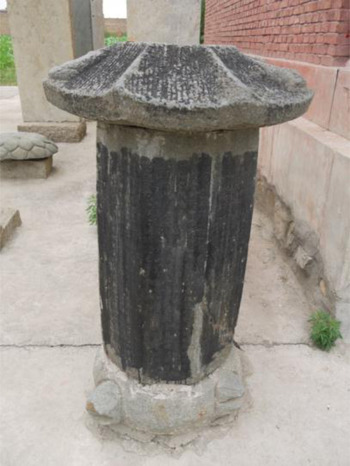
Zunsheng pillars were normally eight-sided stones, carved with Buddha images and with the text, in full or in excerpts, of the Buddhosnīsavijayadhāranī Sūtra (Foding Zunsheng tuoluoni jing 佛頂尊勝陀羅尼經; hereafter the Zunsheng Dhāranī Sutra). A popular Buddhist scripture since the Tang dynasty, this sutra had acquired a history, or rather a miracle story, of its own. According to local Mt. Wutai legends, an Indian monk named Buddha-pali (Fotuoboli 佛陀波利) had entered the Diamond Cave (Jingang ku 金剛窟) at Mt. Wutai, where the Bodhisattva Mañjuśrī instructed him to bring the Zunsheng Dhāranī Sutra from India to China. This scripture grew in fame and popularity throughout the empire in the mid-eighth century due to both its alleged power to assist the living and the dead as well as its ties to the growing cult of Mt. Wutai.Footnote 60 Because this sutra emphasized that merit could be gained for the deceased by erecting Buddhist Dhāranī pillars, the custom soon arose of inscribing these stone pillars with all or part of the Zunsheng Dhāranī sutra as an act of Buddhist devotion for a deceased ancestor. Over time, pious Buddhists started to install Zunsheng pillars near their ancestors’ tombs or within ancestral graveyards and to inscribe epitaphs on them; such Zunsheng pillars were naturally called tomb pillars (fenchuang 墳幢 or muchuang 墓幢) (see Figure 2). Although Zunsheng tomb pillars gradually disappeared in south China after the Song dynasty, they remained popular throughout the north.Footnote 61
A Zunsheng tomb pillar installed in 1186, now at Temple of Worshipping the Light (Chongming si 崇明寺) in Wen Village of Xinzhou, Shanxi (Photo by author, July 5, 2014)

Within Dingxiang county, according to Niu Chengxiu, these inscribed tomb pillars were installed in increasing numbers during the Jin and Yuan periods. So many of their inscriptions survive that Niu was able to include only a portion of them in his collection of Zunsheng inscriptions. In a brief introduction to his compilation Niu explained the practice and its donors’ intentions:
Most Zunsheng pillars date from the Jin and Yuan periods, a few from the Song dynasty. Tomb pillars of the Jin and Yuan periods were often installed in Buddhist temples and Daoist shrines. These pillars were inscribed with the Zunsheng Dhāranī sutra followed by the personal names and surnames of the males and the surnames of the females in the three generations of the great-grandfather, the grandfather, and father and among their sons and grandsons. They wished to make use of this to implore for good fortune in the afterlife and to bring glory to the virtues of their ancestors. They were just like the steles carved with Buddhist images in the Six Dynasties.Footnote 62
The laity in Shanxi may have started to list the names of their family members on Buddhist steles from as early as the sixth century.Footnote 63 Yet, the names mentioned on their early Buddhist steles were limited mostly to members of the deceased's immediate family.Footnote 64 Zunsheng tomb pillars from the Jin and Yuan were different. Regardless of whether they commemorated the laity or the sangha (and often we have seen the distinction was hard to make), Zunsheng pillars over time began to have more complete genealogies of local lineages. For instance, the 1186 stele in Figure 2 records the genealogy of a local kinship group that spans five generations beginning with the generation of the great-great-grandfather. Although they clearly were not the multi-volume compilations of later centuries, these genealogical charts during the Yuan grew longer and, significantly, included both men and women.
As early as the late twelfth century, some Zunsheng pillars began to bear such genealogies in diagrams, as in “A Record of the Chart of the Descent Group and Its Branches” (Zongpai tuji 宗派圖記) or “The Lineage and Its Multitudinous Branches” (Zhongfang zongzu 衆房宗族). For example, at the bottom of a tomb pillar erected for a man from a Zhou 周 lineage in Nanwang Village, a genealogical chart of his lineage was inscribed in 1177 with a note explaining that the chart was made to document the relationship among branches of the Zhou lineage, many of which had migrated elsewhere. This tomb pillar was installed in the village's Temple for Making the Kingdom Prosper (Xingguo si 興國寺), a subordinate temple of the Cloister of the True Countenance at Mt. Wutai.Footnote 65 For a similar reason, another Zunsheng pillar, erected in 1177 in the Buddhist Cloister of Great Peace (Taiping yuan 太平院) at Kou Village, bears a list of men and women from all branches of a Zhi 智 lineage there.Footnote 66
Large stone steles, as Iiyama Tomoyasu's research has amply demonstrated, were a popular medium for recording genealogies in north China during the Jin and Yuan periods. But a social distinction arose between families who used stone Zunsheng pillars and those who used stone steles. Ordinary families without official status (like two commoner branches of the Zhang lineage at Anheng Village) mostly employed Zunsheng pillars, while families with official status often used stone steles. All but one of the twenty-three Jin and Yuan tomb pillars for the laity in Niu Chengxiu's collection were erected for commoners.Footnote 67 Similarly, twelve of Niu's thirteen tomb steles for the laity were for officials, scholars, or their family members. The one exception was a stele for a chaste woman. Iiyama's accompanying study of steles in an ancestral graveyard (xianying bei 先塋碑) in north China in this period confirms that stone steles were commonly used by Yuan official and scholarly families to inscribe genealogical charts.Footnote 68 Yet in north China the ready availability of stone materials enabled ordinary Chinese families to make Zunsheng pillars, on which they inscribed epitaphs and genealogies to serve as their family's permanent records.
The widespread use of these Zunsheng pillars in Shanxi is confirmed in a roughly contemporary manual of burial rites, entitled The Burial Scripture of Mausoleums of the Great Han (Da Han yuanling mizang jing 大漢原陵秘葬經). As analyzed by Xu Pingfang and confirmed by his archeological discoveries, this burial text was composed by the geomancer Zhang Jingwen 張景文 in Shanxi during the Jin and Yuan periods. It documents the burial rites and customs popular then among commoners and officials in the Shanxi region.Footnote 69 In particular, it specifies the regulations for commoners’ use of Zunsheng tomb pillars:
For officials ranking lower than 5b and for commoners, they should install stone pillars in front of their ancestral tombs. On top of these pillars, the Dhāranī sutra should be carved, while the name of the ancestors as well as their birth and death dates should be inscribed on the pillar. A stone pillar should be four meters (twelve chi 尺) tall if it shows a year of twelve months, or three meters (nine chi) if it shows nine-hall diagrams.Footnote 70 If commoners install a stone pillar, the dead will rise to Heaven and the living will have propitious lives and great wealth and title. … Installing the pillar two steps away from the tomb is auspicious.Footnote 71
Some surviving Jin and Yuan tomb pillars in Dingxiang, as prescribed here, contain an inscription with names as well as birth and death dates. Other tomb pillars include epitaphs and genealogical charts.Footnote 72 Unfortunately, Niu Chengxiu's transcriptions do not reproduce the charts, and today we have no way to learn how they looked.
In the Yuan period Zunsheng tomb pillars for Buddhist monks began to include biographical records of their lay family's members. Whereas earlier writings about Buddhist monks rarely mentioned members of the monk's natal family, a 1297 Zunsheng pillar inscription entitled “A Longevity Pagoda for Master An, a Lecturer at the Cloister of Abundant Merit of Mt. Wutai” gave biographies of not just Master An but also his parents, brothers, and nephews (their marital status is indicated as well).Footnote 73 In its echoes of what we have seen for the monk Zhiyu and in the prominence of his and his ancestors’ biographies on the steles he erected in Anheng Village, Master An's stele confirms the practice of turning Buddhist monuments, such as steles and Zunsheng pillars, into media for genealogy writing. According to its tomb pillar inscription, Master An's younger brother and nephew like him became Buddhist monks. This nephew followed him into the Cloister of Abundant Merit. Although it was a subordinate temple of the Cloister of the True Countenance on Mt. Wutai, the Cloister of Abundant Merit was located in Master An's native village of Jizhuang. Along with it was a Living Pagoda established by his family and lay relations living there. In addition to affirming ties among themselves, these kinsmen erected these monuments in honor of Master An because he alone of their ancestors had had connections with powerful secular and religious figures: he had received a decree and an honorary religious title from a Mongol prince and had been associated with Master Fazhao, the head of the Buddhist Supervisory Office at Mt. Wutai and Five Circuits.
Master An's case was far from unusual, as dense temple networks in northern Shanxi villages certainly strengthened bonds between local kinship groups and their Buddhist temples. Thus, while many of these villages had someone born there (like Master An) stay on and serve as a monk in their village temple, other villages would invite a neighboring village's monk to head their village temple.Footnote 74 These network ties could also operate hierarchically, either when a monk would actively dispatch his disciples to temples in other villages or when village temples were integrated as subordinate temples into a larger monastic network based at a Mt. Wutai establishment like the Cloister of the True Countenance. If Monk Zhiyu's case tells us of the ways in which high-ranking Buddhist officials at Mt. Wutai interacted with their lay families, cases like Master An's demonstrate how monks at the bottom of the Mt. Wutai Buddhist order interacted with more humble kinship groups.
In addition, the location of the Zunsheng pillars often underlines the closeness of these ties between the local laity and the local sangha. Although The Scripture of Mausoleums of the Great Han recommended that tomb pillars for ordinary people be established near their tombs, many Jin and Yuan dynasty Zunsheng tomb pillars for the laity were installed, as Niu Chengxiu noticed, in the grounds of Buddhist monasteries and Daoist abbeys. Of the thirty-six tomb pillars and tomb steles covered by Niu's survey, fourteen were erected in Buddhist monasteries and Daoist abbeys, and all of them were pillars. While most of these pillars were carved with Buddha images and the Zunsheng Dhāranī Sutra or passages from it, just one example was carved with images of Daoist deities and Daoist texts.Footnote 75
Tomb pillars for the laity were installed in these religious establishments sometimes during their construction and sometimes later. They were placed there, out of respect for the monks who were often thought to have made them and for the power their Zunsheng Dhāranī Sutra texts and Buddha images were thought to have for repelling misfortune and attracting good fortune.Footnote 76 Thus, when placed inside a temple, the pillars were more likely to be preserved by the temple than if placed outside it, especially after the supporting family had broken up and dispersed.Footnote 77 Invasions, emigrations, abandonment of graveyards, and fragmentation of kinship groups, all fed a persistent instability in the villages of north China and especially northern Shanxi from the twelfth to fourteenth centuries, making descendants and books often less reliable transmitters of genealogical information than temples and their stone steles and Zunsheng pillars.Footnote 78 Similar ingenuity and flexibility born from hardship and frustration are evident in the family heads’ creative use of Buddhist chapels to transmit both their Buddhist beliefs and their families’ genealogical information in the turbulent world of Shanxi during the thirteenth and fourteenth centuries.
Buddhist Chapels as Family Shrines
In the Yuan period some Dingxiang families built private Buddhist chapels. Containing statues of Buddhist deities but bereft of monks, these small chapels provided a ritual space for the worship of more than Buddhist deities. They also served as ancestral halls with rites of worship for the chapel owners’ ancestors. These families were usually not politically powerful, but they had enough wealth or rose high enough in village politics as a government appointee to mark them off from the ordinary commoner household. In some cases like the Guanyin Chapel 觀音堂 of the rich Xing family of Nanwang Village in Dingxiang, they built these chapels to show off their wealth;Footnote 79 in other cases they sought to demonstrate their rise in their world, as when the head of the Yu family, having been appointed a community head (shezhang 社長) by the local government, decided to have a Guanyin Chapel built at the gate to his house.Footnote 80 Construction halted at his death. But it was to revive at the century's end, when his son, having received a government appointment as head carpenter of Xinzhou prefecture, helped in temple construction at Mr. Wutai in 1299 and thereafter saw to the completion of his father's dream chapel. Humble as these minor appointments may strike the sinologist normally concerned only with markers of elite status such as examination degrees and official titles, they actually conferred honor and face on ordinary village families like the Yus. They distinguished them from other households in a social landscape blessed with few degree holders and gentry families.
In all these instances the Buddhist chapel was used to bring kinsmen together to perform ancestral worship and thereby strengthen their kinship ties. For instance, the Yus, having seen many of their members move elsewhere in the county during the second quarter of the thirteenth century, viewed the revived construction of their Buddhist chapel in the late fourteenth century as an opportunity to reconnect with long-lost kinsmen. And, as in this case, if the reconnection led to donations from long-absent kinsmen for the building of the Guanyin Chapel, and if some generous kinsmen had an even higher status to share (two Yu donors held the post of battalion commander [qianhu 千戶]), so much the better for the Yus back in the ancestral village.
When used as a site of ancestral worship, the Buddhist chapel was naturally where family members also made sacrificial offerings to their ancestors. It then acquired a range of other kinship-affiliated functions not usually associated with Buddhist chapels (and even ancestral shrines [citang 祠堂]) in south China. For instance, a certain Li Shirong in 1310 had a Guanyin Chapel built in the Dingxiang village of Dongli in 1310. His great-grandfather Li Zhi had raised his family in the world when, having shrewdly surrendered to the invading Mongol army, he ended up being rewarded with a military position as Army Supervisor (jianjun 監軍). Three generations on, when the Lis had become one of the “great lineages (juzu 巨族)” of Dingxiang, Li Shirong wanted to confirm that family success as well as make annual sacrifices to his great-grandfather.Footnote 81 In other words, the Guanyin Chapel was intended to serve the Lis also as the site of their ancestral offerings and worship rituals.
More interestingly, Li Shirong used a stele at the Guanyin Chapel to record his lineage's genealogy. The author of the record about the Chapel reports:
Li Shirong often said that it would be very shameful if within a few generations lineage members became confused about the status of superiors and inferiors, disturbed the [differences of] rank and generation, treated each other no differently from strangers, showed no sympathy to each other in times of hunger and cold, and did not save each other from disasters and troubles. In doing so, they would have greatly neglected the moral duty of being close to one's relations. One day, having been introduced by Li Yanming, Li Shirong told me, “I wish to install a small stone in front of the Guanyin Chapel. Its front side will be inscribed with words about Guanyin's virtues and the backside with the genealogy [of the Li lineage]. It will make the worship of Guanyin among later generations stronger over time and clarify the degree of kinship proximity among the Li lineage's members.”Footnote 82
Li Shirong is here referring to a new form of genealogy—far longer and more comprehensive than that on the Zunsheng pillars—and a relatively new type of kinship organization that sprang up in north China during the thirteenth and fourteenth centuries. As Iiyama Tomoyasu points out in his accompanying article in this issue, some Dingxiang natives who surrendered and fought for the Mongols drew upon their personal connections with Mongol nobles to form a new type of local elite. These families often installed steles in ancestral graveyards to record genealogies and used these graveyards for collective ancestral worship by their kinship group. Li Shirong's family had become such an elite family thanks to Li Zhi's achievement. Yet, in Li Shirong's generation no Li had obtained an official position, and the family appears to have fallen somewhat in the world. And so, instead of a mere genealogical stele in an ancestral graveyard, Li Shirong put up a Guanyin Chapel in his village to forestall a weakening of kinship ties among his fellow Lis. In short, Buddhist monuments, be they a Zunsheng tomb pillar or a Buddhist chapel, provided ways for a family, on the rise or in decline, to record and preserve its ancestors’ names. They also might mark an attempt to halt a decline and begin a revival of its descendants’ collective fortune.
The significance of these private Buddhist chapels in the social history of north China becomes clear when they are compared with the slightly earlier institutions of the merit cloister (gongde yuan 功德院) and tomb temple (fen si 墳寺) of the Song dynasty, which were also sponsored by wealthy families as private temples for the cult of their ancestors. The merit cloisters first arose out of the wish of high-ranking officials of the Northern Song (960–1127) and their families to preserve their ancestral tombs and property, especially when they had to spend most of their life in government assignments far from home. Thus, merit cloisters initially came with an official stamp of approval, for a practice associated with high court officials. Although monks were invited to reside in and care for these merit cloisters, these Northern Song families usually retained control over them as their private property. During the Southern Song and Yuan the practice spread among wealthy literati families in the south. Most merit cloisters, which were better known as tomb chapels (fen'an 墳庵), no longer received an official stamp of approval, particularly in the Yuan dynasty when the government did not carry on the Song practice of acknowledging the opening and operation of merit cloisters.Footnote 83 Also, large lineages like the Fangs in the coastal Fujian county of Putian apparently built a gravesite temple that contained both a Buddha hall for worshipping Buddhism and an ancestral hall for performing their lineage rituals.Footnote 84
A private Buddhist chapel in Dingxiang likewise was a place for making sacrificial offerings to ancestors, but it differed from merit cloisters in at least three important ways. Above all, it was not an independent Buddhist institution; no monks or nuns resided there. Secondly, it was attached—literally in most known cases—not to a graveyard for the dead but to a household for the living. All records of these Guanyin chapels state that they were places where family members made daily incense offerings to the Bodhisattva Guanyin (whose worship would seem to have become a vital part of their everyday life). In addition, almost no land was attached to private chapels in Dingxiang, so they did not function as tax shelters, as merit cloisters often had in the Song. No evidence suggests that a separate ancestral shrine coexisted here with a private Buddhist chapel. The chapel itself was the ancestral hall for collective ancestral worship.
In sum, private Buddhist chapels played a significant role in the development of kinship relations and especially relatively large kinship groups in Dingxiang and thus in the fostering of a distinctive marriage of religious and secular interests along the lines already discussed for Zhiyu and his family. Zhiyu's decision to build a private Buddhist chapel and to install memorial steles for two monks, his father and his teacher, inside the chapel represents a convergence of apparent opposites, undertaken for the benefit of a family. Furthermore, for Zhiyu's family as well as for many others in Diangxiang county the ability to navigate the perils and uncertainties of Mongol rule and improve their fortunes depended almost entirely on their members’ ability to gain government appointments or personal connections to powerful people, especially the Mongol nobles. This political and social environment encouraged many Chinese, especially in families that never or no longer had official status, to take a step that in the Northern Song they would not have seriously contemplated: to become a Buddhist monk. For Zhiyu and his contemporaries, lay as well as clerical, the seemingly contradictory commitments described at the beginning of this article, of a monk's placement of genealogical steles in a Buddhist chapel that also served as his natal family's hall of ancestral worship, were neither unusual nor unreasonable. Instead, as I hope is now clear, they made eminent sense.
CONCLUSION
In this article I have argued a set of ideas about Mongol rule in north China and especially about the role of highly placed Buddhist monks and institutions in their regime. Firstly, Mongol rule caused significant changes in the making and the composition of the social elite of north China. While titles and positions in the civil bureaucracy continued to signify elite political status in Yuan China, the routes to this status and power changed greatly from Song and even Jin times. Examination degrees, once the Mongols suspended the civil service examinations, no longer functioned as the key marker of elite legal and social status. Instead, the Yuan had multiple power centers, such as the Buddhist bureaucracy examined in this article and the princely appanages and bureaus for specialist households introduced in Iiyama's article in this issue. Virtually any position in the government or government-related agencies could conceivably qualify its holder for admission to either the national, regional, county, or village elite. Even a village monk (or armorer), so long as he received an official appointment, could see his social position and status transformed overnight from ordinary to distinguished. Of course, Buddhist monks did not supplant Confucian scholar-officials in running the empire. But the Mongol rulers favored Buddhism and even gave Buddhist monk-administrators considerable power and conferred on those monks in certain Buddhist offices a legal and social status akin to that enjoyed exclusively by civil or military officials in other dynasties. In this respect, the Buddhist ascendance under Mongol rule seriously challenged the Confucian official's traditional dominance in the Chinese bureaucracy as well as the social and legal order that had supported his privileged position in Chinese society.
Significant change also came to the social role of Buddhist monks under Mongol rule. Prominent monks in influential Buddhist orders based at Mt. Wutai were able to pursue family agendas in not just monastic but also government institutions. In a society where the educated and uneducated openly vied for official status and appointment, “huja'ur monks” like Zhiyu used their prestigious positions to open doors for family members wishing for a career as a Buddhist official or clerk in government agencies charged with handling Buddhist matters. Consequently, ties to these Mt. Wutai networks improved a monk's chance of achieving an official rank and office that—because often he was able to form a family, presumably before ordination—his heirs could inherit. As monastic lineages and lay kinship groups overlapped in the thirteenth and fourteenth centuries, Buddhism was enveloped by the kinship system and practices of northern Shanxi, particularly when such jobs were often hereditary.
Understandably, many people in Yuan China came to regard a position and rank in Buddhist administration as a way to attain power, wealth, and prestige for themselves and their families. Some Buddhist monks, for their part, justified their improved status on secular grounds. They saw themselves, quite likely as their natal families would have wished, as filial sons who raised their family in the world by gaining powerful positions in Buddhist networks established and authorized by the Yuan government. This concept of the Buddhist monk as a filial son differed considerably from traditional Buddhist understandings of filial piety. In place of emphasizing the monk's salvation of his ancestors in the afterlife, the filial monk was now seen to improve their material and physical well-being in their lifetime. In addition, this new Buddhist understanding of filial piety continued to legitimize close ties between temples and families through the installation of memorial steles, Zunsheng Dhāranī pillars, and private Buddhist chapels to consolidate their kinship ties. Buddhism in the Yuan dynasty thus played a critical role in the long-term development of the kinship system of north China.
Finally, this Shanxi pattern of kinship group development differed noticeably from the well-studied Neo-Confucian models of kinship that are often assumed to have dominated Chinese society since the twelfth century.Footnote 85 Starting from the Northern Song, Neo-Confucians had advocated the renewal of large kinship organizations associated with ancient China and sought to have these organizations adapted and adopted by a far greater share of the Chinese population than ever before. Lineage genealogies, ancestral halls, and family rituals all became hallmarks of this alternative model for the family that “largely ignored its relations to the state and religion.”Footnote 86 The predominance of this Neo-Confucian model in modern scholarship on the late imperial Chinese family has had two unfortunate consequences: a tendency to underestimate the continuous role of religion in the development of Chinese family and kinship systems, and a tendency to overlook regions like north China, where lineage organizations set up and operating on strict Neo-Confucian lines were far fewer than in the south. As this article demonstrates, religion, in particular Buddhist institutions and practices, played a vital role, greater than ever before, in consolidating kinship institutions and shaping their activities in north China from the twelfth to the fourteenth centuries.