1. Introduction
Studies across the lifespan have shown that bilingualism positively impacts performance on tasks tapping into multiple aspects of executive functions, particularly inhibitory control (children: Sorge, Toplak & Bialystok, Reference Sorge, Toplak and Bialystok2017; young adults: Costa, Hernández & Sebastián-Gallés, Reference Costa, Hernández and Sebastián-Gallés2008; and older adults: Bialystok, Craik & Luk, Reference Bialystok, Craik and Luk2008). The Inhibitory Control (IC) model (Green, Reference Green1998) and the Bilingual Interactive Activation Model (BIA+) (Dijkstra & van Heuven, Reference Dijkstra and van Heuven2002), further refined in the Adaptive Control Hypothesis (Green & Abutalebi, Reference Green and Abutalebi2013), suggest that bilinguals’ two languages are simultaneously activated (Blumenfeld & Marian, Reference Blumenfeld and Marian2013; Chen, Bobb, Hoshino & Marian, Reference Chen, Bobb, Hoshino and Marian2017; Thierry & Wu, Reference Thierry and Wu2007); thus, bilinguals have to select the target language and inhibit the non-target language, thereby posing increased cognitive demands on cognitive control (e.g., inhibitory control) for language processing (Bialystok, Craik & Luk, Reference Bialystok, Craik and Luk2012; Kroll, Dussias, Bice & Perrotti, Reference Kroll, Dussias, Bice and Perrotti2015). On the other hand, not all studies produced comparable results (Paap & Greenberg, Reference Paap and Greenberg2013; Paap, Johnson & Sawi, Reference Paap, Johnson and Sawi2014), resulting in a debate as to whether bilingual experience benefits in terms of the nature and extent of possible bilingualism effects (Bak, Reference Bak2016; Bialystok, Reference Bialystok2017, Reference Bialystok2020; Lehtonen et al., Reference Lehtonen, Soveri, Laine, Järvenpää, de Bruin and Antfolk2018; Kroll & Bialystok, Reference Kroll and Bialystok2013).
This conflicting evidence could be due to a variety of interacting variables, such as the definition of bilingualism, the type of selected tasks, and the populations under study (Cox et al., Reference Cox, Bak, Allerhand, Redmond, Starr, Deary and MacPherson2016). In terms of selected tasks, researchers have argued that the effects of bilingualism on executive control are dependent upon specific task conditions. Firstly, the demand levels of the selected tasks can vary. It appears that monolingual-bilingual group differences tend to emerge under sufficiently high cognitive control demands, such as a high task-demanding condition (Bialystok, Reference Bialystok2006), a high-monitoring condition in the Flanker task (i.e., 75% congruent vs. 25% incongruent trials; Costa, Hernández, Costa-Faidella & Sebastián-Gallés, Reference Costa, Hernández, Costa-Faidella and Sebastián-Gallés2009), or high working memory demands (Jiao, Liu, Wang & Chen, Reference Jiao, Liu, Wang and Chen2019). Secondly, the bilingual effects might depend on the different types of inhibition involved in different tasks; that is, interference suppression (i.e., refers to the capacity to detect and filter out irrelevant information in the environment) and response inhibition (i.e., refers to the capacity to inhibit inappropriate, but prepotent, response tendencies) (Bunge, Dudukovic, Thomason, Vaidya & Gabrieli, Reference Bunge, Dudukovic, Thomason, Vaidya and Gabrieli2002). Previous studies have found that bilingualism mainly influences interference suppression, but not response inhibition (Bialystok & Viswanathan, Reference Bialystok and Viswanathan2009; Esposito, Baker-Ward & Mueller, Reference Esposito, Baker-Ward and Mueller2013; Martin-Rhee & Bialystok, Reference Martin-Rhee and Bialystok2008). Luk, Anderson, Craik, Grady, and Bialystok (Reference Luk, Anderson, Craik, Grady and Bialystok2010), for example, reported distinct neural correlates for the two types of inhibition in bilinguals. Specifically, they used partial least squares (PLS) to identify monolinguals and bilinguals’ brain regions where activity covaried across flanker incongruent and non-go trials, representing interference suppression and response inhibition, respectively. The results showed that monolinguals and bilinguals activated similar regions for response inhibition but not for interference suppression.
However, even within interference suppression, the differences between monolinguals and bilinguals have not been consistently replicated, especially in young adult population. While some studies report better performance by bilinguals (Costa et al., Reference Costa, Hernández, Costa-Faidella and Sebastián-Gallés2009; Garraffa, Obregon, O'Rourke & Sorace, Reference Garraffa, Obregon, O'Rourke and Sorace2020; Marzecová, Asanowicz, Krivá & Wodniecka, Reference Marzecová, Asanowicz, Krivá and Wodniecka2013; Yow & Li, Reference Yow and Li2015), a substantial number of studies report no group differences (Kousaie & Phillips, Reference Kousaie and Phillips2012; Paap & Greenberg, Reference Paap and Greenberg2013; Samuel, Roehr-Brackin, Pak & Kim, Reference Samuel, Roehr-Brackin, Pak and Kim2018). One possibility is that the tasks typically used in bilingualism research (e.g., the Flanker, Stroop, and Simon tasks) are not sufficiently sensitive to detect group differences in performance for young adults, given that the null results tend to be observed in young adult population, who may be at their peak cognitive level and show ceiling performance (Grundy, Reference Grundy2020; Paap & Greenberg, Reference Paap and Greenberg2013). An alternative possibility could be that the task performance might vary depending on the subcomponents within interference suppression; that is, Stimulus-Stimulus (S-S) inhibition vs. Stimulus-Response (S-R) inhibition (Hilchey & Klein, Reference Hilchey and Klein2011). Blumenfeld and Marian (Reference Blumenfeld and Marian2014), for instance, conducted two experiments comparing monolinguals to bilinguals on S-S and S-R conflict type of tasks and found that bilinguals showed more efficient S-S performance than S-R performance. They explained that S-S inhibition was more likely to be recruited for bilingual control as a result of parallel language activations (Blumenfeld & Marian, Reference Blumenfeld and Marian2013) and competitions during language comprehension and production processes. On the other hand, S-R inhibition might be limited to production context where both languages remain active until a response is given. This could partly explain the lack of consistency across studies using different interference tasks. The current study aimed to investigate the role of conflict types (i.e., S-S and S-R conflict) in modulating interference suppression in relation to the bilingual effects in young adult bilinguals while accounting for the theoretical and methodological aspects of previous research (Bak, Reference Bak2016; Bialystok, Reference Bialystok2020).
1.1. The Stimulus-Stimulus and Stimulus-Response type of interference tasks
Interference tasks, such as the Flanker task/Attention Network Task (ANT), Simon task, and variations of Stroop tasks (e.g., colour-word vs. number version) have been frequently used in bilingualism research, in which bilinguals were reported to outperform monolinguals (Costa et al., Reference Costa, Hernández and Sebastián-Gallés2008; Costa et al., Reference Costa, Hernández, Costa-Faidella and Sebastián-Gallés2009; Bialystok, Craik, Klein & Viswanathan, Reference Bialystok, Craik, Klein and Viswanathan2004; Bialystok et al., Reference Bialystok, Craik and Luk2008; also see Paap, Anders-Jefferson, Zimiga, Mason & Mikulinsky, Reference Paap, Anders-Jefferson, Zimiga, Mason and Mikulinsky2020 for counterarguments). Although all the tasks are assumed to measure the same executive control component (i.e., interference suppression), they may require different cognitive processes, as reflected in the different brain activation patterns (Hübner & Töbel, Reference Hübner and Töbel2019; Liu, Banich, Jacobson & Tanabe, Reference Liu, Banich, Jacobson and Tanabe2004; Kousaie & Phillips, Reference Kousaie and Phillips2012; Pratte, Rouder, Morey & Feng, Reference Pratte, Rouder, Morey and Feng2010), as well as different sources of conflicts; that is, S-S conflict vs. S-R conflict (Hilchey & Klein, Reference Hilchey and Klein2011; Paap, Anders-Jefferson, Mikulinsky, Masuda & Mason, Reference Paap, Anders-Jefferson, Mikulinsky, Masuda and Mason2019).
Three non-linguistic interference tasks associated with different S-S and S-R conflict resolution were included in the current study: the ANT (Costa et al., Reference Costa, Hernández and Sebastián-Gallés2008), the Number Stroop task (adapted from Hernández, Costa, Fuentes, Vivas & Sebastián-Gallés, Reference Hernández, Costa, Fuentes, Vivas and Sebastián-Gallés2010), and the Arrow Simon task (details of the three tasks were provided in the methodology section). Specifically, in the incongruent trials, the conflict resolutions were varied across the three tasks, reflecting different conflict sources (see Figure 1). While the S-R conflicts stem from competition between the task-relevant stimuli (Sr), the task-irrelevant stimuli (Si), and response tendencies (R), the S-S conflicts stem from the same stimulus category (i.e., Sr –Si)(Paap et al., Reference Paap, Anders-Jefferson, Zimiga, Mason and Mikulinsky2020; Tiego, Testa, Bellgrove, Pantelis & Whittle, Reference Tiego, Testa, Bellgrove, Pantelis and Whittle2018).
Schematic representation of the three RT-based interference tasks: a) ANT; b) the Number Stroop task; c) the Simon task

In the ANT, the pointing direction of the central arrow (Sr) is conflicted with that of the other arrows (Si)(e.g., →→←→→), conforming a S-S conflict. In the Number Stroop task, the correct response (i.e., counting the number of digits; Sr) is conflicted with the numerical value of the digits (e.g., 222; Si) that triggers the response tendency (R), reflecting a S-R conflict. The Number Stroop task could arguably reflect a S-S conflict, see Blumenfeld and Marian (Reference Blumenfeld and Marian2014). In the classic Colour-Word Stroop task, there are two stimulus dimensions: the colour of the word's ink (e.g., red) and the meaning of the word (e.g., green). In a study conducted by Yow and Li (Reference Yow and Li2015), for example, participants were instructed to respond according to the colour of the word by pressing a designated key on the keyboard (i.e., D, F, G, and H for red, yellow, green, and blue, respectively). There was no overlap between required response and key pressing tendency. Thus, the Colour-Word Stroop task was assumed to reflect a S-S conflict. In contrast, in the Number Stroop task, participants were instructed to count the number of digits by pressing corresponding 1, 2, or 3 keys on the keyboard. Given the natural tendency to react toward the value of digits, there was an overlap between required response and key pressing tendency; thus, reflecting a S-R conflict. Similarly, in the Arrow Simon task, the correct response (i.e., pointing direction of the arrow; Sr) is conflicted with the location of the arrow (Si) that triggers the response tendency (R), and thus conforms S-R type of conflict. More specifically, the Arrow Simon task used in the current study was a combination of Spatial and Vertical Stroop task with different response instructions (see more details in the methodology section). The Spatial Stroop Task, in which participants identified the direction of an arrow (i.e., left and right) while ignoring its location (i.e., left and right) by pressing Left and Right key, could arguably reflect different conflict types: S-S conflict (Blumenfeld & Marian, Reference Blumenfeld and Marian2014) and S-R conflict (Hilchey & Klein, Reference Hilchey and Klein2011; Paap et al., Reference Paap, Anders-Jefferson, Zimiga, Mason and Mikulinsky2020). The Vertical Stroop task, in which participants respond to the direction of an arrow (i.e., up and down) while ignoring its location (i.e., up and down) by pressing Left and Right key, was categorized as measuring the S-S conflict (Paap et al., Reference Paap, Anders-Jefferson, Zimiga, Mason and Mikulinsky2020). In the current study, there was overlap between required response and key pressing tendency in the Arrow Simon task; thus, reflecting a S-R conflict.
1.2. The role of language proficiency in bilingualism
Language proficiency is one of the core aspects of bilingualism (Mishra, Reference Mishra2015). Given that the level of language proficiency may dynamically change with specific learning experiences (e.g., continuous language learning and daily language use), it is not clear when and how improvements in L2 proficiency might contribute to a change in executive control in bilingualism. Previous studies have shown that higher L2 proficiency predicts better executive control in bilinguals of various languages, including attentional monitoring abilities (Singh & Mishra, Reference Singh and Mishra2015), reactive inhibition (Khare, Verma, Kar, Srinivasan & Brysbaert, Reference Khare, Verma, Kar, Srinivasan and Brysbaert2013), and endogenous disengagement of attention in Hindi–English adults (Mishra, Hilchey, Singh & Klein, Reference Mishra, Hilchey, Singh and Klein2012), conflict monitoring in Chinese–English adults (Xie & Pisano, Reference Xie and Pisano2018), and auditory inhibition and switching in English-Spanish adults (Vega-Mendoza, West, Sorace & Bak, Reference Vega-Mendoza, West, Sorace and Bak2015). Some studies conducted with children also support this association. For instance, higher L2 proficiency was reported to be correlated with better performance in inhibition and shifting abilities in English-Hebrew children (Iluz-Cohen & Armon-Lotem, Reference Iluz-Cohen and Armon-Lotem2013), response inhibition in Chinese–English children (Chen, Zhou, Uchikoshi & Bunge, Reference Chen, Zhou, Uchikoshi and Bunge2014), and in conflict resolution and working memory capacity, but not in goal maintenance or task-set switching in Cantonese–English children (Tse & Altarriba, Reference Tse and Altarriba2014).
Other studies have shown no effects of language proficiency on executive control in bilinguals (Dong & Xie, Reference Dong and Xie2014; Rosselli, Ardila, Lalwani & Vélez-Uribe, Reference Rosselli, Ardila, Lalwani and Vélez-Uribe2016; Verreyt, Woumans, Vandelanotte, Szmalec & Duyck, Reference Verreyt, Woumans, Vandelanotte, Szmalec and Duyck2016). For example, Dong and Xie (Reference Dong and Xie2014) reported no effects of language proficiency on either the inhibition or mental set shifting, but the language interpreting experience was strongly associated with better performance in mental set shifting. The authors explained that the small proficiency gap between high and low-proficiency level might be responsible for the inconsistent findings with regard to the effects associated with language proficiency. Rosselli et al. (Reference Rosselli, Ardila, Lalwani and Vélez-Uribe2016) compared three groups of participants (i.e., balanced bilinguals vs. unbalanced bilinguals vs. monolinguals) performing both verbal and nonverbal executive tasks. The results demonstrated that nonverbal intelligence rather than language proficiency or bilingualism was a significant predictor of performance on these tasks. Similarly, Verreyt et al. (Reference Verreyt, Woumans, Vandelanotte, Szmalec and Duyck2016) compared three groups of bilinguals differing in language proficiency and switching experience. They found that language switching patterns, rather than proficiency, modulated executive control.
It has been suggested that a strong L2 (i.e., higher proficiency) is assumed to elicit a stronger interference on the L1 as compared to a weak L2 (i.e., lower proficiency), leading to increased cognitive demands (e.g., inhibitory control; Green, Reference Green1998; Hui, Yuan, Fong & Wang, Reference Hui, Yuan, Fong and Wang2020; Lehtonen et al., Reference Lehtonen, Soveri, Laine, Järvenpää, de Bruin and Antfolk2018). Given that bilingualism is a continuous and dynamic process, it could be possible that monolingual-bilingual differences could only be observed when bilinguals reach certain level of L2 proficiency (Vega-Mendoza et al., Reference Vega-Mendoza, West, Sorace and Bak2015). The current study aimed at investigating the extent to which level of proficiency might play a role in modulating executive control.
1.3. The current study
Previous research has shown group differences between monolinguals and bilinguals on a variety of tasks that have been described as tapping into executive functioning, but the precise mechanism for the cognitive effects associated with bilingualism is unknown and the executive functions are heterogeneous without a clear definition (Chung-Fat-Yim, Sorge & Bialystok, Reference Chung-Fat-Yim, Sorge and Bialystok2017). The present study aimed to investigate the potential subcomponents (i.e., S-S vs. S-R inhibition) within interference suppression in relation to the bilingual effect while taking into account relevant theoretical and methodological issues, such as the role of language proficiency in modulating these effects.
The S-S and S-R inhibition were indexed by three different non-linguistic interference tasks: while the ANT taps into S-S conflicts, the Stroop and the Simon tasks tap into S-R conflicts. Following Blumenfeld and Marian (Reference Blumenfeld and Marian2014), we predicted that group differences between monolinguals and bilinguals (e.g., smaller conflict effects by bilinguals) would be observed in the ANT rather than the Stroop and Simon tasks.
The effects of language proficiency on executive control were examined by comparing performance on these abovementioned cognitive tasks of high and low-proficient bilinguals to monolinguals. We predicted that monolingual-bilingual differences would be more likely to be observed between high-proficient bilinguals and monolinguals, while low-proficient bilinguals took an intermediate position (Hui et al., Reference Hui, Yuan, Fong and Wang2020; Vega-Mendoza et al., Reference Vega-Mendoza, West, Sorace and Bak2015).
The selection of tasks takes into account the fact that the process of language learning involves multiple fundamental and interactive components, such as visual (i.e., reading and writing) and auditory ones (i.e., speaking and listening). While most of previous studies have been focusing on the visual domain, an increasing number of studies have demonstrated effects associated with bilingual experience in the auditory domain (Bak, Long, Vega-Mendoza & Sorace, Reference Bak, Long, Vega-Mendoza and Sorace2016; Bak, Vega-Mendoza & Sorace, Reference Bak, Vega-Mendoza and Sorace2014; Garraffa et al., Reference Garraffa, Obregon, O'Rourke and Sorace2020; Ooi, Goh, Sorace & Bak, Reference Ooi, Goh, Sorace and Bak2018; Long, Vega-Mendoza, Rohde, Sorace & Bak, Reference Long, Vega-Mendoza, Rohde, Sorace and Bak2020; Vega-Mendoza et al., Reference Vega-Mendoza, West, Sorace and Bak2015). Hence, in addition to the visual domain (i.e., as measured by the three RT-based tasks), we adopted three Elevator subtests of the Test of Everyday Attention (TEA) from previous studies as a measure of executive control in the auditory domain (i.e., sustained attention, inhibitory control, and attentional switching). The combination of multiple tasks can avoid the task impurity problem (Miyake & Friedman, Reference Miyake and Friedman2012) and limitations of the use of a single indicator to measure a single aspect of cognitive functions (von Bastian et al., Reference von Bastian, Souza and Gade2016). It has been suggested that it would be difficult to establish whether the measured performance is a reflection of task-specific or ability-general effects (Shipstead, Redick & Engle, Reference Shipstead, Redick and Engle2012). Moreover, the use of these tasks can provide a more varied approach in assessing attentional control: the ANT, the Stroop task, and the Simon task are motivated by a theoretical framework of attentional control and commonly used in an experimental setting, whereas the TEA was designed to stimulate daily activities using a humanised approach (Ooi et al., Reference Ooi, Goh, Sorace and Bak2018).
2. Method
2.1. Participants
A total number of 111 University of Edinburgh students took part in this experiment. All were English native speakers. The participants were divided into three groups according to their second language (L2) proficiency: monolinguals (i.e., Mono group; n = 37), bilinguals with low proficiency (i.e., Bi-low group; n = 39), and bilinguals with relatively higher proficiency (i.e., Bi-high group; n = 35). As second language learning is a global communicative practice (Kramsch & Thorne, Reference Kramsch, Thorne, Block and Cameron2002), it is difficult to recruit pure “monolinguals” with no exposure to any other language than their mother tongue. Hence, the criterion for defining monolinguals and bilinguals was consistent with previous studies; as will be explained in more detail below, monolinguals were defined as those who were not functionally fluent in any other language (Luk & Bialystok, Reference Luk and Bialystok2013; Vega-Mendoza et al., Reference Vega-Mendoza, West, Sorace and Bak2015).
Before attending the testing session, all participants were asked to self-report their overall L2 proficiency (the scale is 1-7 marked from “poor” to “excellent”) and the ability to hold a conversation in an L2Footnote 1. The grouping was based on the information collected from the background questionnaire that was adopted from a previous study (Ooi et al., Reference Ooi, Goh, Sorace and Bak2018; see details in Appendix S1). Self-reported language proficiency was rated using 4-point scales (i.e., 1-4, marked from “poor” to “excellent”), participants rated their speaking, understanding, reading and writing skills in every language they had learnt. Moreover, participants were required to report whether they had actively used their L2s. Given the small language scale, we divided participants into three groups based on their L2 proficiency and the experience of active use of L2: monolinguals were those who could not hold a conversation in L2 and had never actively used their L2s, the Bi-low group were those who used to actively use their L2 but could only hold a basic conversation in L2 at the time of testing (e.g., this could be due to their lesser exposure to and usage of their L2s in their later life), the Bi-high group were those who could hold a conversation in L2 and actively use their L2. We also used an alternative splitting approach following Grundy, Pavlenko, and Bialystok (Reference Grundy, Pavlenko and Bialystok2020): low and high-proficient bilingual groups were created by averaging bilinguals’ L2 proficiency and then doing a median split: participants whose L2 proficiency was below the median were assigned into the Bi-low group and the others were assigned into the Bi-high group. The two approaches to grouping high and low-proficient groups showed the same results.
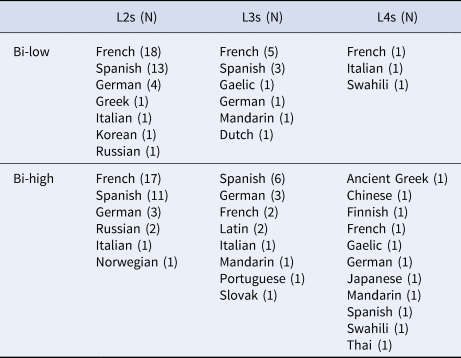
All bilinguals had learned an Indo-European language (e.g., French, German, or Spanish) as their main L2s. One participant in the Bi-low group had Korean as the main L2. Excluding and including this participant did not change the results, thus their results were included in the full set of data. The information of the bilingual participants’ other languages is presented in Table S1. Due to technical issues, some participants’ data was missing in some tasks, as follows: in ANT, one in the monolingual group; in the Number Stroop task, three in each of the three groups; and in the Simon task, five in the Bi-low group.
2.2. Background measures
Raven's Advanced Progressive Matrices (APM)
The APM (Raven & Foulds, Reference Raven and Foulds1962) was used as a control of nonverbal general intelligence. Consistent with a previous study (Ooi et al., Reference Ooi, Goh, Sorace and Bak2018), we adopted Set I (i.e., Item 5 or Item 7) as practice and Set II as the experimental test. The design of the Matrices is that the demand of the level gradually increases with the items. Participants were instructed to complete the matrices item by item in 10 minutes and were told that if they were having difficulty with a specific item, they could guess the answer and continue to the next one. They started with Item 1 and had to answer as many items as they could. The results were scored as the number of correct items for each participant.
Corsi Tapping Task (CTT)
The Corsi Tapping task (Wechsler Memory Scale-III, Wechsler, Reference Wechsler1997) was administered as a measure of working memory (forward and backward conditions; Luo, Luk & Bialystok, Reference Luo, Luk and Bialystok2010) and mental rotation (rotated condition; adapted from Keehner & Gathercole, Reference Keehner and Gathercole2007), in order to control fundamental cognitive abilities. This task was presented on a plastic whiteboard (27.5 cm × 21cm) with ten blue cube-shaped numbered blocks (3 cm × 3 cm; from 1 to 10). During the testing, the board was placed between the experimenter and the participant, and the numbers were only visible to the experimenter. In the forward condition, the experimenter tapped a sequence of blocks at a rate of approximately one second per block in a predetermined order and participants had to reproduce the tapping sequence with the same blocks and same order. In the backward condition, all the procedures were the same except that the participants had to reproduce the tapping in the reverse order. There were eight items in both the forward and backward conditions, varying from two 2-block to 9-block trials. In the rotated condition, there were two identical whiteboards, with numbers facing the experimenter only and one of the boards was rotated for 180° from the other one. The experimenter tapped on the blocks in a predetermined order and the participants had to reproduce the tapping sequence with the same blocks and the same order on the rotated board. There were five items, consisting of six trials, which varied from 1-block to 5-blocks. The task would stop when the participants made errors on all trials (i.e., two trials in the forward and backward conditions, and five trials in the rotated condition, respectively) in a given item. The rotated condition started with four 1-block trials practice, and there was no practice in the forward and backward conditions.
Background questionnaire
Participants completed both a background questionnaire about their demographic and language related information. The demographic information included gender, age, nationality, and handedness. Factors that have previously been reported to affect cognitive performance were collected, including socioeconomic status (SES; Xie & Pisano, Reference Xie and Pisano2018), immigration status (Paap, Johnson & Sawi, Reference Paap, Johnson and Sawi2015), musical experience (Bialystok & DePape, Reference Bialystok and DePape2009), and video-gaming experience (Bialystok, Reference Bialystok2006).
2.3. Experimental Tasks
Four non-linguistic cognitive tasks (i.e., Attention Network Task-ANT, Number Stroop task, Simon task, and Elevator subtests of the Test of Everyday Attention) were employed to measure different aspects of executive functions. In the computerised tasks (i.e., the ANT, Stroop, and Simon tasks), all stimuli were presented on E-Prime (version 2.0) on a 17-inch computer screen. The subtests of the TEA were displayed through media player. A schematic representation of each task is depicted in Figure 1.
Attention Network Task (ANT)
This task is a well-established assessment of attentional capacities (i.e., alerting, orienting, and inhibition) (Fan, McCandliss, Sommer, Raz & Posner, Reference Fan, McCandliss, Sommer, Raz and Posner2002), and has been used to investigate the cognitive effects of bilingualism (e.g., Costa et al., Reference Costa, Hernández and Sebastián-Gallés2008). We used it to measure S-S conflict effects in the current study. Participants were instructed to respond to the central arrow of the five horizontal arrows presented in the middle of the screen either below or above a fixation cross. In the congruent condition (e.g., →→→→→), the five arrows pointed in the same direction. In the incongruent condition (e.g., →→←→→), the central arrow was pointing opposite to the other arrows, creating a S-S conflict (see Figure 1). Three attentional indices were obtained calculating the difference in RTs / Accuracy rate between the following trials: ANT conflict (congruent vs. incongruent trials), ANT alerting (double-cue vs. no-cue trials), ANT orienting (centre-cue vs. single-cue trials). Participants started with a practice block consisting of 24 trials and followed by three experimental blocks of 96 trials each. All stimuli were presented randomly at an equal number of times in each block. Feedback on performance was only provided in the practice block.
Number Stroop Task
To avoid any linguistic influence, we used a numerical version of the Stroop task adapted from Hernández et al. (Reference Hernández, Costa, Fuentes, Vivas and Sebastián-Gallés2010). Participants were asked to count digits or symbols presented on the centre of the screen by pressing the keys 1, 2, or 3 on the keyboard while ignoring the numerical value of the digits. In the congruent condition (e.g., 22), the numerical value matched the number of digits. In the incongruent condition (e.g., 222), the correct response conflicted with the numerical value, creating a S-R conflict. The Stroop effect was assessed by the RTs/ accuracy differences between incongruent and congruent trials (Stroop, Reference Stroop1935) (see Figure 1). Participants were given a practice block with 18 trials which were followed by two experimental blocks of 90 trials each. Feedback on performance was only provided in the practice block.
Simon Task
We used an arrow version of the Simon task, which comprises a S-R conflict. In this task, an arrow appeared at one of four possible locations of the screen (left, right, up, or down), pointing at one of four possible directions (left, right, up, or down). Participants were instructed to respond to the direction of the arrow by pressing the correspondent button on the keyboard. There were three types of trials: baseline, congruent, and incongruent. Executive functioning was assessed by computing the RTs/ accuracy differences between incongruent and congruent trials (Simon Effect; Simon & Rudell, Reference Simon and Rudell1967). Participants started with a practice block consisting of 10 trials followed by three experimental blocks of 60 trials each in the order of baseline block, congruent block, and incongruent block.
Test of Everyday Attention (TEA)
The TEA (Robertson, Ward, Ridgeway & Nimmo-Smith, Reference Robertson, Ward, Ridgeway and Nimmo-Smith1994) is a well-established clinical assessment of attention. We selected three subtests of the Elevator tasks to measure executive control in the auditory domain (Bak et al., Reference Bak, Vega-Mendoza and Sorace2014; Vega-Mendoza et al., Reference Vega-Mendoza, West, Sorace and Bak2015). All tasks were presented through media player with a headset.
a) Elevator with Counting (EC: 7 trials): this task assesses sustained attention. Participants were asked to count tones of the same pitch presented at irregular intervals.
b) Elevator with Distraction (ED: 10 trials): this task assesses auditory selective attention/inhibition. Participants were asked to count low tones while ignoring interspersed high tones.
c) Elevator with Reversal (ER: 10 trials): this task assesses auditory attentional switching (auditory-verbal working memory). Participants were presented with high, middle, and low tones. The middle tones were to be counted while the high and low tones indicated the counting direction (upwards and downwards, respectively).
2.4. Statistical analyses
All analyses were conducted by fitting linear mixed-effect models (LMMs) from the lme4 packages (Bates, Mächler, Bolker & Walker, Reference Bates, Mächler, Bolker and Walker2015) into R (Version 3.6.1, The R Foundation for Statistical Computing, 2019). The main motivation for using LMMs in favour of traditional analysis is that LMMs are robust against unbalanced datasets and based on by-subjects and by-items analyses (Baayen, Davidson & Bates, Reference Baayen, Davidson and Bates2008). Given the advantages of using LMMs, it was recommended by Second Language Acquisition researchers (Cunnings, Reference Cunnings2012).
In the initial analysis, background measures with continuous variables were tested with the Shapiro-Wilk test for their normality. Normally distributed variables were analysed using the ANOVA test, and non-normally distributed variables (i.e., L2 proficiency, SES, age, AoA, and Raven's) were analysed using the Kruskal-Wallis test. Other experience measures on a nominal scale (i.e., gender, handedness, musical experience, and video-gaming experience) were using the chi-squared test. In the main analyses, LMMs were employedFootnote 2. Before the RT data analyses, following Ooi et al. (Reference Ooi, Goh, Sorace and Bak2018), we excluded the trials for which RTs were outside of 3-SD of each participant mean across all trial types and RTs associated with incorrect responses. Thus, the total trials excluded in each task were the following: ANT: 2.87%; Stroop: 6.49%; Simon: 4.37%. In the LMMs for RT analyses, Group (i.e., Mono vs. High-Bi vs. Low-Bi) and Trial Type (e.g., congruent vs. incongruent trials in the model for Conflict effect) were fixed variables unless specified, and participants and items were random variables (e.g., including random intercepts for each participant and item). Fixed variables were allowed to interact with each other in a single model. For reasons of relevance to the research questions, background measures that indicated group differences were added into the model without interaction with the other fixed variables. All participants showed comparable performance and relatively high accuracy rate (i.e., ANT: 97.16%; Stroop: 94.98%; and Simon: 96.94%) – therefore, we did not analyse it.
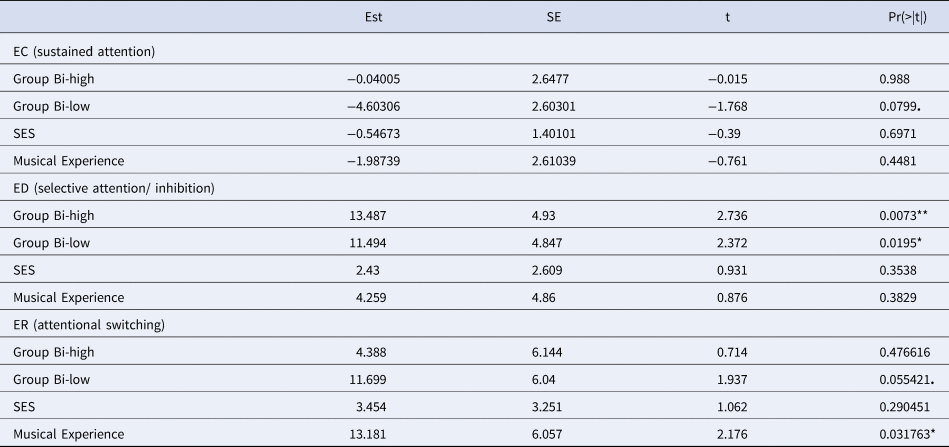
As to the three subtests of the TEA, the accuracy rate was obtained based on the number of correct responses. Linear regression models were used with the accuracy rate as a dependent variable, and the Group as a fixed variable. Bonferroni corrections were applied with adjusted significance level of p = .0167. The outputs of main fixed effects of interest for each model are presented in Supporting Materials (Supplementary Materials).
3. Results
3.1. Initial analyses
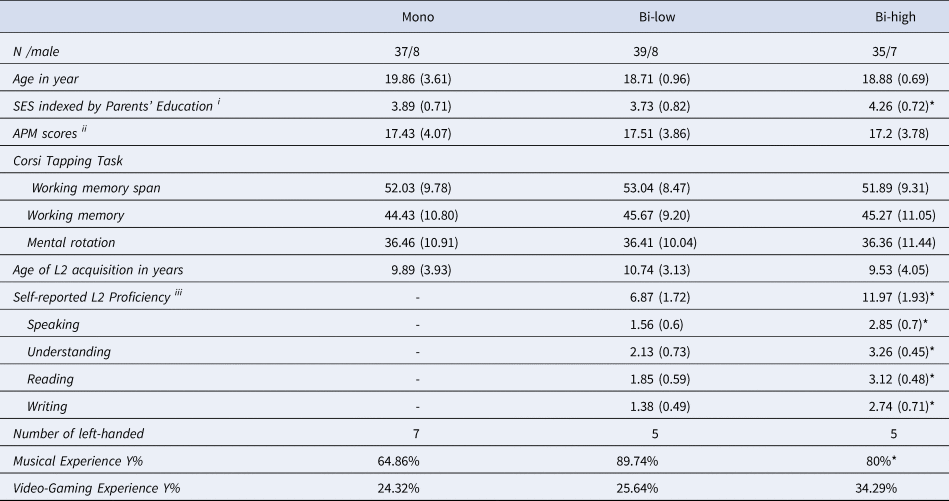
There were no group differences on age, AoA, gender distribution, video-gaming experience, and handedness distribution (all ps > .05); and no group differences on the APM and CTT (forward, backward, and rotated conditions) (all ps > .05) were found either, suggesting comparable basic cognitive abilities among the three groups.
Group differences were found on SES (p = .003) and musical experience (p = .03). Both SES and musical experience were put into the models as fixed variables, indicating that the main effects of Group and Trial Type were interpreted as controlling the effects of these background measures. As expected, the Bi-high group had higher self-reported L2 proficiency than that of the Bi-low group on overall proficiency, as well as four sub-components of language skills (all ps< .05; see Table 1).
Participants’ background measures. SDs are given in parentheses.

i This is an average score based on parental education level. The scale ranged from 1: primary school, 2: O level or equivalent, 3: A level, 4: Bachelor's or equivalent to 5: postgraduate, 6: Ph.D.
ii APM scores were the number of corrected items (the total number was 36)
iii The scale of self-reported L2 proficiency ranged from 1-4, marked by “poor” to “excellent”
* The difference between the groups was statistically significant
3.2. Main analyses
ANT
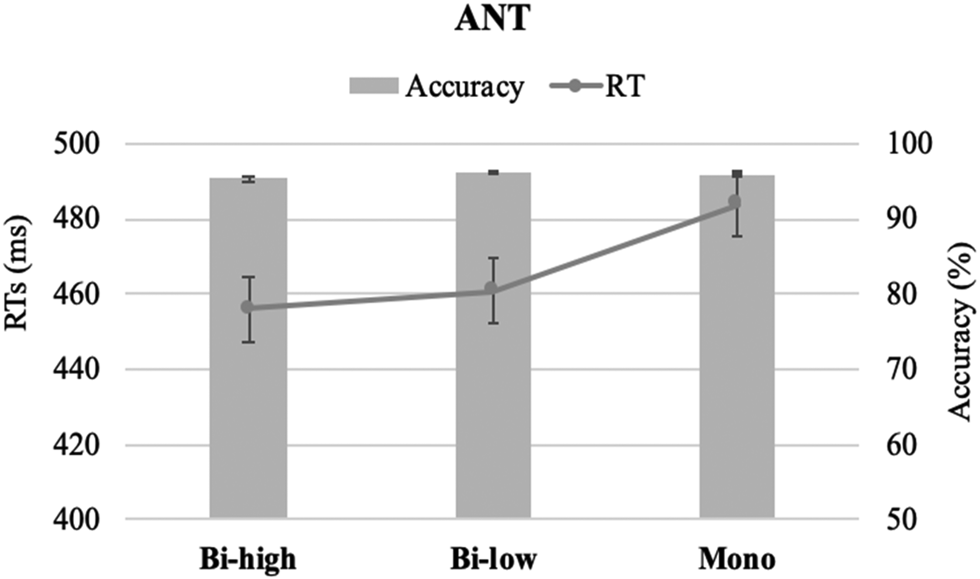
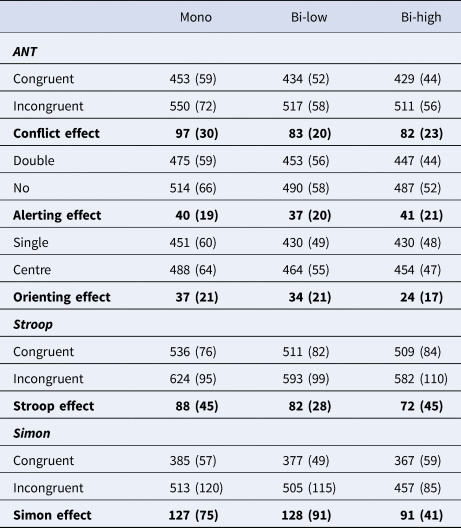
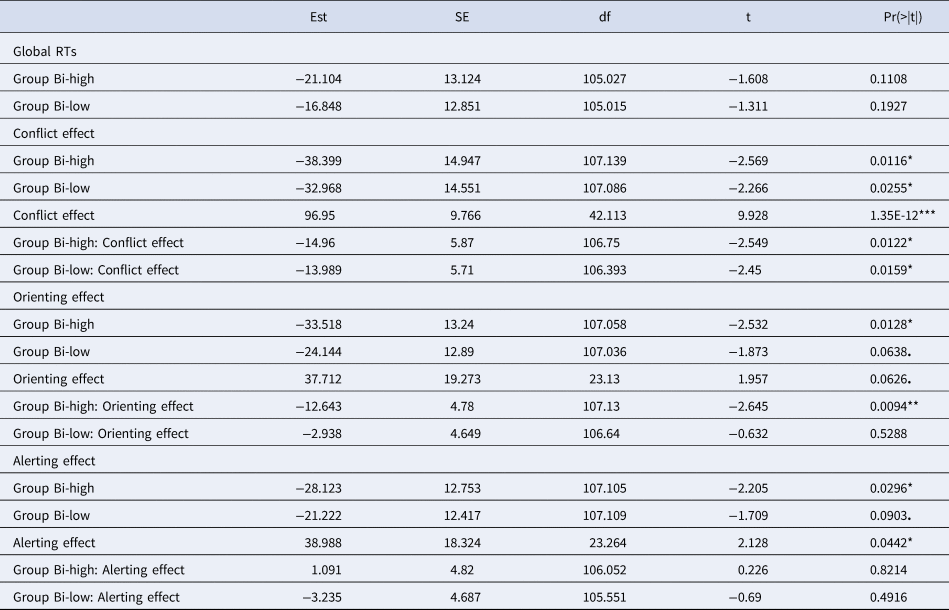
Overall performance (i.e., RTs and accuracy rate) is shown in Figure 2. Mean RTs on the respective trial types are given in Table 2. The outputs of main fixed effects of interest are presented in Table S2.
Overall performance in the ANT by group, collapsed across trial- and cue-type. Error bars represent ±1SE.

Interference tasks indices by Group. SDs are given in parentheses.

Note: ANT Conflict: congruent trial vs. incongruent trial; Alerting: double-cue vs. no-cue;
Orienting: centre-cue vs. single-cue. Stroop effect: congruent trial vs. incongruent trial.
Simon effect: congruent trial vs. incongruent trial.
Overall performance
On overall RTs that collapsed across all conditions, the main effects of Group and SES were not significant (p = .23 and p = .44, respectively). The effect of musical experience was significant, with faster responses in those having musical experience than those who did not (p = .048).
Alerting effect
The Alerting effect was significant, with faster responses on double-cue trials than on no-cue trials [F (1, 22.22) = 4.47, p = .046]. No other fixed effects or interaction effect were significant (all ps > .05).
Orienting effect
The main effects of Orienting, Group, and SES were not significant (all ps > .05). The main effect of musical experience was significant (p = .04), with faster responses in those having musical experience than those who did not. The interaction between Group and Orienting effect was significant [F (2, 106.89) = 3.84, p = .025]. Follow-up analysis showed that the Bi-high group displayed a smaller orienting effect than the monolinguals (β = 12.64, t = 2.65, p = .009), with no group differences between the Bi-low and monolingual groups (β = 2.94, t = .63, p = .53) or between the Bi-low and the Bi-high groups (β = 9.71, t = 2.071, p = .041) (p-value did not survive Bonferroni correction). Further analysis showed that the Bi-high and monolingual groups had similar response time on single-cue trials (p = .23), but the Bi-high group responded faster on centre-cue trials than the monolinguals did (p = .038), which led to a smaller Orienting effect in the Bi-high group relative to the monolinguals.
Conflict effect
The Conflict effect was significant, with faster responses on congruent trials than on incongruent trials [F (1, 33.02) = 90.76, p < .001]. The main effects of Group and SES were not significant (p = .15 and p = .53, respectively). The main effect of musical experience was significant (p = .043), with faster responses in those having musical experience than those who did not. The interaction between the Group and Conflict effect was significant [F (2, 106.61) = 4.16, p = .018]. Follow-up analysis found that both the Bi-high and Bi-low groups showed smaller conflict effects than the monolinguals did (β = 14.97, t = 2.56, p = .012 and β = 14.00, t = 2.45, p = .016, respectively), with no group difference found between the Bi-high and Bi-low groups (β = .97, t = .17, p = .87).
Number Stroop Task
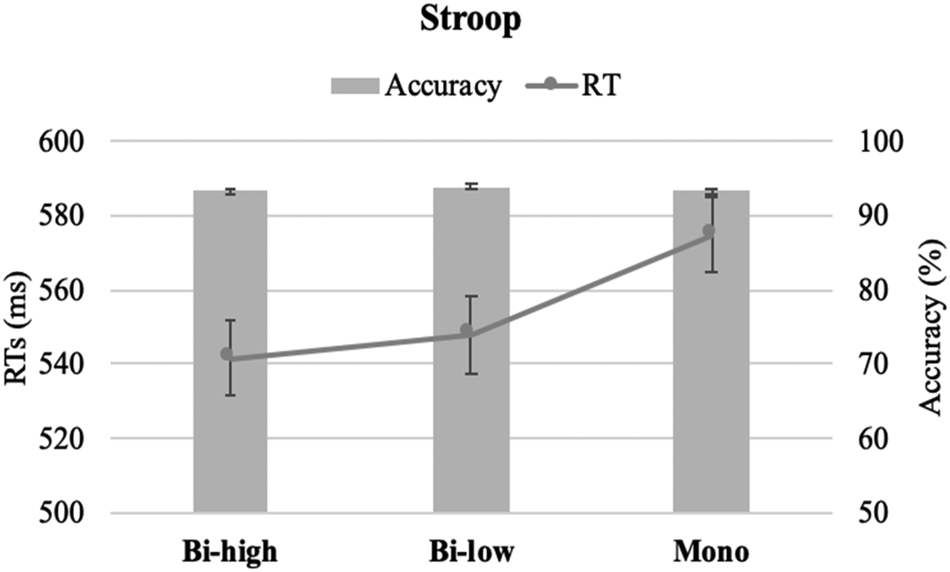
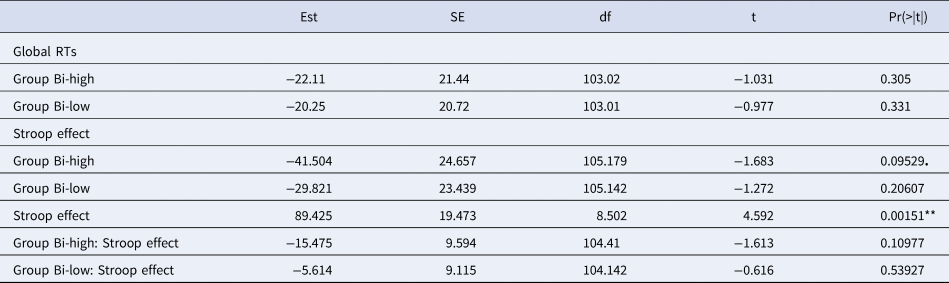
Overall performance is shown in Figure 3. Mean RTs on the respective trial types are given in Table 2. The outputs of main fixed effects of interest are presented in Table S3.
Overall performance in the Number Stroop task by group, collapsed across trial type. Error bars represent ±1SE.

Overall performance
In the analysis of Global RTs, no fixed effects were significant (all ps > .05).
Stroop effect
The Stroop effect was significant, with faster responses on congruent trials than on incongruent trials [F (1, 7.31) = 19.36, p = .003]. No other fixed effects or interaction effect were significant (all ps > .05).
Simon Task
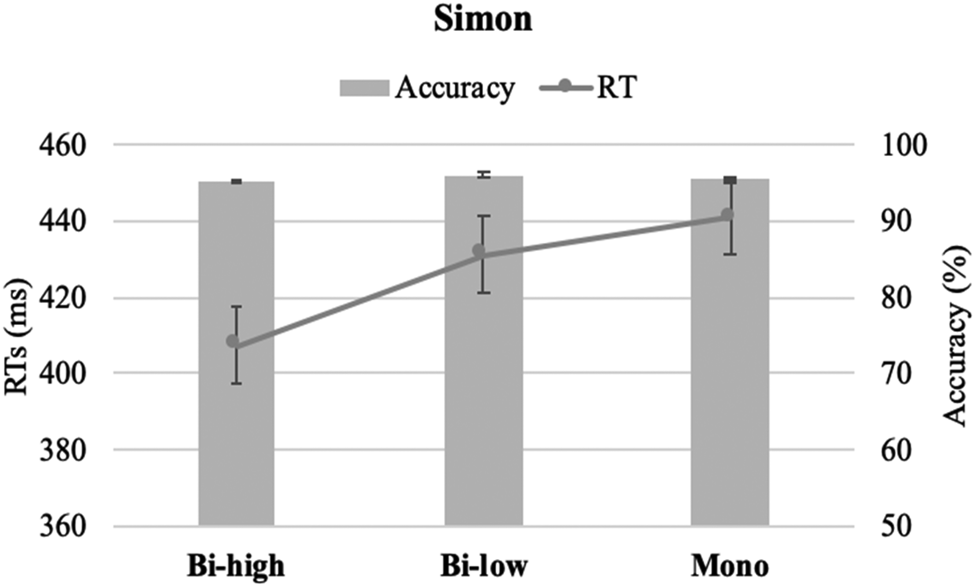
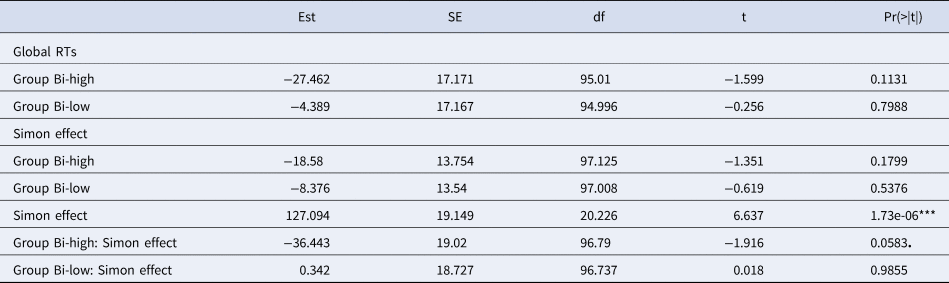
Overall performance (i.e., RTs and accuracy rate) is illustrated in Figure 4. Mean RTs on the respective trial types are given in Table 2. The outputs of main fixed effects of interest are presented in Table S4.
Overall performance in the Simon task by group, collapsed across trial type. Error bars represent ±1SE.

Overall performance
In the analysis of Global RTs, no fixed effects were significant (all ps > .05).
Simon effect
The Simon effect was significant, with faster responses on congruent trials than on incongruent trials [F (1, 9.88) = 52.74, p <. 001]. The main effect of SES was significant (p = .02): higher SES predicated faster response time. No other fixed effects or interaction effect were significant (all ps > .05).
TEA
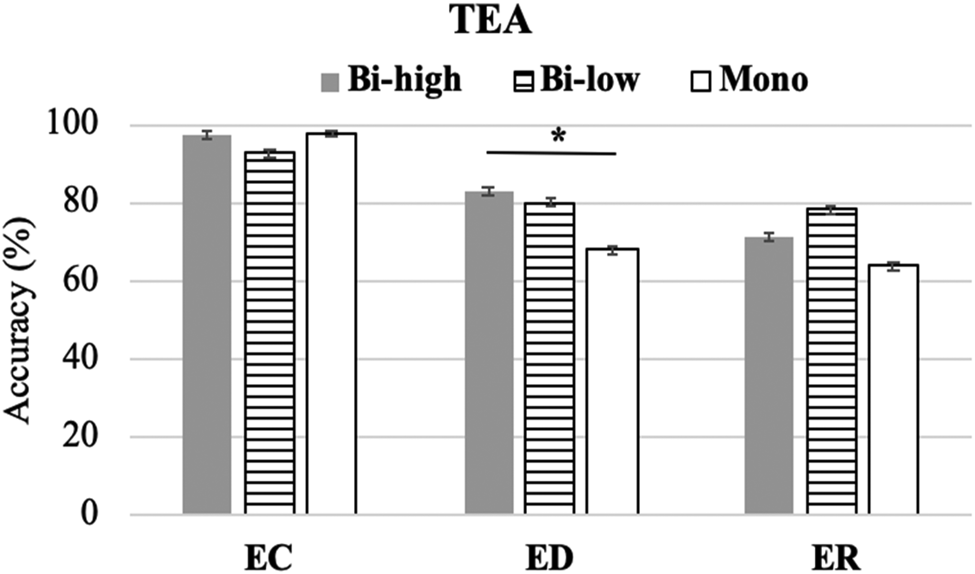
In the EC and ER, there were no group differences (all ps > .05). In the ED, after Bonferroni correction (i.e., adjusted p = .0167), the Bi-high group showed a significant better performance than the monolinguals did [β = 13.49 [3.71, 23.26], t = 2.74, p = .007]; the difference between the Bi-low group and the monolinguals did not reach significance [β = 11.49 [1.89, 21.1], t = 2.37, p = .020](see Figure 5). There was no group difference between the Bi-high and Bi-low groups [β = 1.99 [-7.84, 11.83], t = 0.4, p = .689]. For background measures, musical experience was a significant predictor of performance in the ER, with better performance in those having musical experience than those who did not [β = 13.18 [1.17, 25.19], t = 2.18, p = .032]. The outputs of main fixed effects of interest are presented in Table S5.
Performance in the respective TEA Elevator subtests by group. Error bars represent ±1SE.

4. Discussion
The main purpose of this study was to identify the effects of bilingualism on two potential subcomponents within interference suppression (i.e., S-S vs. S-R inhibition) in young adult monolinguals and bilinguals. Under the hypothesis that the bilingual experience affects specific inhibitory mechanisms, performance of young bilinguals and monolinguals was compared on three non-linguistic visual interference tasks (i.e., the ANT, Stroop, and Simon tasks) and one auditory inhibition task (i.e., the ED subtest in the TEA). We predicted superior performance in bilinguals relative to monolinguals in tasks tapping into inhibitory control in both the visual and auditory domains.
More specifically, based on previous research (Blumenfeld & Marian, Reference Blumenfeld and Marian2014), better performance by bilinguals tends to be observed in tasks tapping into S-S inhibition (i.e., ANT), but not in tasks involving S-R inhibition (i.e., Stroop and Simon tasks) in the visual domain. The results of this study confirmed the prediction, showing better performance in the bilingual groups (i.e., the Bi-high and Bi-low groups) compared to the monolingual group in the ANT (i.e., smaller conflict effects), but comparable performance in the Stroop and Simon tasks between the groups. Our findings were consistent with previous research that bilingualism might engage S-S inhibition mechanisms more than S-R mechanisms due to cross-linguistic co-activation and competitions in language comprehension and competition processes. As Blumenfeld and Marian (Reference Blumenfeld and Marian2014) suggested, S-S and S-R inhibition might not arise together, although both of them are likely to present during bilingual production. Bilinguals who lived in their dominant-language linguistic context may co-activate their two languages up to the lemma level, with cross-linguistic competition resolved at this stage and with language selective processing at the response planning stages. Hence, such bilinguals may mainly experience S-S inhibition, but not S-R inhibition. This could explain the patterns of results in the current study, as the bilingual participants were native English speakers living in a unilingual context (i.e., English). Therefore, interference tasks (i.e., the ANT) involving S-S conflict, as compared to tasks involving S-R conflict (i.e., the Stroop and Simon tasks), are more sensitive to detect group differences between monolinguals and bilinguals in the current study. Moreover, the multiple alternative responses in the Stroop and Simon tasks (i.e., three and four alternative forced choices in the Stroop and Simon tasks, respectively) are more likely to result in slower responses and higher error rate (Albantakis, Branzi, Costa & Deco, Reference Albantakis, Branzi, Costa and Deco2012). ERP measures have showed that different cognitive processes are required in the three different tasks; namely, conflict monitoring in the Stroop task, resource allocation in the Simon task, stimulus categorization and error-processing in the Flanker task (Kousaie & Phillips, Reference Kousaie and Phillips2012). However, in the present study, only behavioural measures were compared, so we do not know what the electrophysiological responses would have been to the three different types of conflict.
In the auditory domain, the results are consistent with previous studies (Bak et al., Reference Bak, Long, Vega-Mendoza and Sorace2016; Bak et al., Reference Bak, Vega-Mendoza and Sorace2014; Long et al., Reference Long, Vega-Mendoza, Rohde, Sorace and Bak2020): only the Bi-high bilinguals outperformed the monolingual group in the ED subtest of the TEA (i.e., auditory inhibition). The Bi-low group took an intermediate position, not being significantly different from either group. This pattern was further confirmed by an additional linear trend analysis. These observations are consistent with previous research (Vega-Mendoza et al., Reference Vega-Mendoza, West, Sorace and Bak2015) that language proficiency might modify specific cognitive performance so that a group difference between the Bi-low group and the monolingual group might not emerge until bilinguals reach a considerable level of proficiency.
Interestingly, the Bi-high group showed a smaller orienting effect (centre-cue vs. single-cue trials) than the monolinguals in the ANT, while the Bi-low group and the monolinguals showed comparable performance. Further analysis showed that the Bi-high and the monolinguals had a similar response time on the single-cue trials, but that the Bi-high group responded faster on the centre-cue trials than the monolinguals did, thus leading to a smaller orienting effect. Previous research has shown that bilinguals show faster overall or global RTs than their monolingual counterparts (Bialystok et al., Reference Bialystok, Craik, Klein and Viswanathan2004; Costa et al., Reference Costa, Hernández, Costa-Faidella and Sebastián-Gallés2009; Kousaie & Phillips, Reference Kousaie and Phillips2012), which was referred to as the Bilingual Executive Processing Advantage (BEPA) hypothesis (Hilchey & Klein, Reference Hilchey and Klein2011). If so, the faster RTs in the centre-cue trials could be due to the general cognitive benefits associated with bilingualism.
With respect to background measures, our results suggest that musical experience is associated with better executive performance (e.g., auditory attentional switching and Global RTs in the ANT), while higher SES predicts faster response across the incongruent and congruent trials in the Simon task. Musical experience is one of the types of experience other than bilingualism that is associated with executive performance (Bialystok & DePape, Reference Bialystok and DePape2009). It has been argued that musical performance is a complex task, which engages selective attention, monitoring, and shifting, particularly in the auditory domain. A growing number of studies have shown different cognitive benefits correlated with musical experience (Janus, Lee, Moreno & Bialystok, Reference Janus, Lee, Moreno and Bialystok2016; Moreno, Bialystok, Barac, Schellenberg, Cepeda & Chau, Reference Moreno, Bialystok, Barac, Schellenberg, Cepeda and Chau2011; Slevc, Davey, Buschkuehl & Jaeggi, Reference Slevc, Davey, Buschkuehl and Jaeggi2016). As to SES, our results are consistent with previous research, in which SES has been reported to modulate cognitive performance (Xie & Pisano, Reference Xie and Pisano2018).
One limitation of the present study is the lack of a formal objective test of L2 proficiency. However, studies have confirmed the validity of self-reported language proficiency and usage (Luk & Bialystok, Reference Luk and Bialystok2013; Marian, Blumenfeld & Kaushanskaya, Reference Marian, Blumenfeld and Kaushanskaya2007). For instance, Marian et al. (Reference Marian, Blumenfeld and Kaushanskaya2007) aimed to develop a valid and reliable tool for assessing language proficiency: the Language Experience and Proficiency Questionnaire (LEAP-Q). They conducted two studies to examine the internal validity and criterion-based validity of the LEAP-Q and suggested that self-reported language proficiency was a reliable indicator of language performance. Moreover, there are studies that have shown that self-reports and objective measures tend to correlate. Vega-Mendoza et al. (Reference Vega-Mendoza, West, Sorace and Bak2015), for example, found a correlation between self-reported L2 proficiency and accuracy to L2 words in a picture name verification task. Therefore, having used only one language measure (i.e., self-reports) in the current study is likely to be reliable.
Taken together, these results suggest that bilingualism benefits individuals in relation to executive functions even in young adults whose cognitive capacities are assumed to be at their highest level. Importantly, the current study separated two potential subcomponents within interference suppression (i.e., S-S vs. S-R inhibition), which could differently affect performance in monolinguals and bilinguals. Moreover, this study also investigates how language proficiency affects cognitive performance in both the visual and auditory domains: language proficiency turns out to modify cognitive performance and cause the emergence of group differences between monolinguals and bilinguals. The results may at least partly address the inconsistencies in the existing literature regarding the cognitive effects associated with bilingualism.
Declaration of Conflicting Interests
The authors declared that they had no conflicts of interests with respect to their authorship and/or the publication of this article.
Acknowledgments
The authors thank Ellen Bialystok and John G. Grundy for their insightful comments on a previous version of this manuscript. This work received support from the School of Philosophy, Psychology & Language Sciences (PPLS) Research Support Grants, the University of Edinburgh.
Supplementary materials
For supplementary material accompanying this paper, visit http://dx.doi.org/10.1017/S1366728921000304
Appendix S1 (questionnaire)
Summary of bilinguals’ other languages

Fixed effects of group comparisons for the ANT

Fixed effects of group comparisons for the Number Stroop task

Fixed effects of group comparisons for the Simon task

Fixed effects of group comparisons for the TEA