Psoriasis is a chronic inflammatory, multi-system disease that often begins in childhood and characterised by inflammatory skin, nails, scalp, and joint manifestations. The prevalence of psoriasis has been estimated to be at 1–4% with lifetime in population.Reference Augustin, Glaeske, Radtke, Christophers, Reich and Schäfer1 Recent evidence suggests that psoriasis is accepted as a systemic, immune-mediated disease associated with an increased prevalence of various cardiovascular comorbidities.Reference Koebnick, Black and Smith2, Reference Augustin, Radtke and Glaeske3 The inflammation in psoriasis may promote some effect on the cardiac conduction system. Several studies demonstrate that adult patients with psoriasis have been linked to cardiovascular risk factors including hypertension, obesity, diabetes, dyslipidemia, atherosclerosis, and more importantly elevated prevalence of cardiovascular disease and cardiovascular mortality.Reference Tollefson, Van Houten, Asante, Yao and Maradit Kremers4 Psoriasis and atherosclerosis have similar inflammatory mechanisms, and it appears that a significant overlap. In literature search, cardiovascular risk in childhood psoriasis is more limited, and only a few studies in literature have examined the association between paediatric psoriasis and related rhythm abnormalities and conduction disturbances.Reference Chiu, Chang, Huang, Wen, Tsai and Tsai5, Reference Kwa, Kwa and Silverberg6
Previous research showed that transmural dispersion of repolarisation also seems to play a major role in the arrhythmogenesis, and P wave dispersion (Pdis), QT dispersion (QTdis), the peak-to-end interval of the T wave, and Tp-e/QT ratio have been accepted as electrocardiographic markers for the assessment of myocardial repolarisation and arrhythmogenesis. These markers constitute a relatively recent contribution to the field of non-invasive electrocardiology. Increased Pdis, QTdis, Tp-e, and Tp-e/QT ratio reflect predisposition of arrhythmias.Reference Okutucu, Aytemir and Oto7–Reference Çetin, Turfan, Karaman, Yasar, Güven and Tunçdemir9 These intervals can be prolonged in psoriasis because of increased inflammation, and it suggests the tendency of myocardium to rhythm disturbances.
The aim of this study is to investigate myocardial repolarisation in the paediatric psoriasis using P wave dispersion, Tpeak–Tend (Tp-e) interval, and Tp-e/QT ratio. To our knowledge, no prior studies have examined previously in the children’s literature.
Materials and methods
This is an observational, cross-sectional study. In this single-centre, observational, cross-sectional study, 42 children with psoriasis who were followed up at the dermatology outpatient clinic between September, 2018 and January, 2019 and the control group consisted of 37 healthy age- and sex-matched volunteers were recruited from the Pediatric Cardiology and Dermatology units of Van Yuzuncu Yil University Hospital. Patients with a murmur in the paediatric cardiology and dermatology outpatient clinic and who had no other illnesses were accepted as the control group. Psoriasis was diagnosed by history, clinical examination, and histopathological findings of all patients.
The participants were submitted to physical examination that included measurements of weight, height, heart rate, systolic and diastolic pressures, and calculation of body mass index (kg/m2). 12-lead electrocardiogram and echocardiography were performed in both groups.
The patients who were taken to study were those who had not received any treatment for the last 1 month. The Psoriasis Area and Severity Index scoring was performed for the severity of the disease. The following criteria were used for exclusion: if they used any medication that disturbs the QT duration, or if they had electrolyte imbalances causing QT elongation (e.g., hypopotasemia, hypocalcemia, and hypomagnesemia), the patient with hypothyroidism, CHD, or a history of dysrhythmia. The patients with heart disease on echocardiographic examination and the patients with any systemic inflammatory disease, infectious disease, obesity, or immunological disease were excluded as well.
All patients’ parents gave informed consent to be involved in this study after the study protocol was explained to them before the initiation of the study. The study protocol was approved by the institutional ethics committee of local institution.
12-Lead surface electrocardiogram and measurements
A standard 12-lead surface electrocardiogram was obtained for all patients and controls in the supine position using Nihon Kohden ECG, Cardiofax GEM, Model 9022K (Tokyo, Japan) machine. The 12-lead electrocardiogram was recorded at paper speed of 25 mm/seconds and 10 mm/mV standardisation.
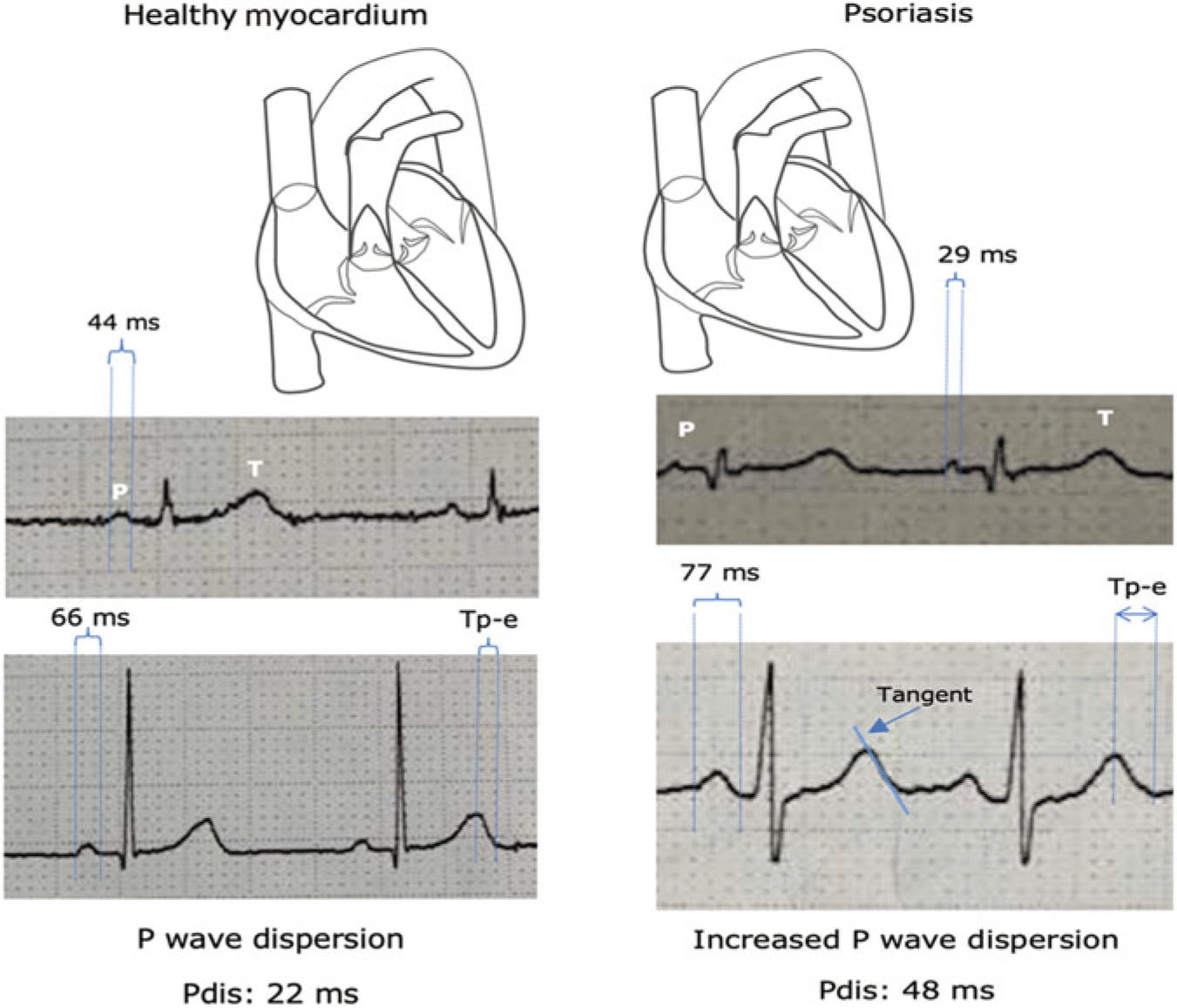
The parameters were calculated manually including the heart rate, P wave dispersion (Pdis), QT interval, QT dispersion (QTdis), the peak-to-end interval of the T wave (Tp-e), Tp-e/QT ratio, and Tp-e/QTc ratio in all 12 leads of the surface electrocardiogram and simultaneously recorded by a single paediatric cardiologist who was blinded to the clinical data of the patients (Fig 1). In this way, the inter-observer variability of measurements was excluded from analysis. All measurements were performed with handheld callipers and magnifying lenses in this study. Handheld calliper measurements may be less accurate than computerised digital callipers. However, higher magnification with improved image quality provides better measurements. Repeated measurements were calculated from all 26 randomly selected study applicants to assess intra-observer variability in patients and controls. The absolute difference between two observations was under 7 ms for Pmin.
Examples for measurement of Pdis, minimum, and maximum P wave duration in healthy controls and patients with psoriasis.

Pdis is calculated as the difference between the widest and the narrowest P wave duration in the 12-lead electrocardiogram during sinus rhythm. The P wave onset is determined as the initial deflection from the T–P segment that is chosen as the isoelectric baseline, and the offset of the P wave is defined as the junction of the end of the P wave and its final return to baseline.
QTdis is calculated as the difference between the longest (QTmax) and the shortest (QTmin) QT intervals. The corrected QT interval is calculated using the Bazett’s formula, and the difference between QTc max and QTc min is the QTc dispersion.
The Tp-e interval is defined as the difference between the peak of T wave and the end of T wave. The end of the T wave is defined as the return to the T-P wave baseline and assessed via the tangent method. The U wave was excluded from the Tp-e interval. Measurements of Tp-e interval were performed from precordial leads. The Tp-e/QT and Tp-e/QTc ratios were also calculated from these measurements.
Statistical analysis
The studied variables were presented as mean, minimum, and maximum values. Student’s t-test was used to compare the control and patient groups’ means for the studied variables. Pearson correlation analysis was carried out to examine linear relationships among the variables, and statistical analysis was performed by SPSS ver. 21.0 software (SPSS Inc., Chicago, Illinois, United States of America). A p value <0.05 was considered statistically significant.
Results
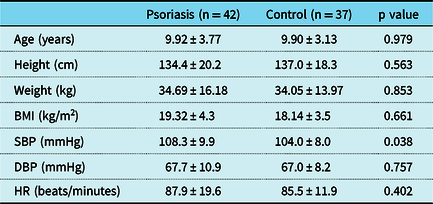
Our study sample involved 42 patients with psoriasis who do not have cardiovascular risk factors and 37 healthy controls. Age and gender did not differ between the groups. The median age of the study group was 9.92 ± 3.77 years, and in the control group it was 9.9 ± 3.13 years. There were no significant differences between groups regarding the demographic characteristics. All the subjects were normotensive, and systolic blood pressures were significantly higher in the study group (108.3 ± 9.9, 104.0 ± 8.0 mmHg, respectively; p = 0.038). No significant differences were observed in diastolic blood pressures and heart rate between the two groups. The baseline characteristics of patients and controls are summarised in Table 1.
The baseline characteristics

BMI = body mass index; DBP = diastolic blood pressure; HR, heart rate; SBP = systolic blood pressure
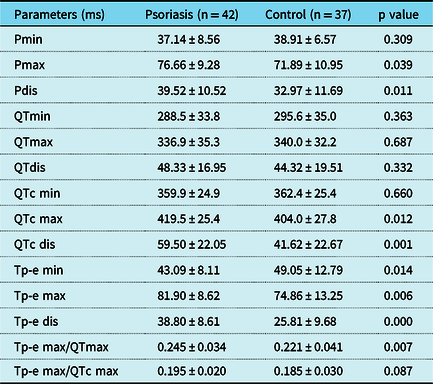
The maximum P wave duration (Pmax) in the study group was significantly higher than in the control group (76.66 ± 9.28, 71.89 ± 10.95 msec, respectively; p = 0.039). The results showed that the Pdis was significantly higher in psoriasis patients than in controls (39.52 ± 10.52, 32.97 ± 11.69 msec, respectively; p = 0.011). And the QTc max, the QTc dis, the Tp-e max, the Tp-e dis, and the Tp-e/QTc max ratio were significantly higher in the study group than in controls. The other electrocardiographic intervals were not significantly different between the groups. Electrocardiographic parameters in the study group and control groups are shown in Table 2.
Electrocardiographic parameters of groups

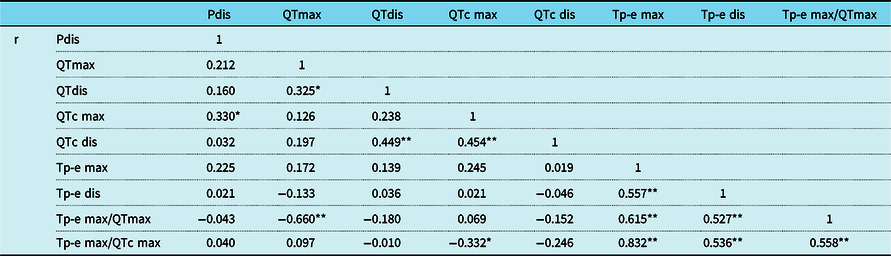
In correlation analysis, we found that the Tp-e/QTmax and the Tp-e/QTc max ratio showed a significant positive correlation with the Tp-e interval (r = 0.527, p < 0.001, r = 0.536, p < 0.001, respectively) and also a significant positive correlation between the Tp-e/QTc max ratio and the Tp-e min (r = 0.316, p < 0.005). There was a significant positive correlation between the Pdis and the QTc max (r = 0.330, P < 0.005). No significant correlations were found between the Tp-e max and the QTdis (Table 3). Also, there was no significant correlation between Pdis and QTdis (Table 3).
Correlation analysis

**p < 0.01; *p < 0.05
Discussion
Our findings in this study showed that transmural dispersion of repolarisation indices of the Pdis, the QTc max, the QTc dis, the Tp-e interval, and the Tp-e/QTc max ratio statistically significantly increased in psoriasis patients compared to healthy controls. The results may indicate increased myocardial repolarisation heterogeneity, and it may be a potential cause of the arrhythmias in patients with psoriasis. To our knowledge, this is the first study that assessed the transmural dispersion of repolarisation in the paediatric psoriatic patients.
P wave dispersion that is defined as the difference between the longest and the shortest P wave durations has been examined in cardiac and non-cardiac disease states. Higher Pdis indicates inhomogeneous propagation of sinus impulses and increasing atrial depolarisation abnormality that may be related to atrial arrhythmia.Reference Okutucu, Aytemir and Oto7 In our study, Pdis was significantly higher in psoriasis patients than in healthy subjects (Table 2).
The prolongation of dispersion in QT can predict ventricular arrhythmia. Assessment of P wave and QT dispersion may provide a simpler alternative for a diagnostic tool. QT and QTc intervals and QTdis are well-known markers, as well as Tp-e interval are marker that also indicate repolarisation features. Recent studies indicate that the Tp-e interval and Tp-e/QT ratio can be used as an index of transmural dispersion of repolarisation.Reference Soylu, İnci and Aksan10–Reference Bieganowska, Sawicka-Parobczyk, Bieganowski and Piskorski12 In our study, we demonstrated that QTc max, QTc dis, Tp-e interval, and Tp-e/QTc max ratio were significantly prolonged in psoriasis patients (Table 2). Also, we found that Pdis had a positive correlation with QTc max (Table 3). Greater repolarisation instability may be related to longer QT interval with the increase in action potential delay.
The correlation with Psoriasis Area and Severity Index score was also evaluated, but there was no correlation between repolarisation parameters and the Psoriasis Area and Severity Index score. These results may be due to all cases with mild psoriasis who have the low Psoriasis Area and Severity Index scores.
Children with psoriasis have increased risk for obesity and various cardiovascular comorbidities.Reference Augustin, Radtke and Glaeske3 Psoriasis is independently associated with an increased risk of cardiovascular comorbidities; however, obesity itself may promote this risk. Recent data have shown that obese patients have an increased risk of arrhythmias and obesity caused significant increase in P wave and QTc dispersion.Reference Kosar, Aksoy, Ari, Keskin and Sahin13 We excluded the obese patients from the study, and our findings indicate that there is a significant increase in P wave and QTc dispersion in psoriasis patients. A recent large-scale cohort study provided evidence that a significant association between psoriasis and arrhythmia remained consistent when patients with obesity were excluded.Reference Chiu, Chang, Huang, Wen, Tsai and Tsai5
There are many studies which indicate that inflammation plays a key role in the pathophysiology of many cardiovascular diseases including coronary artery disease, heart failure, hypertension, and cardiac arrhythmias.Reference Markuszeski, Bissinger, Janusz, Narbutt, Jedrzejowska and Zalewska14–Reference Fujino, Hata and Kuriki16 The inflammation can cause progressive electrophysiological changes that are responsible for the pathogenesis of arrhythmias. For example, arrhythmia is a frequent occurrence in patients with acute or chronic myocarditis. Previous studies have demonstrated that anti-inflammatory therapies decrease the risk of post-operative arrhythmias recurrences.Reference Okutucu, Aytemir and Oto7
In many studies, researchers have found, similarly, that psoriasis in adults is related to increased arrhythmias and altered autonomic function and a positive association between inflammation and myocardial repolarisation parameters.Reference Chiu, Chang, Huang, Wen, Tsai and Tsai5, Reference Ahlehoff, Gislason and Jørgensen17 Conversely, Armstrong et al had considered no statistically significant difference in atrial fibrillation incidence between psoriatic patients and healthy subjects.Reference Armstrong, Azizi and Wu18A recent large-scale study found that electrocardiographic findings (e.g., QTc, P wave duration, and P terminal force) in psoriasis are not associated with electrocardiographic abnormalities that carry independent risk of cardiovascular disease.Reference Hansen, Juhl, Isaksen, Jemec, Ellervik and Kanters19
Limited evidence has also indicated that children with psoriasis have a rhythm abnormalities and conduction disturbances.Reference Kwa, Kwa and Silverberg6 Although the pathogenesis of this disease is still not fully understood, inflammation is considered to be the most important mechanism for disease development and myocardial heterogeneity. Inflammation in psoriasis is mediated by both the innate and adaptive immune systems. Psoriasis shares inflammatory mechanisms with coronary atherosclerosis that may contribute to the myocardial repolarisation heterogeneity. The results of the our study support increased myocardial repolarisation heterogeneity, and inflammatory mechanisms may also play an important role in the tendency of myocardium to rhythm disturbances. Previous studies have indicated that some chronic inflammatory diseases such as rheumatoid arthritis, sarcoidosis, and systemic lupus erythematosus are associated with an increased myocardial repolarisation heterogeneity and an increased risk of arrhythmias.Reference Lazzerini, Capecchi, Acampa, Galeazzi and Laghi-Pasini15, Reference Guler, Seyfeli and Sahin20
Inflammatory mediators linked with arrhythmias has been demonstrated in animal models.Reference Sawaya, Rajawat and Rami21, Reference De Jesus, Wang and Herren22 Dave et al showed that increased inflammation in the blood vessels of patients with psoriasis and inflammation is related to the risk of major cardiovascular events.Reference Dave, Ahlman, Lockshin, Bluemke and Mehta23 These findings suggested that the inflammation may be an important link between arrhythmia and psoriasis. In our study, we found that the transmural dispersion of repolarisation indices of the electrocardiographic parameters were increased in patients with psoriasis compared with control subjects, and we speculated that the inflammation in psoriasis may play an important role in the pathophysiology of cardiac arrhythmias. The electrocardiogram-based screening tools may provide a predictive screening test for the arrhythmias.
Limitations in our study include a small sample size to reach definite conclusions. Other limitation was that we did not investigate the true incidence of arrhythmia. Although little is known about the risk of significant arrhythmia in paediatric psoriasis, this may have underestimated the risk of arrhythmia.
Conclusions
The results of this study add to evidence linking psoriasis with increased myocardial repolarisation heterogeneity. In conclusion, these findings suggest that this patient population may be at an increased risk for arrhythmias. A standard 12-lead surface electrocardiogram may simply provide the prediction of arrhythmic events in psoriasis. However, further research is necessary to demonstrate link between arrhythmia and paediatric psoriasis. In addition, our findings may be a basis for further studies.
Acknowledgements
Thank you very much Dr. Kamuran Karaman for his advices.
Author Contribution
M.Ç. and İ.H.Y. designed the study; M.Ç. and G.Ö.Y. performed experiments; M.Ç. and M.G. collected and analysed data; M.Ç., İ.H.Y., and M.G. wrote the manuscript and statistical analysis; İ.H.Y. and G.Ö.Y. gave technical support and conceptual advice. All authors read and approved the final manuscript.
Financial Support
This research received no specific grant from any funding agency, commercial or not-for-profit sectors.
Conflicts of Interest
None.
Ethical Standards
The authors assert that this work complies with the ethical standards of the relevant national guidelines and with the Helsinki Declaration of 1975, as revised in 2008, and has been approved by the Ethical Review Committee at the University of Yuzuncu Yil, Turkey.