Introduction
Nigeria, with a population of over 173 million, has one of the lowest levels of modern contraceptive use in the world, based on the 2006 census figure and projected with a 2.6% rate of natural increase (National Population Commission, 2009). Modern contraceptive prevalence in the country, which was about 1% in 1970, was still as low at 9.4% in 2013, an increase of approximately 8% in over four decades (Caldwell & Caldwell, Reference Caldwell, Caldwell, Ebigbola and Renne2000; National Population Commission & Macro, 2009; United Nations 2012; Population Reference Bureau, 2013). Non-use of modern contraceptives remains very high in spite of the high level of awareness of various modern methods (Wusu & Isiugo-Abanihe, Reference Wusu and Isiugo-Abanihe2007; Avidime et al., Reference Avidime, Aku-Akai, Mohammed, Adaji, Shittu and Ejembi2010; Monjok et al., Reference Monjok, Smeeny, Ekabua and Essien2010; Adinma et al., Reference Adinma, Adinma, Eke, Iwuoha, Akiode and Oji2011). Approximately 90% of women aged 15–49 in the country have never used any modern contraceptives.
The high non-use of modern contraceptives has grave consequences for the country (National Population Commission, 2009), including the rapid spread of sexually transmitted infections (STIs). For instance, HIV prevalence increased from 2.5% to 3.7% between 1995 and 2012/2013, although the epidemic is declining in many African countries (Population Reference Bureau, 2013). Also, the relatively high rates of unwanted pregnancies (13%) and childbirth (11%) are partly responsible for the high fertility rates (TFR=5.7) (National Population Commission & ICF Macro, 2009). Other consequences are the widespread incidence of abortion, largely executed covertly by ‘quacks’ in a context of highly restrictive abortion law, and high maternal and infant mortality (Bongaarts, Reference Bongaarts2006; Murray et al., Reference Murray, Winfrey, Chatterji, Moreland, Dougherty and Okonofua2006; Okonofua et al., Reference Okonofua, Odimegwu, Ajabor, Daru and Johnson1999, Reference Okonofua, Hammed, Abass, Mairiga, Mohammend, Adewale and Garba2011; Sundaram et al., Reference Sundaram, Juarez, Bankole and Singh2012).
Predictors of the non-use of modern contraceptives in non-Western societies include high level of illiteracy, poor spousal communication, wrong perception of husband's disposition, fertility preference, gender inequality, poor access to media and poor quality and inaccessibility of family planning services (Biddlecom & Fapohunda, Reference Biddlecom and Fapohunda1998; Kane et al., Reference Kane, Gueye, Speizer, Pacque-Margolis and Baron1998; Nazar-Beutelspacher et al., Reference Nazar-Beutelspacher, Molina-Rosales, Salvatierra-Izaba, Zapata-Matelo and Halperin1999; Lutalo et al., Reference Lutalo, Kidugavu, Serwadda, Zabin and Gray2000; Babalola et al., Reference Babalola, Vondrasek, Brown and Traore2001; Casterline et al., Reference Casterline, Sathar and Haque2001; Agha & Rossen, Reference Agha and Rossen2002; Babalola et al., Reference Babalola, Folda and Babayaro2008; Izugbara et al., Reference Izugbara, Ibisomi, Ezeh and Mandara2010; Cleland et al., Reference Cleland, Ndugwa and Zulu2011). The role of religion in contraceptive use has not been well explored, and the interconnections between religion and non-use of modern contraceptives are still an issue of huge debate (Adongo et al., Reference Adongo, Phillips and Binka1998; Yeatman & Trinitapoli, Reference Yeatman and Trinitapoli2008; Agadjanian, Reference Agadjanian2013).
Religion is believed to play a pivotal role in human society: predominant religious values shape and regulate individual behaviour, including sexual and reproductive health behaviour (Edewor, Reference Edewor2005; Goujon et al., Reference Goujon, Skirbekk, Fliegenschnee and Strzelecki2006). Nigeria is a highly religious society; all kinds of worship centres with a regular high traffic of people are pervasive in the society. The popular religious groups propagate varied teachings on contraception, which are expected to shape and regulate the contraceptive behaviour of reproductive aged individuals. In spite of the role of religion in the everyday life of Nigerians, studies on the influence of religion on non-use of modern contraceptives are limited. The few empirical studies that have considered this association employed narrow samples that were not nationally representative making it difficult to generalize findings to the whole country (e.g. Olaitan, Reference Olaitan2011; Odusina et al., Reference Odusina, Ugal and Olaposi2012; Akintunde et al., Reference Akintunde, Lawal and Simeon2013). Most of these studies terminated statistical analysis at the bivariate level, compounding the problem of generalization of the results (e.g. Envuladu et al., Reference Envuladu, Agbo, Mohammed, Chia, Kigbu and Zoakah2012; Odusina et al., Reference Odusina, Ugal and Olaposi2012). In addition, the country has witnessed a significant degree of social and cultural change over the years, yet studies reflecting on the influence of such changes on the association between religion and contraception are rare (if any).
Hence, this study employed the first and latest (as at the time of analysis) Nigeria Demographic and Health Survey data to examine differences and similarities in the independent influence of religion on non-use of modern contraceptives between 1990 and 2008. The study endeavoured to proffer answers to two research questions: What was the nature of the association between religion and non-use of modern contraceptives in Nigeria over the last two decades? What are the differences or similarities in the nature of the association?
Background
The findings of available studies on the relationship between religion and non-use of modern contraceptives in Nigeria and a few sub-Saharan African countries are reviewed in this section within two relevant perspectives: particularized and characteristic perspectives (Adongo et al., Reference Adongo, Phillips and Binka1998; Hirsch, Reference Hirsch2008; Zhang, Reference Zhang2008). The particularized perspective argues that differences in contraceptive behaviour of individuals (whether they adopt contraceptives or not) are a function of the differences in doctrinal stance of their religious groups. Women who belong to religions or denominations whose doctrines prohibit the use of contraceptives are likely to be averse to contraceptive use, while their counterparts who are adherents of religious groups that are liberal about contraception are very likely to use contraceptives, especially modern, more effective methods. In essence, this hypothesis suggests that religion is an independent significant predictor of contraceptive behaviour. Studies in northern, central, and western Nigeria have argued in support of this hypothesis. An overview of the findings implies that religious differentials in contraceptive behaviour exist among women as a result of differences in the teachings of Catholicism, Protestantism, Islam and Traditional religions in the country (Agadjanian et al., Reference Agadjanian, Yabiku and Fawcett2009; Monjok et al., Reference Monjok, Smeeny, Ekabua and Essien2010; Olugbenga-Bello et al., Reference Olugbenga-Bello, Abodunrin and Adeoni2011; Avong, Reference Avong2012; Envuladu et al., Reference Envuladu, Agbo, Mohammed, Chia, Kigbu and Zoakah2012; Odusina et al., Reference Odusina, Ugal and Olaposi2012; Akintunde et al., Reference Akintunde, Lawal and Simeon2013). Results of studies in other parts of sub-Saharan Africa, namely Cameroon, Ghana and Malawi, also support the proposition that contraception differentials among the religious faithful are attributable to variations in the doctrinal positions of Islam, Christianity and Traditional religion on contraceptive use (Doctor et al., Reference Doctor, Phillips and Sakeah2009; Browne, Reference Browne2012). In addition, Agadjanian (Reference Agadjanian2013) observed a significant difference in modern contraceptive use among Catholics, traditional Protestants and Penticostals in Mozambique, with Catholics and traditional Protestants being more likely to report use of modern contraceptives than Pentecostals.
The characteristic perspective contends that religious doctrines on contraception cannot solely explain contraceptive use differentials among religious groups, but that it is more of differences in social, economic and demographic characteristics of adherents of religious groups (Zhang, Reference Zhang2008). In the context of this study, the characteristic hypothesis argues that there is no independent effect of religious doctrines on contraception. Olaitan's study in south-western Nigeria appears the only available recent research with findings that partially support the characteristic hypothesis in the country. Besides the fact that the study did not support any significant influence of socioeconomic factors on the choice of family planning, it lends support for non-association of religious and other cultural factors and the choice of family planning (Olaitan, Reference Olaitan2011). In Senegal, Browne found that adjusting for social-demographic variables obliterated the initial significant relationship observed between Islam and contraceptive use (Browne, Reference Browne2012). Similarly, the pattern of contraceptive behaviour in rural Malawi was found to be more a function of the characteristics and interactions among members than different doctrinal stances of different denominations (Yeatman & Trinitapoli, Reference Yeatman and Trinitapoli2008).
The rarity of previous studies supporting the characteristic hypothesis may imply that religion's influence on contraceptive behaviour in sub-Saharan Africa, and particularly in Nigeria, cannot be overlooked. Hence, studies with a national focus to deepen understanding of the association between religion and non-use of modern contraceptives are imperative. Given the fact that the use of modern contraceptives remains very low in Nigeria, with serious public health implications, and that the society is a religious one, this need is critical. Hence, this study sought to test the hypothesis that religious affiliation was not likely to have significantly and independently predicted non-use of modern contraceptives in Nigeria over the last two decades.
Theological positions of major religious groups on contraception
The four main religious categories in Nigeria are Catholicism, Protestantism, Islam and Traditional. Roman Catholicism, based on the scriptures and the natural law, posits that the only divinely designed outcome of sexual intercourse is procreation, even with a legitimate wife, and spouses must be available for sex with one another (Hirsch, Reference Hirsch2008; Srikanthan & Reid, Reference Srikanthan and Reid2008). The sole aim of marriage is the procreation and education of children; the promotion of mutual love ‘between spouses and remedy for concupiscence’ is secondary (Dalla-Zuanna, Reference Dalla-Zuanna2011). The Church fathers, and later St Thomas Aquinas, considered contraception to be sinful, and that it contradicts scriptural teachings (John-Stevas, Reference John-Stevas1960). From the point of view of Catholicism, artificial birth control measures (modern contraceptives) are unacceptable, and their adoption is an affront to God's injunction. In line with this theological position, natural methods such as abstinence and rhythm are, at best, permissible amongst the Catholic faithful (John-Stevas, Reference John-Stevas1960; Srikanthan & Reid, Reference Srikanthan and Reid2008). In other words, at least in doctrinal stance, use of all forms of modern contraceptive is forbidden amongst Catholics until today.
Protestantism consists of two broad categories in Nigeria, namely conservative (popularly known as the Orthodox in Nigeria) and what is referred to here as ‘liberal believer’. While the conservatives (the Orthodox) comprise of Bible-based religious groups that can be described as the first generation of Christians in the country beside Catholicism, the liberal category consists largely of modern forms of Bible-based religious groups that fall into either Evangelicals or Pentecostals. The two categories do not have any restriction on contraceptive use among their members (Edewor, Reference Edewor2005; Srikanthan & Reid, Reference Srikanthan and Reid2008). Although Protestantism encourages procreation, the interpretation of the sacred book on sexual relation does not consider procreation as the sole aim of marriage; rather, sex promotes love and Protestants see no difference between natural and artificial contraceptive methods (Edewor, Reference Edewor2005). In essence, Protestantism does not prohibit categorically any contraceptives.
Islam's doctrine on contraception is rooted in the injunction in the Qur'an and the Hadith, the sacred or holy books of Islam, that no one must kill children because of want or poverty (Raimi, Reference Raimi, Ebigbola and Renne2000). Although abortion is quite controversial in Islam, it is, however, permitted in situations such as rape, incest and more importantly when a woman's life is at risk (Aramesh, Reference Aramesh2007; Whaley, Reference Whaley2007; Alamri, Reference Alamri2011). However, fundamentalist interpretation of the holy book's injunction encourages a large family size and thus tends to forbid contraceptive use (Edewor, Reference Edewor2005). Islam permits the use of contraceptives for the purpose of birth spacing and on health grounds, and with the exception of sterilization and infanticide, it is also permissible for the purpose of limiting family size (Edewor, Reference Edewor2005; Srikanthan & Reid, Reference Srikanthan and Reid2008). In the view of the Qur'an, Allah desires no hardship for Muslims; therefore, the majority of Islamic scholars approve of contraception for the purpose of child spacing or limiting family size to enhance mothers' and fathers' physical and financial comforts (Roudi-Fahimi, Reference Roudi-Fahimi2004). But ignorance of these provisions amongst Muslims prevents the majority of them taking advantage of the liberal doctrinal position of Islam on contraception (Raimi, Reference Raimi, Ebigbola and Renne2000; Srikanthan & Reid, Reference Srikanthan and Reid2008).
In sub-Saharan Africa beliefs and practices that centre on departed souls being perpetually interested in the affairs of their lineage on earth predominates in Traditional religion (Adongo et al., Reference Adongo, Phillips and Binka1998). Also, Traditionalists believe that ancestral spirits possess the power to punish their descendants living on the earth who work against their interests, and the spirits are also capable of bringing blessings upon those who promote their wishes (Adongo et al., Reference Adongo, Phillips and Binka1998). This belief tends to keep Traditional worshipers under pressure to appease ancestral spirits. As a result, Traditionalists intrinsically adopt pronatalist fertility behaviours, including non-use of modern contraceptives (Doctor et al., Reference Doctor, Phillips and Sakeah2009). The Traditionalist's propensity to opt for non-use of contraceptives is reinforced by older generation relatives, who command respect in traditional communities. They tend to act as custodians of traditions. In this case, they oppose any attempt to limit family size in consonance with ancestral spirit's dictate (Caldwell & Caldwell, Reference Caldwell, Caldwell, Ebigbola and Renne2000). Hence, modern contraceptive use is prohibited among Traditionalists.
Notwithstanding the theological positions of the popular religions enunciated above, the extent to which the doctrines influence adherents' contraceptive behaviour is largely a function of the individual interpretation of the doctrines, and their willingness to put the interpretations into practice (Hirsch, Reference Hirsch2008; Srikanthan & Reid, Reference Srikanthan and Reid2008). Intra- and inter-religious variations in contraceptive behaviour may emanate from those conditions. Therefore, it is an important research goal to examine the relationship between religion and contraceptive behaviour in a highly religious society like Nigeria.
Methods
Data sets from the 1990 and 2008 standard Nigeria Demographic and Health Surveys (NDHSs) were obtained and analysed after due permission from Measure DHS (publicly available at www.measuredhs.com). The data emanated from two surveys conducted in 1990 and 2008 among nationally representative samples of reproductive aged women selected through cluster probability sampling strategy. A total of 42,166 women within the age group 15–49 years were interviewed in the two surveys: 8781 and 33,385 in 1990 and 2008 respectively. The reports on the two surveys contain details on the sampling procedures (Federal Office of Statistics & IRD/Macro International, 1992; National Population Commission & Macro, 2009). At the time of analysis the 2008 NDHS was the latest in Nigeria. The analysis compared the 2008 NDHS with the 1990 NDHS.
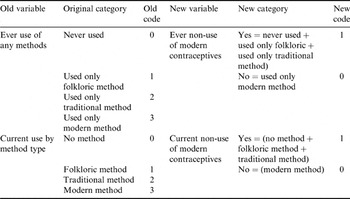
The two dependent variables used in the analysis were ‘ever non-use of modern contraceptives’ and ‘current non-use of modern contraceptives’. As shown in Table 1, the variables were constructed from the NDHS variables ‘ever use of any method’ (v302) and ‘current use by method type’ (v313). Never use of any method and ever use of traditional and folkloric methods were classified as ‘ever non-use of modern method’. This category was tagged ‘yes’ and coded ‘1’, whereas ever use of modern method was renamed ‘no’ and coded ‘0’ to generate a new variable called ‘ever non-use of modern contraceptives’. Similarly, for current use by method type, the traditional and folkloric methods were merged to form a ‘current non-use of modern method’ category, which was tagged ‘yes’ and coded ‘1’, while current use of modern methods was renamed ‘no’ and coded ‘0’. The variables were constructed this way with the sole aim of measuring the likelihood of ever non-use and current non-use of modern contraceptives in the two surveys.
Dependent variables: reclassification and recoding

Religious affiliation was the main independent variable employed in the analysis. The religious affiliation categories in 1990 (Catholicism, Protestantism, Islam, Traditional religion, no religion) and in 2008 (Catholicism, Other Christian, Islam, Traditionalist, others) were reconstructed dummy variables. A code of ‘1’ was assigned to a ‘yes’ response for each of the categories, while all other categories were coded ‘0’.
Potential confounding variables involved in the analysis are age, age at first marriage, education, employment, number of living children, ideal number of children, fertility preference, geopolitical region and place of residence. Wealth status was excluded because the 1990 survey data file did not include wealth status. Similarly, ethnicity was excluded owing to the inconsistencies between the categories in 1990 and 2008 surveys. Instead, education and occupation were considered proxies of wealth status. In the same vein region was used to represent ethnicity because the regions correspond to the ethnic pattern of the country. The Hausa dominate the north; the Yoruba occupy the south-west; the Igbos dominate in the south-east; and the Ijaws, Irhobos, Ishekiris and Efiks dominate the south-south, which was part of the south-east during the 1990 survey.
The analysis employed IBM SPSS version 20. The procedure involved univariate, bivariate and multivariate levels of statistical analysis. The univariate analysis presents a concise description of the socio-demographic characteristics of the respondents in the two surveys, although the significance of the difference between the proportions in the two surveys is highlighted. In addition, an independent t-test was used to point out the significance of the difference between the mean scores of selected continuous variables in 1990 and 2008. Bivariate level analysis involves the chi-squared test of association between religious affiliation and ever and current non-use of modern contraceptives. The multivariate analysis tests the effect of religious affiliations on ever and current non-use of modern contraceptives in unadjusted and adjusted logistic regression models. The adjusted models controlled for the confounding variables in order to determine the independent effects of religion on non-use of modern contraceptives. Logical association between the confounding variables and the dependent variables as highlighted in the literature influenced the selection. In addition, the observation of significant bivariate relationships between them and non-use of modern contraceptives contributed to the selection. Note that bivariate and multivariate tests of the association between religion and the two dependent variables were confined to sexually active reproductive aged women. The variable termed ‘sexually active’ (coded no=0 and yes=1) emanated from the merging of two variables: currently pregnant and abstinence. Respondents who indicated not abstaining from sex and who were not pregnant constituted sexually active, otherwise not sexually active. Although pregnant women could be sexually active, they were not included in this category because they did not need contraceptives given that they were already pregnant.
Results
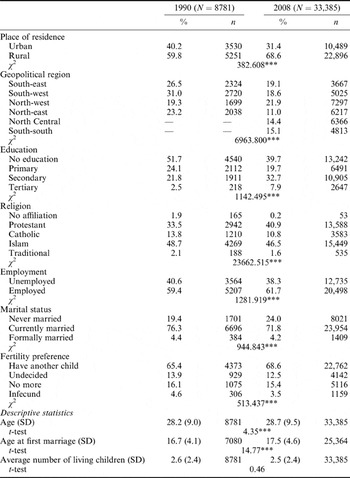
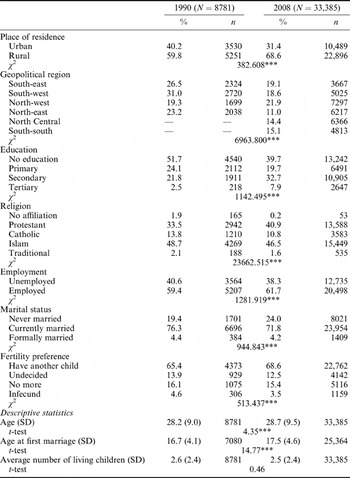
Table 2 presents the basic characteristics of the respondents. The majority of the sampled women were of rural residence and nearly evenly distributed across the four (in the 1990 survey) and six (in the 2008 survey) geopolitical regions of the country. Almost all the respondents indicated membership of one religious group or the other; they were mostly Christians (Protestants and Catholics) or Muslims. In other words, the three predominant religions among the respondents in both surveys were Islam, Catholicism and Protestantism. In the two surveys, roughly 2% of the respondents were Traditionalist. The proportion with no education declined from about 52% to roughly 40% between the two surveys (p<0.001), and most of the educated respondents indicated primary and secondary levels of schooling. On the other hand, the difference between the proportion of respondents employed in 1990 (59%) and 2008 (62%) was negligible (p<0.001). Over 70% were married in both surveys and the majority were sexually active. Traditional religion recorded the highest proportion sexually active (89.6%) in 1990, while Protestants (90.5%) indicated the same level in 2008 (p<0.001).
Percentage distribution of respondents by selected socio-demographic characteristics, NDHS 1990, 2008
SD, standard deviation.
*** p<0.001.
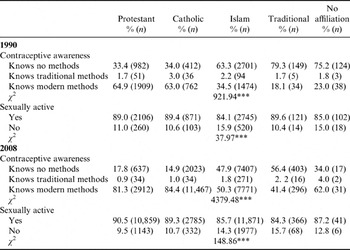
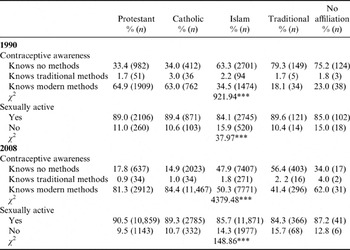
Table 3 shows the percentage distribution of respondents by contraceptive awareness, sexual activity, religious affiliation and survey year. It is apparent that in both surveys, of the three most popular religions, Muslims indicated the lowest level of awareness of modern contraceptives (35% in 1990 and 50% in 2008). However, the levels of modern contraceptive awareness amongst Protestants (65% in 1990 and 81% in 2008) and Catholics (63% in 1990 and 84% in 2008) were very high.
Percentage distribution of respondents by selected sexual and contraceptive variables and religious affiliation, NDHS 1990, 2008
*p<0.05; **p<0.01; ***p<0.001.
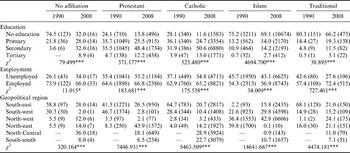
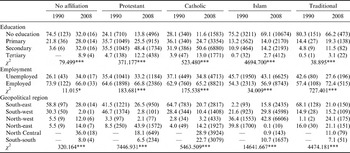
In Table 4, the analysis explored the association between religious affiliation and level of education, occupation status and geographical region. The proportion with no education was highest among Muslims (74.5% in 1990 and 69.1% in 2008) and Traditionalists (80.3% in 1990 and 66.2% in 2008) (χ 2 p<0.001). The proportions of women with primary, secondary and tertiary education were also lower amongst Muslims in both surveys (χ 2 p<0.001). In addition, the proportion of educated women in 1990 and 2008 did not suggest noticeable improvement in educational attainment in Islam (χ 2 p<0.001). However, amongst Protestant and Catholic Christians there was an appreciable improvement between the two surveys. For instance, in 1990, 5% (Protestants), 4% (Catholics) and 0.7% (Muslims) reported having tertiary level of education (χ 2 p<0.001). However, in 2008 12% (Protestants), 13% (Catholics) and 2.7% (Muslims) reported the same level of education (χ 2 p<0.001). Also, the proportion of women with secondary education improved significantly amongst Protestant and Catholic Christians (χ 2 p<0.001) but change amongst Muslims and Traditionalists was insignificant (χ2 p<0.001). A similar pattern occurred in the employment status of the Muslim respondents. Amongst the three major religions, Islam recorded the highest proportion of the unemployed (45.7% in 1990 and 43.1% in 2008) compared with their Protestant (35.4% and 33.2% in 1990 and 2008 respectively) and Catholic (37.1% in 1990 and 34.8% in 2008) counterparts (χ 2 p<0.001).
Percentage distribution of respondents by selected socioeconomic characteristics and religious affiliation, NDHS 1990, 2008
*p<0.05; **p<0.01; ***p<0.001.
The congruence between geopolitical zones and ethnicity in Nigeria is clearly shown in the 1990 survey. Islam recorded the highest proportion of respondents in the north-west (36.4%) and north-east (39.8%) but the least in the south-east (2.2%) and south-west (21.6%) (p<0.001). However, Christianity recorded the highest proportion in the south-east (Protestants, 42%; Catholics, 69%) and south-west (Protestants, 47%; Catholics, 28.4%) (p<0.001). In addition, it is obvious that Catholicism is the most popular religion in the south-east while Protestantism predominates in the south-west. Although the pattern of geopolitical distribution of the respondents in the 2008 survey is not quite clear owing to the splitting of the regions into smaller units, it is apparent that Islam and Christianity remain predominant in the north and south respectively (p<0.001). This pattern is consistent with the ethnic landscape of Nigeria: Islam predominates in the north while Christianity is the most popular religion in the south. The implication is that the Hausas in the north are predominantly Muslims while Christianity is the major religion amongst the Yoruba and Igbo ethnic groups in the south-west and south-east.
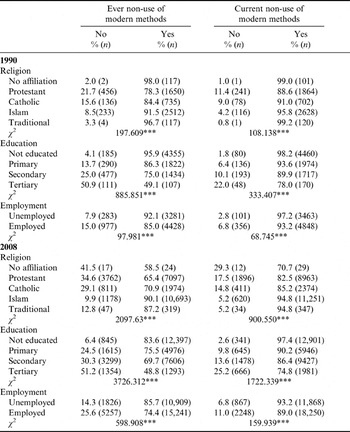
Table 5 shows the bivariate association between religious affiliation and non-use of modern contraceptives. First, the χ 2 test of association shows that religion was significantly associated with non-use of modern contraceptives in both surveys (p<0.001). Non-use of modern contraceptives was astronomically high in the two survey samples and a higher proportion of women in various religions reported non-use of modern contraceptives in 1990 than 2008. Among the three popular religions, the highest level of ever and current non-use of modern contraceptives was reported amongst Muslims in the 1990 and 2008 surveys. Reported ever and current non-use of modern contraceptives was slightly lower amongst Protestants than Catholics in both surveys. Another contrast exists amongst the ‘no affiliation’ group compared with the three popular religions. Women who indicated no religious affiliation reported the highest level of ever and current non-use of modern contraceptives in 1990, but they reported the lowest level of non-use in 2008.
Percentage distribution of sexually active respondents by religion and non-use of contraceptives by survey year, NDHS 1990, 2008

*p<0.05; **p<0.01; ***p<0.001.
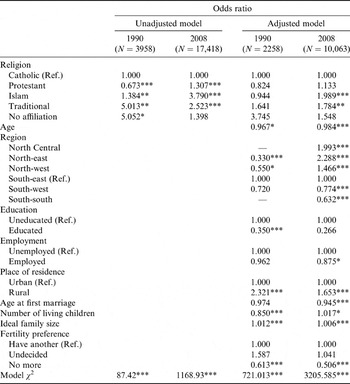
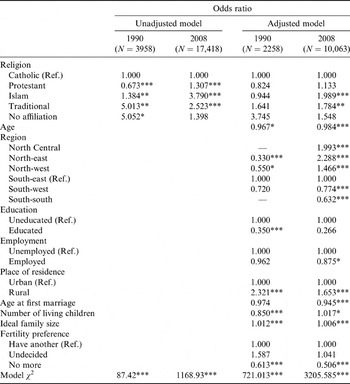
Table 6 shows the unadjusted and adjusted odds ratios of logistic regression examining the association between religious affiliation and ever non-use of modern contraceptives. Columns one and two show the unadjusted odds ratios for the 1990 and 2008 surveys respectively. Catholicism is the reference category because of the anti-modern contraception theological position of this Christian denomination. Protestantism, Islam and Traditional religion significantly predicted ever non-use of modern contraceptives in the two surveys. It is apparent that Protestants, Muslims (Islam) and Traditionalists were more likely to report non-use of modern contraceptives relative to Catholics. In the odds ratios given in the third and fourth columns of Table 6, the models adjusted for the confounding variables, including: age, age at first marriage, education, occupation, place of residence, region, ideal number of children, fertility preference and number of living children. Interestingly, the significance in the 1990 logistic regression model dropped, and none of the religious categories significantly predicted non-use of modern contraceptives. In contrast, Islam (OR=1.989, p<0.001) and Traditional religion (OR=1.784, p<0.05) significantly predicted non-use of modern contraceptives in the 2008 survey data. Thus, members of the two religious groups were more likely to report ever non-use of modern contraceptives compared with their Catholic counterparts.
Unadjusted and adjusted odds ratios of logistic regression on the association between religious affiliation and ever non-use of modern contraceptives among sexually active reproductive aged women in Nigeria, NDHS 1990, 2008
Ref., reference category. —, category not included in survey.
*p<0.05; **p<0.01; ***p<0.001.
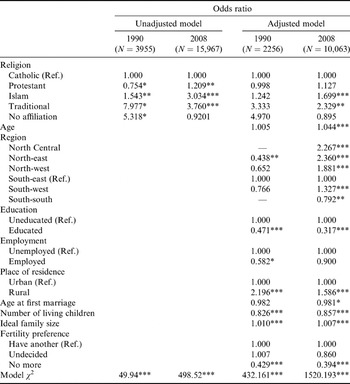
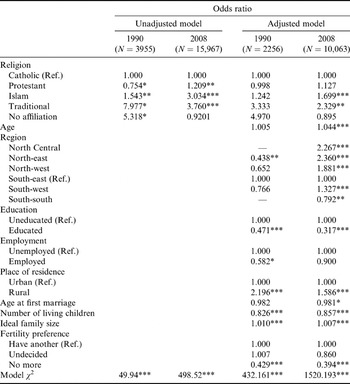
Table 7 shows the unadjusted and adjusted odds ratios of logistic regression examining the association between religious affiliation and current non-use of modern contraceptives in the two surveys. Both unadjusted and adjusted odds ratios demonstrated a pattern similar to that of ever non-use of modern contraceptives in the two surveys. Amongst the predominant religions, Protestants were less likely in 1990 but more likely in 2008 to report current non-use of modern contraceptives. However, Muslims and Traditionalists were more likely to report current non-use of modern contraceptives relative to Catholics in the two survey samples. Conversely, after adjusting for the confounding variables, no religious affiliation significantly predicted current non-use of modern contraceptives in the 1990 sample. Thus, the significant associations observed in the unadjusted model were spurious. In contrast, Islam and Traditional religion significantly predicted current non-use of modern contraceptives in the 2008 survey. Muslims (OR=0.699, p<0.001) and Traditionalists (OR=2.329, p<0.05) were more likely to report current non-use of modern contraceptives compared with their Catholic counterparts.
Unadjusted and adjusted odds ratios of logistic regression examining association between religion and current non-use of modern contraceptives among sexually active reproductive aged women in Nigeria, NDHS 1990, 2008
Ref., reference category; —, category not included in survey.
*p<0.05; **p<0.01; ***p<0.001.
Discussion
The analysis has tested the hypothesis that religious affiliation influenced non-use of modern contraceptives differently in Nigeria between 1990 and 2008. This study has examined the influence of religion on contraception from two main perspectives. The perspectives argue that religious influence on contraceptive use may be traced to differences in doctrinal positions of various religious groups on contraception (the particularized hypothesis) or to the effects of differences in the socioeconomic characteristics of the adherents of different religions (the characteristics hypothesis) (Hirsch, Reference Hirsch2008; Zhang, Reference Zhang2008). Thus, this study has examined whether the high level of non-use of modern contraceptives in Nigeria is the product of the influence of either the doctrinal stances of the popular religions in the country or the socioeconomic characteristics of the adherents.
The findings of almost all previous studies available on the subject in Nigeria argue in favour of the particularized hypothesis (Agadjanian et al., Reference Agadjanian, Yabiku and Fawcett2009; Monjok et al., Reference Monjok, Smeeny, Ekabua and Essien2010; Olugbenga-Bello et al., Reference Olugbenga-Bello, Abodunrin and Adeoni2011; Odusina et al., Reference Odusina, Ugal and Olaposi2012; Akintunde et al., Reference Akintunde, Lawal and Simeon2013). The bivariate findings of this study appear to corroborate the previous findings in specific ways owing to the significant association observed between religious affiliation and non-use of modern contraceptives in the chi-squared analysis. Although the level of non-use of modern contraceptives is very high across the three predominant religions in the country, Muslims reported the highest proportion of ever and current non-use in both surveys. At the bivariate level of analysis, Islam appears to have the strongest negative influence on contraceptive behaviour of reproductive aged female adherents in Nigeria, and they tend to be more averse to contraception than their non-Muslim counterparts (Envuladu et al., Reference Envuladu, Agbo, Mohammed, Chia, Kigbu and Zoakah2012).
The logistic regression analysis of the baseline data set (1990 survey) demonstrates an important phase of religious interaction with modern contraception in Nigeria. The unadjusted odds ratios indicate that all the religious affiliations significantly predicted ever and current non-use of modern contraceptives. Women in all religious groups, and those who indicated no affiliation, except Protestants, were more likely to report non-use of modern contraceptives compared with Catholics. However, after adjusting for the confounding variables none of the religious categories significantly predicted both ever and current non-use of modern contraceptives. Therefore, it is plausible that the bivariate statistical association between religion and non-use of modern contraceptives, corroborated by the unadjusted logistic regression odds ratios, was spurious. In other words, the initial association was a function of the interaction of the confounding factors. Thus, the findings of the analysis of the 1990 data set provide evidence in support of the characteristic hypothesis in Nigeria, as previously reported by Olaitan's study in south-western Nigeria in which he argues that religion is not a significant predictor of family planning (Olaitan, Reference Olaitan2011). Hence, the data set suggests that the doctrinal positions of the various religions did not exert any significant independent influence on modern contraception amongst reproductive aged women in Nigeria in the 1990s.
Conversely, the findings from the logistic regression analysis of the 2008 data suggest that, amongst the three predominant religions in the country, Muslims were more likely to report non-use of both ever and current non-use of modern contraceptives compared with Catholic Christians. Bivariate analysis also supports this observation. This situation did not change even after adjusting for confounding variables. It thus appears that the results corroborate previous reports that adherents of Islam are more likely to oppose modern contraception than their counterparts in other religions (Agadjanian et al., Reference Agadjanian, Yabiku and Fawcett2009; Izugbara & Ezeh, Reference Izugbara and Ezeh2010; Izugbara et al., Reference Izugbara, Ibisomi, Ezeh and Mandara2010; Envuladu et al., Reference Envuladu, Agbo, Mohammed, Chia, Kigbu and Zoakah2012; Akintunde et al., Reference Akintunde, Lawal and Simeon2013). Although Islam as a religion is not categorically opposed to contraception, ignorance among adherents that contraception is permissible in Islam and the emphasis on large family size may account for the higher odds of reporting non-use of modern contraceptives in the sample population (Edewor, Reference Edewor2005; Srikanthan & Reid, Reference Srikanthan and Reid2008). This argument is supported by the analysis of the socioeconomic characteristics of the memberships of the religions, which indicates that Muslims recorded the highest level of illiteracy. In addition, improvement in educational attainment amongst them was insignificant relative to that of the other two major religions over the last two decades. This suggests that the rate of enlightenment has been quite slow in Islam in Nigeria and primordial reproductive behaviour such as non-use of modern contraceptives still predominates among its adherents in the country. Also, the majority of Muslims in Nigeria reside in the northern region where Islamic fundamentalism that is opposed to Western civilization predominates (Wusu, Reference Wusu2012). In the last one and half decades, Islamic fundamentalists have stepped up their activities and have been wielding great influence on adherents against Western civilization in that part of the country. Yeatman and Trinitapoli's (Reference Yeatman and Trinitapoli2008) observation in rural Malawi that the attitude of religious leaders about family planning, rather than denominational stance, is strongly associated with the practice among their congregants corroborates this argument. Hence, it may be erroneous to conclude that Islamic aversion to contraception accounts for the adherents' reported higher odds of non-use of modern contraceptives. Rather, the relatively low socioeconomic status of the adherents and the strong influence of fundamentalists on their attitude towards contraceptives are more plausible explanations.
In a similar vein, Traditional religion indicated a significant association with non-use of modern contraceptives in 2008, suggesting that this religious affiliation is a significant predictor of the variable. Nevertheless, the persistence of poor socioeconomic status prevalent amongst the adherents relative to the improved status of Protestants and Catholics might have influenced the significant positive association observed between Traditional religion and non-use of modern contraceptives. This argument is consistent with the findings of a previous study in Ghana that, contrary to the Western literature's association of African Traditional religion with pronatalist fertility behaviour, the religion does not constitute a significant barrier to family planning (Adongo et al., Reference Adongo, Phillips and Binka1998).
The inability of Protestantism to significantly and independently predict non-use of modern contraceptives after adjusting for the confounding socioeconomic factors in both surveys may be because of the absence of a significant difference in socioeconomic status between them and Catholics. For instance, the difference in educational attainment between the two religious affiliations was apparently negligible in both surveys. In addition, a similar degree of improvement in educational attainment occurred amongst Protestants and Catholics between 1990 and 2008. Hence, the significant association between Protestantism and non-use of modern contraceptives noticed in the unadjusted models disappeared in the adjusted models. However, in comparison with Catholics, Muslims and Traditionalists indicated significantly lower proportions with secondary and tertiary education in 1990 and 2008. The marked difference in socioeconomic characteristics between Muslims, Traditionalists and Catholics may be responsible for the significant association exhibited by Islam and Traditional religions in the adjusted models.
One could advance, therefore, based on the analysis here, that Islam and Traditional religions significantly predicted non-use of modern contraceptives in Nigeria. However, the persistence of the poor socioeconomic characteristics of Muslims and Traditionalists relative to the higher socioeconomic status of Catholics may account for the significance of the two religions as predictors of non-use of modern contraceptives. However, the fact that there is no significant difference in the socioeconomic status of Protestants and Catholics obliterated the influence of Protestantism on non-use of modern contraceptives. Therefore, the findings of this study appear more supportive of the characteristic hypothesis than the particularized hypothesis.
It is important to highlight a few limitations of the study. In the first instance, the data analysed were cross-sectional and the usual difficulty of establishing a cause–effect relationship holds. Secondly, the fact that the analysis could not include religiosity as a variable because the DHS surveys do not measure this limited the study (Agadjanian, Reference Agadjanian2013). Thus, the analysis could not estimate its influence on non-use of modern contraceptives, which might have provided further illumination on the modern contraceptive behaviour of reproductive aged women in Nigeria. Also, the study might have suffered some limitations from the broad categorizations of religious affiliations into five groups. The study employed this categorization owing to the negligible cases of other minority religious groups in the country. The consolation is that the majority of such groups fall into the broad categories utilized here.
Nevertheless, the study has significant scientific content to draw some valid conclusions that should make a substantial contribution to effective programme intervention on the task of promoting modern contraceptives in Nigeria. The analysis suggests that a significant increase occurred in the level of awareness of modern contraceptives amongst adherents of the popular religions in Nigeria, over the last two decades, but non-use remains very high. Amongst the three popular religious affiliations in Nigeria, religion could not independently predict non-use of modern contraceptives in 1990. However, Islam and Traditional religions significantly predicted non-use of modern contraceptives in 2008 (p<0.05). Muslim and Traditionalist women are less likely to be educated and less likely to be employed. Therefore, improving women's socioeconomic status is an imperative in the promotion of modern contraception in Nigeria. Education and employment are critical in this regard and adherents of Islam and Traditional religions require special attention.