Introduction
Garry oak, Quercus garryana Douglas ex Hooker (Fagaceae), ranges from southwestern British Columbia (BC) south to central California (Stein Reference Stein1990) and is the only oak species native to BC. In BC, Garry oak is restricted to the southeast coast of Vancouver Island, the southern Gulf Islands, and two small stands on the adjacent mainland (Hosie Reference Hosie1979; Stein Reference Stein1990; Farrar Reference Farrar1995). Garry oak ecosystems contain the largest number of rare plant species of any terrestrial ecosystem in BC (Fuchs Reference Fuchs2001) and have been declining dramatically due to urban encroachment and invasions of exotic plant species (Meidinger and Pojar Reference Meidinger and Pojar1991; Erickson Reference Erickson1996).
To date, little information has been published on Garry oak acorn crop sizes (Peter and Harrington Reference Peter and Harrington2009). Acorn production by oaks is extremely variable among years and within stands (Beck Reference Beck1977; Fenner Reference Fenner1991; Koenig et al. Reference Koenig, Mumme, Carmen and Stanback1994) and many acorns are abscised during development (Stephenson Reference Stephenson1981). Garry oak appears to produce mast (large) acorn crops at 2–3-year intervals (Peter and Harrington Reference Peter and Harrington2009).
Conservation efforts are currently underway to protect and maintain the estimated 1%–5% of the original Garry oak ecosystems remaining on southern Vancouver Island (Fuchs Reference Fuchs2001). Viable, healthy acorn crops, and successful seedling recruitment are needed to achieve this goal. Unburied acorns can suffer 53%–97% predation from insects, birds, and mammals, and seedling mortality can reach 78% during periods of drought (Fuchs et al. Reference Fuchs, Krannitz and Harestad2000; Mangini and Perry Reference Mangini and Perry2004). In addition, seed-feeding insects can reduce the number and viability of acorns on trees (Stephenson Reference Stephenson1981; Oliver and Chapin Reference Oliver and Chapin1984; Crawley and Long Reference Crawley and Long1995; Branco et al. Reference Branco, Branco, Merouani and Almeida2002). Insect damage to acorns by weevils, Curculio Linnaeus (Coleoptera: Curculionidae), and caterpillars (Lepidoptera) is widespread among species of Quercus Linnaeus and combined acorn infestation by these insects has been reported as high as 80% (Brezner Reference Brezner1960; Beck Reference Beck1977; Gibson Reference Gibson1982; Dunning et al. Reference Dunning, Paine and Redak2002; Mangini and Perry Reference Mangini and Perry2004).
In BC, two insects native to western North America, the filbert weevil, Curculio occidentis (Casey) and the filbertworm, Cydia latiferreana (Walsingham) (Lepidoptera: Tortricidae), are known to attack Garry oak acorns (Furniss and Carolin Reference Furniss and Carolin1977), but quantitative estimates of their damage and impact on Garry oak recruitment is unknown. Filbert weevil females lay a single egg into a hole they chew in the acorn pericarp and then cover the egg with a frass plug. Filbert weevil eggs reared in the laboratory at 25°C hatch in about 10 days (Rohlfs Reference Rohlfs1999). Filbertworms, on the other hand, glue their eggs individually to the surface of the acorn. The eggs hatch in 8–11 days, and the larvae bore into the acorn (Dohanian Reference Dohanian1940). Larvae of both species feed inside the kernel, and the mature larvae bore out of the acorn, drop to the ground, and burrow into the soil, where they overwinter as mature larvae. We are not aware of any published research on the amount of damage caused by C. occidentis and C. latiferreana to Garry oak acorns while the acorns are still on the tree, or the effect of this damage on germination success.
In this paper we report on: (1) the amount of damage caused by C. occidentis and C. latiferreana to Garry oak acorns in low and high acorn crop years; (2) the spatial distribution of acorns infested by each of these insects within the crown of Garry oak trees; (3) the effect of feeding damage caused by these insects on acorn germination; and (4) how these two acorn-feeding insects may affect recruitment of Garry oak in BC.
Materials and methods
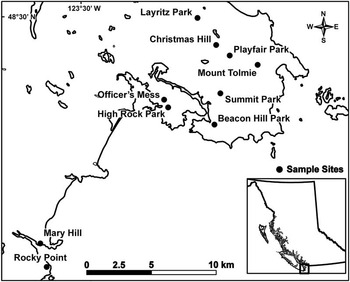
The study was conducted from May to October in 1996, 1997, and 1998 in the Districts of Metchosin and Saanich, the city of Victoria and the other municipalities, collectively referred to in this paper as the Greater Victoria area, at 10 study sites (Fig. 1). Acorns were sampled by four methods (acorn traps, weekly collections, strata sampling, and mass collection) to determine acorn health (including when acorn abortion occurs), infestation rates by C. occidentis and C. latiferreana by crown level, direction, and year, and the effects of feeding on acorn germination and seedling growth during the first year. The four sampling methods are described below. The same trees were not necessarily sampled every year, because acorn production on Garry oak varies from year to year.
Location of the 10 Garry oak study sites in the Greater Victoria area on Vancouver Island, British Columbia, 1996–1998.

Acorn abortion
Acorn traps were used to determine when acorns were aborted during the growing season. Three wire frame traps, each with a surface area of 0.25 m2, were placed under 12 randomly selected Garry oak trees at Mary Hill and Rocky Point Canadian Department of National Defence properties, for a total of 72 traps. These locations were selected for the acorn traps because it was unlikely that the traps would be disturbed. Each trap was lined with 57 × 92 cm, 34 kg, 2.75-mm transparent polyethylene plastic bags (Unisource Canada, Victoria, BC, Canada) with small holes for drainage. A funnel-shaped plastic mesh cover was placed inside the trap, allowing acorns to fall into the trap but discouraging predation on the acorns in the trap by birds and mammals.
In 1997, acorn traps were set up on 15 July. Acorns were collected from the traps once at the end of acorn maturation, on 16 September from Mary Hill and on 23 September from Rocky Point. In 1998, the traps were set up at the same two locations on 14 July and collections were made weekly from 21 July to 29 September (a total of 11 weeks). All acorns were checked visually for evidence of attack by the filbert weevil and filbertworm (eggs, entrance and exit holes) and none had signs of attack by either insect. Thus, the acorns were sorted into two categories: aborted (nonviable) and apparently healthy. Aborted acorns were identified by small caps with little or no pericarp, whereas healthy acorns appeared to be developing normally, though we did not confirm this by dissection.
Insect damage versus time of season and acorn crop
Acorn infestation rates were assessed by weekly collections of acorns starting 22 July 1996, 24 June 1997, and 23 June 1998, when young acorns began to develop. Infestation rates recorded time of attack, stage of development, and amount of damage caused by C. occidentis and C. latiferreana. Sampling continued for 10 weeks in 1996 and 15 weeks in both 1997 and 1998. At each of the 10 study sites, 15 acorn-producing trees, with crowns accessible by 7.5-m long aluminium telescoping pole pruners, were chosen as sample trees. The 15 trees were randomly divided into five groups of three trees each. Each week, 10 acorns were collected, using the telescoping pole pruner, from one group of three sample trees at each of the 10 study sites (total of 300 acorns per week). Sampling of the five groups of three trees each was rotated, with a different group being sampled each week. The acorns were removed from the branches, placed into plastic bags, and stored at 4°C until processing. Infestation rates by the two insect species among years were compared using one-way analysis of variance (ANOVA), and interactions between the two insects within each year were compared using chi-square analysis (SPSS version 9, SPSS Inc., Chicago, Illinois, United States of America).
Distribution of insect attack in the crown
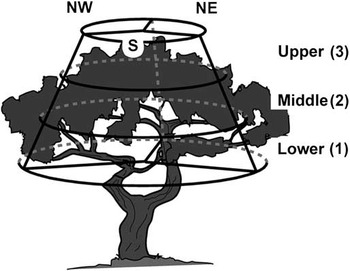
The within-crown distribution of infested acorns was determined from samples collected during peak filbert weevil and filbertworm activity, which occurred from 8–15 September 1997, and 26–28 August 1998. Six trees were sampled from four plots in 1997 (Rocky Point [3], Christmas Hill [1], Officer's Mess [1], and Layritz Park [1]) and 24 trees were sampled from four plots (Rocky Point [10], Christmas Hill [8], Officer's Mess [4], and High Rock Park [2]) in 1998 and a total of 532 and 2160 acorns were collected, respectively. Each tree was divided into nine sampling strata with three crown levels (lower-crowns, middle-crowns, and upper-crowns) and three horizontal directions (northeast [NE], south [S] and northwest [NW]) (Fig. 2) and 10 acorns were collected from each stratum (total of 90 acorns) from each sample tree. We used this particular design because it had been used previously to determine spatial distribution of filbert weevil and filbertworm in pecans (Carya illinoinensis (Wangenheim) Koch) (Boethel et al. Reference Boethel, Eikenbary, Bolte and Gentry1974) and Quercus agrifolia Née acorns (Lewis Reference Lewis1992) and this allowed us to compare our results with theirs.
Garry oak crown sampling levels and directions used during strata sampling.

The data were analysed separately for the number of acorns (per sample of 10 acorns) infested by C. occidentis, C. latiferreana, or both insect species using a four-factor mixed model ANOVA. A randomised complete block design was used for the analysis, in which each tree was considered a block, and crown directions and levels were treatments with a split-plot effect (year). The factors were: crown level (L: lower, middle, and upper), crown direction (D: NE, S, and NW) (Fig. 2), year (Y: 1997 and 1998), and trees (T: 6 in 1997, 24 in 1998). Trees (blocks) were considered as random, while L, D, and Y were fixed factors. The general linear model (GLM) (SAS Institute Inc., Cary, North Carolina, United States of America) used was: 

 . Residuals were tested for normality (Shapiro-Wilk) and homogeneity of variance (Bartlett's test) and when required, data were transformed to satisfy these two requirements. The mean square for trees within year (T(Y)) was used to test the significance of year, and the mean square for L × D × T(Y) (= residual error) was used to test the significance of crown level, direction, trees within year, and their interactions. Least squares means were compared by Bonferroni's multiple comparison test for those factors found significant in the GLM.
Acorn processing
Of the 29 899 acorns collected by weekly sampling, strata sample, and mass collection (see below), about 75% (22 219 acorns) were processed to record acorn size (length, width measured to the nearest 0.01 mm) using an electronic caliper (Digimatic CD-6: Mitutoyo Corporation, Tokyo, Japan) and were examined to record the presence of filbert weevil oviposition punctures and eggs; filbertworm eggs; and entrance holes, larval feeding, and emergence holes by both species. Emergence holes of the filbert weevil larvae are round with uneven edges, while those of the filbertworm larvae are oval in shape (as observed in a prior experiment in which larvae from infested acorns were reared to adults to determine species). After external examination, each acorn was split longitudinally using a cone cutter (a sharp knife affixed to a stationary base) and the kernel of the acorn was examined for insect damage. Insect feeding and the resulting damage was visually estimated using the scale developed by Swiecki et al. (Reference Swiecki, Bernhardt and Arnold1991) where 0 = no damage, 1 = trace to 2.5%, 2 = >2.5% to 20%, 3 = >20% to 50%, 4 = >50% to 80%, 5 = 80% to 97.5%, and 6 = >97.5% damage to the acorn kernel. All acorns from weekly and strata collections were dissected, as were the mass-collected acorns used to establish the regression equations. Acorns used in the germination test in 1997 were not dissected. Acorns collected in the acorn traps were not measured, and infestation was determined by external visual examination only.
Effect of insect damage on germination and seedling growth
We expected that acorn density would decrease as the level of feeding damage increased and thus acorn size and weight could be useful for estimating the damage class of acorns without the need for dissection. Acorns classified in this way could then be used to test the effect of damage class on germination and seedling growth.
Mass collections of mature acorns were made 26–29 September 1997 and on 5, 6, and 20 October 1998, after acorns had dropped to the ground. Acorns were collected under 10–15 trees with good acorn production. In 1997, only three sites produced enough acorns for mass collection and a total of 3000 acorns (1000 per site) were collected. A total of 3500 acorns (500 per site) were collected from seven study sites in 1998. An additional 10 000 acorns (5000 in each of 1997 and 1998) were collected from the study sites and from other areas.
Subsamples of ∼2500 and 1500 acorns, randomly chosen from the samples of 8000–8500 mass-collected acorns in each of 1997 and 1998, respectively, were measured for length and width, weighed to the nearest 0.01 g (Model BA 610, Sartorius GMBH, Gottingen, Germany), dissected as previously described, and classified into three categories using a modified version of the categories developed by Swiecki et al. (Reference Swiecki, Bernhardt and Arnold1991): healthy (no damage), light to moderate damage (trace–50%), and severe damage (>50%). Linear regression models (SPSS version 9, SPSS Inc., Chicago, Illinois, United States of America) were developed to determine level of damage (dependent variable) from acorn length and weight (independent variables) in 1997, and from acorn length, width and weight in 1998.
The regression models were applied to a third and different random subsample of acorns from each damage class in 1997 and 1998, respectively. The length, width, and weight of the acorns were measured and used in the regression equation to estimate the damage category (healthy, light to moderate, or severe damage) of each acorn without having to dissect them.
1997. Ninety intact acorns (not dissected) were chosen randomly from each of the three damage categories and planted 1 November 1997, in styroplugs (Ventblock®45 (615A) 45 cavity block at 336 ml per block, Beaver Plastics Ltd., Edmonton, Alberta, Canada). The acorns were kept under a covered shelter (shade house) at the Pacific Forestry Centre to imitate “natural” conditions for Garry oak recruitment without exposing them to ground predators and were watered twice a week. Acorns were checked at weekly intervals starting 1 December 1997, and the date of germination recorded. Linear regression chi-square analysis (Steel and Torrie Reference Steel and Torrie1980) was applied to the data to determine the effect of predicted damage category (healthy = 1, light to moderate = 2, and severe = 3) on germination success. Seedling growth was recorded to the nearest mm weekly for 7 months until the end of the first growing season (28 September 1998). Mean height of seedlings from healthy and damaged acorns were compared at each of the 33 weekly intervals by independent samples t-test (SPSS version 9, SPSS Inc., Chicago, Illinois, United States of America).
1998. Due to time constraints, a faster method of germination potential testing was used in 1998 (Bonner Reference Bonner1984; Bonner and Vozzo Reference Bonner and Vozzo1987). This method is routinely used for official germination testing of acorns (Association of Official Seed Analysts 1978), and involved: (1) cutting the acorn in half (cross section) and discarding the half with the cup scar; (2) peeling the pericarp from the remaining half and placing the acorn, cut side down, on a moist blotter paper; and (3) incubating the cut acorns at 25°C with photoperiod L:D 8:16 for 28 days, keeping the blotter paper moist.
An acorn was scored as germinated if both radicle and shoot exhibited growth. One hundred acorns from each of the three damage categories were tested in this manner, and the number of acorns that germinated within 28 days recorded. Linear regression chi-square analysis (Steel and Torrie Reference Steel and Torrie1980) was used to determine the effect of damage on germination success.
Results
Between July 1996 and October 1998, a total of 31 577 acorns were collected: 1678 acorns (338 in 1997 and 1340 in 1998) in acorn traps, 13 399 acorns (10 879 from weekly sampling, and 2520 from strata sampling) were collected from trees, and the remaining 16 500 were mass collected from the ground. Five thousand acorns in each of 1997 and 1998 were used to generate regression equations to estimate the levels of feeding damage, and 270 acorns (1997) and 300 (1998) were used in the germination tests.
Acorn abortion
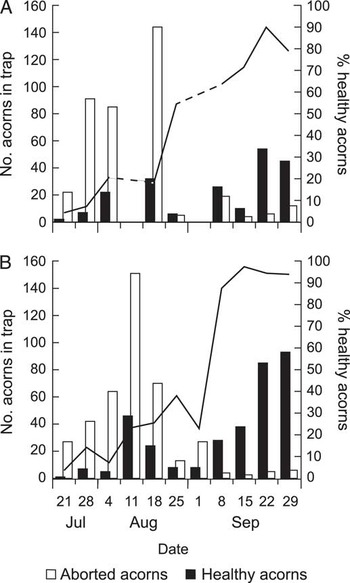
The percentage of aborted acorns was 78% in 1997 (a poor crop year) and 59% in 1998 (a mast year), and the proportion of aborted acorns was almost identical at both locations (Fig. 3A, 3B). There were no visible signs of insect attack in any of the acorns in the traps so nonaborted acorns were considered healthy, although we did not confirm this by dissection.
Number and percentage of aborted and other (healthy and possibly some infested) acorns obtained during weekly collections from acorn traps in Victoria, British Columbia, in 1998 at (A) Mary Hill and (B) Rocky Point. Bars = numbers of acorns; lines = % healthy acorns.

In 1998, about 90% of aborted acorns dropped from the trees between 21 July and 1 September, with peak numbers in mid-August. Healthy acorns started dropping slightly later, and the proportion of healthy acorns gradually increased in the traps until the end of August, after which almost all the acorns collected in the traps were classified as healthy (Fig. 3A, 3B).
Insect damage versus time of season and acorn crop
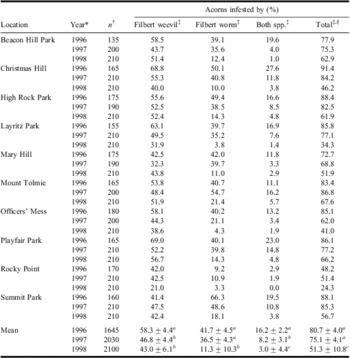
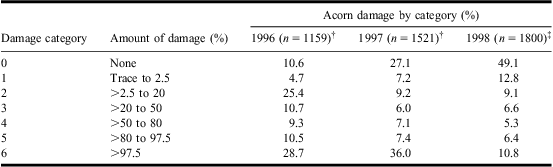
During the 3 years of investigation, the only insects we found associated with Garry oak acorns; either during sampling, dissection, or rearing; were C. occidentis and C. latiferreana. The average total (overall) infestation rates by these two insects for 1996, 1997, and 1998 were 80.7%, 75.1%, and 51.3%, respectively (Table 1). In all cases, for all locations, total infestation was lowest in 1998 (a mast year), and at eight of the ten sites infestation rates were highest in 1996 (Table 1), the year with the poorest acorn crop. The highest total infestation rate, among all sites and years, was 91.4% (Christmas Hill) in 1996 (poor crop year) and the lowest was 24.3% (Rocky Point) in 1998 (mast year).
Percentage of Garry oak acorns infested by filbert weevil and filbertworm, collected weekly during the final 7 weeks of the growing season, during the 3 years of the study, by site and year at 10 sites in the Greater Victoria area, British Columbia.

*1996 and 1997 were poor acorn crop years, 1998 was a mast crop year.
†n = total number of acorns collected during the last 7 weeks of the collection period (12 August–26 September 1996, 12 August–30 September 1997, 11 August–29 September 1998) when insect activity was at its peak; from 15 sample trees in each year of the study.
‡Means ± SE among years within acorn infestation categories followed by the same superscript letter were not significantly different. Bonferroni's test (P < 0.05).
§Total infestation = (number of acorns infested by filbert weevil + number of acorns infested by filbertworm) − number of acorns infested simultaneously by both filbert weevil and filbertworm.
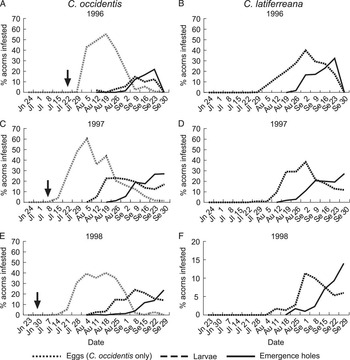
Infestation by the filbert weevil (F 2,739 = 13.57, P < 0.001), filbertworm (F 2,739 = 82.93, P < 0.001), both species within the same acorn (F 2,739 = 42.27, P < 0.001), and total infestation (F 2,737 = 88.58, P < 0.001) differed significantly among years. The mean filbert weevil infestation was highest in 1996 (58.3%) and did not change significantly from 1997 to 1998. There were significantly fewer filbertworm-infested acorns (11.3%) in 1998 than in the previous 2 years (Table 1, Fig. 4A, 4C, 4E).
Infestation of Quercus garryana acorns by Curculio occidentis and Cydia latiferreana indicated by eggs, larvae, and emergence holes, from acorn; collected during weekly sampling in the Greater Victoria area, in 1996, 1997, and 1998. Arrows indicates date when weevil feeding/oviposition holes were first observed on the acorns. Oviposition by C. latiferreana is not indicated because the larvae hatch and burrow into the acorn about 1 week after the eggs are laid and the eggs frequently fell off when the acorns were collected.

Filbert weevil attacked earlier in the season, with oviposition starting around the beginning of July, and peaking in late July and August (Fig. 4A, 4C, 4E). The majority of the eggs were laid in the middle (76.8%) and cap end (19.9%) of the acorn, and only rarely (3.3%) at the distal end. Filbert weevils attacked an average of 43%–58% of acorns each year, regardless of size of the crop (Table 1). In contrast, filbertworm attack began later in the season (late July to early August), and attacked fewer acorns (11%–42%) (Table 1, Fig. 4B, 4D, 4F). Filbertworm attack was in inverse proportion to size of the acorn crop, being higher in the two poor crop years compared with the mast year (Fig. 4B, 4D, 4F).
In poor acorn crop years, about one-third of the acorns were in the highest damage category (category 6), while in the good crop year (1998) only about 11% of the acorns were in this category (Table 2). About one-sixth and one-third of the acorns collected were undamaged in 1996 and 1997, respectively, while in 1998 nearly half of the acorns collected were undamaged.
Percentage of acorns damaged by filbert weevil and filbertworm, by damage categories, in the Greater Victoria area during the last 7 weeksFootnote * of weekly collection in 1996, 1997, and 1998.
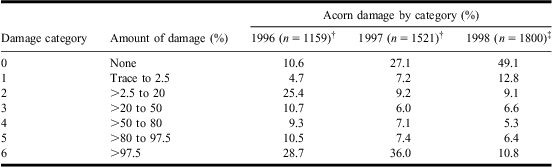
* Peak activity period for the insects.
† Poor acorn production.
‡ Mast acorn production.
Distribution of insect attack in the crown
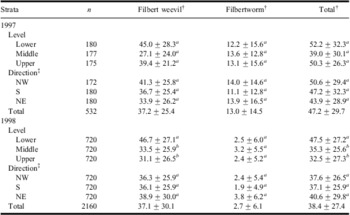
Filbert weevil. Weevil infestations were highest (number of weevils per 10 acorns) in the lowest crown level in both years but the difference among crown levels was significant only in 1998 (Table 3). Further evidence that distribution of weevil infestation among crown levels was inconsistent between the 2 years was the significant interaction between crown level and year (F 2,112 = 3.19, P = 0.045). Weevil infestation did not differ significantly among the three crown directions (NE, S, and NW) and there was no significant interaction between crown direction and crown level. Tree-to-tree variation in weevil infestation within years (T(Y)) was highly significant (F 2,112 = 16.67, P < 0.001), as were the effects of crown level (F 2,112 = 18.41, P < 0.001) and the interaction between crown level and tree within year (F 2,112 = 2.62, P < 0.001).
Average percentage of Garry oak acorns infested by the filbert weevil or filbertworm in different crown strata in 1997 and 1998Footnote *.

* Six trees (n = 532 acorns) were sampled in 1997 and 24 trees (n = 2160 acorns) in 1998.
† Within columns, year and strata, means ± SD followed by the same superscript letter are not significantly different. Bonferroni's test, P < 0.05.
‡ NW, northwest; S, south; NE, northeast.
Filbertworm. The residuals of the raw data on filbertworm-attacked acorns did not meet the assumptions of normality (Shapiro-Wilk, W = 0.99, P = 0.056) and equal variance (Bartlett's test, χ 2 = 17.53, df = 17, P = 0.419) so power transformation (x + 0.1)0.08 was used. The number of attacks was significantly higher (F 1,112 = 11.03, P = 0.003) in 1997 (1.28) (a poor crop year) than in 1998 (0.27) (a mast year) and varied significantly from tree to tree (T(Y)) (F 28,112 = 6.15, P < 0.001) but did not differ significantly among crown levels or directions, and no interactions were significant (Table 3).
Co-occurrence of both insects in the same acorns. Only 13 of 30 trees sampled and only 45 of the 2692 acorns collected by strata sampling (1.7%) contained both filbertworm and filbert weevil larvae. Attempts to run ANOVAs to test for the effects of crop year or crown strata on number of co-infested acorns did not meet the normality assumption (Shapiro-Wilk, W = 0.89, P < 0.001) and adequate transformation could be found. However, chi-square analysis of data pooled within year indicated that the observed rates of co-occurrence were significantly lower from expected values in all 3 years: 1996 (χ 2 = 124.72, df = 1, P < 0.001), 1997 (χ 2 = 183.06, df = 1, P < 0.001), and 1998 (χ 2 = 64.84, df = 1, P < 0.001).
Effect of insect damage on germination and seedling growth
In 1997, acorn length and weight were used to generate the following linear regression equation to predict damage category without dissecting the acorn: Y = 1.97 − 0.47x 1 − 0.67x 2, where Y is the damage category, x 1 is the weight of the acorn (g), and x 2 is the length of the acorn (mm). Both weight and length were significant in this equation (P < 0.001), and the equation was also significant (F 2,2159 = 902.99, P < 0.001), but the adjusted coefficient of determination was not high (r 2 = 0.46).
In 1998, in an attempt to improve the r 2 value, acorn width was included among the independent variables. Eight different regression equations (linear, quadratic, cubic, logarithmic, exponential, growth, inverse, and power) were tested using the three independent variables (length, width, and weight) separately or in different combinations, and their adjusted r 2 values calculated, to determine which equation gave the best prediction of damage category. The independent variable with the highest adjusted correlation coefficient (0.7997) was an inverse density-based variable calculated by the formula x = [(width)2 × length]/weight. Of the eight equations tested, the equation Y = 0.86 + 0.042x − 0.006x 2 gave the best estimate of damage category (F 1,592 = 1659.91, P < 0.001) with adjusted r 2 = 0.80.
Germination test
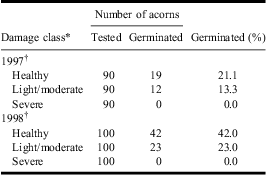
None of the severely damaged acorns germinated (Table 4). In 1997, only about one-quarter of healthy acorns and slightly more than one-tenth of lightly to moderately damaged acorns germinated, but in 1998, the number of acorns that germinated almost doubled (Table 4). There was a statistically significant inverse relationship between increasing damage category and germination success (Table 4) in 1997 (χ 2 = 19.73, df = 1, P < 0.001) and 1998 (χ 2 = 51.97, df = 1, P < 0.001).
Germination of Garry oak acorns in three damage categories in 1997 and 1998.
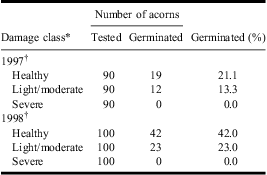
*Damage classes: healthy = no damage to the kernel, Light/moderate damage = trace to 50% damage to the kernel, severe damage = >50% damage to the kernel.
†In 1997, acorns were planted and seedling growth monitored, while in 1998 the germination test methodology recommended by the Association of Official Seed Analysts (1978) (i.e. cutting the acorns in half) was used.
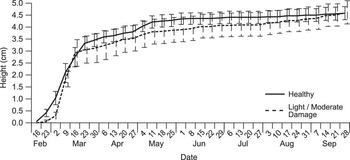
Light to moderately damaged acorns started germinating 1 week later and continued germinating for 2 weeks longer (22 February to 5 April 1998) than healthy acorns (15 February to 22 March 1998). This delay in germination resulted in a significant difference in seedling heights at week 2 (t = 2.24, df = 21, P = 0.036), but by week 3 the difference had become insignificant (t = 1.99, df = 28, P = 0.056). After week 3 (2 March) and for the remainder of the growing season (until 28 September 1998), there were no significant differences in mean seedling heights between healthy and light to moderately damaged acorn categories (see overlapping standard error bars in Fig. 5).
Garry oak seedling growth in 1998 from healthy (n = 19) and light to moderately damaged (n = 11) acorns planted 1 November 1997. Dashed vertical bars denoting the SE for the light/moderately damaged acorns are slightly offset to the right of their respective data points to allow for visual comparison of each pair of SE bars.

Discussion
Our results on acorn abscission from Garry oak agrees closely with trends observed by Williamson (Reference Williamson1966), Sharp and Sprague (Reference Sharp and Sprague1967), Boucher and Sork (Reference Boucher and Sork1979), and Feret et al. (Reference Feret, Kreh, Merkle and Oderwald1982), namely that premature abscission occurs during early acorn development. Short-term studies on Quercus alba Linnaeus showed that while increased flower production results in an increase in the number of mature acorns, the relationship is not linear (Williamson Reference Williamson1966; Feret et al. Reference Feret, Kreh, Merkle and Oderwald1982). A 14-year study, also on Q. alba, revealed that the amount of abscission has a greater influence on the amount of acorn crop production (poor versus mast years) than the initial number of flowers produced (Sharp and Sprague Reference Sharp and Sprague1967).
Garry oak acorns may have abscised due to lack of resources (Stephenson Reference Stephenson1981). Many plant species, including oaks, initiate more fruit than can be supported to maturation (Stephenson Reference Stephenson1981). Some of these developing fruits/seeds can be damaged by abiotic factors and insects, affecting seed production and these “damaged” fruits will be aborted (Sharp and Sprague Reference Sharp and Sprague1967). In addition, acorns will be aborted if the tree has insufficient resources to complete the maturation of the remaining acorns on the tree. According to Stephenson (Reference Stephenson1981), most abortion of damaged fruit (seed) is due to limited resources, and this process has the evolutionary benefit to the tree of not wasting energy on seeds that will be lost from the seedling recruitment pool.
We recognise it is possible that some of the larger acorns that we classed as healthy in our acorn traps could have been attacked by filbertworm or filbert weevil without leaving visual evidence of attack. However, we considered this unlikely because most acorns aborted in 1998 (∼90%) dropped before mid-August (Fig. 3), which was prior to peak weevil oviposition and detection of the first weevil larvae (Fig. 4E), and 2 weeks before peak filbertworm attack (Fig. 4F). This suggests that neither filbertworm nor filbert weevil damage are important contributors to acorn abortion in Garry oak. In hindsight, we should have dissected at least some of the acorns collected in the traps to verify if indeed none of the acorns in the traps were infested by filbertworm and filbert weevil.
There are conflicting reports in the literature on the relationship between acorn crop size and insect infestations. Like Crawley and Long (Reference Crawley and Long1995), we found an inverse trend between annual crop size and acorn infestation. In mast years, the severity of the combined damage of both insect species was lower (Tables 1 and 2), while in poor crop years infestation rates were higher. This trend was more noticeable for the filbertworm than the filbert weevil. Filbert weevil caused greater damage than the filbertworm in all 3 years of the study, irrespective of the acorn crop production (Tables 1 and 3).
Similar inverse trends between acorn production and infestation rates have been reported for the filbertworm, and the pecan weevil (Gibson Reference Gibson1972; Beck Reference Beck1977; McQuilkin and Musbach Reference McQuilkin and Musbach1977; Crawley and Long Reference Crawley and Long1995). Others, however, have found no such correlation (Gibson Reference Gibson1971; Kearby et al. Reference Kearby, Christisen and Myers1986). In the case of the filbert weevil and the filbertworm, the cyclic nature of Garry oak acorn production, with the variation in good and poor crop years, may serve as a form of “natural control” for these two insect species. We hypothesise these two insect species may be relatively efficient searchers in low crop years. However, we believe that the lower infestation rates of acorns in 1998 (about one-quarter to one-third the infestation rates in poor crop years) indicate that filbertworm may be unable to respond to, and exploit, a large increase in acorn crop size, resulting in a lower infestation rate in mast crop years (Tables 1 and 3). Lower population densities of the filbertworm could be an alternate explanation. Because we did not measure adult population densities of these two insects, we can only assume that the higher infestation rate by filbert weevil in all 3 years may indicate that it occurs at higher population densities than filbertworm.
Lower than expected levels of co-occurrence by filbert weevil and filbertworm in the same acorns suggests that these two insects may either compete for the same food source or try to avoid competition. Since filbertworm starts ovipositing later in the season and infests fewer acorns than filbert weevil, it seems likely that filbertworm females tend to avoid acorns already infested by filbert weevil. The possibility of competition or avoidance of competition between these two insects was not one of the aims of the original design, and the low numbers of co-infested acorns collected during sampling restricts our ability to examine this relationship further.
Infestation of acorns by the filbert weevil and filbertworm varied significantly by year, and filbert weevil attacked more acorns than the filbertworm in each of the 3 years of the study (Table 1). These findings agree with those of Brezner (Reference Brezner1960) and Jones (Reference Jones1959), both of whom reported a variation among the proportion of Curculio- and Lepidoptera-attacked acorns among years. Lewis (Reference Lewis1992) also reported higher attack of acorns by C. occidentis than by C. latiferreana, as did an unpublished undergraduate research paper (Waller Reference Waller2006). Overwintering survival, insect searching ability, predation on acorns and larval survival inside the acorns, and competition with other species of insects elsewhere (no other species of insect were reared from or found in dissected Garry oak acorns collected in BC during this study) may affect the insect/crop interaction, and consequently, the year-to-year variation in acorn infestation and damage.
Filbertworm-infested acorns were evenly distributed in the three crown levels and the three directions in the crown of Garry oak trees both in 1997 and 1998 (Table 3). We noted that the standard deviation for mean number of filbertworm attacks was higher than that for the filbert weevil, but we do not know if this was due to lower population densities, patchy distribution within the study areas, poor searching ability of the filbertworm, a combination of these factors, or some other factor. On the other hand, filbert weevil attacked a higher proportion of acorns in the lower crown, both in 1997 and 1998, although the difference was only significant in 1998. The lack of difference in 1997 among crown levels could have been in part due to the relatively small sample size collected from the small acorn crop in 1997. Direction (S, NE, NW) had no influence on the distribution of filbert weevil or filbertworm infestations on Garry oaks in 1997 or 1998.
Homogeneous distribution of infested filbertworm acorns in the crown may be because filbertworm adults are good fliers and can easily reach all three crown levels of the host tree (AliNiazee Reference AliNiazee1981; Peacock et al. Reference Peacock, Wright and Galford1988). Filbert weevil adults, on the other hand, are slow, clumsy fliers, and generally walk up the bole and branches of a tree, instead of flying, to reach the acorns in the canopy (Kearby et al. Reference Kearby, Christisen and Myers1986). This limits their access to the upper crown levels. Consequently, there will be a tendency for filbert weevils to attack acorns in the lower crown of the tree (Eikenbary and Raney Reference Eikenbary and Raney1973; Lewis Reference Lewis1992), especially in mast years when female weevils find an abundance of suitable acorns in the lower part of the crown and do not need to “waste” energy searching for suitable acorns further up in the tree.
Differences in infestation rates of acorns within the tree canopy may also be due, in part, to uneven acorn distribution in the crown. Acorn abundance and distribution within the crown levels were not examined in our study. Without this data, we would only be able to speculate on how acorn abundance and distribution within the crown may have affected the within-crown distribution of acorns infested by the filbert weevil or filbertworm.
The germination rate of healthy acorns in our study was lower than the ∼75% normally expected for Garry oak (Stein Reference Stein1990; Waller Reference Waller2006) and other species of oak (Oliver and Chapin Reference Oliver and Chapin1984; Branco et al. Reference Branco, Branco, Merouani and Almeida2002). The relatively poor germination rate in our study in 1997 for both healthy and damaged acorns may have been caused, in part, by excessive moisture resulting from condensation in the plastic bags used to store the acorns at 4°C until processing. It is also possible that the acorns in the low crop year may have been of poorer quality. In 1998, when paper towel was placed in each plastic bag to absorb condensation, the germination rate doubled, but this was still well below the rate normally expected. Because of the low germination success obtained in our study, caution should be exercised when drawing conclusions or making extrapolations from these data.
The most important factor in reducing the number of viable Garry oak acorns on the tree is the consumption of the cotyledon by filbert weevil and filbertworm larvae. To the best of our knowledge, this study is the first to report on the amount of feeding damage caused by these two insects on Garry oak acorns and the effects of this damage on acorn germination in a peer reviewed journal. In our study, severely damaged Garry oak acorns (>50% consumed) did not germinate, while light to moderately damaged acorns did germinate, albeit with a lower success rate. Other studies (Oliver and Chapin Reference Oliver and Chapin1984; Weckerly et al. Reference Weckerly, Sugg and Semlitsch1989; Andersson Reference Andersson1992; Branco et al. Reference Branco, Branco, Merouani and Almeida2002; Waller Reference Waller2006; Bonal et al. Reference Bonal, Muñoz and Díaz2007) also reported that germination rates were lower for insect-infested acorns than for healthy acorns, but in these earlier studies the infested acorns were not always separated into different damage categories.
Three weeks after germination, there was no difference in height of seedlings grown from healthy or lightly to moderately damaged acorns. In contrast, Bonal et al. (Reference Bonal, Muñoz and Díaz2007) reported that seedlings from weevil-damaged Quercus ilex Linnaeus acorns were smaller than those from healthy acorns. Seedlings from acorns with depleted cotyledons may also be more susceptible to desiccation, environmental stress, and lower survivorship to sapling age than seedlings from healthy acorns (Barnett Reference Barnett1977; Stein Reference Stein1990). On the other hand, Branco et al. (Reference Branco, Branco, Merouani and Almeida2002) reported very high germination (89%) and seedling survival (77%) even for acorns in the highest damage category (those damaged by older, later instars). Their unique results may be partly due to the different methodology they used, including classifying damage, the oak species (Quercus suber Linnaeus) they worked with in Spain, or some other factor.
Weckerly et al. (Reference Weckerly, Sugg and Semlitsch1989) suggested that germination of damaged acorns has little effect on the overall recruitment of new trees in the population in spite of the fact that only 2%–8% of the acorns damaged by weevils germinated. This conclusion, however, was based on fairly low levels of acorn predation (10%–43% of acorns were infested). In contrast, in our study, acorns in the severe damage categories (>50% damage; damage classes 4–6) comprised about half the acorns examined in 1996 and 1997, and one-quarter of those examined in 1998. These severely damaged acorns represented ∼50% of the developing acorns, especially in low crop years. None of these severely damaged acorns germinated in either 1997 or 1998 (Table 4). Although the proportion of acorns in the light/moderate damage category in 1997 (low acorn production) and 1998 (mast crop production) were similar, twice as many acorns germinated in 1998 compared with 1997 (Table 4). This may have been due partly to lower rates of feeding damage during the mast crop year (Table 2), or to the way the acorns were stored until the germination test (less condensation in 1998).
Acorns damaged by C. occidentis may still germinate due to a combination of acorn structure, chemical composition of the acorn, and where the feeding damage occurred within the acorn. Our study showed that, as long as more than 50% of the acorn kernel was intact, germination was still possible, but the success rate was reduced by about half. However, if the acorn germinated, there were sufficient nutrients available for the seedlings to become established and survive at least the first growing season.
Location of oviposition site and movement of the larvae inside the acorns may be influenced by the high tannin concentrations in certain parts of the acorn (Steele et al. Reference Steele, Knowles, Bridle and Simms1993). In our study, filbert weevil adults oviposited in the middle and proximal (cap end) portion of the acorn (76.8% and 19.9%, respectively) and rarely in the distal end (3.3%). This is consistent with observations that only 6.4% of Curculio caryae (Horn) larvae were found in the distal portion of the acorn (Steele et al. Reference Steele, Knowles, Bridle and Simms1993). The elevated tannin content in the distal portion of the acorn (Steele et al. Reference Steele, Knowles, Bridle and Simms1993) (the portion containing the embryo) may act as a feeding deterrent in the distal end, which may prompt the insects to feed in the middle and proximal portions, thereby protecting the seed embryo and increasing germination success. Tannins have also been reported to cause direct toxic effects to larvae by reducing the digestibility, protein availability, or palatability of the acorn (Chapman Reference Chapman1974; Levin Reference Levin1976; Bernays Reference Bernays1981; Weckerly et al. Reference Weckerly, Sugg and Semlitsch1989; Fleck and Layne Reference Fleck and Layne1990; Steele et al. Reference Steele, Knowles, Bridle and Simms1993).
Although damage of Garry oak acorns by these two insects seems to be high, it appears that the cyclic nature of the acorn crops, with years of mast crops, helps to insure that a sufficient number of healthy acorns are available to germinate and maintain the species. It has also been shown that even acorns that have sustained up to 50% damage (categories 1–3) to the kernel by filbert weevil and filbertworm can still geminate and produce healthy seedlings that survived for one growing season in a sheltered environment. Germination of insect-damaged acorns of several species of oaks has also been reported from different parts of the world (Oliver and Chapin Reference Oliver and Chapin1984; Weckerly et al. Reference Weckerly, Sugg and Semlitsch1989; Andersson Reference Andersson1992; Branco et al. Reference Branco, Branco, Merouani and Almeida2002; Bonal et al. Reference Bonal, Muñoz and Díaz2007). In light of these findings, direct control measures of these insects on Garry oak in BC are not necessary or warranted.
Acknowledgements
The authors thank Professor Antal Kozak, University of British Columbia, and Dr. Laszlo Safranyik, formerly with Natural Resources Canada, Canadian Forest Service, for their advice on experimental design, data analysis, and assistance with interpreting the results of the statistical analyses. Special thanks are given to Dr. Jon Sweeney, Division Editor, for his extraordinary editorial help and assistance. They would also like to thank Bob Betts, Meaghan Complin, Weiling Mah, John Truong, Shannon Lee, and Ralph Koglin for their assistance collecting, examining, and rearing the insects from the acorns. They also thank the Canadian Department of National Defence, Environmental Science Advisory Committee, for granting access to their properties at Mary Hill and Rocky Point. This research formed part of the requirements for a Master of Science degree by the second author (DAM née Rohlfs) in the Faculty of Forestry, University of British Columbia.