Introduction
Bipolar disorder (BD) is characterised by episodes of depression and (hypo)mania, alternated with periods of euthymia. Typically, BD presents with a (mild) depressive episode, whereas the first (hypo)manic episode appears years later (Duffy et al. Reference Duffy, Alda, Hajek and Grof2009; Mesman et al. Reference Mesman, Nolen, Reichart, Wals and Hillegers2013). On average, this typical early course leads to a 10-year diagnostic delay (Suppes et al. Reference Suppes, Leverich, Keck, Nolen, Denicoff, Altshuler, McElroy, Rush, Kupka, Frye, Bickel and Post2001; Altamura et al. Reference Altamura, Mundo, Cattaneo, Pozzoli, Dell'osso, Gennarelli, Vergani, Trabattoni, Arosio and Clerici2010; Drancourt et al. Reference Drancourt, Etain, Lajnef, Henry, Raust, Cochet, Mathieu, Gard, Mbailara, Zanouy, Kahn, Cohen, Wajsbrot-Elgrabli, Leboyer, Scott and Bellivier2013). Presently, the most reliable predictor for BD remains a positive family history for BD (Craddock & Jones, Reference Craddock and Jones1999; Gottesman et al. Reference Gottesman, Laursen, Bertelsen and Mortensen2010). Several studies have consistently shown that children of patients with BD (bipolar offspring) have an increased risk for bipolar spectrum disorders, as well as (recurrent) unipolar mood disorders (Lapalme et al. Reference Lapalme, Hodgins and LaRoche1997; Duffy et al. Reference Duffy, Doucette, Lewitzka, Alda, Hajek and Grof2011; Mesman et al. Reference Mesman, Nolen, Reichart, Wals and Hillegers2013).
Apart from a positive family history, stressful life events are associated with the onset of first as well as subsequent mood episodes in BD (Brown & Harris, Reference Brown and Harris1989; Malkoff-Schwartz et al. Reference Malkoff-Schwartz, Frank, Anderson, Sherrill, Siegel, Patterson and Kupfer1998; Hlastala et al. Reference Hlastala, Frank, Kowalski, Sherrill, Tu, Anderson and Kupfer2000; Johnson, Reference Johnson2005; Bender & Alloy, Reference Bender and Alloy2011; Koenders et al. Reference Koenders, Giltay, Spijker, Hoencamp, Spinhoven and Elzinga2014). However, the understanding of the precise role of stressful life events in the pathogenesis and the course of BD remains quite poor. There is also evidence that life events are particularly influential with regard to the first number of mood episodes, yet become less so as subsequent episodes emerge; also known as the ‘kindling hypothesis’ (Post, Reference Post1992; Monroe & Harkness, Reference Monroe and Harkness2005; Bender & Alloy, Reference Bender and Alloy2011). However, the results of studies like these are inconsistent. Evidence for the kindling hypothesis would emphasize the importance of studying the role of life events in populations at risk of developing BD prior to the onset of the first episode, such as bipolar offspring.
Presently, only a few studies have investigated the role of life events in bipolar offspring. Overall, these studies identified an increased number of life events and/or more severe life events in bipolar offspring (Hillegers et al. Reference Hillegers, Burger, Wals, Reichart, Verhulst, Nolen and Ormel2004; Petti et al. Reference Petti, Reich, Todd, Joshi, Galvin, Reich, Raymond and Nurnberger2004; Wals et al. Reference Wals, Hillegers, Reichart, Verhulst, Nolen and Ormel2005; Duffy et al. Reference Duffy, Alda, Trinneer, Demidenko, Grof and Goodyer2007; Ostiguy et al. Reference Ostiguy, Ellenbogen, Linnen, Walker, Hammen and Hodgins2009). Two studies reported on life events in the Dutch Bipolar Offspring Study. Wals et al. (Reference Wals, Hillegers, Reichart, Verhulst, Nolen and Ormel2005) found an increased number of life events preceding the year of mood episode onset, but this effect faded when controlling for prodromal mood symptoms in that same year. However, this study only took into account life events in the year preceding the onset of the first mood episode. While a single life event may only have a moderate effect on mood susceptibility, it is likely that especially the accumulation of events gradually increases mood susceptibility (Kessing et al. Reference Kessing, Agerbo and Mortensen2004). It is, therefore, particularly interesting to follow the course of life events across the life cycle in relation to the onset of mood episodes. The second Dutch Bipolar Offspring Study found an association between life events and the onset of the first mood episode in 140 bipolar offspring age 5 up to 16 years, while the adverse effects of life events gradually subsided by 25% per year (Hillegers et al. Reference Hillegers, Burger, Wals, Reichart, Verhulst, Nolen and Ormel2004).
Studies in unipolar depression have found that the interplay between psychosocial factors and life events is also important. Life events are not equally stressful to everyone and their effect depends on several factors, such as temperament, coping, cognitive styles and social support; the so-called stress-buffering hypothesis (Cohen & Wills, Reference Cohen and Wills1985; Swendsen et al. Reference Swendsen, Hammen, Heller and Gitlin1995; Compas et al. Reference Compas, Connor-Smith, Saltzman, Thomsen and Wadsworth2001, Reference Compas, Connor-Smith and Jaser2004). Two studies found a relationship between maladaptive cognitive styles and increased reactivity to life events in bipolar patients (Swendsen et al. Reference Swendsen, Hammen, Heller and Gitlin1995; Alloy et al. Reference Alloy, Reilly-Harrington, Fresco, Whitehouse and Zechmeister1999; Reilly-Harrington et al. Reference Reilly-Harrington, Alloy, Fresco and Whitehouse1999). One study in bipolar offspring (Duffy et al. Reference Duffy, Alda, Trinneer, Demidenko, Grof and Goodyer2007) reported an increased number of recent life events in bipolar offspring with psychopathology, while emotionality was positively correlated with recent life events and psychopathology. Moreover, emotionality contributed to the risk of psychopathology, whereas life events only functioned as a mediator. However, a limitation of this study was that life events were not assessed longitudinally, and both life events and temperament measures were only assessed after the onset of the illness.
This study investigates the association of stressful life events on the onset of first and recurrent mood episodes, in the same Dutch Bipolar Offspring cohort as reported above (Hillegers et al. Reference Hillegers, Burger, Wals, Reichart, Verhulst, Nolen and Ormel2004; Wals et al. Reference Wals, Hillegers, Reichart, Verhulst, Nolen and Ormel2005), now followed up 12 years to a mean age of 28 years. Furthermore, we investigated the effects of psychological factors such as temperament, coping and parental rearing styles on this association.
Method
Sample
All data are derived from the Dutch Bipolar Offspring Study, a longitudinal fixed cohort study established in 1997 (Wals et al. Reference Wals, Hillegers, Reichart, Ormel, Nolen and Verhulst2001; Reichart et al. Reference Reichart, Wals, Hillegers, Ormel, Nolen and Verhulst2004; Hillegers et al. Reference Hillegers, Reichart, Wals, Verhulst, Ormel and Nolen2005; Mesman et al. Reference Mesman, Nolen, Reichart, Wals and Hillegers2013). A detailed description of the study design and recruitment procedure has been described elsewhere (Wals et al. Reference Wals, Hillegers, Reichart, Ormel, Nolen and Verhulst2001). In short, 140 offspring (ages 12–21 years) from 86 families with one bipolar parent (74% bipolar I; 26% bipolar II) were recruited from 1997 to 1999 and followed for a period of 12 years. A family was only included if all offspring within the age range 12–21 years agreed to participate. Exclusion criteria were a severe physical illness or handicap or an intelligence quotient below 70. Participants were recruited through the Dutch patient association (62 families; 102 children) and through out-patient clinics in nine psychiatric hospitals (24 families; 38 children). Bipolar offspring were assessed at baseline and at 1-, 5- and 12-year follow-up (Wals et al. Reference Wals, Hillegers, Reichart, Ormel, Nolen and Verhulst2001; Reichart et al. Reference Reichart, Wals, Hillegers, Ormel, Nolen and Verhulst2004; Hillegers et al. Reference Hillegers, Reichart, Wals, Verhulst, Ormel and Nolen2005; Mesman et al. Reference Mesman, Nolen, Reichart, Wals and Hillegers2013). In total, 108 (77%) subjects were followed for the full 12 years. The study was approved by the Medical Ethical Review Committee of the University Medical Center Utrecht. Written informed consent was obtained from both offspring and parents after a complete description of the study.
Instruments
Mood disorders
Offspring were psychiatrically evaluated at each assessment; at baseline and during the 1-year follow-up Statistical Manual of Mental Disorders, 4th edition (DSM-IV) diagnoses were obtained through direct interviews with both child and parent(s), using the Kiddie Schedule of Affective Disorders and Schizophrenia –Present and Lifetime Version (K-SADS-PL) (Kaufman et al. Reference Kaufman, Birmaher, Brent, Rao, Flynn, Moreci, Williamson and Ryan1997). From the 5-year follow-up onwards, the K-SADS-PL was replaced by the Structured Clinical Interview for DSM-IV Axis I Disorders (SCID-I) (First et al. Reference First, Spitzer, Gibbon and Williams1997). Lifetime DSM-IV diagnoses are based on all four interviews. For a detailed overview of the psychopathology after the 12-year follow-up, see Mesman et al. (Reference Mesman, Nolen, Reichart, Wals and Hillegers2013). In the current study, the presence of mood disorders was extrapolated by identifying a lifetime history of DSM-IV major depressive disorder, dysthymia, cyclothymia, bipolar I or II disorder, depression not otherwise specified (NOS) or adjustment disorder with depressed mood. For depression NOS only ‘minor depressive disorder’ and ‘recurrent brief depressive disorder’ were included. Moreover, because of the perceived uncertainty of the BD-NOS diagnosis (Goodwin & Jamison, Reference Goodwin and Jamison2007), BD-NOS was not specifically assessed. Recurrent mood disorder was defined as any consecutive mood episode/disorder after the first episode (e.g. depression NOS and subsequent major depressive disorder). For all diagnoses, both onset age and episode(s) duration were documented.
Stressful life events
Life events were assessed with the investigator-based Bedford College Life Events and Difficulties Schedule (LEDS), a semi-structured interview assessing life events and long-term difficulties (Brown & Harris, Reference Brown and Harris1978, Reference Brown and Harris1989), adjusted for adolescents (Monck & Dobbs, Reference Monck and Dobbs1985). The present study focused solely on life events. The LEDS collects detailed information about the event itself, the timing of its occurrence (date) and relevant contextual information for each event. Based on the contextual information, the threat for each event is rated via standardized rating procedures. The threat score represents the severity of the event, ranging from mild (1) to severe (4). The contextual threat is conceptualized as: ‘What most people would be expected to feel about an event in a particular set of circumstances and biography, taking no account of what the respondent says either about his or her reaction or about any psychiatric or physical symptoms that followed it’ (Brown & Harris, Reference Brown and Harris1989). Severe events could be negative as well as positive, for example: moving to another country can be a very positive, but at the same time stressful, life event. No distinction was made between positive and negative life events. Because of the retrospective nature of the data, only severe events (threat score 3 or 4) that had occurred after age 4 years were included for analyses. For all severe life events we defined whether the event was related to the respondents’ psychopathology and whether the event was dependent on the respondents’ own behaviour. Several studies support the reliability and validity of the LEDS in adults exhibiting a variety of psychiatric symptoms (Brown & Harris, Reference Brown and Harris1978, Reference Brown and Harris1989; Ormel et al. Reference Ormel, Oldehinkel and Brilman2001). The LEDS interviews were administered at each assessment. The interviews covered life events from early childhood (after age 4 years) up to baseline assessment and for the interim periods at the follow-up assessments. Life events were rated on a yearly basis. All interviewers and raters were trained by M.H.J.H., who herself was trained by Brown and Harris who developed the LEDS. The events were rated from written transcripts by two independent raters who had not been involved in the interview, and were unaware of the respondent's psychiatric status. A panel consisting of five raters, including S.M.K., E.M. and M.H.J.H., reached consensus on the events that raised rating problems.
Temperament
Temperament was examined using the Dutch adaption of the short version of the Temperament and Character Inventory (TCI) (105 items) (Cloninger, Reference Cloninger1994; Cloninger et al. Reference Cloninger, Przybeck, Svrakic and Wetzel1994; Duijsens et al. Reference Duijsens, Spinhoven, Verschuur and Eurelings-Bontekoe1999; Duijsens & Spinhoven, Reference Duijsens and Spinhoven2001). The TCI is based on the neurobiological model of |Cloninger (Reference Cloninger1994), measuring four temperament dimensions (novelty seeking, harm avoidance, reward dependence and persistence) and three character dimensions (self-directness, cooperativeness and self-transcendence). Temperament reflects the developmentally stable personality components from infancy through to adulthood, and character is thought of as the part of the personality that gradually matures throughout life (Cloninger, Reference Cloninger1994). To maintain a certain stable personality measurement, only temperament scales were used for further study. Each dimension contains 15 items with a true/false scoring. The Dutch adaption of the TCI shows modest to good reliability in terms of internal consistency, with Cronbach α ranging from 0.69 (reward dependence) up to 0.89 (harm avoidance) and good test–retest reliability (0.71 to 0.90) (Duijsens & Spinhoven, Reference Duijsens and Spinhoven2001).
Coping
Coping was assessed with the Utrecht Coping List (UCL), a self-report questionnaire of 47 items that measures seven coping styles (Scheurs et al. Reference Scheurs, van de Willege, Tellegen and Brosschot1993). The items describe possible reactions to problem situations or unpleasant events, and are answered on a four-point response scale ranging from rarely to never. The seven coping styles include active tackling (six items), i.e. the individual actively approaches the problem situation and is goal-oriented; palliative response (eight items), i.e. distraction, engaging in other activities and trying to relax; avoidance and passive expectancy (eight items), i.e. avoidance of the problem situation and waiting to see what happens; seeking social support (six items), i.e. sharing feelings of discomfort and seeking support and understanding from others; passive reacting (seven items), i.e. being completely overwhelmed by the situation, pessimistic and withdrawn; expression of emotion (three items), i.e. venting emotions of discomfort such as anger and irritation; and reassuring thoughts (five items), i.e. realizing worse things can happen and positive reframing of the situation. The UCL has moderate to good internal consistency, with Cronbach α ranging from 0.64 to 0.82 and reasonable test–retest reliability 0.52 to 78 (Scheurs et al. Reference Scheurs, van de Willege, Tellegen and Brosschot1993).
Parental rearing
The respondents’ subjective experience of parental rearing (both father and mother) was assessed by use of the short-EMBU [Swedish acronym for Egna Minnen Beträffande Uppfostran (My memories of upbringing); s-EMBU] at the 5-year follow-up (Perris et al. Reference Perris, Jacobsson, Lindstrom, von Knorring and Perris1980; Arrindell et al. Reference Arrindell, Emmelkamp, Brilman and Monsma1983, Reference Arrindell, Richter, Eisemann, Garling, Ryden, Hansson, Kasielke, Frindte, Gillholm and Gustafsson2001). The s-EMBU is a 23-item instrument with a four-point Likert-type sresponse scale and examines three parenting rearing styles: emotional warmth (six items), protection (nine items) and rejection (seven items). Emotional warmth refers to affectionate, stimulating and praising behaviour in the parent; protection refers to fear and anxiety for the subject's safety, and intrusive and overinvolved behaviour of the parent; and rejection refers to punitive behaviour, shaming, favouring a sibling, rejection through criticism, rejection of the subject and abusive behaviour. All were found to have good internal reliability, with Cronbach α > 0.70 (Arrindell et al. Reference Arrindell, Richter, Eisemann, Garling, Ryden, Hansson, Kasielke, Frindte, Gillholm and Gustafsson2001). The correlation of parenting styles of mothers and fathers were moderate to high in this study (emotional warmth, r = 0.58, protection, r = 0.68 and rejection r = 0.72). For further analyses these scores were combined to a mean total score for parenting style.
Temperament, coping and subjective parental rearing styles were all assessed during the 5-year follow-up of the study.
Data analysis
Time-dependent life event load (LEL)
In order to study the impact of life events at the onset of first and subsequent episodes, a time-dependent LEL for each year of follow-up was calculated, representing the sum of all severe life events (threat scores 3 and 4). The cumulative LEL (CLEL) at a particular point in time (year Y) was calculated as the sum of the LEL in year Y and all preceding years. For the impact of life events on the onset of a first mood episode, we calculated a CLEL for the year before its onset. For the impact of recurrent episodes the CLEL load started at zero after each episode. Subsequently, the CLEL in the year preceding recurrence was used for analysis. Overall, we calculated three different types of life event measures: cumulative load (CLEL); cumulative load excluding events related to psychopathology of the respondent (CLEL-NoPsy); and cumulative load including only independent events (CLEL-Ind). Taking into account a possible decay effect of life events over time, a time-specific LEL was subjected to an exponential decay function (Wainwright & Surtees, Reference Wainwright and Surtees2002). We tested four models: model I tested a purely cumulative effect of life events (=CLEL); model II, the decay function implied a 25% loss of CLEL per year; model III, the decay function implied a 50% loss of CLEL per year; and model IV, the decay function implied a 75% loss of CLEL per year. The decay function that yielded the best model fit (−2 log likelihood) was subsequently used for all further analysis.
Statistical analyses
The impact of life events and the onset and recurrence of mood disorders was studied using an extension of the standard Cox proportional hazard model for recurrent events, the Andersen–Gill model (A-G model). The A-G model accommodates censored data and time-dependent covariates (Fleming & Harrington, Reference Fleming and Harrington1991; Therneau & Grambsch, Reference Therneau and Grambsch2000). Data for the A-G model were structured in such a way that each individual risk interval was defined by variables describing the start and end times of each year of age. An event variable was coded ‘1’ for episode and ‘0’ for no episode. Time from age 5 years to first mood episode was used or, when no episode occurred, the time until the last interview was used to test the influence of life events on mood episode onset. To test the impact of life events on recurrent episodes, the time until the last interview was included regardless of whether one or more episodes occurred. The A-G approach follows the usual assumption of the Cox model, whereby the hazard ratio (HR) or risk ratio is proportional over time and, more specifically, that the risk of developing a mood episode is unaffected by earlier episodes. Time-dependent covariates, such as the CLEL or the number of previous episodes, may be used to relax the latter assumption. The HR represents the proportionate change in the ‘episode’ rate due to a unit change in the respective covariate, in this case the CLEL. Subsequently, temperament, coping styles, subjective parental rearing style, plus the number of episodes were added as covariates in the A-G model. Our aim was to examine whether these variables affected the risk of mood episode onset and/or recurrence, and the impact of life events. A moderating effect was considered present if inclusion of these variables substantially (by at least 10%) changed the coefficient for LEL. If a significant moderating effect of any of these three psychological factors was present, the interaction between those factors and all other psychological factor was tested. This was realized by incorporating an interaction function into the A-G model. Finally, the presence of a kindling effect was tested by the interaction between the number of previous episodes and the CLEL between episodes. Analyses were performed using the statistical programming platform R (R Development Core Team, 2008).
Results
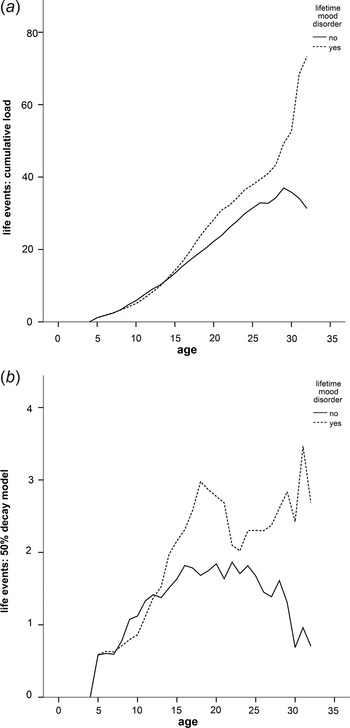
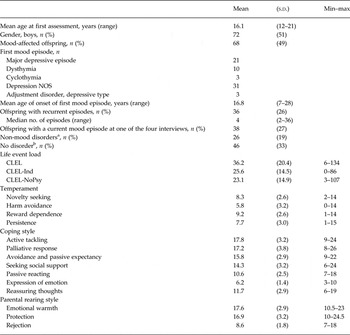
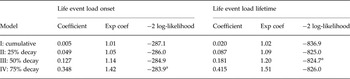
The general characteristics of the study population are shown in Table 1. In total, 68 (54%) of the 140 offspring were diagnosed with a lifetime mood disorder, of which 38 had a history of one or more recurrent episodes, including 16 (24%) with bipolar spectrum disorder. Of the offspring with a recurrent mood disorder, the median number of recurrent episodes was 4 (range 2–36). Descriptives of CLEL, temperament, coping and subjective parenting styles are shown in Table 1. In order to take into account a temporal decay effect of the impact of life events, life event data were fitted to four different models with decay function 0, 25, 50 and 75% (models I–IV, respectively) (Table 2). According to the log-likelihood, the decay function of 75% (model IV) was in most agreement with the observed data for the first mood episode, and for recurrent mood episodes the decay function of 50% (model III). Since the difference between the log-likelihoods of the fitted models was minimal, all further analyses were performed under model III. Fig. 1 displays the difference in course of CLEL and the CLEL according to model III for mood-affected offspring versus unaffected offspring over time.
(a) Course of cumulative life event load by age (years) for mood-affected and unaffected offspring. (b) Course of cumulative life event load by age (years) according to decay model III for mood-affected and unaffected offspring.

Descriptive characteristics of bipolar offspring (n = 140)

Data are given as mean (s.d. or range), median (range) or as number of participants (percentage).
s.d., Standard deviation; Min–max, minimum to maximum; NOS, not otherwise specified; CLEL, cumulative life event load; CLEL-Ind, CLEL including only independent events; CLEL-NoPsy, CLEL excluding events related to psychopathology.
a Including all subjects without a lifetime mood disorder or dropping out from the study without developing a mood disorder, but with other non-mood pathology. Including anxiety, attention-deficit/hyperactivity disorder, disruptive behaviour, substance abuse, enuresis, encopresis, pervasive developmental disorder, tic, obsessive–compulsive disorder and eating disorders.
b Offspring without a lifetime Statistical Manual of Mental Disorders, 4th edition Axis I disorder before the end of/leaving the study.
Relative risk of an episode using four models of decay onset and lifetime

Exp coef, Exponentiated linear coefficient.
a Lowest absolute log-likelihood of fitted model.
First mood episode onset
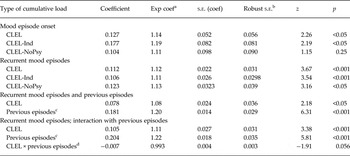
As shown in Table 3, the CLEL up to the first mood episode was associated with a positive coefficient of 0.127 (HR = 1.14) indicating the increased relative risk for mood episode onset per increase per unit of CLEL. Next, we looked at the different types of life events, namely: CLEL including only independent events (CLEL-Ind), excluding events related to psychopathology of the respondent (CLEL-NoPsy). The coefficient of CLEL-Ind was 0.177 (HR = 1.19) and was also positively associated with mood episode onset per increase in unit CLEL. A coefficient of 0.104 (HR = 1.11) was found for CL-NoPsy, and did not reach significance, suggesting that life events triggering mood disorder onset also include events already associated with previous non-mood disorders.
Influence of different types of life event load under model III (50% decay) on mood episodes

s.e., Standard error; CLEL, cumulative life event load including all events under model III (50% decay model); CLEL-Ind, cumulative life event load including only independent events; CLEL-NoPsy, cumulative life event load excluding events related to psychopathology.
a Exponentiated coefficient, representing the hazard ratio.
b Robust s.e., corrected for the dependency of multiple times to event within the same subject.
c Expresses the relative risk per each episode.
d Interaction term.
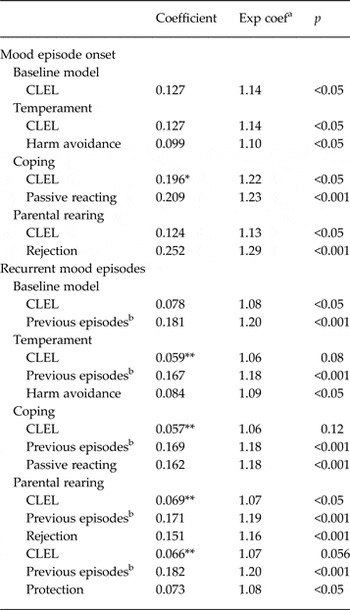
Looking at psychological features and social support, only harm-avoidant temperament, passive reacting coping style, and a rejecting parenting style were significantly associated with first mood episode onset (Table 4). Yet, only passive reacting coping style altered the coefficient of CLEL by more than 10% from 0.127 (HR = 1.14) to 0.196 (HR = 1.22), suggesting that having more passive reacting coping-style features enhances the risk of mood episode onset, whereas the impact of CLEL decreases, suggesting a moderating effect. All other coefficients for psychosocial factors did not reach significance (for an overview of all temperament, coping and parental rearing styles, see online Supplementary Table S1).
Influence of life event load, psychological and social factors on mood episode onset

CLEL, Cumulative life event load including all severe events under model III (50% decay model); previous episodes, number of previous episodes.
a Exponentiated coefficient, representing the hazard ratio.
b Expresses the relative risk per each episode.
* Main effect is significant and coefficient for life events changes >10%; < 0.114 or >0.140.
** Main effect is significant and coefficient for life events changes >10%; < 0.0702 or >0.0858.
Recurrent mood episodes
For recurrent mood episodes a coefficient of 0.112 (HR = 1.12, p < 0.001) for CLEL on the risk of mood episodes was found. Also, CLEL-Ind and CLEL-NoPsy showed significant and positive coefficients (CLEL-Ind 0.106, HR = 1.11, p < 0.001 and CLEL-NoPsy 0.123, HR = 1.13, p = <0.05), indicating that all types of LEL are associated with an increased risk of recurrent episodes. Table 3 provides the results of the final A-G model of LEL, as modelled for recurrent episodes. Adding the number of previous episodes in the model decreased the coefficient for life events by more than 10% with a positive and significant coefficient for previous episodes, indicating that the number of previous episodes is a significant contributor to the risk of recurrent episodes. In addition, a greater number of previous episodes is associated with a lower CLEL preceding episode onset; since the amount of time between the episodes decreases, so does the CLEL preceding the episode. The interaction term for CLEL and number of prior episodes effect did not reach significance, indicating that the effect of CLEL on the risk of recurrence does not change with subsequent episodes, as suggested by the kindling hypothesis. However, significance reached trend level and the influence of life events on first episode was higher compared with the influence of life events after the first episode, suggesting a shift in the effect of life events between first and subsequent episodes and thus a possible kindling effect.
Apart from the CLEL and number of previous episodes, harm-avoidant temperament, passive reacting coping style and a rejecting and protective parenting style were significantly associated with the risk for recurrent episodes and altered the impact of CLEL (Table 4). Including these factors into the model, in addition to the number of previous episodes, lowers the impact of life events on mood episode recurrence. The change of the coefficient of life events was largest for harm-avoidant temperament and passive reactive coping style. Furthermore, for these two factors the coefficient for life events not only decreased, but also became non-significant. The coefficients of these two factors were positive, indicating that the presence of a more pronounced harm-avoidant temperament and/or passive reactive coping style increases the risk of recurrent episodes. Adding these four psychosocial factors decreased the coefficient of life events, though not reduced to zero, indicating that, although not significant, life events are still present as a risk factor for recurrent episodes. For an overview of the effects of the other psychological and social factors, see online Supplementary Table S2.
Discussion
To our knowledge, this is the first long-term follow-up study investigating the impact of life events and psychological variables on the onset and course of psychopathology in bipolar offspring. In this study, bipolar offspring were followed for 12 years, from early adolescence (n = 140) to adulthood (n = 108). In total, 68 offspring developed a mood disorder, of which 36 a recurrent mood disorder. The results illustrate that the effect of life events is especially a risk factor in the early stage of mood disorders, and that this effect is enhanced by passive reactive coping styles in bipolar offspring. After the first episode, the number of previous episodes became an important predictor for new episodes, with a shift in the effect of life events between first and subsequent episodes, supporting the kindling hypothesis. Moreover, psychological factors, such as harm-avoidant temperament and passive reactive coping style, increase the risk of subsequent episodes.
That life events are associated with mood episode onset in bipolar offspring confirms findings in other offspring studies (Petti et al. Reference Petti, Reich, Todd, Joshi, Galvin, Reich, Raymond and Nurnberger2004; Duffy et al. Reference Duffy, Alda, Trinneer, Demidenko, Grof and Goodyer2007; Ostiguy et al. Reference Ostiguy, Ellenbogen, Linnen, Walker, Hammen and Hodgins2009). The impact of life events was the strongest with regard to the first episode, becoming less so with recurrent episodes. Although we found no interaction between previous episodes and CLEL, the impact of life events becoming less evident corresponds with a possible kindling effect. Thus far, the kindling effect has consistently been reported in unipolar depression, but irregularly in BD (Swendsen et al. Reference Swendsen, Hammen, Heller and Gitlin1995; Hammen & Gitlin, Reference Hammen and Gitlin1997; Dienes et al. Reference Dienes, Hammen, Henry, Cohen and Daley2006).
Previous research has suggested that especially dependent life events (e.g. life events related to the individual's own behaviour) are important in light of mood episode onset (Hammen, Reference Hammen1991). In line with others (Reilly-Harrington et al. Reference Reilly-Harrington, Alloy, Fresco and Whitehouse1999; Grandin et al. Reference Grandin, Alloy and Abramson2007; Ostiguy et al. Reference Ostiguy, Ellenbogen, Linnen, Walker, Hammen and Hodgins2009), we found that differentiating between dependent and independent life events did not change our findings, suggesting that no specific type of life event contributes to increased mood liability, but rather the full range of severe life events.
Regarding the psychological factors we found that a more passive reactive coping style, defined as being overwhelmed by situations, pessimism, and withdrawal, was associated with mood episode onset. This finding is in line with previous research, where especially the disengaging coping styles are related to an increased risk of internalizing symptoms (Compas et al. Reference Compas, Connor-Smith, Saltzman, Thomsen and Wadsworth2001). More interestingly, adding passive reactive coping style enhanced the association between life events and mood episode onset, suggesting a moderating effect for passive reactive coping style, thus supporting the stress-buffering theory in this population (Cohen & Wills, Reference Cohen and Wills1985; Swendsen et al. Reference Swendsen, Hammen, Heller and Gitlin1995; Compas et al. Reference Compas, Connor-Smith, Saltzman, Thomsen and Wadsworth2001, Reference Compas, Connor-Smith and Jaser2004). For recurrent episodes, especially harm-avoidant temperament and passive reactive coping style were important predictors: while the association between life events and recurrent episodes was less pronounced, it did not become redundant. Parental rearing styles were not found to have an additional effect on the association between life events and mood episode onset. In summary, our study suggests that life events play an important role in the early stages of mood episode onset, yet psychological factors such as a negative temperament and/or passive reactive coping style may be of more significance for recurrent mood disorder susceptibility.
Strengths in our study are that life events were recorded over the life course within relatively short retrospective time-frames, limiting the effect of recall bias. Furthermore, a natural decay effect of life events was taken into account, aiming to model the natural processes of life events. Moreover, life events were recorded using the LEDS of Brown & Harris (Reference Brown and Harris1978, 1989), the suggested ‘gold standard’ in life event research (Dohrenwend, Reference Dohrenwend2006). Nevertheless, the findings of this study should be interpreted in the light of several limitations. The first limitation of the study is that temperament, coping, and parental rearing styles were administered at the third assessment (mean age 21 years). Although the present study shows that harm-avoidant temperament and passive reacting coping style are associated with the susceptibility for mood episodes in a high-risk population, the direction of the impact of these factors remains partly intangible. Temperament has been suggested to be relatively stable over time and across situations, but there are also suggestions that temperament can be changed by previous mood episodes (e.g. Compas et al. Reference Compas, Connor-Smith and Jaser2004). Second, due to the small sample size of subjects with BD, it was not possible to run separate analyses for depressive or hypomanic episodes. Third, the present study concerns a high-risk population, limiting generalization for other populations. However, studies have shown that the impact of life events is especially significant within the context of familial risk for mood disorders (e.g. Kessler, Reference Kessler1997; Zimmermann et al. Reference Zimmermann, Bruckl, Lieb, Nocon, Ising, Beesdo and Wittchen2008).
More studies are needed to further disentangle the interplay of life events, psychological factors, impact of social support and mood susceptibility. These studies could benefit by incorporating not only early assessment of psychological factors, in order to determine directions of associations, but also considering more diverse populations, and including healthy controls and larger sample sizes. In the meantime, our findings suggest that early intervention on stress reduction in terms of enhancement of coping skills through training, cognitive–behavioural therapy or EMDR (eye movement desensitization and reprocessing) in the case of more severe trauma, might potentially prove beneficial in preventing onset and recurrences op mood episodes in high-risk populations. In conclusion, our study shows that both life events and psychological factors play an important role in bipolar offspring regarding their susceptibility to develop first as well as recurrent mood episodes. These findings provide potential for early intervention.
Supplementary material
For supplementary material accompanying this paper visit http://dx.doi.org/10.1017/S0033291715000495
Acknowledgements
This study was supported by grant no. 22963 from the 7FP of the European Commission and grant no. 9120818 from the Netherlands Organization for Health Research and Development (Zon-Mw). Previous measurements of this study were financially supported by the Stanley Medical Research Institute and the Netherlands Organization for Scientific Research (NWO). We thank Bianca Nieuwenhuis for her considerate and thoughtful edits on the manuscript.
Declaration of Interest
M.H.J.H. has served on the advisory board of Benecke and has received speaker fees from Astra Zeneca, Shire and Lundbeck, and has received grants from the Netherlands Organization for Health Research and Development and the European Union. W.A.N. has received grants from the Netherlands Organization for Health Research and Development, the European Union, Astra Zeneca, GlaxoSmithKline and Wyeth, and has received honoraria/speaker's fees from Astra Zeneca and Lundbeck. The other authors report no competing interests.