Introduction
The incidence of tonsil cancer has been on the rise globally.Reference Weatherspoon, Chattopadhyay, Boroumand and Garcia1 In the UK, cases of tonsil cancers have increased at least two-fold over the past 20 years, and patients are being diagnosed at a younger age.Reference Olaleye, Moorthy, Lyne, Black, Mitchell and Wiseberg2 This trend is thought to be related to the increased prevalence of human papillomavirus (HPV), evidenced by the increased number of HPV-positive squamous cell carcinoma (SCC) cases.Reference Marur, D'Souza, Westra and Forastiere3 Histologically, tonsil cancers are mainly divided into SCC, lymphoma and, rarely, small cell carcinoma.Reference Sehdev, Zhao, Singh and Sharma4 These can present with a wide array of symptoms, from persistent sore throat to a neck lump. Studies have focused on whether unilateral tonsillar enlargement should raise concern of a suspected tonsillar malignancy, but currently there is no general consensus or evidence-based guidance.Reference Rokkjaer and Klug5,Reference Papouliakos, Karkos, Korres, Karatzias, Sastry and Riga6
Nationally, cases of suspected cancer (two-week wait) referrals have increased by approximately 10 per cent, with an excess of 2 million referrals received in the year 2020–2021.7,Reference Round, Gildea, Ashworth and Møller8 This increasingly large number of referrals creates a significant burden on clinic waiting times and has its own financial implications for the National Health Service (NHS).
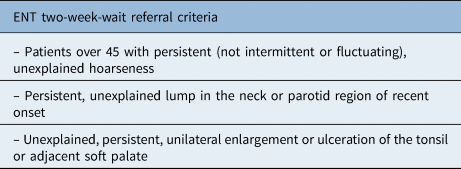
The suspected head and neck cancer referral guideline was last revised in 2015 by the National Institute for Health and Care Excellence. Outside of the nationally agreed criteria, our regional guideline (published by the Northern Cancer Alliance commissioned by NHS England) has also included unexplained unilateral tonsillar enlargement and/or lesion as an additional criterion to the adult suspected head and neck cancer referral pathway (Table 1).9 This originated after concerns from general practitioners about missing potential tonsil cancers. In our regional head and neck specialist unit, approximately 5000 two-week wait head and neck cancer referrals were received in the year 2018–2019.7
Northern Cancer Alliance: suspected head and neck cancer two-week-wait referral criteria

Given the uncertainty regarding the predictive value of unilateral tonsillar enlargement and/or lesion in malignancies, this study aimed to evaluate the efficacy of the unilateral tonsillar enlargement and/or lesion referral criterion in the adult suspected head and neck cancer pathway.
Methods
Study design and setting
The study was set in a tertiary head and neck specialist unit in the North of England. All head and neck cancer two-week wait referrals from January 2018 to December 2019 inclusive were identified from a prospectively held specialist multidisciplinary team database. The presenting symptoms on the suspected head and neck cancer two-week wait referral forms were reviewed as well as each patient's clinical documentation. All patients referred with unilateral tonsillar enlargement and/or lesion in the suspected head and neck cancer pathway during the study period were included.
Main outcome measures
Data were collected from the electronic medical record system and clinic letters. The primary outcome was the final diagnosis at the end of the cancer pathway. Patient demographic data, outcome of first clinic encounter, smoking status and associated presenting symptoms were also recorded.
Statistical analysis
Data were analysed using SPSS® (version 26) for logistic regression modelling. Pearson's chi-square test was used for analysis of the presenting symptoms in relation to their association with a final diagnosis of malignancy. Odds ratios with their respective 95 per cent confidence intervals (CIs) and p-values were calculated, with p < 0.05 defined as being statistically significant.
Ethical considerations
This study was registered with our hospital clinical governance department and was compliant with local institutional ethical guidelines.
Results
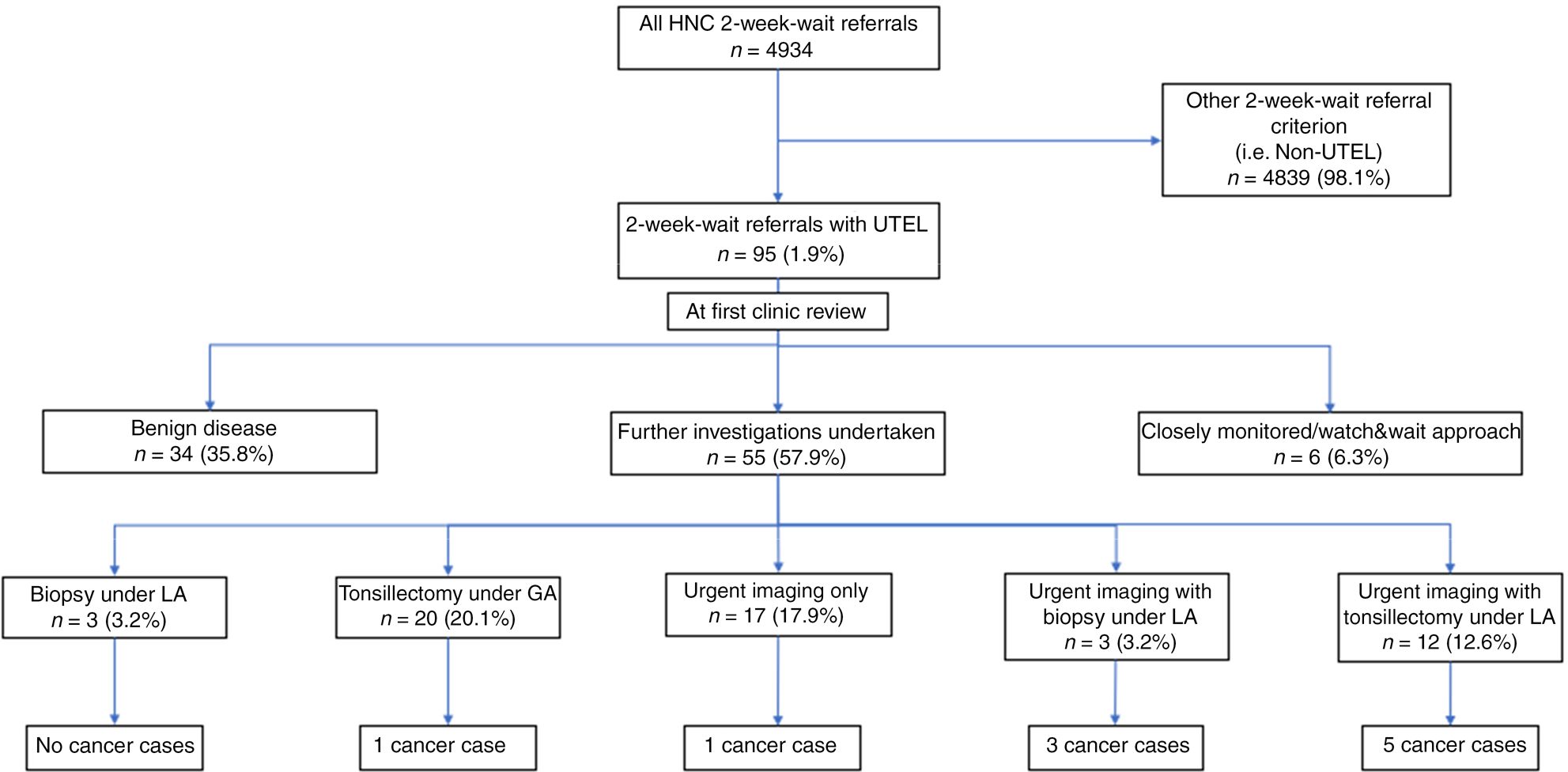
In the 24-month study period, a total of 4934 suspected head and neck cancer referrals were received in the specialist unit. Among these, 95 cases (1.9 per cent) were unilateral tonsillar enlargement and/or lesion referrals. All 95 cases were included in the study (Figure 1).
Graphical representation of outcomes from the adult with suspected head and neck cancer pathway for patients with unilateral tonsil enlargement and/or lesion. HNC = head and neck cancer; UTEL = unilateral tonsillar enlargement and/or lesion; LA = local anaesthetic; GA = general anaesthetic

Patient demographic data
In this study cohort, the mean age was 51.3 years (range, 19–91 years; standard deviation, 19.1 years). The male-to-female ratio was 0.83. Smokers or ex-smokers with a significant smoking history (more than 10 packs per year) comprised 32.6 per cent (n = 31) of the cohort.
Outcome of first clinic
Thirty-four (35.8 per cent) patients in the study cohort were clinically diagnosed to have a benign pathology and were taken off the two-week wait pathway after the first clinic visit. Six patients (6.3 per cent) received a ‘watch and wait’ outcome and were offered subsequent reviews. Three patients (3.2 per cent) were offered biopsy under local anaesthetic, and 20 (21.1 per cent) patients were offered a diagnostic tonsillectomy under general anaesthetic. Seventeen (17.9 per cent) patients received urgent imaging in the form of either a computed tomography or magnetic resonance imaging scan. Three (3.2 per cent) patients had urgent imaging with biopsy under local anaesthetic, and 12 (12.6 per cent) patients had urgent imaging with tonsillectomy.
Outcome of final diagnosis
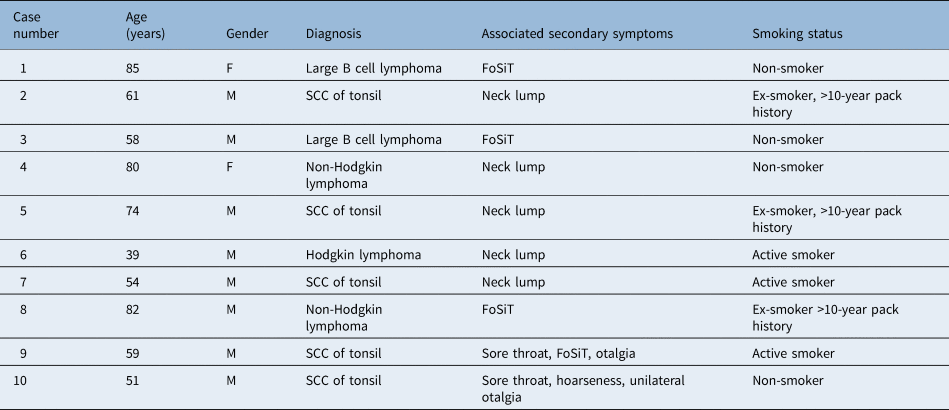
Ten patients (10.5 per cent) from the unilateral tonsillar enlargement and/or lesion referrals were diagnosed with cancer. These included five cases of SCC of the tonsil and five cases of lymphoma (Table 2). All 10 cases had additional associated symptoms on presentation. The rest of the cohort (n = 85) were benign cases and were discharged.
Study patients referred with UTEL who received positive cancer diagnoses

UTEL = unilateral tonsillar enlargement and/or lesion; F = female; FoSiT = feeling of something in throat; M = male; SCC = squamous cell carcinoma
Study cohort presenting symptoms
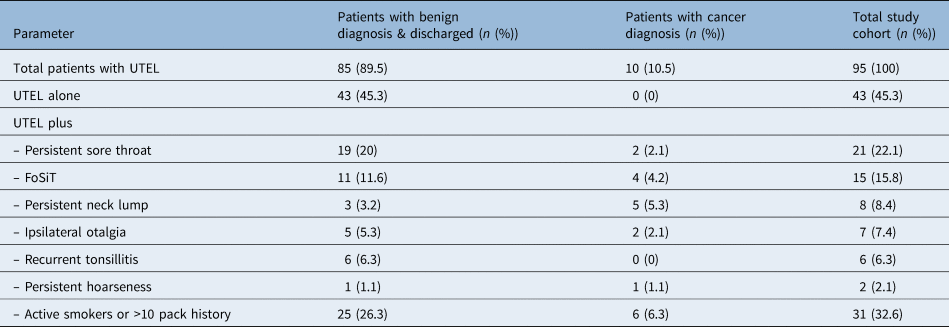
Six additional presenting symptoms were identified among the unilateral tonsillar enlargement and/or lesion referrals. The most common symptom in the cohort was persistent sore throat (22.1 per cent), followed by feeling of something in throat (15.8 per cent), persistent neck lump (8.4 per cent), ipsilateral otalgia (7.4 per cent), recurrent tonsillitis (6.3 per cent) and persistent hoarseness (2.1 per cent). Among patients who received no cancer diagnosis at the end of the referral pathway (n = 85), 43 patients presented with unilateral tonsillar enlargement and/or lesion alone, and 42 patients presented with additional symptoms (Table 3).
Presenting symptoms of study cohort

UTEL = unilateral tonsillar enlargement and/or lesion; FoSiT = feeling of something in throat
Logistic regression analysis
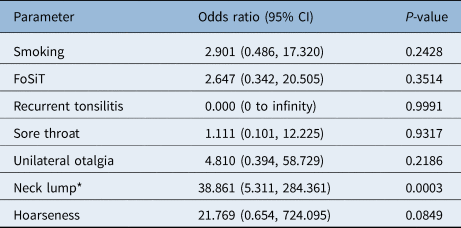
Among the 6 additional presenting symptoms, neck lump (odds ratio, 38.9; 95 per cent CI, 5.311–284.361; p < 0.001) was the only statistically significant symptom associated with a positive tonsil cancer diagnosis (Table 4).
Logistic regression of secondary presenting symptoms associated with a positive tonsil cancer diagnosis

* p < 0.05. CI = confidence interval; FoSiT = feeling of something in throat
Discussion
Studies on the suspected head and neck cancer pathway have reported that approximately 25 per cent of urgent referrals are discharged after the first consultation.Reference Hong, Shaikh, Adcock and Aldallal10,Reference Roy and Anjum11 This is comparable with our findings in the unilateral tonsillar enlargement and/or lesion referrals, where the discharge rate after first consultation was 35.8 per cent. Among the 10 cases of cancer identified in the study, all of these patients presented with unilateral tonsillar enlargement and/or lesion alongside another associated concerning head and neck symptom or B-symptom. These included neck lumps and a combination of persistent head and neck symptoms, such as sore throat, hoarseness and unilateral otalgia. This suggests that unilateral tonsillar enlargement and/or lesion alone is a poor clinical sign to suggest malignancy. In fact, of the patient cohort who presented with unilateral tonsillar enlargement and/or lesion alone in our study, none was diagnosed with cancer, suggesting that the positive predictive value of unilateral tonsillar enlargement and/or lesion alone was effectively zero.
Nationally, the number of urgent head and neck cancer referrals from general practitioners has steadily increased over the years.7 There are concerns that an escalated number of suspected head and neck cancer referrals could be a burden to secondary specialist services and increase the waiting times for clinics.Reference Rimmer, Watson, O'Flynn and Vaz12 In our study, 1.9 per cent of the total urgent head and neck cancer referrals were for unilateral tonsillar enlargement and/or lesion. This is a significant burden on an already pressurised cancer clinic. If the unilateral tonsillar enlargement and/or lesion sign alone does not correlate with tonsil malignancy, it should potentially be removed as a criterion for this pathway.
• There is currently no evidence-based guideline on whether unexplained unilateral tonsillar enlargement and/or lesion should raise suspicion of tonsillar malignancies
• Over two years, the regional specialist unit of this study received 95 referrals with unexplained unilateral tonsillar enlargement and/or lesion, out of a total of 4934 urgent head and neck cancer referrals
• Only 10 patients were diagnosed with tonsil cancer. All of them presented with at least one additional red flag symptom, suggesting unexplained unilateral tonsillar enlargement and/or lesion alone may be of limited value in the urgent head and neck cancer referral pathway
Current literature suggests that tonsillar asymmetry can be further risk stratified by considering additional clinical findings. Features such as tonsil firmness and ulceration, neck lump and history of cancer are associated with a positive tonsil cancer diagnosis.Reference Randall, Martin and Thompson13,Reference Sunkaraneni, Jones, Prasai and Fish14 In our study, 5 out of 10 cancer cases presented with a neck lump. Our logistic regression analysis also demonstrated that a persistent neck lump is a significant red flag for tonsil cancers in patients presenting with unilateral tonsillar enlargement and/or lesion. This further emphasises that unilateral tonsillar enlargement alongside other red flags has greater predictive value than unilateral tonsillar enlargement and/or lesion alone. As persistent neck lump already meets the suspected head and neck cancer referral criteria, it could be argued that unilateral tonsillar enlargement and/or lesion alone has limited value.
Limitation
Being a retrospective study, there was a lack of homogeneity in the collected data. Patients were assessed by different clinicians, and there was no set proforma on which associated symptoms to explore, although routinely all head and neck cancer surgeons would document the presence of other relevant symptoms. There was also a lack of detailed and uniform assessment of unilateral tonsillar enlargement and/or lesion, such as the size of enlargement and appearance of the lesion, preventing further risk stratification. The sample size was also limited because only the 4934 suspected head and neck cancer two-week wait referrals were reviewed, and unilateral tonsillar enlargement and/or lesion referrals from routine clinics were not part of the remit of this study.
Conclusion
During the two-year study period, we identified that approximately 2 per cent of the urgent head and neck cancer two-week wait referrals were for unilateral tonsillar enlargement and/or lesion. In this cohort, all of the positive cancer cases presented with unilateral tonsillar enlargement and/or lesion plus additional head and neck red flag symptoms. Therefore, our results suggest that the criterion of unilateral tonsillar enlargement and/or lesion alone may be of limited benefit in an already economically challenged NHS. Further large-scale, multicentre studies should be undertaken to further refine conclusions on the value of unilateral tonsillar enlargement and/or lesion as a criterion for the head and neck cancer two-week wait pathway.
Competing interests
None declared