Implications
The higher intake of early harvested grass silage is most likely due to a shorter mean chewing time per kg of dry matter intake when voluntary feed intake is physically constrained. Early harvested (EH), highly digestible and low lignified forage NDF is degraded to smaller and thinner particles, compared with late harvested and highly lignified forage NDF. The EH forage also results in a larger proportion of large particles (LP) and a high number of LP in faeces of pregnant ewes. These results challenge the concept of a fixed critical particle size for particles leaving the rumen.
Introduction
Stage of maturity at harvest is one of the most important factors affecting forage quality (Nelson and Moser, Reference Nelson and Moser1994). It is well known that an advanced stage of maturity at harvest increases the NDF and lignin contents and the ADL : NDF ratio in the forage cell wall (Van Soest, Reference Van Soest1994). According to a review by Mertens (Reference Mertens1997), less lignified NDF is easier to chew and masticate than more lignified NDF. Likewise, the ruminating index per kg of forage NDF (as measured by the Nordic Chewing Index system) increases with increasing lignification of forage NDF (Nørgaard et al., Reference Nørgaard, Nadeau, Randby and Volden2011). The mastication processes during chewing have been shown to perform the major physical breakdown of forage particles in the gastrointestinal tract (Ulyatt et al., Reference Ulyatt, Dellow, John, Reid and Waghorn1986). Advancing stage of maturity of grass at harvest and increased lignification of forage NDF have been shown to increase both the mean rumination time per kg of NDF and the mean faecal particle size (Shaver et al., Reference Shaver, Nytes, Satter and Jorgensen1988; Rustas et al., Reference Rustas, Nørgaard, Jalali and Nadeau2010). The critical threshold for feed particles to leave the rumen in sheep is less than 1 mm (Poppi et al., Reference Poppi, Norton, Minson and Hendricksen1980). Consequently, the physical breakdown of large rumen particles during rumination is important for the clearance of digesta from the rumen and continued feed intake (Ulyatt et al., Reference Ulyatt, Dellow, John, Reid and Waghorn1986). In this regard, faecal particle size distribution reflects the size distribution of particles leaving the rumen (Ulyatt et al., Reference Ulyatt, Dellow, John, Reid and Waghorn1986); no further particle size reduction occurs after the rumen.
Faecal particles have been studied using both wet and dry sieving (Udén and Van Soest, Reference Udén and Van Soest1982) and image analysis (Nørgaard, Reference Nørgaard2006). Sieving techniques have been used for measuring the proportions of different particle sizes and of large particles (LP) in faeces (Udén and Van Soest, Reference Udén and Van Soest1982). Nørgaard and Kornfelt (Reference Nørgaard and Kornfelt2006) observed thinner particles in faeces from cattle fed early cut grass silage when compared with those fed barley straw. Image analysis provides data for estimations of continued distribution functions for particle length and width values, and consequently, reliable estimations of the most frequent, the median and the 95 percentile values (Nørgaard, Reference Nørgaard2006). To our knowledge, no studies have compared data obtained from dry sieving, simple wet sieving and image analysis. In addition, there is no or very limited information available regarding the effect of grass maturity on the chewing, distribution of faecal particle size and proportion of LP in faeces from ewes during late pregnancy.
Our hypothesis in this study was that increased lignification of forage NDF due to delayed harvest results in longer mean eating and ruminating times per kg of NDF intake and increased mean particle size in faeces. Hence, we investigated the effect of harvest time of grass silage on the feed intake, chewing activity and distribution of particle size in faeces from ewes during late pregnancy. We also examined the relationship between the results from a simple wet sieving technique and those from image analysis.
Material and methods
Animals and experimental design
The experiment used 18 Swedish Finull × Dorset ewes aged 24 ± 2 months (mean ± s.d.), all bearing twins, 6 weeks before lambing. Ewes were assigned to three dietary treatments, with six ewes per treatment, in a completely randomised design. The treatments included ad libitum feeding of early harvested (EH), medium harvested (MH) or late harvested (LH) grass silage. The ewes were housed in individual pens (2 m2) bedded with wheat straw, and had free access to a vitamin–mineral mixture and fresh water. The average BW of the ewes at the start of the experiment was 82 ± 6, 82 ± 5 and 84 ± 4 kg (mean ± s.d.) for EH, MH and LH, respectively. The ewes were scored for body condition (BCS) using the 0 to 5 scoring system as reported by Russel (Reference Russel1984); the initial scores for EH, MH and LH were 3.3 ± 0.3, 3.4 ± 0.4 and 3.4 ± 0.5, respectively (mean ± s.d.). The BW and BCS were recorded once a week. During the experimental period, animals were adapted to the different diets for 2 weeks before a 4-day measurement period 38 ± 14 (mean ± s.d.) days before lambing. During the adaptation and the measurement periods, the ewes were fed 120% of their ad libitum intake daily, divided into two equal meals given at 0800 and 1600 h. Individual feed intake was recorded daily during the measurement period and it was related to BW just after lambing in order to eliminate the effect of late pregnancy on BW.
Forage
The EH, MH and LH grasses containing timothy (Phleum pratense L.), meadow fescue (Festuca pratensis Huds.) and perennial ryegrass (Lolium perenne L.) were harvested at the early, medium and late heading stages on 2, 12 and 21 June, respectively, during the 2006 spring growth cycle at Götala Research Station (58°23′ N, 13°29′ E; altitude 120 m), Skara, Sweden. Forages were ensiled as unchopped grass in round bales without the use of an additive. The bales were wrapped with eight layers of a white plastic film (Horse Wrap®, 0.025 × 750 mm; Trioplast AB, Smålandsstenar, Sweden) with an integrated round baler and wrapping machine (Deutz-Fahr RB 4.6 OC). The grass was ensiled for at least 150 days before being fed to the ewes. The mean length of 100 randomly selected silage particles from each treatment was measured manually with a ruler during the 1st, 2nd and 4th recording days for each treatment.
Sample collection
Samples from the silages were taken daily on each of the 4 measurement days for each treatment. Orts were sampled daily from each ewe during the measurement period. Faeces was sampled on the bedding twice a day (morning and afternoon), cleaned manually and composited to one daily sample per ewe. The concentrations of dry matter (DM) in daily feed and ort samples were determined at 60°C for 24 h, and the DM contents of daily faeces samples were determined at 105°C for 24 h. Feed samples were composited to one sample per treatment. Samples of orts and faeces for chemical analyses were composited to one sample per ewe and measurement period and frozen at −18°C for later analysis.
Chemical analyses
All feed analyses were performed in duplicate. Except for analysis of CP and fermentation characteristics, all chemical analyses of feed were performed on dried (60°C for 24 h) samples. Dried samples were ground through a 1 mm screen size in a mill (Kamas Kvarnmaskiner AB, Malmö, Sweden) before analysis of NDF, ADF, ADL, in vitro rumen organic matter digestibility (IVOMD), ash and crude fat, whereas samples for in situ degradation studies were ground through a 1.5 mm screen in a Wiley mill (Cyclotec, 1093 Sample mill; Tecator AB, Höganäs, Sweden). The total N concentrations of the silages were determined using a Kjeltec 1030 auto analyzer (Tecator, Höganäs, Sweden) (AOAC, 2004) and multiplied by 6.25 to estimate the content of CP. The pH, ammonia-N and the contents of sugar, lactic, acetic, propionic and butyric acid were analysed according to the principles described by Nadeau (Reference Nadeau2007). The contents of ash and crude fat of the silages were determined according to AOAC (2004). The concentrations of NDF, ADF and ADL were determined sequentially using the FibreCap system with a pore size of 10 μm (FOSS Tecator AB, Höganäs, Sweden). The NDF was determined according to the principles described by Mertens (Reference Mertens2002). The ADF was determined according to AOAC (2004) and the ADL was determined using the method described by Van Soest et al. (Reference Van Soest, Robertson and Lewis1991) modified to 6 h of incubation. The metabolisable energy (ME) content was calculated from IVOMD, which was determined after 96 h of incubation in buffer and rumen liquid (Lindgren, Reference Lindgren1979). The concentrations of indigestible NDF (INDF) of the silages were measured in situ using polyester bags with a pore size of 12 μm, which were incubated for 288 h in the rumen of three dry cows fed a standard maintenance diet (Åkerlind et al., Reference Åkerlind, Weisbjerg, Eriksson, Tøgersen, Udén, Ólafsson, Harstad and Volden2011). The fractional degradation rate of the potentially degradable NDF fraction (kdDNDF) in the silages was measured in situ after 0, 2, 4, 8, 16, 24, 48, 96 and 168 h of incubation according to Hvelplund and Weisbjerg (Reference Hvelplund and Weisbjerg2000).
Chewing activity
Chewing activity was recorded for all ewes over 4 consecutive days, averaging 38 days before lambing. Jaw movements (JM) and oscillations were recorded for 96 h according to the principle described in our previous study for sheep (Jalali et al., Reference Jalali, Nørgaard, Weisbjerg and Nielsen2012). Individual JM were identified and clustered into crude cycles (CC) after a time interval of 3.5 s between two JM. The basic chewing rate (BCR) within each cycle was estimated as the reciprocal most frequent time interval between JM according to Nørgaard and Hilden (Reference Nørgaard and Hilden2004). Effective chewing time within each CC (ECC) was calculated as the time from the first to the last JM plus 1/BCR. The CC were clustered into periods classified as eating, ruminating or idling periods using the principles described by Schleisner et al. (Reference Schleisner, Norgaard and Hansen1999). The daily eating (ET) and ruminating times (RT) were estimated as the accumulated duration of identified eating and ruminating periods. The effective eating and ruminating times were estimated as the accumulated ECC values within eating and ruminating periods. The daily chewing time was estimated as the sum of ET and RT. The mean intercycle time during rumination was estimated using the principle described by Schleisner et al. (Reference Schleisner, Norgaard and Hansen1999). Eating, ruminating, drinking and licking behaviours were observed and recorded manually for 3 h after the morning meal on each of the 4 measurement days. These observations were used to validate the identified eating and ruminating periods. Through analysis of JM, the eating and ruminating periods identified were validated by visual validation of the pattern of JM. Atypical eating or ruminating patterns were further revalidated from true patterns of the same activity and separated from licking or drinking activities using the recorded observed behaviours of the ewes on the same day and time.
Particle size in faeces
Dry sieving
Faeces samples were washed using a commercial laundry detergent (BIOTEX Color, Blumøller, Denmark) in 10 μm polyester bags and freeze dried before dry sieving into six fractions as described by Nørgaard et al. (Reference Nørgaard, Husted and Ranvig2004) and Jalali et al. (Reference Jalali, Nørgaard, Weisbjerg and Nielsen2012). The content of particle DM (PDM) in faeces DM was defined as the residual DM left after washing and freeze drying. The arithmetic and geometric mean particle sizes were estimated according to Waldo et al. (Reference Waldo, Smith, Cox, Weinland and Lucas1971). The most frequent particle size and the median and 95 percentile particle size values were estimated as described by Nørgaard (Reference Nørgaard2006).
Image analysis
The length and width values of particles in subsamples from each sieving fraction were measured using image analysis after scanning on an HP Scanjet 8300 (Regulatory Model, FCLSD-0503, CN617A0135) as described by Nørgaard et al. (Reference Nørgaard, Husted and Ranvig2004) and Jalali et al. (Reference Jalali, Nørgaard, Weisbjerg and Nielsen2012). The arithmetic mean length, width and variance values along with the geometric mean length and width values were estimated for each sieving fraction by weighting with the area value. Gamma density distribution functions for particle length (PL) (fi(PL)) and width (PW) (gi(PW)) were estimated for each sieving fraction from the arithmetic mean and variance values. The overall density distribution functions for particle length and width were estimated as composite functions of fi(PL) and gi(PW), respectively, by weighting with the particle mass proportion of individual sieving fractions. The most frequent, median and 95 percentile length and width values were estimated from the overall distribution and the accumulated distribution functions by stepwise identification (Nørgaard, Reference Nørgaard2006).
Simple sieving
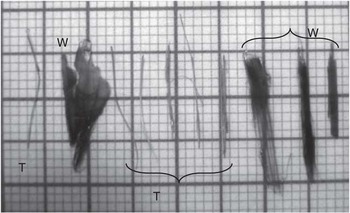
For each simple sieving, 50 g of a mixed faeces sample was placed on a sieve with a pore size of 2.36 mm, 210 mm diameter and 100 mm edge (Retsch AS 200, Retsch GmbH, Haan, Germany). The sieve was shaken gently in a plastic container of 500 mm length, 400 mm width and 200 mm height filled with running 39°C tap water for ∼10 min until all large faeces particles on the sieve were visible and cleaned from the non-particle matter in the faeces (Nørgaard et al., Reference Nørgaard, Nadeau and Nordquist2007). Forceps and a graph paper were used to select the very LP and divide them into two length (7 to 10 mm and >10 mm) and two width groups (< or >1 mm; Figure 1) defined by the double critical PL and PW, respectively, estimated from the C(PL) and C(PW) functions by image analysis. The amount of very LP DM (VLP_DM) was measured after drying at 105°C for 8 h for each size group. The proportion of VLP_DM to total particle DM (PVLP_DM) was estimated.
Particles longer than 10 mm, including both thin (T) and wide (W) particles. Large squares are 5 × 5 mm and small squares are 1 × 1 mm.

Statistical analysis
Data for intake, chewing activity and faecal particle size for both dry sieving and image analysis were analysed (model 1) using the Mixed model procedure of SAS® (SAS system for Windows, release 9.2; Cary, NC, USA). The effects of increased INDF : NDF or ADL : NDF ratios were also tested (model 2). The statistical models were as follows:
 $$ {{Y}_i}\,{\rm{ = }}\,\mu \,{\rm{ + }}\,{{T}_i}\,{\rm{ + }}\,{{{\epsilon}}_i} $$
 $$ {{Y}_i}\,{\rm{ = }}\,\mu \,{\rm{ + }}\,\beta {{L}_i}\,{\rm{ + }}\,{{{\epsilon}}_i} $$
where Yi is the dependent variable, μ the overall mean, Ti the fixed class effect of treatment (i = 1, 2, 3), βLi the regression effects of increased INDF : NDF or ADL : NDF ratios (i = 1, 2, 3) and εi the residual error and ewe is included as a random effect. The number of very LP identified by the simple sieving technique was analysed using the Kruskal–Wallis chi-square procedure in order to test for differences between dietary treatments for the individual group combinations of length and width. The PVLP_DM values were validated against the corresponding predicted accumulated proportion of particle mass longer than 10 mm estimated from the accumulated distribution function of particle length (AF(PL)) measured by an image analysis using DM intake as a covariate.
Differences between dietary treatments in the F-test were considered significant at P < 0.05 and as a tendency towards significance at 0.05 < P < 0.10. Pairwise comparisons between treatment means, shown as least square means, were performed using Tukey's test. The correlations between BCS and the daily intake of ME and between the mean chewing time per kg NDF intake and the arithmetic mean particle size value were analysed using the CORR procedure of SAS (SAS system for Windows, release 9.2; Cary, NC, USA).
Results
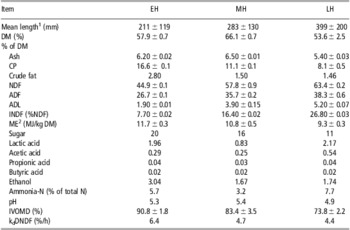
The mean length size of grass silage, chemical composition, fermentation and degradation characteristics of the silages are presented in Table 1.
Mean length, chemical composition, fermentation and degradation characteristics (mean ± s.d.) of grass silage EH, MH or LH

EH = early harvested; MH = medium harvested; LH = late harvested; DM = dry matter; INDF = indigestible NDF; ME = metabolisable energy; IVOMD = in vitro rumen organic matter digestibility; kdDNDF = degradation rate of the potentially degradable NDF.
1Lengths of 100 particles were measured from each treatment.
2ME (in MJ) calculated from IVOMD.
Intake
As maturity of the grass at harvest increased, the daily intakes of silage DM (2.40, 2.00 and 2.73 kg for EH, MH and LH, respectively; P < 0.001) and ME (28, 22 and 16 MJ for EH, MH and LH, respectively; P < 0.001) decreased. Also, advancing stage of maturity of the forage at harvest resulted in increased daily intakes of NDF (1.13%, 1.27% and 1.33% of BW for EH, MH and LH, respectively; P < 0.05) and INDF (0.09%, 0.22% and 0.38% of BW for EH, MH and LH, respectively; P < 0.001). The BW values were 94, 90 and 83 kg (P = 0.08) for the EH, MH and LH, respectively. Feeding the EH treatment resulted in a higher BCS value of 3.1 compared with 2.8 and 2.5 for MH and LH, respectively (P < 0.01).
Chewing activity
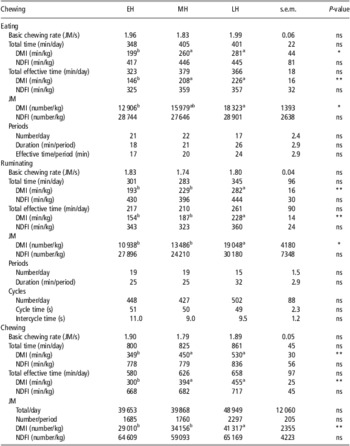
The mean daily and effective time spent eating, ruminating and chewing per kg of DM intake increased with delayed harvest (Table 2). However, the mean effective time spent eating, ruminating and total chewing per kg of NDF intake was not affected by harvest date. The mean number of JM per kg of DM intake during eating, ruminating and the total chewing activity was larger in ewes fed LH compared with those fed MH and EH (Table 2).
Eating, ruminating and total chewing activity in ewes fed grass silage EH, MH or LH (n = 6 for each treatment)

EH = early harvested; MH = medium harvested; LH = late harvested; JM = jaw movements; DMI = dry matter intake; NDFI = NDF intake.
Within a row, means without common superscripts differ (P < 0.05).
**P < 0.01, *P < 0.05, T = tendency to significance (0.05 < P < 0.1), ns, P > 0.10.
Faecal particle size
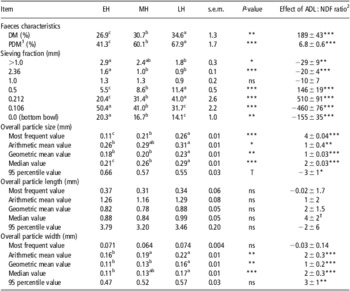
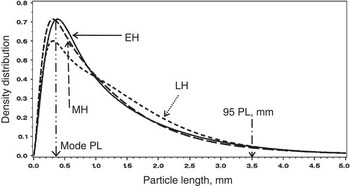
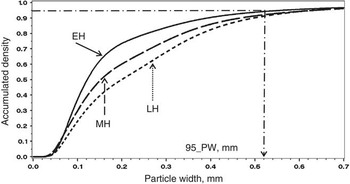
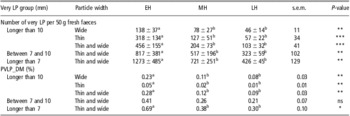
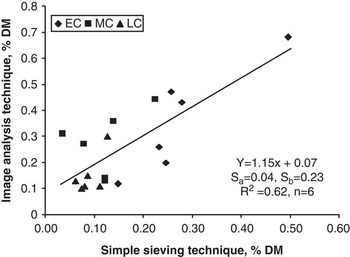
Feeding EH resulted in thinner faecal particles, lower most frequent, arithmetic and geometric mean and median particle size values and lower arithmetic and geometric mean and median width values compared with feeding more mature silages (Table 3). There were linear correlations between the ADL : NDF ratio of the silages and the proportion of faeces particles retained in different sieving fractions, the overall particle size and the particle width (Table 3). The mean 95 percentile particle length and width values were shorter than 3.5 mm and thinner than 0.52 mm, respectively (Table 3; Figures 2 and 3). In comparison with MH and LH feeding, EH feeding resulted in larger numbers of very LP retained on the sieve with 2.36 mm pores, and, consequently, a higher proportion of VLP_DM for particles longer than 7 mm and longer than 10 mm (Table 4). The R 2 values for the correlations between the AF(PL > 10 mm) values from image analysis and the VLP_DM values from the simple sieving technique for EH, MH and LH treatments were 0.81, 0.16 and 0.49, respectively. An overall linear correlation was found between the PVLP_DM values for LP > 10 mm for both the thin and the wide groups and the AF(PL > 10 mm) percentile values obtained from image analysis (R 2 = 0.62; P < 0.001; Figure 4). The single upper value was tested using Cook's D test in SAS (SAS system for Windows, release 9.2; Cary, NC, USA); it was not found to be an outlier for both PVLP_DM for the particles longer than 10 mm obtained by simple sieving or image analysis. However, when the maximal value was excluded, the R 2 value decreased from 0.62 to 0.37 (P < 0.05).
Faeces characteristics, proportion (%) of faeces particles in the individual sieving fractions and overall particle size from dry sieving, linear effect of forage lignification (slope ± s.d.) and overall width and length (mm) values from image analysis in ewes fed grass silage EH, MH or LH (n = 6 for each treatment)

EH = early harvested; MH = medium harvested; LH = late harvested; DM = dry matter; PDM = particle DM.
1Proportion of PDM left in bags after washing procedure.
2Slope from Yi = μ + βADLi/NDFi and significance for linear effect of increased ADL : NDF ratio (g/g) in the silages on faeces characteristics.
Within a row, means without common superscripts differ (P < 0.05).
***P < 0.001, **P < 0.01, *P < 0.05, T = tendency to significance (0.05<P < 0.10), ns, P > 0.10.
Distribution of all particle length values in faeces from ewes fed grass silage harvested early (EH), medium (MH) or late (LH). 95_PL: 95 percentile of particle length value and Mode_PL: most frequent particle length value.

Accumulated density distribution of particle width values in faeces from ewes fed grass silage harvested early (EH), medium (MH) or late (LH). 95_PW: 95 percentile of particle width value.

Number of very large faeces particles (LP) retained on a 2.36 mm sieve (mean ± s.d.) from simple sieving technique and the PVLP_DM (%) in different length and width groups from ewes fed grass silage EH, MH or LH (n = 6 for each treatment)

LP = large particles; DM = dry matter; PVLP_DM = proportion of very large particle DM to total particle DM; EH = early harvested; MH = medium harvested; LH = late harvested.
Within a row, means without common superscripts differ (P < 0.05).
***P < 0.001, **P < 0.01, *P < 0.05, ns, P > 0.10.
Relationship between the proportions of very large particles in faeces (PVLP > 10 mm; % DM) measured using simple sieving within two width groups (< or >1 mm; x) and by image analysis AF(PL >10 mm; y) from ewes fed grass silage harvested early (EH), medium (MH) or late (LH). S a and S b represent the standard deviation for the intercept and the slope value, respectively.

Discussion
Intake, BW and BCS
Ewes fed MH and LH had an NDF intake of 1.27% and 1.33% of BW, respectively. These figures are close to the maximal silage NDF intake in small and large ruminants presented by Mertens (Reference Mertens1994), which indicates physical constraints on intake for both MH and LH. Results from a field study (Arnesson and Eggertsen, Reference Arnesson and Eggertsen2006) showed that ewes lose more BCS during lactation than during pregnancy, and that the decrease is more extensive in ewes fed LH compared with EH silage. In addition, our results showed a Pearson correlation of 0.59 (P < 0.02) between the daily intake of ME and BCS values, which were higher in ewes fed the EH treatment compared with the other treatments.
Chewing activity
The physical breakdown of fibrous feed is mainly due to chewing during eating and further chewing during rumination (Ulyatt et al., Reference Ulyatt, Dellow, John, Reid and Waghorn1986). Chewing during rumination plays a major role in the continued reduction of LP in the rumen (Ulyatt et al., Reference Ulyatt, Dellow, John, Reid and Waghorn1986). The ewes in our study showed a mean ratio of 1.24 between the ET and RT, in contrast to the ratio of 0.49 reported in Blackface ewes fed medium or finely chopped ryegrass hay (Hadjigeorgiou et al., Reference Hadjigeorgiou, Gordon and Milne2003). This difference in the results might be explained by differences in the physiological status of the animals, DM intake and physical form of the feed.
The mean eating time value of 436 min/kg of NDF intake in this study was lower than the value of 558 min/kg of NDF intake obtained by Kaske and Groth (Reference Kaske and Groth1997) in pregnant Blackhead ewes fed long hay ad libitum. The lower value might be explained by a larger body size of the ewes (Bae et al., Reference Bae, Welch and Gilman1983). The 46% longer mean ruminating time per kg DM intake for the LH compared with the EH can be explained by the higher NDF content.
Our hypothesis was that higher ADL : NDF and INDF : NDF ratios due to later harvest would increase the mean eating, ruminating or chewing activity per kg of NDF intake; however, this hypothesis was not confirmed (P > 0.1). Instead, the daily time spent eating, ruminating and total chewing appears to depend primarily on the intake of forage NDF, which agrees with the results on dairy cows obtained by Oba and Allen (Reference Oba and Allen2000). However, our results did not demonstrate a close correlation between the mean chewing time per kg of NDF intake and the arithmetic mean particle size value in faeces. The daily number of JM and time spent eating, ruminating and total chewing were not affected by harvest time. These results support the hypothesis that ad libitum voluntary DM intake is dependent on the mean chewing time per kg DM intake when feed intake is physically constrained (Allen, Reference Allen1996).
Faecal particle size
The particle size distribution in faeces is characterised by the proportion of particle mass retained in the different sieving fractions, the overall particle size, particle length and particle width. The proportions of particle mass in the lower sieving fractions and the most frequent particle size differed between EH, MH and LH, while the most frequent length and width values were not affected by the stage of maturity at harvest. The increasing arithmetic mean particle sizes from EH to LH are in accordance with the results obtained by Rustas et al. (Reference Rustas, Nørgaard, Jalali and Nadeau2010), who found an increase in the mean particle size in faeces with increased stage of maturity of whole-crop barley silage fed to steers. It is well known that the ADL : NDF ratio in forage fibre increases with advancing stages of forage maturity (Van Soest, Reference Van Soest1994). This study shows that there is a linear correlation between increased lignification of NDF and the proportion of faeces particles in the different sieving fractions and the overall particle size and width values of particles in the faeces.
The smaller mean particle size in our study as compared with the values obtained using wet sieving (Kaske and Groth, Reference Kaske and Groth1997; Hadjigeorgiou et al., Reference Hadjigeorgiou, Gordon and Milne2003) might be explained by the use of different sieving methods and by the use of the smallest available bag pore size, which retained more small particles during the washing procedure in our study. Van Soest (Reference Van Soest1994) reported that dry sieving tends to separate faeces particles based on the particle width, whereas wet sieving sorts particles according to their length. In addition, our results show that 14% to 20% of the particle DM passed a sieve with a pore size of 0.106 mm and 2% to 3% was retained on the top fractions (>1 mm). These findings imply that the smallest pore size of sieves used in a study has an effect on both the mean particle size reported and the proportion of LP retained on the 1 mm screen size. The mean particle size and the proportion of LP in faeces from pregnant ewes in our study were within the range of values presented by Jalali et al. (Reference Jalali, Nørgaard, Weisbjerg and Nielsen2012) for mature sheep fed at the maintenance level. Advancing stage of maturity at harvest leads to a lower proportion of faeces particles retained on the 1 mm sieve size and a lower number of very LP longer than 10 mm (Tables 3 and 4). However, the proportions of long and wide particles (95 percentile values) were not affected by treatment. This might be explained by the selective retention of LP and very LP in the rumen system, which appears to be less effective when immature forages, such as EH, were fed to ewes and by higher intakes of EH-fed ewes. The simple sieving technique can be used instead of image analysis for a better study of the proportion of very LP in faeces, which might be due to a four times larger sample size (50 g v. 12 g faeces), used for the simple sieving technique.
Dry sieving provides information about both the mean and the distribution of both small and large faeces particles, whereas simple sieving only provides information about the proportion of very LP. The most frequent particle size, the median particle size and the arithmetic mean values differ from those in a normal distribution (Nørgaard, Reference Nørgaard2006). The results from image analysis showed that the 95 percentile particle length values were, on average, six times higher than the 95 percentile particle width values (3.48 mm v. 0.52 mm), which were close to the 95 percentile particle size values from dry sieving (0.59 mm). The proximate values between 95 percentile particle size and width confirmed that dry sieving, followed by brushing, as applied in this study, sorts the particles according to their width rather than their length. Furthermore, both the arithmetic mean particle size analysed by dry sieving and the arithmetic mean particle width size analysed by image analysis increased with advanced maturity and increasing lignification of the forage in this study. The mean particle size values from sieving techniques were 60%, 50% and 40% higher compared with the mean particle width values obtained by image analysis at the EH, MH and LH treatments, respectively. The mean particle size and width values increased at increasing lignification of the forages, but the mean length values were not significantly affected by lignification (Table 3). Increased lignification of forage cell wall during maturation appears to increase the width of forage cell wall cells and the resistance against physical degradation, resulting in wider faeces particles. Consequently, the arithmetic mean particle size and width size in faeces from ewes appear to indicate the stage of maturity at harvest and the NDF digestibility of the forage eaten by the ewes as shown by Jalali et al. (Reference Jalali, Nørgaard, Weisbjerg and Nielsen2012).
Shaver et al. (Reference Shaver, Nytes, Satter and Jorgensen1988) reported that the proportion of small particles decreased with increasing ADL : NDF ratio in lactating cows fed alfalfa hay. This finding is in accordance with our results, where the proportion of particles smaller than 0.106 mm was lower for the LH than for the other treatments and the proportion of thin particles from 0.1 to 0.2 mm decreased with forage maturation (Figure 3). This finding might indicate that less lignified forages, such as EH compared with MH and LH, contain large forage particles that are more easily broken down into small particles during chewing (Mertens, Reference Mertens1997). On the other hand, the larger proportion of particles smaller than 0.106 mm might be correlated with a faster rate of digestion in the EH-fed ewes than in those fed MH and LH, resulting in a quicker degradation of particle size small enough to leave the rumen (Tables 1 and 3).
We observed that an average of 2.4% of the total faeces particle DM were larger than 1 mm. Similarly, Eilersen (Reference Eilersen2008) found that LP comprised 2.3% of faeces DM in pregnant ewes fed long grass silage ad libitum supplemented with 800 g mixed concentrate daily, when using the same dry sieving technique as in this study. The larger proportion of faecal particles retained on a 1 mm pore size from ewes fed EH may be related to the higher DM intake from EH compared with LH silage. Likewise, Deswysen and Ellis (Reference Deswysen and Ellis1990) observed that the proportion of LP retained on a 1 mm sieve size increased with increasing intake of maize silage by heifers supplemented with cotton seed meal daily. Lechner-Doll et al. (Reference Lechner-Doll, Kaske and Engelhardt1991) proposed that the effective density of rumen particles and their selective retention in the rumen system increased with increasing fermentation activity. However, the importance of that mechanism is not supported by the relatively high proportion of LP in faeces from ewes fed EH compared with ewes fed MH and LH with the lower IVOMD values in this study. Therefore, we consider faecal LP to be only partly digested, as the study by Jalali et al. (Reference Jalali, Nørgaard, Weisbjerg and Nielsen2012) showed that the NDF digestibility within forage diets was negatively correlated with the mean particle size in faeces. The higher faeces DM content and the higher proportion of particle DM in faeces from ewes fed LH compared with EH and MH in our study are similar to the results obtained by Zaaijer and Noordhuizen (Reference Zaaijer and Noordhuizen2003), who found that feeding immature forage to cattle led to a lower DM content in faeces as compared with feeding mature forage. Finally, increased lignification of forage fibre led to an increased mean particle size and width in faeces, a decreased proportion of LP, a higher faeces DM content and a higher proportion of particle DM in faeces, but did not affect the length of faeces particles.
Correlation between simple sieving and image analysis techniques
A high number of very LP in the faeces has been considered as an indication of a ‘poor’ stratification of rumen particles due to subclinical rumen disorders, causing low fibre digestion and poor manure consistency (Zaaijer and Noordhuizen, Reference Zaaijer and Noordhuizen2003; Nørgaard, Reference Nørgaard2006). In this study, three methods were used to measure the proportion of very LP in faeces from ewes: as particles retained on the 2.36 mm sieve using dry sieving, as 95 percentile particle length and width values from image analysis and by manually counting particles longer than 7 or 10 mm using the simple sieving technique. Very LP was defined as those equivalent to twice the 95 percentile particle length and width values. Poppi et al. (Reference Poppi, Norton, Minson and Hendricksen1980) reported that the critical particle size in sheep fed different forage maturities is 1.18 mm; particles larger than this are supposed to be retained in the rumen. However, we found that feeding EH led to a higher proportion of particles longer than 1 mm and a tendency towards a higher 95 percentile particle size value in faeces, compared with MH and LH. These results can be explained by higher DM intake or less lignified fibre in the EH silage than in the other treatments. The simple sieving, dry sieving and image analysis techniques showed similar results in terms of the proportion of very LP, such as a higher number of very LP in the EH-fed ewes compared with the other treatments.
Conclusions
The mean eating, ruminating and chewing time per kg of NDF intake were not affected by the stage of maturity at harvest. However, early harvested grass with a low lignification of NDF resulted in a higher DM intake, a shorter chewing time per kg of DM intake, a lower mean particle size and width and a larger proportion of both small and large faeces particles. The mean particle length and the distribution of particle length values were not affected by stage of maturity at harvest or lignification of NDF. The 95 percentile values appeared to increase with earlier maturities, due to either increased intake or decreased lignification of forage NDF. The distribution of faecal particle size might be considered as a footprint of the characteristics of forage fibre eaten by ewes. Less lignified forage NDF particles are degraded into smaller and thinner particles compared with more lignified forage NDF.
Acknowledgements
The project was funded by the Swedish Farmers Foundation for Agricultural Research, the Swedish Foundation for Sheep Research, Agroväst, the Swedish University of Agricultural Sciences and the University of Copenhagen. The authors thank Associate Professor Bo Markussen for his statistical advice.