Implications
Ascites syndrome is one of the major causes of mortality and economic loss in broiler industry. The present study demonstrated that in addition to improve feed efficiency, applying a 40% quantitative feed restriction (FDR) program from days 7 to 14 of age can successfully decrease syndrome incidence and mortality and can be used as an easy, applicable and economic method in broiler farms. Also, this study investigated physiological mechanisms through which FDR may reduce ascites incidence from a different perspective and confirms that one of the major mechanisms is allowing better development of internal organs specially liver and cardiopulmonary system.
Introduction
Modern broilers are intensively selected for fast growth rate combined with a low feed conversion ratio (FCR) (Luger et al., Reference Luger, Shinder, Rzepakovsky, Rusal and Yahav2003; Baghbanzadeh and Decuypere, Reference Baghbanzadeh and Decuypere2008). This, coupled with insufficient development of cardio-pulmonary systems to support that rapid growth, resulted in greater susceptibility to metabolic disorders such as ascites syndrome (also known as pulmonary hypertension syndrome and pulmonary arterial hypertension syndrome) (Luger et al., Reference Luger, Shinder, Rzepakovsky, Rusal and Yahav2003; Wideman et al., Reference Wideman, Rhoads, Erf and Anthony2013), which is one of the major causes of mortality and economic loss in modern broiler industry (Aftab and Khan, Reference Aftab and Khan2005; Ozkan et al., Reference Ozkan, Plavnik and Yahav2010).
It has been stated that fast growth and cool temperatures are the primary triggers for ascites in commercial broiler production (Wideman, Reference Wideman2001; Ipek and Sahan, Reference Ipek and Sahan2006). In a cold environment, the growth rate is faster and metabolic rate rises to increase heat production and maintain normal body temperature (Julian, Reference Julian2000). Consequently, cardiac output increases to supply the oxygen required for metabolism causing increased vascular pressure in the lung and pulmonary arteries (pulmonary hypertension). Pulmonary hypertension triggers series of events, which finally lead to the ascites syndrome (Julian, Reference Julian2000 and Reference Julian2007). During cold stress several studies have reported important physiological changes, including classic hematological changes and increased right ventricle weight per total ventricle weight (RV : TV) ratio (Yahav et al., Reference Yahav, Straschnow, Plavnik and Hurwitz1997; Luger et al., Reference Luger, Shinder, Rzepakovsky, Rusal and Yahav2003; Ipek and Sahan, Reference Ipek and Sahan2006), but there is only very little or no information on the other physiological responses such as blood chemical alterations.
There are several management, nutritional and medicinal strategies to minimize losses caused by ascites, among which, early FDR is one of the most commercial and practical techniques that significantly alleviates the syndrome incidence and mortality (Balog et al., Reference Balog, Anthony, Cooper, Kidd, Huff, Huff and Rath2000; Ozkan et al., Reference Ozkan, Plavnik and Yahav2010). Early FDR decreases ascites development and incidence by reducing the rate of weight gain and thus metabolic and oxygen demand of the bird through crucial periods of life (Arce et al., Reference Arce, Berger and Lopez Coello1992; Ozkan et al., Reference Ozkan, Takma, Yahav, Söğüt, Türkmut, Erturun and Cahaner2006). Although the effects of FDR on performance and ascites incidence have been studied extensively, but only few studies investigated the physiological responses to this technique in cold-exposed chickens. Previous studies have examined the impacts of a skip-a-day FDR program (Khajali and Qujeq, Reference Khajali and Qujeq2005; Khajali et al., Reference Khajali, Zamani-Moghaddam and Asadi-Khoshoei2007), and reducing daily intake energy to 50% of required energy for normal growth (Ozkan et al., Reference Ozkan, Plavnik and Yahav2010) in a combined condition of high altitude and low environmental temperature. Also, Ozkan et al. (Reference Ozkan, Takma, Yahav, Söğüt, Türkmut, Erturun and Cahaner2006) investigated the effect of reducing daily intake energy to 50% of required energy for normal growth on ascites incidence and some physiological parameters such as hematocrit and thyroid hormones concentrations in Cobb chickens exposed to the cold temperature (CT), without any control group in normal temperature (NT).
Hematology and evaluation of blood chemistry are fundamental tools for disease diagnosis and permit identifying metabolic alterations caused by different physiological and pathological states (Harr, Reference Harr2002; Rajman et al., Reference Rajman, Juráni, Lamošová, Máčajová, Sedlačková, Košťál, Ježová and Výboh2006). Few studies have investigated the impact of FDR or cold exposure on some blood biochemical parameters separately, but studies on FDR effects in low ambient temperatures are very scarce. Therefore, the purpose of this study was to determine the effect of a 40% quantitative early FDR on blood hematological, biochemical and enzymatic alterations, thyroid hormones concentrations, anatomical changes of internal organs, growth performance and incidence of ascites syndrome in broiler chickens under cold and normal ambient temperatures.
Material and methods
Birds and diets
One-day-old male chicks (Ross 308) (n=400) were obtained from a commercial hatchery. Then 320 chicks were selected according to the BW, birds of extreme weights were discarded, and randomly divided into two treatment groups of ad libitum (Ad) and feed restricted (FR), each group comprising eight floor pens (120×100×50 cm, length×width×height), 20 chicks/pen. Broilers were fed a crumble starter (day 1 to 14 of age), grower (day 14 to 28) and finisher diet (from day 28 onwards). Diets were formulated according to the National Research Council (1994) recommendations and contained 2960, 3000 and 3100 kcal/kg of metabolic energy, respectively, and 22.5%, 21% and 18% of CP, respectively. The birds had continuous access to water. The experimental protocols were approved by Isfahan University of Technology Institutional Animal Care and Use Committee.
Feed restriction and cold exposure
Ad libitum chicks had free access to the feed throughout the experiment. FR chickens had free access to the feed during 1st week of rearing period, but they were subjected to a 40% quantitative FDR program from 7 to 14 days of age and allowed a daily intake of 60% of the feed consumed by Ad group on the previous day. They had free access to the feed from day 14 onwards. All birds were kept under normal environmental conditions up to week 3 of age (33°C, 30°C and 27°C for weeks 1, 2 and 3, respectively). On day 21 half of the birds (four pens) in both Ad and FR treatment groups were exposed to the CT. For these birds environment temperature was reduced to 20°C and 15°C at 21 and 28 days of age, respectively, and maintained at 15°C to 16°C until the end of the experiment. The other half of the birds, continued with NT. Their environment temperature was reduced to 25°C and 22°C, at days 21 and 28, respectively, and maintained at ~22°C for the rest of the experiment. Therefore, from week 4 onwards, this study contained four treatment groups (four pen replicates each, 20 chicks/pen) including NT/Ad, NT/FR, CT/Ad and CT/FR.
Performance, ascites mortality and sampling
At 7, 14, 21, 28 and 42 days of age, BW and feed consumption were measured by pen basis after 4 h of feed withdrawal. Mortality was recorded daily to correct the average daily intake and average daily gain data. Also, all dead birds were necropsied to determine cause of death. At 39 and 46 days of age, two chicks with a BW around the pen average were selected from each pen, weighed subsequent to 4 h of starvation and killed after collecting blood samples. Then, the liver and heart were excised and weighed immediately. The heart was dissected (McGovern et al., Reference McGovern, Feddes, Robinson and Hanson1999), right ventricle thickness was measured and after weighing ventricles, the RV : TV ratio was calculated for each bird.
Hematocrit and blood chemistry
Two fractions of heparinized and non-heparinized blood samples were collected from each bird during sampling operation. Heparinized samples were used to measure hematocrit, using an auto-hematology analyzer (BC-5800; Mindray, Shenzhen, China). Serum samples from non-heparinized blood were used to measure biochemical and enzymatic parameters including triglyceride, cholesterol, high-density lipoprotein, total protein, alanine aminotransferase (ALT), aspartate aminotransferase (AST) and lactate dehydrogenase (LDH), using an autoanalyzer (BT3000plus; Biotecnica Instruments, Rome, Italy). Total triiodothyronine (T3) and thyroxine (T4) were determined by performing radioimmunoassay and using a gamma counter (Genesys Gamma; Laboratory Technologies Inc., Elburn, IL, USA).
Statistical analysis
All data except for performance from days 7 to 21 were analyzed in a complete randomized block design using the GLM procedures of SAS software (SAS Institute, 2002, Cary, NC, USA), in which the pen was considered as the experimental unit for performance parameters, and the individual chicks as the experimental unit for anatomical and blood parameters. Performance data from days 7 to 21 were analyzed in a completely randomized design. Replicate number for performance data was eight pens from days 7 to 21 and it was four pens from day 21 onwards. Replicate number for anatomical and blood parameters was eight birds (two birds from each pen). Treatment means were compared using Tukey’s test and considered significantly different at P⩽0.05.
Results
Performance and ascites mortality
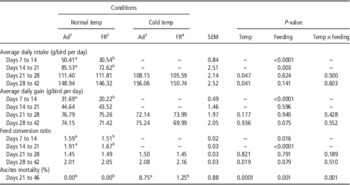
The data of average daily intake, average daily gain and FCR are shown in Table 1. During the FDR period (days 7 to 14) and the 1st week following it (days 14 to 21), Ad chickens had greater (P<0.01) average daily intake than FR ones. Within the 1st week of cold exposure (days 21 to 28), chickens in CT group consumed less (P<0.05) feed than NT chicks, but from days 28 to 42 CT chickens consumed more (P<0.05). The FDR treatment did not affect feed consumption during cold exposure period and average daily intake showed no significant differences between Ad and FR chickens. Average daily gain of Ad chickens was significantly (P<0.01) greater than FR chickens during FDR period. Thereafter, there were not any significant differences in BW gain between Ad and FR chickens. Also, average daily gain was not affected by temperature and no differences were observed between CT and NT chickens.
Effect of the feed restriction and cold temperature on growth performance of broilers at different age intervals and cumulative mortality due to ascites (%) from day 21 to 46 of age

Temp=temperature; Ad=ad libitum; FR=feed restricted.
a,bWithin row, values with no common superscript differ significantly (P⩽0.05).
1 Ad libitum broilers reared under normal temperature.
2 FR broilers reared under normal temperature.
3 Ad libitum broilers exposed to the cold temperature from day 21 onwards.
4 FR broilers exposed to the cold temperature from day 21 onwards.
During the FDR period and the 1st week after that (days 14 to 21), FR chickens showed lower (P<0.05) FCR and thus better performance. Thereafter, no significant differences were observed between Ad and FR chickens. Temperature significantly (P<0.05) influenced feed efficiency, and CT birds showed greater FCR than NT ones from days 28 to 42. Cold exposure increased (P<0.01) ascites mortality, whereas FDR treatment significantly (P<0.01) reduced it from 8.75% in CT/Ad chickens to 1.25% in CT/FR birds (Table 1). No mortality due to ascites was observed in normal conditions. Mortality due to other causes than ascites was observed only in NT/Ad and NT/FR birds and was 1.25% for each group.
Hematocrit and anatomical changes of internal organs
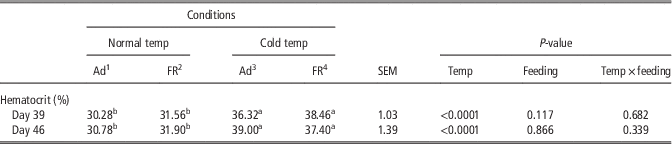
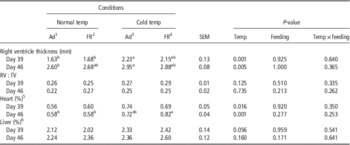
Hematocrit was significantly (P<0.01) higher in CT birds at both slaughter ages of day 39 and day 46 (Table 2). However, this hematological parameter was not affected by feeding regimen and no significant differences of hematocrit were seen between FR birds and their Ad counterparts. Cold exposure affected some anatomical parameters of internal organs at both 39 and 46 days of age (Table 3), and CT birds showed significantly (P<0.05) thicker right ventricle and greater relative weight of heart. None of the anatomical parameters were affected by FDR treatment under normal or cold environmental conditions.
Effect of the feed restriction and cold temperature on hematocrit (%) of broilers at days 39 and 46 of age

Temp=temperature; Ad=ad libitum; FR=feed restricted.
a,bWithin row, values with no common superscript differ significantly (P⩽0.05).
1 Ad libitum broilers reared under normal temperature.
2 FR broilers reared under normal temperature.
3 Ad libitum broilers exposed to the cold temperature from day 21 onwards.
4 FR broilers exposed to the cold temperature from day 21 onwards.
Effect of the feed restriction and cold temperature on internal organs anatomy of broilers at days 39 and 46 of age

Temp=temperature; Ad=ad libitum; FR=feed restricted; RV : TV=right ventricle weight per total ventricle weight.
a,bWithin row, values with no common superscript differ significantly (P⩽0.05).
1 Ad libitum broilers reared under normal temperature.
2 FR broilers reared under normal temperature.
3 Ad libitum broilers exposed to the cold temperature from day 21 onwards.
4 FR broilers exposed to the cold temperature from day 21 onwards.
5 Relative weight of heart as the percentage of BW.
6 Relative weight of liver as the percentage of BW.
Blood biochemical parameters and enzymatic activity
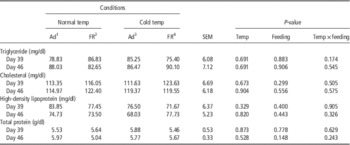
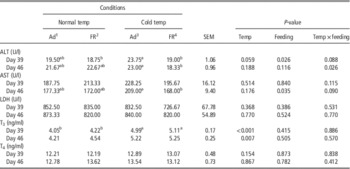
Blood biochemical parameters including concentrations of serum triglyceride, cholesterol, high-density lipoprotein and total protein were not affected by temperature, feeding regimen and their interaction, and none of them showed significant differences among treatment groups at days 39 and 46 (Table 4). In comparison with Ad chickens, FR birds showed significantly (P<0.05) lower activity of ALT at day 39 and AST at day 46 (Table 5). For broilers exposed to CT, the FDR treatment significantly (P<0.05) reduced ALT (days 39 and 46) and AST (day 46) when compared with the Ad treatment (Table 5).
Effect of the feed restriction and cold temperature on blood biochemical parameters of broilers at days 39 and 46 of age

Temp=temperature; Ad=ad libitum; FR=feed restricted.
1 Ad libitum broilers reared under normal temperature.
2 FR broilers reared under normal temperature.
3 Ad libitum broilers exposed to the cold temperature from day 21 onwards.
4 FR broilers exposed to the cold temperature from day 21 onwards.
Effect of the feed restriction and cold temperature on blood enzymatic activity (U/l) and circulatory concentrations of thyroid hormones (ng/ml) in broilers at days 39 and 46 of age

ALT=alanine aminotransferase; AST=aspartate aminotransferase; LDH=lactate dehydrogenase; T3=triiodothyronine; T4=thyroxine; Temp=temperature; Ad=ad libitum; FR=feed restricted.
a,bWithin row, values with no common superscript differ significantly (P⩽0.05).
1 Ad libitum broilers reared under normal temperature.
2 FR broilers reared under normal temperature.
3 Ad libitum broilers exposed to the cold temperature from day 21 onwards.
4 FR broilers exposed to the cold temperature from day 21 onwards.
Thyroid hormones
Temperature, but not feeding regimen, affected T3 circulatory concentrations at both 39 and 46 days of age resulted in significantly (P<0.01) higher concentrations of this thyroid hormone in cold exposed chicks when compared with the chickens reared under normal ambient temperature (Table 5). However, the T4 circulatory concentrations were not affected by temperature or feeding regimen and their interaction and showed no significant differences among treatment groups at days 39 and 46 (Table 5).
Discussion
Performance
Restricted chickens had significantly lower daily intake during FDR period and the 1st week following it (days 14 to 21), which is consistent with previous findings (Zhan et al., Reference Zhan, Wang, Ren, Zhao, Li and Tan2007; Butzen et al., Reference Butzen, Ribeiro, Vieira, Kessler, Dadalt and Della2013). Butzen et al. (Reference Butzen, Ribeiro, Vieira, Kessler, Dadalt and Della2013) also observed that after refeeding, restricted male chickens still consumed less feed and it took them a few days to reach the levels of the control group that had free access to the feed. Average daily gain was significantly lower in FR chickens during FDR period, but it increased to the level of their Ad counterparts during the next week after FDR. FCR improvement due to FDR has been reported in several studies, and our observation of better FCR in FR chickens is in accordance with those reports (Fontana et al., Reference Fontana, Weaver, Watkins and Denbow1992; Ozkan et al., Reference Ozkan, Takma, Yahav, Söğüt, Türkmut, Erturun and Cahaner2006 and Reference Ozkan, Plavnik and Yahav2010). Following FDR period, FR birds utilized feed more efficiently than Ad chicks (Table 1), which can be an explanation for equality of daily gain between Ad and FR chickens despite of lower daily intake of restricted chicks at this age.
From days 21 to 42 (during cold exposure), none of the performance parameters were affected by FDR and no significant differences were observed between FR and Ad chicks in none of the cold and normal environments. These results are in agreement with those of Zhan et al. (Reference Zhan, Wang, Ren, Zhao, Li and Tan2007) and Ozkan et al. (Reference Ozkan, Plavnik and Yahav2010) for NT, and Ozkan et al. (Reference Ozkan, Takma, Yahav, Söğüt, Türkmut, Erturun and Cahaner2006) for CT. On the other hand, CT significantly affected performance of the CT birds. Within the 1st week of cold exposure (days 21 to 28), chickens reared in cold environment showed significantly lower feed intake. This is consistent with results of Daneshyar et al. (Reference Daneshyar, Kermanshahi and Golian2009) and seems to be due to stressful conditions of starting cold exposure and dramatic reduction in environmental temperature. After adaptation to the new conditions, cold-exposed chickens consumed significantly more feed than NT chicks from days 28 to 42 without any increase in average daily gain, which resulted in significantly higher (worse) FCR in CT birds. Results of thyroid hormones evaluation revealed that CT birds had significantly higher T3 concentrations than their NT counterparts (Table 5). It has been approved that circulatory concentration of T3 is positively correlated to feed intake (Luger et al., Reference Luger, Shinder, Wolfenson and Yahav2001). So, increased daily intake in CT chickens can be due to their higher T3 levels. Also, increased T3 boosts metabolic rate leading to increase heat production and maintain normal body temperature in cold environment (Julian, Reference Julian2000; Luger et al., Reference Luger, Shinder, Wolfenson and Yahav2001). This results in reducing feed efficiency due to partial waste of energy for heat production. Consequently, increased feed intake does not accompany with increased weight gain leading to worse FCR.
Ascites mortality
Under cold conditions, FDR significantly reduced ascites mortality from 8.75% in CT/Ad to 1.25% in CT/FR chicks. This protective effect of FDR on ascites incidence and mortality has been reported by previous studies (Ozkan et al., Reference Ozkan, Takma, Yahav, Söğüt, Türkmut, Erturun and Cahaner2006 and Reference Ozkan, Plavnik and Yahav2010) and is probably due to the reduced growth, metabolic rate and thus oxygen demand in critical periods of life. The 1st several weeks of age are crucial periods of the chickens’ life with a dramatic somatic growth and very high oxygen demand. Growth restriction via applying FDR programs allows achieving a harmony between somatic growth and functional growth of internal organs. This results in a stronger cardiopulmonary system (Arce et al., Reference Arce, Berger and Lopez Coello1992), which can respond to the high oxygen demand and endure increased metabolic rate in conditions such as low ambient temperature.
Hematocrit
Compared with NT chickens, CT chicks had significantly higher hematocrit which is in agreement with previous findings (Yahav et al., Reference Yahav, Straschnow, Plavnik and Hurwitz1997; Ipek and Sahan, Reference Ipek and Sahan2006), and can be a sign of enhanced erythropoiesis in CT. Thermoneutral zone of chickens is too narrow and exposure to suboptimal temperatures increases their oxygen demand (Julian et al., Reference Julian, McMillan and Quinton1989), which stimulates erythropoiesis (Luger et al., Reference Luger, Shinder, Rzepakovsky, Rusal and Yahav2003) leading to elevated red blood cells number and hematocrit. In the current study, CT birds showed higher levels of T3 (Table 5) which is an indication of raised metabolic rate and increased oxygen demand in these chickens. Under these conditions, it seems that erythropoiesis enhances as a physiological response in order to increase oxygen transport capacity and provide sufficient oxygen for the high metabolic rate which results in elevated hematocrit.
According to the results of this study, FDR treatment could not affect hematocrit under any of the NT or CT. Balog et al. (Reference Balog, Anthony, Cooper, Kidd, Huff, Huff and Rath2000) demonstrated that limiting feed access to 8 h/day throughout rearing period (6 weeks) could decrease hematocrit in chickens reared under hypobaric conditions, but FDR from week 1 to 3 or 2 to 4 had no effect on this blood parameter. Ozkan et al. (Reference Ozkan, Takma, Yahav, Söğüt, Türkmut, Erturun and Cahaner2006) showed that reducing daily intake energy to 50% of required energy for normal growth from days 5 to 11 of age did not affect hematocrit of birds in cold ambient temperature. Also, Ozkan et al. (Reference Ozkan, Plavnik and Yahav2010) indicated that restricting daily intake energy from days 7 to 14 and also 7 to 21 could not affect this variable in broilers reared at low altitude and normal ambient temperature. Results of the present study showed that FDR treatment had no significant effect on hematocrit at none of the NT and CT. This is consistent with results of Ozkan et al. (Reference Ozkan, Takma, Yahav, Söğüt, Türkmut, Erturun and Cahaner2006 and Reference Ozkan, Plavnik and Yahav2010) and also Balog et al. (Reference Balog, Anthony, Cooper, Kidd, Huff, Huff and Rath2000) regarding shorter periods of FDR and is in contrast to that of Balog et al. (Reference Balog, Anthony, Cooper, Kidd, Huff, Huff and Rath2000) regarding long-term FDR treatment and suggests that short-term FDR programs cannot affect hematocrit and alleviate its alterations caused by conditions which increase oxygen demand such as cold exposure.
Anatomical changes of internal organs
Findings of the present study demonstrated that cold exposure treatment affected internal organs. Cold-exposed birds had significantly thicker right ventricle than NT chickens at both 39 and 46 days of age. In a cold environment the metabolic rate rises to increase heat production and maintain normal body temperature (Julian, Reference Julian2000). Consequently, cardiac output increases to supply the oxygen required for metabolism. This leads to pulmonary hypertension which resists blood flowing through lungs. Consequently, the muscle cells of right ventricle add sarcomeres in parallel to pump blood more powerfully into lungs which results in hypertrophy of muscle cells and thickening of the right ventricular wall (Julian, Reference Julian2000 and Reference Julian2007). In addition to increased right ventricle thickness, results of the present study showed a significant increase in relative weight of the heart in cold-treated chickens. These findings in addition to hematological results, illustrate an adaptation of heart mass to elevated hematocrit and enhanced cardiac output to satisfy the oxygen demand of increased metabolic rate in cold-exposed chickens.
Similar to the hematocrit, none of the anatomical parameters in this study were influenced by FDR treatment and were consistent with Ozkan et al. (Reference Ozkan, Takma, Yahav, Söğüt, Türkmut, Erturun and Cahaner2006), which indicated that restricted energy intake from days 5 to 11 of age did not affect relative weight of internal organs and RV : TV ratio in cold environment. On the contrary, Balog et al. (Reference Balog, Anthony, Cooper, Kidd, Huff, Huff and Rath2000) showed decreasing effect of long-term FDR on RV : TV ratio under normal and hypobaric conditions. However, they did not observe this decrease by shorter FDR periods. Timing and duration are important factors of applying a FDR program (Balog et al., Reference Balog, Anthony, Cooper, Kidd, Huff, Huff and Rath2000) that their alterations can change the effects of the applied FDR. Whereas, we and Ozkan et al. (Reference Ozkan, Takma, Yahav, Söğüt, Türkmut, Erturun and Cahaner2006) used a short-term FDR program and Balog et al. (Reference Balog, Anthony, Cooper, Kidd, Huff, Huff and Rath2000) used a long-term one, the observed differences can be attributed to different timing and duration of used FDR.
Blood biochemical parameters and enzymatic activity
Although the effects of cold exposure or FDR treatment on some blood biochemical parameters have been investigated separately in a few studies, but the impact of FDR on serum triglyceride, cholesterol, high-density lipoprotein and total protein concentrations and enzymatic activity of ALT and AST in cold exposed chickens has not been reported previously. According to the results of the present study, CT did not affect triglyceride, cholesterol, high-density lipoprotein and total protein at days 39 and 46. These findings, except for total protein concentration, are in agreement with those of Daneshyar et al. (Reference Daneshyar, Kermanshahi and Golian2009) which observed no significant differences in serum triglyceride and cholesterol between cold treated and normal broilers. In contrast to our results, they reported significantly lower serum total protein in cold-exposed chickens and attributed it to glucose generation from serum proteins by gluconeogenesis. Furthermore, our results showed no impact of FDR on serum triglyceride, cholesterol, high-density lipoprotein and total protein under none of the normal or cold conditions, and are consistent with results of Rajman et al. (Reference Rajman, Juráni, Lamošová, Máčajová, Sedlačková, Košťál, Ježová and Výboh2006) in NT which demonstrated no significant differences in these biochemical parameters between restricted and control birds at 30 and 44 days of age.
Aminotransferases (ALT and AST) are sensitive indicators of liver-cell damage (Pratt and Kaplan, Reference Pratt and Kaplan2000), which their activity increases due to hepatocyte membrane injury and liver damages (Pratt and Kaplan, Reference Pratt and Kaplan2000; Rajman et al., Reference Rajman, Juráni, Lamošová, Máčajová, Sedlačková, Košťál, Ježová and Výboh2006). Also, it has been recognized that serum AST beside LDH isoenzymes are elevated in association with heart damages (Daneshyar et al., Reference Daneshyar, Kermanshahi and Golian2009). Present study demonstrated that FDR treatment affected activity of ALT at days 39 and 46 and AST at day 46 under cold conditions which resulted in significantly lower activity of these enzymes in CT/FR chickens than CT/Ad ones. These results can be an indication of less liver and heart damages in FR chickens rather than their Ad counterparts under cold environmental conditions. Restricted somatic growth during FDR period allows better development of internal organs including liver and cardiopulmonary system (Arce et al., Reference Arce, Berger and Lopez Coello1992). It seems that these well-developed internal organs are more capable to deal with tough conditions such as increased metabolic rate due to CT and thus suffer less damage. This results in lower activity of serum ALT and AST in restricted chickens.
Thyroid hormones
Our findings from this study demonstrated that CT enhanced circulatory T3 concentrations and CT birds had significantly higher T3 than NT chicks at both days 39 and 46. Increased concentration of circulatory T3 in broilers kept at low ambient temperatures had been reported earlier (Yahav et al., Reference Yahav, Straschnow, Plavnik and Hurwitz1996). Thyroid hormones especially T3, the most functionally active form, have a central role in controlling metabolic rate and thus heat production and regulating body temperature (Luger et al., Reference Luger, Shinder, Wolfenson and Yahav2001; Zhan et al., Reference Zhan, Wang, Ren, Zhao, Li and Tan2007). Therefore its elevation as a physiological response to the cold exposure boosts metabolic rate and heat production which helps the bird maintain its normal body temperature in a cold environment.
Luger et al. (Reference Luger, Shinder, Wolfenson and Yahav2001) demonstrated cold-exposed chickens had higher levels of T3 compared with the control group. On the contrary, they observed significantly lower T4 concentrations in cold environment. Our results for T3 concentrations were consistent with those of Luger et al. (Reference Luger, Shinder, Wolfenson and Yahav2001), but we observed no significant differences in T4 concentrations between CT and NT birds. Thyroid gland contains and releases primarily T4 (McNichols and McNabb, Reference McNichols and McNabb1987; McNabb, Reference McNabb2000) and circulatory concentration of T3 is mainly produced by deiodination of T4 in the peripheral tissues, mostly in liver and kidneys (Zhan et al., Reference Zhan, Wang, Ren, Zhao, Li and Tan2007). CTs increase thyroid secretion rate (TSR) (McNabb, Reference McNabb2000) and also T4 conversion to T3 (Rudas and Pethes, Reference Rudas and Pethes1984). Therefore, significant increase in T3 without any decline of T4 which was observed in this study might be due to simultaneous increase in both TSR and T4 conversion to T3, which resulted in significant increase of T3 without any decline in T4 concentrations.
In contrast to the CT, FDR did not affect circulatory concentrations of thyroid hormones under any of CT or NT conditions. It has been reported that under normal environmental conditions, circulatory thyroid hormones are suppressed during FDR period and then recover to the control levels upon refeeding (McMurtry et al., Reference McMurtry, Plavnik, Rosebrough, Steele and Proudman1988; Zhan et al., Reference Zhan, Wang, Ren, Zhao, Li and Tan2007). However, present study cannot provide any information about thyroid hormones concentrations during FDR period, but our findings about refeeding period are in accordance with previous reports and suggest that FDR could not alleviate high metabolic pressure on cold-exposed chickens at days 39 and 46 of age.
Conclusion
On the one hand, FDR treatment could not decrease elevated hematocrit and T3 concentrations in cold-exposed chickens at old ages of 39 and 46 days that can be an indication of this technique inability to alleviate enhanced metabolic pressure in CT. On the other hand, FDR could decrease activity of ALT and AST under cold stress conditions that can be a sign of reduced damage in internal organs. So, it might be concluded that FDR exerts its effects on reducing ascites incidence primarily via allowing better development of internal organs mainly cardiopulmonary system and liver which these well-developed organs can cope very well with the high metabolic pressure during cold exposure, resulting in reducing incidence of ascites syndrome.
Acknowledgments
The authors gratefully acknowledge Shekoufeh Hejazi, Mohsen Mohammadalipour, Dr. Farzad Hashemzadeh-Cigari, Dr. Azizollah Bakhtari and all contributing research assistants and laboratory technicians for their technical and scientific assistance. The authors would also like to thank the journal’s editors and reviewers whose comments helped in improving the manuscript.