Introduction
Nasopharyngeal carcinoma (NPC) is a complex disease arising from the interaction of genetic and environmental factors. It primarily affects the epithelial cells lining the nasopharynx, the uppermost region of the pharynx where the nasal passages and Eustachian tubes converge.Reference Reffai, Mesmoudi, Derkaoui, Ghailani Nourouti, Barakat and Sellal1 NPC exhibits a distinctive geographical distribution, with higher prevalence in southern China and Southeast Asia.Reference Reffai, Mesmoudi, Derkaoui, Ghailani Nourouti, Barakat and Sellal1, Reference Chen, Chan, Le, Blanchard, Sun and Ma2 The disease demonstrates a notable gender disparity, with males accounting for the majority of cases. Global Cancer Statistics reveal that males face a 2.75-fold higher risk of NPC diagnosis and a 3.25-fold greater likelihood of NPC-related mortality compared to females.Reference Li, Lv, Liu, Liang, Xia and Xiang3 Although NPC is rare, comprising only 0.8 per cent of all human neoplasms worldwide (1.1 per cent in males and 0.4 per cent in females), it accounted for over 129,079 cases globally in 2018.Reference Bray, Ferlay, Soerjomataram, Siegel, Torre and Jemal4 The disease’s unique geographical clustering extends to Mediterranean countries, including Greece.Reference Bray, Ferlay, Soerjomataram, Siegel, Torre and Jemal4
NPC can occur at any age, but it is most commonly diagnosed in adults between 30 and 50 years old. Early-stage symptoms are often nonspecific, leading to delayed diagnosis. Risk factors associated with NPC include smoking, alcohol consumption, dietary habits, occupational exposures, genetic predisposition and infection with the Epstein–Barr virus (EBV).Reference Haleshappa, Thanky, Kuntegowdanahalli, Kanakasetty, Dasappa and Jacob5, Reference Tian, Xiao, Bai, Liu, Zhao and Lu6
Studies in the United States have highlighted racial and ethnic differences in NPC epidemiology and survival rates.Reference Patel, Chen and Resto7, Reference Richards, Dahl, Gow, Goldin, Doski and Goldfarb8 Asian individuals demonstrate both increased incidence and improved overall and disease-specific survival rates compared to other races,Reference Patel, Chen and Resto7, Reference Richards, Dahl, Gow, Goldin, Doski and Goldfarb8 while Black individuals show higher prevalence in paediatric and young adult groups.Reference Wang, Zhang and Ma9 The five-year overall survival (OS) rate now exceeds 85 per cent in locoregionally advanced NPC patients aged 18–59 years.Reference Chen, Ismaila, Chua, Colevas, Haddad and Huang10, Reference Sun, Li, Chen, Zhang, Hu and Xie11 However, treatment guidelines often exclude patients aged ≥70 years due to higher comorbidity burdens and suboptimal organ function, raising questions about the applicability of these guidelines to elderly populations.Reference You, Liu, Huang, Zou, Sun and He12, Reference Li, Lv, Hu, Lv, Liu and Liang13 Several retrospective studies have shown significantly poorer survival outcomes in NPC patients aged ≥70 years, with five-year OS rates ranging from 43.9 per cent to 61.8 per cent.Reference Jin, Zhang, Cai, Li, Lawrence and Wang14–Reference Lyu, Ni, Zhai, Kong, Du and Hu16
Given these demographics, clinical and survival variations, our study aimed to provide a comprehensive 21-year analysis of NPC in the United States, focusing on epidemiological characteristics, incidence trends and survival outcomes. This approach seeks to identify long-term patterns and disparities that could inform targeted prevention strategies and optimise patient management.
Methods
Data source and study population
We used SEER*Stat software (version 8.4.3) to retrieve microscopically confirmed cases of NPC, identified using the “Site Recode ICD-O-3/WHO 2008” classification, diagnosed between 2000 and 2021. The dataset included the year of diagnosis, gender, race, stage at diagnosis (based on the combined summary stage 2004+), vital status, cause of death (categorised by site recodes) and survival in months. The data were extracted from the U.S. Surveillance, Epidemiology, and End Results (SEER) Research Database, which includes 22 population-based cancer registries, November 2022 submission. Since the data were publicly available and anonymised, institutional review board approval was not required.
Study outcomes
We focused on five primary outcomes: incidence rates, trends in incidence over time, stage at diagnosis, survival outcomes and cause of death.
Statistical analysis
Incidence rates, adjusted to the 2000 U.S. standard population, were computed using SEER*Stat. Trends in NPC incidence were analysed using the National Cancer Institute’s Joinpoint Regression Program (version 5.0), which estimated the annual per cent change (APC) and tested statistical significance using t-tests (p < 0.05). To mitigate the impact of the coronavirus disease 2019 (Covid-19) pandemic on incidence trends, we applied the “Exclude Last Data Point (Covid Outlier)” option. The data were then analysed using IBM SPSS Statistics for Windows, version 28 (IBM Corp., Armonk, NY, USA). Categorical variables were summarised as frequencies and percentages, and group differences were compared using the chi-squared test. Kaplan–Meier survival analysis was used to estimate the median overall survival with corresponding 95 per cent confidence intervals (CIs), and the log-rank test was employed to evaluate the statistical significance of differences between groups. Additionally, univariable and multivariable Cox regression analyses were performed to identify independent predictors of mortality, reported as hazard ratios (HRs) with 95 per cent CIs. All tests were two-tailed, with p less than 0.05 considered statistically significant.
Results
Characteristics of patients with nasopharyngeal carcinoma
We included a total of 10,419 patients with NPC diagnosed between 2000 and 2021. The cohort comprised 68.9 per cent (n = 7,183) males and 31.1 per cent (n = 3,236) females. Among 10,299 patients with available race data, 51.2 per cent (n = 5,269) were White, 35.8 per cent (n = 3,691) Asian, 11.8 per cent (n = 1,216) Black and 1.2 per cent (n = 123) Native American individuals. Staging data were available for 7,994 patients: 12.9 per cent (n = 1,030) had localised disease, 49.5 per cent (n = 3,957) regional and 37.6 per cent (n = 3,007) distant stage (Table 1).
Baseline characteristics of the studied patients

Note: Data are presented as number (percentage).
Distribution of patient characteristics by stage at diagnosis
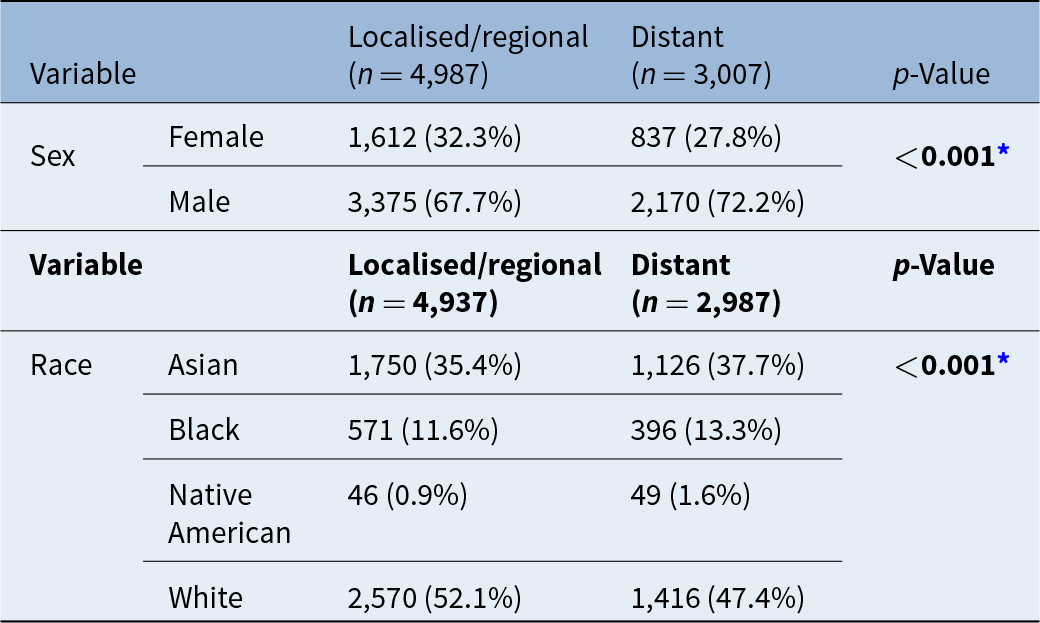
Among the 3,007 patients with distant-stage disease, males predominated (72.2 per cent; n = 2,170) compared with females (27.8 per cent; n = 837; p < 0.001). A significant difference was also observed across racial groups with respect to stage at diagnosis. Race data were available for 2,987 patients with distant-stage disease, among whom White individuals represented the largest proportion (47.4 per cent; n = 1,416), followed by Asian (37.7 per cent; n = 1,126), Black (13.3 per cent; n = 396) and Native American (1.6 per cent; n = 49) individuals (Table 2).
Distribution of patient characteristics by stage at diagnosis

Note: Data are presented as number (percentage). Chi-square test was used for comparisons.
* Statistically significant at p < 0.05.
Incidence and trends of nasopharyngeal carcinoma
The overall incidence of NPC was 0.55 per 100,000 population (95 per cent CI 0.45–0.65). The incidence was significantly higher among males (0.80; 95 per cent CI 0.78–0.81) compared with females (0.33; 95 per cent CI 0.32–0.34). By race, the incidence rate was highest among Asian individuals (1.87; 95 per cent CI 1.81–1.93), followed by Black (0.61; 95 per cent CI 0.58–0.65), Native American (0.53; 95 per cent CI 0.44–0.65) and White (0.35; 95 per cent CI 0.34–0.36) individuals. Between 2000 and 2021, the incidence of NPC declined significantly, with an AAPC of –0.8 (95 per cent CI –1.3 to –0.3; p = 0.002) (Figure 1).
Trend in the incidence rate of nasopharyngeal cancer showing a significant decline in the overall incidence through the study period (average annual per centage change [AAPC], –0.8; 95 per cent confidence interval [CI] –1.3 to –0.3; p = 0.002).

Survival outcomes of nasopharyngeal carcinoma
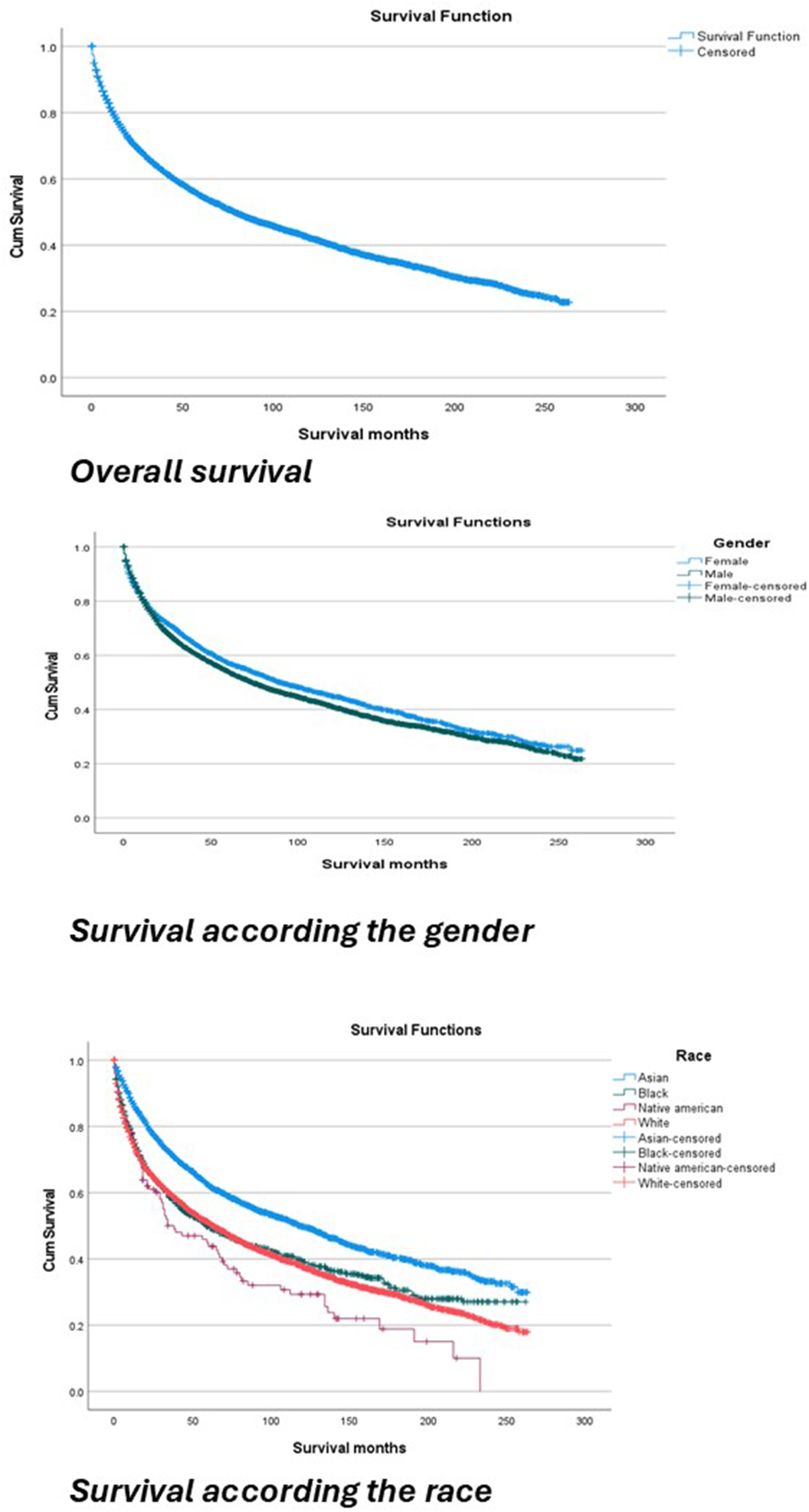
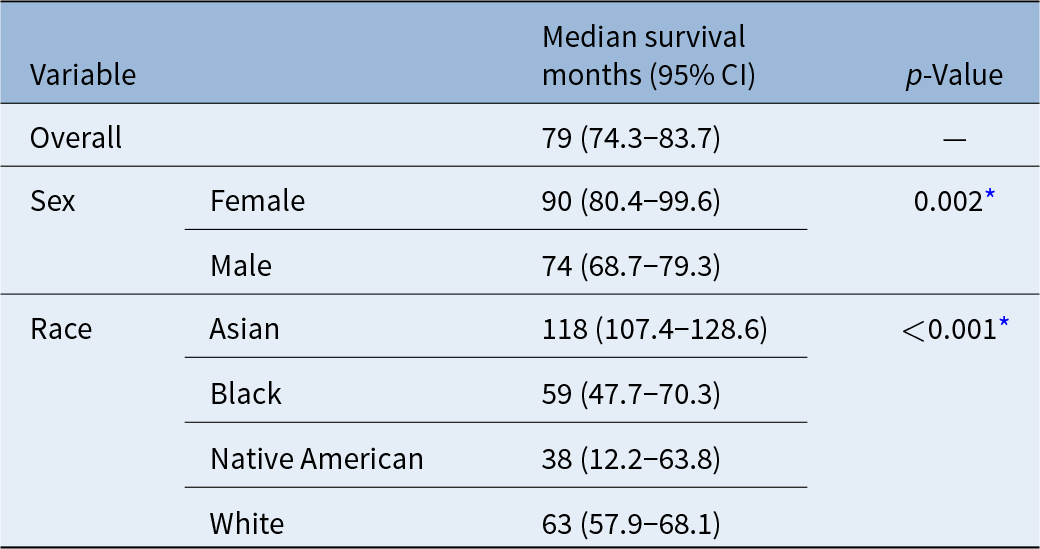
The median overall survival was 79 months (95 per cent CI 74.3–83.7). Females had a significantly longer median survival compared with males (90 months, 95 per cent CI 80.4–99.6 vs. 74 months, 95 per cent CI 68.7–79.3; p = 0.002). Across racial groups, Asian individuals had the longest median survival (118 months; 95 per cent CI 107.4–128.6), followed by White (63 months; 95 per cent CI 57.9–68.1), Black (59 months; 95 per cent CI 47.7–70.3) and Native American (38 months; 95 per cent CI 12.2–63.8) individuals. Survival differences across racial groups were statistically significant (p < 0.001) (Table 3; Figure 2).
Kaplan–Meier plots of the median overall survival, median survival according to sex and median survival according to race.

Median survival months

CI = confidence interval.
Log-rank test was used for survival comparisons.
* Statistically significant at p < 0.05.
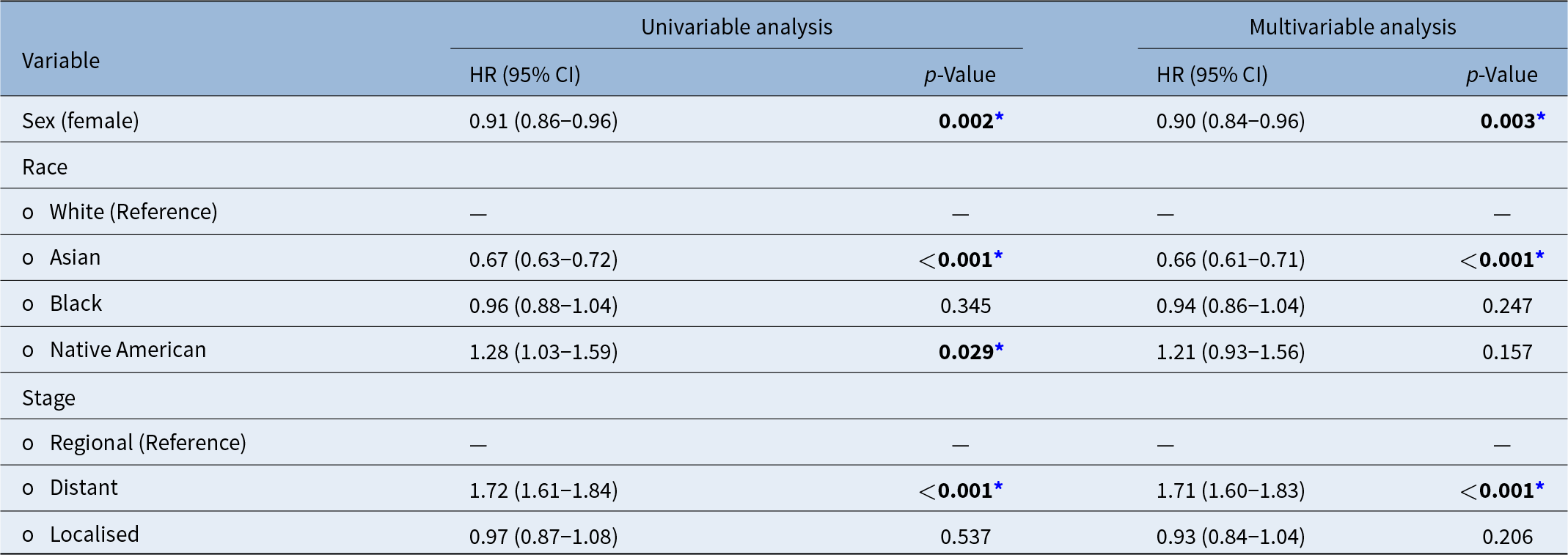
Cox regression analysis identified several factors associated with mortality in NPC. In multivariable analysis, female sex was independently associated with lower risk of mortality (HR 0.90, 95 per cent CI 0.84–0.96; p = 0.003). Compared with White individuals, Asian individuals had a significantly lower risk of mortality (HR 0.66, 95 per cent CI 0.61–0.71; p < 0.001), whereas the association for Black and Native American individuals was not statistically significant. Regarding stage at diagnosis, distant-stage disease was associated with a significantly higher risk of mortality compared with regional stage (HR 1.71, 95 per cent CI 1.60–1.83; p < 0.001), while localised stage did not differ significantly from regional stage (Table 4).
Cox regression analysis of factors predicting the mortality of NPC

CI = confidence interval; HR = hazard ratio; NPC = nasopharyngeal carcinoma.
* Statistically significant at p < 0.05.
Cause of death
Among 10,419 cases, 53.7 per cent (n = 5,591) died during the study period. The leading cause of death was NPC (43.6 per cent; n = 4,828), followed by other malignant cancers (8.6 per cent; n = 497) and cardiovascular disease (6.0 per cent; n = 338).
Discussion
Understanding the NPC’s characteristics and survival rates is essential for improving the diagnostic and treatment approaches. Our study provides a thorough analysis of 10,419 cases from the SEER database to examine the epidemiological characteristics, incidence trends and survival outcomes of NPC over two decades between 2000 and 2021.
Our study indicated that male patients had a higher overall incidence, shorter overall survival rates and were more likely to have distant metastases compared to female patients. These findings imply that tumour behavior differs between male and female patients. Genetic variations influenced by the hormonal environment could be the cause of gender differences in NPC incidence and prognosis. In 2008, Nasr et al.Reference Nasr, Chahed, Bouaouina and Chouchane17 were the first to identify functional vascular endothelial growth factor (VEGF) polymorphisms in NPC patients, reporting that men carrying the VEGF-2578 C allele faced a higher risk of developing NPC compared to women. Additionally, a significant association was found between the VEGF-2578 CC genotype in male patients and larger tumour sizes, as well as more advanced cancer stages. This underscores the potential role of genetic factors in shaping gender-specific differences in NPC clinical and demographic characteristics. Our results were consistent in one way or another with several studies investigating the effect of gender on NPC survival.Reference Liu, Chen, Cui, Li, Li and Wei18–Reference Sun, Li, Huang and Vaughan25 These studies showed that females demonstrated significant advantages in overall survival, distant metastasis-free survival (DMFS) and locoregional relapse-free survival (LRFS), regardless of clinical stage. This suggests that sex is an independent prognostic factor for NPC, with females consistently showing better survival rates compared to males. However, previous studies have some methodological limitations, including assumptions of constant gender disparity throughout the life-cycle, insufficient follow-up duration, selection bias, small sample sizes and inadequate confounding adjustment.
Furthermore, the study demonstrated that Asians have the highest incidence rates but the best survival outcomes compared to other racial groups. Five studies using SEER data reported similar findings. Lee et al.Reference Lee and Ko26 (1973–1999) found that Asians consistently had the highest incidence and five-year survival rates for NPC. BhattacharyyaReference Bhattacharyya27 (1988–2000) showed that Chinese patients had better overall survival than White patients, but that there was no difference in cause-specific survival. Similarly, Burt et al.Reference Burt, Vaughan and McKnight28 (1973–1986) found that Chinese patients had the longest survival, followed by Filipino, non-Hispanic White and Black patients. Sun et al.Reference Sun, Li, Huang and Vaughan25 (1973–2002) demonstrated that Chinese patients had better overall survival despite higher NPC incidence. Wang et al.Reference Wang, Zhang and Ma29 (1973–2009) showed that Asian patients had the highest incidence and best survival rates, with significant racial differences in treatment and outcomes. Our results also align with those of multiple other studies that revealed Asian patients exhibited the highest survival rates.Reference Patel, Chen and Resto7, Reference Challapalli, Simpson, Adjei Boakye, Walker, Antisdel and Ward30–Reference Brody-Camp, McCoul, Lefante and Aslam33 The favourable prognosis observed among Asian patients with NPC has been attributed to several factors in the literature, including younger age at diagnosis,Reference Hamilton, Ho, Laskin, Zhai, Mak and Wu31, Reference Su and Wang34–Reference Fandi, Altun, Azli, Armand and Cvitkovic36 a higher prevalence of Chinese ethnicityReference Bhattacharyya27, Reference S-HI, Zell, Ziogas and Anton-Culver37 and genetic predispositions.Reference Zhou, Shen, Li, Ding, Liu and Huang32, Reference Ren, Yang, Zhang, Sun, Zhao and Zhang38 Additionally, a significant contributing factor is the higher incidence of undifferentiated nonkeratinising histology (previously classified as World Health Organization [WHO] type III) in this population.Reference Patel, Chen and Resto7, Reference Yu, Xu, Chen and Wu39 This histologic subtype has consistently been associated with the highest survival rates across all racial groups compared to other variants of NPC.Reference Lee and Ko26, Reference Brody-Camp, McCoul, Lefante and Aslam33 Asian individuals, in particular, have a greater proportion of this favourable histology, which may explain their better survival outcomes compared to other ethnic groups.Reference Lee and Ko26, Reference S-HI, Zell, Ziogas and Anton-Culver37 Furthermore, Asian patients have a higher proportion of localised or regional-stage diagnoses compared with distant-stage disease. A probable explanation is that the well-established risk of NPC in this population may lead to improved screening practices, resulting in earlier diagnosis and treatment.Reference Brody-Camp, McCoul, Lefante and Aslam33
In contrast, Native American and Black patients had the lowest survival rates, and Native American patients were more likely to present with distant metastasis compared to localised or regional stage. Similarly, other studies demonstrated that African American patients showed the poorest survival prognosis,Reference Zhou, Shen, Li, Ding, Liu and Huang32, Reference Yu, Xu, Chen and Wu39 and the highest rates of metastasis at diagnosis.Reference Zhou, Shen, Li, Ding, Liu and Huang32 Richey et al. analysed SEER data from 1973 to 2002, focusing on patients aged 30 or younger only, and found that Black individuals had the highest incidence rate.Reference Richey, Olshan, George, Shores, Zanation and Cannon40 Sun and others demonstrated that Black patients had the highest proportion of distant-stage disease.Reference Sun, Li, Huang and Vaughan25 This could be explained by the fact that minority racial groups had less access to and use of healthcare services, including clinic visits, screenings, preventive care and diagnostic testing.Reference Mayberry, Mili and Ofili41 Currently, the standard treatment for locally advanced-stage NPC is neoadjuvant chemotherapy combined with concurrent radio-chemotherapy.Reference Chen, Ismaila, Chua, Colevas, Haddad and Huang42 However, a study from the National Cancer Database, which included 75.5 per cent White and Black patients, found that neoadjuvant chemotherapy did not improve survival outcomes for patients with locally advanced-stage NPC.Reference Tam, Lee, Wu, Gerber, Li and Givi43 Another study found that African American patients had the largest proportion of cases where no standard NPC treatments (surgery or radiation) were provided. These findings could explain the lower survival rates in the Black race.Reference Zhou, Shen, Li, Ding, Liu and Huang32 Yu et al. showed that African American patients had a higher proportion of keratinising squamous cell carcinoma (KSCC),Reference Yu, Xu, Chen and Wu39 which exhibits the worst prognosis compared to other subtypes.Reference Pan, Liu, Yang, Chen, Tang and Li44
White patients, according to our analysis, tend to present with earlier stages of NPC and thus a higher survival rate. This group also has the lowest incidence of NPC compared to other racial or ethnic groups. Wang et al. also revealed that Hispanic White patients have the lowest incidence rate of NPC. Additionally, their analysis revealed that non-Hispanic White patients have the most localised tumours compared to other racial groups, including Black and Asian patients.Reference Wang, Zhang and Ma29 Similarly, Sun and others showed that non-Hispanic White patients were older and more likely to have WHO histology grades of types I and II compared with NPC cases of other ethnicities.Reference Sun, Li, Huang and Vaughan25 The higher survival rates in this group may be due to the histology, as it is less likely to present with distant-stage disease,Reference Lee and Ko26 and the lower incidence could be due to easier access to screening.
More than half of the patients (53.7 per cent) in our study died during the study period, primarily due to NPC, followed by other cancers and cardiovascular disease. Similarly, Yang et al. reported that the most common cause of death was primary NPC, followed by other causes, other cancers, with a significant risk of mortality persisting even 15 years post-diagnosis, emphasising the need for long-term surveillance of NPC survivors.Reference Yang, Rao, Chen, Zhou, Lian and Wu45 Zhou et al. found that while NPC remains the leading cause of death, non-NPC causes have also increased among NPC patients. These findings highlight the importance of multidisciplinary care in follow-up strategies for NPC patients.Reference Zhou, Jiang, Li, Shao and Liao46
Our study has some limitations. First, while alcohol, tobacco and EBV are known risk factors for NPC, we were unable to control these variables as they weren’t reported by SEER. Additionally, genetic factors and other lifestyle influences, which may contribute to NPC, were not measured. Despite these limitations, this study makes a significant contribution to the head and neck literature, updating the epidemiological characteristics, incidence rates and survival disparities among various ethnic populations. Furthermore, although NPC is very rare, the SEER database enabled us to analyse a large dataset (10,419 cases) over more than 20 years (2000-2021), which strengthens the validity of our conclusions.
• Nasopharyngeal carcinoma (NPC) incidence was higher in males (0.8/100,000) than in females (0.33/100,000) and highest among Asian individuals (1.87/100,000).
• Overall incidence declined significantly between 2000 and 2021 (AAPC –0.8 per cent, p = 0.002).
• Males were more likely to present with distant-stage disease than females (72.2 per cent vs. 27.8 per cent; p < 0.001).
• Median survival was longer in females (90 months) than in males (74 months) and longest in Asian individuals (118 months).
• Female sex (hazard ratio [HR] = 0.90; 95 per cent confidence interval [CI] 0.84–0.96; p = 0.003) and Asian race (HR = 0.66; 95 per cent CI 0.61–0.71; p < 0.001) predicted better survival, while distant-stage disease (HR = 1.71; 95 per cent CI 1.60–1.83; p < 0.001) was associated with increased mortality.
• NPC was the leading cause of death, accounting for 43.6 per cent of all deaths.
Conclusion
Our study showed that males and Asian populations have a higher incidence of NPC, although the overall incidence declined over the study period. Survival analysis revealed that female sex and Asian race were independently associated with better survival, whereas distant-stage disease markedly increased mortality risk. NPC itself was the leading cause of death among patients. These findings highlight the importance of targeted screening and early detection strategies, particularly in high-risk populations, to improve survival outcomes.
Ethics approval and consent to participate
Not applicable.
Consent for publication
Not applicable.
Availability of data and materials
All data were publicly available and de-identified. Institutional review board approval was not required.
Competing interests
The authors declare that they have no competing interests.
Funding
This research did not receive any specific grant from funding agencies in the public, commercial or not-for-profit sectors.
Authors’ contributions
Conceptualisation and methodology: A.M.K.; Investigation and data acquisition: S.A., M.A.; Formal analysis: A.R.A., M.B.H., R.A.; Writing, review and editing: A.R.A., M.B.H., R.A.; Supervision and project administration: M.N.E., M.E. All authors read and approved the final manuscript.
Acknowledgments
Not applicable.