1. Introduction
The first extended port-of-call on Darwin's journey aboard HMS Beagle in 1832 was at Praia in southeastern Santiago in the Cape Verde Islands. Darwin contributed the earliest studies on former basaltic rocky shores based on his original observations in this area. Fossil oysters, limpets and other molluscs together with abundant fossil ‘Nulliporae’ (i.e. rhodoliths formed by coralline red algae) were recorded by Darwin (Reference Darwin1844) from a 6 m thick limestone deposit stratigraphically located between basalt formations. This tri-part arrangement with its prominent middle limestone deposit can be traced for at least 10 km along the SW coast of Santiago. In his autobiography (1958, p. 81), Darwin made it clear that the field experience with this tripartite section on Santiago became a turning point for him as a budding scientist. Johnson et al. (Reference Johnson, Baarli, Cachão, Da Silva, Ledesma-Vázquez, Mayoral, Ramalho and Santos2012) re-examined the limestone deposits and found that Darwin correctly interpreted the lower parts of the sequence as a former beach. Darwin (Reference Darwin1844, p. 35) recorded: ‘I suppose the shells in the former beach are the same as now exists.’ A small coastal quarry is located on Pontas das Bicudas, south of Signal Post Hill. It is probably close to the place where the 22-year-old was inspired to write a book on volcanic islands based on the promise of his Beagle travels (Pearson & Nicholas, Reference Pearson, Nicholas and Wyse Jackson2007). The quarry reveals a rich coral, barnacle and mollusc fauna. When Darwin reflected on his life in 1876, he warmly recalls the fossil shells and corals from Praia in his autobiography (Darwin, Reference Darwin1958). However, no fossil corals are mentioned in his general journal or field notebook written at the time and later consulted for his books (Darwin, Reference Darwin and FitzRoy1839, Reference Darwin1844) and none were collected. Thus, we believe the quarry post-dates his visits to Santiago Island in 1832 and 1836.
High-energy rocky shores are harsh environments that elicit special adaptations by encrusting, clinging, boring and wedging organisms. On exposed, plunging coasts the constant swells and surge of waves warrant the same kinds of adaptations well below the intertidal zone. Rocky-shore ecosystems are geographically widespread, dominating roughly one-third of present-day coastlines (Johnson, Reference Johnson1988). In order to gauge the evolution of intertidal biotas through Phanerozoic time, Johnson & Baarli (Reference Johnson, Baarli and Talent2012) assembled a database on 1622 species of invertebrate fossils from 361 localities around the world. Nearly half those species surveyed were found confined to rocky-shore deposits. However, the palaeontological database from Johnson & Baarli (Reference Johnson, Baarli and Talent2012) relates exclusively to unconformities on flooded continental margins and continental islands. Unconformities on basalt associated with basalt-derived conglomerates from oceanic islands are largely missing from the analysis, with the notable exception of Donovan (Reference Donovan1989) who studied barnacle associations in the Lesser Antilles on Tobago. Recent studies on fossil faunas from oceanic islands include observations on a Holocene unconformity and related carbonate sandstone from the Galápagos Islands (Johnson, Karabinos & Mendia, Reference Johnson, Karabinos and Mendia2010) and middle Miocene unconformities with fossil deposits in the Porto Santo area of the Madeira archipelago (Johnson et al. Reference Johnson, Da Silva, Santos, Baarli, Cachão, Mayoral, Rebelo and Ledesma-Vázquez2011; Santos et al. Reference Santos, Mayoral, Da Silva, Cachão, Johnson and Baarli2011, Reference Santos, Da Silva, Johnson, Baarli, Cachão, Ledesma-Vásquez and Mayoral2012).
This paper describes the stratigraphic and palaeontologic details from a small coastal outcrop on Ponta das Bicudas, south of Signal Post Hill, but east of Praia City, where unconformities between local limestone beds with underlying and overlying basalt formations are well exposed. Quarry exposures are rich in coral colonies that encrust an irregular basalt surface. Two aspects of shore development at this single locality are treated: (1) the palaeoecology of marine invertebrates preserved in growth position on basalt surfaces on different parts of a plunging shoreline; and (2) the ichnology of associated organisms.
2. Geographical and geological setting
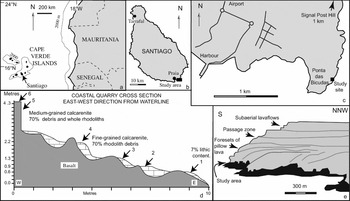
A recent paper by the present authors (Johnson et al. Reference Johnson, Baarli, Cachão, Da Silva, Ledesma-Vázquez, Mayoral, Ramalho and Santos2012) investigated lateral variations in basalt–limestone–basalt formations originally described by Darwin (Reference Darwin and FitzRoy1839, Reference Darwin1844) on the coastal Praia area of SE Santiago. A full discussion of the geographical and geological setting can be found, therein. The following provides only a brief summary. The Cape Verde archipelago arose from magmatic hotspot activity on the NW margin of the African plate (Holm et al. Reference Holm, Grandvuinet, Friis, Wilson, Barker and Plesner2008), where Santiago is the largest island (Fig. 1a). Lava flows over the coastal plains of SE Santiago are from the post-erosional stage of island development and commonly date within the last few million years (Holm et al. Reference Holm, Grandvuinet, Friis, Wilson, Barker and Plesner2008; Barker et al. Reference Barker, Holm, Peate and Baker2010; Ramalho et al. Reference Ramalho, Helffrich, Vance and Schmidt2010). Johnson et al. (Reference Johnson, Baarli, Cachão, Da Silva, Ledesma-Vázquez, Mayoral, Ramalho and Santos2012) proposed that Darwin's coastal sequence reflects two separate marine transgressions depositing limestone within beds of the Monte das Vacas Formation and within the Assomada Formation, both mapped by Serralheiro (Reference Serralheiro1976). These formations date from between 1.1 and 0.7 Ma (Johnson et al. Reference Johnson, Baarli, Cachão, Da Silva, Ledesma-Vázquez, Mayoral, Ramalho and Santos2012).
Maps and transect of the study site. (a) Overview of the Cape Verde archipelago. (b) Map of Santiago Island with study site indicated. (c) Close-up map of the area east of the harbour at Praia with study site indicated. (d) Cross-section of the transect at the study site with surface features to scale and grid positions indicated by arrows. (e) Sketch of study area drawn as an overlay from a photo. The black area indicates the older basalt as seen in (d). Notice the broken upper outline of the basalt wall. The light grey is the enveloping younger lava delta with foreset beds visible.

The study site (14° 54.464′ N, 23° 28.815′ W) is located in a small coastal quarry 2.25 km SSW of Signal Post Hill and 0.5 km NE of the southern tip of Ponta das Bicudas (Fig. 1b, c). The quarry is on a clean swept wave-cut platform situated about 4 to 6 m above present sea level (Fig. 2a). Pipe borings drilled for explosive charges remain as evidence of quarrying activities. The quarry is roughly 10 m by 110 m. In the seaward direction, limestone was sufficiently excavated to uncover the tops of pillow-shaped mounds in the Assomada Formation. The quarry is delimited in the landward direction by a wall of basalt. Darwin (Reference Darwin1844, p. 8) observed that when exposed in ravines intersecting the coast, limestone strata dip seaward ‘probably with the same inclination as when deposited round the ancient shores of the island’. The quarry provides a suitable excavation, showing that here the limestone succession banks locally against underlying basalt to make a relatively high-angle abutment unconformity. All five limestone profiles found emplaced between layers of pillow lava from the Assomada Formation, including the one at the study site, show an initial regressive sequence succeeded by transgressive strata (Johnson et al. Reference Johnson, Baarli, Cachão, Da Silva, Ledesma-Vázquez, Mayoral, Ramalho and Santos2012).
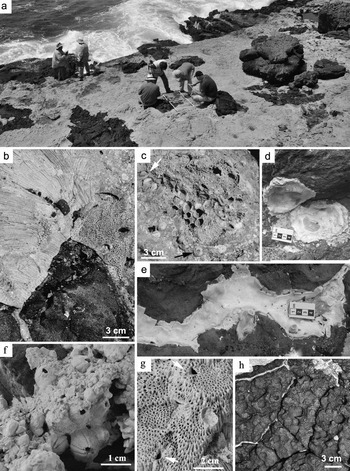
(a) View of the coastal outcrop on the east side of Ponta das Bicudas taken from the basalt wall. (b) Siderastrea radians encrusting on basalt. (c) Gastrochaenolites isp. borings in S. radians. The white arrow indicates a boring with shells of the former producer intact. The black arrow points to one of several balanids. (d) Oyster valves. (e) Millepora alcicornis (notice the truncated branch). (f) Megabalanus azoricus in and among encrusting red corraline algae. (g) Unknown borings in S. radians, marked by white arrows. (h) Circolites kotoncensis on basalt with the quenched surface of pillow lava exhibiting typical jigsaw jointing.

3. Methods
Sample quadrates 0.5 × 0.5 m divided into 25 units of 10 × 10 cm were applied both to semi-horizontal surfaces and vertical surfaces along a transect across the quarry in order to collect data on body and trace-fossil content preserved in situ on basalt surfaces. Data were collected at five discrete levels moving perpendicular to the basalt wall through the quarry's stratigraphic profile. As many grids as possible covering the surface area were canvassed at each station, and the ratio of bare basalt to limestone cover was calculated. The remains of all encrusting and bioeroding organisms were identified and tallied. In addition, a spot survey of the entire quarry and adjacent areas was performed to derive a more comprehensive species list. In terms of corals, species identification is based on the regional survey work for the Cape Verde Islands by Boekschoten & Best (Reference Boekschoten and Best1988). A standard stratigraphic column bridging the basalt unconformities below and above the limestone succession was measured using a hand level and metre tape. The fossil fauna was photographed in situ and all specimens were left in place.
4. Results
4.a. The stratigraphic section
The base of the section lies on eroded pillow basalts with up to 4.3 m relief laterally within the quarry (Fig. 1d). A 2.95 m thick interval of calcarenite covers a sloping and very uneven base and is terminated against a 1.35 m high vertical block. Laterally, these blocks protrude above the sedimentary rocks, forming a discontinuous wall of older basalt (Fig. 1e). There is no basal conglomerate within the section, only a few floating basalt pebbles with diameters up to 3 cm. The sequence initially coarsens upward followed by a fining-up sequence. Both the basalt knobs, exposed through the calcarenite on the sloping base, as well as the sides and tops of the basalt wall, are covered by encrusters and bioeroders.
4.b. Burial by basalt
The tip of the Ponta das Bicudas peninsula represents a lava delta (Fig. 1e). The calcareous section lies on foresets of older pillow lava and is entombed by the foresets of younger pillow basalt flows. These younger lavas lie directly on the carbonate sand in addition to the angular, eroded basalt wall. The passage zone between overlying pillow lavas and subaerial lava appears 18 m above the carbonate section (Johnson et al. Reference Johnson, Baarli, Cachão, Da Silva, Ledesma-Vázquez, Mayoral, Ramalho and Santos2012).
4.c. Encrusters
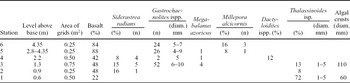
All body fossils found in the census grids are listed in Table 1. There is a clear difference between the grids sampled from the basalt knobs surrounded by calcarenites (0.6 to 2.2 m above the base) and the fauna encrusted directly on the vertical and horizontal surface of the basalt wall (2.8–4.35 m above the base).
Grid count from transect

% denotes coverage in grid; diam. – diameter; n – number.
The main encruster on the basalt knobs is the coral Siderastrea radians (Fig. 2b), represented by dome-shaped colonies up to 200 mm thick. Some of the S. radians colonies found elsewhere in the quarry are fan shaped, up to 550 mm tall, and toppled over on the side. Crusts of coralline algae directly on the basalt often show knobby protuberances. A few balanid barnacles colonized these crusts of coralline algae (Fig. 2c, black arrow).
The main encrusting organisms from the grids on the basalt wall are the hydrozoan Millepora alcicornis and balanid barnacles. The upper horizontal surface of the wall is incised by shallow grooves, 30–50 mm deep, and M. alcicornis occurs only in the grooves and growing up their sides. Vertical branches of the hydrozoans are truncated at the level surface (Fig. 2e). Thus, it is likely that M. alcicornis covered the entire surface at one time.
Other encrusters were found laterally on the basalt wall within the quarry. Small examples of the balanid Megabalanus azoricus are common, while scattered large oyster shells, Ostrea sp. (Fig. 2d), and Spondylus sp. also are present, as well as minor occurrences of the solitary coral Balanophyllia sp. and Tubastraea sp. The most prolific surface is a rounded spur of basalt that runs perpendicular to the wall, 20 m south of the transect. The encrusters are exposed along the upper limits and slightly above the enclosing calcarenites. Balanid barnacles are numerous and represented by small Megabalanus azoricus (Fig. 2f). The barnacles most often grew on crusts of red coralline algae, as did a few individuals of the serpulid Spirobis sp. Oysters and Spondylus sp. are also encrusted on the basalt.
4.d. Bioeroders (and trace fossils)
Gastrochaenolites ispp. are the only common trace fossils observed. Gastrochaenolites isp. borings in Siderastraea radians consist of common Gastrochaenolites isp. and rare unidentified apertures (Fig. 2g), although are most often represented by only a few in each colony. They have diameters varying from 5 to 10 mm. The extended borings shown in Figure 2c are exceptional in their abundance. Some borings still exhibit the shells of their producers (Fig. 2c, white arrow). On the basalt wall Gastrochaenolites isp. and G. cluniformis commonly bored into Millepora alcicornis, but in some instances penetrated through the hydrozoan and into the volcanic rock below. The bottoms of Gastrochaenolites ispp. borings with calcareous linings are preserved on the bare basal surface. These borings measure 4 to 9 mm in diameter and are perpendicular to the rock on both the vertical and horizontal surfaces. Small dwelling structures after echinoids Circolites kotoncensis were found in large numbers on one basalt pillow with a quenched surface exhibiting typical jigsaw jointing (Fig. 2h). The diameter of Circolites kotoncensis varies between 12 and 28 mm. A few scars after Circolites kotoncensis also appear on one of the horizontal surfaces on top of the vertical wall.
4.e. Associated fauna
Few whole body fossils are found floating in the calcarenites. The calcarenites are extensively reworked by dwelling and feeding activities of infaunal deposits feeders, mainly crustaceans, represented by the ichnogenus Thalassinoides. Arca sp. sometimes occurs wedged into cracks in the basalt. Conus sp. tends to appear congregated in shallow joints in the basalt, although it is also found free in calcarenite. Rare tests of spatangoid echinoids and one shell of Venus verrucosa also were observed. Broken fragments of the coral Porites sp. occur as components of the coarse-grained calcarenites, but none were found in situ.
4.f. Fossil assemblages
From the census data supplemented by spot samples, two fossil assemblages can be differentiated. The lower and likely older Siderastrea radians assemblage consists of large colonies of S. radians with associated borings of Gastrochaenolites isp., crusts of red coralline algal and bioerosion traces of echinoids left on the basalt knobs. The echinoid traces, Circolites, were probably produced by some species of Echinometra (Asgaard & Bromley, Reference Asgaard, Bromley, Wisshak and Tapanila2008), because regular echinoids of the Echinomnetridae family are the only ones able to produce real depressions when looking for food. The Millepora alcicornis–Megabalanus azoricus assemblage on the basalt wall is represented by M. alcicornis, M. azoricus, Balanophyllia sp., oysters, Arca sp. and Gastrochaenolites ispp. borings.
5. Discussion
5.a. Modern analogues
As pointed out by Darwin (Reference Darwin and FitzRoy1839, Reference Darwin1844), nearly all the fossils in the study area have modern counterparts living in the Cape Verde archipelago. Therefore, it is pertinent to look for modern analogues when analysing the data. Also, it is germane to point out that Darwin (Reference Darwin and FitzRoy1839, Reference Darwin1844) was impressed by the singularity of steady trade winds that cross Santiago Island from the northeast. Wind-driven waves directly impact sea cliffs below the quarry site and sweep the platform clean of loose rocks and debris. The same trade winds were active during the Pleistocene, and the present eastern coastline along the Bicudas peninsula is probably very similar to the Pleistocene setting (Johnson et al. Reference Johnson, Baarli, Cachão, Da Silva, Ledesma-Vázquez, Mayoral, Ramalho and Santos2012).
5.b. Siderastrea radians fossil assemblage
Siderastrea radians is a common coral today in the Cape Verde archipelago, living in shallow to moderately deep infra-littoral waters (Morri & Bianchi, Reference Morri and Bianchi1995; Morri et al. Reference Morri, Cattaeno-Vietti, Sartori and Bianchi2000; Monteiro et al. Reference Monteiro, Almeida, Freitas, Delgado, Porteiro and Santos2008). Studies show that S. radians strongly dominates bedrock patches and boulders in water depths from 5 to 15 m with Favia sp. and Porites sp. occurring less commonly. The presence of corals tapers off towards a depth of 20 m. Studies from a moderately exposed site on Sal Island in the Cape Verde Islands (Morri & Bianchi, Reference Morri and Bianchi1995), as elaborated by Morri et al. (Reference Morri, Cattaeno-Vietti, Sartori and Bianchi2000), found that S. radians dominates sandy bottoms at depths from 4 to 10 m. Millepora alcicornis and Porites sp. may be common, but only on more elevated patches, well above the sand. Green algae, sea urchins and a few gastropods inhabit the surrounding sand. The fossil community at Ponta das Bicudas is an appropriate fossil analogue.
5.c. Millepora alcicornis–Megabalanus azoricus fossil assemblage
A modern epibenthic community close to the fossil Millepora alcicornis–Megabalanus azoricus assemblage described herein is known from an exposed site on the west coast of Sal (Morri et al. Reference Morri, Cattaeno-Vietti, Sartori and Bianchi2000). There, the coast consists of high, vertical cliffs that descend to a depth of 27 m. The community in question can be found between 8 and 20 m below sea level. The biota consists of Millepora alcicornis, Megabalanus azoricus and the cup coral Balanophyllia sp. under a cover of brown algae. Tubastraea aurea grows in the overhanging parts of the cliff and in caves down to 8 m, but is not common on the open cliff between 8 and 20 m. Sparse oysters found in the Bicudas fossil assemblage differentiate it from the modern community.
5.d. Depth interpretations
A depth range close to that reported for the modern communities is likely to have influenced the Pleistocene assemblages. The overlying pillow lavas have a thickness of 18 m up to the level of the passage zone. Therefore, at the time of catastrophic burial by pillow lava, the water depth must have stood at 18 m at minimum.
Calcarenites surrounding the coral assemblage show a coarsening-up pattern over the first 2.6 m followed by a short fining-up sequence similar to the pattern observed in the other sections of the Praia limestone (Johnson et al. Reference Johnson, Baarli, Cachão, Da Silva, Ledesma-Vázquez, Mayoral, Ramalho and Santos2012). It is likely there occurred a rapid initial transgression leading to tranquil, deeper conditions where the tall corals thrived. This was followed by a brief regression due to local uplift in connection with volcanism. As the site was lifted into shallower, more turbulent water, strong storms may have toppled the tall colonies from time to time.
The Millepora alcicornis–Megabalanus azoricus fossil assemblage grew well above the sediment surface and represents the biota extinguished at the moment of sudden burial by submarine lava. It probably grew in the lower range of the modern counterpart of 8–20 m. A slightly shallower range, as known for the modern equivalent community (4–10 m), is likely for the Siderastrea radians assemblage. The former assemblage exhibits a characteristic ‘rocky-shore’ fauna due to an environment with similar stress, even if it existed well below the intertidal zone.
5.e. Bioerosion structures
Bioerosion structures in basalt are rarely referenced. Santos et al. (Reference Santos, Da Silva, Johnson, Baarli, Cachão, Ledesma-Vásquez and Mayoral2012) briefly described the ichnofossil Gastrochaenolites isp. from Ponta das Bicudas and gave an overview of the scant record of it in volcanic rocks. Likewise, among the few references for Circolites isp. in basalt are Ávila et al. (Reference Ávila, Madeira, Zazo, Kroh, Kirby, Da Silva, Cachão and De Frias Martins2009) who gave an example from the Pleistocene of the Azores. A study of basalt bioerosion in the modern intertidal zone from the Cape Verde peninsula of Senegal (Allouc, Le Campion-Alsumard & Leung Tack, Reference Allouc, Le Campion-Alsumard and Leung Tack1996) showed that sea urchins are able to erode their dwelling structures in basalt. Fischer (Reference Fischer1981) described some examples of sea urchins that bioeroded modern volcanic substrates along the modern Pacific coast of Costa Rica. According to Fischer (Reference Fischer1981), the bioeroding organisms require mechanical means to penetrate basalt, often by exploiting the differences in mineral hardness and crystal boundaries in the rock. The Circolites kotoncensis structures in our study are situated on a quenched surface of pillow lava exhibiting typical jigsaw jointing. The very outer rim of a basalt pillow is beset with macro- and microscopic cracks and vesicles (Kawachi & Pringle, Reference Kawachi and Pringle1988), and this may further facilitate the erosion of the homing structures.
6. Conclusions
The first place Darwin enjoyed the opportunity for fieldwork during the 1831–1836 voyage of HMS Beagle was on Santiago in the Cape Verde Islands. He thoroughly investigated limestone deposits in the southeast part of the island around Praia that are stratigraphically fixed between basalt formations. Darwin (Reference Darwin and FitzRoy1839, Reference Darwin1844) correctly concluded that the fossil assemblage could be closely compared with what he saw on the beach in front of him, both in terms of environment and a relatively young age. The small quarry at Ponta das Bicudas post-dates Darwin's visits, and it affords a more complex view of local biofacies representing Pleistocene fossil assemblages from an exposed, plunging coast. The excavated unconformity surface reveals two distinct fossil assemblages: the Siderastrea radians assemblage and the Millepora alcicornis–Megabalanus azoricus assemblage. These have close analogues in the modern coastal biota of the Cape Verde Islands. The Siderastrea radians assemblage was deposited on a slope in front of a vertical basalt cliff descending from the shore. It was a low-diversity assemblage consisting of corals and red corraline algae crusts growing on rocky basalt knobs surrounded by sand in the range of 4–10 m under moderate wave energy. The Millepora alcicornis–Megabalanus azoricus assemblage grew on the upper cliff face, and consisted of a typical rocky-shore assemblage with barnacles, low growing and encrusting hydrozoa, corals, oysters and a wedging bivalve. The depth was probably well below tide level and in the lower range of the 10–20 m inhabited by comparable modern communities. It was strongly affected by the swell and surge of incoming waves driven by persistent NE winds.
Both communities preserve bioerosion features in basalt. The cliff-side exhibits Gastrochaenolites ispp., which seems to be more common than previously thought. The slope zone below retains the homing structures of sea urchins eroded in pillow lava. Polygonal-shaped shrinking structures in the basalt may have facilitated the erosion.
Acknowledgements
Funding for fieldwork on Santiago Island in June 2011 was provided under grant CGL2010–15372-BTE from the Spanish Ministry of Science and Innovation to project leader Eduardo Mayoral (University of Huelva). Financial support to A. Santos came from the Spanish Ministry of Science and Technology (Juan de la Cierva subprogram, Ref: JCI-2008-2431). Additional support by the Junta de Andalucía (Spanish government) to the Research Group RNM276 is also acknowledged. Partial funding to J. Ledesma-Vazquez on this project came from the Programma Integral de Fortalecimiento Institucional 2010. We thank Christopher K. Pham, Department of Oceanography and Fisheries, University of the Azores, Portugal, for help with identification of the fossil barnacles and Ricardo Ramalho, Institut für Geophysik, Westphälishe-Wilhelms Universitat, Germany, for discussions about bioerosion by sea urchins on basalt surfaces.