




No CrossRef data available.
Article contents
- Abstract
- European Foreign Policy as a Contested Institution
- Possible Explanatory Factors: Interests, Capabilities, Identities, and Constitutional Cultures
- Explanatory Strategies
- Operationalization and Data
- Logistic Regression Analysis
- Fuzzy-Set Analysis
- Discussion
- Conclusion
- Appendix: Sources on Government Positions on CFSP Reform, 1996
- References
Explaining Government Preferences for Institutional Change in EU Foreign and Security Policy
Published online by Cambridge University Press: 09 March 2004
Article contents
- Abstract
- European Foreign Policy as a Contested Institution
- Possible Explanatory Factors: Interests, Capabilities, Identities, and Constitutional Cultures
- Explanatory Strategies
- Operationalization and Data
- Logistic Regression Analysis
- Fuzzy-Set Analysis
- Discussion
- Conclusion
- Appendix: Sources on Government Positions on CFSP Reform, 1996
- References
Abstract
Some member-states of the European Union (EU) want a supranational foreign and security policy, while other member-states oppose any significant limitation of national sovereignty in this domain. What explains this variation? Answering this question could help us to better understand not only the trajectory of European unification, but also the conditions and prospects of consensual political integration in other regional contexts and territorial scales. The main research traditions in international relations theory suggest different explanations. I examine the roles of relative power capabilities, foreign policy interests, Europeanized identities, and domestic multilevel governance in determining the preferences of the fifteen EU member governments concerning the institutional depth of their foreign and security policy cooperation. I find that power capabilities and collective identities have a significant influence, but the effect of ideas about the nature and locus of sovereignty, as reflected in the domestic constitution of each country, is particularly remarkable.A previous version of this article was presented at the 4th ECPR Pan-European International Relations Conference, Canterbury, 8–10 September 2001. For their valuable comments, I would like to thank Filippo Andreatta, Daniele Archibugi, Simone Borra, Nicola Dunbar, Fabio Franchino, Alkuin Kölliker, Leonardo Morlino, Angelo Panebianco, Eiko Thielemann, Ben Tonra, the editors of IO, and three anonymous reviewers. I am responsible for any mistakes.
Information
- Type
- Research Article
- Information
- Copyright
- © 2004 The IO Foundation and Cambridge University Press
What can induce the governments of independent states to relinquish one of their most cherished possessions, that is, the right and the ability to act on the international stage according to their own judgment and preferences? This question is particularly pressing in a time when international interdependence is widely perceived as expanding and intensifying. As long as states remain central actors in world affairs, the possibility of solving common problems and seizing mutually beneficial opportunities depends crucially on their willingness to cooperate and—in the view of many—to go beyond cooperation toward deeper forms of supranational political integration.
Blueprints for the creation of global political structures face the problem that, as things stand, transcending the present state-centric world would require the consent of the leaders of the states themselves. Certainly this is one of the reasons why the consensual merging of states has been such a rare phenomenon. However, even the greatest pessimists cannot deny that in history, there have been instances of unification among states that resulted from a voluntary agreement among their leaders: the United States is a prominent example. This fact brings one back to the question mentioned at the beginning: why should governments of sovereign states wish to limit their freedom of action to the point of merging with other states within larger governmental structures?
This article aims to offer a contribution to this sweeping question by examining the preferences of specific governments on a specific issue in a specific historical moment. The governments are those of European Union (EU) member-states, the issue is the creation of a supranational foreign and security policy, and the moment is the 1990s. Of course, given the vast differences between the EU and other settings, it is not part of my argument that the results of the following inquiry can be easily generalized to other regional contexts or even to questions of global political integration. However, it seems plausible to think that a realistic analysis of international polity formation requires, as a preliminary step, a certain number of empirical investigations of analogous processes at the macroregional level.
In this article I assess various factors that might plausibly explain a government's willingness to pool and delegate sovereignty. Because the importance of each factor examined here is emphasized by a different school of international relations theory, this article can also be seen as a contribution to the assessment of the empirical accuracy of various contending or complementary perspectives within the discipline.
The first section of this article specifies the terms and the relevance of the research question. The second section presents a number of potential explanations of the willingness of governments to pool and delegate sovereignty in foreign and security policy, and relates those explanations to specific research programs in international relations theory. I focus in particular on the distinction between instrumentalist and culturalist approaches to institutions. The third section presents the explanatory strategies used in this article: logistic regression analysis and a novel qualitative comparative method based on fuzzy-set logic, developed by Charles Ragin. The fourth section discusses the operationalization of the explanatory factors chosen for consideration and presents the data sources used in the analyses. The fifth and sixth sections present the results of the two analyses, and the seventh section interprets them. The conclusion summarizes the findings and their implications for current debates in international relations theory.
European Foreign Policy as a Contested Institution
The differences between European integration in the economic domain on the one hand and integration in security affairs on the other are often emphasized by policymakers and scholars alike. Market-building policies and some market-correcting policies are governed according to what has become known as the “Community method,” that is, a complex set of institutional rules and practices that ensure a prominent role for supranational agencies and a high level of legalization. In foreign and security policy, on the contrary, supranational institutions have little or no power, and the obligations laid upon governments are vague or frequently ignored.1
Until 1993 the institutional arrangements for foreign policy coordination among EU member-states were known as European Political Cooperation (EPC). Since the Maastricht Treaty, they have been called Common Foreign and Security Policy (CFSP).
Hoffmann 1965, 88.
To many international relations scholars, the relatively feeble state of foreign policy integration is far from surprising. Foreign and security policies are pivotal to state sovereignty, and for these authors, sovereignty—understood as the survival of the state as a distinct political entity in world affairs—is a “good” that states value over all others. According to John J. Mearsheimer, “the most basic motive driving states is survival. States want to maintain their sovereignty.”3
Mearsheimer 1994/95, 10.
Waltz 1979, 118.
Riker 1975 and 1996.
While this perspective has some empirical merit, it neglects a crucial aspect of the Western European experience: there was, and still is, considerable variation in the preferences of governments concerning foreign policy integration. The optimal level of political unification in the EU is a matter of intense controversy not only among its citizens, but also among its member governments. In the light of these controversies, any interpretation of foreign and security policy integration that assumes a uniform concern for sovereignty and ignores differences between government preferences is bound to remain inadequate.
The institutional trajectory of European integration is decided mainly during Intergovernmental Conferences (IGCs), which since the 1980s have taken place approximately every five years. These conferences produce “grand bargains,” whose terms are generally written into the basic treaties of the EU. European governments have expressed divergent positions on the form and depth of foreign and security policy integration, and as a consequence long and difficult negotiations have ensued. For instance, during the IGC of 1996–97, which led to the Amsterdam Treaty, EU foreign ministers or their personal representatives met on more than twenty different occasions to discuss possible revisions of the Maastricht Treaty provisions pertaining to the Common Foreign and Security Policy (CFSP) and the defense policy of the Union. In this time, dozens of position papers, nonpapers, and draft treaty articles on the CFSP were presented and discussed by ministers and officials.6
Moreover, the Amsterdam Treaty negotiations were relatively simple compared to those that generated the foreign and security provisions of the Maastricht Treaty in the 1990–91 IGC, which occurred in the uncertain international context that followed the end of the Cold War.7On the Maastricht negotiations, see Forster 1999; Laursen and Vanhoonacker 1992; and Moravcsik 1998.
Gourevitch 1999, 137.
Table 1 offers a synoptic presentation of these disagreements, with reference to the main treaty revisions on CFSP that were considered in the IGC of 1996–97. For each revision, the table indicates the position expressed by each member-state during the prenegotiation phase. If implemented, these treaty revisions would have meant a higher level of sovereignty pooling or sovereignty delegation in the institutional structure of the EU.9
On the distinction between sovereignty pooling and sovereignty delegation, see Moravcsik 1998, 67. In this article I ignore the negotiations on whether to add defense policy to the competencies of the EU. That is, I am interested in changes of the “institutional capacity” and not of the “functional scope” of the EU, to use Lindberg and Scheingold's 1970 terminology. During the 1990s, most of the countries that demanded a supranational CFSP also wanted the inclusion of defense among the competencies of the EU, and vice versa. However, the sets of countries supporting the two reforms (increasing the depth of integration and extending it to defense issues) do not coincide perfectly. This is mainly because of France's position, which was and is strongly supportive of a European defense identity but is opposed to supranational decision making for defense as well as for the CFSP. As remarked by a French member of the European Parliament, Jean-Louis Bourlanges, France wants a strong Europe, as do the Germans, but with weak institutions, as do the British (quoted in Agence Europe 6507, 23 June 1995). Since 1998, the British government has no longer opposed a defense role for the EU, but—as with France—the United Kingdom has retained its hostility toward supranational procedures, as opposed to intergovernmental decision making. The resulting convergence of the preferences of France and Britain has made possible the recent progress in creating a European Security and Defence Policy on an intergovernmental basis. Furthermore, during the 1990–91 IGC, the Netherlands had the opposite combination of preferences as France: it supported a federal foreign policy but opposed the development of a European defense. In sum, national positions on the two dimensions do not coincide perfectly, and this article examines only the issue of the institutional depth of CFSP.
Support for supranational integration in foreign and security policy, 1996

The diversity of government positions challenges the view that the preservation of sovereignty is a basic goal shared by all states. It also calls for an explanation: why are some European governments more willing to pool and delegate sovereignty than others? The next section reviews various possible answers to this puzzle.
Possible Explanatory Factors: Interests, Capabilities, Identities, and Constitutional Cultures
There are several research programs in international relations theory, and each of them stresses one particular set of factors as especially useful for explaining foreign and security policies in general and supranational integration in particular. While it is often assumed that foreign policy decisions require multicausal explanations, there is little clarity about when the predictions of different theoretical approaches should be seen as complementary and when they are competing. In this article I consider a number of explanatory factors that have been highlighted by different theoretical traditions, without trying to determine ex ante how their effects might be combined in each particular case.
Broadly speaking, international institution-building can be interpreted from two perspectives. The first assumes that governments have a purely instrumental attitude toward international institutions. According to this instrumentalist approach,10
Gourevitch 1999, 142.
In the instrumentalist perspective, the fact that governments prefer different institutional arrangements can be explained in reference to their varying interests or their varying resources. This consideration forms the basis for selecting the first two causal factors that will be considered in the examination of institution-building in CFSP.
The first causal factor to be considered is the congruence between the anticipated outcomes of a supranational foreign policy on the one hand, and each government's interests in world affairs on the other. The importance of this factor is stressed by rational institutionalism,12
See Keohane 1984; Martin 1992; Moravcsik 1998, 67–77; and Bräuninger and König 2000.
See Garrett and Tsebelis 1996; Gourevitch 1999; and Bräuninger et al. 2001, 49. Strictly speaking, constitutional preferences depend on interests as well as beliefs about how institutions will affect outcomes—“theories,” in the terminology of Vanberg and Buchanan 1989. This second aspect does not receive separate consideration in this article, because it can plausibly be assumed that governments do not have different beliefs about the operation of existing or possible EU institutions.
In the context of CFSP, EU governments have preferences regarding a number of issues of world politics and can be expected to support those institutional forms that make their preferred outcome more likely to happen. According to rational institutionalism, the main determinant of a government's opposition to supranational institutions in CFSP should be its concern that, once they are introduced, the EU would make decisions that frequently run against the preferences of that government on particular international issues. Specifically, with regard to sovereignty pooling, the concern is that the government might often be outvoted in the Council of Ministers. With regard to sovereignty delegation, a government might be concerned that on specific policy questions, the supranational agencies would be more responsive to the preferences of a majority of member-states while the government itself is in a minority position.
Supranational integration implies the abolition of the national veto, and this might be especially difficult to accept for governments whose preferences can be expected to often be at odds with the view of the majority—that is, for preference outliers. Rational institutionalism expects that (1) the more a government fears to be outvoted, the less likely it is to accept supranational integration, and (2) the fear to be outvoted depends mainly on the extent to which its policy preferences conform to, or depart from, the expected policy preferences of a majority of governments. In this analysis, this aspect is called “policy conformity.”
When choosing institutional rules, of course, governments cannot know for certain what their policy preferences and those of the other governments will be once the rules are operative. However, it would be implausible to think that governments choose rules behind a “veil of ignorance”: because issues in world politics display a certain degree of continuity, the governments' knowledge about past and current preferences is sufficient to form reasonable expectations about future policy preferences. Hence the first hypothesis to be tested is the following:
H1: Governments that expect to be outliers with respect to policy preferences will be less supportive of supranational integration in the foreign and security field than governments with a high level of expected policy conformity.
The second causal factor to be considered in this article is also connected to a consequentialist approach to international politics, but this approach stresses differences in resources rather than differences in interests.14
Realist scholars in international relations are less interested in the specific content and variation of policy preferences than in the means states have to obtain what they want. While realism comes in many variants, all of them hold that the distribution of power capabilities among states is a crucial determinant of their behavior.15See Waltz 1979; and Legro and Moravcsik 1998.
Some realist authors, as I have pointed out in the previous section, make assumptions about state goals that are incompatible with the demonstrated willingness of various European governments to deepen their foreign and security policy integration. Other variants of realism, however, do not rule out the possibility of voluntary integration, but seek to explain it by referring to the distribution of power among states. In particular, Joseph Grieco has suggested a “neorealist” interpretation of the EU's Economic and Monetary Union, according to which the institutional arrangement agreed upon at Maastricht reflects the interest of France and Italy in gaining “voice opportunities” vis-à-vis Germany for determining monetary policy in Europe. Grieco's thesis is that, “especially for weaker but still salient states, institutionalization might constitute an effective second-best solution to the problem of working with, but not being dominated by, a stronger partner in the context of mutually beneficial joint action (the first-best solution would be to become more powerful and thus be on more equal terms with the stronger partner, or perhaps even not to require cooperation).”16
Grieco 1996, 289. A similar argument with regard to European defense cooperation is presented by Art 1996.
Realist theory leads to the expectation that the international distribution of power affects each government's interest in a common foreign and security policy in a different way. More specifically, governments whose power resources allow them to conduct an independent and effective foreign policy should see no need to relinquish their autonomy and have their hands tied by supranational institutions. Weaker countries, on the contrary, should be interested in an integrated foreign and security policy for at least two reasons. First, these countries can expect their influence on world affairs to increase when the EU acts as a unit. The autonomy they would lose would be offset by the collective power of the supranational polity of which they are a part. Second, a tight institutional structure would be a way to constrain the stronger member-states, whose independent foreign policy might become a threat to the interests of the smaller countries in the future. By this logic, supranational integration enhances the security of smaller states by augmenting their external influence and by constraining potential sources of tension.
The hypothesis deriving from realism's emphasis on relative power resources is thus the following:
H2: Governments with higher power capabilities will be less supportive of supranational integration in foreign and security matters than governments with lower capabilities.
Both explanatory factors considered so far—policy preferences and relative capabilities—suppose an instrumental and calculating attitude toward European institution-building in foreign and security matters. The other two factors considered in this article reflect a logic of appropriateness rather than of consequences. In international relations theory, this logic is generally emphasized by constructivism, which regards identities, culture, and norms as independent determinants of the behavior of actors in the international system. Some constructivists emphasize the processes of identity formation and transformation that derive from interactions among states,17
Alexander Wendt is one such systemic constructivist, who nonetheless acknowledges that “certainly a complete theory of state identity would have a substantial domestic component.” Wendt 1999, 28.
This approach has been called liberal constructivism—see Risse-Kappen 1996—or ideational liberalism—see Moravcsik 1997.
Whether constructivists stress the systemic or the domestic sources of state identity formation, they all hold that “variation in state identity, or changes in state identity, affect the national security interests or policies of states.”19
Furthermore, “changes in the collective identity of societal actors transform the interests of relevant collective actors that constitute the [international] system.”20Hall 1999, 5 (italics omitted).
See Hall 1999; Reus-Smit 1999; Cronin 1999; and Philpott 2001. According to Reus-Smit, “[c]ulturally and historically contingent beliefs about what constitutes a ‘civilized’ state, and how such states ought to solve cooperation problems, exert a far greater influence on basic institutional practices than do material structural conditions, the strategic imperatives of particular cooperation problems, or the stabilization of territorial property rights.” Reus-Smit 1997, 583.
Many think that since World War II, a further shift in collective identities has occurred in Europe, as nationalism has declined significantly among West European publics.23
According to some authors, this decline is part of a general trend toward the endorsement of postmaterialist values.24Inglehart 1990, 408–14.
Asserting that a common European identity is progressively developing in Western Europe is not incompatible with the recognition of substantial differences among countries in this dimension. European identity formation can be promoted or hindered by a number of factors, both at the individual and collective level. The latter might include a diversity of historical experiences, especially those related to wars, and geographical features of countries, such as peripheral location or insularity. These differences can affect the degree to which collective identities are Europeanized.
Constructivists argue that the attitude of national government vis-à-vis European integration is shaped by the way their populations or their elites relate themselves to Europe. A widespread perception of belonging to a European entity, in addition to—or even as a substitute for—national belonging, is considered a major determinant of government policies on supranational integration.26
A strong degree of European identity promotes the perception that authority is “shared” with other Europeans rather than “lost” to foreigners, and thus facilitates the transfer of competencies to the supranational level.Generally speaking, collective identities might affect government policies toward European treaty reform through two types of causal mechanism. In the first, members of the political elite make choices on European political integration on the basis of their identities. In the second, members of the general public form preferences on European political integration on the basis of their identities, and political elites engaged in political competition adjust their stance toward the EU to what they perceive are the preferences of their potential voters. In the first case, identities influence policy directly; in the second case, their influence on policy is mediated by instrumental interests. In reality, it is plausible to assume that the two causal mechanisms tend to operate simultaneously, generating various patterns of interaction. As Thomas Risse notes, “[p]olitical elites (including party elites) try to promote ideas (including identity constructions) with an eye on gaining power or remaining in government.”27
Risse 2001, 202–3.
The hypothesis deriving from the constructivist emphasis on collective identities is the following:
H3: Governments of countries with strong [mass/elite] identification with “Europe” will be more supportive of supranational integration in foreign and security policy than governments of countries with less European identification.
The text in brackets indicates that two versions of the hypothesis should be tested: one concerning the general public and the other concerning elite identities.
The balance between national and European identity may not be the only component of political culture that affects the willingness to create supranational political structures. Ideas about how the exercise of public authority is best organized might also exert an influence. Some scholars believe that “where states have an opportunity, they will seek to create international rules and institutions that are consistent with domestic principles of political order.”29
Ikenberry 1998, 163.
Deudney 1996, 213–16.
In the context of the EU, it has been noted that adaptation to supranational integration is easier for some countries than for others. In particular, the institutional structures of the EU strongly resemble those of the Federal Republic of Germany, ensuring a high degree of “congruence” between the two constitutional orders.33
See Bulmer 1997; Schmidt 1999; and Buller and Jeffery 2000.
Bulmer 1997, 76.
Based on these considerations, the fourth causal factor examined in this article is the constitutional culture that prevails in a country, and specifically the legitimacy and practice of multilayered governance in the domestic context. Two typical constitutional cultures can be envisaged from this perspective. One conceives sovereignty as a unitary and indivisible attribute of a polity. With reference to France, Stanley Hoffmann has pointed to “the tendency to look at sovereignty not as a bundle of discrete powers and separable state functions, but rather as a talisman, indivisible and inalienable yet eminently losable.”36
Hoffmann 1995, 254.
Clark 1991, 60.
Quoted by Goldsworthy 1999, 10. On the central role of the sovereignty of Parliament in English political culture and its implications for European integration, see Clark 1991 and Larsen 1997.
The fourth hypothesis considered in this article is thus:
H4: Governments of countries where a monocentric conception of political authority prevails will find it more difficult to accept a supranational transfer of powers in the CFSP than governments of countries where the pluricentric constitutional culture is stronger.
In other words, a constitutional culture that emphasizes multilayered governance within the boundaries of the state predisposes its leaders to accept and promote the creation of an additional layer of governance, if this seems to increase policy effectiveness. This predisposition facilitates institutional isomorphism. The idea of indivisible sovereignty, on the contrary, creates a conceptual obstacle to supranational political integration.
It is important to note that the analyses below are not based on measures of “culture,” but on an index measuring domestic institutional structures. In a later section, I will argue that this index is suitable for assessing the hypothesis formulated above. The validity of my conclusions about the impact of constitutional culture will depend crucially on the plausibility of that argument.
In this section I have identified four factors that might plausibly explain the variance in government support for a supranational foreign and security policy. Each of these factors is stressed by a different “school” in international relations theory, but this does not exclude the idea that they can complement each other in explaining governmental preferences concerning political integration.
Most importantly, each causal factor is formulated in such a general way that, taken together, they encompass a large number of more specific explanations advanced in the literature. For instance, national characteristics such as neutral status and a “special relationship” with the United States can be subsumed under preferences over policies; and factors such as the consequences of a peripheral or insular location, of historical experiences and memories, and socialization effects deriving from EU membership can be subsumed under the question of European identity. An explanatory framework that focuses on the four variables discussed above can hope to grasp many of the relevant differences between the member- states. Even so, the expectation is that the variables considered can explain a substantial part of the variance—not the total variance.
Explanatory Strategies
The previous section has identified a number of possible influences on the willingness of European governments to establish a supranational foreign and security policy. The hypotheses, however, have been formulated in such a general way as to leave unspecified the character of the causal links. Before the hypotheses can be tested empirically, this character must be made explicit. This article considers two possible interpretations of the causal link concept. According to the first interpretation, the causal factor increases the probability of the outcome (net of the effect of other relevant causes). According to the second interpretation, the cause (by itself or in combination with other causes) represents a necessary and/or sufficient condition for the outcome to occur. The first understanding underpins most quantitative research. The second understanding underpins, sometimes implicitly, many qualitative comparative, “small-N” investigations.39
See Ragin 2000, 313; and Mahoney 2000.
In this article I posit that both approaches are legitimate for the study of the problem at hand.40
Mahoney 2001, 589 notes that it is “an open question whether relationships based on the logic of necessary and sufficient conditions or relationships derived from linear correlations will be found more frequently by researchers.”
This article aims to answer the first question using multivariate logistic regression. Correlational methods, however, might not be equally suited for answering questions of the second kind, which are expressed in logical terms. Sufficiency and necessity can be conceptualized as set-theoretic relationships, and for this reason I will examine the second research question using a novel method that has been developed by Charles Ragin and is based on fuzzy-set logic.41
Both explanatory strategies involve a comparison between the member-states of the EU, although the logic of comparison is different.42Another study that combines logistic regression analysis with Ragin's Qualitative Comparative Analysis (the precursor of his fuzzy-set method) is Kiser et al. 1995.
The following collections include case studies on single countries: Hill 1996; Howorth and Menon 1997; and Manners and Whitman 2000. The most satisfactory answer to the research questions of the present article is likely to emerge from the dialogue between country-level case studies and the kind of comparative investigation conducted here.
Logistic regression is used frequently in the analysis of social and political data and does not require an introduction. Ragin's fuzzy-set method is less well known, and thus a brief description is appropriate. The method is a formal tool for qualitative comparisons that builds on a previous technique, Qualitative Comparative Analysis (QCA),44
See Ragin 1987; and Ragin et al. 1996.
See, for instance, Amenta and Poulsen 1996; Berg-Schlosser and de Meur 1994; Chernoff 1995; Goodwin 2001; Harvey 1999; and Wickham-Crowley 1992.
Compared to QCA, the main strength of fuzzy-set analysis is that it is not restricted to situations in which the outcome and the causes are either present or absent; it can also be applied to observations displaying more or less of a certain property. This is because fuzzy sets embody both qualitative states (full membership and full nonmembership in a set) and variation by level (degrees of membership between 0 and 1). In addition, fuzzy-set analysis can incorporate a probabilistic interpretation of causality and take into account statistical significance.46
Probabilistic techniques for statistical significance testing in fuzzy-set QCA require a population with a relatively large number of cases. Since the population considered in this article includes only thirteen countries, I conduct what Ragin calls a “veristic” test of necessity and sufficiency. In a veristic test, one single disconfirming case is considered enough to reject the hypothesis of sufficiency and necessity. This criterion is common in small-N comparative studies. Mahoney 2000. It seems adequate in the context of the present study because its deterministic character is balanced by the probabilistic character of logistic regression analysis.
Compared to quantitative methods, fuzzy-set analysis is designed for the discovery of patterns of causal necessity and sufficiency in intermediate-sized N's. It is very sensitive to causal complexity, that is, multiple and conjunctural causation. The use of interaction terms is subject to stringent limitations in most quantitative methods, whereas fuzzy-set analysis starts by examining all possible combinations of causal conditions (saturated interaction) and then simplifies the model in a top-down manner.47
Ragin 2000, 72.
In a nutshell, researchers using fuzzy-set QCA do the following. First, they use substantive and theoretical knowledge to assign fuzzy-set membership scores to cases in both the outcome and the causal conditions in which they are interested. Second, they look for causal conditions with membership scores that are consistently greater than outcome membership scores. If there is a causal condition in which this happens in all cases, then this condition passes the test of necessity. Third, to examine sufficiency they compare the membership scores of the outcome with the score of all logically possible combinations of the causal conditions, and they look for combinations with membership scores that are consistently lower than outcome membership scores. If there is a combination for which this happens in all cases, then this condition passes the test of sufficiency. Researchers eliminate those expressions that pass the test of sufficiency but are logically redundant and obtain a logically parsimonious statement of causal sufficiency. This statement is then evaluated in terms of any simplifying assumption that it incorporates (simplifying assumptions are statements about the hypothetical outcome of combinations of causal conditions that do not occur in the population studied).48
A paper describing the various steps in more detail is available at 〈http://personal.lse.ac.uk/koenigar/fuzzy.htm〉. Accessed 8 September 2003. For a full exposition, see Ragin 2000.
Operationalization and Data
In this article, logistic regression and the fuzzy-set method are used to analyze evidence collected from all the states that were EU members in 1996. This requires an operationalization of the causal factors that is sufficiently precise to allow comparisons between fifteen countries and that takes into account the difficulty of collecting in-depth homogeneous data for such a range of countries.
The first task is to operationalize the outcome variable, that is, the preferences of governments concerning the degree of supranationalism in their foreign and security policy cooperation. In most areas of political research, to identify the preferences of actors is more difficult than to ascertain their behavior, which is generally visible. To determine the preference ordering of collective actors such as national governments is even more difficult, given their composite nature and the possibility of internal disagreements and even conflicts. In this article, the problem of determining preferences is solved by relying on the public statements that the governments themselves issued to illustrate the position they intended to promote at the Intergovernmental Conferences for the institutional reform of the EU. The audiences for these statements were their parliaments and publics, as well as the governments of other member-states. The prenegotiation phase of the IGC held in 1996–97 seems a useful context to elicit these positions, as all fifteen governments prepared and publicized papers outlining their stance on a broad range of issues expected to be on the negotiating table.49
These documents are listed in the Appendix. They are treated here not as indicators of the optimal level of integration preferred by each government in absolute terms, but as indications of their relative location on the continuum from national sovereignty to supranational governance.
The assessment of the first explanatory variable, “policy conformity,” requires a way to identify governments that tend to be preference outliers with respect to various international problems. Here I use voting behavior in the UN General Assembly as a proxy, because UN delegations vote on a number of issues of world politics that might be the topic of CFSP decisions. In fact, about 95 percent of roll-call votes in the period 1991–96 fell into four categories: disarmament, colonialism, the Middle East, and human and political rights (including the conflict in former Yugoslavia).50
Voeten 2000, 209.
Voting behavior in the UN Assembly is an imperfect indicator of the “true” preferences of governments, because there are several incentives for misrepresentation. However, this indicator seems a useful way to determine how often the position of each government differs from the position of most other EU governments, and thus its relative tendency to be a preference outlier.
1996 membership status.
Data from UN (various years).
The maximum number of partners a government can have in a vote is thirteen because I do not consider the resolutions voted unanimously by all fifteen EU member-states.
The average number of partners, or “likeminded” states, determines the likelihood that a government would have its preferences overrun in hypothetical votes in the EU. This proxy certainly has several limitations. For instance, it can capture the risk, but not the cost, of being outvoted, because the latter depends on the relative importance of the issues for the governments. However, short of an indepth analysis of the foreign policy preferences of each EU government, this approach would seem the best way to systematically compare the disadvantage of supranationalism that each state has to bear because of disagreements about the best way to respond to international problems. This proxy, for instance, would indicate that a country such as Italy (average number of partners: 9.9) can be almost certain to be part of either a majority or a blocking minority, while the United Kingdom (5.3) would be much more uncertain about its ability to thwart undesired decisions in case of a vote.
To measure the second causal factor—power capabilities—I rely on the Composite Index of Material Capabilities (CIMC) developed by the Correlates of War (COW) Project, which is probably the most commonly used power index in the international relations literature. The CIMC results from two demographic indicators (total population and urban population), two industrial indicators (energy consumption and steel production), and two military indicators (military expenditures and armed forces size). For each of these indicators, the COW research team calculates the total score (in people, tons, dollars, etc.) for the international system in a given year, ascertains the percentage share held by each state, and calculates the average of these percentage shares.56
In this article, however, I consider each state's share of the EU total, because I am interested in the differences in power among member-states only. The CIMC used here is for 1992, the last year for which data on EU countries are currently available in the National Material Capabilities Data set.57In comparison to other possible indicators of national power capabilities, the CIMC has the advantage of expressing economic power as well as military power, and potential military power (expressed by the economic indicators) as well as actual power. The inclusion of the economic dimension is useful because economic coercion and incentives are important tools of foreign and security policy even when the possibility of using military force remains essential. Considering potential military power is important to do justice to the neorealist position according to which structural factors ultimately govern international politics: in this logic, potential capabilities are crucial because states will sooner or later transform them into actual military capabilities as a result of the competitive nature of the international environment (a state that fails to do so is a clear anomaly from the point of view of neorealism).58
Waltz 1993, 66–67.
The results reported in the following sections are not affected substantially if the gross domestic product (GDP) or total population are used as indicators of material capability instead of the CIMC. Regarding military indicators, the number of personnel committed for the new European Rapid Reaction Force at the Capabilities Pledging Conference (November 2000) could be considered an approximation of the military capabilities that each state could deploy abroad in the medium term. National shares correlate almost perfectly with each state's CIMC (Spearman's rho = 0.94). Data from NATO 2001.
Concerning my third causal factor, the study of national and supranational identity is occasionally conducted by means of discourse analysis.60
However, the state of the art in EU studies does not yet allow the use of this sophisticated tool to compare all EU member-states. Another common way to operationalize European identity is to rely on the results of opinion polls. The standard source on public attitudes toward European integration is the Eurobarometer survey, which is conducted periodically in all member-states on behalf of the European Commission. The survey question that will be used in this article is the following: “In the near future do you see yourself as … ?” where five answers are possible: (1) Austrian/Belgian/Danish/etc. only, (2) Austrian/Belgian/Danish/etc. and European, (3) European and Austrian/Belgian/Danish/etc., (4) European only, and (5) don't know. For each country, I construct a “European identity score,” which equals the sum of the percentages of all respondents indicating “European” as (part of) their identity minus the percentage of respondents indicating “[nationality] only.” I pooled the data from four different Eurobarometer surveys, which were conducted between March 1992 and December 1995.61The Eurobarometer surveys used are: No. 37 (fieldwork: March–April 1992), No. 40 (fieldwork: October–November 1993), No. 43.1 (fieldwork: April–May 1995), and No. 44.1 (fieldwork: November–December 1995). See Reif and Melich 1995, 1997; and Reif and Marlier 1998a, 1998b. These surveys were selected because they include all the questions relevant for the hypothesis. Figures for Austria and Sweden are taken from surveys No. 43.1 and 44.1 only; figures for Finland are taken from No. 40, 43.1, and 44.1.
Two different European identity scores were computed: one for all respondents and one for the respondents that scored highest on the “opinion leadership index” developed by the Eurobarometer investigators.62
On the construction of the opinion leadership index, see Reif and Marlier 1998c, 1089, or other versions of the Eurobarometer codebook. In the four surveys used, 7,249 respondents out of a total of 58,443 (12.4 percent) received the highest score on that index.
Wessels 1995, 145.
A comparison of the scores of the general public and the scores of the opinion leaders reveals three things: (1) In every country, the European identity score of opinion leaders is positive (that is, the number of respondents feeling European is larger than the number of “nationals only”), while in five out of fifteen countries the score of the general population is negative (that is, the respondents not feeling European outnumber those who do). (2) In every country, the opinion leaders score higher than the general population (the average difference is 23 points, with a minimum of 11.1 and a maximum of 33.8). This pattern clearly matches the results of a number of studies on public support for European integration.64
Notably Inglehart 1977.
In order to assess the fourth causal factor, it is necessary to estimate whether the constitutional culture of a country is closer to the monocentric or to the pluricentric ideal type. The actual institutional structure of the polity can be considered a proxy of that culture, as it is plausible to assume a broad correspondence between the predominant views on the legitimate distribution of public authority and the rules concerning regional governance in each country. Liesbet Hooghe and Gary Marks have developed a twelve-point index of regional governance in EU countries, based on the degree of constitutional federalism, the presence of special territorial autonomy, the role of regions in central government, and the existence of regional elections.65
Hooghe and Marks 2001, 191–212.
This completes the description of the data that will be used in measuring the five variables involved in the following analyses. For the logistic regression analysis, no further manipulation of the data is necessary: they will be used as input as they appear in the original data sets.66
The data set is available at 〈http://personal.lse.ac.uk/koenigar/data.htm〉. Accessed 8 September 2003. Policy conformity ranges from 5.30 to 9.97 (mean: 8.70); material capabilities ranges from 0.00 to 22.00 (mean: 6.94); European identity of the general public ranges from −23.00 to 49.10 (mean: 13.69); European identity of opinion leaders ranges from 10.80 to 66.20 (mean: 36.30); and regional governance ranges from 0.00 to 10.00 (mean: 3.41). The highest correlation coefficient among the independent variables (apart from the two identity scores) is 0.53. Other statistics confirm that the analysis below is not affected by multicolinearity problems (the variance inflation factor values are all well below 10, the average variance inflation factor is close to 1 and the tolerance statistics are all above 0.40).
In the following fuzzy-set analysis, the relevant population consists of thirteen member-states of the EU that participated in the IGC of 1996–97. Ireland and Sweden have not been included because of too little information about their positions. On the basis of the data presented above, I have assigned to each EU member-state a fuzzy-set score in the outcome and in the four causal conditions. These scores are listed in Table 2. With regard to the outcome, the governments that supported all treaty revisions listed in Table 1 are considered fully in the “set of supranationalist governments” and consequently are assigned a fuzzy-set score of 1. The governments that rejected all treaty changes are considered to be fully out of the set of supranationalist governments and receive a fuzzy-set score of 0. The other governments are assigned intermediate scores exactly in proportion to the number of treaty changes they supported or opposed.
Fuzzy-set membership scores of EU member-states

With regard to the causal conditions, I have assigned fuzzy-set scores to countries according to a standardized criterion: the country with the lowest value on each variable (as recorded in the data sources presented earlier in this section) is assigned a fuzzy-set membership score of 0, the country with the highest value is assigned a fuzzy-set score of 1, and all other countries receive intermediate scores.67
More specifically: (1) the country with the most “conformist” preferences in the UN General Assembly receives a fuzzy-set score of 1, while the country that is more often a preference outlier has a score of 0; (2) the country with the highest material capabilities has a score of 1, while the weakest country has a score of 0; (3) the country with the most developed layer of regional governance is assigned a fuzzy-set score of 1, while the most centralized one has a score of 0; (4) the country with the highest proportion of people feeling European in the Eurobarometer survey is assigned a fuzzy-set membership score of 1, while the country with the lowest proportion receives a score of 0; and finally (5) the country with the highest proportion of opinion leaders feeling European in the Eurobarometer survey is assigned a fuzzy-set membership score of 1, while the country with the lowest proportion receives a score of 0. Scores are normalized to unit interval by applying the following equation:

where mi is the fuzzy-set membership score of the ith country, vi is the original value of the variable for the ith country, and the max(v) and min(v) are the maximum and minimum values respectively.
The first concerns the decision to retain all the variation to be found in the raw data. According to Ragin, one of the advantages of fuzzy sets over conventional ratio or interval scale measures is the possibility of eliminating variation in the data that is not meaningful from the point of view of the research question. For instance, if a researcher is interested in how democratic states conduct wars and has identified a threshold beyond which states can be considered fully democratic, then it can be advisable to ignore any further variation in levels of democracy beyond that threshold.
In the case of the four causal conditions examined here, however, no variation can be declared clearly irrelevant on the basis of prior information at the case level or theoretical considerations. In such situations, any truncation of the original data runs the risk of being arbitrary and controversial. The safest option is to retain all naturally occurring variation and invite readers to replicate the analysis with different fuzzy-set scores if they believe that more appropriate breakpoints can be identified.
The second comment concerns the countries that are classified as fully in or fully out of the set of countries with a relevant characteristic. I maintain that the countries that are assigned a score of 1 or 0 because they display the maximum or minimum value on the four variables correspond to the countries that can be considered fully in or fully out of each set on the basis of other substantive and theoretical knowledge. Because space constraints prevent a detailed discussion of those countries, the following offers a quick overview. Germany has been described by structural realists as the potentially dominant power in Europe68
and can be considered to be fully in the “set of European countries with high material capabilities.” Conversely, Luxemburg can be seen as fully out of that set. On the other hand, Luxemburg and Italy can be seen as fully in (or virtually fully in) the “set of countries with Europeanized identities,”69 while Britain can be considered fully out because “the prevailing English identity still perceives Europe as the (friendly) ‘other.’”70Risse 2001, 199.
Hooghe and Marks 2001, 191–212.
Logistic Regression Analysis
The units of observation of the regression analysis are the governments' decisions to support or oppose specific treaty changes that were on the agenda of the 1996–97 IGC. As indicated above, six possible changes were particularly relevant for the creation of a supranational CFSP. The outcome variable is dichotomous (support of or opposition to the treaty change) and the number of observations is seventy.72
This is less than ninety (six revisions multiplied by fifteen governments), because the position of certain governments on particular issues could not be ascertained.
The four hypotheses articulated earlier in this article can be reformulated with greater precision: the probability that a specific treaty change is supported by a government increases when (1) the policy conformity of the government is higher, (2) its level of material capabilities is lower, (3) European identification is stronger, and (4) domestic regional governance is stronger. These hypotheses are tested by estimating logistic models with robust standard errors and clustering by country.73
The models were estimated in STATA using a Huber/White/sandwich estimator to calculate robust standard errors that are corrected for clustering by country. StataCorp 2001. Clustering allows the relaxation of the assumption that decisions taken by the same government are independent. I continue to assume that observations are independent across countries.
Logistic regression of government support for supranational CFSP, 1996

Overall, the models perform well, predicting about 93 percent of all cases correctly, which is an 80 percent reduction in error from the null model that predicts about 64 percent correctly. The explanatory variables account for about 68 percent of the variation in outcome. Considering the individual variables, all have a statistically significant impact on the likelihood that a government will support a supranationalist treaty change, with the exception of policy conformity. That impact is in the expected direction.
To facilitate the interpretation of logit coefficients, I use statistical simulation to convert them into probabilities and confidence intervals, which provide a more intuitive illustration of the relationship between the variables.74
I use the technique developed by King, Tomz, and Wittenberg 2000 and implemented in their software CLARIFY. Tomz, Wittenberg, and King 2001.
The simulation process was repeated 1000 times, thus the lower and upper bounds of the confidence interval correspond to the numbers in the 25th and 976th position respectively.
Predicted probabilities of support for supranationalism

Table 4 shows that, all else being equal, as material capabilities decrease from the maximum value found in the data (that of Germany) to the minimum value (that of Luxemburg), the probability of support rises from 0 to almost 1. In other words, the absence of support is certain when capabilities are at their highest, and the presence of support is virtually certain when they are at their lowest. Extremely narrow confidence intervals confirm that the margin of error is very low. Similarly, shifting the level of regional governance from its minimum (that of Ireland and other countries) to its maximum (Germany) increases the probability of support from almost 0 (certain absence) to 1 (certain presence), ceteris paribus. Again, extremely narrow confidence intervals indicate that error is very unlikely. Finally, all else being equal, as European identity increases from its minimum value (corresponding to Sweden) to its maximum value (Luxemburg), the probability of support rises from 0.59 to 0.99. This effect is smaller than the impact of capabilities and regional governance, but still substantial. The confidence intervals of the minimum are large: this means that, while one can be confident about the existence and direction of the relationship, one is less certain about the precise magnitude of the effect of European identity.
Fuzzy-Set Analysis
This section reports the results of the application of the fuzzy-set method to the scores in Table 2.76
As mentioned above, I conducted a “veristic” test, that is, one single disconfirming case is considered enough to reject the hypothesis of sufficiency and necessity. The analysis was aided by the computer program fs/QCA. Ragin and Drass 2002.
The first result is that for none of the four causal conditions, fuzzy membership scores in the outcome were in all cases less than or equal to fuzzy membership scores in the causal condition. This suggests that none of the causal factors examined is necessary for supranationalism. This applies regardless of whether opinion leaders' identity or mass identity is considered.
The second result is that, after algebraic simplification, the analysis of sufficiency yields the following solution: there is one combination of causes that is sufficient for supranationalism—the combination of regional governance and policy conformity. In fuzzy-set notation, this solution can be expressed as follows:

where the symbol [bull ] indicates the logical “and,” and → means “is sufficient for.” Again, this result applies regardless of whether leaders' opinion or mass opinion is considered.
It should be noted that the sufficiency solution just reported can be described as conservative, because it does not use any “simplifying assumptions.” In QCA, simplifying assumptions are statements about the hypothetical outcome of combinations of causal conditions that do not occur in the population studied. They are a reflection of the limited diversity of naturally occurring social phenomena. On the basis of substantive knowledge about the object of study, the researcher may assume that a given combination of causal conditions, if it had occurred, would have been sufficient for the outcome. If such an assumption is included in the analysis, the result may be different than it would have been otherwise.
Various simplifying assumptions have been considered in the present analysis, but only one of them seems plausible enough to justify its inclusion in the final solution: the assumption that the combination of regional governance, low capabilities, strong European identity of the general public, and low policy conformity is sufficient for supranationalism.77
The simplifying assumptions that were considered but not accepted are the following: in the analysis with general public opinion,

and in the analysis with opinion leaders' identity:


where the symbol + indicates the logical “or” and ∼ indicates the negation of a causal condition. In plain English, this means that either the combination of regional governance and policy conformity, or the combination of regional governance, European identity of the general public, and low power capabilities is sufficient for supranationalism. This indicates that there are two paths to supranationalism, both involving regional governance. Regional governance appears to be sufficient for supranationalism if it is combined either with policy conformity or with two other facilitating conditions: strong European identity of the general public and low material capabilities. If one looks at the European identity of opinion leaders rather than that of the general public, only the first causal combination appears sufficient.
I have shown that the main result of the fuzzy-set analysis is that the combination of regional governance and policy conformity is sufficient for supranationalism. Figure 1 presents this result in graphical form: for each one of the thirteen governments examined, it is the case that its membership in the fuzzy set of supranationalist governments (y-axis) is at least as high as its membership in the intersection of regional governance and policy conformity (x-axis).

Supranationalism, regional governance, and policy conformity
Discussion
Regression and fuzzy-set analyses have yielded the following results:
- Strong regional governance increases the probability that governments prefer a supranational foreign and security policy, ceteris paribus, and it represents a sufficient condition for supranationalism when combined with policy conformity (or with low material capabilities and Europeanized mass identities, under reasonable assumptions).
- Higher material capabilities decrease the probability that governments prefer a supranational foreign and security policy, ceteris paribus.
- More Europeanized identities increase the probability that governments prefer a supranational foreign and security policy, ceteris paribus, although the impact seems somewhat smaller than that of regional governance and material capabilities.
- Policy conformity does not significantly affect the probability of supranationalism, but in combination with strong regional governance it becomes sufficient to generate supranationalism.
- None of the four causal factors is a necessary condition for supranationalism. In other words, governments that support a supranational CFSP are not necessarily weak, federal, conformist, or Europeanized. Indeed, among the most vocal supporters of foreign policy integration, one finds a powerful state such as Germany, a government whose citizens declare little European identification such as Austria, a centralized state such as Luxemburg, and a moderate policy outlier such as Spain. This negative finding highlights an important point: none of the factors examined here represents an insuperable obstacle to supranationalism—that is, an adverse condition that cannot be overcome even when other, more favorable, characteristics are present.
A number of issues deserve closer attention. The first concerns policy conformity, which has no statistically significant effect on the probability of supranationalism according to regression analysis, but is sufficient for supranationalism if it is found together with a high degree of supranational governance according to fuzzy-set analysis. As indicated above, the two analytical strategies have different explanatory aims and, therefore, the fact that a causal factor is shown to be relevant by one of them and irrelevant by the other is not necessarily a problem. However, it is a finding that demands an explanation. The most plausible interpretation is the following. A pluricentric constitutional culture removes an important conceptual obstacle—the idea of national sovereignty as unitary and indivisible—from the transfer of decisional powers to the European level. The anticipation that most decisions made in supranational fora would correspond to the government's substantive policy preferences adds to this permissive factor a positive incentive to support supranationalization, and it is the combination of permissive and positive conditions that makes this particular conjuncture sufficient for the outcome. This linkage deserves to be explored in further research, possibly by using indepth case studies.78
In the logistic regression analysis, the coefficient of the interaction term between regional governance and policy conformity is not statistically significant at conventional levels.
The second point concerns the impact of regional governance itself. As indicated above, constitutional culture is measured indirectly, using the actual institutional structure of a country as a proxy. While the assumption of a correspondence between ideas and institutions seems reasonable in this case, one should take into account that domestic structures—and specifically institutions of regional governance—can affect national positions on supranational integration in ways that do not necessarily reflect constitutional ideas and norms.79
I am grateful to the editors of IO for bringing this important point to my attention.
Börzel 2002, 32–33.
This argument, which points to the logic of expected consequences rather than the logic of appropriateness,81
See March and Olsen 1998; and Börzel and Risse 2000.
The third point that needs attention concerns the impact of European identity and the causal mechanisms that may link it to government support for supranationalism. The two possibilities discussed above are: first, that the identities of political elites affect government policies (direct causal path); and second, that mass identities affect government policies through the mediation of instrumental interests of political leaders (indirect causal path). The analysis conducted above shows that European identity matters, but is unable to indicate which causal mechanism matters most or how they interact. This is because the measures chosen to represent mass identities and opinion leaders' identities are almost perfectly correlated (although in every country, opinion leaders feel considerably more “European” than the general public). The clarification of the relative weight of the causal mechanisms and their interplay is an important topic for research, possibly through case studies at the country level.82
Such as Marcussen et al. 1999.
The final point concerns the possibility of generalizing the findings beyond the EU. For instance, it could be argued that federal domestic structures have a positive influence on the propensity to join international governance structures, all else being equal. The ceteris paribus clause must be stressed, as countries such as Switzerland and the United States show that this cannot be an overriding factor. The strong national identity of the Swiss and their strong preference for isolationism in security policy might counteract an integrative impetus stemming from their federalism. The United States is a model case of federalism, but it is also a global hegemonic power and this latter characteristic might be more influential in determining its attitude toward transfers of sovereignty. The presence of other, possibly stronger, factors does not imply, however, that a federalist constitutional culture has no influence on foreign policy.83
The fact that the United States is less willing to compromise its sovereignty than most of its Western allies should not overshadow another crucial comparison: as argued by G. John Ikenberry, of all powers that won major wars in modern history, the United States has accepted the strongest constraints on its power through international institutions. “American power is not only unprecedented in its preponderance but it is also unprecedented in the way it is manifest with and through institutions.” See Ikenberry 2001, 258. A counterfactual thought experiment might ask whether the same level of self-binding would have been attained had the United States been a country with a centralistic constitutional culture. Similarly, a comparison with the foreign policy of Canada, which shares with the United States various institutional and cultural characteristics but occupies a different rank in the international distribution of power, might be useful in this context.
Conclusion
In this article, I have tried to explore systematically the sources of the preferences of Western European governments concerning the institutional form of their foreign and security cooperation. In contrast to the assumptions of certain theorists of international politics, I have stressed that the preservation of national sovereignty is not a goal shared equally by all governments, because some of them have shown a willingness to promote strong forms of political integration in Europe. The desire to perpetuate the state as an autonomous actor in world politics is a variable, not a constant.
This article has considered a number of possible explanations for the diversity of preferences, which were drawn from research programs that emphasize instrumental attitudes toward international institutions and from approaches that stress the logic of appropriateness in institutional choice. Regression and fuzzy-set analyses show that both approaches contribute important insights about the causes of national preferences. Differences in power resources, stressed by the realist tradition in general and by the “voice opportunity” thesis in particular, indeed explain part of the difference: all else being equal, governments of weaker countries are more likely to support supranational CFSP institutions than governments of stronger countries.
In addition, the constructivist research program provides important insights. First, the share of a country's population that feels “European” affects the position of its government with regard to constitutional change in EU foreign and security policy. The link between collective identity and government policy holds regardless of whether one looks at the identity of the general public or at that of “opinion leaders.” Second, and more strikingly, this article has shown that the strength of regional governance in a country is strongly related to the preference of its government with regard to sovereignty pooling and delegation in foreign affairs. This suggests that attitudes toward supranational integration are shaped by distinct conceptions of sovereignty and political authority that prevail in the political culture of the member-states. Governments of countries whose domestic constitutions reflect and reinforce a positive attitude toward a multilayered distribution of authority tend to support further integration in foreign and security policy more than countries where sovereignty is considered indivisible.
In contrast to material power capabilities, Europeanized identities, and domestic regional governance, the second factor derived from rationalist approaches—policy conformity (that is, the tendency to have preferences on specific policy issues of world politics that are consistent with the preferences of most other EU member-states)—has no statistically significant effect on institutional choice, at least as this variable is measured in this article. However, even this factor may play a role, because fuzzy-set analysis reveals that in combination with regional governance, it constitutes a sufficient condition for supranationalism.
These results lend support to the argument that the relationships among the main research programs in international relations theory can be complementary as well as competitive. While I have compared the explanatory power of hypotheses inspired by different theoretical perspectives, I have avoided a “gladiator” style of analysis, where “one perspective goes forth and slays all others.”84
Checkel 2001, 243.
See, for instance, Grieco 1996, 282; Russett and Oneal 2001, 90; Legro and Moravcsik 1999, 49; and Checkel 2001, 243.
Appendix: Sources on Government Positions on CFSP Reform, 1996
Austria:
- Regierungskonferenz 1996: Oesterreichische Grundsatzpositionen, 26 March 1996.
- Leitlinien zu den voraussichtlichen Themen der Regierungskonferenz 1996, June 1995.
Belgium:
- Note politique du gouvernement au parlement concernant la CIG de 1996, October 1995.
- Mémorandum de la Belgique, des Pays-Bas et du Luxembourg en vue de la CIG, March 1996.
Denmark:
- Bases of Negotiations: An Open Europe—Intergovernmental Conference 1996, 30 November 1995.
- Agenda for Europe: The 1996 Intergovernmental Conference. Report of the Danish Foreign Ministry, June 1995.
Finland:
- Memorandum Concerning Finnish Points of View with Regard to the 1996 Intergovernmental Conference of the European Union, 18 September 1995.
- The IGC and the Security and Defence Dimension—Toward an Enhanced EU Role in Crises Management, memorandum by Finland and Sweden, 24 April 1996.
- Finland's Points of Departure at the Intergovernmental Conference—Report to the Parliament, 27 February 1996.
France:
- Déclaration du Gouvernement sur la préparation et les perspectives de la Conferénce intergouvernementale, Assemblée Nationale, 13 March 1996.
- Orientations sur la PESC—séminaire franco-allemand des Ministères des Affaires étrangères à Fribourg, 27 February 1996.
- Confidential Memorandum on France's Guidelines for the IGC 1996, published in Le Figaro, 20 February 1996.
Germany:
- Deutsche Ziele für die Regierungskonferenz, 26 March 1996.
Greece:
- For a Democratic European Union with Political and Social Content—Greece's Contribution to the 1996 IGC, 22 March 1996.
Ireland:
- Challenges and Opportunities Abroad: Irish White Paper on Foreign Policy, 26 March 1996.
Italy:
- Posizione del Governo italiano sulla Conferenza intergovernativa per la revisione dei Trattati, 18 March 1996.
- Dichiarazione del Governo italiano sulla Conferenza intergovernativa, 23 May 1995.
Luxemburg:
- Aide-mémoire du gouvernement luxembourgeois sur la CIG 96, 30 June 1995.
- Mémorandum de la Belgique, des Pays-Bas et du Luxembourg en vue de la CIG, 7 March 1996.
The Netherlands:
- Between Madrid and Turin: Dutch Priorities on the Eve of the 1996 IGC. Communication of the Government to the Parliament, March 1996.
- European Foreign Policy, Security and Defence: Toward Stronger External Action by the European Union, 30 March 1995.
- Mémorandum de la Belgique, des Pays-Bas et du Luxembourg en vue de la Cig, 7 March 1996.
Portugal:
- Portugal e a conferencia intergovernamental para a revisao do tratado da uniao europeia, March 1996.
Spain:
- Elementos para una posiciòn española en la Conferencia intergubernamental de 1996, March 1996.
Sweden:
- Memorandum on the Fundamental Interests of Sweden with a View to the 1996 IGC, 2 March 1995.
- Government Report. The EU Intergovernmental Conference 1996, 30 November 1995.
- The IGC and the Security and Defence Dimension—Toward an Enhanced EU Role in Crises Management, memorandum by Finland and Sweden, 24 April 1996.
United Kingdom:
- A Partnership of Nations: The British Approach to the European Union Intergovernmental Conference 1996, 13 March 1996.
- Memorandum on the Treatment of European Defence Issues at the 1996 IGC, 2 March 1995.
References
REFERENCES
Amenta, Edwin, and
Jane Duss Poulsen.
1996.
Social Politics in Context: The Institutional Politics Theory and
Social Spending at the End of the New Deal.
Social Forces
75 (1):33–60.Google Scholar
Art, Robert J.
1996.
Why Western Europe Needs the United States and NATO.
Political Science Quarterly
111 (1):1–39.Google Scholar
Banchoff, Thomas.
1999.
German Identity and European Integration.
European Journal of International Relations
5 (3):259–89.Google Scholar
Berg-Schlosser, Dirk, and
Gisèle de Meur.
1994.
Conditions of Democracy in Interwar Europe: A Boolean Test of Major
Hypotheses.
Comparative Politics
26 (3):253–79.Google Scholar
Börzel, Tanja A.
2002.
States and Regions in the European Union: Institutional Adaptation
in Germany and Spain.
Cambridge:
Cambridge University Press.
Börzel, Tanja A., and
Thomas Risse.
2000.
When Europe Hits Home: Europeanization and Domestic Change.
European Integration Online Papers
4 (15).
Available from
〈http://eiop.or.at/eiop/texte/2000-015a.htm〉.
Accessed 8 September 2003.Google Scholar
Bräuninger, Thomas,
Tanja Cornelius,
Thomas König, and
Thomas Schuster.
2001.
The Dynamics of European Integration: A Constitutional Choice
Analysis of the Amsterdam Treaty. In
The Rules of Integration: Institutionalist Approaches to the Study
of Europe, edited by
Gerald Schneider and
Mark Aspinwall,
46–68.
Manchester, England:
Manchester University Press.
Bräuninger, Thomas, and
Thomas König.
2000.
Making Rules for Governing Global Commons: The Case of Deep-Sea
Mining.
Journal of Conflict Resolution
44 (5):604–29.Google Scholar
Buller, Jim, and
Charlie Jeffery.
2000.
Britain, Germany, and the Deepening of Europe: The Role of
Domestic Norms and Institutions. In
Uneasy Allies: British-German Relations and European Integration
Since 1945, edited by
Klaus Marres and
Elizabeth Meehan,
127–42.
New York:
Oxford University Press.
Bulmer, Simon J.
1997.
Shaping the Rules? The Constitutive Politics of the European Union
and German Power. In
Tamed Power: Germany in Europe, edited by
Peter J. Katzenstein,
49–79.
Ithaca, N.Y.:
Cornell University Press.
Burley, Anne-Marie.
1993.
Regulating the World: Multilateralism, International Law, and the
Projection of the New Deal Regulatory State. In
Multilateralism Matters: The Theory and Praxis of an Institutional
Form, edited by
John Gerard Ruggie,
125–56.
New York:
Columbia University Press.
Checkel, Jeffrey T.
2001.
Constructivism and Integration Theory: Crash Landing or Safe
Arrival?
European Union Politics
2 (2):240–49.Google Scholar
Chernoff, Fred.
1995.
After Bipolarity: The Vanishing Threat, Theories of Cooperation,
and the Future of the Atlantic Alliance.
Ann Arbor:
University of Michigan Press.
Clark, J. C. D.
1991.
Britain as a Composite State: Sovereignty and European Integration.
Culture and History
9–10 (Special Issue):
55–84.Google Scholar
Conseil de l'Union Européenne.
2003.
Actes Juridiques PESC: Liste Thematique. Brussels (14 July).
Available at
〈http://ue.eu.int/PESC/legislation/1993-2003.pdf〉.
Accessed 8 September 2003.
Cronin, Bruce.
1999.
Community Under Anarchy: Transnational Identity and the Evolution
of Cooperation.
New York:
Columbia University Press.
Deudney, Daniel.
1996.
Binding Sovereigns: Authorities, Structures, and Geopolitics in
Philadelphian Systems. In
State Sovereignty as Social Construct, edited by
Thomas J. Biersteker and
Cynthia Weber,
190–239.
Cambridge:
Cambridge University Press.
Dogan, Mattei.
1994.
The Decline of Nationalisms within Western Europe.
Comparative Politics
26 (3):281–305.Google Scholar
Forster, Anthony.
1999.
Britain and the Maastricht Negotiations.
Basingstoke, England:
Macmillan.
Garrett, Geoffrey, and
George Tsebelis.
1996.
An Institutional Critique of Intergovernmentalism.
International Organization
50 (2):269–99.Google Scholar
Goldsworthy, Jeffrey.
1999.
The Sovereignty of Parliament: History and Philosophy.
Oxford:
Oxford University Press.
Goodwin, Jeff.
2001.
No Other Way Out: States and Revolutionary Movements,
1945–1991.
Cambridge:
Cambridge University Press.
Gourevitch, Peter Alexis.
1999.
The Governance Problem in International Relations. In
Strategic Choice and International Relations, edited by
David A. Lake and
Robert Powell,
137–64.
Princeton, N.J.:
Princeton University Press.
Grieco, Joseph M.
1996.
State Interests and Institutional Rule Trajectories: A Neorealist
Interpretation of the Maastricht Treaty and European Economic and
Monetary Union. In
Realism: Restatements and Renewal, edited by
Benjamin Frankel,
261–306.
London:
Frank Cass.
Hall, Rodney Bruce.
1999.
National Collective Identity: Social Constructs and International
Systems.
New York:
Columbia University Press.
Hansen, Lene, and
Ole Wæver, eds.
2002.
European Integration and National Identity: The Challenge of the
Nordic States.
London:
Routledge.
Harvey, Frank P.
1999.
Practicing Coercion: Revisiting Successes and Failures Using
Boolean Logic and Comparative Methods.
Journal of Conflict Resolution
43 (6):840–71.Google Scholar
Hasenclever, Andreas,
Peter Mayer, and
Volker Rittberger.
1997.
Theories of International Regimes.
Cambridge:
Cambridge University Press.
Hill, Christopher, ed.
1996.
The Actors in Europe's Foreign Policy.
London and New York:
Routledge.
Hoffmann, Stanley.
1965.
The European Process at Atlantic Crosspurposes.
Journal of Common Market Studies
3 (2):85–101.Google Scholar
Hoffmann, Stanley.
1995.
Thoughts on Sovereignty and French Politics. In
Remaking the Hexagon: The New France in the New Europe, edited by
Gregory Flynn,
251–58.
Boulder, Colo.:
Westview.
Hooghe, Liesbet, and
Gary Marks.
2001.
Multi-Level Governance and European Integration.
Lanham, Md.:
Rowman & Littlefield.
Howorth, Joylon, and
Anand Menon, eds.
1997.
The European Union and National Defence Policy.
London:
Routledge.
Ikenberry, G. John.
1998.
Constitutional Politics in International Relations.
European Journal of International Relations
4 (2):147–77.Google Scholar
Ikenberry, G. John.
2001.
After Victory: Institutions, Strategic Restraint, and the
Rebuilding of Order After Major Wars.
Princeton, N.J.:
Princeton University Press.
Inglehart, Ronald.
1977.
The Silent Revolution: Changing Values and Political Styles Among
Western Publics.
Princeton, N.J.:
Princeton University Press.
Inglehart, Ronald.
1990.
Culture Shift in Advanced Industrial Society.
Princeton, N.J.:
Princeton University Press.
Jepperson, Ronald L.,
Alexander Wendt, and
Peter J. Katzenstein.
1996.
Norms, Identity, and Culture in National Security. In
The Culture of National Security: Norms and Identity in World
Politics, edited by
Peter J. Katzenstein,
33–75.
New York:
Columbia University Press.
Keohane, Robert O.
1984.
After Hegemony: Cooperation and Discord in the World Political
Economy.
Princeton, N.J.:
Princeton University Press.
King, Gary,
Michael Tomz, and
Jason Wittenberg.
2000.
Making the Most of Statistical Analyses: Improving Interpretation
and Presentation.
American Journal of Political Science
44 (2):347–61.Google Scholar
Kiser, Edgar,
Kriss A. Drass, and
William Brustein.
1995.
Ruler Autonomy and War in Early Modern Europe.
International Studies Quarterly
39 (1):109–38.Google Scholar
Koenig-Archibugi, Mathias.
2003.
National and European Citizenship: The Italian Case in Historical
Perspective.
Citizenship Studies
7 (1):85–109.Google Scholar
Larsen, Henrik.
1997.
Foreign Policy and Discourse Analysis: France, Britain and Europe.
London:
Routledge.
Laursen, Finn, and
Sophie Vanhoonacker, eds.
1992.
Intergovernmental Conference on Political Union: Institutional
Reforms, New Policies, and International Identity of the European
Community.
Dordrecht, Netherlands:
Nijhoff Publishers.
Legro, Jeffrey W., and
Andrew Moravcsik.
1999.
Is Anybody Still a Realist?
International Security
24 (2):5–55.Google Scholar
Lindberg, Leon N., and
Stuart A. Scheingold.
1970.
Europe's Would-Be Polity: Patterns of Change in the European
Community.
Englewood Cliffs, N.J.:
Prentice-Hall.
Mahoney, James.
2000.
Strategies of Causal Inference in Small-N Analysis.
Sociological Methods & Research
28 (4):387–424.Google Scholar
Mahoney, James.
2001.
Beyond Correlational Analysis: Recent Innovations in Theory and
Method.
Sociological Forum
16 (3):575–93.Google Scholar
Manners, Ian, and
Richard G. Whitman, eds.
2000.
The Foreign Policies of European Union Member States.
Manchester, England:
Manchester University Press.
Maoz, Zeev, and
Bruce Russett.
1993.
Normative and Structural Causes of Democratic Peace.
American Political Science Review
87 (3):624–38.Google Scholar
March, James G., and
Johan P. Olsen.
1998.
The Institutional Dynamics of International Political Orders.
International Organization
52 (4):943–70.Google Scholar
Marcussen, Martin,
Thomas Risse,
Daniela Engelmann-Martin,
Hans Joachim Knopf, and
Klaus Roscher.
1999.
Constructing Europe? The Evolution of French, British, and German
Nation State Identities.
Journal of European Public Policy
6 (4):614–33.Google Scholar
Martin, Lisa L.
1992.
Interests, Power and Multilateralism.
International Organization
46 (4):765–92.Google Scholar
McDonagh, Bobby.
1998.
Original Sin in a Brave New World: The Paradox of Europe: An
Account of the Negotiation of the Treaty of Amsterdam.
Dublin, Ireland:
Institute of European Affairs.
Mearsheimer, John J.
1994/1995.
The False Promise of International Institutions.
International Security
19 (3):5–49.Google Scholar
Moravcsik, Andrew.
1997.
Taking Preferences Seriously: A Liberal Theory of International
Politics.
International Organization
51 (4):513–53.Google Scholar
Moravcsik, Andrew.
1998.
The Choice for Europe: Social Purpose and State Power from Messina
to Maastricht.
Ithaca, N.Y.:
Cornell University Press.
NATO.
2001.
NATO and the European Security and Defence Policy: Draft Interim
Report.
NATO Parliamentary Assembly, Defence and Security Sub-Committee on
Transatlantic Defence and Security Co-operation. April 2001.
Available at
〈http://www.naa.be/archivedpub/comrep/2001/au-200-e.asp〉.
Accessed 1 September 2003.
Philpott, Daniel.
2001.
Revolutions in Sovereignty: How Ideas Shaped Modern International
Relations.
Princeton, N.J.:
Princeton University Press.
Ragin, Charles C.
1987.
The Comparative Method: Moving Beyond Qualitative and Quantitative
Strategies.
Berkeley:
University of California Press.
Ragin, Charles C.
2000.
Fuzzy-Set Social Science.
Chicago:
University of Chicago Press.
Ragin, Charles C., and
Kriss A. Drass.
2002.
Fuzzy-Set/Qualitative Comparative Analysis 0.963.
Tucson, Ariz.:
Department of Sociology, University of Arizona.
Available at
〈http://www.u.arizona.edu/∼cragin/software.htm〉.
Accessed 8 September, 2003.
Ragin, Charles C.,
Dirk Berg-Schlosser, and
Gisèle de Meur.
1996.
Political Methodology: Qualitative Methods. In
New Handbook of Political Science, edited by
Robert E. Goodin and
Hans-Dieter Klingemann,
749–68.
Oxford:
Oxford University Press.
Reif, Karlheinz, and
Anna Melich.
1995.
Euro-Barometer 37.0: Awareness and Importance of Maastricht and the
Future of the European Community, March–April 1992 [computer
file]. 4th ed.
Colchester, England: Data Archive [distributor], 4 December
1995. SN: 2930.
Reif, Karlheinz, and
Anna Melich.
1997.
Euro-Barometer 40.0: Poverty and Social Exclusion, October–November
1993 [computer file]. 2d ed.
Colchester, England: Data Archive [distributor], 13 January
1997. SN: 3258.
Reif, Karlheinz, and
Eric Marlier.
1998a.
Eurobarometer 43.1: International Trade and Radiation Protection,
April–May 1995 [computer file]. 2d ed.
Colchester, England: Data Archive [distributor], 11 May 1998.
SN: 3681.
Reif, Karlheinz, and
Eric Marlier.
1998b.
Eurobarometer 44.1: Education and Training Throughout Life, and the
Common European Currency, November-December 1995 [computer
file].
Conducted by INRA (Europe), Brussels, on request of the European
Commission. ZA 2d ed. Cologne, Germany: Zentralarchiv für Empirische
Sozialforschung [producer and distributor]/Ann Arbor, Mich.:
Inter-University Consortium for Political and Social Research
[distributor].
Reif, Karlheinz, and
Eric Marlier.
1998c.
Eurobarometer 44.1 Codebook.
Cologne, Germany: Zentralarchiv für Empirische
Sozialforschung/Ann Arbor. Mich.: Inter-University Consortium for
Political and Social Research.
Reus-Smit, Christian.
1997.
The Constitutional Structure of International Society and the
Nature of Fundamental Institutions.
International Organization
51 (4):555–90.Google Scholar
Reus-Smit, Christian.
1999.
The Moral Purpose of the State: Culture, Social Identity, and
Institutional Rationality in International Relations.
Princeton, N.J.:
Princeton University Press.
Riker, William H.
1975.
Federalism. In
Handbook of Political Science, Vol. 5, edited by
Fred I. Greenstein and
Nelson W. Polsby,
93–161.
Reading, Mass.:
Addison-Wesley.
Riker, William H.
1996.
European Federalism: The Lessons of Past Experience. In
Federalizing Europe? The Costs, Benefits, and Preconditions of
Federal Political Systems, edited by
Joachim Jens Hesse and
Vincent Wright,
9–24.
Oxford:
Oxford University Press.
Risse, Thomas.
2001.
A European Identity? Europeanization and the Evolution of
Nation-State Identities. In
Transforming Europe: Europeanization and Domestic Change, edited by
Maria Green Cowles,
James A. Caporaso, and
Thomas Risse,
198–216.
Ithaca, N.Y.:
Cornell University Press.
Risse-Kappen, Thomas.
1996.
Collective Identity in a Democratic Community: The Case of NATO. In
The Culture of National Security: Norms and Identity in World
Politics, edited by
Peter J. Katzenstein,
357–99.
New York:
Columbia University Press.
Russett, Bruce M., and
John R. Oneal.
2001.
Triangulating Peace: Democracy, Interdependence, and International
Organizations.
New York:
Norton.
Schmidt, Vivien A.
1999.
European “Federalism” and Its Encroachments on National
Institutions.
Publius
29 (1):19–45.Google Scholar
Singer, J. David,
Stuart Bremer, and
John Stuckey.
1972.
Capability Distribution, Uncertainty, and Major Power War,
1820–1965. In
Peace, War, and Numbers, edited by
Bruce M. Russett,
19–48.
Beverly Hills, Calif.:
Sage Publications.
Singer, J. David, and
Melvin Small.
1990/1999.
National Material Capabilities Data, 1816–1993 [computer
file].
Ann Arbor, Mich.: J. David Singer, University of Michigan/Detroit,
Mich.: Melvin Small, Wayne State University [producers].
Originally created July 1990, updated April 1999.
Available at
〈http://www.umich.edu/∼cowproj〉. Accessed 8
September 2003.
StataCorp.
2001.
STATA Reference Manual: Release 7.
College Station, Tex.:
Stata Press.
Tomz, Michael,
Jason Wittenberg, and
Gary King.
2001.
CLARIFY: Software for Interpreting and Presenting Statistical
Results. Version 2.1.
Cambridge, Mass.:
Harvard University.
Available at 〈http://gking.harvard.edu〉.
Accessed 8 September 2003.
United Nations.
Various years.
Index to Proceedings of the General Assembly, Part I.
New York:
UN Dag Hammarskjöld Library.
Vanberg, Viktor, and
James M. Buchanan.
1989.
Interests and Theories in Constitutional Choice.
Journal of Theoretical Politics
1 (1):49–62.Google Scholar
Voeten, Erik.
2000.
Clashes in the Assembly.
International Organization
54 (2):185–217.Google Scholar
Wagner, Wolfgang.
2002.
The Subnational Foundations of the European Parliament.
Journal of International Relations and Development
5 (1):24–36.Google Scholar
Waltz, Kenneth N.
1979.
Theory of International Politics.
Reading, Mass.:
Addison-Wesley.
Waltz, Kenneth N.
1993.
The Emerging Structure of International Politics.
International Security
18 (2):44–79.Google Scholar
Wendt, Alexander.
1999.
Social Theory of International Politics.
Cambridge:
Cambridge University Press.
Wessels, Bernhard.
1995.
Evaluations of the EC: Elite of Mass-Driven? In
Public Opinion and Internationalized Governance, edited by
Oskar Niedermayer and
Richard Sinnott,
137–62.
Oxford:
Oxford University Press.
Wickham-Crowley, Timothy P.
1992.
Guerrillas and Revolution in Latin America: A Comparative Study of
Insurgents and Regimes Since 1956.
Princeton, N.J.:
Princeton University Press.
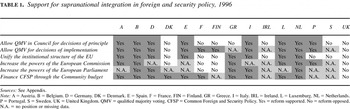
Support for supranational integration in foreign and security policy, 1996
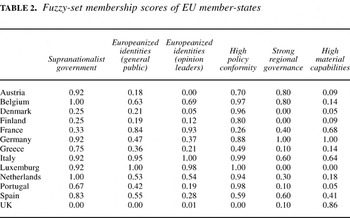
Fuzzy-set membership scores of EU member-states
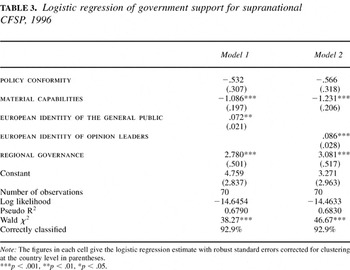
Logistic regression of government support for supranational CFSP, 1996
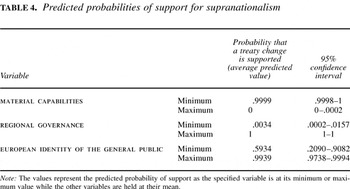
Predicted probabilities of support for supranationalism
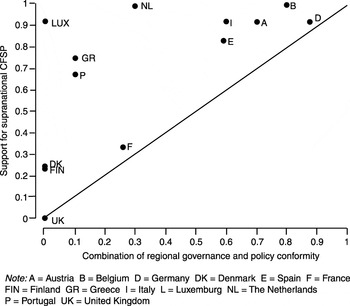
Supranationalism, regional governance, and policy conformity
 You have
Access
- 64
- Cited by