INTRODUCTION
As a result of advances in medicine, there is considerable interest in end-of-life (EoL) care, however, the associated discussion has just begun in Korea (National Evidence-Based Healthcare Collaborating Agency, 2009). Discussion of EoL care occurs in a variety of healthcare contexts. Due to improved survival after cancer treatment and still high mortality, patients with terminal cancer have been targeted for this type of discussion (Korean Statistical Information Service, 2013). The goals of EoL care are focused on pain and symptom relief, as well as palliative care, and eventually improvement of quality of life. Palliative care is currently available in Korea, with the service limited to those with terminal cancer only. Healthcare professionals are responsible for explaining palliative care options to these terminally ill patients, whose life expectancy is estimated at less than several months, and their families (Korean Ministry of Government Legislation, 2013).
Introduction to palliative care early, at the time of diagnosis of advanced cancer, has been shown to likely result in a meaningful EoL experience for patients and family caregivers (Greer et al., Reference Greer, Jackson and Meier2013). However, EoL discussion in Korea often does not occur until near death, often leading patients to lose valuable time during the last moments of their lives. Patients are usually excluded from the loop of such communication regarding EoL care decisions, and ethical concerns arise (Kim et al., Reference Kim, Hong and Hong2013). Over the last decade, our society has undergone continuous legal, social, and cultural evolution with respect to EoL care, with a recent movement taking place in terms of relevant law making and consensus on associated matters (Ministry of Health & Welfare, 2012; 2013; National Evidence-Based Healthcare Collaborating Agency, 2009). The evolution of life-sustaining treatment (LST) issues has occurred over three generations, which involved attempts to define futility, and procedures to resolve disputes on futility and effective communication and negotiation followed (Burns & Truog, Reference Burns and Truog2007). End-of-life care in Korea follows a similar trajectory, and it is time to make an effort to support EoL communication, which is expected to facilitate informed healthcare decision making.
In Western countries, to facilitate the EoL decision-making process, efforts have been undertaken to develop communication guidelines that are available as part of standard EoL care in clinical practice (Berlinger et al., Reference Berlinger, Jennings and Wolf2013; Ngo-Metzger et al., Reference Ngo-Metzger, August and Srinivasan2008). In Korea, given the lack of such guidelines, where the patient him or herself is a major stakeholder often not involved in such an EoL circumstance, clinicians are likely to experience difficulties when starting EoL care planning with patients. A demand for communication-fostering guidelines that reflect the reality and culture in Korean clinical settings is highly important, but guidelines that abide by the ethical and legal standards for EoL care decision making. Therefore, as an initiative in a series of research studies for development of an EoL communication model, the purpose of our study was to solicit opinions from healthcare professionals on a strategic approach for EoL communication with cancer patients and their families. Our specific aims were to (1) explore clinical contexts encountered by healthcare professionals during the critical EoL period, such as breaking bad news and communicating any relevant information for EoL care planning, and (2) develop a communication model for EoL care decision making that is compatible with the clinical environment and Korean culture.
METHODS
Focus-group interviews (FGIs) were conducted in order to solicit professional opinions on communication related to EoL care discussion with patients and their families. Guided by focus-group methodology (Krueger & Casey, Reference Krueger and Casey2009) and content analysis (Hsieh & Shannon, Reference Hsieh and Shannon2005), investigators developed instructional guidelines based on a literature review and expert consultation. These proposals involved open-ended questions, followed by a list of questions about experience and opinions with regard to EoL decision making that should be addressed.
Participants
Physicians and nurses who actively engage in the EoL decision-making process with terminal cancer patients were invited to participate. Specific inclusion criteria included: (1) they had provided care to patients with a diagnosis of terminal cancer for at least five years, and (2) they would be willing to participate and provide their expert opinion on EoL care issues. Further, those who worked in different clinical environments across various geological districts and institutions of Korea were invited to participate, preventing a predominance of a particular institutional culture, one that may affect professional opinions on associated matters and possibly yield biased opinions.
Data Collection
Two researchers were teamed for conduct of FGIs with each group of physicians and nurses independently. Each interview lasted approximately 3 hours, with a 20-minute break. An instructional guide for FGIs developed by the research team was followed when conducting each interview. Interview guidelines that should be addressed included, but were not limited to: (1) introduce ground rules for the interviewing process; (2) ask how EoL care decision making occurs at a participant's current workplace; (3) solicit the participant's beliefs regarding EoL care decision making; (4) consult a participant about professional opinions in clinical practice regarding communication near the end of life for appropriate informed decision making; (5) ask for other opinions about overall EoL decision process realities for specific clinical situations; (6) prompt or probe as needed; (7) encourage group discussion if needed; and (8) provide closing remarks.
One of the two researchers became a moderator of the interviews and encouraged group members to exchange opinions and make comments; the other recorded the dialogue generated during the FGI. The dialogue of each group was audiotaped with consent. After interviews, an additional inquiry was requested via email for clarification or elaboration. This inquiry included a list of questions, specifying the following: who, when, and to whom a patient's terminal condition is informed; and who, when, and with whom decisions on treatment and EoL care are discussed.
Data Analysis
The tape-recorded interviews were transcribed verbatim by a research assistant, and two researchers who conducted interviews reviewed the transcriptions independently for content validity. Agreement between independent researchers was determined by a cutoff point of four or over on a five-point Likert-type scale. The transcription was compared with written notes dictated by one of the two researchers during the interviews. Researchers then performed independent analysis of the transcription in order to identify themes, using a directed content-analysis approach (Hsieh & Shannon, Reference Hsieh and Shannon2005). Coding by predetermined concepts related to decision making on treatment and EoL care was then followed. Agreement on coding of transcribed materials was also pursued among investigators using the same procedure as the verbatim transcription.
RESULTS
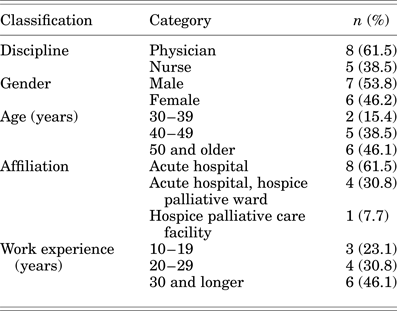
The physicians' group consisted of eight oncologists, one of whom was also a hospice palliative care specialist. The nurses' group consisted of five nurses who worked in hospice and palliative care units and one in an oncology care unit. All of them provided care to patients with terminal cancer (Table 1).
Key characteristics of participants

Themes
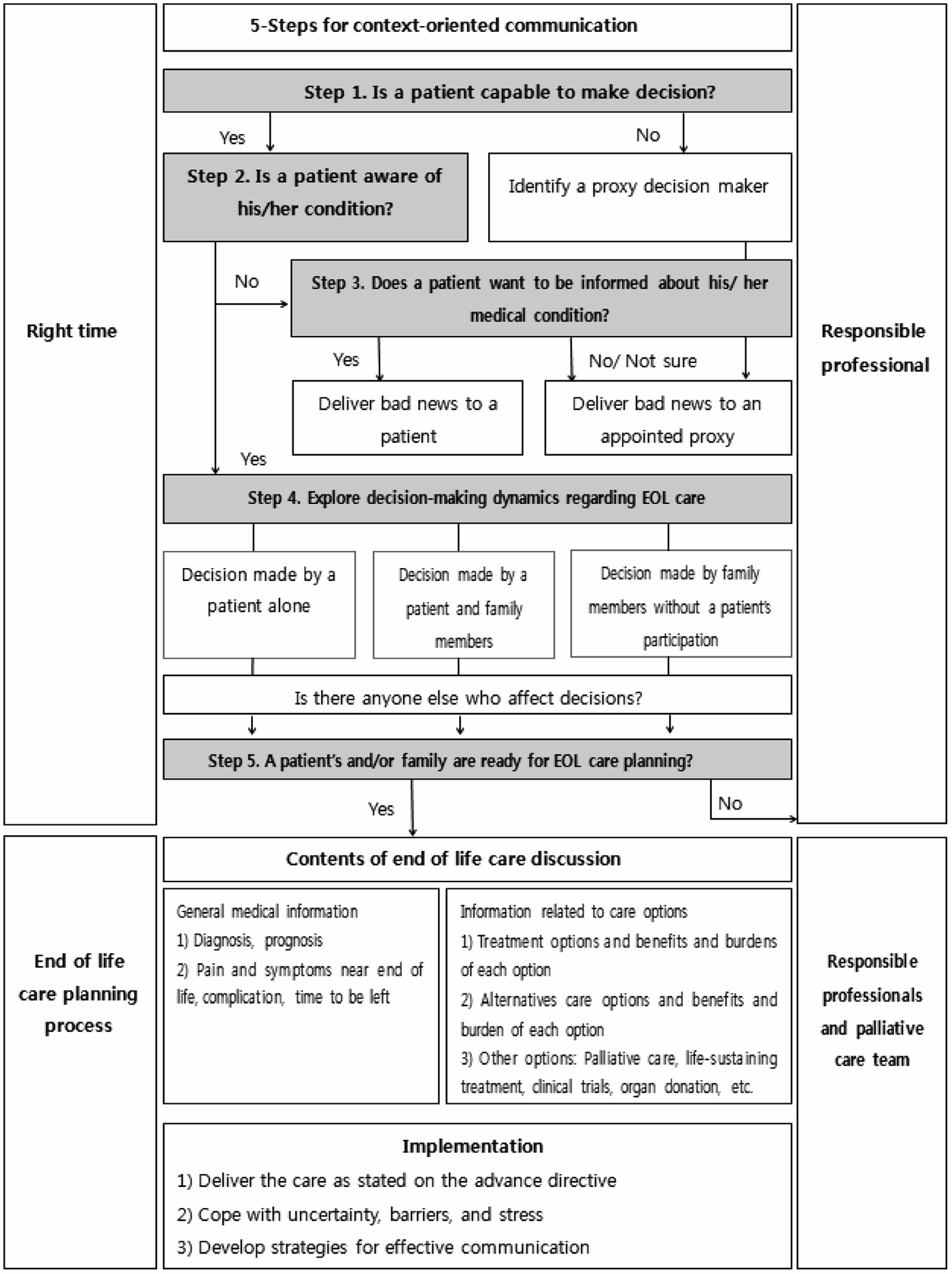
The themes that emerged from the analysis included: (1) timing of EoL care planning, (2) responsible professionals, (3) disclosure of bad news, (4) contents of EoL care discussions, and (5) implementation of EoL care decisions. These five themes evolved from the lived experiences of participating healthcare professionals, who have provided EoL care to patients with terminal cancer, and were based on development of a communication algorithm for EoL care discussion within Korea (Figure 1).
A communication algorithm for end-of-life care discussion in Korean clinical environments (context-oriented communication model).
Timing
A foremost shared opinion among professionals was the ambiguity about “timing” for disclosure of a terminal prognosis and initiation of EoL care discussion. Defining a “terminal condition” varies according to the professional and often leads to stopping of standard treatments, ending chemotherapy, or avoiding meaningless treatments. An a-priori assumption of these variations was that participants supposed a specific time for the terminal state to be context based, defining it as when burdens exceed the benefits of an associated therapeutic treatment. They reached an agreement against arbitrarily specifying “terminal” as a certain amount of time left in life, requesting efforts of expert circles of the Korean Medical Society to reach a consensus on the term “terminal state.”
A consensus on this issue of timing was that the right time to initiate EoL discussion is at the time of a diagnosis of a terminal condition or when a responsible physician believes that an impending terminal stage is imminent. Some professionals have suggested that EoL discussions could be initiated even before a terminal condition actually occurs. As one physician reported, “Among those who were diagnosed with advanced cancer, some are receiving chemotherapy that could be a last time if not successful. In this case, it may be an appropriate time to break bad news and inform that them a consult about EoL care planning could be initiated next.” However, caution should be exercised if EoL care is mentioned upon the diagnosis of advanced cancer. Another physician stated that “for cancer patients, early discussion about EoL care might be considered as a sign of no hope for cure and giving up on treatment.”
One of the primary challenges for EoL care planning is encountered with patients who had a diagnosis of a terminal condition but were unable to be involved in EoL decision making. As an exemplar, one healthcare professional suggested, “It is the right time to discuss EoL care when a patient's decision-making capacity is intact.” Another oft-stated belief was that “Those with terminal cancer get worse rapidly near the end of life, with their consciousness altered, so they are barely able to communicate and will die shortly thereafter.”
Responsible Professional
Participants reached agreement with the attending physician, who in Korea is often a physician-oncologist, and is felt to be the most logical person to deliver the bad news, and then the physicians and palliative care team (PCT) jointly continue to discuss EoL care thereafter. Based on the trusted physician–patient relationship, which has been built throughout the course of the cancer treatment, an attending physician is in an appropriate position for such communication. One physician stated, “One of the greatest difficulties is to disclose bad news. However, I have been with him all the way through his ordeal while providing care and support, so that I felt obliged to break the bad news.” Another physician commented, “It is easier for me to deliver the bad news because I have shared with the patient in his battle over repeated trials and failure of treatment, and eventually patients would like to discuss hospice and palliative care options with the physicians who witnessed their battles.”
Some participants suggested a PCT for ongoing discussions, stating, “In a busy and critical clinical practice, it is hard to allocate sufficient time for assisting patients with informed decision making, and an alternative is to run a PCT.” Others suggested that a PCT be interdisciplinary in nature and that access to a PCT facilitates associated matters of EoL care, including DNR consults if needed, family meetings, and liaison for necessary resource utilization.
Five-Step Communication Algorithm Regarding EoL Care Planning
The five-step communication algorithm for context-oriented end-of-life care discussion (see Figure 1) begins with a query: “Is a patient capable of making any necessary decision, which means is he/she capacitated?” (step 1). In step 2, healthcare professionals determine whether a patient is aware of his/her terminal condition and, if not, who the primary caregiver is. Then, healthcare professionals determine whether a patient wants to be informed about his/her medical status (step 3). The next step involves exploring decision-making dynamics to determine who would be invited to participate in a patient's EoL care planning: an individual who may have a desire for informed decision making for one's own EoL care, patient and family members together, or family members alone (step 4). EoL care planning then proceeds, given that patients and/or family are receptive to the terminal condition and ready for EoL discussion (step 5).
One professional expressed a popular sentiment: “Each person is under a unique situation in terms of psychosocial status and value systems. In Korean clinical environments, both traditional and new values from Western countries largely affect patient medical decision making. Due to various EoL situations generated from these mixed values, context-specific communication for EoL discussion is more appropriate than a single or uniform pathway.” Another physician commented, “I believe that patients should be able to take part in the EoL decision-making process, but family dynamics in Korea were fundamentally influenced by Confucianism, in which family members have the responsibility of determining whether to involve a patient in his or her EoL care discussion.”
Contents of EoL Discussion
Healthcare professionals suggested that general medical information and specific information considered in relation to EoL care be addressed during this collaborative EoL decision-making process. General information involves disclosure of a terminal diagnosis and prognosis, signs and symptoms, pain and symptom management, probable complications near death, and available support and resources as needed. The specifics of EoL care include patient preferences, the benefits and burdens of each option for LSTs, the benefits and burdens for alternative care options, and other options, such as hospice and palliative care, clinical trials, or organ donation, and continuation of care through coordinated efforts among healthcare professionals.
Implementation
Participants argued that, despite recognition of the importance of EoL care planning, noncompliance with patient preferences and reluctance to discuss these issues often occurs. Many professionals suggested the following approach as prerequisites for implementation of EoL care planning in the real world: (1) clarify terms and concepts in relation to EoL care, such as “terminal condition,” “LST,” or “end-of-life”; (2) establish a standardized institutional system for delivery and continuity of EoL care; (3) cope with uncertainty, barriers, and stress among patients, families, and healthcare professionals as they continue to provide EoL care; and (4) provide professional training as needed.
DISCUSSION
Our study is one of the few that examine effective communication for EoL discussions in Korea. Using FGIs, professional opinions on EoL care discussion were solicited for development of a culturally and clinically compatible communication model for terminal cancer patients. Five themes emerged that facilitated the EoL care process in clinical practice. In particular, the thematic pathway involved five steps, which provide step-by-step guidance for healthcare professionals in communication with clients through breaking bad news, and considering an individual's physical, cognitive, and psychological capability. Based on these themes, a communication model for EoL discussion was proposed, called a “context-oriented model” because of its algorithm that takes account of the individual context and takes different routes accordingly.
The first theme started with the “timing” to initiate communication for EoL care for terminal cancer patients. Consistent with a previous study that most patients with terminal cancer were likely to be informed of their illness immediately after the diagnosis (Yun et al., Reference Yun, Lee and Kim2004), participating healthcare professionals suggested that the time of diagnosis or anticipation of terminal stage was a realistic option as timepoints for disclosure of terminal illness and an attempt to initiate EoL discussion in current clinical practice. An important observation of our study was that healthcare professionals asked for consideration of an individual context regarding when to determine a terminal state and begin EoL discussions, rather than relying on an arbitrarily determined, quantified life expectancy. Given that such a conditional state is determined, advance directives (ADs) can provide a useful vehicle to guide the EoL discussion. In past studies, advance directives as part of advance care planning were feasible for administration in both clinical practice and the community in Korea ahead of time when an individual was healthy and capable of decision making (Kim et al., Reference Kim, Son and Koh2012; 2013). However, a concern raised in our study was that the use of ADs in EoL care planning might result in a misreading by patients and/or families in critical care settings, so that they believe that the healthcare professionals have given up on the them and their treatment. Further study is warranted in that the question of whether protocols for EoL care planning with ADs that vary by populations and healthcare settings are less likely to mislead all stakeholders during this stressful period should be investigated.
The next theme was related to “a responsible professional who discloses bad news.” Given various situations for EoL discussions, no consistent procedure exists; therefore, a probe into the individual context and the family dynamics should be performed. An attending physician is usually responsible for disclosure of a terminal condition in Korea. The PCT may then lead the following EoL decision making jointly with the attending physician. This is contradictory to results reported in a previous study in that a primary care physician was in this position based on his/her longstanding relationship with the patients and their ample experience with EoL care (Ngo-Metzger et al., Reference Ngo-Metzger, August and Srinivasan2008). However, a primary care physician is an unfamiliar concept in the Korean clinical environment. The most common pathway of disease management in Korea involves a diagnosis of a critical condition and the following treatments in hospital settings, and eventual EoL care is often initiated during hospitalization for exacerbation of the underlying terminal condition. This leads patients and/or their families to build trusted and collaborative relationships with their physicians, who have the best knowledge of patients' health conditions and goals for care.
Healthcare professionals suggest that, given the limited time, the work overload, and the lack of support for EoL care, which prevent attending physicians from active engagement in EoL care planning, a PCT might take over and continue EoL care planning after the bad news has been broken, particularly in acute hospital settings. The benefits of a hospital PCT have been reported to include an increase in patients' insights into their cancer, symptom control, and increased satisfaction with services for both patients and staff (Gade et al., Reference Gade, Venohr and Conner2008; Jack et al., Reference Jack, Hillier and Williams2004; Morita et al., Reference Morita, Fujimoto and Tei2005b). In Japan, earlier referrals to a PCT have become a standard procedure that activated palliative care service and increased EoL quality of life as a result (Morita et al., Reference Morita, Fujimoto and Imura2005a). Therefore, institutional support and insurance reimbursement for PCTs is required in Korea as well.
The next theme is to determine whether patients and/or families are ready for EoL decision making through “right pathways.” Each of the five steps assists healthcare professionals in effective communication with patients and/or families, which has often been reported as the most difficult aspect of EoL care planning. More importantly, these steps were approached for integration of patients' capability as well as wishes for involvement in the EoL decision-making process and family dynamics, which both have a profound impact on the course of a patient's end of life. Consistent with a previous report (Broom & Cavenagh, Reference Broom and Cavenagh2011), family dynamics largely affected a patient's EoL decision-making process, with a couple of different channels emerging in this study, including the patient alone, the patient and family jointly, and the family or significant others alone. In the Korean clinical environment today, there has been a shift in decision making, particularly with respect to EoL care, from the traditional physician-directed to patient-directed decision making (Kim et al., Reference Kim, Son and Koh2012). However, EoL care decision making by a patient alone is still very unlikely, as reported by study participants; rather, it depends upon the individual's preferences, values, and psycho/socio/physical circumstances, which can be considered in context.
The structural communication steps for disclosure of bad news begin with determination of a patient's decision-making capability, followed by a patient's perception of his/her own condition, a patient's desire to be informed of his or her medical condition, family dynamics, and a patient's and/or family's readiness for EoL discussions. These five steps in part reflect this shift with respect to the importance of each individual's context in medical decision making, as stated earlier. Respect for a patient's autonomy regarding EoL care decision making is often restricted in Korea because of the family-centered tendency for medical decision making. Contrary to the family-centered tradition, in which physicians tend to disclose bad news to the family, healthcare professionals participating in the current study suggested that patients be informed of his/or her terminal condition directly. Prior to disclosure of bad news to patients, their decision-making capacity should be assessed. Patients are often caught “out of the loop” of EoL care planning (Kim et al., Reference Kim, Hong and Hong2013); therefore, the three previous steps enable healthcare professionals to determine who is the right person to break the bad news. In these steps, integration of an individual's desires for decision making as well as family dynamics were recommended; therefore, this process is entitled a “context-oriented communication pathway.” This pathway is believed to be make it easier for healthcare professionals to engage in EoL care planning with a clear direction and subsequent confidence.
The next theme was related to the contents of the EoL care discussions. Consistent with findings from a previous study investigating the cultural impacts on EoL communication (Shrank et al., Reference Shrank, Kutner and Richardson2005), EoL discussion contents that emerged in our study were general medical information and EoL care relational specifics. The last theme was implementable strategies of medical decisions directed by a patient and/or surrogate decision maker, usually a family member. All healthcare professionals who participated in this study were in agreement regarding the importance of EoL care planning. However, a concern was raised about noncompliance with EoL care planning for both healthcare professionals and clients. One strategy to resolve this challenge is to make what is unclear clear. For example, a definitive consensus on several terms, such as “terminal” or “end-of-life,” is vital in that various interpretations of these terms may prevent effective communication related to EoL care planning between physician and patient, and even among healthcare professionals. Another concern is the unpredictability of a specific clinical situation and the associated responsibility that leads healthcare professionals to be reluctant to engage in EoL care planning. Institutional support systems play a key role in resolving this concern, such as development of a practical EoL communication model, a standardized mechanism for EoL care application, or sufficient professional training for EoL care. Problem solving related to these concerns will also facilitate legal and policy making for EoL care and advance EoL care delivery accordingly.
In summary, the five themes that emerged from professional opinions on EoL care discussions were based on development of a communication algorithm for EoL care. To the best of our knowledge, this algorithm is the first communication model for EoL decision making in Korea that is congruent with the organizational culture of hospital settings and can be applied in the context of individual patients. All study participants spoke in one voice that what matters during this critical period near the end of life is effective communication across all stages of the process.
Now is the time to focus on communication and care planning rather than on establishing the perfect forms, such as advance directives (Rogne & McCune, Reference Rogne and McCune2014). The importance of communication for EoL care has been well recognized in Western countries, coupled with efforts to develop communication guidelines (Berlinger et al., Reference Berlinger, Jennings and Wolf2013; Ngo-Metzger et al., Reference Ngo-Metzger, August and Srinivasan2008).
In Korea, a considerable individual and social demand for EoL care planning led to development of Korean Advance Directives (K-ADs), a core product of EoL care planning led by the individual's goals and values (Kim et al., Reference Kim, Son and Koh2012; 2013). For practical utility of the K-ADs as vehicles for communication in clinical practice within the EoL care planning paradigm, effective communication skills are critical for education and training of healthcare professionals. The proposed communication algorithm is timely and appropriate for facilitation of EoL care planning. Application of this clinical communicative algorithm to EoL care planning is also expected to improve the quality of EoL care.
STUDY LIMITATIONS
Our study did have a couple of limitations. First, this context-oriented model was generated from the perspectives of healthcare professionals who were major stakeholders in EoL discussion. Given an assumption that this model varies according to the contexts of patients with terminal illnesses, the question of how this context-oriented communication algorithm can be modified with respect to patient/family perspectives for the EoL circumstance is a priority for future research. In addition, the question of whether this model can be applied to other patient populations and their specific contexts is also worthy of investigation. Another limitation comes from the study design and the small sample size. Although the FGI is useful for obtaining ample data from experts in EoL care, future research is warranted to validate the feasibility of this algorithm in a larger sample of patients with terminal cancers using a quantitative-research methodology.
FUNDING
Financial support for this study was provided in part by The Korea National Institute for Bioethics Policy fund and in part by The National Research Foundation of Korea fund of The Korean Government (Grant #2010-0021379).
CONFLICTS OF INTEREST
The authors state that they have no conflicts of interest to declare.
ACKNOWLEDGEMENTS
The authors acknowledge all participating physicians and nurses who gave of their precious time for the interviews and provided expert opinions on end-of-life care issues.
 .