Introduction
Most young people in England face a challenging housing market with ripple effects for their families, society, and the economy. Researchers and the media portray this as a “housing crisis,” manifested by rising property prices, declining affordable housing, falling homeownership rates, and rising levels of long-term renting, in part fuelled by an insecure labour market with stagnating wages (Gallent, Reference Gallent2019; Roberts et al., Reference Roberts, Eager, Anderson, Baxter and Boyd2020). Two main consequences arise, distinguishing the housing tenure of Millennials from earlier generations. First, most young people cannot afford to buy a home and are being priced out of homeownership (Cribb et al., Reference Cribb, Hood and Hoyle2018). Second, they are more likely than earlier generations to live with their parents. Numerous factors contribute to these trends. Some researchers and policymakers suggest that growing student debt, which is the focus of this paper, is playing a role (McKee and Soaita, Reference McKee and Soaita2018; Stone et al., Reference Stone, Berrington and Falkingham2011).
How might student debt affect graduates’ housing?Footnote 1 It might inhibit homeownership and encourage parental co-residence in several ways. Lower take-home pay resulting from loan repayments means less disposable income. Borrowers might save less and take longer to raise a deposit for a mortgage (Andrew, Reference Andrew2010). Lower take-home pay also means borrowers have less to spend on monthly mortgage repayments if they succeed in obtaining one (McKee et al., Reference McKee, Moore, Soaita and Crawford2017). Student loan repayments, which continue well into a graduate’s working life, are factored into a lender’s assessment of both current and future ability to service a mortgage. This affects the amount graduates with student loans can borrow and the properties they can buy. Borrowers may also find some mortgage lenders unwilling to lend because of existing student debt and the recent tightening of lending regulations (Edmonds, Reference Edmonds2014). In addition, the psychological burden of debt may deter some from taking on additional loans. Some researchers hypothesize that holding student debt leads to self-selection out of homeownership based on deepened debt aversion (e.g. Elliott and Lewis, Reference Elliott and Lewis2015).
Graduate borrowers’ lower take-home pay might also render renting unaffordable, especially in the costly private sector, making parental co-residence financially more attractive or the only option. Parental co-residence is by far the cheapest housing alternative because of no or very low rent and utility bills. It might also be a pathway to homeownership, allowing individuals to save for a mortgage deposit (Roberts et al., Reference Roberts, Noden, West and Lewis2016), which might be difficult or impossible while paying high rent.
Understanding the role played by student debt in limiting young people’s housing options, or maybe fuelling the housing crisis, is important because of the potential repercussions for young people, society, and the economy. Housing issues have contributed to the lengthening of the transition to adulthood, including extending the time when young people leave the parental home or enter into homeownership, thereby making them dependent on their parents for financial or in-kind support for a longer period of time (McKee et al., Reference McKee, Moore, Soaita and Crawford2017). Because young people’s housing options are increasingly dictated by their parents’ financial resources, their housing tenure may perpetuate existing social and economic inequalities (Christophers, Reference Christophers2018; Coulter, Reference Coulter2018), potentially contributing to a more unequal society. Also, homeownership – the most significant source of individual and national wealth (Appleyard and Rowlingson, Reference Appleyard and Rowlingson2010) – is important for economic growth. If student debt is a barrier to homeownership, it may have negative social and economic consequences.
This paper contributes to the literature on the housing challenges faced by young people. It provides new insights by exploring the relationship between both student debt and attitudes towards debt and graduates’ housing options, including homeownership and parental co-residence. This research is significant because, to the best of our knowledge, no other study has examined these relationships in the English context, where debt repayments are based on graduates’ income. Extant research primarily focuses on student loan systems that have time-based repayment schemes with fixed-term repayments. This study brings together two increasingly important areas of social policy for young people: housing and higher education – policy arenas rarely examined together. It also sheds light on the post-graduation consequences of student debt and their role in potentially promoting or undermining the benefits of higher education (HE). Specifically, while student loans can be an instrument of equity by allowing access to HE, loans’ possible relationship to housing tenure could strengthen wealth inequities among young people.
The English policy context
Housing
The housing problems young people face are evidenced in the decline in homeownership and the rise in parental co-residence. Despite shifts in their housing aspirations (Preece et al., Reference Preece, Crawford, McKee, Flint and Robinson2020), most young people in England want to buy a home. In 2018, 85 percent of 16–25 year-olds preferred homeownership to renting (MHCLG, 2019b). Yet, only 37.6 percent of 25–34 year-olds were owner-occupiers in 2017–18, compared to 66.5 percent in 1991 (MHCLG, 2019a). Rising house prices has made homeownership unattainable for many young people. The housing affordability ratio, measuring the ratio of house prices to earnings, doubled between 1997 and 2016 reaching 7.72 (ONS, 2017) because of escalating house prices associated with rising demand due to the financialization of the housing market (Gallent, Reference Gallent2019). This is particularly problematic for young people at the beginning of their career, earning low starting salaries. The affordability issue faced by young people is, however, more complex than just increased house prices. As Preece et al. (Reference Preece, Crawford, McKee, Flint and Robinson2020) argue: “the (un)affordability of homeownership cannot solely be conceptualized as a housing issue, but is structured by labour market conditions, mortgage finance and the nature of welfare systems” (p. 7). And as argued here, it may also be affected by HE funding policies.
Many young people who lack access to homeownership and to social housing (McKee and Soaita, Reference McKee and Soaita2018) turn to private renting. But some are priced out of that sector too. Over the last decade, private sector rents, especially in London and the South East, have increased significantly (ONS, 2019). The affordability of rising rents is also related to the labour market, access to housing benefits, and potentially student debt. Consequently, graduates’ housing options are constrained.
The rise in both house prices and private sector rents are linked to the growth in parental co-residence among young people. In 2017 in England, 26 percent of 20–34 year-olds lived with their parents, up from 20 percent in 1996. There were large regional variations ranging from 30 percent in the West Midlands to 22 percent in Yorkshire (ONS, 2018). Living independently has become an unpredictable transition for young generations, with more exits and returns to the parental home (Furlong and Cartmel, Reference Furlong and Cartmel2007). The housing and labour markets play key roles in these patterns of parental co-residence (Newman and Aptekar, Reference Newman, Aptekar, Danziger and Rouse2008), but other factors are important, such as the lengthening of educational careers (Christie et al., Reference Christie, Munro and Rettig2002) and returns to the parental home after a period of living away, including for HE. Economic factors also remain significant barriers to housing independence. One such suggested factor is rising levels of student loan debt and associated repayments (Stone et al., Reference Stone, Berrington and Falkingham2011).
Student loan debt
With the expansion of undergraduate HE in England, since the 1990s successive governments have introduced cost-sharing policies – primarily higher tuition fees repaid by government-funded income-contingent student loans.Footnote 2 These policies aim to shift more HE costs from government to students. As study costs have risen, so has reliance on student loans. All English domiciled full-time undergraduates qualify for loans covering all their tuition fees and means-tested maintenance loans towards their living costs. In 2017–18, with tuition fees of £9,250 and no maintenance grants, 94 percent of full-time undergraduates took out a tuition fee loan and 89 percent a maintenance loan (Bolton, Reference Bolton2020). Students today can expect to graduate with average debts over £50,000. Since the abolition of maintenance grants in 2016, student loan debt has become unequally distributed. Students from the poorest 40 percent of families will graduate with average debts of about £57,000, compared with £43,000 for students from the richest 30 percent of families (Belfield et al., Reference Belfield, Britton, Dearden and van der Erve2017a).
Students start repaying their loans once they leave HE and their income reaches a threshold.Footnote 3 They then pay nine percent of their earnings above the threshold until their loans are paid off, with any outstanding debt forgiven after 30 years. The more graduates earn, the larger their repayments, making the repayment system progressive and protecting low-earning graduates from high repayments. An estimated 83 percent of graduates will not repay their loan in full within 30 years (Belfield et al., Reference Belfield, Britton and van der Erve2017b). Consequently, most students will be repaying their debts for most of their working lives. Significantly, monthly repayments deducted from graduates’ pay packet are dictated by graduates’ earnings and not the total amount borrowed, unlike time-based repayment schemes found, for instance, in the United States (US) where repayments are not linked to graduates’ capacity to repay. In an income-contingent plan, large student loans increase the time it takes to pay them off, but not monthly loan repayments. These design features of income-contingent loans might protect graduates and render their student debt irrelevant to their housing options. Alternatively, the fact that most graduates will be saddled with loan repayments for most of their working lives might matter for their financial resources. Moreover, the psychological burden of carrying debt – which can shape students’ HE decisions (e.g. Callender and Mason, Reference Callender and Mason2017) – might influence housing options too.
Literature review
The literature on student debt and homeownership is almost exclusively focused on the North American context and unanimous in two respects. First, holding student debt is negatively associated with homeownership (Elliott and Lewis, Reference Elliott and Lewis2015; Luong, Reference Luong2010; Miller and Nikaj, Reference Miller and Nikaj2018). Second, student debt relates negatively to housing value and equity (Elliott et al., Reference Elliott, Grinstein-Weiss and Nam2013; Elliott and Lewis, Reference Elliott and Lewis2015; Hiltonsmith, Reference Hiltonsmith2013). The literature, however, is conflicted on the effect of the level of student debt. Several studies uncovered a negative relationship between the amount of student loan debt and homeownership (Elliott et al., Reference Elliott, Grinstein-Weiss and Nam2013; Mezza et al., Reference Mezza, Ringo, Sherlund and Sommer2015; Miller and Nikaj, Reference Miller and Nikaj2018), but others fail to find any association (Gicheva and Thompson, Reference Gicheva, Thompson, Hershbein and Hollenbeck2015; Velez et al., Reference Velez, Cominole and Bentz2019) including a study from Australia, where income-contingent loans are used (Marks, Reference Marks2009).
The negative relationship between student loan debt and homeownership is associated with mortgage requirements. Data from the US and England suggest student loans impede access to mortgages (Andrew, Reference Andrew2010; Mishory and O’Sullivan, Reference Mishory and O’Sullivan2012). In England, Andrew (Reference Andrew2010) estimates that student loans delay saving for a mortgage deposit by at least two years. However, not all agree that credit eligibility is the issue (Mezza et al., Reference Mezza, Ringo, Sherlund and Sommer2015; Shand, Reference Shand2007). Others hypothesise that borrowers self-select out of homeownership, experience deepened debt aversion, or face tightened mortgage eligibility criteria (Brown et al., Reference Brown, Haughwout, Donghoon, Scally and van der Klaauw2014; Elliott and Lewis, Reference Elliott and Lewis2015; Lee, Reference Lee2013).
Research on the potential link between student debt and parental co-residence is scarce and contradictory. In Australia, Marks (Reference Marks2009) finds that higher levels of student debt are moderately associated with living with parents. In England, a survey finds that student debt prevents graduates from leaving the parental home (Purcell et al., Reference Purcell, Elias, Atfield, Behle, Ellison, Luchinskaya, Snape, Conaghan and Tzanakou2012). In the US context, one study finds a positive association between higher levels of student debt and parental co-residence (Bleemer et al., Reference Bleemer, Brown, Lee and van der Klaauw2014), while another finds no link (Houle and Warner, Reference Houle and Warner2017).
The literature on the relationship between student debt and housing tenure is, however, limited. First, except for three studies, two English and one Australian, all the studies cited were conducted in North America where student loan repayments are based on fixed time-based repayments. The generalizability of the findings from these studies to countries where student loan repayments are income-contingent, such as England, might be problematic. Second, many studies fail to control for geographic disparities, ignoring large variability in house prices that may affect homeownership and rents. Finally, whereas the literature has explored the financial burden of debt, to our knowledge, no research has examined the role of attitudes towards student loan debt on housing tenure. Our paper addresses these limitations.
Data and methods
Data and respondents
This study uses the Next Steps dataset to examine the relationship between debt and housing issues. Next Steps first interviewed 13–14 year old individuals born in 1989–1990 in England. It used a two-stage stratified random sampling, with schools as primary sampling units stratified by deprivation statusFootnote 4 and pupils as second stage with different probabilities based on ethnicity (DfE, 2011). Individuals were surveyed annually until the age of 19–20 and again at the age of 25 (sample attrition is provided in Appendix Table 1, Supplementary Materials). Information in Next Steps covers a wide array of topics including family, schooling, work, and health.
Most Next Steps respondents reached the age of 18 in 2007-08 and would have entered HE in 2008-09, graduating three years later. As full-time students, they were initially charged annual tuition fees of £3,145 which subsequently rose in line with inflation (The Student Fees (Amounts) (England) (Amendment) Regulations 2008, no. 2507, Parliament, 2008). They could receive tuition fee loans covering all their fees. They were also eligible for maintenance loans with low-income students qualifying for maintenance grants too. Most Next Steps respondents finished their first degree in 2011 with an average of £17,000 in loan debt (SLC, 2018). This means that by age 25 most had been repaying their loans for three years, having started repayments in April 2012.
The loan repayment income threshold was £15,000 in 2012, reaching £18,935 in 2019–20 (SLC, 2020). Outstanding student loan balance for the Next Steps generation will be forgiven after 25 years.Footnote 5
A total of 7,707 individuals responded to the Age 25 wave of Next Steps. There were 690 individuals who entered HE but failed to provide information about student loans and are excluded from our sample. The sample size for this study is therefore 7,017 individuals.Footnote 6 The variables included come from several waves of Next Steps: the Age 25 wave for housing tenure information, the age 18, 19 and 25 waves for student loan information, and the parental questionnaires from the first four waves (ages 13 to 16).
Methodological framework
We analyse the relationship between student debt and housing options by evaluating housing tenure in relationship to borrowing and attitudes toward debt. First, we use treatment effects to evaluate the differences in housing tenure for three groups of 25 year olds: those who did not attend HE (non-graduates), those who attended HE and took out student loans (graduate borrowers), and those who attended HE but did not borrow (graduate non-borrowers). Specifically, we estimate four models with different outcomes: 1) homeownership, 2) renting, 3) parental co-residence, and 4) the difference in reasons for parental co-residence
Due to self-selection into HE and loan take-up, one concern is potential endogeneity, which may bias the estimates. To mitigate such potential problems, a rich set of background variables associated with HE enrolment and loan take-up – including demographics, socio-economic variables, and type of schooling – are included in the models. This “selection on observables” approach could, however, be insufficient if not all confounders are controlled for. Nevertheless, statistical testsFootnote 7 suggest that, for most models estimated, selection on unobservables may not be an issue.
Our use of treatment effects with a multivalued treatment allows comparisons across three treatment categories of interest (non-graduates, graduate non-borrowers, graduate borrowers). Regression-adjustment (RA), augmented inverse probability weighting (AIPW), and inverse probability weighting with regression adjustment (IPWRA) estimators are employed and yield similar results. The IPWRA estimator is the preferred model because of its doubly robust property, meaning that only one of the treatment or outcome models estimated has to be correct to properly estimate the treatment effects (Drukker, Reference Drukker2016). In addition, the IPWRA command in Stata allows us to estimate the average treatment effect on the treated (ATT) which is essential because not everyone in our sample qualifies for HE or student loans.
Second, we regress housing outcomes on debt attitude for graduate borrowers only. Debt aversion may prompt individuals to self-select out of some housing options, as they might be unwilling to take on additional loans – including a mortgage – or to pay high rents. We exploit variation in debt attitudes and housing outcomes using logistic regressionFootnote 8 and the same four outcomes described above. The independent variables consist of six debt attitude statements included in the Next Steps waves when respondents were age 16, 17 and 18 (Table 1). The responses from the age 16 wave are used because most respondents had already applied to HE by age 17, and entered HE by age 18. Using measures from the latter two waves would be problematic because students’ HE choices may affect their attitudes towards debt (Oosterbeek and van den Broek, Reference Oosterbeek and van den Broek2009).
Debt attitude items

To evaluate the association between student debt and housing options, the models include factors that may confound these relationships. Gender, race, and religion have all been linked to housing tenure (Coulter, Reference Coulter2016; Stone et al., Reference Stone, Berrington and Falkingham2011) and could be related to earnings differentials, affecting housing affordability. The income and socio-economic background of respondents’ parents are included in the models because they influence intergenerational resource transfers and respondents’ ability to pay for housing (Avery et al., Reference Avery, Goldscheider and Speare1992; Blaauboer, Reference Blaauboer2010). Socio-economic background is also key in the decision to take up student loans (de Gayardon et al., Reference de Gayardon, Callender and Green2019). Parents’ housing tenure also matters because of intergenerational continuity in housing tenure stemming from shared values (Coulter, Reference Coulter2016). Geographical variablesFootnote 9 are included in the model to control for regional differences in the housing market that shape individuals’ ability to rent or buy (Coulter, Reference Coulter2016). Both average (mean) house prices and average monthly change in housing prices are included for the year 2011 (HM Land Registry, 2019) – the year respondents left HE. We also add the number of months of employment and the income at age 19 to the outcome (housing arrangement) equation in the treatment effect model, to proxy for savings capacity and therefore the ability to acquire a deposit.Footnote 10 Appendix Table 3 (Supplementary Materials) provides descriptive statistics by group of interest (non-graduates, graduate non-borrowers, graduate borrowers) for all control variables mentioned above. It also includes information on respondents’ income and living arrangements at age 25, which might influence their housing choices but cannot be included in the models because of simultaneity issues.Footnote 11
All models include clustered standard errors using the school deprivation strata to adjust for the survey design.
Results
Descriptive results
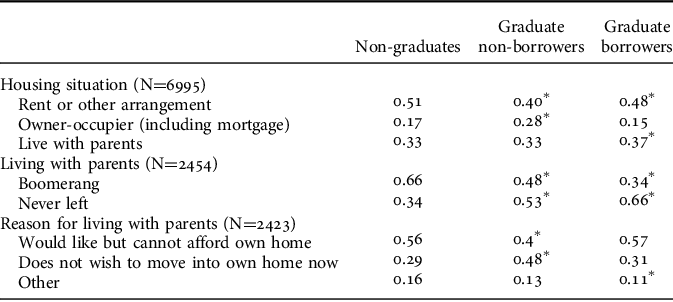
Tables 2 and 3 offer insights into young people’s housing tenure in England. Homeownership is the least common form of housing tenure among 25 year-olds. It is more widespread among graduate non-borrowers (28%) compared to borrowers (15%) and non-graduates (17%). This pattern is mirrored in renting, with more renters among non-graduates.
Housing options of 25 year-olds in England, by higher education participation and borrowing status

Note: * indicates a significant difference at the 0.5 level between the coefficient and the coefficient for non-graduates, using Wald tests.
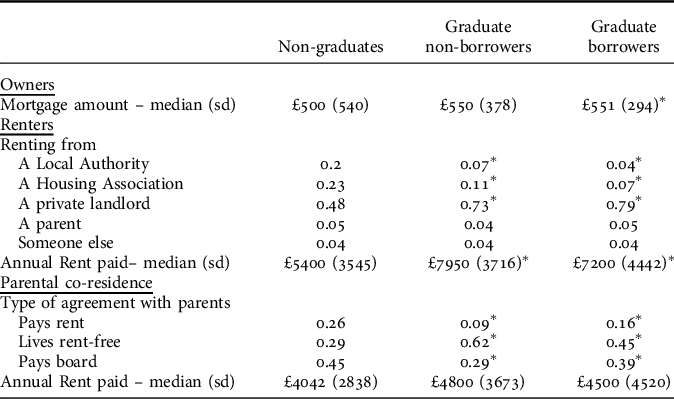
Details of housing, by housing arrangement, higher education participation and borrowing status

Note: * indicates a significant difference at the 0.5 level between the coefficient and the coefficient for non-graduates, using Wald tests. For continuous variables, the Wald tests analyse mean differences.
Parental co-residence is most frequent among graduate borrowers (37%) compared with graduate non-borrowers and non-graduates (33%). Among those who live with their parents, 66 percent of non-graduates never left the parental nest while 53 percent of graduate non-borrowers (66% of graduate borrowers) returned to the parental home after a period away – they are ‘boomerang’ children. About 56 percent of non-HE goers and a similar proportion of graduate borrowers (57%) live with their parents for financial reasons, compared to only 40 percent of graduate non-borrowers.
The results in Table 3 indicate that graduate owner-occupiers paid higher median mortgage amounts than non-graduates. Among renters, non-graduates are more likely to live in social housing than graduates. By contrast, graduates are far more likely to rent from a private landlord. These differences are reflected in the rent paid: the median annual rent for non-graduates is £5,400, £7,950 for graduate non-borrowers and £7,200 for borrowers, suggesting that graduates without loans can afford the highest rents.
The financial arrangements for those living at home differ starkly. While 26 percent of non-graduates pay rent, only 9 and 16 percent of graduate non-borrowers and borrowers respectively do. Most graduate non-borrowers live rent-free (62%), while borrowers either live rent-free (45%) or pay towards their board (39%). Even when paying rent, the amounts paid are significantly lower than for those living in rented accommodation: parental co-residence saves, at the median, between £1,358 and £3,150 annually in rent alone.
Higher education and borrowing status
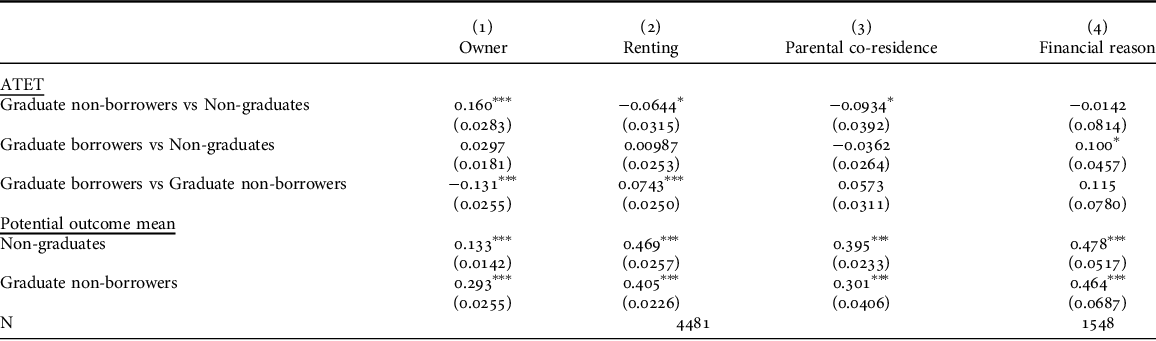
Table 4 provides the results of the analysis of differences in housing tenure by HE and borrowing status, using binary outcomes for each potential tenure option: owning (column 1), renting (column 2), and parental co-residence (column 3). In addition, column (4) evaluates the factors affecting the reason for parental co-residence. Table 4 displays average treatment effects on the treated among those who borrowed for HE, controlling for demographics, socio-economic background, and the regional housing market. Auxiliary-equation results, including the outcome models and the treatment models, are available on request.
Average treatment effects on the treated using AIPW estimators for the relationship between higher education and borrowing on housing

Note: The outcome for column (1) is coded 1 for owner and 0 for renting or parental coresidence. The outcome for column (2) is coded 1 for renting and 0 for owner or parental coresidence. The outcome for column (3) is coded 1 for parental co-residence and 0 for owning or renting. The outcome for column (4) is coded 1 for financial reason and 0 for other reasons. The treatment equations – with non-graduate, graduate non-borrowers, and graduate borrowers as outcomes – control for gender, ethnicity, religion, the region where they lived at age 14, parental NSSEC, parental education, parental housing tenure, parental income, and type of schooling at age 13 (private or state). The outcome equations – with housing options as outcomes – control for gender, ethnicity, the region where they lived at age 14, parental NSSEC, parental education, parental housing tenure, parental income, type of schooling at age 13, average housing price in 2011 and average monthly change in housing price in 2011 in their region of residence at age 25, income at age 19, and number of months worked by age 25. The outcome equations for the reason to live with one’s parents exclude the type of schooling because of small cells.
Standard errors are in parentheses.
* p < 0.05, ** p < 0.01, *** p < 0.005
All else being equal, the probability of being a homeowner compared to other housing tenures for graduate non-borrowers is 16.0 percentage points higher than for non-graduates, and 13.1 percentage points higher than for graduate borrowers. At age 25, graduate borrowers seem unable to capitalise on their education in terms of homeownership, while graduate non-borrowers do. Their likelihood of being a homeowner is the same as non-graduates, even though non-graduates are more likely to be settled geographically and able to commit to a location through homeownership. Student loan debt might therefore be a contributing factor to the lack of homeownership at age 25.
The corollary of these relationships is found in columns 2 and 3, with graduate non-borrowers less likely to rent and/or be in parental co-residence. Graduate non-borrowers are 6.4 percentage points less likely to rent than non-graduates and 7.4 percentage points less likely than graduate borrowers. Furthermore, the probability of parental co-residence for graduate non-borrowers is 9.3 percentage points lower than the 40 percent likelihood that would be observed if no one went to HE (the potential outcome mean for non-graduates).
Among those who live with their parents, graduate borrowers are disproportionately likely to say they cannot afford to live independently. Specifically, the probability of citing a financial reason is 10.0 percentage points higher than for non-graduates, and 12.5 percentage points higher than for graduate non- borrowers. The last result is not statistically significant, however.
Debt attitude
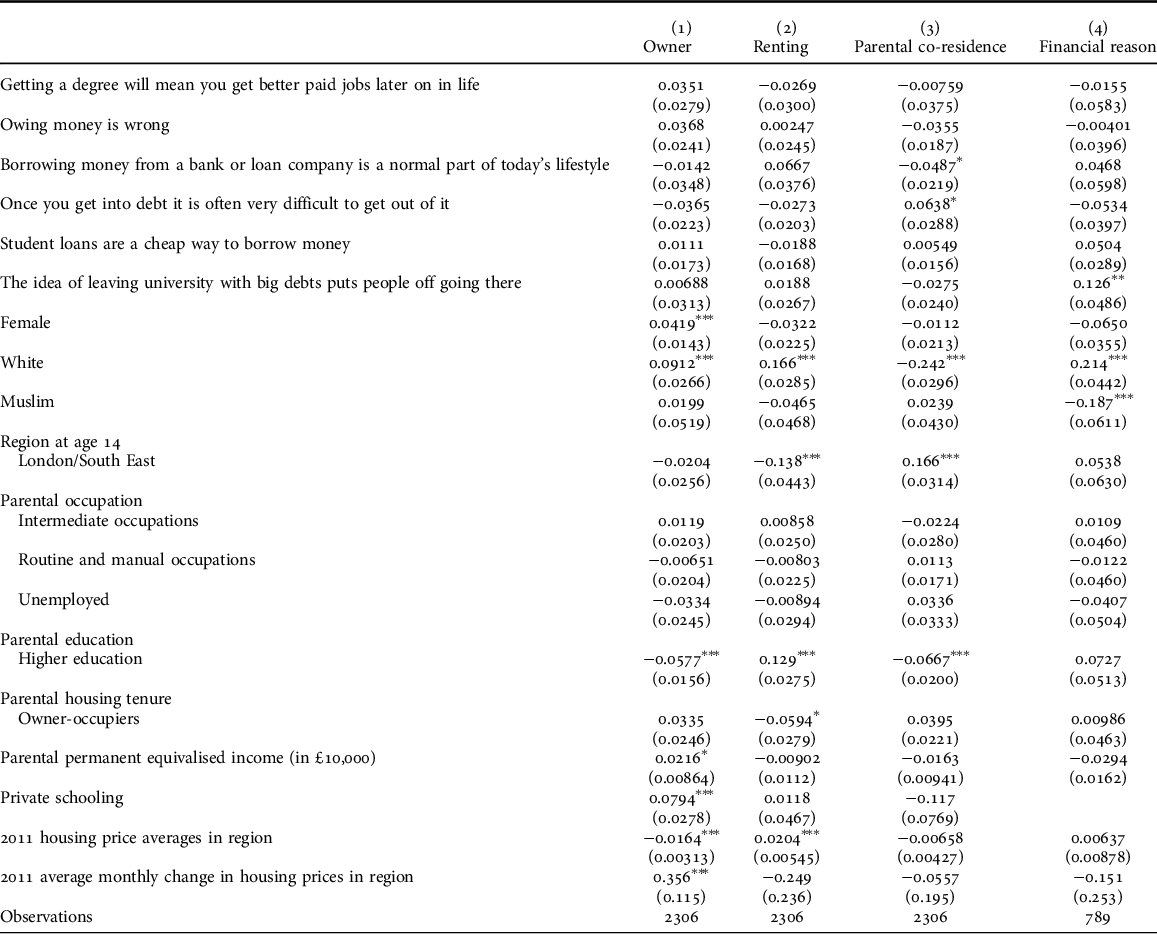
Table 5 provides the estimated marginal effects of the logistic regressions for the binary variables of types of housing (columns 1 to 3) and reason for parental co-residence (column 4) for debt attitudes among graduate borrowers only.
Estimated marginal effects for the association between debt attitude and housing outcomes for graduate borrowers

Note: The outcomes are coded similarly to Table 4.
Standard errors are in parentheses.
* p < 0.05, ** p < 0.01, *** p < 0.005
These results indicate that attitudes toward debt are not related to young people’s homeownership or renting; all marginal effects are small and not statistically significant at conventional levels. Debt attitude, however, matters when it comes to parental co-residence. Graduate borrowers who agree that “borrowing money from a bank or loan company is a normal part of today’s lifestyle” are 4.9 percentages points less likely to live with their parents than those who disagree. By contrast, those who agree that “once you get into debt it is often very difficult to get out of it” are 6.4 percentage points more likely to live with their parents than those who disagree. In addition, for those living with their parents, agreeing that “the idea of leaving university with big debts puts people off going there” is associated with a 12.6 percentage point higher probability of citing financial reasons for parental co-residence compared to disagreeing.Footnote 12
Table 5 also reveals some interesting insights into the relationships between control variables and housing outcomes for graduate borrowers. Compared to all other housing options at age 25, being female increases the probability of owning a house by 4.2 percentage points, whereas there are no gender differences in the probability of renting and parental co-residence. White respondents are more likely than other ethnic groups to own and rent by 9.1 and 16.6 percentage points, respectively. By contrast, White respondents are 24.2 percentage points less likely to live with their parents. Borrowers who grew up in London or the South East are also 13.8 percentage points less likely to rent and 16.6 percentages points more likely to live in their parental home than those in other regions. No differences by religion in housing tenure at age 25 were apparent.
Regarding respondents’ socio-economic background, whereas parental NSSEC does not appear to be related to any outcomes, having a parent with a first degree increases the likelihood of renting by 12.9 percentage points. This is mirrored by decreases in the likelihood of homeownership or parental co-residence, by 5.8 and 6.7 percentage points, respectively. All else being equal, graduate borrowers whose parents were owner-occupiers are 5.9 percentage points less likely to be renters compared to borrowers whose parents were not owner-occupiers, maybe reflecting the transmission of values around housing tenure (Coulter, Reference Coulter2016). Parental income and attending a private school at the age of 13 similarly increase the probability of being an owner-occupier at the age of 25, reinforcing the importance of intergenerational resource transfers (Avery et al., Reference Avery, Goldscheider and Speare1992; Blaauboer, Reference Blaauboer2010).
The state of the housing market in the region of residence the year graduates finished their first degree is also important. Higher average housing prices are related to lower likelihoods of being owner-occupiers and higher probabilities of renting, whereas the average monthly change in housing prices in that year increases the likelihood of owning. The first result may be tied to the ability to buy and the latter to the value of the investment.
Finally, for those who live with their parents, non-White and Muslim individuals have lower chances of doing so for a financial reason. Other controls are not significant, maybe due to smaller cell sizes.
Limitations
Our findings are based on the analysis of one dataset of a single cohort of English respondents limiting their generalizability, especially to countries with different types of student loan systems and to more recent English cohorts graduating with higher debt.
The paper only covers young adults, aged 25, kerbing our understanding of homeownership, when the average age of first-time buyers was 33 years old in England in 2018–19 (MHCLG, 2020). While our research provides useful information on early housing tenure, further research is required with older cohorts to assess longer-term changes.
Our analysis was also constrained by the absence of data on indicators of parental wealth to assess the role of resource transfers, smaller regions to explore variations in housing prices at a local level, and the amount of student loans originally borrowed to explore its effect. All could influence young people’s housing options.
Discussion
Despite these limitations, this study provides new insight into young people’s housing tenure in England and the constraining effects of student loan debt. The burden of debt is particularly visible through the advantageous choices afforded graduate non-borrowers. The probability of being homeowners is 13.1 percentage points higher for graduate non-borrowers compared to graduate borrowers, after controlling for demographics, socio-economic background, and the local housing market. The probability of graduate borrowers owning their home is similar to that of non-graduates, despite enjoying higher salaries and being more likely to have a partner – important factors shaping housing decisions. At the age of 25, student loan debt therefore can be a significant barrier to homeownership partially because of loan repayments resulting in lower take-home pay (which contributes to a reduced capacity both to save for a deposit and repay a mortgage).
A corollary is that graduate non-borrowers are less likely to rent than both graduate borrowers and non-graduates, by 7.4 and 6.4 percentage points respectively. They are also less likely to live with their parents than non-graduates. Moreover, graduate borrowers living at home are more likely to report they cannot afford to live independently compared with graduate non-borrowers and non-graduates by 11.5 percentage points and 10.0 percentage points, respectively. While parental co-residence may provide opportunities for saving towards future homeownership (Roberts et al., Reference Roberts, Noden, West and Lewis2016), our results are further evidence of the financial burden of student loans, with graduate borrowers being pushed into parental co-residence because of their inability to afford rents or a mortgage.
There also may be a psychological toll to student loan debt in relation to parental co-residence. Graduate borrowers who are comfortable with a lifestyle that includes loans are less likely to live with their parents (by 4.9 percentage points), while those believing debt is a financial trap are more likely to do so (by 6.4 percentage points). Similarly, graduate borrowers who think high debts on graduation deter university entry are 12.6 percentage points more likely to live with their parents for financial reasons than for other reasons. These findings tangentially support the idea that borrowers self-select out of some housing choices, including homeownership (Elliott and Lewis, Reference Elliott and Lewis2015), at least in England.
This research highlights the uncharted interaction between two spheres of public policy: housing and HE. Housing policies in England have been criticized for failing to tackle the housing crisis facing young people who cannot afford to buy a home or even rent. Simultaneously, HE funding policies have been criticized for creating unsustainable and growing levels of student loan debt. Our findings provide evidence that, as hypothesized in the literature (McKee and Soaita, Reference McKee and Soaita2018; Stone et al., Reference Stone, Berrington and Falkingham2011), the financial and psychological toll of student loan debt is associated with lower levels of homeownership and higher chances of parental co-residence amongst young people. The housing crisis young people face is not only structured by the housing market, labour market conditions, mortgage finance and the nature of welfare systems but also by HE funding policies.
This shows failings in both HE and housing policies, and how policy thinking remains siloed within government departments. The most recent government-commissioned report on student funding (DfE, 2019), like those before it, ignores the consequences of student loan debt post-graduation and their inter-relationship with other policies arenas. The sole reference found linking housing to loans was in a House of Commons Committee report (HoC, 2011) on the HE funding reforms which declared student “debt will not affect the graduate’s ability to secure a mortgage” (p. 16). Our findings suggest otherwise. Meanwhile, in response to the “housing crisis” in England, numerous policies have attempted to create more affordable housing for young people – both on the supply and demand side – and affordable rents (Gallent, Reference Gallent2019; Hilber and Schöni, Reference Hilber and Schöni2016; Wilson and Bate, Reference Wilson and Bate2015). However, housing policies fail to consider the role played by student debt in graduates’ housing tenure patterns or to tackle it directly. Nearly all HE students in England will graduate with student loan debt, which helps structure their housing options and futures. Policy-makers need to acknowledge this relationship to ensure graduate borrowers can afford to buy and rent homes.
Acknowledgments
This research was supported by the Economic and Social Research Council, the Office for Students and Research England under Grant ES/M010082/1. We are grateful to Nick Gallent for his helpful comments on this paper and to UCL and UK Data Service for providing access to the following dataset: University College London, UCL Institute of Education, Centre for Longitudinal Studies. (2018). Next Steps: Sweeps 1–8, 2004–2016. [data collection]. 14th Edition. UK Data Service. SN: 5545, http://doi.org/10.5255/UKDA-SN-5545-6
Supplementary material
To view supplementary material for this article, please visit https://doi.org/10.1017/S004727942000077X