Introduction
The spotted wing Drosophila, Drosophila suzukii (Matsumura, 1931) (Diptera: Drosophilidae), is a worldwide pest of soft-skinned fruits (Anfora et al., Reference Anfora, Cini and Ioriatti2012; Bellamy et al., Reference Bellamy, Sisterson and Walse2013). The serrated ovipositor of females can penetrate the epicarp of intact or ripening fruits to lay eggs (Mitsui et al., Reference Mitsui, Takahashi and Kimura2006). Once hatched, larvae feed and develop on the fruit causing marked degradation (Rombaut et al., Reference Rombaut, Guilhot, Xuéreb, Benoit, Chapuis, Gibert and Fellous2015; Ioriatti et al., Reference Ioriatti, Guzzon, Anfora, Ghidoni, Mazzoni, Villegas, Dalton and Walton2018). Drosophila suzukii has been reported to infest a vast range of fruit species (Walsh et al., Reference Walsh, Bolda, Goodhue, Dreves, Lee, Bruck, Walton, O'Neal and Zalom2011; Lee et al., Reference Lee, Dreves, Cave, Kawai, Isaacs, Miller, Van Timmeren and Bruck2015), causing remarkable yield losses in many economically important fruit crops (Farnsworth et al., Reference Farnsworth, Hamby, Bolda, Goodhue, Williams and Zalom2017; Mazzi et al., Reference Mazzi, Bravin, Meraner, Finger and Kuske2017).
Drosophila suzukii infestations are mainly controlled by insecticides (Jaffe and Guédot, Reference Jaffe and Guédot2019), raising concerns of risk to human and environmental health. Consequently, biological alternatives have been proposed, such as the use of predators, parasitoids or pathogens (Stacconi et al. Reference Stacconi, Buffington, Daane, Dalton, Grassi, Kaçar, Miller, Miller, Baser, Ioriatti, Walton, Wiman, Wang and Anfora2015, Reference Rossi Stacconi, Grassi, Ioriatti and Anfora2019; Lee et al., Reference Lee, Wang, Daane, Hoelmer, Isaacs, Sial and Walton2019). Recently, great potential has been attributed to the application of the sterile insect technique (SIT) to control D. suzukii infestations (Lanouette et al., Reference Lanouette, Brodeur, Fournier, Martel, Vreysen, Cáceres and Firlej2017; Krüger et al., Reference Krüger, Schlesener, Martins, Wollmann, Deprá and Garcia2018b; Nikolouli et al., Reference Nikolouli, Colinet, Renault, Enriquez, Mouton, Gibert, Sassu, Cáceres, Stauffer, Pereira and Bourtzis2018, Reference Nikolouli, Sassù, Mouton, Stauffer and Bourtzis2020). SIT is an ecologically friendly and safe management tactic that has largely been used to control, suppress and/or eradicate populations of insects (Klassen and Curtis, Reference Klassen, Curtis, Dyck, Hendrichs and Robinson2005; Lees et al., Reference Lees, Gilles, Hendrichs, Vreysen and Bourtzis2015; Enkerlin et al., Reference Enkerlin, Gutiérrez Ruelas, Pantaleon, Soto Litera, Villaseñor Cortés, Zavala López, Orozco Dávila, Montoya Gerardo, Silva Villarreal, Cotoc Roldán, Hernández López, Arenas Castillo, Castellanos Dominguez, Valle Mora, Rendón Arana, Cáceres Barrios, Midgarden, Villatoro, Lira Prera, Zelaya Estradé, Castañeda Aldana, López Culajay, Ramírez y Ramírez, Liedo Fernández, Ortíz Moreno, Reyes Flores and Hendrichs2017). SIT is based on the repeated release of sterile insects in a targeted area. The released sterile males compete with fertile wild males to mate with wild females resulting in the production of non-viable eggs, and thus, the reduction of offspring in the wild population (Knipling, Reference Knipling1955; Dyck et al., Reference Dyck, Hendrichs and Robinson2005). SIT programmes require the establishment of species-specific protocols allowing high efficiency and production of sterile insects without detrimental effects on their biological quality (Cáceres et al., Reference Cáceres, Hendrichs and Vreysen2014; FAO/IAEA/USDA, 2014; Culbert et al., Reference Culbert, Balestrino, Dor, Herranz, Yamada, Wallner and Bouyer2018). Although previous studies showed that D. suzukii can be sterilized with γ radiation without significant negative effects on its biological quality (Lanouette et al., Reference Lanouette, Brodeur, Fournier, Martel, Vreysen, Cáceres and Firlej2017; Krüger et al., Reference Krüger, Schlesener, Martins, Wollmann, Deprá and Garcia2018a, Reference Krüger, Schlesener, Martins, Wollmann, Deprá and Garcia2018b), nothing is currently known about other crucial steps for the development of SIT of this pest.
One of the major steps for the implementation of SIT is the shipment of sterile insects to the release site. Long-transport of sterile insects is common in many ongoing SIT programmes (Kakinohana et al., Reference Kakinohana, Kuba, Kohama, Kinjo, Taniguchi, Nakamori, Tanahara and Sokei1997; Enkerlin and Quinlan, Reference Enkerlin and Quinlan2002). In fruit fly species, the shipment time is usually held under 48 h because the quality of flies drops rapidly beyond 24 h (FAO/IAEA/USDA, 2014; Chung et al., Reference Chung, Rodriguez, Gonzales, Vulcan, JJ, Mitra, CG, Moses-Gonzales, Tam, JW, GM and Hansen2018). Conditions during transport may compromise the quality of insects (Pagabeleguem et al., Reference Pagabeleguem, Seck, Sall, Vreysen, Gimonneau, Fall, Bassene, Sidibé, Rayaissé, Belem and Bouyer2015; Seck et al., Reference Seck, Pagabeleguem, Bassene, Fall, Diouf, Sall, Vreysen, Rayaissé, Takac, Sidibé, Parker, Mutika, Bouyer and Gimonneau2015; Melicher et al., Reference Melicher, Wilson, Bowsher, Peterson, Yocum and Rinehart2019), such as a decrease in emergence or an increase in wing deformities (Cuisance and Itard, Reference Cuisance and Itard1973; Pagabeleguem et al., Reference Pagabeleguem, Seck, Sall, Vreysen, Gimonneau, Fall, Bassene, Sidibé, Rayaissé, Belem and Bouyer2015). Chilling and hypoxia are the two main treatments used to prevent emergence during the transportation in SIT programmes (Andress et al., Reference Andress, Jones, War and Shelly2013; Diallo et al., Reference Diallo, Seck, Rayaissé, Fall, Bassene, Sall, Sanon, Vreysen, Takac, Parker, Gimonneau and Bouyer2019). The consequences of these stressors during shipment are poorly known and were examined in few species (Calkins and Parker, Reference Calkins and Parker2005; Diallo et al., Reference Diallo, Seck, Rayaissé, Fall, Bassene, Sall, Sanon, Vreysen, Takac, Parker, Gimonneau and Bouyer2019). Shipment protocols need to be adjusted to guarantee the quality of shipped D. suzukii.
The objective of this study was to determine the consequences of various pupal shipment conditions on the quality of emerged adults (proportion of emergence, flight ability and survival under starvation stress). Specifically, we tested the effects of hypoxia or normoxia of irradiated or non-irradiated pupae that were subsequently treated or not with chilling. Drosophila suzukii is chill-susceptible, but can easily sustain moderately low temperatures for short periods (e.g. 2 days) (Dalton et al., Reference Dalton, Walton, Shearer, Walsh, Caprile and Isaacs2011; Enriquez and Colinet, Reference Enriquez and Colinet2017; Enriquez et al., Reference Enriquez, Ruel, Charrier and Colinet2018b). Hence, we expected its survival and quality after short simulated transport (maximum 48 h) at moderately low temperature to be unaffected. Exposure of insects to hypoxia (hypoxia correspond to oxygen level below 20.94%, for the majority of terrestrial organisms) or anoxia (absence of oxygen) reduces the stress from the accumulation of reactive oxygen species caused by irradiation (López-Martínez and Hahn, Reference López-Martínez and Hahn2012). For this reason, hypoxia or anoxia was induced prior to and during irradiation for insects sterilization (Calkins and Parker, Reference Calkins and Parker2005). But Drosophila flies are known to be rather tolerant to hypoxia (Haddad et al., Reference Haddad, Sun, Wyman and Xu1997), exposure to hypoxic conditions for periods longer than a few hours can be highly detrimental and even lethal (Zhao and Haddad, Reference Zhao and Haddad2011). Under hypoxia, consumption of protons by oxidative pathways cannot keep up with protons produced by ATP hydrolysis and an unavoidable state of acidosis results (Robergs et al., Reference Robergs, Ghiasvand and Parker2004; Feala et al., Reference Feala, Coquin, McCulloch and Paternostro2007). We expected that contrary to cold, prolonged hypoxia (>24 h) during transport may be highly detrimental and alter the performance of flies, while allowing a developmental delay. Also we predicted that combining hypoxia with chilling may alleviate the detrimental effect of hypoxia (i.e. oxidative stress) by reducing metabolic activity and therefore respiration dependency (Berrigan and Partridge, Reference Berrigan and Partridge1997; Colinet and Renault, Reference Colinet and Renault2018).
Materials and methods
Flies husbandry
All flies used in this study were obtained from a colony established in 2014 at the Insect Pest Control Laboratory (IPCL), Joint FAO/IAEA Division of Nuclear Techniques in Food and Agriculture, Seibersdorf, Austria. Flies were kept in population cages and were provided with water and adult diet containing a mixture of sugar and hydrolysate enzymatic yeast (MP Biomedicals) in a 3:1 ratio (Deutscher et al., Reference Deutscher, Reynolds and Chapman2017). Controlled environment conditions of 22 ± 5°C, 65 ± 5% RH and a 14:10 (L: D) photoperiod were maintained. Petri dishes with artificial wheat bran-based diet (Sassù et al., Reference Sassù, Nikolouli, Caravantes, Taret, Pereira, Vreysen, Stauffer and Cáceres2019a) served as egg-laying substrates and larval diet. The Petri dishes were removed daily and kept in the laboratory to complete larval development and pupation. After 11 days, pupae were separated from diet by flotation in water and kept under the same controlled conditions as the colony.
Atmospheric conditioning and irradiation procedure
For this step, we selected pupae that were dark brown with visible red eyes and wings. At this stage, pupae were about 24 h before emergence under normal rearing conditions. We separated groups of approximately 150 pupae, treated under either standard atmospheric conditions (normoxia) or low oxygen conditions (hypoxia). The pupae of the normoxia group were maintained under normal laboratory conditions before irradiation. The pupae of the hypoxia group were placed in a hermetic polyethylene bag sealed for 5 h at 18°C; in such conditions, the O2 was progressively consumed, achieving severe hypoxic, near anoxic conditions (approximately 0.3% O2; Sassù et al., Reference Sassù, Nikolouli, Pereira, Vreysen, Stauffer and Cáceres2019b). We conducted atmospheric conditioning and irradiation exposure at a dose of 220 Gy based on a previous study (Sassù et al., Reference Sassù, Nikolouli, Pereira, Vreysen, Stauffer and Cáceres2019b). Pupae of the treatment groups were from the same batch and they were treated at the same time.
Shipment simulation
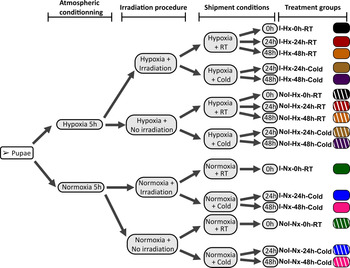
After irradiation, pupae were either held under laboratory conditions (control for temperature and irradiation effects) or placed under various shipment conditions. To simulate transport, pupae from the various treatments (irradiated vs. non-irradiated crossed with hypoxia vs. normoxia) were exposed to moderate cold (chilling) or not. During the whole shipment simulation, pupae were maintained under the same atmospheric conditions than during the irradiation procedure (i.e. normoxia or hypoxia). To induce cold environment, pupae were placed in sealed polystyrene boxes (26 × 21 × 18 cm) filled with ice packs. Flies left at room temperature were placed within the same boxes but without ice packs. Temperature inside experimental boxes was monitored using Ibutton's Thermochron (Maxim Integrated, San Jose, CA, USA). Preliminary experiments using ice packs directly from −20°C freezer killed all pupae due to freezing stress. Hence, in subsequent experiments, we introduced pupae in the boxes after 1 h when the temperature was approximately at 0°C (mild chilling). Under such conditions, the temperature inside the boxes slowly increased with time and remained under 10°C for approximately 20 h (fig. 1). The experiments lasted for either 24 or 48 h. Normoxia and hypoxia conditions were maintained during the whole experimental period. Shipment under normoxia at room temperature could not be assessed after 24 and 48 h because, under these conditions, the majority of flies would have already emerged. The combination of all treatments resulted in an experimental design allowing to test the following effects: (1) hypoxia vs. normoxia, (2) irradiation vs. non-irradiation, (3) cold vs. room temperature and (4) 24 or 48 h duration of shipment. The treatments combinations resulted in 16 different experimental groups that are illustrated in fig. 2.
Temperature recordings inside box used for simulated shipment under low temperature. Low temperature was induced using ice packs placed in the box. Temperature was recorded directly in the box using Thermochron data logger.

Experimental plan. First, pupae were subjected to hypoxia or normoxia for 5 h. After this, they were either irradiated at 220 Gy or non-irradiated. At the end of the irradiation procedure, pupae were maintained under laboratory conditions, or placed under simulated shipment conditions either at cold or room temperature for 24 or 48 h. This experimental design therefore resulted in 16 experimental treatments. I, irradiated; NoI, non-irradiated; Hx, hypoxia; Nx, normoxia; 0 h, no shipment (control pupae maintained under laboratory conditions); 24 or 48 h, shipment simulation for 24 or 48 h; RT, room temperature; Cold, low temperature (see fig. 1).

Emergence time and starvation resistance
At the end of shipment simulation, pupae were taken from each treatment group and isolated in wells of 72-well plastic microplates that were sealed with plastic film. The film on the top of each well was delicately perforated in order to allow air flux, but preventing flies from escaping the wells. Plates were maintained under laboratory conditions. Wells were partially filled with agar-water (1 litre distilled water, 15 g agar and 0.12 g methyl 4-hydroxybenzoate dissolved in 12 ml ethanol) to provide hydration to the flies. Were checked plates 6–7 times (approximately every 4 h) a day to record the emergence of flies. Each time a fly emerged, time to emergence and sex were recorded. With this information, we could monitor the remaining emergence time after the shipment simulation period. After emergence, flies were individually checked 6–7 times a day until death (approximately every 4 h). Since flies had only agar-water in the wells, the time to death corresponded here to survival time under starvation. For each fly, we recorded time to death, and constructed survival curves based on these data.
Flight ability
At the end of the shipment simulations, pupae were tested by groups of 25 individuals for flight capabilities, following the protocol from the IAEA quality control procedures (FAO/IAEA/USDA, 2014). Briefly, we placed pupae into plexiglass cylinders open at the top. The outside diameter of the cylinders was 8.9 cm with 3 mm thick wall, and 10 cm high. Cylinders were painted black so that light entered only from the top. The walls of cylinders were covered with unscented talcum powder in order to prevent flies from climbing the walls. Therefore, emerged flies were forced to fly to exit the cylinders. Then cylinders were placed into a chamber in which temperature and humidity were at laboratory conditions. We used three cylinders containing 25 pupae per treatment conditions (N = 75). Flies were left free to emerge for 48 h after treatment. Flies that flew out of the cylinders were regularly removed from the chamber in order to avoid re-entry into cylinders. At the end of the 48 h, the number of empty pupae, number of pupae that contained dead individuals and number of emerged flies still present in the cylinders were recorded. With these data, we calculated the emergence proportion as follows: number of empty pupae/total number of pupae. Flight proportion was calculated as follows: (number of emerged flies–flies still present into cylinders)/number of emerged flies. We performed a second set of flight tests with another cohort of insects to confirm patterns, but only with flies treated for 48 h.
Statistical analyses
Remaining emergence time, emergence and flight proportions for each treatment group were analysed using one-way ANOVAs followed by Tukey HSD post-hoc comparisons using R version 3.4.3 (R Core Team, 2016). We used time to death under starvation to compute survival curves (the survival curves are available online as Supplementary material, fig. S1) that were compared among treatment groups with Gehan-Breslow-Wilcoxon tests in GraphPad Prism5. The α level of significance was adjusted following a Bonferroni correction (α = 0.0004).
Results
Remaining emergence time
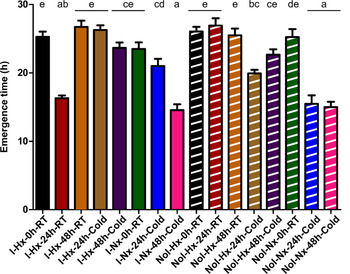
Figure 3 represents the emergence time after the shipment simulations. Remaining emergence time was affected by treatments (F (15,1074) = 25.81, P-value <0.001). Results from post-hoc comparisons are indicated in fig. 3. The longest emergence times were observed under hypoxia conditions (combined or not with cold), and the shortest under normoxia, except for the irradiated group maintained under hypoxia at room temperature for 24 h (I-Hx-24 h-RT) which showed a remaining emergence time of approximately 16 h. Globally, remaining emergence time decreased with the duration of shipment simulation, but this trend was more visible under normoxia than under hypoxia.
Remaining emergence time after shipment simulation. At the end of the different shipment simulations, pupae were isolated and the emergence time of each fly was recorded. Treatment groups sharing the same letter are not significantly different (P-value <0.05; Tukey HSD test); N = approximately 72 flies per group. I, irradiated; NoI, non-irradiated; Hx, hypoxia; Nx, normoxia; 0 h, no shipment (pupae maintained under laboratory conditions); 24 or 48 h, shipment simulation for 24 or 48 h; RT, room temperature; Cold, low temperature. Error bars represent standard errors.

Starvation resistance
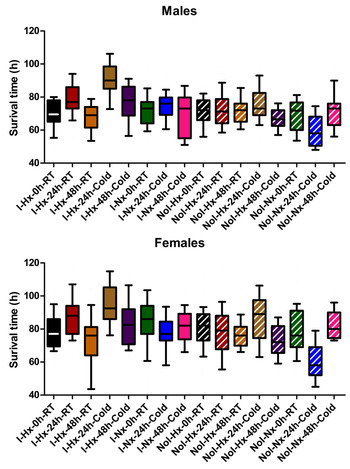
Survival time under starvation for males and females is displayed in fig. 4. Outcomes from the Gehan-Breslow-Wilcoxon tests are available on tables 1 and 2. There were some differences observed but no clear pattern resulted from these assays, and differences were not consistent between males and females. However, in both males and females, irradiated flies maintained under hypoxia combined with cold for 24 h (i.e. I-Hx-24 h-Cold) survived for longer, and non-irradiated flies maintained under normoxia plus cold for 24 h (i.e. NoI-Nx-24 h-Cold) survived for shorter than all other treatments (fig. 4, tables 1 and 2).
Median survival times under starvation conditions for both males (top) and females (bottom) after shipment simulation. At the end of the different shipment simulations, pupae were isolated and placed on an agar-water medium in order to monitor time to death under starvation. Survival data were analysed using survival analyses (Gehan-Breslow-Wilcoxon tests, see table 1 for statistics). Data from males and females were analysed separately. N = approximately 72 flies per treatment groups. I, irradiated; NoI, non-irradiated; Hx, hypoxia; Nx, normoxia; 0 h, no shipment (pupae maintained under laboratory conditions); 24 or 48 h, shipment simulation for 24 or 48 h; RT, room temperature; Cold, low temperature. Error bars represent 10 and 90 percentiles.

Comparisons of survival curves for starvation resistance between the different treatment groups for males

Survival curves are available in fig. 4. P-values have been adjusted using Bonferroni correction: α = 0.0004. *Significant differences; I, irradiated; No, non-irradiated; H, hypoxia; N, normoxia; 0 h, no shipment (pupae maintained under laboratory conditions); 24 or 48 h, shipment simulation for 24 or 48 h; RT, room temperature; Cold, cold temperatures.
Comparisons of survival curves for starvation resistance between the different treatment groups for females

Survival curves are available in fig. 4. P-values have been adjusted using Bonferroni correction: α = 0.0004. *Significant differences; I, irradiated; No, non-irradiated; H, hypoxia; N, normoxia; 0 h, no shipment (pupae maintained under laboratory conditions); 24 or 48 h, shipment simulation for 24 or 48 h; RT, room temperature; Cold, cold temperatures.
Emergence and flight ability
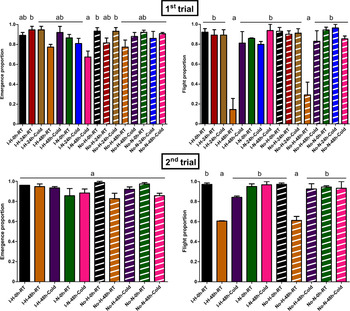
Figure 5 shows the emergence and flight proportions for the first and second trials. In the second, only treatments lasting for 48 h were tested. Proportions of emergence were generally high in all cases (>80%), yet there was an effect of treatments (first trial: F (15,29) = 2.76, P-value <0.01; second trial: F (9,20) = 2.58, P-value <0.05). In the first trial, post-hoc comparisons revealed only a small difference between the condition I-Nx-48 h-Cold and three other conditions (see letters a vs. b in fig. 5). In the second trial, post-hoc comparisons showed no difference in emergence (all >80%).
Emergence (left) and flight (right) proportions after shipment simulation for the first and second trials (the second only assessed durations of 48 h). At the end of the different treatments, pupae were placed into unplugged cylinders and left free to emerge and fly off the cylinders (see Materials and methods). Emergence proportion: number of empty pupae/total number of pupae; Flight proportion: (number of emerged flies–flies still present into cylinders)/number of emerged flies. Treatment groups sharing the same letter are not significantly different (P-value <0.05; Tukey HSD test); N = approximately 75 flies per group. I, irradiated; NoI, non-irradiated; Hx, hypoxia; Nx, normoxia; 0 h, no shipment (pupae maintained under laboratory conditions); 24 or 48 h, shipment simulation for 24 or 48 h; RT, room temperature; Cold, low temperature. Error bars represent standard errors.

Proportions of flight differed markedly among conditions and ranged from 20 to 90% (fig. 5). Proportions of flight were significantly impacted by treatments in the first trial (F (15,29) = 8.41, P-value <0.001). Post-hoc comparisons indicated that flies (irradiated or not) maintained under hypoxia at room temperature for 48 h (i.e. I-Hx-48 h-RT or NoI-Hx-48 h-RT) showed lower flight proportions than in the other treatments, with values around 20–30%. However, when hypoxia was combined with cold (i.e. I-Hx-48 h-cold or NoI-Hx-48 h-cold), flight proportions were higher than 90%. These significant patterns were found again in the second trial (F (9,20) = 26.34, P-value <0.001), supporting that these differences were not random but indeed due to treatments.
Discussion
Irradiation can potentially cause somatic damages to organisms due to oxidative stress (Calkins and Parker, Reference Calkins and Parker2005; López-Martínez and Hahn, Reference López-Martínez and Hahn2012; FAO/IAEA/USDA, 2014). Despite this, we observed that radiation dose applied here did not deeply affect D. suzukii quality (emergence time, emergence and flight proportions or starvation resistance). Similarly, Diallo et al. (Reference Diallo, Seck, Rayaissé, Fall, Bassene, Sall, Sanon, Vreysen, Takac, Parker, Gimonneau and Bouyer2019) observed that irradiated Glossina p. gambiensis showed no decrease in emergence or in flight ability. Also, Collins et al. (Reference Collins, Weldon, Banos and Taylor2008) observed similar results on the fruit fly Bactrocera tryoni.
When insects are transported as pupae, conditions during shipment must prevent emergence. To do so, shipment of irradiated insects is often done at low temperatures, under hypoxia or a combination of both (Benelli et al., Reference Benelli, Ponton and Taylor2019; Diallo et al., Reference Diallo, Seck, Rayaissé, Fall, Bassene, Sall, Sanon, Vreysen, Takac, Parker, Gimonneau and Bouyer2019). Here, we measured the remaining emergence time after the shipment treatments. Under laboratory conditions (e.g. no shipment), pupae emerged approximately 24 h after irradiation. Under hypoxic conditions, almost all treatments resulted in an emergence time of ~24 h after shipment, except for pupae of I-Hx-24 h-RT treatment that emerged in <20 h. However, for the same conditions maintained for 48 h, emergence time was equal to approximately 24 h. We suspect that these differences resulted from random variations, and probably due to slight differences in the age of pupae at the start of the shipment simulation, or to the data record pattern, as flies were checked for emergence and death approximately every 4 h. Hence, we confirm here that hypoxia conditions efficiently reduce the rate of development and thus delay emergence during shipment, even if the transport lasted up to 48 h. Hypoxia is known to prevent insect development (Frazier et al., Reference Frazier, Woods and Harrison2001; Hoback and Stanley, Reference Hoback and Stanley2001). By contrast, when pupae were maintained under chilling only, the emergence time was <20 h after 24 h of shipment and <15 h after 48 h of shipment (in irradiated or non-irradiated flies). From these results, we reason that when applied alone, chilling is not able to delay the emergence of D. suzukii during shipment. The lower developmental threshold of D. suzukii is estimated to be around 7.2°C (Tochen et al., Reference Tochen, Dalton, Wiman, Hamm, Shearer and Walton2014), and during the experiment, this threshold was quickly reached allowing pupal development to proceed. Similarly, Enriquez et al. (Reference Enriquez, Renault, Charrier and Colinet2018a) observed that pupae develop slowly when stored at 10°C.
Shipment conditions must guarantee insect quality in order to maximize the ability to compete with wild individuals once released. However, D. suzukii is a chill-susceptible insect (Dalton et al., Reference Dalton, Walton, Shearer, Walsh, Caprile and Isaacs2011), and pupae suffer more from chilling than adults (Enriquez and Colinet, Reference Enriquez and Colinet2017). In the present study, neither chilling nor hypoxia greatly altered flies emergence. Several other studies showed no adverse effects of chilling during transport for insects (Birkenmeyer and Dame, Reference Birkenmeyer and Dame1975; Mutika et al., Reference Mutika, Opiyo and Robinson2002, Reference Mutika, Kabore, Parker and Vreysen2014; Blomefield et al., Reference Blomefield, Carpenter and Vreysen2011), but other studies reported detrimental effects. The level of chilling injuries depends on the basal level of cold tolerance of every tested species and on the intensity and duration of cold exposures (Rezende et al., Reference Rezende, Castañeda and Santos2014). Enriquez and Colinet (Reference Enriquez and Colinet2017) showed that D. suzukii can tolerate temperatures superior to 7.5°C for extended periods (1 month) without any detrimental effect on survival. Therefore, it is not surprising that we found that cold exposure length and intensity (max 48 h at temperatures mostly above 10°C) did not alter D. suzukii pupae quality.
We hypothesized that, as chilling and hypoxia are known stressors, they would affect D. suzukii quality. Although hypoxia did not alter the proportion of emergence, it decreased the flight ability of D. suzukii when applied for 48 h. However, this deleterious effect was counteracted when hypoxia was combined with chilling. Hypoxia induces oxidative stress (Hermes-Lima and Zenteno-Savín, Reference Hermes-Lima and Zenteno-Savín2002; Guzy et al., Reference Guzy, Hoyos, Robin, Chen, Liu, Mansfield, Simon, Hammerling and Schumacker2005), and the resulting damage may have altered the flight ability of D. suzukii. In fact, flight is one of the most energetically demanding forms of locomotion and oxidative stress is known to reduce muscle force production (Powers and Jackson, Reference Powers and Jackson2008). In bees, the flight capacity decreases with age; an effect due to oxidative damage in flight muscle (Vance et al., Reference Vance, Williams, Elekonich and Roberts2009). Hence, hypoxia-induced oxidative stress may partly explain the reduced flight ability of D. suzukii. We suggest that low temperature reduces the metabolic rate of insects (Terblanche et al., Reference Terblanche, Klok and Chown2005; Boardman et al., Reference Boardman, Sørensen, Koštál, Šimek and Terblanche2016). Low temperature could result in a lower rate of accumulation of oxidative damage during hypoxia, and thus help to maintain flight ability. Frazier et al. (Reference Frazier, Woods and Harrison2001) explored the interactive effects of temperature and oxygen on D. melanogaster development and life history traits. They reported that in general, the effects of hypoxia are dramatic at high temperature (altering survival, mass or growth rate), and by contrast, the low temperature prevented these detrimental effects.
We found that hypoxia prevented emergence during a simulated shipment of 24 or 48 h when applied in irradiated and non-irradiated pupae of D. suzukii. However, prolonged hypoxia decreased the quality of the emerged adults and decrease their flight ability. Yet, when hypoxia was combined with chilling, the quality of the flies was maintained. Therefore, we can conclude that hypoxia when combined with cold temperature is a suitable condition for the shipment of irradiated D. suzukii pupae. We suggest avoiding transportation longer than 24 h to prevent the detrimental impact on the quality of D. suzukii flies caused by prolonged hypoxia. Our results represent a step towards the implementation of an SIT programme to control populations of D. suzukii. We focused on atmospheric conditions and temperature. However, additional potential stressors may occur during shipment in real conditions, such as compaction, altitude, atmospheric pressure and vibrations that may impact the quality of the shipped insects. Future studies should assess these factors and real shipment experiments should also be carried out.
Supplementary material
The supplementary material for this article can be found at https://doi.org/10.1017/S0007485321000146
Acknowledgments
We are grateful to Silvana Caravantes for assistance on colony maintenance and laboratory assays. We are also grateful to the anonymous reviewers for their insightful comments and suggestions that helped improve the scientific quality of the submitted manuscript.
Financial support
This study was supported by SUZUKILL project (The French National Research Agency): ANR-20-CE02-0011-01 and Austrian Science Fund (FWF): I 2604-B25.
Conflict of interest
None.
Ethical standards
This article does not contain any studies with human participants or animals performed by any of the authors.