INTRODUCTION
Prior to the discoveries of ancient texts and artifacts in Inner Asia at the beginning of the 20th century, a common view from central China was that the people in Inner Asia were “without history” (Harmatta Reference Harmatta1994). Their past had been lost, was imagined in fantastic ways, or appeared indistinctly in the twilight at the peripheries of great historical traditions. However, at the beginning of the 20th century, with the exploration of Inner Asia, quantities of texts and artifacts began to be discovered, and their study shed light on the civilizations and cultures of the region. Among these discoveries, documents and artifacts from the ancient city of Loulan are especially significant among the historical sources on early Inner Asia (Harmatta Reference Harmatta1994; Hare Reference Hare1999). The excavated artifacts include Wuzhu and Kharosthi coins, beautiful silk fabrics, glassware, weapons, iron and bronze tools, bronze mirrors, ornaments, and woodcarvings of Gandhara (Wang Reference Wang2014). They are some of the earliest textual corpora of their kind from this region, some of which reveal in rich detail the nature of everyday life (Harmatta Reference Harmatta1994). As a result, their discovery has been more closely contextualized within the archaeological interpretation of their provenance than most other corpora (Harmatta Reference Harmatta1994; Higham Reference Higham2014; Wang Reference Wang2014). Scholarship on the Loulan culture is now over a century old, and the texts have long been translated and interpreted in a wide range of textual and linguistic studies. However, due to lack of systematic chronological control, there remains considerable debate regarding the history of the ancient city of Loulan, its association with Loulan Kingdom, and the causes of its disappearance.
Until now, little systematic radiocarbon (14C) dating work has been carried out for ancient Loulan city (Lü et al. Reference Lü, Xia, Liu, Qin, Wang, Yidilisi, Zhou, Mu, Jiao and Li2010). This is because most of the excavations were carried out before 1980, and investigation of the area is very difficult due to the lack of roads and fresh water (Xiao Reference Xiao2006; Qin et al. Reference Qin, Liu, Jia, Lu, Xia, Zhou, Mu, Xu and Jiao2011). Present knowledge of the city mainly comes from excavated documents (letters) and historical records. The ages of excavated documents and letters range from the Wei to Jin Dynasties of China (Xiao Reference Xiao2006; Wang Reference Wang2014). The oldest document was written in the 4th year of the reign of Jiaping of the Wei Dynasty (252 AD), whereas the latest was in the 18th year of the reign of Jianxing of the Pre-Liang Dynasty (330 AD). These ages are much younger than the results of previous 14C dating, which suggest that the age of the city ranged from ca. 100 to 230 AD (Lü et al. Reference Lü, Xia, Liu, Qin, Wang, Yidilisi, Zhou, Mu, Jiao and Li2010). Most importantly, all of these ages are much younger than the historical records of both Shiji (“The Records of the Historian”) (Sima Reference Sima1959) and Houhanshu [“The History of Han Dynasty (202 BC–220 AD)”], which indicated that ancient Loulan city was established at least before 127 BC.
Here, we present the results of the first comprehensive 14C dating of the artifacts from ancient Loulan city. These data provide a chronological framework for the ancient Loulan city, including estimates of the ages of its construction, expansion, and abandonment. In addition, we use this chronology to discuss possible causes of its abandonment.
SAMPLES AND METHODS
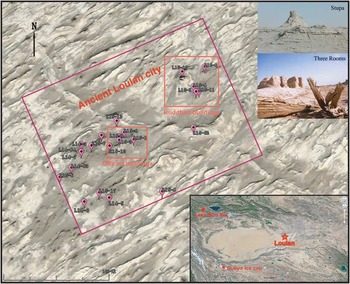
The ancient city of Loulan (40°30ʹ58.34ʺN, 89°55ʹ3.97ʺE) is located on the western shore of lake Lop Nor in Ruoqiang County in Xinjiang, China. It is situated in the eastern corner of the Tarim Basin (Figure 1), the largest sedimentary basin to the north of the Tibetan Plateau. The Tarim Basin is bounded by the Tianshan Mountains to the north, by the Pamir Plateau to the west, and by the Kunlun and Altyn Taq mountain ranges to the south. Thus, three sides consist of high mountain peaks permanently covered with snow and ice, with few passes by which they may be crossed. This region has been the core of the arid area of Eurasia from at least the beginning of the Quaternary (Zhu et al. 1981). Snowmelt from the Kunlun, Tianshan, and Pamir mountain ranges flows from different directions towards the desert, forming short inland streams. For example, more than 45 rivers originating from the Kunlun Mountains discharge into the Tarim Basin. These rivers give rise to a number of oases, but they are all relatively small. Since antiquity, the oases supported many ancient kingdoms along the ancient Silk Road, one of which was Loulan.
Location of Loulan city and 14C samples from the ancient city (samples L15-3 and L15-10 were collected from Three Rooms and the stupa, respectively).

The ruins of Loulan city were discovered and registered as LA by Sven Hedin, who excavated several houses and found a wooden Kharosthi tablet and many Chinese manuscripts, which revealed that the area was called Krorän by the local people in Kharosthi script, but was rendered as Loulan in Chinese (Hedin Reference Hedin1898). Aurel Stein made further excavations in 1906 and 1914 around the ancient lake of Lop Nur. Stein recovered many artifacts, including various documents, a wool-pile carpet fragment, yellow silks, and Gandharan architectural wood carvings. In 1979 and 1980, three archaeological expeditions sponsored by the Xinjiang Branch of the Chinese Academy of Social Sciences conducted excavations in Loulan (Ma Reference Ma1995). They discovered a canal (4.6 m deep and 17 m wide) running from northwest to southeast through Loulan city, a 32-foot (9.8 m) high earthen dome-shaped Buddhist stupa, and a house with a length of 41 feet (12 m) and width of 28 feet (8.5 m), apparently for a Chinese official. They also collected 797 objects from the area, including wooden vessels, bronze objects, jewelry and coins, and Mesolithic stone tools (Di Cosmo Reference Di Cosmo2002).
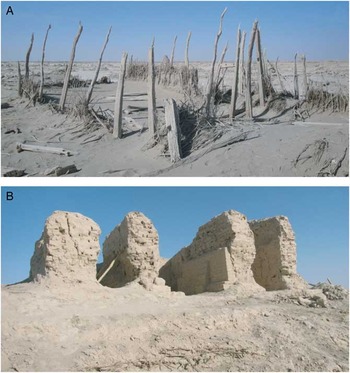
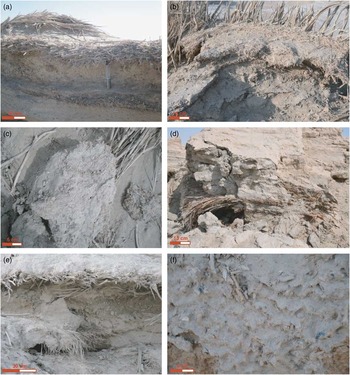
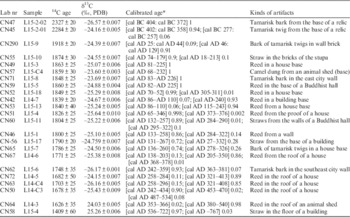
There are many building relics in the abandoned Loulan city, including Buddhist buildings, city walls, houses, and animal sheds. The dimensions and structures of most of the buildings could be determined. Two different architectural styles are evident in the buildings. One is constructed with wooden pillar supports and adobe walls (Han architecture style), and in the other the walls consist of a framework of tamarisk branches with the exterior daubed with mud (a regional architecture style) (Figure 2). Buildings in the former style are located in the center of the city, on the western bank of the river, and are assumed to have been the houses of officials of the Han Dynasty (Figure 1). The Buddhist buildings of the regional architectural style, including a stupa and hall, are located in the northeastern part of the city, on the eastern bank of the river (Figure 1). The city walls were constructed of compressed earth interleaved with layers of tamarisk branches to provide resistance to strong winds that prevail in the region. Samples for 14C dating were collected from these abandoned buildings and middens in the city (Table 1). A total of 23 samples were collected, including reeds from both the floor and foundations of the buildings, the bark of tamarisk twigs from the intercalated tamarisk layers within city walls, camel dung from the animal sheds, artifacts from middens, and straw from mud walls and in bricks (Figure 3), all of which could provide reliable 14C ages.
The two typical architectural styles in ancient Loulan city: (A) regional, and (B) Han.

The main types of artifact in Loulan city: (a) collapsed reed roof and underlying reed layer; (b) tamarisk wall; (c) wall consisting of mud daubed on a framework of tamarisk; (d) layer of tamarisk branches and reed in the building base; (e) tamarisk twigs in the building roof; (f) midden.

14C dates and calibrated ages of various organic materials from ancient Loulan city.

*14C ages were calibrated by Calib 7.1 (Stuiver et al. Reference Stuiver, Reimer and Reimer2017).
The samples were initially washed with tap water to remove the soil and extraneous contamination and then with deionized water. Then, they were successively treated with 1% HCI for 1 hr to remove carbonates and 1% NaOH for 1 hr, and then with a hot solution of 0.5% HCl for 0.5 hr, all at 80°C, in order to remove humic acids. After rinsing with deionized water, they were dried in an oven at 105°C overnight. The dried samples were combusted with CuO to produce CO2 at 850°C for 3 hr under vacuum conditions (better than 10–4 pa). The CO2 was then reduced to graphite with Zn and Fe as catalyst at 525°C for 6 hr (Getachew et al. Reference Getachew, Kim, Burri, Kelly, Haac, Ognibene, Buchholz, Vogel, Modrow and Clifford2006). The pretreatment and graphite synthesis were conducted in the Cosmogenic Nuclide Chronology Lab of the Institute of Geology and Geophysics, Chinese Academy of Science. AMS 14C measurements were made in the Key Laboratory of Heavy Ion Physics, Peking University (0.6 MV PCAMS). The stable carbon isotopic composition was measured using a stable-isotope mass spectrometer (MAT 253) with an uncertainty better than 0.1‰. All 14C dates were calibrated using the calibration program Calib 7.1 (Stuiver et al. Reference Stuiver, Reimer and Reimer2017).
RESULTS
The results of the AMS 14C dating, together with the calibrated ages, are listed in Table 1. The ages range from around the 4th century cal BC to the 6th century cal AD (Table 1), indicating a much longer history of Loulan city than that was inferred from the preliminary chronological study (100–230 AD) (Lü et al. Reference Lü, Xia, Liu, Qin, Wang, Yidilisi, Zhou, Mu, Jiao and Li2010). The earliest ages are from the tamarisk bark and twigs collected from the base of a relic, the structure of which could not be identified. Although it is possible that these samples may have consisted of old wood that was used to construct the foundations, their ages should not be much older than the time of construction. As observed in all of the ruined cities discovered in the Lop Nor region, including Loulan city, the tamarisks were living before they were felled for use as construction materials. This characteristic is consistent with the traditions of modern people who prefer to use living rather than dead wood as construction material because of its greater strength. Most importantly, both our own work, as well as previous studies (Lü et al. Reference Lü, Xia, Liu, Qin, Wang, Yidilisi, Zhou, Mu, Jiao and Li2010; Jiao Reference Jiao2014), have consistently shown little difference between the 14C ages of tamarisks and the anticipated reliable dating materials such as reeds and straw.
The earliest ages are 404–372 and 402–358 cal BC, indicating that human activity occurred at the site before the 3rd century BC. There is an apparent hiatus in the 14C ages during the interval from 350 cal BC and 25 cal AD (Table 1). This may be related to the crude structure of the buildings before 25 cal AD and the occurrence of strong wind erosion. It is estimated that a thickness of 5 m has been eroded from exposed areas (Xia et al. Reference Xia, Wang and Zhao2007; Qin et al. Reference Qin, Liu, Jia, Lu, Xia, Zhou, Mu, Xu and Jiao2011). A high degree of wind erosion may have destroyed most of the early relics. In addition, the dimensions of the early city may have been very small (perhaps only a small village), and thus few early relics have been preserved.
The 14C ages of the samples from the base of the ruined buildings consistently suggest that the periods of construction of most of the buildings correspond to the Eastern Han Dynasty rather than the Wei and Jin dynasties (220–420 AD), as was suggested by the excavated documents and letters. Almost all of the ages of the samples from the foundations of the buildings, such as the Buddhist stupa (with a regional style), Three Rooms, and the surrounding houses (Han style), fall within the period of the Eastern Han Dynasty (Table 1). The ages of the city walls also indicate that the city was constructed during the Eastern Han Dynasty (25–220 AD). The 14C ages of the samples from the eastern and southeastern walls are 83–226 cal AD and 242–381 cal AD, suggesting that the city walls were constructed at least before 226 AD and were later repaired. Furthermore, there are no significant differences in 14C ages between the buildings with different architectural styles (Table 1), indicating that they were constructed either at the same time or within a relatively narrow time interval. Thus, the evidence consistently indicates that most of the buildings of ancient Loulan city were constructed exclusively during the Eastern Han Dynasty and almost at the same time.
The 14C ages of the samples from both the roofs and floors of the ruined buildings, including the animal sheds, are younger than those from those collected from the building foundations (Table 1). The ages of the roofs and floors range from 138 to 540 cal AD (corresponding to the Eastern Han to the Jin Dynasty) (Table 1), which is consistent with the ages of the documents excavated from Loulan city (252–330 AD).
DISCUSSION
There are several areas of uncertainty regarding the ancient city of Loulan and the Loulan Kingdom, which became the Shanshan Kingdom after 76 BC, based on the registers of Shiji (Sima Reference Sima1959). The major areas of uncertainty are as follows: (1) the date when ancient Loulan city was constructed, and its relationship with the Loulan and Shanshan Kingdoms; (2) the date when the city was abandoned; and (3) cause of the abandonment.
The first question is a central issue for understanding the history of Loulan and Shanshan Kingdom, because different interpretations of the nature of Loulan city would lead to a very different understanding of the history of Loulan and Shanshan Kingdom (Xiao Reference Xiao2006; Meng Reference Meng2014). Unfortunately, there is great deal of debate regarding the history of the Loulan city and thus its nature. According to the Xiongnu bibliography of Chanyu Shiji, Xiongnu sent a letter to Emperor Wen of the Western Han Dynasty in 176 BC, which stated: “the Kingdoms of Loulan, Wusun Hujie, and near twenty-four countries have surrendered to Xiongnu” (Sima Reference Sima1959). This is the earliest record of Loulan Kingdom. In 126 BC, Zhang Qian, the first official diplomat who brought back reliable information about Central Asia to the Chinese imperial court, informed Emperor Wu of the Western Han that the kingdoms of Loulan and Gushi had city walls and were adjacent to a salt lake (Sima Reference Sima1959). In 77 BC, the kingdom was renamed Shanshan following the assassination of its king by an envoy of the Han Dynasty. These records suggest that Loulan city had been established before 176 BC. However, the ages of the documents and letters excavated from Loulan city correspond to the Wei and Jin Dynasty, though the words Kroraina and Loulan are mentioned therein. The earliest document was written in 252 AD (Xiao Reference Xiao2006), but no documents of the Han Dynasty (202 BC–220 AD) have been found. Furthermore, some documents, such as the so-called Li Bo manuscript discovered by Tachibana in the region of Loulan in 1909 (Xiao Reference Xiao2006), comprise a collection of fragments of draft letters written by the Chief Administrator of the Western Dominions during the Former Liang period (320–376 AD).
This evidence, together with the historical record, leads to two contrasting interpretations of the nature of Loulan city and thus of the history of Loulan and Shanshan Kingdom. One interpretation considers that Loulan city was established at least before 176 BC and was the capital of the Loulan Kingdom (Huang Reference Huang1996; Hou Reference Hou2002; Xiao Reference Xiao2006; Huang Reference Huang2014). The other considers that Loulan city was not the capital of the Loulan Kingdom (Stein Reference Stein1921; Lin Reference Lin1995; Meng Reference Meng2014), but was the official site of the Administrator of the Western Dominion, which was constructed much later than the capital of Loulan Kingdom (Meng Reference Meng2014).
Our results provide critical chronological evidence for resolving these issues. Based on our 14C dates, the history of the artifacts in Loulan city can be traced to as early as around 400 cal BC (Table 1), which is consistent with historical records (Ban Reference Ban1930; Sima Reference Sima1959). The few relics found of this age may be the result of strong wind erosion, the small dimensions of the old city, the weak structure of the buildings, and the destruction of building by later human activity. In addition, the geographical location of Loulan city is consistent with the descriptions in the historical record (Huang Reference Huang2014). Most importantly, the available chronological work demonstrates that the ages of the ruined cities in Lop Nor, such as LE and Milan, which have been suggested as the capital city of Loulan or Shanshan, are younger than that of Loulan city (Lü et al. Reference Lü, Xia, Liu, Qin, Wang, Yidilisi, Zhou, Mu, Jiao and Li2010; Jiao Reference Jiao2014). This evidence indicates that the ancient Loulan city might have been the original capital of Loulan Kingdom (Huang Reference Huang1996, Reference Huang2014). However, the few artifacts of the Western Han Dynasty in Loulan city, together with the limited chronological control available for the other cities, indicate that much more work is needed to demonstrate conclusively that this ancient city was the capital of Loulan Kingdom.
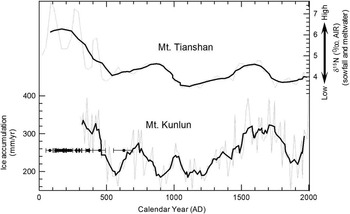
Our data provide a relatively clear picture of the chronology of Loulan city. Most of the ages of the samples from the city concentrated in the range from 25 to 400 cal AD (Figure 4), indicating that Loulan city flourished during this interval. In addition, our data reveal that in the case of the oldest ages there are no significant differences between the Buddhist buildings, official buildings, and city walls, and that they were all constructed within an interval of the Eastern Han Dynasty (Table 1). This evidence suggests that the ruined Loulan city was constructed around the first century AD (Table 1).
Correlation of the development of Loulan city, as indicated by the 14C ages of the artifacts (solid circles are the calibrated ages of median probability; the length of error bar represents the range of calibrated age), with ice accumulation in Kunlun Mountains (Yao et al. 1996) and meltwater supply in Tianshan Mountains (Lauterbach et al. Reference Lauterbach, Witt, Plessen, Dulski, Prasad, Mingram, Gleixner, Hettler-Riedel, Stebich and Schnetger2014).

The age of construction of the ruined Loulan city corresponds to the period when the Eastern Han Dynasty recovered the function of the Administrator of the Western Dominions. According to the record of Houhanshu (Fan and Sima Reference Fan and Sima1996), Ban Yong was appointed to be the Administrator of the Western Dominions, he was garrisoned in Liuzhong in 123 AD, and that he went to Loulan the following year. Houhanshu also records the fact that Ban Yong recognized the great political and military function of Loulan city in administrating the western region, and thus he strongly advised that garrison should be established in Loulan before he was appointed as the administer of the Western Dominion (Fan and Sima Reference Fan and Sima1996). Therefore, it is possible that Ban had established a garrison in Loulan city, as he had advised, in the course of his administration of the western region, although the official administrator’s mansion might not have been moved to Loulan.
In terms of the age of the abandonment of Loulan city, most of the 14C ages of the samples from the roofs and floors of the ruined buildings are consistent with the youngest age of the documents discovered (330 AD) (Table 1). Only two samples, which were collected from the roof of an animal shed (353–540 cal AD) and floor of a ruined building (480–767 cal AD), have younger ages. The distribution of 14C ages for Loulan city suggests that it began to decline after around 400 AD, and was completely abandoned by around 620 AD (Figure 4).
The reasons for the abandonment have generated much debate within the archeological community. Various factors including war, plague, immoderate human activity, and climate change have been proposed as the causes. Although several scholars (Yuan and Zhao Reference Yuan and Zhao1999; Wang Reference Wang2010) have suggested that climate changes, especially aridification and resulting freshwater shortages, were the major factors for the abandonment of the city, the evidence and arguments are not well constrained due to the limitations of chronological control of the history of Loulan city. Our 14C dates, together with high-resolution paleoclimatic records with independent dating of the timing, amplitude, and duration of past climate events, make it possible to place the development and abandonment of Loulan city within a climatic context.
Among various climatic records in Central Asia, the ice accumulation in the Guliaya ice core (GIC) (Yao et al. Reference Yao, Thompson, Qin and Tian1996) is of special significance because it is located in the water source areas of Lop Nor and is a record of precipitation changes in arid Central Asia (Yang et al. Reference Yang, Wang, Bräuning, Dong and Esper2009). Ice accumulation in the Guliya ice core demonstrates a good correlation with the meteorological records, historical record, archeological data, and various proxy data including tree rings, ice cores, lake sediments, and glacier fluctuations from Central Asia on both short and long timescales. On a short timescale, the GIC exhibits a close correlation with instrumental precipitation data from the Xinjiang region of China and bordering areas to the west (Yang et al. Reference Yang, Wang, Bräuning, Dong and Esper2009). On the long timescale, available Chinese historical documents suggest that river flow on the southern fringe of the Tarim Basin increased during 1–300, 650–800, and 1450–1850 AD (Liu Reference Liu1976). In agreement with changes in the GIC during the past 2000 yr, climatic records from Lakes Bosten and Aibi in the western arid zone of northwest China (Wünnemann et al. Reference Wünnemann, Chen, Riedel, Zhang, Mischke, Chen, Demske and Ming2003; Wu et al. Reference Wu, Liu and Wang2004; Chen et al. Reference Chen, Huang, Zhang, Holmes and Chen2006), together with records of lake level changes in the Tianshan Mountains (Issyk-Kul Lake, Balkhash Lake, Chatyr-Kel Lake, and Bosten Lake) and the northern Xinjiang region (Aibi Lake) (Yang et al. Reference Yang, Wang, Bräuning, Dong and Esper2009), consistently indicate that the climate was humid from 0 to 300 AD and experienced the most arid interval from 500 to 1500 AD.
Because of the low precipitations and high evaporation in the studied region, the main source of the water in the oases of the Tarim Basin is meltwater from mountains. Therefore, changes in the snow/ice accumulation and resulting meltwater supply would be expected to have played a major role in the development and evolution of the oases in the Tarim Basin and the associated settlement. This postulation gets a robust test by the consistence of the timing of development and abandonment of Loulan city with changes of GIC in the southern Kulun Mountains (Yao et al. Reference Yao, Thompson, Qin and Tian1996) and winter snowfall and meltwater supply in the northern Tianshan (Lauterbach et al. Reference Lauterbach, Witt, Plessen, Dulski, Prasad, Mingram, Gleixner, Hettler-Riedel, Stebich and Schnetger2014) (Figure 4). Most of the 14C ages of the artifacts in Loulan city fall within the range from 25 to 390 cal AD, coinciding with the interval of high ice accumulation (Yao et al. Reference Yao, Thompson, Qin and Tian1996) and with high winter snowfall and meltwater supply (Lauterbach et al. Reference Lauterbach, Witt, Plessen, Dulski, Prasad, Mingram, Gleixner, Hettler-Riedel, Stebich and Schnetger2014) (Figure 4). The wet interval from the 1st to 4th century AD is also detected in the compilation of 14C ages of various paleoenvironmental records, and historical and archeological data from arid northwest China across the Tarim Basin, the Junggar Basin, the Tianshan, and the Alaxa Plateau (Yang et al. Reference Yang, Braeuning, Johnson and Yafeng2002a, Reference Yang, Zhu, Jaekel, Owen and Han2002b; Zhang et al. Reference Zhang, Cheng, Yao, Kang and Huang2003; Sheppard et al. Reference Sheppard, Tarasov, Graumlich, Heussner, Wagner, Österle and Thompson2004; Yang et al. Reference Yang, Braeuning, Yafeng and Fahu2004).
In contrast, there are no 14C dates available for the interval from 400 to 600 AD when an abrupt decrease in ice accumulation and meltwater supply occurred. Around 600 AD, humidity and related environmental conditions recovered with the increased ice accumulation and meltwater supply, and there was a resurgence of human activity. However, ice accumulation and meltwater supply were much lower than before 450 AD (Figure 4), indicating that the climate was not humid enough to sustain long-term human activity as before. This assumption is consistent with the climate and paleovegetation records from Lop Nor. The multi-proxy climate records indicate that the climate was wet from 2.4 to 1.8 ka, and subsequently became dry (Liu et al. Reference Liu, Zhang, Jiao and Mischke2016). The paleovegetation consisted of reeds, grasses, and shrubs during the early period of ancient Loulan city, and was eventually replaced by desert during the late period, although the exact timing of this replacement has not been determined (Zhang et al. Reference Zhang, Lu, Wu, Qin and Wang2013). Therefore, we suggest that the intensity of human activity around 600 AD should have been low due to the limitations imposed by the harsh ecological conditions. However, it is possible that nomadic herders visited the site occasionally. This interpretation is consistent with the sparsity of artifacts in the ruins of Loulan city.
Although some scholars have suggested that other factors, such as changes in the nature of human activity, warfare, and plague, could have contributed to the abandonment of Loulan city, our results strongly suggest that natural climate change is the major forcing influencing both its development and eventual abandonment. Among the alternative explanations, changes in the nature of human activity may also have been significant from the early to the late period. Both the historical record (Ban Reference Ban1930) and a recent study (Qin et al. Reference Qin, Liu, Jia, Lu, Xia, Zhou, Mu, Xu and Jiao2011) suggest that the agriculture of the Loulan region was well developed during the early period. The wooden tablets found in Loulan indicate that cultivation and irrigation lasted at least until 330 AD (Xia et al. Reference Xia, Wang and Zhao2007). However, human activity decreased in the late period. Faxian, a Chinese pilgrim monk of the Eastern Jin Dynasty who traveled to India from 399 to 412 AD, stayed for about a month in Shanshan in 399 AD. He described the kingdom as being “rugged and hilly, with a thin and barren soil.” Clearly, a thin and barren soil in the Loulan regions would be unlikely to have been able to sustain a high intensity of agricultural activity. This evidence suggests that a harsh environment in the late period might be associated with the decline in the intensity of human activity. In addition, the evident correlation between human activity and multi-proxy climate records indicates that climate change was the main factor (Figure 4). Human activity, especially the intensity of agriculture activity, should have decreased with the retreat of the Han administration in the Western region during the Pre-Liang Dynasty (320–376 AD). This evidence, together with the sparsity of artifacts dating to after 400 AD, suggests that the environment would have gradually recovered and the city would have revived in the late period if changes in human activity were the major factor responsible for the abandonment of Loulan city. However, in fact, the city never recovered during the late period and no cities have been discovered in the Loulan region dating to after 600 AD. In addition, although the wars and plague may have forced people to abandon their homes, a favorable environment would have encouraged people to eventually return because of the limited areas of oases in the Tarim Basin.
CONCLUSIONS
We have conducted the first systematic 14C dating of the artifacts from ancient Loulan city, following the preliminary work of Lü et al. (Reference Lü, Xia, Liu, Qin, Wang, Yidilisi, Zhou, Mu, Jiao and Li2010). The results have enabled us to elucidate both the history of Loulan city and the cause of its abandonment. Our results indicate that human activity occurred as early as 350 BC at the site of Loulan city, and that the city was completely abandoned around 600 AD. Most of the buildings, including the city walls, Buddhist stupa, and the assumed official houses of the Han Dynasty, were constructed nearly simultaneously. The ages of the artifacts from Loulan city are concentrated within the range of 25 to 400 cal AD, indicating that the city flourished during this interval. The establishment and development of Loulan city correspond to an interval of high ice accumulation and meltwater supply from surrounding mountains before 400 AD. Subsequently, the frequency of artifacts decreased and disappeared around 450 AD, indicating that Loulan city was abandoned at around that time. We suggest that natural climatic change, especially factors associated with ice accumulation and meltwater supply in the mountains surrounding the Tarim Basin, was the forcing factor for both the development and the abandonment of the ancient city.
ACKNOWLEDGMENTS
The authors would like to thank Editor A J T Jull, former Managing Editor Mark McClure, and two anonymous reviewers for their valuable and constructive advice. Special thanks are owed to Prof Ding Xingfang for help with the AMS 14C measurements. Thanks are also owed to Prof Jan Bloemendal for his help in correcting our manuscript in both English and scientific contents. This study was supported by the project “Comprehensive Scientific Investigation of Natural and Cultural Heritage in the Lop Nor Area” (grant: 2014FY210500) and the National Natural Science Foundation (grant nrs 41472152 and 41172324).