Previous antibiotic therapy is a well-known risk factor for the emergence of antimicrobial resistance.Reference Safdar and Maki 1 – Reference Jeon, Choi and Kwak 5 The rational use of antibiotics is key to preventing such emergence.Reference Owens and Rice 6 – Reference Davey, Brown and Fenelon 9 Results from a recent systematic review and meta-analysis have confirmed significant benefits of many antimicrobial stewardship program (ASP) strategies; they include empirical therapy according to guidelines, de-escalation therapy, switching from intravenous to oral treatment, therapeutic drug monitoring, using a list of restricted antibiotics, and bedside consultation.Reference Schuts, Hulscher and Mouton 10
To reduce antibiotic use in the healthcare setting, the 2016 Infectious Diseases Society of America and Society for Healthcare Epidemiology of America guidelines for implementing an antibiotic stewardship program strongly recommend both preauthorization and prospective audit and feedback strategies.Reference Barlam, Cosgrove and Abbo 11 Antibiotic postprescription review and authorization implemented by infectious disease (ID) specialists has been confirmed as an effective strategy to improve clinical outcomes and to reduce antibiotic consumption and expenditure.Reference Rattanaumpawan, Sutha and Thamlikitkul 12 A recent study revealed that postprescription authorization may have greater impact on decreasing antibiotic consumption than preprescription authorization.Reference Tamma, Avdic and Keenan 13
In terms of appropriateness of antibiotic prescriptions, antibiotic consumption, and clinical outcomes, an ASP implemented by ID clinical pharmacists under ID faculty supervision was shown to be superior to an ASP implemented by ID clinical fellows.Reference Gross, Morgan and Kinky 14 In some resource-limited countries, including Thailand, the availability of ID clinical pharmacists is very restricted. In such countries, most pharmacists on the ASP team are general pharmacists without any formal ID training. To date, the effectiveness of postprescription authorization of antibiotics determined by trained general pharmacists has not been confirmed.
Accordingly, we conducted a cluster-randomized controlled trial to determine the effectiveness of postprescription review and authorization of antibiotics made by ID clinical fellows. We undertook a comparative study of such review and authorization made by trained general pharmacists in terms of important treatment outcomes of IDs treated by the targeted antibiotics, antibiotic consumption, and antibiotic expenditure.
Material and Methods
Study settings and design
From February 1 to September 30, 2013, we conducted a cluster-randomized controlled study at 6 general medical wards in Siriraj Hospital, a 2,200-bed tertiary-care university hospital in Bangkok, Thailand. The Siriraj Institutional Review Board approved this study with a waiver of informed consent.
Antimicrobial stewardship at Siriraj Hospital
The Siriraj ASP was officially established in 2007 by a multidisciplinary team composed of ID physicians, ID clinical fellows, general pharmacists, and microbiologists. The hospital antibiotic formulary includes 3 classes of antibiotics: general, restricted, and controlled antibiotics.
General antibiotics can be prescribed by any physician without restriction, and restricted antibiotics require approval from ID physicians before dispensing (preprescription authorization). Controlled antibiotics can be prescribed by any physician for use within the first 72 hours of the index prescription; thereafter, application of such antibiotics requires approval from an ID physician: postprescription review and authorization (PPRA). The list of controlled antibiotics at Siriraj Hospital includes piperacillin/tazobactam, imipenem/cilastatin, and meropenem. These were the targeted antibiotics in the present study.
Study subjects
The study subjects were hospitalized patients aged >15 years who received at least 1 dose of the targeted antibiotics. The need for informed consent was waived; thus, all eligible patients were automatically enrolled in the study.
The study subjects could be enrolled more than once if they underwent multiple hospitalizations during the study period. However, only the first prescription during a given hospitalization was included in the study.
Randomization
The unit of randomization was the medical ward. Three medical wards were randomly assigned to the intervention group; an additional 3 wards were assigned to the standard-of-care or control group. Owing to the cluster-randomization design and the nature of antibiotic approval processes, blinding was impossible. However, the research team did not reveal the research hypothesis to patients or related personnel.
Standard of care and study intervention
Standard of care: PPRA of targeted antibiotics by ID clinical fellows (fellow PPRA). Prior to the study period, the PPRA was conducted by an ID clinical fellow under an ID physician’s supervision. To prescribe the targeted antibiotic, the responsible physician was required to complete the drug-use evaluation form for targeted antibiotics. The form included data about the infection site, the causative pathogen if culture results were available, and an indication of targeted antibiotics. A prescription for targeted antibiotics could be made by any physician for use within the first 72 hours of the index prescription. Continuation of targeted antibiotics beyond 72 hours required approval from an ID clinical fellow under an ID physician’s supervision. The decision to continue the targeted antibiotics was classified as approved, temporarily approved, or not approved. If the targeted antibiotic was appropriately prescribed, it could be continued for up to 14 days. Additional approval was required if a longer duration of the targeted antibiotic became necessary. The approval processes began within the 72 hours after initiation of the targeted antibiotics. In the case of waiting for further information, the targeted antibiotic could be temporarily approved for an additional 72 hours. If the targeted antibiotic was inappropriately prescribed, it had to be discontinued. Alternative antibiotic regimens could be suggested if necessary. The ID clinical fellow could independently approve the prescription of targeted antibiotics; however, final agreement from an ID physician was required before discontinuing any prescription of targeted antibiotics. The responsible physician could directly consult the ID service consultation team for a second opinion. The recommendation from the ID service consultation team was considered final.
Intervention: PPRA of targeted antibiotics by trained general pharmacist (pharmacist PPRA). The intervention processes were identical to those for fellow PPRA except that a trained general pharmacist, rather than a clinical ID fellow, was responsible for approval of the targeted antibiotics. The trained general pharmacist could independently approve the prescription of targeted antibiotics; however, final agreement from an ID physician was required before discontinuing any prescription of targeted antibiotics.
The pharmacists had received 3-month intensive training in ASP. The ASP training course included attending an 8-hour lecture course, a monthly interactive case discussion, and daily ward rounds with an ID physician. The 8-hour lecture course focused on all important aspects for ASP implementation: ASP concept, basic laboratory interpretation, rational antibiotic use for common infections, pharmacokinetic/pharmacodynamic approach to antibiotic therapy, and basic concept of antibiotic allergy. Only trained pharmacists who passed a qualification exam (10 clinical scenarios) could participate in this study.
Data collection
Patient characteristics and clinical outcomes were obtained by reviewing medical records; data on antibiotic use and expenditure were retrieved directly from the Siriraj Hospital electronic database. The primary outcome was a favorable clinical response of patients receiving the targeted antibiotics; the secondary outcome was the defined daily dose (DDD) of targeted antibiotics. We also collected data about other outcomes of IDs treated with the targeted antibiotics, the DDDs of all antibiotics, and antibiotic expenditure.
An independent ID physician determined the appropriateness of the antibiotic recommendation, and that physician retrospectively reviewed all patients’ medical records and drug-use evaluation forms. The initial recommendation was any recommendation made within the first 72 hours of the index prescription or any recommendation with a temporarily approved decision. The final recommendation was any recommendation made after the first 72 hours of index prescription together with the decision to approve or not.
Sample size calculation
Based on a previous study conducted at our hospital,Reference Rattanaumpawan, Sutha and Thamlikitkul 12 the favorable clinical response was ~60%, with an intracluster correlation of 0.0001. The mean DDD of targeted antibiotics per prescription was 7.0, with an intracluster correlation of 0.00001. We hypothesized that the pharmacist PPRA group would not be inferior to the fellow PPRA group in terms of the favorable clinical response (with a noninferiority margin of 10%) and mean DDD of targeted antibiotics per prescription (with a noninferiority margin of 1.5 DDD). After adjusting for the clustering effect (design effect), the total sample size for the favorable clinical response and DDD of targeted antibiotic was 600 prescriptions (100 per cluster) and 540 prescriptions (90 per cluster), respectively.
Statistical analysis
Categorical variables were reported as frequencies and percentages. According to the distribution of the data, continuous variables were reported as means±standard deviations, medians, and ranges. We used intention-to-treat analysis with clustering effect adjustment in assessing all treatment outcomes. We also calculated the percent agreement between the independent ID physician and the trained pharmacist or ID clinical fellow.
We performed all analyses using Stata version 14.0 software (StataCorp, College Station, TX) with 2-sided analysis. We considered a P value≤.05 to be statistically significant.
Results
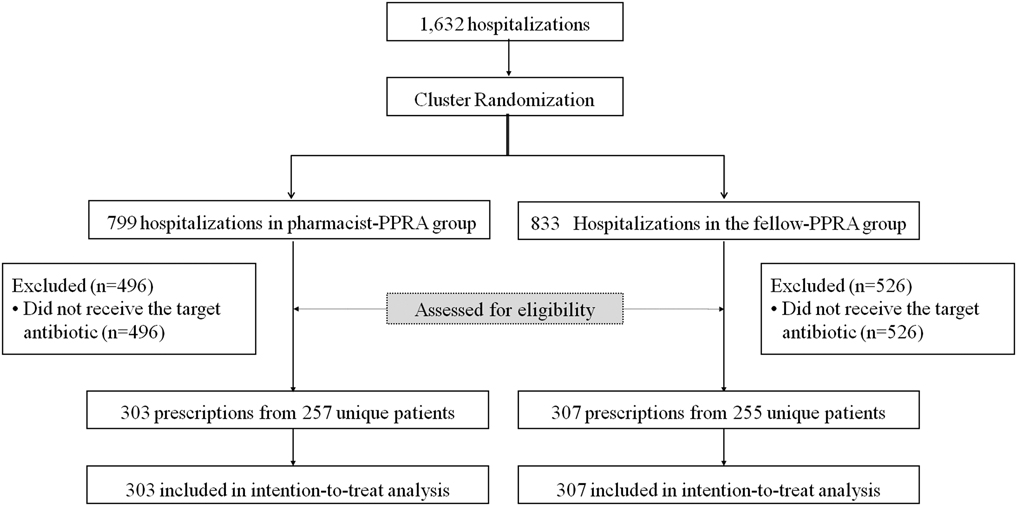
During the 8-month study period (February to September 2013), there were 1,632 hospitalizations in the study medical wards: 799 hospitalizations in the pharmacist PPRA group and 833 in the fellow PPRA group. Of those 1,632 hospitalizations, there were 610 prescriptions with at least 1 dose of the targeted antibiotics: 303 prescriptions in the pharmacist PPRA group and 307 prescriptions in the fellow PPRA group). The study flow chart appears in Fig. 1.
Study flow chart.

Baseline and clinical characteristics
The baseline characteristics of the 2 groups are shown in Table 1. The mean ages of patients in the pharmacist PPRA and fellow PPRA groups were 60.06±19.22 and 60.48±19.03 years, respectively. In both groups, ~60% of participants were female; almost all of them had at least 1 underlying disease. Most of the baseline characteristics were similar in the 2 groups. However, patients in the pharmacist PPRA group had a higher proportion of neutropenia (6.3% vs 2.9%; P=.05), previous use of a urinary catheter (20.5% vs 13.4%; P=.02), and previous exposure to clindamycin during the previous 3 months (3.6% vs 1.0%; P=.03).
Baseline Characteristics of the 610 Study Patients

Note. SD, standard deviation; HIV, human immunodeficiency virus.
a P value from nonparametric test.
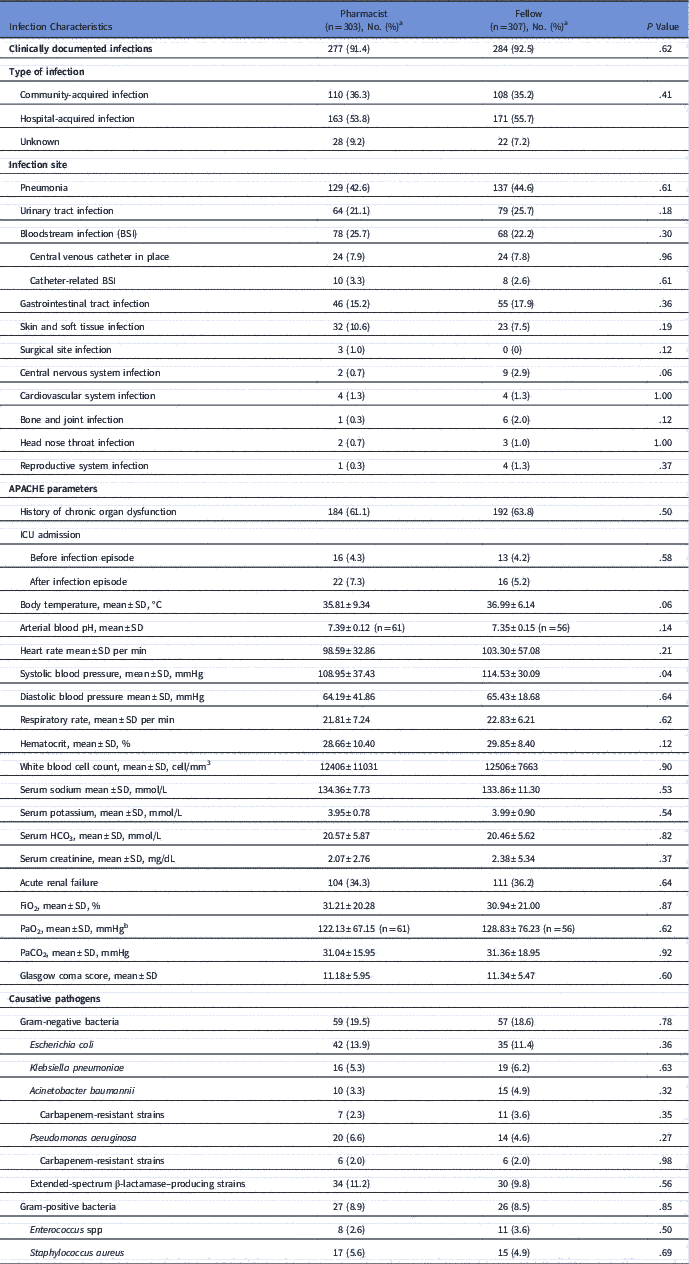
Table 2 presents the clinical characteristics of the 2 groups (pharmacist PPRA versus fellow PPRA; P value). More than 90% of patients in both groups had clinically documented infections. Almost half of the infections were healthcare-associated infections (53.8% vs 55.7%; P=.41). The 3 leading types of infections in both groups were pneumonia (42.6% vs 44.6%; P=.61), urinary tract infections (21.1% vs 25.7%; P=.18), and bloodstream infections (25.7% vs 22.2%; P=.30).
Clinical Characteristics of the 610 Study Patients

Note. APACHE: Acute Physiology and Chronic Health Evaluation; SD, standard deviation.
a Unless otherwise specified.
b Arterial blood pH results were not available in some patients.
Treatment outcomes
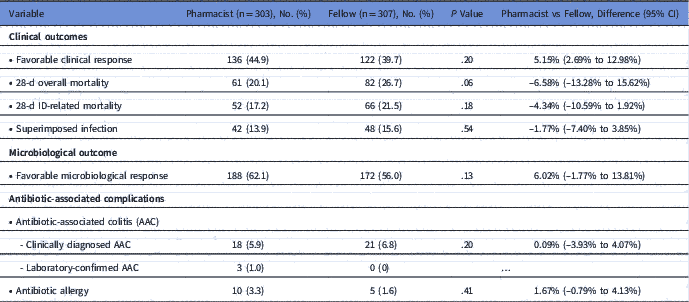
Table 3 displays the treatment outcomes between the 2 groups (pharmacist PPRA versus fellow PPRA; P value). All treatment outcomes were similar between the 2 groups (P > 0.05). Table 3 also shows the difference in outcomes of interest between the 2 groups. The lower bound of the 95% confidence interval (CI) of difference in all favorable treatment outcomes (favorable clinical response and favorable microbiological response) and the upper bound of the 95% CI of difference in all unfavorable treatment outcomes (ie, 28-day overall mortality, 28-day ID-related mortality, superimposed infection, clinically diagnosed antibiotic associated colitis, and antibiotic allergy) did not include the +10% noninferiority margin.
Treatment Outcomes

Note. CI, confidence interval; ID, infectious disease.
Antibiotic consumption and antibiotic expenditure
Data from the pharmacy database, including antibiotic consumption and expenditure from 610 hospitalizations, appear in Table 4. There were no significant differences in the DDD, cost of targeted antibiotics, cost of overall antibiotics per prescription, or length of hospital stay. The difference in the DDD of targeted antibiotic use (pharmacist PPRA minus fellow PPRA) was 0.62 (95% CI, –1.57 to 2.82).
Antibiotic Consumption and Expenditure

Note. CI, confidence interval; DDD, defined daily dose; SD, standard deviation.
Antibiotic prescriptions and approval
Table 5 presents details of all 610 prescriptions and recommendations made by the pharmacist PPRA and fellow PPRA. The targeted antibiotics were mainly prescribed for treatment purposes (97.7% vs 92.8%, respectively; P=.34). Another similarity between the 2 groups (P=.59) was that the most frequently prescribed targeted antibiotics (pharmacist PPRA group versus fellow PPRA group) were meropenem (52.8% vs 56.4%), followed by piperacillin/tazobactam (40.9% vs 37.5%), and imipenem/cilastatin (6.3% vs 6.2%).
Details of 610 Prescriptions of Targeted AntibioticsFootnote

a Excluding all prescriptions discontinued before evaluation.
Note. ID, infections diseases.
During the first 72 hours of prescriptions, 133 of 303 prescriptions (43.9%) in the pharmacist PPRA group and 112 of 307 prescriptions (45.7%) in the fellow PPRA group were discontinued before evaluation (P=.06). More than half of prescriptions in both groups were approved or temporarily approved. Only 17 of 303 prescriptions (5.6%) in the pharmacist PPRA group and 27 of 307 prescriptions (8.8%) in the fellow PPRA group were immediately disapproved (P=.11). The distribution of the final recommendation was also similar in the 2 groups. Of prescriptions of the targeted antibiotics 63 of 303 prescriptions (20.8%) in the pharmacist PPRA group were finally disapproved versus 66 of 307 prescriptions (21.2%) in the fellow PPRA group (P = 0.17).
Prescriptions that were disapproved mostly led to changes in or discontinuation of antibiotics. Among the patients whose prescriptions for targeted antibiotics were disapproved, 19 of 29 prescriptions (65.5%) in the pharmacist PPRA group were later evaluated by the ID service consultation team; 21 of the 35 rejected prescriptions (60.0%) in the fellow PPRA group were later assessed by the ID service consultation team. Of the 40 ID service consultations, only 1 of 40 patients (2.5%) in the pharmacist PPRA group subsequently received approval from the ID service consultation team, and the targeted antibiotic was then continued. In the pharmacist PPRA group, the common reasons for rejected prescriptions were too broad antibiotic coverage (70.7%) and no clinical evidence of infection (13.8%). In the fellow PPRA group, the common reasons for rejected prescriptions were too broad antibiotic coverage (65.7%) and no clinical evidence of infection (18.6%).
The agreement rates between the initial recommendation in the pharmacist PPRA and fellow PPRA groups were 84.7% and 91.3% (P=.05), respectively. The final recommendations between the groups revealed nearly perfect agreement: 100% in the pharmacist PPRA group and 99.0% in the fellow PPRA group (P=.19). The details of the recommendations made by an independent ID physician, trained general pharmacist, and ID clinical fellows appear in Table 6.
Recommendations by Independent ID Physician, Trained Pharmacist, and ID Clinical Fellow

Note. ID, infectious diseases; NA, not applicable. Shading cells represent the number of concordant recommendations.
Discussion
Several studies have demonstrated the benefits of ASP facilitated by ID clinical pharmacists.Reference Rybak 15 , Reference Moody, Cosgrove and Olmsted 16 The Infectious Diseases Society of America has recognized the value of the pharmacist’s expertise and recommends including an ID clinical pharmacist in the ASP team.Reference Dellit, Owens and McGowan 17 Thailand faces a shortage in ID specialists and ID clinical pharmacists; thus, the present investigation sought to determine whether trained general pharmacists could effectively implement an antibiotic approval program.
The lower bound of the 95% CI of difference in all favorable treatment outcomes (favorable clinical response and favorable microbiological response) and the upper bound of the 95% CI of difference in all unfavorable treatment outcomes (28-day overall mortality, 28-day ID-related mortality, superimposed infection, clinically diagnosed antibiotic associated colitis, and antibiotic allergy) did not include the +10% noninferiority margin. These results confirmed that the recommendations of the pharmacist PPRA were not inferior to those of the fellow PPRA in terms of all treatment outcomes. Furthermore, 28-day overall mortality was slightly lower in the pharmacist PPRA group; however, the difference was not statistically significant.
The upper bound of the 95% CI of difference in the targeted antibiotic use (pharmacist PPRA minus fellow PPRA) was >1.5 DDDs; thus, this study failed to confirm noninferiority in targeted antibiotic consumption in the pharmacist PPRA group. Furthermore, the mean DDD of targeted antibiotic use and all antibiotic use was slightly—but not significantly—higher in the pharmacist PPRA group. These findings may be explained in the following ways. First, the pharmacist PPRA group was less stringent than the fellow PPRA group. This possibility is supported by the slightly lower rate of disapproval on the initial evaluation. Second, with the pharmacist PPRA group, the targeted antibiotics were usually approved for a longer duration (eg, 14 days for upper urinary tract infection), especially if the initial diagnosis was bacteremia. Additionally, the ID clinical fellows may have had more clinical experience and may have been more comfortable in discontinuing the target antibiotic as early as possible (eg, 7 days for upper urinary tract infection). Unfortunately, to confirm that hypothesis, we lacked data about the number of days of antibiotic therapy.
Researchers comparing antibiotic recommendations by ID clinical pharmacists versus ID clinical fellows reported that ID faculty agreement in antibiotic choice was higher among the former (87.0% vs 47.0%, respectively; P < .001).Reference Gross, Morgan and Kinky 14 In contrast, we found a lower proportion of agreement with the initial recommendation among pharmacists. However, the pharmacists in the present study were general pharmacists without any formal ID training; they were not ID clinical pharmacists as in the earlier investigation.
The present study has several strengths. First, to the best of our knowledge, this is the first randomized controlled trial to compare the effectiveness of an antibiotic approval program implemented by trained general pharmacists compared with ID clinical fellows. Second, this study was specifically designed to obtain not only aggregate data on antibiotic consumption and expenditure but also data on all important clinical outcomes. Third, we also compared the data on recommendations by the pharmacist, the ID clinical fellow, and the independent ID physician. This helped us understand precisely the pitfalls and strengths of both strategies.
Our study has several limitations. First, the cluster-randomization design may have been unable to control all confounders and led to unbalanced baseline characteristics between the 2 groups. Second, this study collected only data on the amount of antibiotic consumption (DDD), not the day of therapy. Therefore, we were unable to thoroughly explore the pattern of antibiotic prescription in the 2 groups.
In conclusion, this study has demonstrated that general pharmacists who have undergone a short ID training course can safely implement an antibiotic approval program. Although our study could not confirm the noninferiority of a pharmacist PPRA in the targeted antibiotic consumption, we did demonstrate noninferiority in terms of favorable clinical response. Furthermore, there was no significant difference in terms of consumption of the targeted antibiotics, antibiotic expenditure, and other important treatment outcomes. From these findings, the strategy of using general pharmacists trained in the above manner appears safe; however, it may not be as efficient in reducing antibiotic consumption as antibiotic approval implemented by an ID clinical fellow. Therefore, using trained general pharmacists could be an alternative to ID specialists for antibiotic approval when resources are limited.
Acknowledgments
The authors thank Sajja Supornpun and all ward pharmacists in the In-patient Pharmacy Unit, Siriraj Hospital for their assistance. We thank the Edanz Group for editing a draft of this manuscript.
Financial support
This study was primarily supported by the Faculty of Medicine Siriraj Hospital and Health Systems Research Institute, Thailand.
Conflicts of interest
All authors report no conflicts of interest relevant to this article.