Background
Anxiety disorders are the most prevalent mental disorders, with lifetime prevalence rates up to 14.5% in the European epidemiological surveys (Alonso & Lepine, Reference Alonso and Lepine2007), or even up to 33.7% in the USA (Kessler et al. Reference Kessler2012). They are associated with considerable impairment and decreased levels of health-related quality of life, as well as a high comorbidity with other mental disorders, health care utilization and economic burden for society (Bandelow & Michaelis, Reference Bandelow and Michaelis2015; Bandelow et al. Reference Bandelow2015). Depending on the core symptoms and the nosological system, individuals suffering from anxiety may be classified into DSM-IV categories such as generalized anxiety disorder (GAD), with a 3.7% lifetime prevalence (Ruscio et al. Reference Ruscio2017), panic disorder (1.7%) (de Jonge et al. Reference De Jonge2016), agoraphobia (0.8%) (Alonso & Lepine, Reference Alonso and Lepine2007), social phobia (12.1%) (Ruscio et al. Reference Ruscio2008) and specific phobias (7.4%) (Wardenaar et al. Reference Wardenaar2017). They might also be classified into diagnostic categories already discontinued in the most recent DSM-5, but traditionally used within this type of disorders, such as obsessive–compulsive disorder (OCD, 1–3%) (Hirschtritt et al. Reference Hirschtritt, Bloch and Mathews2017), and post-traumatic stress disorder (PTSD, 3.9%) (Koenen et al. Reference Koenen2017).
It has been established that cognitive therapy (CT), behavioural therapy (BT), and cognitive and behavioural therapy (CBT), all together referred from now on as (C)BTs, are effective in the treatment of anxiety disorders (Cuijpers et al. Reference Cuijpers2016), although other treatments, e.g. psychopharmacological drugs, might present even higher effects than those achieved with (C)BTs (Bandelow & Michaelis, Reference Bandelow and Michaelis2015; Bandelow et al. Reference Bandelow2015). Relaxation training has also been used to treat anxiety with some degree of success (Hayes-Skelton et al. Reference Hayes-Skelton2013). Relaxation training includes methods such as progressive muscle relaxation (PMR), which emphasizes reducing muscle tension and achieving relaxed states (Bernstein & Borkovec, Reference Bernstein and Borkovec1973), and applied relaxation (AR), which focuses on making relaxation as a skill to be used in natural settings (Öst, Reference Öst1987). Relaxation techniques are based on the premise that anxiety involves interacting central and peripheral physiological systems, each of them influencing the others, so that changes in reducing one channel should also reduce the others. These interventions have usually been used as active control groups compared with (C)BTs, although the effects of relaxation compared to (C)BTs when treating anxiety disorders are not clear in general terms, and neither their relative effects in the treatment of one anxiety disorder compared with another. A previous meta-analysis comparing (C)BTs and relaxation therapy (Siev & Chambless, Reference Siev and Chambless2007) found no differences in the treatment of GAD, although a group considered in this study as relaxation therapy, in fact, included some components of BT (Butler et al. Reference Butler1991). The referred meta-analysis proposed some possible differences when treating panic disorder, favouring (C)BTs, and suggesting specificity of treatment to anxiety class disorders. However, the number of studies given support to this conclusion were scarce, and new studies adding evidences seems to be appeared since then. No other meta-analysis comparing (C)BTs and relaxation has been done since, while many new studies have been conducted. Furthermore, the referred early meta-analysis only focused on GAD and panic disorder, while a considerable number of trials have also compared the effects of (C)BTs and relaxation in other distinct anxiety disorders. For instance, it has recently been said that a range of interventions is effective in the management of OCD, but considerable uncertainty exists regarding their relative efficacy (Skapinakis et al. Reference Skapinakis2016).
We decided therefore to conduct a meta-analysis to examine the efficacy of relaxation compared to (C)BTs, and whether their relative efficacy varies across different anxiety disorders.
Method
We followed the PRISMA guidelines for systematic reviews and meta-analyses, and the recommendations of the Cochrane Collaboration (Moher et al. Reference Moher2010; Higgins & Green, Reference Higgins and Green2011). The protocol was registered with PROSPERO (registration number CRD42015026254).
Identification and selection of studies
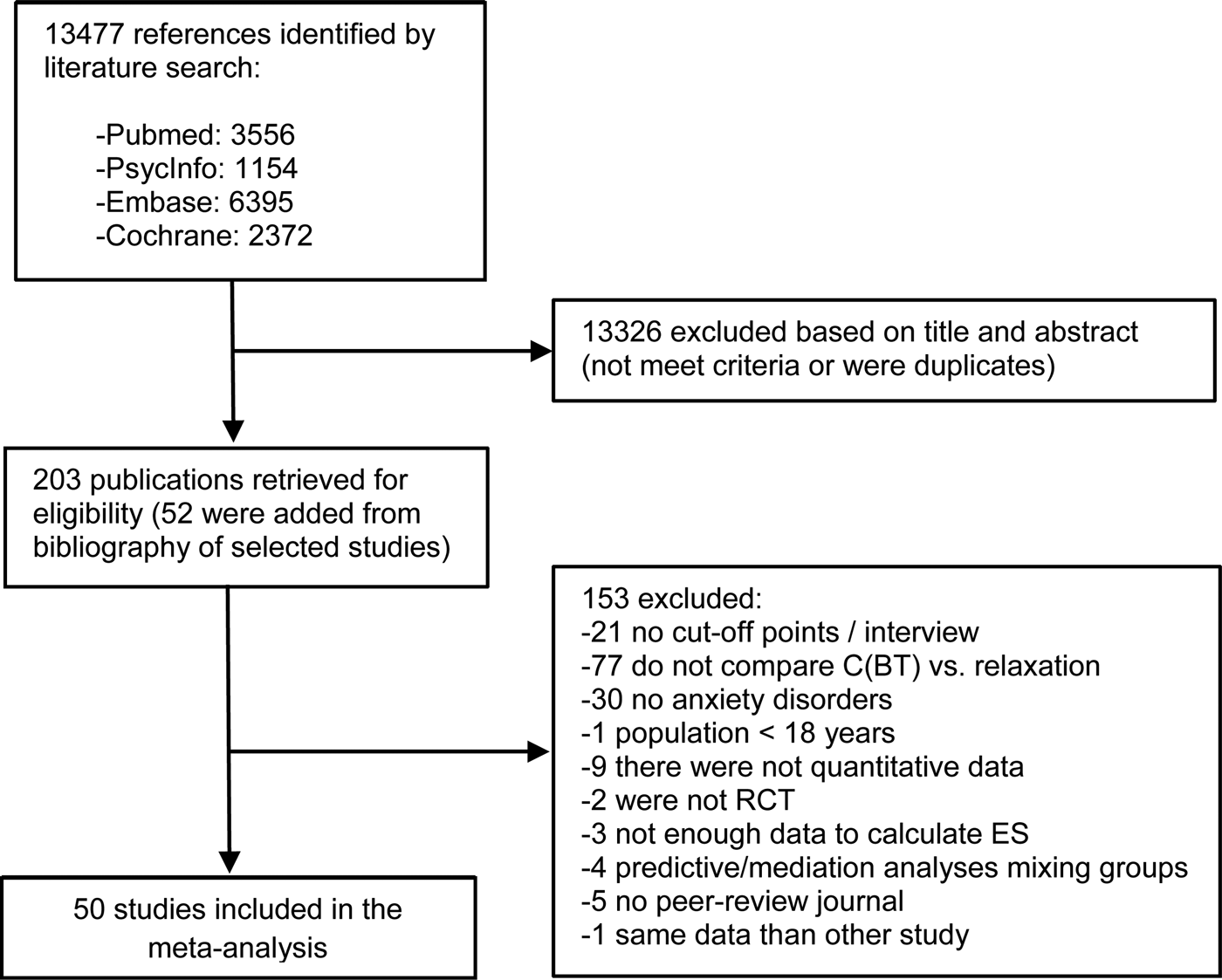
We built a database of papers searching four major bibliographical databases (PubMed, PsycInfo, Embase and the Cochrane Database of randomized trials), by using both MeSH terms and text words indicative of anxiety disorders and relaxation trainings, with filters for randomized controlled trials (RCTs), but with no (C)BT specifications, to avoid the risk of letting out studies with specific (C)BT interventions, and to construct an open and continuously updated database for future research. In these database searches, we identified 13 477 titles and abstracts, from PubMed (3556), PsycInfo (1154), Embase (6395), and the Cochrane Database of randomized trials (2372). From the 13 477 records, 13 326 were excluded because they did not meet criteria or were duplicates. Moreover, 52 references were added from the reference lists of selected articles and metadata. In total 203 publications were retrieved for possible inclusion in the database. The full search string for PubMed is given in the online Supplementary Material 1. The deadline of the searches was 24 March 2017.
The inclusion criteria of studies were: (a) RCTs, (b) in which patients met diagnostic criteria for anxiety according to a formal interview or scored above a specific cut-off on a self-rating scale, (c) with age >17 years, (d) published in a peer-review journal, (e) comparing at least a group of relaxation therapy with a group of (C)BT. Relaxation techniques included those focused in changing physiological responses of anxiety, but did not include bio-feedback or mindfulness procedures (and other meditation techniques such as yoga, tai chi, qigong or spiritual therapies, which will be analysed in a separate meta-analysis). (C)BTs were defined as therapies aimed at cognitive restructuring or at changing current anxiety behaviour, such as exposure. Studies on eye movement desensitization and reprocessing, interpersonal therapy or psychodynamic interventions were excluded, because they do not offer the cognitive and behavioural strategies that are typically offered in (C)BTs. Third-generation (C)BTs, e.g. acceptance-based behaviour therapy, were included. Comorbid mental or somatic disorders were not excluded if anxiety was the primary diagnosis or in the case of dual diagnosis. We excluded studies that did not report enough data to calculate standardized effect sizes (ESs) (e.g. qualitative, predictive or mediation studies with no other data), as well as papers that reported about a trial that already included the same parameters. No language restriction was applied. Anxiety disorders were defined according to the DSM-IV and included GAD, panic disorder, social anxiety disorder, specific phobias, as well as disorders that were categorized as anxiety disorder in the DSM-IV but not in the DSM-5 (OCD and PTSD).
Data extraction and quality assessment
Two reviewers independently screened citations for inclusion by examining titles and abstracts, and the full text of the potentially relevant studies. Data extraction and quality assessment were conducted by two independent researchers, using a predefined data extraction sheet. In case of disagreement, resolution was reached through discussion with a third researcher.
We coded aspects of the studies, including year of publication, country, intervention format (individual, group), number of participants, setting for delivery, who delivered, follow-up measurements (post-test, 3, 12, >12 months); anxiety outcome domain (physiological, e.g. skin conductance; cognitive, e.g. worries; behavioural, e.g. avoidance; mixed, e.g. Hamilton Anxiety Scale); depression outcomes (e.g. Beck Depression Inventory); credibility; acceptability (completion rate); others (e.g. general functioning); patient characteristics (age; sex as percentage of women); type of anxiety disorder (PTSD, OCD, social phobia, specific phobia, panic, GAD, mixing anxiety disorders); hours of relaxation (based on the number of sessions and the length of the intervention); relaxation technique (PMR, AR, others); relaxation treatment format (therapist, self-guided, therapist + self-guided); (C)BT technique (cognitive restructuring, exposure, cognitive restructuring + exposure, others); hours of (C)BT therapy.
Risk of bias was assessed using four criteria of the Cochrane Collaboration's tool (Higgins & Green, Reference Wardenaar2011), including adequate generation of allocation sequence, concealment of allocation to conditions, prevention of knowledge of the allocated intervention (masking of assessors), and dealing with incomplete outcome data (positive when intention-to-treat analyses were conducted). Quality of interventions was evaluated according to three criteria (Chambless & Hollon, Reference Chambless and Hollon1998): use of a treatment manual, provision of therapy by specifically trained therapists and verification of treatment integrity during the study.
Statistical analysis
For each comparison between a relaxation condition and a (C)BT group, we calculated Hedges’ g as an ES, assuming normal distributions with equal variances. The ES indicated the differences between the two groups and the 95% confidence interval (95% CI), at post-test or follow-up. We choose Hedges’ g as the ES because it corrects for small sample bias (Hedges, Reference Hedges1981). In general, it has been proposed that an ES of 0.20 is small; of 0.50 is moderate and of 0.80 is large (Cohen, Reference Cohen1988). When more than one outcome measure was provided in each of the groups of variables referred above (anxiety, depression, credibility, acceptability, others and all the variables together), outcomes were pooled within the study before pooling across studies (the specific variables used are in Appendix 2), so that each comparison used only one effect (Borenstein et al. Reference Borenstein2009). For continuous outcomes, the ES was calculated by subtracting the post-test or follow-up mean score of the (C)BT group, from the mean score of the relaxation group, and dividing the result by the pooled standard deviation. When dichotomous outcomes were reported, we estimated the corresponding Hedges’ g ES by the procedures provided by Borenstein et al. (Reference Borenstein2009). To facilitate the clinical interpretation of Hedges’ g, we transformed the ESs into the number needed to treat (NNT), with the conversion of Kraemer & Kupfer (Reference Kraemer and Kupfer2006). The NNT indicates the number of patients that have to be treated in order to generate one additional positive outcome (Laupacis et al. Reference Laupacis, Sackett and Roberts1988). Acceptability was defined as study drop-out for any reason. In this case, we calculated the relative risk (RR) of dropping-out of (C)BTs compared with relaxation, as well as the risk difference. NNT was directly calculated for acceptability as 1 divided by the risk difference. Because considerable heterogeneity among studies was expected, the pooled ES was calculated using the random-effects model. We examined heterogeneity using the I 2 statistic, and 95% CI around I 2 using the non-central χ2 approach (Ioannidis et al. Reference Ioannidis, Patsopoulos and Evangelou2007). A value of 0% indicates no observed heterogeneity, 25% low, 50%, moderate and 75%, high heterogeneity.
Subgroup analyses were conducted according to the mixed-effects model, to evaluate possible differences in ESs according to the format of intervention (group, individual), anxiety disorder (PTSD, OCD, any phobia, panic, GAD, mixed), relaxation technique (PMR, AR, others), (C)BT technique (cognitive restructuring, exposure, cognitive restructuring + exposure, others) and relaxation treatment format (therapist, self, therapist + self), as possible sources of heterogeneity. The mixed-effects model pools studies within the subgroups according to the random-effects model, and test for significant differences between subgroups with the fixed-effects model (Borenstein et al. Reference Borenstein2009). Multivariate meta-regression analyses, with the anxiety ES as the dependent variable, were also conducted by the method of moments, indicating by a Z-value and its associated p value whether there was a significant relationship between independent variables and ES. As predictors, we entered all the variables of the previous subgroup analyses, and also the following continuous variables: age, sex (% females), hours of relaxation, hours of (C)BT, risk of bias and quality of intervention. Possible collinearity problems between predictors were evaluated by using the variance inflation factor (VIF). Moreover, we also conducted a manual back-step meta-regression analysis, in which we dropped the least significant variable in each step, until only significant predictors were retained in the model, looking for a parsimonious model (Cuijpers et al. Reference Cuijpers2016). The R 2 value, as a percentage of the explained variance from the total variance in true effects by the parsimonious model, was also calculated, as well as a simultaneous test for all coefficients, and a test of goodness fit by using the Q statistic.
Publication bias was evaluated by visually inspecting the funnel plot on anxiety ESs and by Duval and Tweedie's trim and fill procedure (Duval & Tweedie, Reference Duval and Tweedie2000), which provides the number of studies probably absent, and gives an estimate of the ES after the publication bias has been taken into account, supposing that the total studies should be distributed evenly on both sides of the mean ES. The Begg and Mazumdar rank correlation test was applied to test whether the adjusted and observed ESs differed significantly from each other (Begg & Mazumdar, Reference Begg and Mazumdar1994), and Egger's test of the intercept to contrast the null hypothesis of bias absence was also conducted (Egger et al. Reference Egger1997). Finally, we also calculated Rosenthal's fail-safe N test (Rosenthal, Reference Rosenthal1979), which computes the number of missing studies that would need to be added to the analysis to yield a statistically insignificant overall effect, assuming that the effect in the hidden studies is nil.
All the tests were set with a significance level of α < 0.05, and they were two-tailed, except for the bias-related test, which were one-tailed. Data were analysed using the Comprehensive Meta-Analysis-3.0, Stata-12 and R-3.1.1 statistical packages.
Results
Fifty studies on anxiety disorders [reported in 59 papers, with 65 possible comparisons between (C)BT v. relaxation using anxiety outcomes] met inclusion criteria for the meta-analysis (Fig. 1) and were analysed. Selected characteristics of the 50 included studies are presented in the online Supplementary Material 2, and their references are given in the online Supplementary Material 3.
Flow chart of inclusion of studies.

Characteristics of included studies
The 50 studies included 2801 participants: 1575 in the (C)BT groups and 1226 in the relaxation groups. The average number of patients per condition was 25. There were 11 studies on GAD; 13 studies on panic (four without or with mild agoraphobia, one without or with mild/moderate agoraphobia, three without or with agoraphobia, five with agoraphobia); 15 studies on any phobia (one agoraphobia, four social phobia, two flying phobia, two death phobia, three blood phobia, one dental phobia, one acrophobia, one claustrophobia); three studies on OCD (one dually diagnosed); four studies on PTSD and four studies mixing different anxiety disorders: one study with agoraphobia, social phobia and specific phobia; one study with social phobia and snake phobia (both studies were finally considered as any phobia studies); one study with social phobia, GAD, panic + alcohol use disorder; one study with social phobia, panic with/without agoraphobia, GAD, specific phobia and OCD. There were differences in the relaxation technique used, although AR was the most included (in 28 of the 65 comparisons), being ‘therapist + self-guided’ the main application form. There were also differences in terms of the (C)BT intervention, but the majority were BT groups (38 of the 65 comparisons), with exposure as the most used technique. The interventions also differed in terms of treatment format (individual, group), and the number of therapy hours, with a relaxation range from 0.3 to 84 h, and a (C)BT range from 0.3 to 96 h. Twenty-three studies were conducted in the USA and 22 in Europe.
The quality of the studies and interventions also varied. Only three studies met all four study quality criteria, 30 met two or three criteria and the remaining 17 had a low quality, with one of the four criteria. Forty-eight studies reported an adequate sequence generation (two studies from the 1970s were unclear, and therefore a sensitivity analysis dropping these two studies was conducted). Thirty studies reported concealment of allocation to conditions. Ten studies reported prevention of knowledge of the allocated intervention. Thirteen studies deal with incomplete outcome data. On the other hand, 20 studies met all three intervention quality criteria, 23 studies met one or two criteria and seven studies met none.
Overall effects on anxiety outcomes
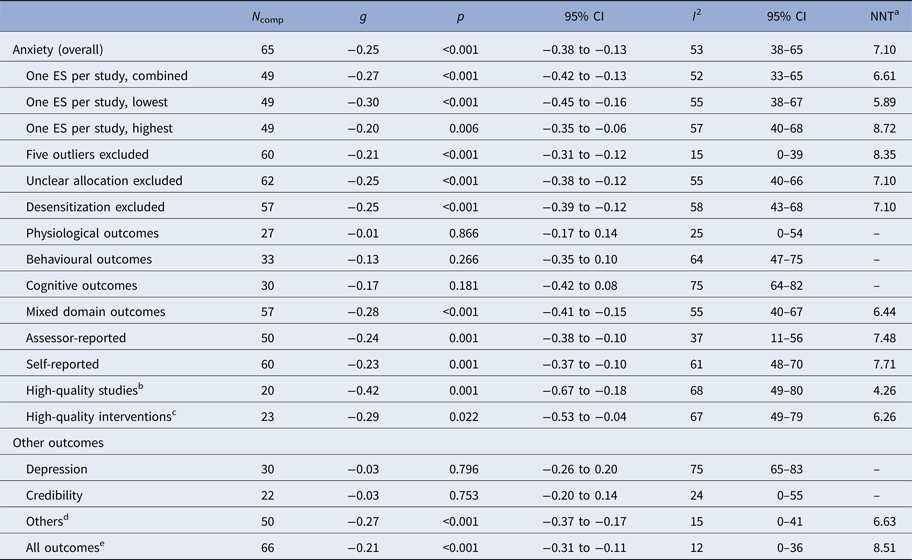
From the 50 included studies, we compared the effects of relaxation with (C)BT in 65 possible comparisons. The overall ES for anxiety outcomes was g = −0.25 (95% CI = −0.38 to −0.13), favouring (C)BT, which corresponds with a NNT of 7.10. Heterogeneity was moderate (I 2 = 53; 95% CI = 38–65). Inspection of a forest plot of the ES and their 95% CI indicated that there were potential outliers. Excluding the five ES that did not overlap with the 95% CI of the pooled ES resulted in a lower ES (g = −0.21; 95% CI = −0.31 to −0.12; NNT = 8.35), as well as reductions in heterogeneity (I 2 = 15; 95% CI = 0–39). Eliminating two old studies with no clear allocation in their report showed similar values than those obtained in the overall estimate, and this was also the case when removing seven studies which used desensitization (a BT technique that makes use of relaxation). Given that 10 studies included multiple (C)BT groups which were considered in the same analysis, we conducted an analysis in which only one ES in each study was included (either the largest or the smallest ES in each study, and also a combination of all of them). The resulting ESs ranged from g = −0.30 to g = −0.20 (with a combined ES of g = −0.27; 95% CI = −0.42 to −0.13; NNT = 6.61), and heterogeneity remained similar to the overall values (Table 1). We also estimated the ESs for each anxiety outcome domain. The ES of the mixed domain outcomes category was the only category remaining significant results, with a similar ES to the overall estimation. The separate analysis of the assessor- and self-reported outcomes showed similar ESs, but heterogeneity seemed to be higher in self-reported outcomes. Finally, we found similar results when including only high-quality interventions (meeting the three criteria), although ES seemed to benefit more to (C)BT groups whether only high-quality studies (meeting three or four criteria) were included (g = −0.42; 95% CI = −0.67 to −0.18; NNT = 4.26).
Effects of relaxation compared with (C)BT for anxiety disorders

N comp, number of comparisons; g, Hedges’ g ES measure; 95% CI, 95% confidence interval; p, p value according to the random effects model; I 2, heterogeneity; NNT, numbers-needed-to-treat.
a NNT for non-significant results are not reported.
b Including studies that meet three or four study quality criteria.
c Including studies that meet the three intervention quality criteria.
d Including general functioning, adverse events, medication use, substance abuse, quality of life, social adjustment, performance, memory, metacognition, mindfulness and experiential avoidance.
e Including anxiety, depression, credibility, acceptability and others.
Some indications of publication bias were found. Duval and Tweedie's trim and fill procedure indicated that six studies might be missing, and the pooled adjusted ES was −0.30 (95% CI = −0.45 to −0.19; NNT = 5.95). However, Begg and Mazumdar rank correlation was not significant (τ = 0.02; p = 0.410), and Egger's regression intercept was also not significant (intercept = 0.25; 95% CI = −0.72 to 1.23; p = 0.303). The fail-safe N was 496. Therefore, it would be needed to include 496 ‘null’ studies to find a statistically insignificant overall effect. In other words, 7.63 missing studies for every observed comparison would be needed for the effect to be nullified.
Overall effects on other outcomes
We calculated (Table 1) the overall ES on depression, with no significant differences (g = −0.03; 95% CI = −0.26 to 0.20), but high heterogeneity (I 2 = 75; 95% CI = 65–83); credibility, with no significant differences (g = −0.03; 95% CI = −0.20 to 0.14), and low heterogeneity (I 2 = 24; 95% CI = 0–55); and on other outcomes (general functioning, adverse events, medication use, substance abuse, quality of life, social adjustment, performance, memory, metacognition, mindfulness and experiential avoidance), with low and significant differences (g = −0.27; 95% CI = −0.37 to 0.17; NNT = 6.63), and low heterogeneity (I 2 = 15; 95% CI = 0–41).
The overall estimate of acceptability (online Supplementary Material 4) did not show significant differences (RR = 1.13; 95% CI = 0.94–1.37), with zero heterogeneity (I 2 = 0; 95% CI = 0–32). Only OCD showed significant differences in acceptability (RR = 1.89; 95% CI = 1.14–3.12; NNT = 16.67), favouring relaxation, and PTSD might present a trend in the same direction, but there were no significant differences in this subgroup analysis. On the contrary, they were subgroup differences regarding the relaxation technique (p = 0.019), and the (C)BT technique (p = 0.018), being that both PMR (RR = 1.65; 95% CI = 1.181–2.32; NNT = 25.00) and exposure (RR = 1.52; 95% CI = 1.16–1.99; NNT = 20), favoured a greater acceptance of relaxation, compared with (C)BT.
Taking into account all the outcomes referred, differences between relaxation and (C)BT were low but significant (g = −0.21; 95% CI = −0.31 to −0.11; NNT = 8.51) (Table 1).
Subgroup analyses on anxiety outcomes
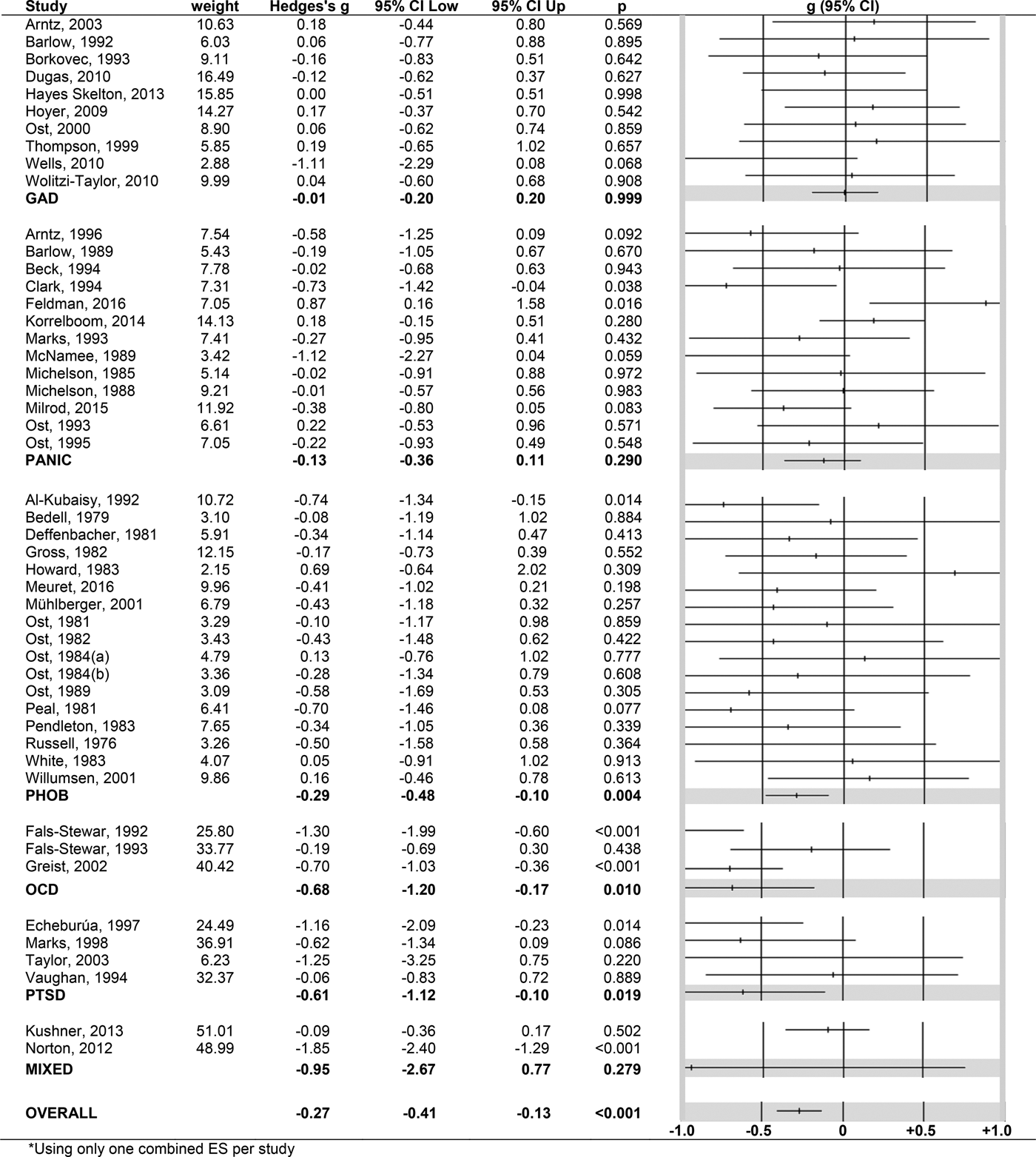
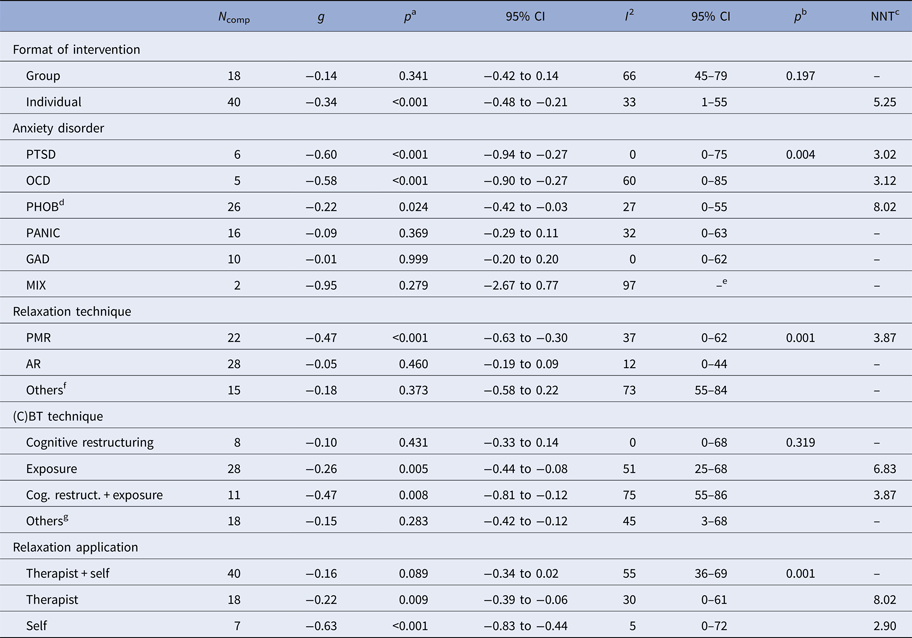
A series of subgroup analyses were conducted to examine whether characteristics of studies were related to the ESs (Table 2). The separate analysis of social phobia (g = −0.16; 95% CI = −0.80 to 0.48) and specific phobias (g = −0.17; 95% CI = −0.37 to 0.04) showed similar ESs, with no significant effects, so they were merged in a category named any phobia (including two studies which mixed different phobias) to gain statistical power. In this condition, we found that ES was significantly associated with type of disorder (p = 0.004), being significant PTSD (g = −0.60; 95% CI = −0.94 to −0.27; NNT = 3.02), OCD (g = −0.58; 95% CI = −0.90 to −0.27; NNT = 3.12) and any phobia (g = −0.22; 95% CI = −0.42 to −0.03; NNT = 8.02), favouring (C)BT. As can be seen in Fig. 2, the same occurred when only a single comparison in each study (based on a combined ES) was used, but showing higher ES values (Fig. 2) also graphically shows the width of the CIs, and that almost all studies were underpowered, making it difficult to reach definite conclusions. These results remained similar for PTSD and OCD when only using high-quality studies, but any phobia lost significance, maybe due to the low number of studies included (online Supplementary Material 5). We also found that ES was significantly related to relaxation technique (p = 0.001), being that PMR (g = −0.47; 95% CI = −0.63 to −0.30; NNT = 3.87) performed worse than AR (g = −0.05; 95% CI = −0.19 to 0.09). ES was also associated with relaxation application (p = 0.001), with self-applied (g = −0.63; 95% CI = −0.83 to −0.44; NNT = 2.90) performing worse than therapist-applied (g = −0.22; 95% CI = −0.39 to −0.06; NNT = 8.02), or therapist + self-applied (g = −0.16; 95% CI = −0.34 to 0.02). We finally found no significant differences according to the format of intervention (p = 0.197), or (C)BT technique (p = 0.319).
Forest plot of standardized effect sizes by anxiety disorder*.

Effects of relaxation compared with (C)BT for anxiety disorders: subgroup analyses

N comp, number of comparisons; g, Hedges’ g ES measure.
a p value according to the random-effects model. 95% CI, 95% confidence interval; I 2, heterogeneity; NNT, numbers-needed-to-treat.
b The p values in this column indicate whether the difference among the effect sizes in the subgroups is significant.
c NNT for non-significant results are not reported.
d Any phobia. PMR, progressive muscle relaxation; AR, applied relaxation.
e The 95% CI of I 2 cannot be calculated when the number of studies is two or smaller.
f This category includes relaxation techniques such as pulsed audio-photic stimulation, cue-controlled relaxation, relaxing without initial muscle tensing, music relaxation or mixed techniques.
g This category includes (C)BT techniques such as paradoxical intention, counterfactual reasoning, metacognitive techniques, activation techniques, coping skills, social skills or acceptance-based behaviour techniques.
Time-point effects on anxiety outcomes
The overall small disadvantage of relaxation compared with (C)BT remained significant from post-test to 12 months follow-up, but differences were no longer significant when the follow-up was 1 year or more after post-test (online Supplementary Material 6). When comparing anxiety disorders by each time point, we also observed significant differences at post-test (p = 0.002), 3 months (p < 0.001) and 12 months follow-up (p = 0.007). Specifically, GAD showed no significant differences at any of the time-point effects; panic only showed significant differences at 12 months follow-up (g = −0.31; 95% CI = −0.56 to −0.06; NNT = 5.76); any phobia showed significant differences at post-test (g = −0.23; 95% CI = −0.42 to −0.03; NNT = 7.81), and 3 months follow-up (g = −0.79; 95% CI = −1.16 to −0.43; NNT = 3.35); OCD showed significant differences at post-test (g = −0.60; 95% CI = −0.94 to −0.27; NNT = 3.04) and at 12 months follow-up (g = −1.16; 95% CI = −1.85 to −0.48; NNT = 1.70), although there were no OCD comparisons at 3 months, and only one at 12 months follow-up; PTSD showed significant differences at post-test (g = −0.62; 95% CI = −0.95 to −0.29; NNT = 2.95), at 3 months follow-up (g = −0.56; 95% CI = −0.90 to −0.22; NNT = 3.25) and at 12 months follow-up, but with just one comparison at this point (g = −1.36; 95% CI = −2.30 to −0.41; NNT = 1.51). There were no evidence of differences in any of the disorders at 1 year or more after post-test (p = 0.838), although the number of comparisons was drastically reduced, and there were no comparisons on OCD nor PTSD.
Multivariate meta-regression analysis
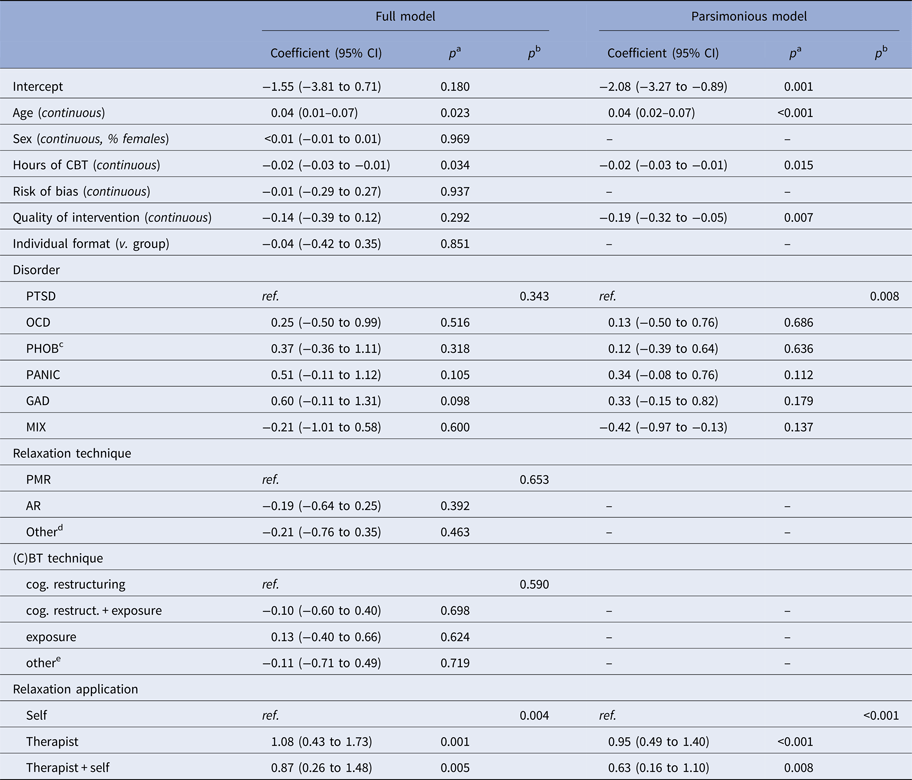
A multivariate meta-regression analysis with the overall ES based on the anxiety outcomes as dependent variable was conducted. As predictors, we entered all the subgroup analyses variables, and the other continuous outcomes referred above. However, hours of relaxation and hours of (C)BT showed collinearity problems (the VIF between them was 10.43). Therefore, hours of relaxation was removed (it also showed higher VIF values with the rest of variables). As can be seen in Table 3, relaxation treatment format remained as a significant predictor of ES, while adjusting for the other study features, and they also were age and hours of (C)BT. The results of the parsimonious model, using the manual back-step meta-regression analysis, indicated that age, hours of (C)BT, quality of intervention, type of disorder and relaxation treatment format were significantly associated with the ES, explaining a 82% of total variance. The simultaneous test of all coefficients of the parsimonious model was significant (Q = 43.09; df = 10; p < 0.001), and the test that unexplained variance is zero which pointed a good fit (Q = 46.35; df = 40; p = 0.227).
Features of studies comparing relaxation with (C)BT for anxiety: multivariate meta-regression

Full model: meta-regression analysis including all the predictors together. Parsimonious model: meta-regression using the manual back-step analysis. Coefficient: standardized regression coefficients. 95% CI, 95% confidence interval.
a p value according to the random-effects model by using the method of moments (MM) computational procedure.
b The p values in this column indicate whether the difference among the coefficients in the subgroups is significant.
c Any phobia. PMR, progressive muscle relaxation; AR, applied relaxation.
d This category includes relaxation techniques such as pulsed audio-photic stimulation, cue-controlled relaxation, relaxing without initial muscle tensing, music relaxation or mixed techniques.
e This category includes (C)BT techniques such as paradoxical intention, counterfactual reasoning, metacognitive techniques, activation techniques, coping skills, social skills or acceptance-based behaviour techniques.
Discussion
We found that (C)BT, compared with relaxation, had a small but statistically significant effect in the treatment of anxiety symptoms, and it was maintained 1 year follow-up. The clinician-rated outcomes and the self-report measures indicated similar values. Surprisingly, significant effects only appeared when using mixed-domain outcomes, but not in physiological, behavioural or cognitive outcomes analysed separately. Around one-third of studies presented adequate quality (none or one possible source of bias), and 40% of studies implemented high-quality interventions. The specific analysis of these high-quality studies and interventions, as well as the different sensitivity analyses developed, maintained results in the same direction, with small ESs, favouring (C)BT. Relaxation therapy has been proposed as an active control or even as a treatment strategy to reduce anxiety symptoms (Hayes-Skelton et al. Reference Hayes-Skelton2013), so it is not surprising that small ESs were found as a result of the referred comparison. We also found that age, hours of (C)BT, quality of intervention, relaxation treatment format and type of anxiety disorder were related to ES, explaining much of the heterogeneity. Our results suggest that the older patients, the less benefits obtained from (C)BT, something that might be explained because anxiety disorders reach a peak in middle age, and tend to decrease with older age (Bandelow & Michaelis, Reference Bandelow and Michaelis2015; Bandelow et al. Reference Bandelow2015), may be an stage easier to be released from anxiety with techniques focused on the physiological system. However, we cannot make strong inferences of individual characteristics of patients related to treatment outcomes, because to document this, developing moderator analyses within each RCT, with larger sample sizes, would be needed. It was also observed that the greater number of (C)BT hours, the higher effects favouring (C)BT were found, something easy to be understood. In the same sense, the higher quality of interventions, the higher benefits to (C)BT, which suggest that, if we want to add some extra effectiveness to (C)BT when treating anxiety, it should be designed and applied with special attention and care. It was also found that when relaxation was applied, totally or partially, by a therapist, relaxation therapy was benefited, maybe because it supposed a greater adherence to the practice, or perhaps implied a practice of higher quality. Finally, different effects were found depending on the anxiety disorder, being that PTSD, OCD and any phobia may be more treatable by using (C)BT, the latter in line with what was pointed for social anxiety (Mayo-Wilson et al. Reference Mayo-Wilson2014), although panic might also benefit from (C)BT, as previously proposed (Pompoli et al. Reference Pompoli2016; Siev & Chambless, Reference Siev and Chambless2007), specifically at 1 year follow-up, so it would be worth to examine long-term effects in panic, as it has been recently pointed out (Imai et al. Reference Imai2016). However, no significant difference between relaxation and (C)BT was found in social anxiety and specific phobias considered separately. Any difference for GAD was also not found in line with a previous meta-analysis (Siev & Chambless, Reference Siev and Chambless2007), something that reinforces the proposal of relaxation to treat it (Hayes-Skelton et al. Reference Hayes-Skelton2013). In general, it has already been suggested that (C)BT may have a different impact on the distinct anxiety disorders (Cuijpers et al. Reference Cuijpers2016).
There were no significant differences in other distinct outcomes such as depression, nor treatment credibility, but there were in a mixed group of variables formed by general functioning measures, favouring (C)BT, but equally with a small ES. There were no significant differences in acceptability between (C)BT and relaxation therapy, although the use of both PMR, as a relaxation technique, or exposure, as a (C)BT technique, favoured significantly the acceptability of relaxation compared with (C)BT. It might be due because coping with the feared stimulus is an uncomfortable situation which could cause higher attrition rates. In general, taking into account all the referred outcomes together, (C)BT showed a small but statistically significant effect in the treatment of anxiety disorders, compared with relaxation therapy.
Limitations
This meta-analysis has several limitations. Firstly, the small number of studies in some of the subgroup analyses, especially when considering OCD or PTSD ‒ two disorders that are quite distinct from the others, in which relaxation could be more used as active controls ‒ distinct time points, or high-quality studies, pointing our results as an exploratory work with factors to be considered in future studies; secondly, the high risk of bias in most studies; thirdly, the fact that disorder-specific and not specific anxiety measures were pooled, in order to gain statistical power, but at the cost of losing sight of the specificity of changes; and finally, the differences found, that were statistically significant, may have no clinical relevance, especially if we consider the low statistical power of the studies, which generated too wide CIs.
Implications
Despite the limitations referred, it is interesting to note that, although in general, (C)BT could have a small advantage compared with relaxation therapy in the treatment of anxiety symptoms, the evidence is not entirely clear and it might heavily be influenced by the type of disorder so that different impacts might appear as a result of treating specific anxiety disorders. No benefit for (C)BT was found for GAD, and for panic there is only a small advantage at the longer term. Future cost-benefit analyses are needed to clarify in which anxiety disorders it is worth to use (C)BT or relaxation therapy.
Supplementary material
The supplementary material for this article can be found at https://doi.org/10.1017/S0033291717003099.
Acknowledgements
This research was supported by the Primary Care Prevention and Health Promotion Research Network (RedIAPP), Zaragoza, Spain; and the VU University, Department of Psychology, Amsterdam, Netherlands.
This research received no specific grant from any funding agency, commercial or not-for-profit sectors.
Declaration of Interest
None.
Ethical standards
The authors assert that all procedures contributing to this work comply with the ethical standards of the relevant national and institutional committees on human experimentation and with the Helsinki Declaration of 1975, as revised in 2008.