Introduction
Overweight and obesity are globally escalating public health problems. A third of the population in western countries is obese (Ogden et al. Reference Ogden, Carroll, Curtin, McDowell, Tabak and Flegal2006) and the prevalence of obesity increased by 33.2% during the 1990s (Flegal et al. Reference Flegal, Carroll, Ogden and Johnson2002). Obesity increases the risk of several illnesses including cardiovascular disease (CVD), type 2 diabetes, cancer, osteoarthritis and sleep apnoea (Visscher & Seidell, Reference Visscher and Seidell2001), and is associated with work disability and excess mortality (McGee, Reference McGee2005). It has been suggested that increased mortality caused by excess body fat is mainly due to abdominal obesity (Bigaard et al. Reference Bigaard, Frederiksen, Tjonneland, Thomsen, Overvad, Heitmann and Sorensen2005). Abdominal obesity consists of subcutaneous and metabolically more active intra-abdominal, i.e. visceral, fat. Waist circumference is a good indicator of visceral fat, which is more harmful than fat deposits elsewhere in the body and is among the main risk factors for metabolic dysfunction and CVD morbidity (Must et al. Reference Must, Spadano, Coakley, Field, Colditz and Dietz1999; Mokdad et al. Reference Mokdad, Marks, Stroup and Gerberding2004). Abdominal obesity is especially harmful due to its promotion of insulin resistance and resultant effects such as elevated triglycerides, diabetes and hypertension, all of which increase the risk of CVD (Reaven, Reference Reaven1988).
The association of severe psychiatric illness and premature death is well documented. CVD is one of the leading causes of the excess deaths attributed to psychotic disorders (Joukamaa et al. Reference Joukamaa, Heliövaara, Knekt, Aromaa, Raitasalo and Lehtinen2001; Osby et al. Reference Osby, Brandt, Correia, Ekbom and Sparen2001; Heilä et al. Reference Heilä, Haukka, Suvisaari and Lönnqvist2005). The increased CVD morbidity and mortality of individuals with psychotic disorder have been explained by lifestyle factors (smoking, nutrition, exercise) (Brown et al. Reference Brown, Birtwistle, Roe and Thompson1999), medication (Allison et al. Reference Allison, Mentore, Heo, Chandler, Cappelleri, Infante and Weiden1999) and by an intrinsic effect related to the psychiatric illness per se (Thakore, Reference Thakore2004; De Hert et al. Reference De Hert, van Winkel, Van Eyck, Hanssens, Wampers, Scheen and Peuskens2006). Obesity, especially abdominal, is a common denominator in many of these. Severe psychiatric illness, and particularly schizophrenia, has been shown to be associated with increased body weight (Homel et al. Reference Homel, Casey and Allison2002; Susce et al. Reference Susce, Villanueva, Diaz and de Leon2005; Dickerson et al. Reference Dickerson, Brown, Kreyenbuhl, Fang, Goldberg, Wohlheiter and Dixon2006), waist circumference (Cohn et al. Reference Cohn, Prud'homme, Streiner, Kameh and Remington2004; Fagiolini et al. Reference Fagiolini, Frank, Scott, Turkin and Kupfer2005; McEvoy et al. Reference McEvoy, Meyer, Goff, Nasrallah, Davis, Sullivan, Meltzer, Hsiao, Scott and Lieberman2005; Saari et al. Reference Saari, Lindeman, Viilo, Isohanni, Jarvelin, Lauren, Savolainen and Koponen2005; Hägg et al. Reference Hägg, Lindblom, Mjörndal and Adolfsson2006) and intra-abdominal fat (Thakore et al. Reference Thakore, Mann, Vlahos, Martin and Reznek2002; Ryan et al. Reference Ryan, Collins and Thakore2003; Thakore, Reference Thakore2004). Recently some studies reporting bioimpedance measures have been published. These studies are based on clinical samples and subjects with schizophrenia or schizophreniform disorder were found to have higher fat percentage than healthy controls (Nilsson et al. Reference Nilsson, Forslund, Olsson, Hambraeus and Wiesel2006; Amani, Reference Amani2007; Satoh et al. Reference Satoh, Sakuda, Kobayashi, Kataoka, Nakao and Turale2007).
The main aim of this study was to compare the detailed body composition of participants with and without Diagnostic and Statistical Manual of Mental Disorders 4th edition (DSM-IV) psychotic disorder from a general population representative of the adult population of one country. In addition, to examine the inherent effect of disease on body composition, we also assessed the most important covariates (medication, lifestyle and sociodemographic factors).
Method
Health 2000 – survey
The study is based on the Health 2000 survey, which comprehensively represents the Finnish population aged 30 years and over, and its substudy Psychoses in Finland (PIF). The methods and basic results of the Health 2000 survey have been published (Koskinen & Aromaa, Reference Koskinen and Aromaa2002). Briefly, the survey had a two-stage, stratified cluster sampling design. The original sample consisted of 8028 persons, with double-sampling of people over 80 years of age. The survey consisted of a health interview, a thorough health examination with measurements, laboratory tests, a structured mental health interview (the Munich version of the Composite International Diagnostic Interview, CIDI) and several self-report questionnaires. Data were collected between August 2000 and July 2001.
Psychiatric diagnostics
The PIF study has been described in detail previously (Perälä et al. Reference Perälä, Suvisaari, Saarni, Kuoppasalmi, Isometsä, Pirkola, Partonen, Tuulio-Henriksson, Hintikka, Kieseppä, Härkänen, Koskinen and Lönnqvist2007). People from the Health 2000 sample were included in the PIF study if they either (a) reported ever having had a psychotic disorder, (b) were diagnosed by the physician conducting the health examination to have definite or probable psychotic disorder, (c) had symptoms of psychotic or bipolar I disorder in the CIDI interview, (d) based on register data had ever been hospitalized in Finland for psychotic disorder, had reimbursed antipsychotic medications or used mood-stabilizing medications without diagnosis of a relevant somatic disorder, or had disability pension because of a psychotic disorder. People identified with this screen were reassessed with the Research Version of the Structured Clinical Interview for DSM-IV (SCID-I) between 2002 and 2004. All case-notes from hospital and out-patient treatments were collected, excluding those who had actively refused from the Health 2000 study.
Final best-estimate lifetime diagnoses were based on a systematic evaluation of all available data performed by three experienced clinicians (J. P., J. S. and S. I. S.) using DSM-IV text revised (DSM-IV-TR) criteria. Kappa values between the raters ranged from 0.74 to 0.97 for different psychotic disorders. The ethics committees of the National Public Health Institute and the Hospital District of Helsinki and Uusimaa approved the Health 2000 survey and the PIF reassessment. Participants provided written informed consent (Perälä et al. Reference Perälä, Suvisaari, Saarni, Kuoppasalmi, Isometsä, Pirkola, Partonen, Tuulio-Henriksson, Hintikka, Kieseppä, Härkänen, Koskinen and Lönnqvist2007).
Lifetime diagnoses of functional psychotic disorders were classified into schizophrenia (schizophrenia and schizo-affective disorder), other non-affective psychosis (ONP; including schizophreniform disorder, delusional disorder, brief psychotic disorder, psychotic disorder not otherwise specified) and affective psychosis (major depressive disorder with psychotic features, and bipolar I disorder). Schizophrenia and schizo-affective disorder were investigated together, in contrast to our previous studies, as we found them to be very similar groups with regard to metabolic co-morbidity (Suvisaari et al. Reference Suvisaari, Perälä, Saarni, Härkänen, Pirkola, Joukamaa, Koskinen, Lönnqvist and Reunanen2008).
Body composition
There are several ways of assessing body composition in addition to traditional anthropometrics such as weight, height and waist circumference. The most common methods are dual-energy X-ray absorptiometry (DXA), bioelectrical impedance analysis (BIA), underwater weighing (UWW), computed tomography and magnetic resonance imaging (Fogelholm & van Marken Lichtenbelt, Reference Fogelholm and van Marken Lichtenbelt1997; Salmi, Reference Salmi2003). Of these, only DXA and BIA are simple, fast and cheap enough to be relevant for large population studies. Unlike DXA, BIA does not use any radiation but is based on measuring the electrical conductivity of the body. Conductivity varies by tissue type so that tissues low in water, such as fat and bone, conduct less electricity than more aqueous tissues. Advanced segmental, multi-frequency bioimpedance analysis (SMFBIA), as used in this study, can also separate intracellular and extracellular fluid and provide several estimates of body composition separately for each limb and trunk. The data from BIA (e.g. resistance) is typically combined with other participant data (e.g. height, weight, age, gender) in a multivariable regression equation which then gives an estimation for body composition. Body composition assessed by, for example, bioimpedance has been shown to be more predictive of all-cause mortality than models with only waist circumference and body mass index (BMI) (Bigaard et al. Reference Bigaard, Frederiksen, Tjonneland, Thomsen, Overvad, Heitmann and Sorensen2005).
Weight and body composition were measured at the health examination using the Inbody 3.0 (Biospace Co. Ltd, Seoul, South Korea) SMFBIA analyser. This uses eight electrodes and four frequencies and produces, among other things, measures of total body fat-free mass, fat percentage and segmental intracellular fluid mass (a proxy for muscle mass; Salmi, Reference Salmi2003) separately for each limb and trunk. The measurement takes about 2 min and requires only that the participant can stand upright holding the electrodes in both hands. In comparisons with DXA, UWW (Malavolti et al. Reference Malavolti, Mussi, Poli, Fantuzzi, Salvioli, Battistini and Bedogni2003; Salmi, Reference Salmi2003; Salmi & Pekkarinen, Reference Salmi and Pekkarinen2004) and 2H2O/Br dilution (Sartorio et al. Reference Sartorio, Malavolti, Agosti, Marinone, Caiti, Battistini and Bedogni2005) the InBody 3.0 has been shown to be a reliable and accurate method for measuring body composition. Pearson correlation coefficients for SMFBIA were high with DXA (r=0.94 for fat mass, r=0.88 for fat-free mass and r=0.88 for fat percentage) and UWW (r=0.91 for fat mass, r=0.83 for fat-free mass and r=0.81 for fat percentage) (Salmi, Reference Salmi2003).
Waist circumference was used to describe abdominal fat. For those not attending the health examination proper, a condensed health examination at home was offered, including weight measurement with a portable spring scale. Height and waist circumference were measured at both examinations. Waist circumference was measured standing, halfway between the iliac crest and the lowest rib, at the end of light expiration. For those not attending any health examination, height and weight were asked for in the health interview. In the analyses, self-reported weight and height were only used if measurements were not available.
BMI was calculated as weight (kg) divided by height (m) squared. Persons with BMI ⩾30 kg/m2 were classified as obese. Men with waist circumference at least 102 cm and women at least 88 cm were classified as having abdominal obesity. These cut-off points are recommended by the WHO, and are associated with an increased risk of metabolic complications (Anon, 2001).
Other variables
Other variables related to body composition included in the study were antipsychotic medications, diet and smoking. Participants were asked to take all prescriptions with them to the health examination. Antipsychotic medications were categorized as low-potency (thioridazine, chlorprotixene, levomepromazine, chlorpromazine, promazine, melperone, sulpiride), high-potency (fluphenazine, haloperidol, flupenthixol, zuclopenthixol, pericyazine, perphenazine) and atypical (clozapine, olanzapine, risperidone, quetiapine). Healthiness of the diet was coded as healthy (high use of vegetables and low use of saturated fat), average or unhealthy (low use of vegetables and high use of saturated fat), based on a standardized, self-report questionnaire assessing the habitual use of butter versus vegetable oils, fat content in milk and cheese products, and daily use of raw vegetables (Koskinen & Aromaa, Reference Koskinen and Aromaa2002; Suvisaari et al. Reference Suvisaari, Saarni, Perälä, Suvisaari, Härkönen, Lönnqvist and Reunanen2007). Smoking status was categorized into three groups: current smoker, ex-smoker and never smoked regularly. Age was categorized as 30–44, 45–54, 55–64, 65–74, 75–85 and >85 years. Education was categorized as basic, secondary, or higher.
Response rates
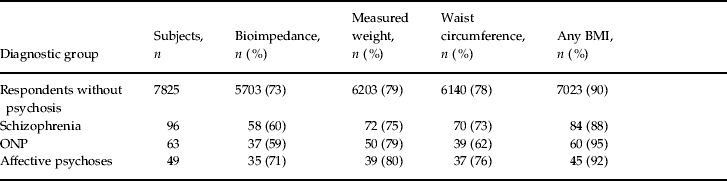
The final sample consisted of 7977 individuals alive at the time of the health interview. Of these, 6354 people participated in the health examination and 416 in the home health examination, yielding measurements of weight for 6361 participants, height for 6197, and valid bioimpedance measurements for 5831 (73.1%). When self-reported weight and height were both available, BMI was calculated for 7208 (90.4%) participants. Participation rates for different measurements are reported in Table 1.
Participation in different measurements

BMI, Body mass index, ONP, other non-affective psychosis.
Statistical methods
Analyses were conducted using stata 8.2 for Windows statistical software (StataCorp LP, College Station, TX, USA). All analyses accounted for the two-stage sampling design. Post-stratification weights were used to correct for non-response and oversampling of people aged >80 years (Koskinen & Aromaa, Reference Koskinen and Aromaa2002). The confidence intervals (CIs) for proportions were constructed using a logit transformation so that their endpoints always lay between 0 and 1.
To analyse the significance of using measured instead of self-reported weight, we compared the prevalence of obesity achieved using both methods, and calculated the mean differences between self-reported and measured weights for different weight groups.
We used logistic regression for the survey data to analyse the association between different diagnoses, obesity and abdominal obesity. Linear regression for the survey data was used to analyse the continuous variables of fat percentage, fat-free mass and muscle mass. Subjects without a psychotic disorder were used as the reference category. Thus the controls could have some other psychiatric diagnosis, but did not have any psychotic disorder. Regression analyses were conducted in a step-wise manner. First, only age and gender were adjusted for; second, BMI was added (except for the model analysing obesity, as BMI was the measure of obesity used). Third, education, healthiness of the diet, smoking and antipsychotic medication were included. All covariates except BMI were entered as dummy variables. Separate models were created for each diagnostic group.
Results
Self-reported and measured weight
Comparing self-reported to measured weight, we found a mean under-reporting of 1.15 (s.d.=2.52) kg. Under-reporting increased with weight, so that people with BMI between 20 and 25 kg/m2 under-reported by 0.43 (s.d.=1.94) kg but people with BMI ⩾30 kg/m2 under-reported by 2.27 (s.d.=3.24) kg. Using self-reported weight would have led to a 15% underestimate in the prevalence of obesity (18.9% instead of the 22.3% found using measured weight).
Sociodemographics and unadjusted body composition measures
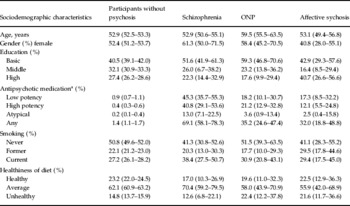
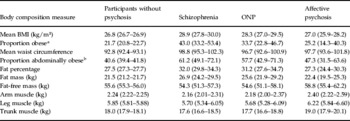
The sociodemographic characteristics of the sample are presented in Table 2. Participants with psychotic disorders did not differ by gender, but those with ONP were significantly (p=0.0009) older than the population. Unadjusted body composition measures are presented in Table 3. Prevalence of obesity was 43.0% (95% CI 22.8–46.7%) in persons with schizophrenia, 33.7% (95% CI 22.8–46.7%) in persons with ONP, 25.2% (95% CI 14.3–40.3%) in persons with affective psychoses and 21.7% (95% CI 20.8–22.7%) in the remaining study sample. Prevalences for abdominal obesity were 61.2% (95% CI 49.1–72.1%), 57.7% (95% CI 42.9–71.3%) and 47.3% (95% CI 31.3–63.3%) in persons with schizophrenia, ONP and affective psychosis, respectively and 40.6% (95% CI 39.4–41.8%) in the remaining participants.
Sociodemographic characteristics and unadjusted body composition measures of the sample

ONP, Other non-affective psychosis.
Values in parentheses are 95% confidence intervals.
a Categories are not mutually exclusive.
Unadjusted body composition measures of the sample

ONP, Other non-affective psychosis; BMI, body mass index.
Values in parentheses are 95% confidence intervals.
a BMI >30 kg/m2.
b Waist circumference ⩾102 cm for men and ⩾88 cm for women.
Adjusted body composition measures
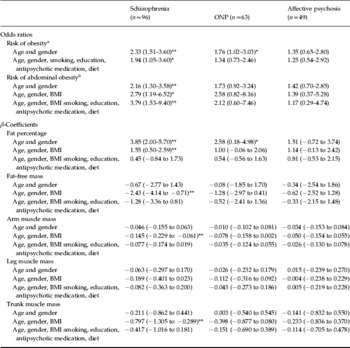
Results of the regression analyses examining the associations between diagnoses and body composition are presented in Table 4.
Risk of obesity or abdominal obesity in different psychotic disorders (reported as odds ratios) and detailed body composition in different psychotic disorders adjusting for age, gender, BMI, smoking, education, antipsychotic medication and diet (reported as β-coefficients)

BMI, Body mass index; ONP, other non-affective psychosis.
Values in parentheses are 95% confidence intervals.
a BMI >30 kg/m2.
b Waist circumference ⩾102 cm for men and ⩾88 cm for women.
* p<0.05, ** p<0.01.
Schizophrenia was associated with obesity [odds ratio (OR) 2.3 (95% CI 1.5–3.6) when age and gender were controlled for; OR 1.9 (95% CI 1.1–3.6) when all background variables were controlled for]. Schizophrenia was also associated with abdominal obesity, with a trend of increasing ORs as more covariates were included in the model. ORs were 2.2 (95% CI 1.3–3.6) for the model including age and gender, 2.8 (95% CI 1.2–6.5) when BMI was added and 3.8 (95% CI 1.5–9.4) when education, antipsychotic medication, smoking and diet were included. Schizophrenia was associated with greater fat percentage when age and gender, and age, gender and BMI were controlled for [β-coefficients 3.8 (95% CI 2.0–5.7) and 1.5 (95% CI 0.5–2.6), respectively], but this association ceased to be statistically significant when all covariates were entered into the model. Schizophrenia was also associated with statistically significantly lower fat-free mass (β-coefficient −2.4, 95% CI −4.1 to −0.7) in the model controlling for age, gender and BMI. When investigating the segmental distribution of muscles between upper and lower limbs and trunk, schizophrenia was associated with statistically significantly lower muscle mass of the upper limbs and trunk in the models adjusting for age, gender and BMI.
In the groups of ONP and affective psychosis the risk for obesity and abdominal obesity were elevated, but the finding was not statistically significant. The participants with ONP had statistically significantly higher fat percentage, but the effect disappeared after adjusting for BMI. There were no statistically significant differences in fat-free mass between participants with ONP and affective psychosis compared with participants with no psychotic disorder. The results of segmental muscle mass distribution did not reveal consistent differences between the reference group and participants with ONP or affective psychosis.
Discussion
To our knowledge this is the first study to show detailed body composition results from individuals with and without psychotic disorder using a population-based sample. The body composition of participants with schizophrenia differed from those without psychotic disorders and from persons with other psychotic disorders. Schizophrenia was associated with obesity and higher fat percentage, but also with abdominal obesity even after controlling for BMI, and with less muscle mass particularly in the arms and trunk. Thus, the problem of adverse body composition appears to be more serious than suggested by the use of mean BMI only: both abdominal obesity (Bigaard et al. Reference Bigaard, Tjonneland, Thomsen, Overvad, Heitmann and Sorensen2003, Reference Bigaard, Frederiksen, Tjonneland, Thomsen, Overvad, Heitmann and Sorensen2005) and low fat-free mass (Bigaard et al. Reference Bigaard, Frederiksen, Tjonneland, Thomsen, Overvad, Heitmann and Sorensen2005) have been associated with higher mortality in previous studies even after adjusting for the effect of BMI. While the independent effect of schizophrenia diagnosis on BMI and fat percentage disappeared after adjusting for the effect of medication and lifestyle-related factors, its effect on abdominal obesity actually became stronger after the adjustment.
Our results are consistent with previous findings of a high prevalence of obesity in persons with schizophrenia (Homel et al. Reference Homel, Casey and Allison2002; Heiskanen et al. Reference Heiskanen, Niskanen, Lyytikäinen, Saarinen and Hintikka2003; Cohn et al. Reference Cohn, Prud'homme, Streiner, Kameh and Remington2004; Kato et al. Reference Kato, Currier, Gomez, Hall and Gonzalez-Blanco2004; McEvoy et al. Reference McEvoy, Meyer, Goff, Nasrallah, Davis, Sullivan, Meltzer, Hsiao, Scott and Lieberman2005; Saari et al. Reference Saari, Lindeman, Viilo, Isohanni, Jarvelin, Lauren, Savolainen and Koponen2005; Susce et al. Reference Susce, Villanueva, Diaz and de Leon2005; Correll et al. Reference Correll, Frederickson, Kane and Manu2006; De Hert et al. Reference De Hert, van Winkel, Van Eyck, Hanssens, Wampers, Scheen and Peuskens2006; Hägg et al. Reference Hägg, Lindblom, Mjörndal and Adolfsson2006; Hakko et al. Reference Hakko, Komulainen, Koponen, Saari, Laitinen, Jarvelin and Lindeman2006; Bobes et al. Reference Bobes, Arango, Aranda, Carmena, Garcia-Garcia and Rejas2007; Suvisaari et al. Reference Suvisaari, Perälä, Saarni, Härkänen, Pirkola, Joukamaa, Koskinen, Lönnqvist and Reunanen2008) and a higher fat percentage of patients with schizophrenia or schizophreniform disorder (Nilsson et al. Reference Nilsson, Forslund, Olsson, Hambraeus and Wiesel2006; Amani, Reference Amani2007; Satoh et al. Reference Satoh, Sakuda, Kobayashi, Kataoka, Nakao and Turale2007). Abdominal obesity is a component of the metabolic syndrome and seems to be particularly prevalent in females with schizophrenia and other psychotic disorders (Heiskanen et al. Reference Heiskanen, Niskanen, Lyytikäinen, Saarinen and Hintikka2003; McEvoy et al. Reference McEvoy, Meyer, Goff, Nasrallah, Davis, Sullivan, Meltzer, Hsiao, Scott and Lieberman2005; Correll et al. Reference Correll, Frederickson, Kane and Manu2006; De Hert et al. Reference De Hert, van Winkel, Van Eyck, Hanssens, Wampers, Scheen and Peuskens2006; Bobes et al. Reference Bobes, Arango, Aranda, Carmena, Garcia-Garcia and Rejas2007). It is well known that antipsychotic medication leads to weight gain and metabolic adverse effects (Allison et al. Reference Allison, Mentore, Heo, Chandler, Cappelleri, Infante and Weiden1999; Anonymous, 2004; Bergman & Ader, Reference Bergman and Ader2005). In a canine model olanzapine has shown to substantially increase adiposity, especially visceral fat depots independently of an underlying psychiatric disease. In the same study risperidone caused only modest increases in adiposity (Ader et al. Reference Ader, Kim, Catalano, Ionut, Hucking, Richey, Kabir and Bergman2005). A small study investigating drug-naive and drug-free patients with schizophrenia and age- and gender-matched controls found over three times more intra-abdominal fat in patients than controls, although total body and subcutaneous fat did not differ significantly (Thakore et al. Reference Thakore, Mann, Vlahos, Martin and Reznek2002). In line with this study, our results suggest that abdominal obesity may be an intrinsic feature of schizophrenia, not explained solely by lifestyle-related factors and antipsychotic medication use. In contrast, the effect of diagnosis on fat mass and BMI disappeared after controlling for the effect of lifestyle and antipsychotic medication. This fits with previous evidence on weight gain associated with antipsychotic medication (Allison et al. Reference Allison, Mentore, Heo, Chandler, Cappelleri, Infante and Weiden1999) and on unhealthy lifestyle in persons with schizophrenia (Brown et al. Reference Brown, Birtwistle, Roe and Thompson1999; Samele et al. Reference Samele, Patel, Boydell, Leese, Wessely and Murray2007). In other words, based on our results, medication and lifestyle contribute to overweight but do not explain why the fat is located around the waist. The interesting comparison between the effects of different antipsychotics was not conducted because risperidone was the only atypical antipsychotic presented in these data and groups by medication were too small to reach statistical power. Taking into account the cross-sectional nature of our sample, no conclusions of causal direction can be made.
Abdominal obesity combined with decreased fat-free mass is a more severe problem than obesity in terms of increased BMI. Decreased fat-free mass is associated with increased disability and mortality (Roubenoff, Reference Roubenoff2003) and a 10% larger waist circumference corresponds to 50% higher mortality over the whole range of waist circumference in men and women (Bigaard et al. Reference Bigaard, Tjonneland, Thomsen, Overvad, Heitmann and Sorensen2003).
A dysfunctional hypothalamic–pituitary axis (HPA) and the resultant insulin resistance may be one explanation for abdominal obesity and low muscle mass in persons with schizophrenia. It is well documented that environmental and biological stress leads to changes in the function of the HPA and glucocorticoid metabolism(Björntorp & Rosmond, Reference Björntorp and Rosmond2000), and increases in activity and volume of the pituitary gland have been found in patients at an early phase of psychosis(Pariante et al. Reference Pariante, Vassilopoulou, Velakoulis, Phillips, Soulsby, Wood, Brewer, Smith, Dazzan, Yung, Zervas, Christodoulou, Murray, McGorry and Pantelis2004). Abnormalities in these humoral pathways seem to be responsible for central fat accumulation(Björntorp & Rosmond, Reference Björntorp and Rosmond2000). Body fat, especially in the abdominal region, is a metabolically active tissue secreting pro-inflammatory [i.e. interleukin (IL)-6, tumour necrosis factor α] and catabolic (leptin, retinol-binding protein 4) agents (Roubenoff, Reference Roubenoff2003; Graham et al. Reference Graham, Yang, Bluher, Hammarstedt, Ciaraldi, Henry, Wason, Oberbach, Jansson, Smith and Kahn2006). These, in concert with the insulin resistance associated with abdominal obesity, contribute to a loss of muscle mass (Roubenoff, Reference Roubenoff2003). And, with lower muscle mass, physical activity becomes progressively more difficult. Increased fat mass and lowered muscle mass act synergistically, leading to increased CVD morbidity (Alexandersen et al. Reference Alexandersen, Tanko, Bagger, Jespersen, Skouby and Christiansen2006) and further disability (Roubenoff, Reference Roubenoff2003; Suvisaari et al. Reference Suvisaari, Saarni, Perälä, Suvisaari, Härkönen, Lönnqvist and Reunanen2007).
Participants with ONP had an increased risk of obesity and a higher fat percentage than the reference group, but the effect diminished after adjusting for confounding factors. The risk for abdominal obesity was elevated in this group too, but not statistically significantly. Although these findings are similar to those in the schizophrenia group they should be interpreted with caution due to the large CIs, which might be explained by the heterogeneity of the ONP group.
We found no consistently significant differences in body composition among participants with affective psychosis as compared with the population with no psychotic disorder. This accords with our previous results concerning the prevalence of type 2 diabetes and the metabolic syndrome, in which no differences between persons with affective psychoses and the general population were found (Suvisaari et al. Reference Suvisaari, Saarni, Perälä, Suvisaari, Härkönen, Lönnqvist and Reunanen2007, Reference Suvisaari, Perälä, Saarni, Härkänen, Pirkola, Joukamaa, Koskinen, Lönnqvist and Reunanen2008). Other studies on the association between mood disorders and obesity are inconsistent and the findings depend on the subtypes of both obesity and psychiatric disorder, and on age, gender and covariates used (McElroy et al. Reference McElroy, Kotwal, Malhotra, Nelson, Keck and Nemeroff2004). Our sample included only participants with psychotic symptoms, and different affective psychoses (bipolar and unipolar) were analysed together.
Although this study was based on a large general population survey the number of subjects in each category of psychotic disorder remained relatively low, yielding wide CIs. As the subjects with psychotic disorder were compared with the rest of the population, some control subjects had psychiatric non-psychotic disorders (Pirkola et al. Reference Pirkola, Isometsä, Suvisaari, Aro, Joukamaa, Poikolainen, Koskinen, Aromaa and Lönnqvist2005). We believe that most probably this diluted our findings to some extent, since there is evidence of association between non-psychotic psychiatric disorders, especially depression, and increased risk for metabolic adversities (Goldbacher & Matthews, Reference Goldbacher and Matthews2007; Räikkönen et al. Reference Räikkönen, Matthews and Kuller2007). This is the first study to report detailed body composition in different DSM-IV psychotic disorders from a representative sample of a general population. The strengths of the study are a good sampling design representing the adult population of one country. The psychiatric diagnostic was reliable and we used detailed measurements of body composition.
BIA is an inexpensive, simple and reasonably accurate technique for assessing fat and fat-free mass in epidemiological studies (Heitmann, Reference Heitmann1994). However, although the SMFBIA analyser used in this study has been shown to correlate well with other methods of body composition analysis, the absolute estimates of fat-free mass and fat percentage still differ significantly between the different methods and also between different equipment based on similar technology (Fogelholm & van Marken Lichtenbelt, Reference Fogelholm and van Marken Lichtenbelt1997). However, as the main results of our study are comparisons of differences between groups, the possibility of a systematic bias in absolute fat percentage and fat-free mass estimates should not be a major problem.
Conclusions
The effect of schizophrenia on abdominal obesity became more evident when adjusting the regression models for lifestyle factors and medication. This can be interpreted as the disease having an inherent effect on fat accumulation. This question would need further investigation, possibly in longitudinal follow-up studies.
In accord with our earlier results, Nasrallah et al. have recently shown that metabolic and CVDs in patients with schizophrenia often go undertreated (Nasrallah et al. Reference Nasrallah, Meyer, Goff, McEvoy, Davis, Stroup and Lieberman2006; Suvisaari et al. Reference Suvisaari, Saarni, Perälä, Suvisaari, Härkönen, Lönnqvist and Reunanen2007, Reference Suvisaari, Perälä, Saarni, Härkänen, Pirkola, Joukamaa, Koskinen, Lönnqvist and Reunanen2008). Our results demonstrate that individuals with schizophrenia have metabolically unfavorable body composition compared with the rest of the population and are therefore at higher risk of metabolic and CVDs. Good care of somatic co-morbidities and monitoring of risk factors would be of great public health importance.
Acknowledgements
This study was supported by grants from the Foundation for Psychiatric Research (S. E. S.) and the Gyllenberg Foundation (S. E. S.), the Stanley Medical Research Institute (J. S.), the Academy of Finland (J. L.) and the Yrjö Jahnsson Foundation (J. S.). The funding sources listed above had no involvement.
Declaration of Interest
None.