1. Introduction
The linkage between carbon emissions reduction, economic growth, and poverty alleviation is an issue of immense relevance for India. India is highly vulnerable to global climate change caused by emissions of greenhouse gases such as carbon dioxide. The adverse effects of climate change would in all likelihood retard the developmental process and aggravate poverty. At the same time, India's per capita carbon emission is already very low. It is 0.26 ton per annum, which is one-fourth of the world average per capita emission of one ton per annum (Parikh et al., Reference Parikh, Parikh, Gokarn, Painuly, Saha and Shukla1991). In other words, India's per capita contribution to the global warming problem is a relatively minor one. However, because of its large and rising population, its total emissions are large and growing. Internationally, India is expected to stabilize its energy-related carbon emissions. Moreover, it is being realized in Indian policy circles that India has a real stake in a global policy regime to stabilize global carbon emissions. More specifically, Indian policy makers are beginning to see the need to understand the implications for India of a Kyoto-type emissions trading regime.
At the domestic level, India is concerned with the reduction of carbon emissions whether a global system of tradable emission permits, inclusive of the developing countries, materializes or not. This concern, however, is a long-term one. Switching over to non-polluting sources of energy such as hydro and nuclear is often unrealistically mentioned as a strategy that will sweep away the problem of carbon emissions. A medium-term policy option such as a carbon tax, however, is viewed with suspicion, largely because of its likely adverse impact on economic growth and poverty reduction. For a low-income country like India, the more pressing need obviously is achieving poverty reduction rather than controlling carbon emissions. Nevertheless, it would be worthwhile exploring how much, if at all, carbon taxes trade-off growth and poverty reduction, and what compensatory mechanisms can be built into the system to mitigate the undesirable effects of carbon taxes on economic growth and poverty alleviation.
1.1. The energy and emissions scene in India
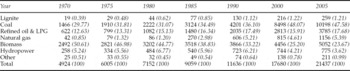
In India the energy consumption pattern has been shifting increasingly in favor of the commercial forms of energy like coal, refined oil, natural gas, and electricity. In the last four decades, the growth rate of commercial energy consumption has been higher than that of the total energy consumption. Coal itself accounts for more than 37 per cent of the total energy consumption in 1990–91, with the share of refined oil and natural gas being about 18 per cent and 5 per cent respectively. Among the non-fossil sources of energy, hydro-electricity has a small share of about 6.2 per cent, and the non-conventional energy sources such as nuclear, wind, and solar power taken together have an even smaller share of 0.6 per cent (table 1).
Energy consumption in India (petajoules)

Notes: 1. Refined Oil and LPG includes non-energy use of gas and fuel oil for fertilizer and petrochemical production.
2. For hydro, nuclear and renewables, energy is the coal equivalent for electricity generation.
3. Other includes nuclear, wind, solar etc.
4. The italicized figures in parentheses show percentages with respect to the total.
Source: Author's estimates based on CMIE–Energy and TEDDY (2002/03).
The flip side of the energy consumption pattern of the Indian economy is that the share of the non-commercial sources of energy, like biomass, in the total energy consumption is secularly declining. It was as high as 51 per cent in 1970–71, but had come down steadily to only 24 per cent by 2005–06. Nevertheless, it remains true that about one-fourth of the total energy requirement in India is still met by traditional biomass (table 1).
Hence, it is arguable that biomass is a carbon-free option, and, given the appropriate shift or tilt in climate change policy, its use may increase rather than decrease. For example, afforestation and reforestation projects may change the relative prices of biomass alternatives, such as fuelwood, in the latter's favor, thereby encouraging its use as a source of energy.
Going by the facts as they exist in India, it is hard to see how the declining trend in the use of traditional biomass energy can be reversed. The facts unmistakably point towards a steady decline in the use of traditional biomass (table 1). There are various reasons for the dwindling importance of traditional biomass as a source of energy (see Karekezi et al., Reference Karekezi, Lata and Coelho2004). Moreover, it must be noted that the burning of biomass per se emits as much carbon dioxide into the atmosphere as, say, the burning of fossil fuels. That is to say, if the renewability of biomass is not taken into account, it will turn out to be a significant contributor to global warming. In fact, owing to the land degradation and deforestation caused by demand for fuelwood and other demands for timber, the forestry sector in India currently ends up emitting more carbon as compared to carbon sequestered by tree growth (Gundimeda, Reference Gundimeda, Toman, Chakravarty and Gupta2004).
On the other hand, use of improved and modern biomass energy technologies coupled with afforestation and reforestation is truly a renewable carbon-free energy option. Improved biomass energy technologies (IBETs) – such as an improved cookstove – and modern biomass energy technologies (MBETs) – such as use of biofuels in transportation – have the potential to provide environmentally friendly energy services based on reproducible biomass resources (Karekezi et al., Reference Karekezi, Lata and Coelho2004). Moreover, Gundimeda (Reference Gundimeda, Toman, Chakravarty and Gupta2004) has shown that India can benefit significantly by using forests for carbon sequestration.
Obviously, then, IBETs and MBETs together with afforestation represent a potent climate policy option for India. However, any perceptible switch to improved and modern biomass must be preceded by appropriate technological innovations in production and consumption. That is not easily forthcoming in the next 2–3 decades in India. Hence, this policy option is beyond the scope of the present paper, which does not take up climate change policies in totality, but focuses on only a subset of the climate policy options for India – domestic carbon taxes and participation in an internationally tradable emission permits regime – over a 30-year time horizon, 1990–2020. Likewise, the emergence of hydropower as a viable clean energy option in the foreseeable future is hardly warranted by the observed lack of success in raising its share in gross power generation in the recent past (Sengupta and Gupta, Reference Sengupta, Gupta, Toman, Chakravarty and Gupta2004).
The present study, therefore, analyses the impact of (i) domestic carbon tax and (ii) India's participation in an internationally tradable emission permits regime, on carbon emissions, gross domestic product (GDP), and poverty in the Indian economy, with the help of a top–down, quasi-dynamic, neoclassical type price-driven computable general equilibrium (CGE) model that excludes renewable energy sources, particularly improved and modern biomass and hydropower. However, to be able to assess the impact of the proposed climate policies on poverty, we had to move from the standard single-representative household-based CGE model to a CGE model with multiple households differentiated on the basis of consumption expenditure limits. Our model has an elaborate income and consumption distribution mechanism, in which factoral incomes are first mapped on to 15 income percentiles and then on to five consumption expenditure classes. The bottom consumption expenditure class corresponds to those below the poverty line, which implies that the poverty ratio – i.e. the percentage of population below the poverty line – is endogenously determined in the model.
The non-uniform increases in the prices of fossil fuels – coal, refined oil, and natural gas – caused by a carbon tax, will lead to some fuel switching as well as an overall fuel reducing effect. Our model will effectively capture the net impact of these effects on GDP, income distribution, and poverty.
Needless to say, having developed a CGE model that endogenously determines the poverty ratio we intend, in a future study, to further enlarge it to incorporate the renewable energy sources as well. This will enable us to analyze other carbon mitigation options, such as promotion of renewable energy and carbon sequestration.
The two policy instruments of domestic carbon taxes and participation in internationally tradable emission permits regime have been under discussion in the literature on climate policy in India. Fisher-Vanden et al. (Reference Fisher-Vanden, Shukla, Edmonds, Kim and Pitcher1997) used a CGE model to compare the impacts of these two policies on GDP, and found that tradable permits are preferable to carbon taxes. In a comparison of the two types of schemes for emission permits – the grandfathered emissions allocation scheme in which permits are allocated on the basis of 1990 emissions, and the equal per capita emission permits allocation scheme – they found the latter to be more beneficial for India. Incidentally, the CGE model of Fisher-Vanden et al. (Reference Fisher-Vanden, Shukla, Edmonds, Kim and Pitcher1997) is based on the assumption of a single representative household. Hence, it does not reflect the impact of carbon taxes on income distribution or the poverty ratio. Murthy et al. (Reference Murthy, Panda and Parikh2007) used an activity-analysis-based model with endogenous determination of income distribution and poverty ratio. They showed that India stands to gain both in terms of GDP and poverty reduction if the emission permits are allocated on the basis of equal per capita emission rights. However, Murthy et al. (Reference Murthy, Panda and Parikh2007) did not analyze the impact of a domestic carbon tax as their model is not price driven.
Our model may thus be viewed as a union of the models of Fisher-Vanden et al. (Reference Fisher-Vanden, Shukla, Edmonds, Kim and Pitcher1997) and Murthy et al. (Reference Murthy, Panda and Parikh2007). Hence, it is ideally suitable for simulating the impact of carbon taxes and participation in an internationally tradable emission permits regime on GDP and poverty ratio.
The rest of the paper is organized as follows. Section 2 presents the overall model framework with special emphasis on the production structure, the linkages between production and carbon emissions, and the income distribution mechanism. (The equations of the model are set out in Ojha, Reference Ojha2005). Section 3 presents the main features, such as GDP growth, emissions growth, energy–GDP ratio and poverty ratio, of the base-line or the business-as-usual (BAU) scenario. In section 4, we report the simulation results of 12 alternative policy scenarios in comparison with the BAU scenario. Section 5 concludes and suggests the policy implications of our results.
2. Model structure
Our model is based on a neoclassical CGE framework that includes institutional features peculiar to the Indian economy. It is multi-sectoral and recursively dynamic. The overall structure of our model is similar to the one presented in Mitra (Reference Mitra1994). However, in formulating the details of the model – the production structure, the carbon dioxide (CO2) emission generation, and the income distribution mechanism – we follow an eclectic approach keeping in mind the focus on the linkages between inter-fossil-fuel substitutions, CO2 emissions, GDP growth, and poverty reduction.
The model includes the interactions of producers, households, the government, and the rest of the world in response to relative prices given certain initial conditions and an exogenously given set of parameters. Producers act as profit maximizers in perfectly competitive markets, i.e. they take factor and output prices (inclusive of any taxes) as given and generate demands for factors so as to minimize unit costs of output. The factors of production include intermediates, energy inputs, and the primary inputs – capital, land, and different types of labor. For households, the initial factor endowments are fixed. They, therefore, supply factors inelastically. Their commodity-wise demands are expressed, for given income and market prices, through the Stone−Geary linear expenditure system (LES). Also households save and pay taxes to the government. Furthermore, households are classified into five rural and five urban consumer expenditure groups. The government is not assumed to be an optimizing agent. Instead, government consumption, transfers, and tax rates are exogenous policy instruments. The total CO2 emissions in the economy are determined on the basis of the inputs of fossil fuels in the production process, the gross outputs produced, and the consumption demands of the households and the government, using fixed emission coefficients. The rest of the world supplies goods to the economy which are imperfect substitutes for domestic output, makes transfer payments, and demands exports. The standard small-country assumption is made, implying that India is a price-taker in import markets and can import as much as it wants. However, because the imported goods are differentiated from the domestically produced goods, the two varieties are aggregated using a constant elasticity of substitution (CES) function, based on the Armington assumption. For exports, a downward-sloping world demand curve is assumed. On the supply side, a constant elasticity of transformation (CET) function is used to define the output of a given sector as a revenue-maximizing aggregate of goods for the domestic market and goods for the foreign markets. The model is Walrasian in character. Markets for all commodities and non-fixed factors clear through adjustment in prices. Capital stocks are fixed and intersectorally immobile. However, by virtue of Walras' law, the model determines only relative prices. The overall price index is chosen to be the numeraire and is, therefore, normalized to unity. With the (domestic) price level fixed exogenously, the model determines endogenously both the nominal exchange rate and the foreign savings in the external closure (Robinson et al., Reference Robinson1999). Finally, because aggregate investment is exogenously fixed, the model follows an investment-driven macro closure, in which the aggregate savings – i.e. the sum of household, government, and foreign savings – adjusts, to satisfy the saving–investment balance.
2.1. Sectoral disaggregation
Our model is based on an 11-sector disaggregation of the Indian economy: (i) agriculture (agricult), (ii) electricity (elec), (iii) coal (coal), (iv) refined oil (refoil), (v) natural gas (nat-gas), (vi) crude petroleum (crude-pet), (vii) transport (trans), (viii) energy-intensive industries (enerint), (ix) other intermediates (otherint), (x) consumer goods (cons-good), and (xi) services (services).
There are five energy sectors – elec, coal, refoil, nat-gas, crude-pet – and six non-energy sectors – agricult, trans, enerint, otherint, cons-good and services. The sectoral division of the economy has been decided after perusal of the sectoral disaggregation in various other models – such as EPPA (Babiker et al., Reference Babiker, Reilly, Mayer, Eckaus, Wing and Hyman2001; Yang et al., Reference Yang, Eckaus, Ellerman and Jacoby1996), SGM (Edmonds et al., Reference Edmonds, Pitcher, Barns, Baron, Wise, Klein and Lo1993 and Murthy et al., Reference Murthy, Panda and Parikh2007) – and bearing in mind the focus of our model on the possibilities of fuel switching in the provision of energy inputs in the production process.
2.2. The production structure
Production technologies for all sectors are defined using nested CES functions, with the nesting structure of inputs differing across the sectors, or groups of sectors as in the EPPA model (Babiker et al., Reference Babiker, Reilly, Mayer, Eckaus, Wing and Hyman2001). At the top level of the nesting structure, domestic gross output is produced as a combination of non-energy–intermediate-inputs aggregate and energy–labor–capital aggregate. The latter, in turn, comprises of value-added (due to capital, self-employed labor, and wage-labor) and energy aggregate. Further down the nest, energy aggregate combines electricity and non-electricity-inputs aggregate, which in turn is an amalgamation of coal, natural gas, and refined oil. For the agriculture, electricity, coal, natural gas, crude petroleum and refined oil sectors, there are minor variations in the nesting structure. Nevertheless, for each sector there is a nested tree-type production function. And at each level of the nested production function, the assumption of CES and constant returns to scale (CRS) is made. Finally, for every level, the producer's problem is to minimize cost (or maximize profit) given the factor and output prices and express demands for inputs.
2.3. Technological change
Energy-saving technological progress is incorporated into our model by making the autonomous energy efficiency improvement (AEEI) assumption used in other carbon emission abatement models such as GREEN (Burniaux et al., Reference Burniaux, Nicoletti and Oliveira-Martins1992) and EPPA (Babiker et al., Reference Babiker, Reilly, Mayer, Eckaus, Wing and Hyman2001). As in the EPPA and GREEN, we also assume that AEEI occurs in all sectors except the primary energy sectors (viz., coal, crude petroleum, and natural gas) and the refined oil sector. India embarked on the path towards energy efficiency after 1991, but its record in energy efficiency improvement in the last decade is not very encouraging (Sengupta and Gupta, Reference Sengupta, Gupta, Toman, Chakravarty and Gupta2004). We have thus assumed a modest annual growth rate of energy efficiency for the Indian economy – i.e. 0.7 per cent.
2.4. Carbon emissions
CO2 is emitted owing to burning of fossil fuel inputs. The major fossil fuels used in India are coal, natural gas, refined oil, and crude petroleum. In addition to CO2 emitted by fuel combustion, there may be CO2 emanating from the very process of output generation. For example, the cement sector (a part of the enerint sector in our sectoral classification) releases CO2 in the limestone calcination process. Finally, CO2 emissions also result from the final consumption of households and the government.
We use fixed CO2 emission coefficients to calculate the sector-specific CO2 emissions from each of the three sources of carbon emissions. For the total CO2 emissions generated in the economy, we first aggregate the emissions from each of the sources over the 11 sectors and subsequently sum up the aggregate emissions across the three sources.
2.5. Carbon taxes
Carbon taxes are applicable only on the CO2 emitted in the production process (i.e. on the first two sources of carbon emissions), not on the CO2 emitted in the final consumption of households and the government (the third source of carbon emissions). Carbon taxes are based on the proportion of each fuel's carbon content, i.e. Rs per ton of carbon emitted. The carbon tax rate multiplied by a sector's carbon emissions gives the carbon emission tax payments by that sector. Summing across sectors we get the total carbon tax payments, which is then recycled to the household sector as additional transfer payments by the government. (In the base-line scenario, the carbon tax rate is fixed at zero and there are, therefore, no carbon tax payments.) Finally, the producer's cost function is modified to include the carbon taxes so that they induce a substitution in favor of lower carbon-emitting fossil fuels.
2.6. Investment
Public and private investments are fed into the model as two distinct constituents of the total investment. There are fixed share parameters for distributing the aggregate investment across sectors of origin. However, the allocation mechanisms for sectors of destination are different in the two cases of public and private investments. For public investment there is discretionary allocation, and the allocation ratios are set exogenously in the model. On the other hand, for private investment the allocation ratios are given in a particular period, but are revised from period to period on the basis of the sectoral relative return on capital. The relative return on capital in any sector is given by the normalization of the implicit price of capital in that sector to the economy-wide returns. This rule does not imply full factor price equalization, but only a sluggish reallocation of investment from sectors where rate of return is low to ones having higher rates of return (Mitra, Reference Mitra1994).
2.7. Capital stocks
Sectoral capital stocks are exogenously given at the beginning of a particular period. However, our model is recursively dynamic, which means that it is run for many periods as a sequence of equilibria. Between two periods there will be additions to capital stocks in each sector because of the investment undertaken in that sector in the previous period. More precisely, sectoral capital stocks for any year t are arrived at by adding the investments by destination sectors, net of depreciation, in year t–1 to the sectoral capital stocks at the beginning of the year t–1.
2.8. Factor, household incomes and transfers
Factor incomes – i.e. self-employment incomes, wage incomes, incomes from rent accruing to fixed factors including land, and capital (profit) incomes – are generated as factor returns times employment in the relevant sectors, and then summed over all the sectors. To these five types of income is added a sixth type – transfer payments by government and rest of the world. From the factor incomes, taxes, wherever applicable, are netted out to arrive at disposable incomes.
2.9. Income distribution and poverty ratio
The treatment of income and consumption distribution in our model is quite elaborate, as it should be. The mechanics of the income distribution are strictly guided by the type of data available in India.Footnote 1 A detailed account of the income distribution module is provided in Mitra (Reference Mitra1994). Here we outline the main steps:
Step 1: We start with the factoral incomes and map them on to incomes accruing to 15 income classes using a constant share income allocation scheme (obtained from secondary data sources of the Indian economy) for all six types of income – self-employment income, wage income, capital income, income from land and fixed factors and transfer payments by government and rest of the world. Given Yh, the income accruing to class h, and θh, the share of households in class h in the total population (also known from data sources), we compute the mean and variance of household income.
Step 2: We then make the assumption that the distribution of population according to per capita income and per capita consumption is bivariate log-normal.
(a) Since the distribution of income and consumption expenditure is assumed to be bivariate log-normal, the mean and variance of the logarithm of per capita income is computed from the mean and variance of household income of step 1.
(b) The bivariate log-normality assumption implies that log income and log consumption expenditure are linearly related, so the mean and variance of log per capita consumption expenditure can be easily calculated.
Step 3: Given the mean and standard deviation of log income and log consumption expenditure, we derive the distributions of population, consumption, and total income from five consumption expenditure classes. The upper boundaries of the five classes – cel1, cel2, cel3, cel4, cel5 in descending order – are taken from the consumption expenditure data published by the NSSO – 45th Round. More specifically, we find the shares of (i) population, (ii) consumption, and (iii) total income accruing to the households that fall under expenditure level celk , for k = 1,2, . . .,5, using the standardized cumulative normal distribution. The per capita expenditure limit cel5 of the bottom-most consumption expenditure class represents the poverty line. Hence, the poverty ratio is the share of population with per capita consumption expenditure less than or equal to “cel5”.
2.10. Savings
For each of the five rural and five urban classes, household savings is determined residually from their respective budget constraints, which state that household income is either allocated to household consumption or to household savings. Total household savings in the economy is an aggregate of the savings of the ten urban and rural consumption expenditure classes. Government savings is obtained as the sum of the tax and tariff revenues, less the value of its consumption and transfers. Government revenue originates from the following five sources: taxes on domestic intermediates, tariffs on imported intermediates, taxes on consumption and investment, taxes on final imports, and income taxes – i.e. taxes on wage, self-employed, and capital (profit) incomes. All taxes (excluding carbon tax) are of the proportional and ad valorem type, and all the tax rates are exogenously given. Government expenditure takes place on account of government consumption and transfers to households, both of which are exogenously fixed. The carbon emission tax revenues are recycled to the households via the government, which means that they are included in (or excluded from) both the revenue and the expenditure of the government budget. Foreign savings in the model is expressed as the excess of payments for intermediate and final imports over the sum of exports earnings, net current transfers and net factor income from abroad. The latter two are exogenously given values in the model.
3. The baseline scenario
Our CGE model has been calibrated to the benchmark equilibrium data set of the Indian economy for the year 1989–90. The basic data set of the Indian economy for the year 1989–90 has been obtained from the CSO-NAS (Central Statistical Organisation, National Accounts Statistics of India, various issues from 1989–90 to 1992–93) and the CSO–IOTT (Central Statistical Organisation, 1997, Input–Output Transactions Table, 1989–90). Other parameters and initial values of different variables have been estimated from the data available in various other published sources.Footnote 2
Given the benchmark data set for all the variables and the elasticity parameters, the shift and share parameters are calibrated in such a manner that if we solve the model using the base-year data inputs, the result will be the input data itself (Shoven and Whalley, Reference Shoven and Whalley1992).
Finally, using a time series of the exogenous variables of the model, we generate a sequence of equilibria for the period 1990–2020. From the sequence of equilibria, the growth paths of selected (macro) variables of the economy are outlined to describe the base-line scenario.
3.1. The macro variables
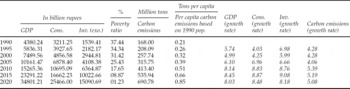
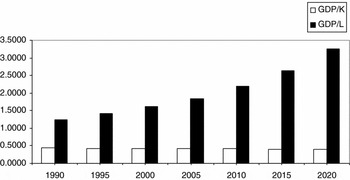
In the base-line scenario, real GDP growth throughout the period 1990–2020 varies in the range 4.5 per cent–8.5 per cent. The GDP growth rate, which is 5.7 per cent per year during 1990–95, slows down to less than 5 per cent in the period 1995–2000. After that, the Indian economy experiences a turnaround during 2000–2005, and subsequently takes off into a high growth zone. That is, beyond the year 2005 the growth rate exceeds 8 per cent per year and this high growth rate is sustained till the end of the period, 2020 (table 2). The driving force of GDP growth in our model comes from growth in two main exogenous variables – investment and labor supply – with the former growing faster than the latter. When capital stock grows faster than labor supply, the relative return on capital declines, which induces a substitution away from labor into capital. This, in turn, results in an increase in labor productivity, measured as GDP per unit of labor (figure 1). Growth in labor productivity coupled with the simultaneous growth in labor supply is what provides the primary impetus to GDP growth.
Macrovariables, poverty ratio and carbon emissions of the BAU scenario

Note: The growth rates for each of the quinquenniums are the annual growth rates.
BAU scenario: GDP/K and GDP/L.

3.2. Poverty ratio
The drivers of the growth process – capital accumulation and labor supply accretion – described above are also instrumental in altering the income distribution and the poverty ratio. The faster growth in capital stock relative to labor supply leads to a fall in the relative return on capital. Predictably, this stimulates a substitution in favor of capital and against labor. The consequent increase in demand for capital arrests the decline in return to capital. Hence, the net effect is that the relative return to capital does not change very much. All in all, in the general equilibrium setting, the functional distribution of income does not vary markedly.
Further, the impact on household income distribution and, thereby on the relative income and/or consumption inequality, is even more muted. Given that the factor incomes are mapped onto household incomes through a fixed allocative scheme signifying a given distribution of endowments of land, capital, and labor of different types, it cannot be otherwise.
However, as the economy grows, there is – minimum change in functional income distribution notwithstanding – a virtual scaling up of factor incomes which via the constant share income allocation scheme leads to scaled-up household incomes. The latter then works itself out interactively through the bivariate lognormally distributed income–consumption module to yield a smaller share of population in the fifth consumption expenditure class or below the so-called ‘poverty line’. Hence, the perceptible decline in poverty ratio.
The poverty ratio in the base-line scenario declines from 37.4 per cent in 1990 to 1.2 per cent in 2020 (see table 2). However, the noteworthy fact is that the decline in poverty ratio is very much linked to the growth in GDP. That is to say, with the GDP growing faster after 2005, the decline in poverty also speeds up. In the first 15-year period (1990–2005), the poverty ratio declines quinquennially by about 3–6 percentage points; in the second 15-year period (2005–2020), it declines quinquennially by about 7–9 percentage points (table 2).
3.3. Energy use
Total energy use increases by about 332 per cent over the 30-year period 1990–2020. The annual growth rates of energy use and GDP move more or less in tandem until 2005. However, after 2005, the growth rates of energy use, relative to the GDP growth rates, fall sharply. This is reflected in a declining energy use per unit of GDP beyond 2005. This happens because of increased substitution of capital in the production process, and modest autonomous energy efficiency improvement.
3.4. Carbon emissions
Total carbon emissions in the period 1990–2020 rise from 168 million tons to 691 million tons at an average rate of 5.7 per cent per year. However, what is significant is that the growth rate of emissions relative to GDP growth rate falls steeply, particularly beyond 2005 (table 2). This is explained principally by the decline in the energy–GDP ratio after 2005, rather than by fuel switching in favor of low carbon-emitting fossil fuels, which in any case is insignificant. The share of coal in the total emissions remains virtually unchanged, around 72 per cent, throughout the period.
In assessing India's contribution to global carbon emissions, it is important to look at the per capita carbon emissions based on the population of year 1990.Footnote 3 India's per capita emissions in 1990 turn out to be 0.21 tons. It increases quite rapidly over the 30-year period and goes up to 0.85 tons by the year 2020 (table 2). Even this level of per capita emissions is considerably less than the global per capita emissions which is approximately 1 ton per year.
4. Policy simulations
We develop 12 alternative policy scenarios for two basic policy instruments for carbon emissions abatement: (i) domestic carbon tax and (ii) internationally tradable emission permits based on grandfathered and equal per capita emissions allocation.
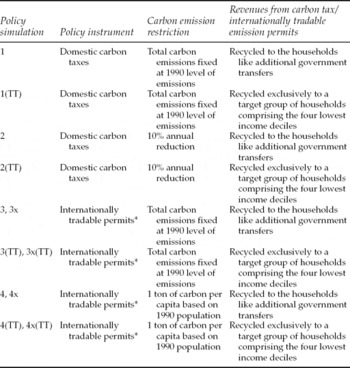
For the domestic carbon tax policy we have four policy scenarios: simulations 1 and 1(TT) and 2 and 2(TT). Policy simulations 1 and 2 deal respectively with the two cases of (1) fixing the carbon emission at the 1990 level all through the 30-year period, and (2) 10 per cent annual reduction in emissions, with two variants in each – one in which the carbon tax revenues are recycled to the households like additional government transfers, i.e. the across-the-board transfers case, and the other in which the tax revenues are transferred exclusively to a target group comprising of the four lowest income deciles, i.e. the targeted transfers (TT) cases.Footnote 4
For internationally tradable emission permits, we have four policy scenarios – simulations 3 and 3(TT) and 4 and 4(TT) – representing the same two variants, with the difference that instead of carbon tax revenues, we have, in this case, revenues earned from the sale of permits. For the policy scenarios 3 and 3(TT), the emission quota is fixed at the (aggregate) emissions level of the year 1990. For the policy scenarios 4 and 4(TT), the emissions quota is fixed at 1 ton per capitaFootnote 5 based on the 1990 population as suggested by Parikh and Parikh (Reference Parikh and Parikh1998), who have argued that this would ensure equity between developed and developing countries and simultaneously discourage the latter from increasing their population. The permit price for the simulations 3, 3(TT), 4, and 4(TT) is exogenously given to be US$ 10 per ton of carbon emission, which is Rs 166 per ton at the 1989–90 exchange rate of Rs 16.60 per dollar. To assess sensitivity of results to higher prices, each of these simulations is also repeated for the higher price of US$20 per ton of carbon emission. These simulations are denoted as 3x, 3x(TT), 4x, and 4x(TT). So, in effect there are eight scenarios for internationally tradable permits (table 3).
The policy simulations

Notes: TT: targeted transfers. *Permit price = $10 (Rs 166) per ton, and $20 (Rs 332) per ton.
In reality, the permit price will emerge from a global trading system of permits, which, for example, has been modeled by Edmonds et al. (Reference Edmonds, Pitcher, Barns, Baron, Wise, Klein and Lo1993) in the SGM. However, ours is a country-specific exercise focusing on how India stands to gain or lose from an internationally tradable permits regime. Moreover, the ‘small-country’ assumption applies, and India's sale or purchase of permits does not affect the latter's world market price; for India, therefore, the world market price of permits is exogenously given (Fisher-Vanden et al., Reference Fisher-Vanden, Shukla, Edmonds, Kim and Pitcher1997; Murthy et al., Reference Murthy, Panda and Parikh2007).
The 12 policy simulations are summarized in table 3.
4.1. The adjustment mechanism at work
It would be useful to bear in mind how the economy would adjust to the imposition of domestic carbon taxes – policy simulations 1, 1(TT), 2, and 2(TT) – and participation in an internationally tradable emission permits regime – policy simulations 3, 3(TT), 3x, 3x(TT), 4, 4(TT), 4x, and 4x(TT) – before going into a detailed discussion of the 12 policy scenarios.
A carbon tax results in price increases for each of the fossil fuels – coal, refined oil, and natural gas. The extents of price increases of these fuels are determined by the carbon content of the respective fuels. The price increase is largest for coal, because coal has the highest carbon content, and smallest for natural gas which has the lowest carbon content. Producers respond by switching from coal towards refined oil and natural gas as a source of energy. At the same time, higher energy prices force a reduction in overall energy use. Carbon emissions are reduced on account of both fuel switching and overall reduction in fuel use. Usually (inter-fossil-fuel substitutions elasticities being low), the fuel reducing effect dominates over the fuel switching effect, resulting in a retardation of GDP growth. Typically, the adverse effect of reduced energy use on GDP growth diminishes over time as energy efficiency improvement coupled with a higher capital intensity in the production process results in a declining energy use per unit of GDP. Typically also, the slowdown in consumption growth is sharper than that in case of GDP growth. When production activity goes down, labor demand and wages decline leading to a fall in personal incomes (unless the additions to personal incomes from the recycled carbon tax revenues are large enough to offset this fall). Moreover, higher energy prices end up as higher prices for consumer goods, thus lowering real consumption.
The internationally tradable emission permits scheme in a participating country is implemented by the government of that country. We assume that the government sells emission permits to the domestic producers at the world market price, and buys or sells permits in the international market, depending upon whether domestic demand for permits is in excess or short of the quota of permits allocated to India. The net revenue gains made by the government are recycled to the households as in the case of the carbon tax. In fact, the sale of emission permits by the government to the domestic producers at the world market price is tantamount to imposing a carbon tax. Hence, the attendant GDP losses come into play. Moreover, looking at the carbon emissions in the BAU scenario (table 2), it is easy to see that India will be a net buyer of tradable permits anytime after 1990, in the internationally tradable permits scenario with a grandfathered emissions quota allocation. A net purchase of permits would amount to a transfer of wealth out of India. These transfer payments to the rest of the world lower disposable incomes and thereby consumption demands, thus dragging down further GDP growth in India.
In the internationally tradable emission permits regime with equal per capita emissions allowances, India will be allowed a carbon emissions quota of 1 ton per capita based on the 1990 population of 810 million. This effectively means an upper limit of 810 million tons of total carbon emissions for the Indian economy. From the trend in the carbon emissions in the BAU scenario (table 2), it is obvious that India will be a net seller of tradable permits, at least for the next two or three decades. That is, countries with high per capita emissions would purchase permits from countries with low per capita emissions, such as India. That would in effect imply a transfer of wealth into India. These transfer payments from the rest of the world are then recycled to the households. They, therefore, lead to an autonomous increase in consumption demand (like an increase in government expenditure), which, in turn, induces higher demand-driven GDP growth.Footnote 6 Higher incomes boost consumption further, so that consumption rises faster than GDP. However, over time as the economy gets close to the upper limit of 810 million tons of total carbon emissions, the revenues earned from the sale of permits will shrink, and the GDP gains will become progressively smaller. In fact, in the not so distant future, the economy will turn around from being a net seller of permits to a net buyer of permits.
4.2. Policy simulations 1 and 1(TT)
In this simulation the procedure followed is to fix the carbon emissions level at the 1990 level and to endogenize the carbon tax rate which was fixed at zero in the base-line scenario. The sequential equilibrium solution of the model then generates, among other values, the appropriate carbon tax rates for each of the years subsequent to 1990. The tax rates rise from Rs 417 per ton in 1995 to Rs 2775 per ton in 2020. Carbon taxes raise the price of the fossil fuels differentially – the increase in price is maximum for coal which has the highest carbon content, followed by that of refined oil and natural gas – and thus induce fuel switching.
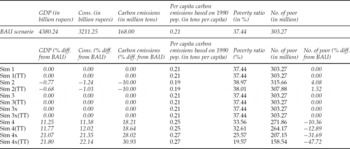
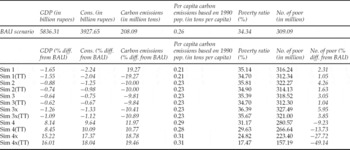
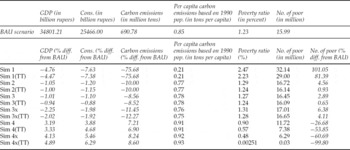
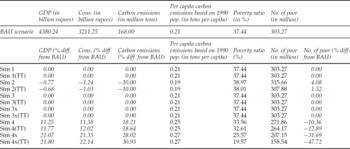
The aggregate emission levels fall relative to the base-line scenario from 19 per cent in 1995 to 76 per cent in 2020. Cumulative emissions in the 30-year period fall by 55 per cent. Per capita carbon emissions, based on the 1990 population, also fall drastically. In 2020, it is down to 0.21 ton per capita compared to 0.85 tons per capita in the base-line scenario (tables 4, 5, and 6).
BAU scenario and the policy simulations: selected variables in 1990
BAU scenario and the policy simulations: selected variables in 1995

BAU scenario and the policy simulations: selected variables in 2020

Losses in consumption are, as explained in section 4.1, higher than losses in GDP even though the carbon tax revenues are recycled to the consumers.
The poverty ratio (i.e. the percentage of population below the poverty line) in simulation 1, in comparison to the base-line scenario, is progressively higher all through from 1995 to 2020. In the final year, 2020, the number of poor people in scenario 1 is more than double that in the base-line scenario (tables 5 and 6).
In the targeted transfers case of scenario 1(TT), the poverty ratio improves a little vis-à-vis the across-the-board transfers case of scenario 1, but with respect to the base-line scenario it is increasingly higher from 1995 to 2020. Moreover, the number of poor persons in the year 2020 under scenario 1(TT) remains about 1.8 times that in the base-line scenario in the same year (tables 5 and 6).
In short, in policy scenario 1, the economy suffers high costs through GDP diminution and poverty accentuation. Further, the costs to the economy are somewhat mitigated, but remain quite high in the policy scenario 1(TT).
4.3. Policy simulations 2 and 2(TT)
Policy simulation 2, on the whole, is a milder version of policy simulation 1. In simulation 1, the average annual reduction in carbon emission works out to be 55 per cent, while in simulation 2, the annual reduction in carbon emissions is fixed to be only 10 per cent. Per capita emissions fall progressively from 1990 to 2020. As compared to the base-line scenario, they are 0.02 tons less in 1990 and 0.09 tons less in 2020 (tables 4 and 6).
As expected, the carbon tax rates of simulation 2 compared to those of simulation 1 are of much lower orders of magnitude.
GDP and consumption losses in scenario 2, relative to the base-line scenario, are also much smaller than the corresponding losses in scenario 1. However, within this scenario, consumption losses are greater than GDP losses, as in scenario 1.
The poverty ratio in scenario 2 increases only marginally with respect to the BAU scenario. However, the real adverse impact of simulation 2 on poverty comes out in terms of the number of poor persons. The number of poor persons in simulation 2, as compared to the base-line scenario, is 12.39 million more in 1990, but only 0.73 million more in 2020 (tables 4 and 6).
Under targeted transfers of simulation 2(TT), the poverty scenario is much less adverse than under simulation 2. The number of poor persons in simulation 2(TT), relative to the BAU scenario, is 4.61 million more in 1990, and only 0.15 million more in the year 2020 (tables 4 and 6).
The results of this simulation clearly show that the setback to GDP and poverty eradication caused by a carbon tax can be redeemed to a great extent by moderating the carbon emission restriction target, and, simultaneously, recycling the carbon tax revenues exclusively to the poverty-stricken segment of the population.
4.4. Policy simulations 3, 3(TT), and 3x, 3x(TT)
In policy scenario 3, India participates in an internationally tradable permits regime with grandfathered emissions allocation. Hence, its emissions quota is fixed at 168 million tons, i.e. the 1990 level of carbon emissions in the BAU scenario. However, unlike scenario 1, this scenario provides scope for going beyond this limit through purchase of emission permits in the international market at the (given) world market price of $10 per ton of carbon emissions. As it turns out, India is a net buyer of tradable permits throughout the period, 1990–2020, and its carbon emissions after 1990 are far in excess of the fixed quota of 168 million tons. Moreover, in policy scenario 3x in which the world market price of emission permits is taken to be $20 per ton, the expenditure on the purchase of emission permits is only slightly less than double that in scenario 3, suggesting that the demand for permits is highly inelastic with respect to its price.
However, with respect to the BAU scenario, there is in scenario 3 a decline in annual carbon emissions all through the 30-year period. For the whole period, the cumulative emissions decline by 8.25 per cent. Per capita emissions in this simulation also decrease. The decreases in per capita emissions in the various years are in the range of 0.03–0.07 tons. In the last year, 2020, per capita emissions in this scenario are 0.78 tons, as compared to 0.85 tons of the BAU scenario (tables 5 and 6).
GDP and consumption losses in simulations 3 and 3(TT) are predictably smaller than those in the carbon tax simulations – 1, 1(TT), 2, and 2(TT). However, in simulations 3x and 3x(TT) – i.e. when emissions permit price is taken to be $20 per ton – GDP and consumption losses are larger compared to simulations 2 and 2(TT) respectively (tables 5 and 6).
Poverty increases marginally in simulation 3. (Recall that poverty increases substantially in simulation 1.) The number of poor people in 2020 is 16.45 million, as compared to 15.99 million of the base-case (table 6).
In simulation 3(TT), there is an even smaller increase in poverty all through the 30-year period. The number of people in poverty, relative to the base-line scenario, increases by 1.04 per cent in 1995, but only by 0.65 per cent in 2020. In that year, the number of poor people is only 16.09 million as compared to 15.99 million of the base-line scenario (tables 5 and 6).
However, there are larger increases in poverty in the simulations 3x and 3x(TT); in 2020, the number of poor persons in these two simulations is respectively 6.38 per cent and 4.11 per cent more than that in the baseline scenario.
It follows that the costs imposed on the Indian economy due to losses in GDP and poverty reduction are far less in the case of participation in an internationally tradable emissions permits regime with grandfathered emissions allocation based on India's 1990 emissions level (policy scenario 3) than those in case of a domestic carbon tax scenario restricting India's carbon emissions to the 1990 level (policy scenario 1). For that matter, the costs to the economy under the tradable emission permits scenario with a permit price of $10 per ton are lower even in comparison to the scenario which achieves 10 per cent annual reduction in emissions through a carbon tax (policy scenario 2) However, this result is reversed for a higher permit price of $20 per ton (tables 5 and 6).
4.5. Policy simulations 4, 4(TT), and 4x, 4x(TT)
In policy simulation 4, the carbon emission quota is fixed at 1 ton per capita based on the 1990 population of 810 million. In other words, the maximum permitted total emissions of carbon is fixed at 810 million tons annually for the Indian economy. For every ton of carbon emitted less than the permitted 810 million tons, the Indian economy earns $10, which is Rs166 at the base-year exchange rate, through the sale of a permit in a global market of permits, and the total revenue from the sale of permits is recycled to the households as transfers from the rest of the world.
The exact procedure followed in this simulation is to fix an upper bound for total emissions – i.e. 810 million tons for each year. The actual total emissions of carbon, restrained by the virtual tax imposed on the domestic producers through sale of permits by the government at the world market price of $10 per ton turns out to be much less than the upper bound for each period. That is, the upper bound is not binding in any of the years. The difference between maximum permissible emissions and the actual emissions is multiplied by the permit price to arrive at the total revenue from the sale of permits, which is then recycled to the households like additional transfer payments from the government. In the process, the model generates a set of equilibrium values for GDP, consumption, poverty ratio, etc.
In simulation 4 the carbon emissions increase relative to the base-line scenario. Per capita emissions also increase throughout the period, with the increases being in the range of 0.03–0.06 tons. However, what needs to be emphasized is that, even in the last year, 2020, per capita emissions are only 0.91 tons, which is less than the world average of 1 ton per capita (tables 4 and 6).
The infusion of additional transfer payments from the rest of the world, in the form of permit revenue, leads to substantial increases in GDP and consumption in this simulation. The consumption gains are higher than the GDP gains in each of the periods (tables 4, 5, and 6). Apart from the increases in consumption resulting from the augmented transfers to households, there are ‘second-round’ increases in consumption when there is additional income generated from a demand-induced expansion of production activities.
The poverty ratio declines significantly in scenario 4. The number of poor persons, relative to the base-line scenario, decreases by 10.36 per cent in 1990, and by 26.68 per cent in the year 2020. That is, in the final year, 2020, the number of people in poverty is only 11.72 million in this simulation, as compared to 15.99 million in the base-line scenario (tables 4 and 6).
Poverty declines even faster under the targeted transfers version of this scenario, namely simulation 4(TT). The number of poor people in this scenario declines by 12.89 per cent in 1990 and by 53.85 per cent in 2020. By the year 2020, the number of poor in this simulation is only 7.38 million, which is less than half of the number of people in poverty in the base-line scenario (tables 4 and 6).
The inflow of additional transfer payments from the rest of the world in the form of permit revenue is augmented when the world market price of permits is increased to $20 per ton in simulations 4x and 4x(TT). The total permit revenue nearly doubles in these two simulations as compared to the simulations 4 and 4(TT) respectively, implying that the supply of emission permits is extremely price-inelastic. The larger inflow of transfer payments, however, enhances gains in both GDP and consumption. It also accelerates poverty reduction in the Indian economy. By the year 2020, poverty declines by 61 per cent in simulation 4x, and virtually vanishes in its targeted transfers version.
5. Conclusions and policy implications
We conclude by highlighting the main policy lessons from our simulation exercises. The policy lessons that emanate from our policy scenarios are fairly clear. They are in two parts.
In the first part, i.e. in policy scenarios 1 and 2, the lessons learnt are about the efficacy of a domestic carbon tax policy to reduce carbon emissions without seriously compromising the growth and poverty reduction goals of the Indian economy. In this regard, the results of policy scenario 1 are very discouraging. That is to say, the employment of a carbon tax to restrict the carbon emissions in the Indian economy to the 1990 level imposes heavy costs through a fall in GDP and a rise in poverty. With targeted transfers to the poor, the costs in terms of higher poverty are somewhat mitigated, but they remain quite high. Furthermore, these high costs in terms of GDP losses and poverty reduction foregone in this policy scenario cannot be expected to be significantly reduced by assuming any major breakthrough in terms of clean energy options such as hydropower and/or modern biomass in India within the limited time horizon of the present study. More importantly, the costs to GDP and poverty alleviation in this policy scenario are not unexpectedly high. In fact, such high costs are a natural consequence of an unduly restrictive carbon emissions policy. The latter is obvious from the fact that per capita emissions (based on the 1990 population) in this scenario in 2020 are 0.21 tons vis-à-vis 0.85 tons in the business–as-usual scenario.
In policy scenario 2, a milder restriction of 10 per cent annual reduction in carbon emission is achieved through the imposition of a carbon tax. The GDP losses are still significant, though not very large. But poverty, relative to the business-as-usual scenario, is higher throughout the 30-year period. However, the situation can be improved upon with targeted recycling of carbon tax revenues to the poorest households in the economy. With targeted recycling, the number of people in poverty in 2020 turns out to be only 0.15 million more than the corresponding number in the business-as-usual scenario. This result clearly suggests that targeted transfers are a contrivance that can be effectively used to dodge the trade-off between poverty reduction and carbon emissions, provided the emission reduction target is a modest one. The emission target can be further moderated to, say, a 5 per cent annual reduction. A 5 per cent annual reduction in total emissions would imply that the per capita emission (based on 1990 population) in 2020 will be 0.81 tons.Footnote 7 This is no mean target for per capita emission, given that the average world per capita emission in 1990 is 1 ton.
In the second part, i.e. in policy scenarios 3 and 4, the implications of India's participation in a global trading system of emission permits are analyzed.
In scenario 3, India participates in an internationally tradable permits regime with grandfathered emissions allocation based on India's 1990 level of emissions. The costs to the economy in this scenario, in terms of a lower GDP and higher poverty, are less in comparison to either of the two scenarios, 1 and 2, when the world market price of emission permits is US$10 per ton. Thus participation in an internationally tradable permits regime is better than any domestic carbon tax option. However, the latter may be preferred to the former for higher prices of emission permits, such as US$20 per ton.
In scenario 4, concerned with India's participation in an internationally tradable permits regime with equal per capita emissions allowances, India stands to gain by keeping its emissions at much lower than the stipulated maximum as possible. In other words, India does not have a perverse incentive to emit more in a tradable emission permits regime, as is sometimes feared. Nor is it true that India can perpetually induce a resource flow from the developed countries through the sale of emission permits, by virtue of having per capita emissions which are lower than the world average per capita emissions of 1 ton of carbon. On the contrary, with actual emissions increasing faster in policy scenario 4 than in the business-as-usual scenario, it is safe to expect that the turnaround for India – from being a net seller of permits to a net buyer of permits – will come around 2030.
Be that as it may, India gains immensely in terms of higher GDP growth and lower poverty in the scenario with internationally tradable emission permits under an equal per capita emissions allocation scheme. That is obvious from the results of policy scenario 4.
It follows that global emissions trade with equal per capita emission entitlements opens up a unique opportunity for India and other developing countries to sidestep the trade-off among carbon emissions, economic growth, and poverty reduction. However, if global cooperation fails to take place or fails to incorporate India's interest, India could contemplate unilateral action. Carbon taxes with simultaneous targeted transfers to the poor and very modest emission reductions may not be detrimental to economic growth and poverty alleviation. Moreover, carbon emission reduction may have associated benefits for the poor not taken into account in our model.