Introduction
The nature and properties of spodumene pegmatite-forming systems are still hotly debated. The overwhelming majority of studies of pegmatite-forming systems have focused on inclusions in quartz, whereas inclusions in spodumene, which is the main lithium mineral in albite–spodumene pegmatites, have received much less attention, with reports in only a limited number of publications (Bazarov, Reference Bazarov, Dolgov, Kostyuk and Bazarov1976; London, Reference London1986a, Reference London1986b; Zagorsky et al., Reference Zagorsky, Prokofiev and Kuzmina1992; Anderson et al., Reference Anderson, Clark and Gray2001; Li and Chou, Reference Li and Chou2017; Thomas et al., Reference Thomas, Davidson and Beurlen2011; Anderson, Reference Anderson2013, Reference Anderson2019). Trace elements in spodumene have been considered by Fersman (Reference Fersman1960), Ginzburg (Reference Ginzburg1959), Gordienko (Reference Gordienko1996), Černý and Ferguson (Reference Černý and Ferguson1972). Investigations of trace elements and inclusions in albite–spodumene pegmatites significantly expand our understanding of the genesis of these rocks. The relevance of these investigations is highlighted by the fact that albite–spodumene pegmatites represent one of the primary sources of lithium, which is essential for the high-tech industries (Černý, Reference Černý and Černý1982; Černý and Ercit, Reference Černý and Ercit2005; Kesler et al., Reference Kesler, Gruber, Medina, Keoleian, Everson and Wallington2012; London, Reference London2017; Bowell et al., Reference Bowell, Lagos, De los Hoyos and Declercq2020). This research provides the first data on trace elements and composition of inclusions in spodumene from rare-metal pegmatites of the Kolmozero lithium deposit in the Kola region in the northeastern Fennoscandian shield and is the largest lithium deposit in Russia (Bykhovsky and Arkhipov, Reference Bykhovsky and Arkhipov2016).
Geological setting
Regional geology
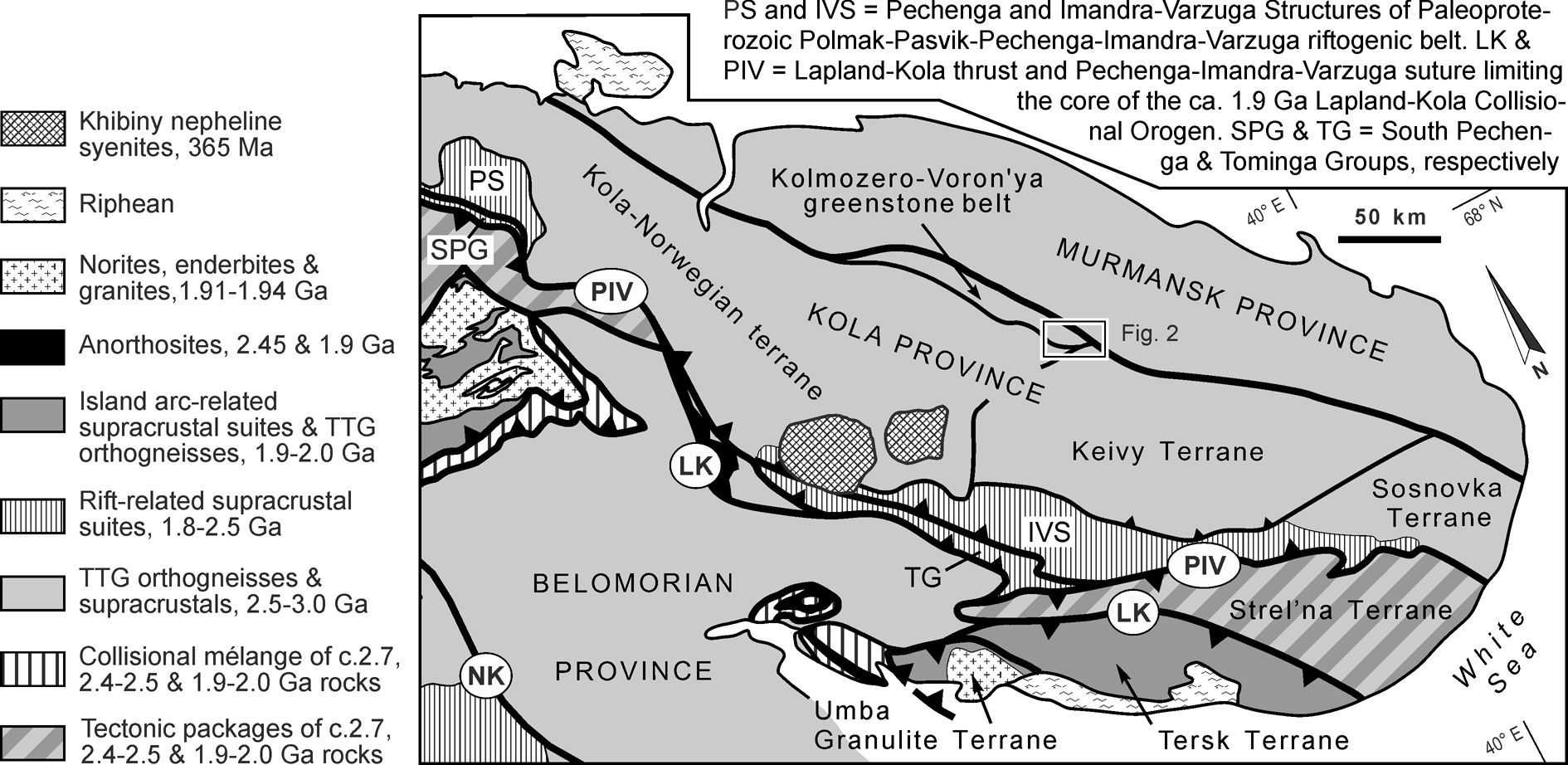
Albite–spodumene pegmatites of the Kolmozero lithium deposit belong to the Kolmozero pegmatite field (Gordienko, Reference Gordienko1970) that occurs in the junction zone of the Archaean Kola and Murmansk provinces (Figs 1, 2). This junction zone has been long considered as an Archaean linear mobile-permeable zone (deep-seated fault), which was activated partially in the Palaeoproterozoic (Kratz, Reference Kratz1978; Rundqvist and Mitrofanov, Reference Rundqvist and Mitrofanov1993). This tectonic structure is now interpreted as the Archaean Kolmozero–Voron'ya greenstone belt transformed into an Archaean accretionary orogen, which can also be classified as an imbricated suture zone (Mints, Reference Mints, Condie and Harvey2015a). From the view point of modern structural geology, we interpret high-strain zones around, and within this suture, as transcrustal shear zones. Due to their high permeability, these zones are channels for circulating ore-bearing fluids that yield ore mineralisation in the zones and their walls (McCaffrey et al., Reference McCaffrey, Lonergan and Wilkinson1999). Fractures can also be structures conducive to ore mineralisation, though the long-term exploration of the Kolmozero lithium pegmatites and our studies have not discovered any fractures of this type.
Tectonic provinces of the northeastern part of the Fennoscandian shield (modified from Daly et al., Reference Daly, Balagansky, Timmerman, Whitehouse, Gee and Stephenson2006).

Schematic geological map of the Kolmozero pegmatite field (modified from Morozova, Reference Morozova2018, figure 2).

The continental crust of the Murmansk and Kola provinces was formed and underwent major metamorphic and deformational reworking 2.6−2.9 Ga ago (Timmerman and Daly, Reference Timmerman and Daly1995; Kozlov et al., Reference Kozlov, Sorokhtin, Glaznev, Kozlova, Ivanov, Kudryashov, Martynov, Tyuremnov, Matyushkin and Osipenko2006; Hölttä et al., Reference Hölttä, Balagansky, Garde, Mertanen, Peltonen, Slabunov, Sorjonen-Ward and Whitehouse2008; Mints, Reference Mints, Condie and Harvey2015b). The Murmansk province is composed principally of late Mesoarchaean and Neoarchaean granites, enderbites, charnockites and tonalite–trondhjemite gneisses with relics of supracrustal rocks (Vetrin, Reference Vetrin1984; Rundqvist and Mitrofanov, Reference Rundqvist and Mitrofanov1993; Mints, Reference Mints, Condie and Harvey2015b). These rocks underwent high-temperature amphibolite-facies metamorphism and locally contain relics of granulite-facies mineral assemblages (Petrov et al., Reference Petrov, Belyaev, Voloshina, Balagansky, Glazunkov and Pozhilenko1990; Mints, Reference Mints, Condie and Harvey2015b). The Kola–Norwegian, Keivy and Kolmozero–Voron'ya terranes represent the main tectonic units of the Kola province (Daly et al., Reference Daly, Balagansky, Timmerman, Whitehouse, Gee and Stephenson2006). The Kola–Norwegian and Keivy terranes are generally made up of tonalite–trondhjemite–granodiorite gneisses, charnockites and enderbites, metasediments and subordinate amphibolites. The Kolmozero–Voron'ya terrane is composed principally of metabasalts, metakomatiites, intermediate and felsic volcanic rocks and subordinate metasedimentary rocks of the late Mesoarchaean Kolmozero–Voron'ya greenstone belt, which is also known as the Polmos–Poros belt (Rundqvist and Mitrofanov, Reference Rundqvist and Mitrofanov1993; Glebovitsky, Reference Glebovitsky2005). The greenstone rocks underwent amphibolite-facies metamorphism (Petrov et al., Reference Petrov, Belyaev, Voloshina, Balagansky, Glazunkov and Pozhilenko1990).
The main tectonic boundaries of northern Fennoscandia finally formed in the Palaeoproterozoic during the Lapland–Kola collisional orogeny (Daly et al., Reference Daly, Balagansky, Timmerman, Whitehouse, Gee and Stephenson2006; Hölttä et al., Reference Hölttä, Balagansky, Garde, Mertanen, Peltonen, Slabunov, Sorjonen-Ward and Whitehouse2008; Lahtinen and Huhma, Reference Lahtinen and Huhma2019). The history of the Lapland–Kola collisional orogen includes intracontinental rifting of Archaean crust (2.5–2.1 Ga), Red Sea-type oceanic separation (~2.1–2.0 Ga), subduction and crustal growth (~2.0–1.9 Ga), intercontinental collision (1.94–1.86 Ga) and orogenic collapse and exhumation (1.90–1.86 Ga). The Kola province was the northeastern foreland of the Lapland–Kola orogen and experienced Palaeoproterozoic deformational reworking predominantly along boundaries of main tectonic structures, whereas the Murmansk province is essentially free of Palaeoproterozoic deformation (Daly et al., Reference Daly, Balagansky, Timmerman, Whitehouse, Gee and Stephenson2006).
Kolmozero pegmatite field
The Kolmozero pegmatite field is entirely within the Murmansk province (Figs 1, 2; Gordienko, Reference Gordienko1970). This pegmatite field occurs in Archaean tonalite–trondhjemite gneisses that are intruded by the Kolmozero massif of metagabbrodiorites, metamonzodiorites and metagranodiorites of sanukitoid affinities of 2.73 Ga (Kudryashov et al., Reference Kudryashov, Petrovsky, Mokrushin and Elizarov2013) and gabbro–anorthosites of the Patchemvarek massif of 2.66 Ga (Vrevsky and Lvov, Reference Vrevsky and Lvov2016) and its two satellites, the Severny and Bezymyanny massifs.
On the basis of mineralogical and structural characteristics, albite–spodumene, muscovite–feldspar and feldspar pegmatites have been distinguished (Gordienko, Reference Gordienko1970; Morozova, Reference Morozova2018). Cross-cutting relationships between these different pegmatites have remained unclear. The albite–spodumene pegmatites contain spodumene in sufficient quantities to be economic and constitute the Kolmozero lithium deposit that also has Be, Ta and Nb mineralisation. The ore-bearing pegmatites intrude the Patchemvarek metagabbros–anorthosites that forms a steeply northeastwardly dipping lenticular massif up to 2 km thick and ~7 km across. Along the massif margins metagabbro–anorthosites are sheared and transformed into fine-grained amphibolites, which indicate a tectonic origin of the massif boundaries. The muscovite–feldspar pegmatites contain Be–Nb–Ta mineralisation and intrude metagabbros–anorthosites of the Bezymyanny massif. The feldspar pegmatites have only Be mineralisation and are widespread north of the Kolmozero lithium deposit in the rocks of the Kolmozero and Severny gabbro–anorthosite massifs and tonalite–trondhjemite gneisses.
Chlorite and holmquistite schists that occur along the northern boundary of the Patchemvarek metagabbros–anorthosite massif with tonalite–trondhjemite gneisses are interpreted as a metasomatic reworking of metagabbro–anorthosites during the pegmatite formation (Gordienko, Reference Gordienko1970). The pegmatites are located in a northwest-trending shear zone along which metasomatic fluids circulated. Metasomatic halos have not been found around pegmatite veins.
Methods
Silica and alumina concentrations in spodumene were determined using a Cameca MS-46 microprobe operated in a wavelength-dispersive spectroscopy mode at 22 kV and 20–40 nA. Reference standards were wollastonite (SiKα) and Y3Al5O12 (AlKα) at the Geological Institute of the Kola Science Centre of the Russian Academy Sciences (Apatity, Russia).
Contents of minor and trace elements in spodumene were determined by laser ablation inductively coupled plasma mass spectrometry (LA-ICP-MS) using a NexION 300S (PerkinElmer) quadruple inductively coupled plasma mass-spectrometer with a NWR 213 laser ablation instrument at the Geoanalitik Core Facilities Centre of the Institute of Geology and Geochemistry of the Urals Branch of the Russian Academy of Sciences (Yekaterinburg, Russia). The analysis was carried out at an ISO class 7 clean room. Laser ablation was performed at pulse repetition rate 12 Hz and laser energy density 10.5‒11.5 J/cm2 in a spot (crater diameter) 50 μm in size. The results were processed using GLITTER V4.4 software (GEMOC, Macquarie University, Australia) and an internal SiO2 standard. NIST SRM 610 glass was measured as the primary external standard after each 10–12 analyses of spodumene. NIST SRM 612 glass was used as the secondary standard. Concentrations were determined for the following elements: Li, Be, B, Na, Mg, Ca, Sc, Ti, V, Cr, Fe, Mn, Co, Ni, Cu, Zn, Ga, Ge, As, Se, Rb, Sr, Y, Zr, Nb, Mo, Ag, Cd, In, Sn, Sb, Te, Cs, Ba, La, Ce, Pr, Nd, Sm, Eu, Gd, Tb, Dy, Ho, Er, Tm, Yb, Lu, Hf, Ta, W, Tl, Pb, Bi, Th and U.
Inclusions in spodumene and quartz were studied at the Fluid Inclusion Laboratory and Core Facilities Centre for multi-element and isotope research of the V.S. Sobolev Institute of Geology and Mineralogy of the Siberian Branch of the Russian Academy of Sciences (IGM SB RAS) (Novosibirsk, Russia). The inclusions were investigated in sections polished on both sides. Optical microscopy of inclusions in quartz and spodumene was performed using an Olympus BX-51 microscope with an Infinity photo camera.
The identification of mineral phases in the crystalline aggregate of crystal-rich fluid inclusions were performed using Tescan Mira 3 LMU and LEO-1430VP scanning electron microscopes (IGM SB RAS), and by Raman spectroscopy using a Horiba LabRam HR 800 spectrometer with a semiconductor detector (IGM SB RAS).
The microthermometric investigation of crystal-rich fluid inclusions in spodumene and fluid inclusions in quartz within a temperature range of –180 to +600°C was made using a Linkam THMSG600 heating–freezing stage (IGM SB RAS). The accuracy at low temperatures (<0°C) is 0.1°C; however, due to the small size of the inclusions (5–15 μm), the errors of determination of the eutectic point, ice melting and homogenisation are as high as a few degrees. The gas–phase composition and some crystalline phases in fluid and crystal-rich fluid inclusions were determined using a Horiba Lab Ram HR 800 Raman spectrometer. The spectra were excited by a solid-state 532 nm Nd YAG laser with output power of 50 mW. The spectrum was taken by a Peltier cooled Endor semiconductor detector with working temperature –70°C. A confocal optical system based on an OLYMPUS BX-41 microscope with a LNA 100× objective was used for focusing the laser to the object studied and collection of the scattered beam. The acquisition time and size of the confocal pinhole varied depending on the size of the analysed phase.
Kolmozero lithium deposit
Geological structure and geochemistry of pegmatite
The Kolmozero lithium deposit consists of 12 large northwest-trending, steeply southwestwardly dipping ore-bearing veins of albite–spodumene pegmatite, as well as numerous small veins with apophyses (Figs 3a,b). The large veins have lengths of over 1400 m and thicknesses of 5 to 65 m and extend down to depths of >500 m. The albite–spodumene pegmatites are cross-cut by Palaeozoic (?) gabbro–dolerite dykes. The pegmatite veins have sheet-like morphology and display no prominent concentric zoning. A quartz–plagioclase aplite up to 5 cm in thickness and coarse-grained quartz–albite aggregates to 30 cm thick were observed at the contact with the country rocks. The veins (85–90%) are almost entirely composed of the coarse- and very coarse-grained quartz–spodumene–feldspar pegmatite. This pegmatite contains segregations of blocky microcline, granular quartz and cleavelandite, quartz–albite aggregates, quartz–muscovite veinlets, saccharoidal albite veinlets, and clusters of beryl and columbite-group minerals. Greyish-pink microcline–perthite (Mc-I) forms rare crystals up to 10 cm in size and aggregates of blocky dark-pink microcline (Mc-II) up to 40‒60 cm in size compose separated areas 5 m × 2 m within veins. A quartz core has been found in only one vein by drilling (Gordienko, Reference Gordienko1970).
(a) Schematic geological map of the Kolmozero lithium deposit. (b) Cross-section illustrating depths of the occurrence of albite–spodumene pegmatites (modified from Morozova, Reference Morozova2018, figure 3).

The major pegmatite minerals are: quartz (30‒35 vol.%); albite (30‒35 vol.%); microcline (10‒25% vol.%); spodumene, the main lithium mineral (~20% vol.%); and muscovite (5‒7 vol.%). Accessory beryl and columbite-group minerals which might have economic interest as a source of Be, Ta and Nb if sufficiently abundant occur in the very large veins. Other accessory minerals include: spessartine; apatite; rare lithiophilite (LiMnPO4); triphylite (LiFePO4); and tourmaline. Tourmaline is a typical minor mineral in other rare-metal pegmatites of the northeastern Kola region and its occurrence as a rare accessory mineral is a characteristic feature of the Kolmozero rare-metal pegmatite. Biotite occurs at contacts with the metagabbros–anorthosite host rock. Phosphates and zeolites predominate among secondary minerals. Sixty four mineral species have been recognised in the Kolmozero albite–spodumene pegmatites (Gordienko, Reference Gordienko1970).
Spodumene is the main carrier of Li2O in the Kolmozero deposit with 97 wt.% of the total, 0.3 wt.% is carried by lithiophilite and 0.45 wt.% by muscovite (Gordienko, Reference Gordienko1970).
The albite–spodumene pegmatites are enriched in: (ppm) Cs (23); Nb (81); Ta (59); Be (142); and Li (12,244). In the albite–spodumene pegmatites the amount of rare earth elements (REE) is ≤3 ppm. These rocks are depleted (ppm) in: Ba (≤20); Sr (≤15.4); Y (≤0.46); Th (≤2.5); and Zr (≤22). They demonstrate low fractionation indexes for Mg/Li ≤0.05 and Zr/Hf ≤7.4 (Morozova, Reference Morozova2018, Reference Morozova2019). Rare-metal lithium–caesium–tantalum (LCT) pegmatites from other regions of the world have similar geochemical features (Chachowsky, Reference Chachowsky1987; Černý, Reference Černý1991, Reference Černý1992; Lagache, Reference Lagache1997; Černý and Ercit, Reference Černý and Ercit2005; Zhu et al., Reference Zhu, Zeng and Gu2006; London, Reference London2008).
A U–Pb radiometric age of 2315 ± 10 Ma for columbite-(Mn) from an albite–spodumene pegmatite is interpreted to give an age for the rare-metal mineralisation (Morozova et al., Reference Morozova, Bayanova, Bazai, Lyalina, Serov, Borisenko and Kunakkuzin2017). This age indicates that the albite–spodumene pegmatites formed during the early Palaeoproterozoic rifting of the Fennoscandian shield (Hanski and Melezhik, Reference Hanski, Melezhik and Melezhik2013).
Spodumene samples
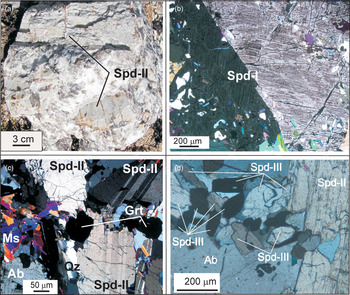
In the Kolmozero albite–spodumene pegmatites spodumene belongs to three morphological types or generations: spodumene-I (Spd-I); spodumene-II (Spd-II); and spodumene-III (Spd-III) occurring in central parts of the veins (Gordienko, Reference Gordienko1970; Morozova and Bazai, Reference Morozova and Bazai2019). Spd-I is represented by opaque, greyish-green prismatic crystals up to 10 cm long. Polarised-light microscopic observations reveal two systems of cleavage planes at an angle of 87° and {100} twins. Spd-I occurs in coarse-grained quartz–spodumene–albite aggregates and is replaced by saccharoidal albite at crystal margins (Fig. 4b). Mineral inclusions in Spd-I are: albite; quartz; muscovite; microcline; and columbite-group minerals. Spd-I crystallised before blocky Мc-II, cleavelandite and large sheets of muscovite (up to 10 cm long), and after Мc-I (Gordienko, Reference Gordienko1970).
(a) Photograph of hand specimen and (b–d) photomicrographs of thin sections of albite–spodumene pegmatites (crossed polarised light). Ab, albite; Gr, garnet; Ms, muscovite; Qz, quartz; Spd, spodumene.

Spd-II occurs as long-to-short prismatic lath-shaped crystals, either individually or aggregated (blocky spodumene), in association with coarse- and very coarse-grained albite and quartz. The crystals are opaque, rarely semi-transparent, greyish-green and green. Individual crystals can reach up to 1.5 m in length. Microscopic investigation reveals twins parallel to {100} (Figs 4a,c). Spd-II contents are high, which makes the albite–spodumene pegmatites a lithium ore. Spd-II contains micro-inclusions of: albite; quartz; muscovite; apatite; cassiterite; and columbite-group minerals. Spd-II crystallised simultaneously with blocky Мc-II prior to cleavelandite and large sheets of muscovite (Gordienko, Reference Gordienko1970).
Spd-III was identified in thin sections in fine-grained quartz–muscovite–spodumene–albite aggregate (Fig. 4d). The mineral occurs as short prismatic and equant crystals up to 0.5 mm in size. The Spd-III crystals, and the aggregates, fill cracks at margins of the Spd-II crystals.
Results
Geochemistry of spodumene
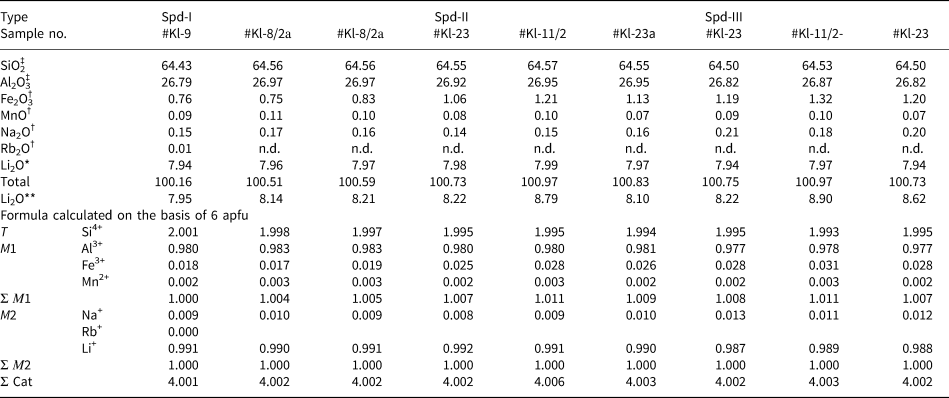
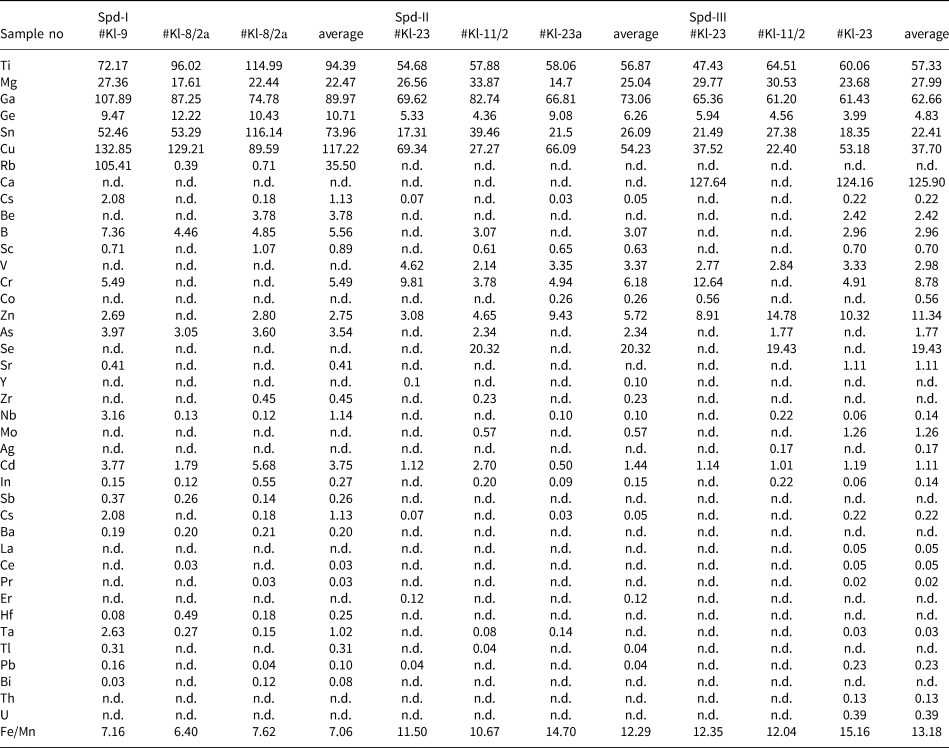
Spodumene, LiAl(Si2O6), is a clinopyroxene. The structure is composed of chains of SiO4 tetrahedra, running along the c axis and connected by Al3+ (M1) and Li+ (M2) cations (Deer et al., Reference Deer, Howie and Zussman1978). Representative compositions of the spodumene from the Kolmozero deposit are given in Tables 1, 2 and Fig. 5. Lithium contents were determined by LA-ICP-MS and by stoichiometric calculations using electron microprobe data. The LA-ICP-MS values are consistently higher than those calculated from stoichiometry, which we attribute to processing of the extremely high signal intensities resulting from the LA-ICP-MS analytical procedure. Thus, our formula calculations are based on Li contents determined by stoichiometry. Structural formulae of the spodumene were calculated on the basis of six oxygen atoms and the total cation charge proved to be 12.00, i.e. the charge-balance is met and the mineral formulae are close to ideal, LiAlSi2O6 (Table 1).
Concentrations of major, minor and trace elements in the Kolmozero spodumenes; I, II and III spodumene generations.

Representative compositions (wt.%) for the Kolmozero spodumenes.

‡ Determined by EMPA; † Determined by LA-ICP-MS; * Calculated from stoichiometry; ** Calculated from LA-ICP-MS data; n.d., not detected.
Tabulated Li contents per formula unit were calculated from stoichiometry.
Trace elements in the Kolmozero spodumenes (ppm).
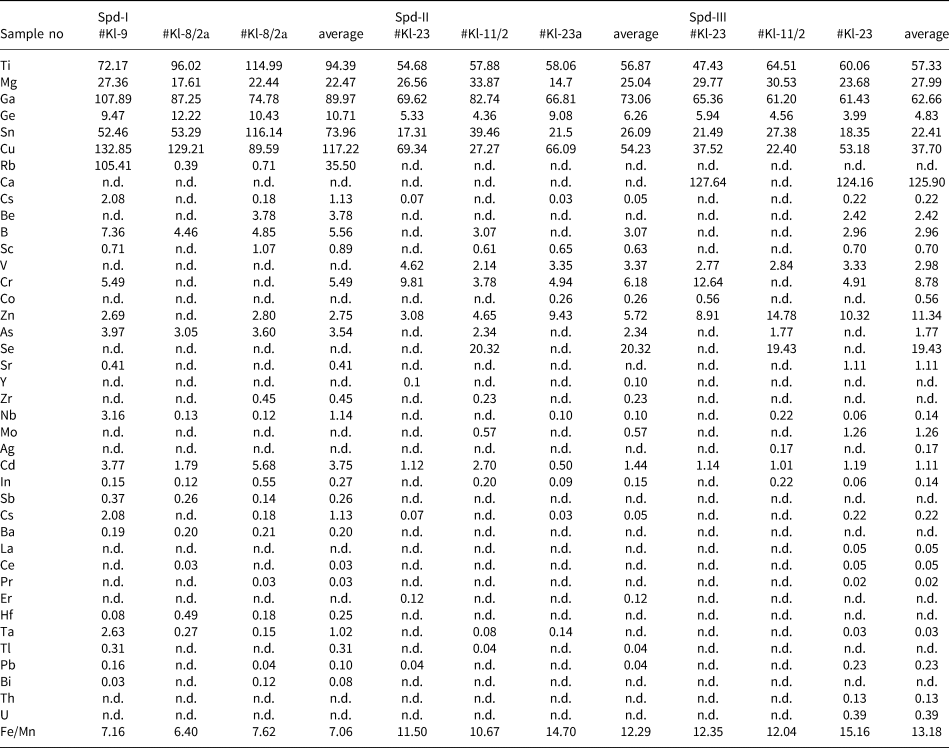
n.d. – not detected; data obtained by the LA-ICP-MS method.
In addition to Li, Al and Si, spodumene contains minor elements among which Fe, Mn and Na dominate. The mass fraction of these elements of the total minor and trace-element contents is 94% in Spd-I and 97% in Spd-II and Spd-III. Spd-I differs from Spd-II and Spd-III in having higher Mn (773 ppm vs. 657 and 665 ppm, respectively). These differences are reflected in the Fe/Mn ratio which is 7.1 in Spd-I and 12.3 and 13.2 in Spd-II and Spd-III, respectively. The Na contents in Spd-I and Spd-II are almost identical (1159 and 1119 ppm, respectively), whereas Spd-III is enriched in Na (1475 ppm) compared to Spd-I and Spd-II (Fig. 5).
Inclusions in Spd-II and quartz
A greenish crystal of Spd-II from the central part of an albite–spodumene pegmatite vein was selected for inclusion study. The core of this crystal is turbid, whereas margins are transparent and one marginal domain is cross-cut by a 0.5 mm thick quartz–muscovite veinlet. Polished thin section KL-GX-11b was prepared from this marginal domain. The surface of the section is oriented parallel to the c axis of the spodumene crystal, close to the parting plane {100}. Fluid inclusions were studied in both spodumene and quartz.
This Spd-II contains numerous negative crystal-rich fluid inclusions 5‒15 μm in size elongated along the c axis of the host mineral. The majority of crystal-rich fluid inclusions are distributed irregularly in the host mineral. Commonly, they are arranged along the crossing planes (Fig. 6). The irregularly distributed crystal-rich fluid inclusions are considered as primary. The origin of those confined to crossing planes is not so obvious. The linearly arranged inclusions have an appearance of inclusions trapped along fractures. However, their oblique orientation to the cleavage and parting fractures indicate that they might have other origins. Similar arrangements of inclusions in spodumene were reported by Anderson (Reference Anderson2013, Reference Anderson2019) who interpreted them as healed microfractures. The linearly arranged crystal-rich fluid inclusion groups in the spodumene crystal investigated do not cross its outlines and thus could be interpreted as microfractures of unknown nature, healed during the crystal growth, however here they are nonetheless regarded as pseudo-secondary inclusions. Their phase compositions are similar to those interpreted as primary inclusions. Therefore, we believe that the pseudo-secondary inclusions are related genetically to the primary ones and hereafter are considered together.
Photomicrographs (plane polarised light) of typical crystal-rich inclusions in Spd-II. (a) Fissures of cleavage {110} are intersected by planar arrays of pseudo-secondary crystal-rich fluid inclusions (PsSec CRFI). Primary crystal-rich fluid inclusions are distributed irregularly in the host mineral. (b) Primary and pseudosecondary CRFI with different proportions of gas, liquid and solid phases.

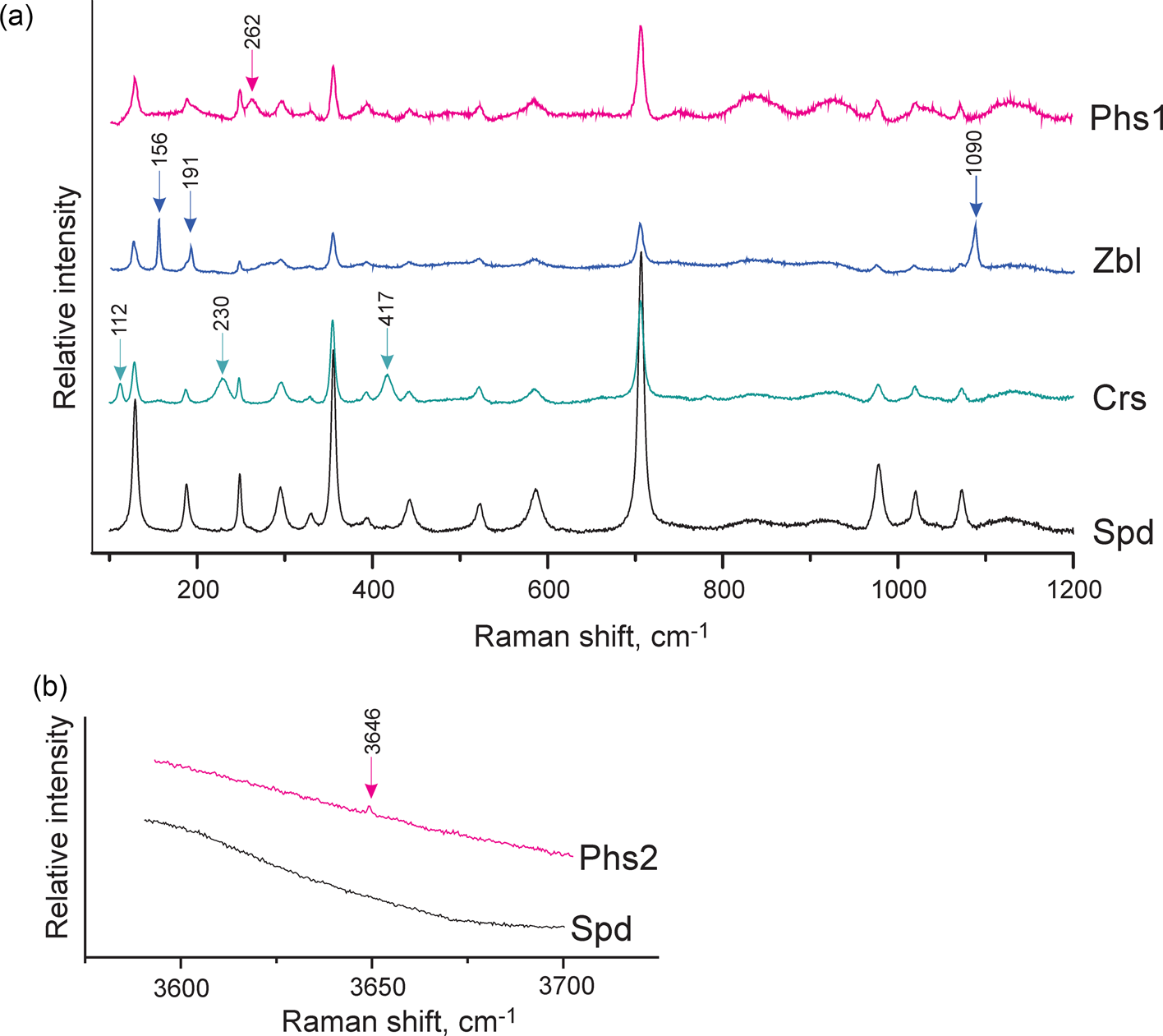
At room temperature, crystal-rich fluid inclusions contain solid phases, liquid and a gas bubble. Relations between these phases vary significantly and the solid phase abundance and composition is not constant. Crystals within crystal-rich fluid inclusions are most commonly transparent, colourless, euhedral and in some inclusions consist of aggregates of grains. Zabuyelite (Li2CO3), cristobalite (SiO2), an unidentified phyllosilicate, which could be either a mica, chlorite or a clay mineral, and locally calcite were identified as solid phases by Raman spectroscopy and scanning electron microscopy energy dispersive analysis (Figs 7, 8). Zabuyelite and cristobalite are described in the Kolmozero deposit for the first time. Some inclusions contain single grains of an As-bearing mineral and unidentified Fe–Mg–K aluminosilicate. Only low-density CO2 was identified by Raman spectroscopy in the gas bubbles of some inclusions. CO2 is more typically observed in crystal-rich fluid inclusions that do not contain the carbonate phases zabuyelite or calcite. Rare tiny single two-phase gas-liquid inclusions containing room temperature aqueous liquid and a low-density gas bubble with, or without detectable CO2, were observed together with crystal-rich fluid inclusions.
Photomicrographs of crystal-rich fluid inclusions in Spd-II. (a), (b) Plane polarised light image. (с) Back-scattered electron image. Cal, calcite; Crs, cristobalite; Ms, mica; Phs2, unidentified phyllosilicate; UPh, unknown phase (Fe–Mg–K aluminosilicate); Zbl, zabuyelite.

Raman spectra of solid phases in spodumene-hosted crystal-rich fluid inclusions and the host Spd-II. Arrows point to the characteristic lines of the solid phases. Crs, cristobalite; Spd, host spodumene; Phs1, Phs2, unidentified phyllosilicate; Zbl, zabuyelite.

Thermometric studies revealed that some crystal-rich fluid inclusions were homogenised into liquid at 275–280°C. Solid phases were insensitive to heating up to 600°C.
Quartz from the quartz–muscovite veinlet contains two-phase fluid inclusions. At room temperature, fluid inclusions contain an aqueous solution and a gas bubble, and in some inclusions mineral phases. These are identified by Raman spectroscopy as calcite and nahcolite. CO2 has been identified in some of these fluid inclusions.
Discussion
The most important minor elements in the spodumene from the Kolmozero albite–spodumene pegmatites are Fe and Mn. High Fe contents in the spodumene might be related to a major replacement of Al by Fe3+ and a subordinate replacement of Li by Fe and Mn in the spodumene structure (Deer et al., Reference Deer, Howie and Zussman1978; Ginzburg, Reference Ginzburg1959; Bulakh et al., Reference Bulakh, Zolotaryov and Krivovichev2014). Iron and Mn impart a green or pink tint to spodumene, respectively (Davis, Reference Davis1904; Claffy, Reference Claffy1953; Ginzburg, Reference Ginzburg1959; Hassan and Labib, Reference Hassan and Labib1978; Charoy et al., Reference Charoy, Lhote and Dusausoy1992). A high Fe content reduces the suitability of spodumene as a raw material for refractory ceramics and for use in the glass industry (Černý and Ferguson, Reference Černý and Ferguson1972; Garrett, Reference Garrett2004).
High Fe contents found in the Kolmozero spodumene are typical of spodumene from rare-metal pegmatites of other regions. For example, Fe dominates over Mn, Ca, Na, K, Rb and Cs in spodumene from the rare-metal pegmatites of the Tashelga deposit in Russia (Annikova et al., Reference Annikova, Vladimirov, Smirnov, Uvarov, Gertner and Gavryushina2013). Iron dominates over other minor elements (Ti, Cr, V, Mn, Mg, Ca, Na, K, Sr, Zn, Nb, P, S and Ni) in the spodumene from the Kaustinen rare-metal pegmatites (Finland) (Ahtola et al., Reference Ahtola, Kuusela, Koistinen, Seppanen, Hatakka and Lohva2010). Elevated Fe contents relative to those of other minor and trace elements are observed in spodumene from pegmatites of other deposits (Filip et al., Reference Filip, Novak and Zboril2006). However, of the trace elements (Ca, Na, Fe, Mg, K, Rb, Cs and P), Na is dominant in the secondary spodumene that has extensively replaced petalite in the Tanco mine (Canada) (Černý and Ferguson, Reference Černý and Ferguson1972; Stilling, Reference Stilling1998; Stilling et al., Reference Stilling, Černý and Vanstone2006).
As described previously, significant variability of the Fe/Mn ratio is common for the spodumenes from the Kolmozero pegmatites. Similar variations of this ratio were also reported for granitic aplite–pegmatites from Portugal (Charoy et al., Reference Charoy, Lhote and Dusausoy1992). These spodumenes contain Ti, Mg, Ca, Na, K, P, Rb and Cs.
Spodumene also contains, commonly, elements that are not present in its crystal structure. In the Kolmozero pegmatites, these could be due to micro-inclusions of the minerals found in crystal-rich fluid inclusions.
Crystal-rich fluid inclusions similar to those described in the Spd-II crystal from the Kolmozero lithium deposit were reported from spodumene of the Tanco (Canada), Jiajika (China) and some other pegmatites (London, Reference London1986b, Reference London2008; Anderson et al., Reference Anderson, Clark and Gray2001; Thomas et al., Reference Thomas, Davidson and Beurlen2011; Li and Chou, Reference Li and Chou2017; Anderson, Reference Anderson2019). The phase composition of these crystal-rich fluid inclusions is very close to that of the Kolmozero spodumene. These crystal-rich fluid inclusions all contain gas, low-salinity aqueous fluid, and crystals of: zabuyelite; quartz/cristobalite; calcite; cookeite; mica; nahcolite; albite; and pollucite/analcime (London, Reference London1986b, Reference London2008; Thomas et al., Reference Thomas, Davidson and Beurlen2011; Li and Chou, Reference Li and Chou2017).
Regardless of the uniform phase composition of crystal-rich fluid inclusions, thermometric studies carried out by different researchers yielded different results. For a thermometric investigation under confining pressure conducted by London (London, Reference London1986b, spodumene from the Tanco pegmatites) crystal-rich fluid inclusions were quenched and yielded silicate glass. Experiments by Anderson (Anderson, Reference Anderson2019, spodumene from Tanco) and Li and Chou (Li and Chou, Reference Li and Chou2017, spodumene from the Jiajika pegmatites) gave different results: quenched crystal-rich fluid inclusions contained aqueous fluid phase, CO2 liquid and CO2 vapour, but not glass. Homogenisation temperatures varied significantly from 260–400°C to 680–720°C (London, Reference London1986b; Anderson et al., Reference Anderson, Clark and Gray2001; Anderson, Reference Anderson2019; Li and Chou, Reference Li and Chou2017). These data indicate the abnormal behaviour of crystal-rich fluid inclusions upon heating. Therefore, crystal-rich fluid inclusions of the given kind are neither isochoric nor isoplethic systems and cannot be used for estimating the P–T parameters of trapping (Anderson, Reference Anderson2019).
We agree with Anderson's conclusion (Anderson et al., Reference Anderson, Clark and Gray2001) that the mineral composition of the crystal-rich fluid inclusions before heating could be defined by a reaction between the trapped alkali-carbonate enriched fluid and the host spodumene. This was based on the fact that calculated bulk compositions of crystal-rich fluid inclusions had significantly higher Li concentrations in comparison with those of fluid inclusions in quartz associated with spodumene (Anderson et al., Reference Anderson, Clark and Gray2001). As to the crystal-rich fluid inclusions in the Kolmozero spodumene, our conclusion is based on variability of the phase composition of inclusions of one fluid inclusion assemblage and the absence of CO2 in crystal-rich fluid inclusions that contain the carbonates zabuyelite and calcite. Furthermore, according to Roedder (Reference Roedder1984) and Heinrich and Gottschalk (Reference Heinrich and Gottschalk1995), a reaction between the host mineral and trapped fluid is a widespread phenomenon except for cases when the host mineral is quartz.
The mechanism of formation of crystal-rich fluid inclusions through a reaction between the fluid and host spodumene is schematically based on the following reaction:
 $$\eqalign{& {\rm LiAlS}{\rm i}_2{\rm O}_6 + {\rm }{\rm fluid }\,\to {\rm L}{\rm i}_2{\rm C}{\rm O}_3 + {\rm }{\rm Si}{\rm O}_2 + {\rm }{\rm LiA}{\rm l}_4\left( {{\rm S}{\rm i}_3{\rm Al}} \right){\rm O}_{10}\left( {{\rm OH}} \right)_8 \cr \quad \left( {{\rm or}\,{\rm KA}{\rm l}_3{\rm S}{\rm i}_4{\rm O}_{10}{\left( {{\rm OH}} \right)}_2} \right){\rm } + {\rm }{\rm H}_2{\rm O}{\rm } + {\rm }{\rm C}{\rm O}_2 \cr & ({\rm spodumene}{\rm } + {\rm }{\rm fluid }\,\to \,\,{\rm zabuyelite}{\rm } + {\rm }{\rm cristobalite}{\rm } \cr \quad + {\rm phyllosilicate}\ {\rm }\left( {{\rm cookeite}\ {\rm }{\rm or}\ {\rm }{\rm mica}} \right) + {\rm }{\rm H}_2{\rm O}{\rm } + {\rm }{\rm C}{\rm O}_2),} $$
products of which are represented by phases in crystal-rich fluid inclusions, and fluid Х is the fluid from which the minerals formed. Carbon dioxide and aqueous solutions in crystal-rich fluid inclusions are most probably relics of the initial fluid. Thus, it can be assumed that the initial fluid was composed of H2O + CO2 + dissolved alkaline carbonates. The presence of dissolved alkaline carbonates in this fluid can be suggested from the formation of zabuyelite and calcite in the spodumene-hosted inclusions. In the course of the reaction, alumina resides in the aluminosilicate, which is represented by phyllosilicates (cookeite or mica) in the reaction above.
Thermodynamic modelling yielded a number of reactions between the indicated reagents and their products (Anderson et al., Reference Anderson, Clark and Gray2001). For the Li2O–Al2O3–SiO2–H2O–CO2 system, the following reaction is proposed:
 $$\eqalign{& 5{\rm LiAlS}{\rm i}_2{\rm O}_6 + 2{\rm C}{\rm O}_2 + 4{\rm H}_2{\rm O\ }\to 2{\rm L}{\rm i}_2{\rm C}{\rm O}_3 + 7{\rm Si}{\rm O}_2 \cr \quad + {\rm LiA}{\rm l}_4{\rm S}{\rm i}_3{\rm Al}{\rm O}_{10}\lpar {{\rm OH}} \rpar _8 \cr & \lpar {\rm spodumene} + 2{\rm C}{\rm O}_2 + 4{\rm H}_2{\rm O\ }\to {\rm zabuyelite} + {\rm \alpha }\hbox{-}{\rm quartz}\cr & \quad \ + {\rm cookeite}\rpar } $$
This is a subsolidus reaction proceeding at temperatures 150‒200°C over a wide range of pressures. Depending on amounts of CO2 in the trapped fluid, all Li from the reacted spodumene in crystal-rich fluid can be accommodated by zabuyelite, or, if CO2 is relatively low, by Li-bearing aluminosilicate phases, as was illustrated by Anderson et al. (Reference Anderson, Clark and Gray2001). Adding K2O in the mineral-forming system makes other reactions possible at higher temperatures (up to ca. 400°C). In the spodumene-hosted inclusions reported in this study, cristobalite occurs in place of α-quartz and an unidentified phyllosilicate is postulated to be an analogue for cookeite.
Spodumene is unstable in the LiAlSiO4–SiO2–H2O system up to temperatures of ca. 700°C at low pressure in the presence of SiO2 (London, Reference London1984). The occurrence of calcite and zabuyelite in the crystal-rich fluid inclusions indicates a high concentration of carbonate in aqueous solutions. Silicates and silica are easily dissolved in alkaline-carbonate aqueous solutions under hydrothermal conditions (Butuzov and Bryatov, Reference Butuzov and Bryatov1957; Wilkinson et al., Reference Wilkinson, Nolan and Rankin1996; Kotel'nikova and Kotel'nikov, Reference Kotel'nikova and Kotel'nikov2009). It suggests that metastable spodumene is readily dissolved in a solution having the composition of the inclusions.
Fluids that were discovered in inclusions in quartz also have an aqueous-carbonate composition. Fluids in inclusions in spodumene and quartz are not coeval because the quartz veinlet cross-cuts the spodumene crystal. Although these fluids have similar compositions and are supposed to have been genetically related, i.e. quartz crystallised after spodumene under similar or even identical conditions of the pegmatite-forming system.
So, we assume that the fluid that existed during the crystallisation of mineral assemblages in the Kolmozero rare-metal pegmatite containing quartz and Spd-II had an aqueous composition with dissolved alkaline carbonates. After the entrapment this fluid reacted with the host spodumene and new solid phases: calcite; zabuyelite; cristobalite; unidentified phyllosilicate; and some others were formed in the crystal-rich fluid inclusions. Inclusions that contain silicate melt have not been found either in spodumene, or in the quartz. We suppose that some silicate melt should have been present in the pegmatite-forming system at earlier stages of formation of the Kolmozero rare-metal pegmatites and it could have been trapped by quartz and spodumene of earlier pegmatitic assemblages. However, constraining the evolution of this silicate melt and its relations to the fluids entrapped by Spd-II was outside of the scope of this work and requires further detailed study of inclusions in earlier-crystallising minerals.
Conclusions
Spodumene (Spd) is one of the main rock-forming minerals and the only primary host for lithium in rare-metal pegmatites of the Kolmozero lithium deposit, and is represented by three generations: Spd-I; Spd-II; and Spd-III (Gordienko, Reference Gordienko1970; Morozova and Bazai, Reference Morozova and Bazai2019). Fe, Na and Mn are the most typical impurity elements in spodumene. Spd-I is characterised by a low Fe/Mn ratio (7.1) which increases to 12.3 and 13.2 in Spd-II and Spd-III, respectively. Relatively high Fe contents in spodumene might be related to replacement of Al by Fe3+ together with minor replacement of Li by Fe and Mn. The increase in the Fe/Mn ratio and decrease in Mn concentration from Spd-I to Spd-III might have been related to the redistribution of Mn between spessartine, apatite, columbite-(Mn), lithiophilite and spodumene during pegmatite crystallisation. The formation of the Kolmozero pegmatite assemblages that contain Spd-II and quartz most probably occurred in a CO2-bearing aqueous fluid with dissolved alkaline carbonates. Solid phases in the crystal-rich fluid inclusions in Spd-II include zabuyelite (Li2CO3), cristobalite (SiO2), calcite and some phyllosilicates. Zabuyelite and cristobalite have not been reported previously from the Kolmozero pegmatites. These minerals have been found only in crystal-rich fluid inclusions, and are interpreted as products of reaction between the trapped fluid and host Spd-II.
Acknowledgements
The authors express their gratitude to P.A. Serov and I.A. Koval (GI KSC RAS) for the participation in field work. Mrs A.A. Merenova is thanked for translating the manuscript into English. The research has been carried out in the framework of the Scientific Research Contract of GI KSC RAS No. 0226-2019-0053, partly within the framework of State Assignment of the IGM SB RAS, and partly within the framework of State Assignment (AAAA-A18-118053090045-8) of the Geoanalitik Core Facilities Centre of the IGG UB RAS. The study was partially funded by the Russian Ministry of Higher Education and Sciences grant № 075-15-2020-802. This study has also been conducted in cooperation with and partly financed by the TD Halmek Lithium Enterprise. An authorised representative of this enterprise, Mr P.S. Galchenko participated in field work. We deeply appreciate the work of the anonymous reviewers, the editorial team of Mineralogical Magazine and Principal Editor, Professor R. Mitchell for their constructive criticism and correcting the English, which resulted in significant improvements to the manuscript.