Introduction
Temperature, rainfall (water), contact with cattle faeces containing trematode eggs, changes in the nutrition of the host (Jordan & Webbe, Reference Jordan, Webbe, Jordan, Webbe and Sturrock1993) and other ecological factors such as vegetation, altitude and nature of substratum (Madsen, Reference Madsen2003) may affect the development of parasites within and outside snails. Susceptibility to infection may be dependent to some extent on the environmental conditions of snails at the time of infection (Dinnik & Dinnik, Reference Dinnik and Dinnik1963; Kendall, Reference Kendall and Taylor1964; Over, Reference Over1982).
It is estimated that over 6% of Zambia's surface is covered by rivers, streams, lakes and wetlands (Yachiyo Engineering, 1995). The Kafue wetlands of Zambia harbour large herds of cattle which are known to be predisposed to infections with Fasciola and other trematodes. They graze pastures in wet areas for at least half of each year. The risk of infection with trematodes begins in June/July, when flood waters recede remarkably, up to November/December when the rains begin. During this period, cattle have unlimited access to potentially metacercariae-infested pastures.
Large wetland areas found in and around ox-bow lakes, marshes, swamps, lagoons, ponds and canals in the Kafue River basin accompanied by high temperatures make them suitable areas for the existence and breeding of snails of veterinary and medical importance. Studies undertaken on larval trematode infections in the country have been limited (Dinnik, Reference Dinnik1961; Wright, Reference Wright1966, Wright et al., Reference Wright, Southgate and Howard1979; Southgate et al., Reference Southgate, Howard, Rollinson, Brown, Ross and Knowles1985; Mubila & Rollinson, Reference Mubila and Rollinson2002) and restricted to Bulinus snails.
Larval trematodes may act as regulators of snail populations if prevalences of infection in natural populations are high (May, Reference May1983; Brown et al., Reference Brown, Leathers and Minchella1988). This is possible as it is known that some trematodes may sometimes be responsible for the elimination of snail populations (Loker et al., Reference Loker, Moyo and Gardner1981). The present aims are to study the availability of freshwater snails and their infection rates with larval trematodes in the Kafue wetlands and to assess the level of trematode infections in cattle accessing the snail-infested areas during a period of highest water contact.
Materials and methods
Study areas
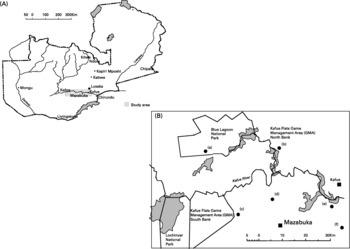
The Kafue wetlands, being the second largest in the country, are massive flood plains of the Kafue River situated in the Southern, Lusaka and Central provinces of Zambia. There is a drop in level of only 8 m along the 250 km length and between 25 and 60 km width of wet natural area through which the river flows. From 985 m above sea level (asl) at Itezhi-tezhi to about 975 m asl at Kafue Gorge Dam (15°11′ to 16°11′ S and 26°00′ to 28°16′ E), the natural ecosystem has been heavily influenced by cycles of floods and droughts. They are open savannah wetlands covering 6500 km2, and protected in part by two national parks, Lochinvar (approximately 440 km2) on the south bank and Blue Lagoon (410 km2) on the north (fig. 1).
Map of Zambia showing (A) the Kafue River Basin and the Kafue Wetlands (shaded area) (adapted from Howard, Reference Howard1985; used with permission from Surrey Beatty & Sons Pty Ltd, Australia); and (B) detailed study area showing cattle and snail sampling sites marked by ● (a, Blue Lagoon; b, Chiyasa; c, Kaleya stream; d, Shimungalu; e, Kafue bridge; f, Shing'oma) (adapted from Jeffrey, Reference Jeffery, Matiza and Chabwela1992; used with permission from Surrey Beatty & Sons Pty Ltd, Australia).

The wetlands are also home to abundant bird life, some of which are migratory (e.g. the crane Grus carunculatus) and wildlife that includes the unique Kafue lechwe Kobus leche kafuensis, a semi-aquatic antelope. Other wildlife found are the wildebeest, zebra, buffalo, sitatunga, crocodile and hippopotamus.
About 50% of the Zambia's electricity is generated from dams along the Kafue River while major commercial farms and industry are centred in this region famed for its sugar estates. Close to 1.3 million people live in this region (partially or directly linked to eight districts), most earning a living directly from the environment through fishing, cattle herding and small-scale farming or are employed in the sugar industry. Under the traditional tenure system, communal rights are exercised in which land is available to all residents for cattle grazing, fishing, farming and water extraction. As a result of their large surface area and availability of nutritive pastures and water during drier periods of the year, the wetlands support a larger cattle population than most parts of the country. At least three quarters of the nearly 250,000 cattle are driven into the area to graze for six months, a tradition that has been followed by many generations of inhabitants.
Temperatures are variable, but the mean annual temperature is 20.6°C with the maximum rising to 39°C. The area is located in the low rainfall region which receives less than 800 mm of rain per year.
Sampling of snails
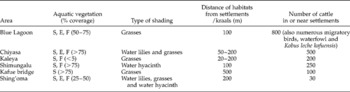
Areas within about 200 km coverage were selected for quantitative snail sampling on the basis of a systematic search for snails without estimating density (fig. 1). Each snail habitat in these areas was represented with at least three sampling sites where possible. In identifying sampling sites, the criterion used was access by cattle to water and grass. Snails were collected from August to October 2003 either using a scoop made from a kitchen sieve mounted on a 1.5 m long wooden handle as described by Coulibaly & Madsen (Reference Coulibaly and Madsen1990) or picked off aquatic plants using gloved hands. Scooping was undertaken for 15–30 min at each potential snail habitat and at the edges of larger water bodies. Snail species of different sizes were collected from habitats with varying ecological factors (table 1). All habitats showed different levels of shading by aquatic vegetation. The substratum at these areas was characterized by mud and leaves except at Shimungalu where it was only mud. While the sampled habitats were generally flat, Kaleya stream was characterized by gently sloping banks.
Variation in the ecological factors (defined by Madsen, Reference Madsen2003), distance from settlements and number of cattle accessing the snail sampling areas.

S, submerged; E, emergent; F, floating.
Snail identification
Snail species were identified according to the morphological features of the shell described by Brown & Kristensen (Reference Brown and Kristensen1989) and then counted. Cercariae-producing snails were identified to species, or at least to genus level as this was important from the viewpoint of cercarial identification (Frandsen & Christensen, Reference Frandsen and Christensen1984).
Snail shedding/cercarial harvesting
Lymnaea natalensis snails were collected and examined for infection as follows: a strip of laboratory film, Parafilm ‘M’® (American National Can™, Chicago, Illinois), was stretched over a Petri dish to form a trough before an individual snail was put in. To prevent shell damage, a plastic forcep was used to lift a snail from the collection beaker before placing it in the created trough and then 10 ml of filtered pond water was placed in the Petri dish. Based on the findings of Da Costa et al. (Reference Da Costa, Dreyfuss, Rakotondravao and Rondelaud1994) that shedding of cercariae from L. natalensis and their transformation into metacercariae occur mainly at night, a cover was placed on the Petri dish containing an individually confined snail before placing in a dark compartment overnight. This entire setup was left undisturbed in the laboratory at room temperature for 12–24 h. Shedding of other snail types (e.g. Bulinus) was induced by exposing snails to artificial illumination for 2 h as described by Frandsen & Christensen (Reference Frandsen and Christensen1984).
Identification and counting of cercariae and metacercariae
After shedding from L. natalensis snails overnight and from other snail types following artificial illumination, cercariae and/or metacercariae were examined and counted under a stereomicroscope. Living and unstained cercariae were identified based on the morphological characteristics, swimming behaviour and resting position described by Frandsen & Christensen (Reference Frandsen and Christensen1984). The level of shedding in the snails was graded as follows: < 200 cercariae/metacercariae were considered as mild; 200–1000 as moderate and >1000 as severe. Metacercariae were counted and handled while still adhering to the parafilm or floating on water, a method described by Urquhart (Reference Urquhart1954) but with minor modifications.
Coprological examination of cattle
Faecal samples from 101 cattle that accessed the snail habitats were collected and analysed for the presence of liver fluke and amphistome eggs as described by Taira et al. (Reference Taira, Suzuki and Boray1983). Fasciola eggs appeared as operculated and golden brown while those of amphistomes were large, clear, operculated and contained large granules.
Results
Snail frequencies
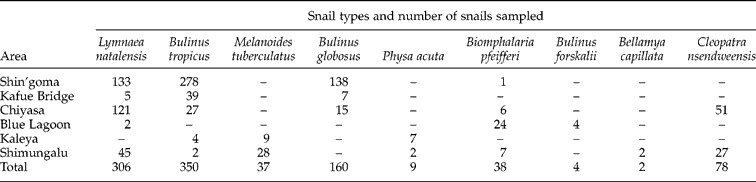
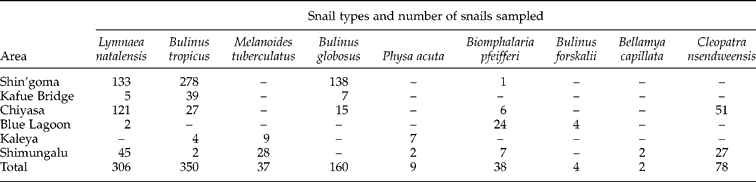
In all study sites, cattle kraals were situated near grazing and water areas (table 1). The majority of snails were found anchored to many types of objects and vegetation along the water, usually in close proximity to deposited cattle faeces, and nine snail species were identified (table 2). In an extensive search along a large section of Kaleya stream (~ 300 m), no L. natalensis were found. Other snail types such as Melanoides were also found but in low numbers (table 2). Many empty snail shells were seen at Blue Lagoon, but few live snails comprising mainly juvenile B. pfeifferi were collected. Numerous migratory birds, waterfowl and the semi-aquatic antelope (Kafue lechwe Kobus leche kafuensis) were found in many snail habitats, with some birds being seen picking at snails and insects. There was human contact in all habitats, especially in sites used for laundry, fishing, watering and drinking purposes (table 3).
Frequency of snail types sampled in six areas of the Kafue wetlands, Zambia.
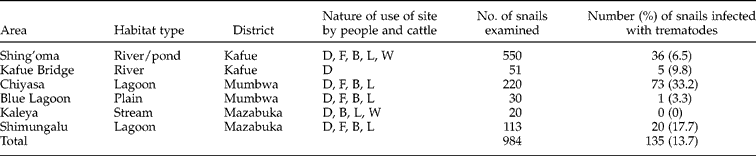
The prevalence (%) of trematode infections in snails sampled in six areas of the Kafue wetlands, Zambia.
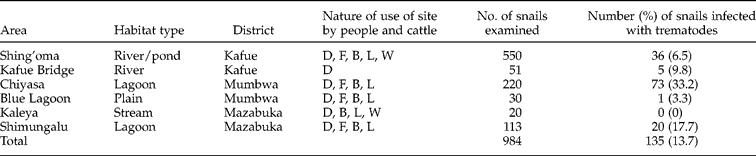
D, drinking site for cattle and/people; F, fishing; B, bathing; L, laundry; W, watering vegetables.
Cercarial/metacercarial harvesting
Of 984 snails collected, only 135 (13.7%) were found to harbour larval trematodes (table 3). There was no larval trematode infection recorded in the Kaleya stream while the highest rate (33.2%) was found in Chiyasa.
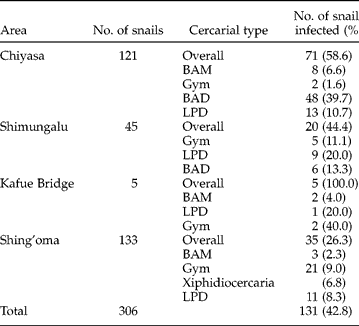
The number of L. natalensis collected at various sites and the infection rates of the cercarial types are shown in table 4. These snails harboured 42.8% of larval trematode infections recorded and consisted of five types of cercariae. Gymnocephalous and longifurcate-pharyngeate distome (LPD) were the commonest types of cercariae shed by all snails. Gymnocephalous cercariae were found in snails from all areas except at Kaleya where no such type of snail was found. The brevifurcate-apharyngeate distome (BAD) was the least common cercaria found. At Blue Lagoon only two Lymnaea snails were collected. One of them mildly shed gymnocephalous cercaria. Avian schistosome cercariae (BAD) were shed from eight L. natalensis snails in two areas; namely five (11.0%) from Shimungalu and three (2.5%) from Chiyasa.
The prevalence (%) of trematode infections in Lymnaea natalensis from four areas of Kafue river basin of Zambia.
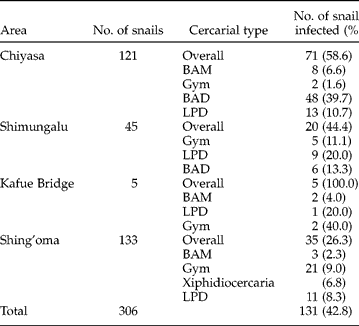
BAD, brevifurcate-apharyngeate distome cercaria (species from either Spirorchiidae or Schistomatidae families); BAM, brevifurcate-apharyngeate monostome cercaria (species of family Clinostomatidae); LPD, longifurcate pharyngeate distome cercaria (species of families Strigeidae and Diplostomatidae); Gym, gymnocephalous cercaria (species of the family Fasciolidae).
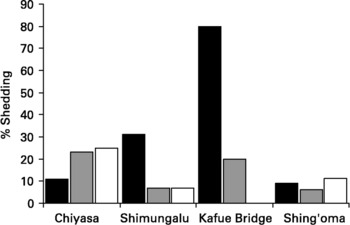
Shedding levels according to area are given in fig. 2. Severe shedding levels were found in Chiyasa (24.8%) while there was no severe shedding in Kafue bridge area. Moderate shedding was highest in Chiyasa (23.1%) and lowest in Shing'oma (6%), while mild shedding was highest in Kafue bridge area (80%) and lowest in Shing'oma (9%).
The proportion (%) of Lymnaea natalensis shedding (■, mild; ░, moderate; □, severe) in four areas of the Kafue wetlands, Zambia.

One snail (0.2%) of 416 Bulinus snails harboured avian schistosome cercariae (BAD) at Shing'oma. Three of Bulinus spp. snails shed amphistome cercariae only in Chiyasa making an overall prevalence of 0.7% (n = 416). No trematodes were recovered from B. capillata, P. acuta, B. pfeifferi, M. tuberculata and C. nswendweensis.
Coprological examination of cattle
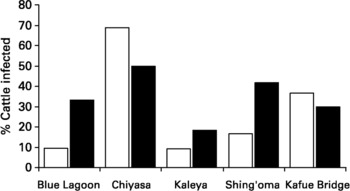
Overall prevalence rates of F. gigantica and amphistomes were 28.7% and 32.7%, respectively. Infections from various areas are shown in fig. 3. Cattle in Chiyasa showed the highest rate of Fasciola (68.8%) while those in Kaleya and Blue Lagoon had the lowest (9.1 and 9.5%, respectively). The prevalence rate of amphistomes was highest in Chiyasa (50.0%) and lowest in Kaleya (18.2%).
The proportion of cattle infected with Fasciola gigantica (□) and amphistomes (■) in five selected regions of the Kafue river basin, Zambia (Blue Lagoon, n = 21; Chiyasa, n = 16; Kaleya, n = 22, Shing'oma, n = 12; Kafue Bridge, n = 30).

Discussion
Larval trematode infections in snails in the present study were low except in Chiyasa (33.2%). However, infections in L. natalensis were high (42.8%). This could be attributed to high parasite pressure, making contact between miracidia and the snail a common occurrence. Similarly, Chingwena et al. (Reference Chingwena, Mukaratirwa, Kristensen and Chimbari2002) reported 23.8% trematode infections in L. natalensis which was second only to 58.5% in B. tropicus. Snails from Chiyasa had a 58.6% prevalence value compared with 68.8% in cattle. Except for this finding, infections in cattle from other areas were much lower than in snails. This could partly be due to light or newly acquired infections, limitations of coprological examination (Anderson et al., Reference Anderson, Luong, Vo, Bui, Smooker and Spithill1999) or sampling snails and cattle mostly during the dry season when most habitats become easily accessible by humans and their cattle. Accurate detection by faecal parasitological sampling has been difficult because of the poor sensitivity of methods to estimate the number of eggs in the voluminous faeces of ruminants (Anderson et al., Reference Anderson, Luong, Vo, Bui, Smooker and Spithill1999). True percentages of infections in cattle are, therefore, likely to be higher than reported. Also, there is no direct relationship between infections in snails and in ruminant hosts (Amato et al., Reference Amato, De Rezende, Gomes and Da Serra Freire1986) because metacercariae may never be consumed or they may encyst on herbage, hay or water long after snails are gone (Roberts & Suhardono, Reference Roberts and Suhardono1996).
The actual distribution of snail species is dependent on seasonal variations in climate and therefore, snail sampling surveys should be conducted repeatedly in all climatic seasons to obtain an overview of these variations. The majority of Fasciola infections in cattle, for example, occur in the second half of the dry season (Schillhorn van Veen, Reference Schillhorn van Veen1979, Reference Schillhorn van Veen1980a). Schillhorn van Veen (Reference Schillhorn van Veen1979) also reported that shedding of cercariae mainly occurs during the middle of the dry season when the infection rate in the snails is declining. Metacercariae are known to be acquired mainly by grazing animals during the middle of the dry season with the resulting patent infections observed at the end of the dry season or at the beginning of the wet season (Schillhorn van Veen, Reference Schillhorn van Veen1980b).
Five morphologically different types of larval trematodes infecting freshwater snails were recorded in the present study as compared with eight found in Zimbabwe (Chingwena et al., Reference Chingwena, Mukaratirwa, Kristensen and Chimbari2002). Concurrent infections of cattle grazing the same pasture zones were confirmed by finding amphistome and Fasciola eggs in their faeces. Overall larval trematode infections (13.7%) were high, whereas other authors reported lower larval trematode infections (Loker et al., Reference Loker, Moyo and Gardner1981; Mattison et al., Reference Mattison, Dunn, Hanna, Nizami and Ali1995; Kigadye, Reference Kigadye1998; Chingwena et al., Reference Chingwena, Mukaratirwa, Kristensen and Chimbari2002). The direct consequence of high rates of mortality induced by parasites (Wright, Reference Wright1966; Sousa, Reference Sousa1992) and hosts developing acquired resistance to infection resulting from host–parasite co-evolution (Begon et al., Reference Begon, Haeper and Townsend1990) may be responsible for this finding.
No mixed infections were recorded in the snails and although natural infections of amphistomes in B. pfeifferi (Dinnik, Reference Dinnik1965) and B. forskalii (Dinnik, Reference Dinnik1961; Wright et al., Reference Wright, Southgate and Howard1979) have previously been recorded in Zambia, no infections in these snail species were found. Only one B. tropicus was found shedding amphistome cercariae. Anderson & May (Reference Anderson and May1979) and Ewers (Reference Ewers1964) reported that larval trematode infections are dependent on snail numbers. Low prevalences in B. tropicus agree with the findings of Brown et al. (Reference Brown, Leathers and Minchella1988), Chao et al. (Reference Chao, Wang and Huang1993) and Chingwena et al. (Reference Chingwena, Mukaratirwa, Kristensen and Chimbari2002). Concurrent infections with more than one parasite species are comparatively uncommon (Kendall, Reference Kendall and Taylor1964). Unlike single infections, double infections in snails could cause higher mortality rates (Sousa, Reference Sousa1992) while scarcity of double infections may be due to antagonism between species (Sousa, Reference Sousa1993; Lafferty et al., Reference Lafferty, Sammond and Kuris1994). Temporal and spatial variations in the abundance of eggs and miracidia of different trematode species in relation to how often a snail can be simultaneously infected with two or more species are other reasons (Williams & Esch, Reference Williams and Esch1991; Sousa, Reference Sousa1993).
Snails were abundant at the beginning of the dry season, and concentrated in numerous marshy areas, the marginal shallow water of the main river, the lagoons and the ox-bow lakes. Critical determinants of infections in snails may be the distance of settlements and/or cattle kraals as well as the number of livestock in nearby homesteads. These factors favour the accumulation of trematode eggs in close proximity to potential snail habitats. Since livestock aggregate around water bodies when there is scarcity of pasture and water elsewhere, an increased frequency of contact between miracidia and snail intermediate hosts is enhanced thereby increasing the prevalence of infection in snails (Chingwena et al., Reference Chingwena, Mukaratirwa, Kristensen and Chimbari2002). The number of suitable final and snail intermediate hosts in an area, except where these are kept entirely apart, largely control the incidence of diseases like fascioliasis (Hammond, Reference Hammond1970), indicating that the more cattle and snails found together at one site, the more likely the disease(s) will propagate. Separating these hosts offers a major control aspect of the disease. Complete separation of susceptible livestock from snail-infested areas in the Kafue wetlands may not be feasible as a control measure but may be practical in the intensive farming husbandry systems in the uplands.
The risk of infection of livestock with trematodes in the Kafue wetlands is therefore high where L. natalensis occurs. Loker et al. (Reference Loker, Moyo and Gardner1981) and Davis (Reference Davis1998) respectively found that L. natalensis and L. tomentosa were the most important intermediate snail hosts for transmitting a wide variety of trematode species. In order to improve our knowledge of trematode control, epidemiological studies need to be made in different ecological regions of Zambia.
Field snail infection rates are routinely measured only by determining the rate of snails shedding cercariae. However, the rate of prepatent infection is usually left unmonitored. Therefore, the technique of natural emergence of cercariae may not be as sensitive and specific as other detection methods (Hamburger et al., Reference Hamburger, Hoffman, Kariuki, Muchiri, Ouma, Koech, Sturrock and King2004). This may not allow the diagnosis of infection during the prepatent period, thus compromising field trials. Molecular methods using the polymerase chain reaction (PCR), which are highly sensitive and specific are likely to further our understanding of the epidemiology of trematode infections by ascertaining the infectivity status in ubiquitous snail populations (Mostafa et al., Reference Mostafa, Taha and Ramadan2003; Hamburger et al., Reference Hamburger, Hoffman, Kariuki, Muchiri, Ouma, Koech, Sturrock and King2004; Velusamy et al., Reference Velusamy, Singh and Raina2004). However, these have not been fully applied for the detection of infections in snails under field conditions.
Acknowledgements
The University of Zambia facilitated this study while financial support was provided by the Enhancement for Research Capacity–Livestock Helminths Research Project. Mr M. Chembensofu is thanked for his technical support. Contributions by Dr A.E. Makundi as well as Messrs M. Makuremwe and T. Zimunya are also acknowledged. We are indebted to A.R Mwanza, School of Engineering, University of Zambia for the cartographic assistance in making the map of study areas.