Introduction
Huntington's disease (HD) is a debilitating neuropsychiatric condition. We know that as the disease progresses there is significant, but variable, deterioration in various disease domains including motor function, cognition and behavior as measured by standardized scales like the Unified Huntington's Disease Rating Scale (UHDRS) (Folstein et al., Reference Folstein, Folstein, Mc Hugh, Chase, Wexler and Barbeau1979; Caine and Shoulson, Reference Caine and Shoulson1983; Huntington Study Group, 1996; Zappacosta et al., Reference Zappacosta1996). Psychiatric disturbances including mood changes, irritability, apathy, obsessive-compulsive behavior, delusions and hallucinations are frequent, with 35% to 75% of patients being affected (Zappacosta et al., Reference Zappacosta1996). It is unclear to what extent these different phenotypic features determine the need for higher levels of care. A better understanding of this might help in better predicting the discharge needs of HD patients. We aimed to explore the relationship, if any, between disease domains and discharge patterns. We hypothesized that deterioration in function or being depressed or having dementia would predict discharge to a higher level of care. We also examined the phenotypic patterns of admitted HD patients using selected UHDRS scales.
Methods
Participants
Subjects were recruited prospectively from a cross-sectional group of people who were admitted to the only Regional Neuropsychiatry Ward in the north-east of England and who had a diagnosis of Huntington's disease. Recruitment was performed over a period of one year (November 2007 to November 2008). Diagnosis was confirmed clinically by the leading regional neuropsychiatrist (WB), who has specialist expertise in the treatment and management of HD. This was based on history of movement disorder in the patient and family history of HD and a confirmatory genetic test as per internationally accepted criteria (Kremer et al., Reference Kremer1994). All subjects who were admitted were considered as potential study subjects. Baseline demographics including age at onset of illness, duration of HD and gender were collected. Subjects received a standardized assessment which included some of the UHDRS scales including Motor Assessment (MAS) and Behavioral Assessment (BAS) (conducted by AV), Functional Assessment, Functional Capacity and an additional assessment of Activities of Daily Living (ADL) (Bylsma et al., Reference Bylsma, Rothlind, Hall, Folstein and Brandt1993) (conducted by TP). The UHDRS Behavioral Assessment Scale (BAS) allowed a binary assessment of presence or absence of depression and dementia on clinical global impression. Discharge outcomes were also collated. The study received approval from relevant ethics committee and all participants gave written informed consent to participation. Where participants themselves were unable to consent due to lack of capacity (caused by significant dysarthria or cognitive disturbance), appropriate consent was obtained from the carer best known to them under the principles of best interests and least possible harm.
Data analysis
Analyses were carried out using SPSS (version 15). Two-tailed independent t tests were applied for continuous data and Fisher's exact tests were applied to categorical data. Pearson correlation coefficients were used to measure the extent of associations.
Results
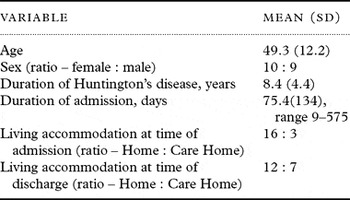
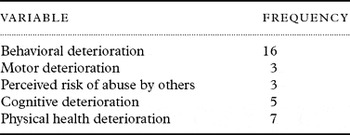
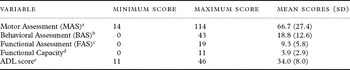
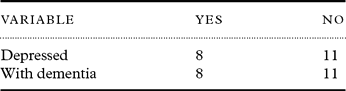
We recruited 19 consecutive subjects who were admitted to the neuropsychiatric ward. None of the subjects declined to participate or withdrew from the study. Tables 1 to 4 show the demographic profile of the participants and their scores on the various assessment scales at the time of admission.
Demographic profile of participants in the study (N = 19)

Reasons for admission (N = 19)*

*Note: There could be more than one reason for admission
Phenotypic pattern of participants at time of admission as measured by UHDRS and ADL functioning scale (N = 19)

aHigher scores denote greater impairment, minimum achievable score 0, maximum 124
bHigher scores denote greater impairment, minimum achievable score 0, maximum 88
cLower scores denote greater impairment, minimum achievable score 0, maximum 25
dLower scores denote greater impairment, minimum achievable score 0, maximum 13
eHigher scores denote greater impairment, minimum achievable score 0, maximum 68
UHDRS = Unified Huntington's Disease Rating Scale; ADL = activities of daily living
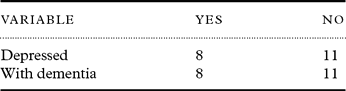
Binary assessment of participants being depressed or having dementia, Behavioral Assessment Scale (N = 19)
Discharge analysis
The participants’ discharge was dichotomized to either discharge to same level of care (n = 14) (e.g. home to home) or to a higher level of care (n = 5) (e.g. home to care home). None of the participants was discharged to a lower level of care.
There was a difference in the ADL scores in the two groups, though this was not statistically significant: mean scores (SD) 32.5 (8.8) and 38.5 (2.3) respectively, p = 0.041; effect sizes were large (Cohen's D = 0.885). Neither being depressed (Fishers exact test, p = 0.338, 2-sided), nor having dementia (Fisher's exact test, p = 1.00, 2-sided) predicted discharge to a higher level of care.
There was no correlation between the duration of admission and prior duration of HD (Pearson r = −0.203, p = 0.41), or with behavior (BAS) (Pearson r = −0.201, p = 0.408) or motor incapacity, (MAS) (Pearson r = −0.039, p = 0.874).
Analysis of parameters at time of admission
There was a positive correlation between MAS and ADL scores (Pearson r = 0.554, p = 0.014), and between MAS and participants having dementia (Pearson r = 0.49, p = 0.033), which suggests that as the disease progresses there is a decrease in functioning and cognition. This is also confirmed by the positive trend of correlation between duration of HD and ADL Score (Pearson r = 0.442, p = 0.058). However, there was no correlation between age and ADL scores.
Discussion
To our knowledge, this is the first attempt to explore determinants of discharge in HD patients from a psychiatric unit. The sample population, as expected, was skewed towards more psychiatric and behavioral disturbances in admitted patients with HD. A previous study (Dubinsky, Reference Dubinsky2005) indicated that 60.3% of people with HD at end of life, who are admitted to a hospital, move to a long-term care facility. However, that study analyzed results across all hospitalizations in the U.S.A. What is clearer from our study is that poor functional ability, as measured by ADL, does predict discharge to higher level of care.
However, contrary to our hypothesis, we did not find that being depressed prompted a move to a higher level of care, suggesting that depression is not necessarily a primary determinant of care needs. This again echoes clinical findings and previous research (Zappacosta et al., Reference Zappacosta1996). Similarly, having dementia did not necessarily mean that people with HD needed increased level of care. However, we used a global impression of presence or absence of dementia. Future studies should attempt to determine the relationship, if any, with various neuropsychological correlates of dementia, e.g. frontal executive dysfunction, visuoperceptive functions and memory and the discharge patterns.
The total duration of admission on the psychiatric ward did not correlate significantly with most measures, which suggests that other variables might be decisive, such as the availability of an appropriate care home, further deterioration in illness or new complications.
We also attempted to find the extent of baseline associations between various illness features. Our results validated previous findings; in particular, there was no correlation between age and ADL scores which suggests that other parameters might be involved in predicting ADL functioning for a particular age, i.e. motor phenotype, CAG repeat lengths (Zappacosta et al., Reference Zappacosta1996).
Our study is limited in being a cross-sectional study and having a small population size. It is therefore not possible to establish the rate of decline in various phenotypic parameters; it does, however, enhance our understanding of which factors prompt admission to a psychiatric unit as well as determine patients’ discharge patterns.
Conflict of interest
None.
Description of authors’ roles
Akshya Vasudev designed the study, collected and analyzed the data, and wrote the paper. Tracy Palmer collected the data and Alan Thomas assisted in writing the paper. David Burn and William Barker assisted in designing study and writing the paper.