Based on the qualitative and quantitative analysis of 36 documents related to environmental education, Srbinovski (Reference Srbinovski2004a) defined the term ‘environmental education’ in the following way: ‘Environmental education is a developing process of active learning in which individuals and groups acquire the necessary knowledge, understanding, attitudes and skills for a determined, motivated, responsible, and above all, joint action towards obtaining and maintaining a dynamic balance in the environment’ (p. 72). This definition includes all the essential components (attitudes, awareness, knowledge, skills and action) of environmental literacy as the ultimate goal of environmental education.
The term ‘environmental worldview’ can be defined as the collective beliefs and values that give people a sense of how the world works, their role in the environment, and right and wrong behaviour toward the environment. Environmental worldviews dictate how we interact with nature and our attitude toward how we use the natural resources it contains (Gillaspy, Reference Gillaspy2015). There is a growing interest among scholars in environmental worldviews as a framework of attitudes and ideas about the environment. Many national and cross-cultural studies have focused on environmental views in a wide variety of fields, including psychology, sociology, life sciences and teacher training. In certain Western societies, researchers have documented an increasingly positive disposition toward environmental issues (Dunlap, Van Liere, Mertige, & Jones, Reference Dunlap, Van Liere, Mertig and Jones2000). On the other hand, some researchers have stressed the need for studies in the context of developing countries because of the fact that cultural value orientations in developing countries differ from those of developed ones (Diekmann & Franzen, Reference Diekmann and Franzen1999). It is therefore very important to identify the cultural, political and educational characteristics that shape environmental values and attitudes related to environmental behaviour. In the last 40 years, a number of scales have been developed to measure environmental attitudes, knowledge and behaviour: the scale for measuring adult environmental attitudes (Maloney, Ward, & Braucht, Reference Maloney, Ward and Braucht1975), the 16-item Likert-type Environmental Concern Scale (Weigel & Weigel, Reference Weigel and Weigel1978), the General Environmental Behavior (GEB) Scale (Kaiser, Reference Kaiser1998; Kaiser & Biel, Reference Kaiser and Biel2000), the Inclusion of Nature in Self Scale (Schultz, Reference Schultz2001), the Connectedness to Nature Scale (Mayer & Frantz, Reference Mayer and Frantz2004), and the Behaviour-Based Attitude Scale (Kaiser, Oerke, & Bogner, Reference Kaiser, Oerke and Bogner2007).
Earlier scales were aimed at concerns about specific problems and environmental attitudes, such as pollution and misuse of natural resources (see Iozzi, Reference Iozzi1981), and energy use at home (Pallak, Cook, & Sullivan, Reference Pallak, Cook, Sullivan and Bickman1980). The availability of a carefully developed and psychometrically sound scale to measure global environmental attitudes would be a valuable teaching and research tool (Leeming, Dwyer, & Bracken, Reference Leeming, Dwyer and Bracken1995). A scale of this kind would provide a single common standard against which the effectiveness of various interventions could be evaluated and compared (Boeve-de Pauw, Donche, & Van Petegem, Reference Boeve-de Pauw, Donche and Van Petegem2011). Dunlap & Van Liere (Reference Dunlap and Van Liere1978) designed one such instrument, the New Environmental Paradigm (NEP) Scale (sometimes called the ‘Original NEP Scale’). The NEP is an expanded and updated version of its predecessor, which has been used by social scientists for over two decades.
An alternative worldview to the Dominant Social Paradigm (DSP) was provided by the NEP, which highlights the disruption to ecosystems caused by modern industrial societies exceeding environmental limits. In this view, nature is seen as a limited resource, delicately balanced and subject to deleterious human interference. Positing endless progress, growth, abundance and attitudes contributing to environmental degradation, the DSP is opposed to the NEP (Dunlap & Van Liere, Reference Dunlap and Van Liere1978). The NEP Scale was constructed to take account of this wider view of the relationship between modern societies and the environment, and the scale acts as a measure of the proposed shift in people’s worldviews at the level of human-environment interaction (Van Petegem & Blieck, Reference Van Petegem and Blieck2006). The original NEP had 12 items that appeared to represent a single scale in the way in which populations responded to them.
The revised NEP Scale by Dunlap et al. (Reference Dunlap, Van Liere, Mertig and Jones2000) appears to be an improved measuring instrument compared to the original version as it (1) provides more comprehensive coverage of the key faces of an ecological worldview, (2) avoids the unfortunate lack of balance in the item direction of the original scale (where only four items, all dealing with anthropocentrism, were stated in an anti-NEP direction), and (3) removes the outmoded, sexist terminology in some of the original scale’s items.
The literature includes discussions on whether the NEP Scale can be acceptably scored as a unidimensional or multidimensional scale. Dunlap and Van Liere (Reference Dunlap and Van Liere1978) found the scale to be unidimensional, with all items loading highly on one factor. They propose environmental attitudes as a unidimensional construct ranging from the unconcerned about the environment at the low end, to the concerned at the high end. In this view, an individual can either have a pro-environmental or anti-environmental perspective but not both. Wiseman and Bogner (Reference Wiseman and Bogner2003) pointed out a problem inherent in the common use of an environmental perception and attitude instrument measuring of first-order factors only. This led them to the development of a Model of Ecological Values (2-MEV) with two orthogonal dimensions: Preservation — reflecting conservation and protection of the environment, and utilisation — reflecting the utilisation of natural resources. This 2-MEV allows individuals to have a high score on preservation, indicating a strong desire to protect the environment, but at the same time the belief that the primary purpose of the environment is to benefit humans, thus giving a low score on utilisation (Le Hebel, Montpied, & Fontanieu, Reference Le Hebel, Montpied and Fontanieu2014). The two-dimensional approach of the 2-MEV has the advantage of being able to sketch a more nuanced picture of environmental values and their effects (Boeve-de Pauw, Reference Boeve-de Pauw2011).
Many authors have found that the NEP can consist of up to five dimensions (Albrecht, Bultena, Hoiberg, & Nowak, Reference Albrecht, Bultena, Hoiberg and Nowak1982; Amburgey & Thoman, Reference Amburgey and Thoman2012; Geller & Lasley, Reference Geller and Lasley1985; Noe & Snow, Reference Noe and Snow1990; Nooney, Woodrum, Hoban, & Clifford, Reference Nooney, Woodrum, Hoban and Clifford2003; Schetzer, Stackman, & Moore, Reference Schetzer, Stackman and Moore1991). Dunlap et al. (Reference Dunlap, Van Liere, Mertig and Jones2000) cautioned that the dimensionality may depend on the specifics of the sample. Worldviews, as measured by the NEP Scale, may be unidimensional in those populations where the environmental belief systems are organised into a coherent framework. They suggest analysing the scale factor in each sample before breaking the scale into dimensions. However, the dimensionality of environmental attitudes and the nature of the dimensions are still being discussed.
It should be noted that the NEP Scale is one of the most widely used measures of environmental concern in the literature (Dunlap, Reference Dunlap2008; Dunlap et al., Reference Dunlap, Van Liere, Mertig and Jones2000; Hawcroft & Milfont, Reference Hawcroft and Milfont2010). It has, however, suffered a great deal of criticism. The NEP Scale has been criticised for several shortcomings, including a lack of internal consistency among the individual responses, poor correlations between the scale and behaviour, and ‘dated’ language used in the instrument’s statements (Anderson, Reference Anderson2012, p. 260). Another critique stems from the cross-cultural applicability of the scale, as the conceptualisation of ecological worldviews may not be applicable outside developed Western nations (e.g., Chatterjee, Reference Chatterjee2008). The differences in perceptions, as well as language barriers between different nations, can be very large. Some studies (e.g., Gooch, Reference Gooch1995) suggest that the items are not always ‘translatable’ outside of Western countries. Also, the NEP Scale has been criticised for being an inadequate measure of one’s affective, experiential relationship to the natural world, as it seems to measure cognitive beliefs rather than affective experience (Mayer & Frantz, Reference Mayer and Frantz2004). Manoli, Johnson, and Dunlap (Reference Manoli, Johnson and Dunlap2007) concluded that caution must be used when interpreting the findings, as the results of their research may not apply to children in other locations because the authors cannot generalise their results until we and other researchers have conducted further studies with children from other backgrounds and in other locations.
Despite these limitations, some studies have supported the cross-cultural validity of the NEP Scale (Bechtel, Corral-Verdugo, & Pinhiero, Reference Bechtel, Corral-Verdugo and Pinhiero1999; Bechtel, Corral-Verdugo, & Asai, & Riesle, Reference Bechtel, Corral-Verdugo, Asai and Riesle2006; Kahn, Reference Kahn1999; Vikan, Camino, Biaggio, & Nordvik, Reference Vikan, Camino, Biaggio and Nordvik2007). Hawcroft and Milfont (Reference Hawcroft and Milfont2010) found that the scale has been used in 36 nations, and they suggest that it may be used productively outside developed Western countries. Van Petegem and Blieck (Reference Van Petegem and Blieck2006) demonstrated that the Children’s NEP Scale can be used in cross-cultural contexts and concluded that there are cross-cultural differences in adolescents’ (aged 13–15) environmental worldviews.
The debate about both the cross-cultural applicability and the dimensionality of the NEP Scale stimulated our interest in exploring these issues on a sample of Serbian and Macedonian school students. Accordingly, the first objective of this study was to test the dimensionality of the NEP Scale. The second task was to explore the environmental worldviews of young people in Serbia and Republic of North Macedonia using the revised NEP Scale (Dunlap et al., Reference Dunlap, Van Liere, Mertig and Jones2000). There is a broad agreement in our countries that environmental education is a good thing, that there is not enough of it, and that our students have urgent need to become literate about the environment. Keeping in mind that relatively little information yet exists in this field, with this study we hope to give a modest contribution to the clarification of environmental worldviews in a sample of Serbian and Macedonian school students. Also, this research will contribute to the evaluation and comparison of the effectiveness of various interventions conducted in the last few decades in the field of education and protection of the environment, especially because of the fact that earlier instruments were aimed at concerns about specific problems and environmental attitudes such as pollution and misuse of natural resources.
At the international level, this study will be interesting: (1) in terms of the fact that cultural value orientations in (our) developing countries differ from those of developed ones, (2) because the NEP Scale measures global environmental attitudes and takes account of a wider view of the relationship between modern societies and the environment, and (3) because it will contribute to the clarification of dimensionality of environmental attitudes that are still being discussed. Thus, this article will contribute to our understanding of the NEP Scale in nations with diverse cultural traditions in terms of the cross-cultural applicability; for example, language barriers between different nations.
Characteristics of the Serbian and Republic of North Macedonian environmental education systems
Although the most recent changes in the curriculum and primary education school policy in Serbia recognise the importance of environmental education and show progress in this field, changes in practice are yet to occur (Stanišić & Maksić, Reference Stanišić and Maksić2014). In primary schools, ‘Ecology’ or ‘Environmental Education’ does not exist as a separate subject, but environmental contents are integrated into the curricula of natural science subjects (biology, geography, physics and chemistry). A study carried out by Stanišić and Maksić (Reference Stanišić and Maksić2014) provides an overview of environmental content in the curricula in Serbia. The curriculum for primary schools contains about 18.62% of environmental issues (Šehović, Reference Šehović2012). An analysis of the curriculum revealed that 32% of the total number of hours is devoted to the relationship of man to natural and environmental protection, and a teaching unit dealing with nature is only 10% of the total number of hours. It seems that a significantly greater number of hours that specifically address the protection and enhancement of the environment are required (Komlenović & Stanišić, Reference Komlenović, Stanišić and Bagoly-Simó2009). The issues that are under-represented or not represented at all in the curriculum are those regarding healthy foods, GMOs and food additives, as well as recycling and biodegradable materials (Stanišić, Reference Stanišić2008). Numerous authors have studied the factors that influence young people’s attitudes towards environmental protection, ecological behaviour and environmental knowledge (family: Andevski, Reference Andevski1997; Kilibarda, Reference Kilibarda1998; Kundačina, Reference Kundačina2006; Markovska, Reference Markovska2002; Mišković, Reference Mišković1997; peers: Stanišić, Reference Stanišić2008; media: Andevski, Reference Andevski1997; Kundačina, Reference Kundačina2006; Mišković, Reference Mišković1997; Stanišić, Reference Stanišić2008). According to Đokić-Ostojić (Reference Đokić-Ostojić2010), 58% of 7th-grade primary school students in Serbia showed pro-environmental attitudes, while 31% demonstrated non-environmental attitudes and orientation towards personal use without thinking about the consequences. Also, 38% of students showed an extremely anthropocentric attitude that implies that man does not need to be a slave to ecological laws, while 34% disagreed with this statement (Đokić-Ostojić, Reference Đokić-Ostojić2010). However, no research has been carried out in Serbia into the impact of education on students’ attitudes towards environmental protection (Đokić-Ostojić, Reference Đokić-Ostojić2010). In any case, research in Serbia shows that it should be done at several levels (institutional and non-institutional) to equip present generations with specific environmental knowledge, and enable them to adopt a positive attitude towards the nature and natural resources and act pro-environmentally (Stanišić, Reference Stanišić2016).
One of the primary aims of the Republic of North Macedonian education system should be the promotion of environmental education as an effective way to improve the quality of our environment. An analysis of the content of the didactic materials in Macedonia showed how little time (2.18% in 2012, compared to 3.04% in 2001) is spent on environmental education, and the inclusion of environmental issues in the curricula and learning materials and textbooks is ‘left to chance’, and lacking in appropriate planning for consistency and theoretical grounding (Srbinovski, Reference Srbinovski2013). Textbooks are richer than the curricula in support of environmental issues in the lower grades of elementary schools (2.31% curricula and 4.77% textbooks) compared to upper elementary (1.93% curricula and 3.10% textbooks) and those of secondary schools (1.22% curricula and 1.24% textbooks; Srbinovski & Palmer, Reference Srbinovski and Palmer2008). A previous study also demonstrated that 93% of the environmental education curricula goals in the Republic of Macedonia are related to learning ‘about the environment’, 2% are related to learning ‘in/from the environment’, and 5% to learning ‘for the environment’ (Abazi, Ismaili, & Srbinovski Reference Abazi, Ismaili, Srbinovski, Sorial and Hong2008). When environmental issues are addressed, this is generally through a scientific approach; yet even then, crucially important topics, including recycling and waste management, endangered species, international and intergenerational inequalities, and sustainability do not feature in the classroom. Environmental education in Macedonian schools is neither a continuous nor a progressive process. The situation in the curricula is similar. Another study showed that there is no balanced distribution of the environmental components (natural systems — 46%, resources — 7%, and human resources — 47%). Within the natural systems great attention is given to: weather and climate, radiation and atmosphere. On the other side, earth, energy, land and soil, water, evolution, extinction and so forth are missing. Resources are also neglected, and the terms ‘biodiversity’ and ‘sustainable development’ are not mentioned at all.
In all countries of the European Union, the most common approach is for environmental education to be taught embedded in other subjects (e.g., Belgium, Denmark, Spain, Finland, France, Greece, Ireland, Italy, Luxembourg, the Netherlands, Portugal, Sweden, UK), but there are also examples of it being taught as a separate subject area (e.g., Belgium, Finland, Spain, France, Greece) or via a thematic interdisciplinary approach (e.g., Austria, Germany, Denmark, Finland; Stokes, Edge, & West, Reference Stokes, Edge and West2001). In all cases where it is taught as a separate subject it is also taught in some other way, primarily embedded in other subjects (Stokes et al., Reference Stokes, Edge and West2001). The survey results show similarities and differences in terms of environmental education in other countries around the world. Environmental aspects of education in the school textbooks in Bangladesh have been described mostly from a knowledge point of view or more correctly from a subject perspective (e.g., physics, chemistry, biology). The environmental education syllabus has been not only brief, random and fragmented, but also incomplete; there is a general lack of continuity or logical progression; it is incomplete and there is hardly any goal or destiny for the learners (Chowdhury, Reference Chowdhury2014). The interpretation of environmental education differs widely throughout the Pacific Islands, and courses or parts of syllabi that might be called environmental studies are very different from one another, ranging from those that teach solely ecological concepts or conservation, to those that incorporate the role of people within their environment (Brayant-Tokalau, Reference Brayant-Tokalau1988). An analysis of environmental education in the Russian Federation for the previous 10 years came to the conclusion that environmental education includes at least five trends: ‘school (theoretical) ecology’, ‘technical (industrial) ecology’, ‘socio-political ecology’, ‘playing ecology’ and ‘field ecology’ (Bogolubov, Reference Bogolubov2018). Romanian schools need more hours in the curricula of elementary and high schools dedicated to the study of educational environment. The requirements of the European curricula model called Green Package recommend that the environmental model be integrated into all school subjects such as mathematics, physics and chemistry (Deleanu, Reference Deleanu2013). In Turkey, most attention is given to knowledge, less to skills and attitudes, and little to environmentally responsible behaviour (Srbinovski, Erdogan, & Ismaili, Reference Srbinovski, Erdogan and Ismaili2010a).
Attitudes, knowledge and action in relation to the environment in the Republic of Macedonia have been studied by: Abazi, Ismaili, and Srbinovski (Reference Abazi, Ismaili and Srbinovski2009); Idrizi, Srbinovski, Jonuzi, and Murati-Sherifi (Reference Idrizi, Srbinovski, Jonuzi and Murati-Sherifi2015); Ismaili, Abazi, and Srbinovski (Reference Ismaili, Abazi and Srbinovski2009); Ismaili, Srbinovski, and Sapuric (Reference Ismaili, Srbinovski and Sapuric2014); Jonuzi (Reference Jonuzi2009, Reference Jonuzi2012); Kundačina (Reference Kundačina1991); Srbinovski (Reference Srbinovski2001, Reference Srbinovski2005a, Reference Srbinovski2005b, Reference Srbinovski2006, Reference Srbinovski2016), Srbinovski, Palmer, Ismaili, Abazi, and Zenki (Reference Srbinovski, Palmer, Ismaili, Abazi and Zenki2007), Srbinovski, Ismaili, and Abazi (Reference Srbinovski, Ismaili and Abazi2010b), Srbinovski, Ismaili, and Abazi (Reference Srbinovski, Ismaili and Abazi2011), Srbinovski, Ismaili, and Jonuzi (Reference Srbinovski, Ismaili and Jonuzi2013), Srbinovski, Idrizi, and Jonuzi (Reference Srbinovski, Idrizi and Jonuzi2014), Srbinovski, Ismaili, and Zenki (Reference Srbinovski, Ismaili and Zenki2014). According to these studies, in the last 20 years approximately 74% of Macedonian students have demonstrated pro-environmental attitudes, measured by 13-item, 5-point, two-way Likert-type scale instruments with values running along the strongly agree/strongly disagree continuum. Developing environmental attitudes is of great importance because there is a statistically significant correlation between knowledge and attitudes (.345), environmental information and attitudes (.453), and attitudes and action (.275) in the Macedonian case (Srbinovski, Reference Srbinovski2005b).
Although a number of studies of attitudes have been published in these countries, there is a need for more detailed studies of this phenomenon. First, we believe that this phenomenon will never be completely studied and explained, not only in these countries, but also around the world. In this regard, Heberlein (Reference Heberlein1981) pointed out that ‘environmental attitudes are fundamentally important, widely discussed, frequently measured and poorly understood’ (p. 241). Second, although there has been criticism about environmental attitude research and some of its methodological shortcomings for developing countries, in terms of the number of this kind of study, we are still far behind developed countries. Third, there is a long tradition of responsibility and care for the environment in the countries involved in the research. Fourth, we need a different instrument from what was used in previous studies as (1) each instrument has both advantages and disadvantages, and (2) it is very important to measure students’ environmental attitudes with the most widely used instruments in the world.
The objectives of this study are to assess the dimensionality of the revised NEP Scale in Serbian and Macedonian cultures and to use it to explore the environmental worldviews of young people in Serbia and Republic of North Macedonia. In accordance with the objectives of this study, we investigated whether school students held beliefs consistent with the DSP or the NEP. The DSP upholds human dominance over nature and faith in progress and technology to solve all problems, including an ecological crisis. On the other hand, the NEP is based on humans as part of nature and on limitations to growth. Since some previous researchers (Bechtel et al., Reference Bechtel, Corral-Verdugo and Pinhiero1999; Corral-Verdugo & Armendariz, Reference Corral-Verdugo and Armendáriz2000; Nooney et al., Reference Nooney, Woodrum, Hoban and Clifford2003; Schultz, Unipan, & Gamba, Reference Schultz, Unipan and Gamba2000; Van Petegem & Blieck, Reference Van Petegem and Blieck2006) suggested that culture plays an important role in this respect, we also looked for possible differences in the perspectives on environmental worldviews between Serbian and Macedonian school students.
Method
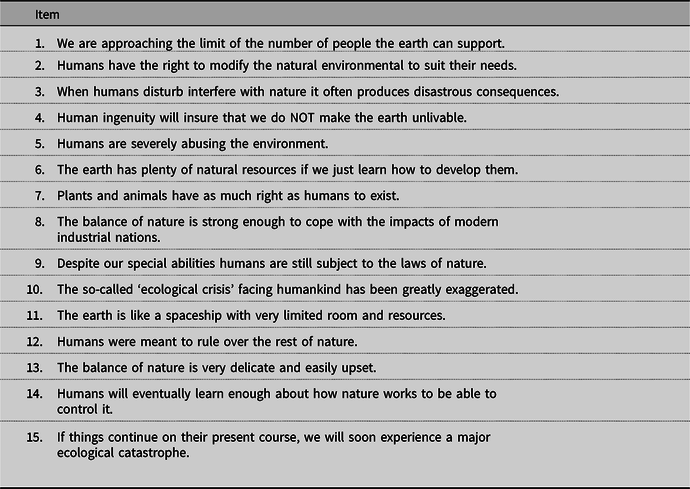
The study employed one of the most widely used scales — the NEP Scale, revised by Dunlap et al. (Reference Dunlap, Van Liere, Mertig and Jones2000), which includes 15 items (Table 1). The degree to whether the new ecological paradigm was accepted was evaluated based on the percentage distribution of the answers given to each item. The items were rated as follows; 1 = I strongly disagree, 2 = I don’t agree, 3 = I am unsure, 4 = I agree, 5 = I definitely agree. Agreement with the eight odd-numbered items indicates pro-NEP orientation (items 1, 3, 5, 7, 9 11, 13, 15), while agreement with the seven even-numbered items indicate pro-DSP orientation (items 2, 4, 6, 8, 10, 12, 14). Thus, the abovementioned rating was reversed for all statistical procedures except for percentage calculation in the items of even numbers. The pro-NEP orientation items assess an ecological — ‘humans as part of nature’ view, and the pro-DSP orientation items an anthropocentric — ‘humans as rulers over nature’ view. For example, ‘Plants and animals have as much right as humans to live’ is an ecological item, whereas ‘Humans were meant to rule over the rest of nature’ is an anthropocentric one.
Items in revised NEP Scale (Dunlap et al., Reference Dunlap, Van Liere, Mertig and Jones2000)

The revised NEP Scale is a 5-point Likert-type scale. Each item was measured on a scale ranging from 1 to 5: strongly agree (5), mildly agree (4), unsure (3), mildly disagree (2), and strongly disagree (1). All pro-NEP responses were expected to have relatively high scores and all DSP responses were expected to be relatively low. The dataset obtained from the scale was analysed via the principal component analysis factor extraction method, and a varimax rotation was applied.
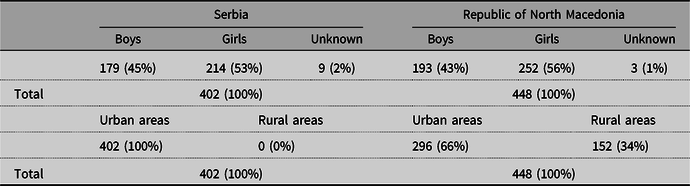
We used the revised NEP Scale with school students aged between 13 and 15, who are exiting ISCED2Footnote 1 and entering ISCED3Footnote 2. This means that at the time of testing the school students in the sample (Serbian and Macedonian) were in 7th and 8th grade of primary school and 1st year of secondary school. The sample covered by the survey was convenient. The study included 402 school students from Serbia and 448 school students from the Republic of North Macedonia, or less than 1% of students at this age (Table 2). A total of 850 pupils from 11 schools (5 elementary schools and 6 secondary schools) took part in this research. The sample was both intentional and systematic; intentional because the students were at this age only, and systematic because we chose each n-th class, that is, the classes were chosen from a target population by selecting a random starting point and selecting other members after a fixed sampling interval (n).
The structure of the sample according to gender and urban character

Because a range of coincidental moments influenced which students will be found in these classes, we can consider the simple as coincidental as well. The schools in which the research was conducted are located in different parts of Serbia and Republic of North Macedonia, so the sample included students from both urban and rural areas (Table 2). The schools were chosen for reasons of access and willingness to cooperate. These schools and students are typical of the nations in terms of the curricula, educational programs and teaching materials, and in general they are traditional. The high school students attended gymnasium education, medicine and economic schools; they were not in a specific environmental class or program.
This research was conducted based on key ethical guidelines for research. In terms of level of risk, this project did not represent a risk to the participants. We always stressed the importance of voluntary participation and the students’ possibility to withdraw from the project at any stage. We offered confidentiality to the participants; thus, we did not require their names or personal details. Another important aspect to consider is that the research was conducted in mother tongues. Special attention was paid to the translation of the NEP Scale into the Macedonian and Serbian languages. First, the NEP Scale was translated by professional translators in Macedonian and Serbian. Then we consulted experts in ecology and sustainable development, and some elementary and secondary school teachers as well. In the third stage of translation, the language versions were proofread in both languages. The NEP Scale was tested by administering it to 80 students from four elementary and secondary schools, and it was tested for reliability using Cronbach’s alpha. For the pilot study, Cronbach’s alpha for this scale was within acceptable internal consistency.
Results
We present our results within the structure of the two subtasks of the analysis as outlined above.
Assessing the NEP’s dimensionality
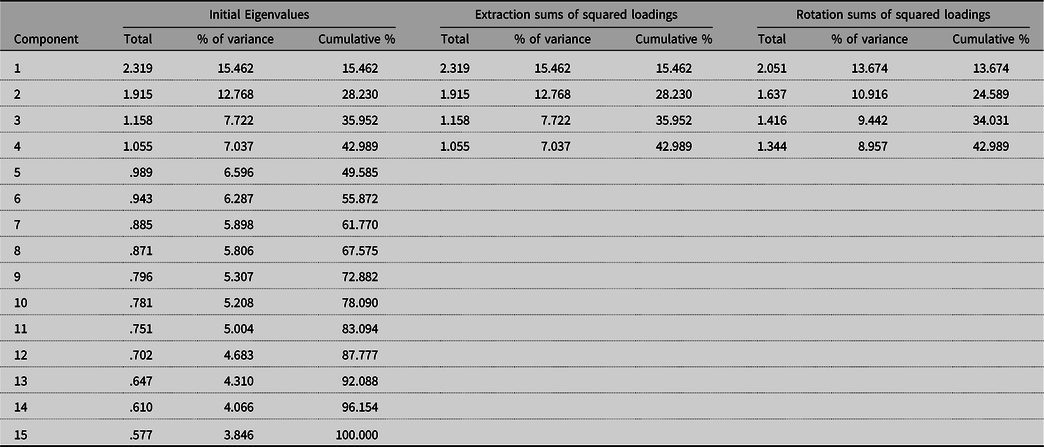
A principal components factor analysis (PCA) with varimax rotation and principal axis factoring (PAF) methods were carried out in order to find out the existence of dimensions. Both of these showed four dimensions. The factor analysis was unconstrained, and the primary factors explained a total of 43% of the variance in the obtained results (Table 3). The PAF method explained 23% of the variance. We will only discuss the results of the PCA for two reasons: (1) in our results, 57% of the variance remains unexplained by the PCA and 77% by the PAF; (2) to facilitate comparison between our results and those found by other authors who also used the PCA (e.g., Dunlap et al., Reference Dunlap, Van Liere, Mertig and Jones2000; Furman, Reference Furman1998; Gambro, Reference Gambro1995; Rideout, Hushen, McGinty, Perkins, & Tate, Reference Rideout, Hushen, McGinty, Perkins and Tate2005, Van Petegem & Blieck, Reference Van Petegem and Blieck2006).
Total variance explained

Note: Extraction method: Principal component analysis.
Factor extraction presents the eigenvalues associated with each linear component (factor) before extraction, after extraction and after rotation. Before extraction, SPSS had identified 15 linear components within the dataset. The first four factors explain 42.98% of the total variance. The columns labelled ‘Extraction sums of squared loadings’ display the eigenvalues associated with these factors. The eigenvalues of the factors after rotation are shown in the final part of the table (labelled ‘Rotation sums of squared loadings’). After extraction, factor 1 accounted for 16.219% of the variance (compared to the other three factors: 10.91%, 9.44% and 8.95% respectively).
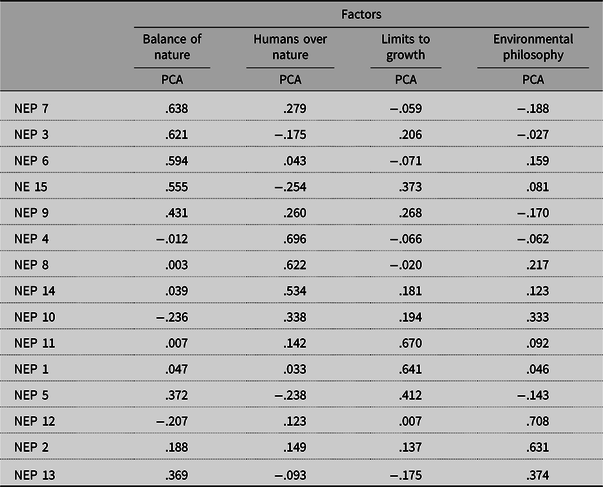
The PCA and the examination of a scree plot supported four dimensions named ‘Balance of Nature’, ‘Humans over Nature’, ‘Limits to Growth’ and ‘Environmental Philosophy’ (Table 4). Items 7, 3, 6, 15 and 9 loaded heavily onto the Balance of Nature component. Four items (4, 8, 14 and 10) loaded onto the Humans over Nature component, three items (11, 1 and 5) onto the Limits to Growth component and items 12, 2 and 13 loaded onto the Environmental Philosophy component.
Factor loadings in the principal component analysis of the revised NEP Scale items with varimax rotation

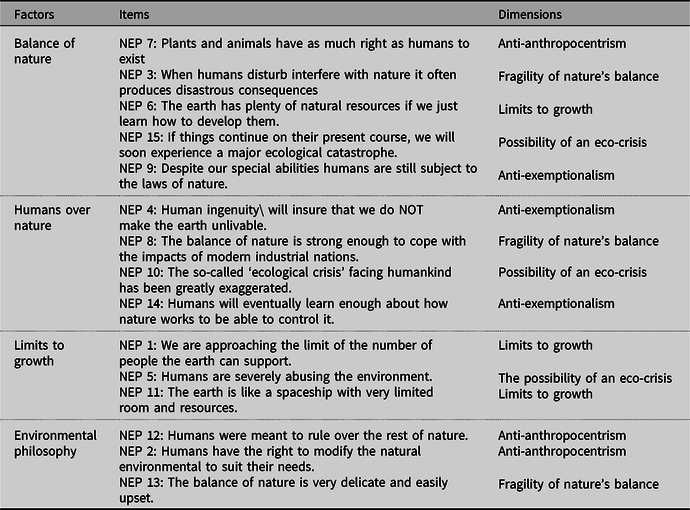
Each of the four factors contains at least two out of five NEP dimensions that include issues pertaining to the fragility of nature’s balance, the possibility of an eco-crisis, anti-anthropocentrism, anti-exemptionalism and limits to growth (Table 5). The first of these four factors (Balance of Nature) contains five related dimensions focusing on limits to growth, the fragility of nature’s balance, the possibility of an eco-crisis, anti-anthropocentrism and anti-exemptionalism. These five items include one item on the possibility of an eco-crisis (item 15), the fragility of nature’s balance (item 3), anti-exemptionalism (item 9), anti-anthropocentrism (item 7) and limits to growth (item 6). The second factor (Humans over Nature) has four items and includes one item on the possibility of an eco-crisis (item 10), two on anti-exemptionalism (items 14 and 4) and one on the fragility of nature’s balance (item 8). The third factor (Limits to Growth) includes one item on the possibility of an eco-crisis (item 5), and two on limits to growth (items 1 and 11). The fourth factor (Environmental Philosophy) consists of one item on the fragility of nature’s balance (item 13) and two on anti-anthropocentrism (items 2 and 12). All the above findings indicate that the NEP Scale cannot be readily accepted as a unidimensional measure of ecological worldviews. It has more than one dimension and each dimension (even each item in some cases) should be evaluated separately. We agree with Van Petegem and Blieck (Reference Van Petegem and Blieck2006), and Rideout et al. (Reference Rideout, Hushen, McGinty, Perkins and Tate2005) that NEP item 6 was probably misinterpreted by the respondents. Erdogan (Reference Erdogan2009) argued that this item (with 1 and 11) is not determinative for Turkish culture, and thus suggested revising or removing it.
Factors by items and dimensions

A comparison of the Serbian and Macedonian student’s answers concerning the four dimensions given by the factor analysis (Table 6) shows that there is a statistically significant difference for three factors (p < .001).
Mean comparison between the answers of the Serbian and Macedonian school students for the four factors

Note: SRB = Serbia, MAC = Republic of North Macedonia, SD = standard deviation, df = degrees of freedom, Sig. = significance probability.
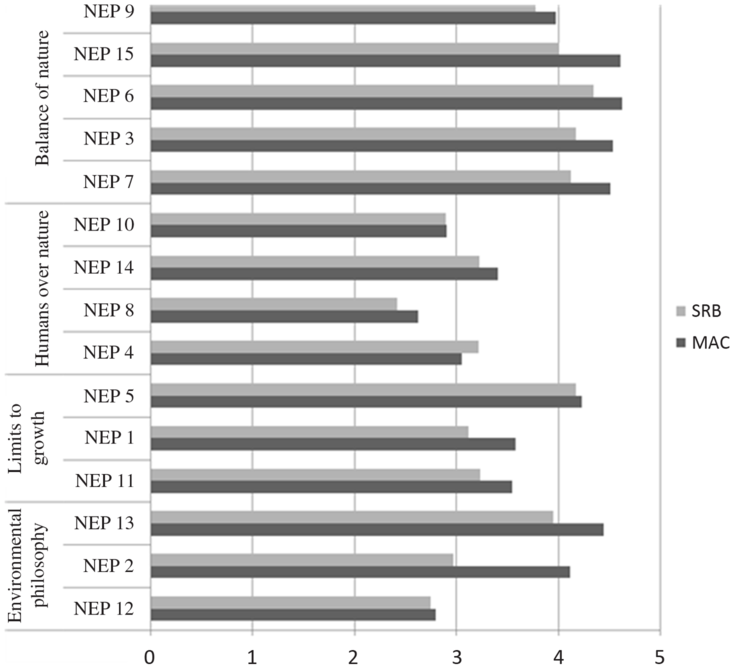
Differences can be seen in the Balance of Nature, Limits to Growth and Environmental Philosophy dimensions (Figure 1). Figure 1 also shows the differences in the Serbian and Macedonian samples for all 15 items. There is a statistically significant difference on all items (item 1: t = −6.5, df = 836; item 2: t = −14.5, df = 842; item 3: t = −6.4, df = 841; item 4: t = 2.0, df = 844; item 6: t = −5.7, df = 847; item 7: t = −5.7, df = 713; item 8: t = −3.0 df = 843; item 9: t = −3.1, df = 842; item 11: t = −4.0, df = 841; item 13: t = −2.8, df = 846; item 14: t = −2.5, df = 847, item 15: t = −9.5, df = 753); except on items 5, 10 and 12.
Comparison of means by item on the revised NEP for school students for the Republic of North Macedonian and Serbian datasets.

Macedonian school students appear to be more convinced than Serbian school students that both economic and population growth are limited, and of the importance of nature being in balance and in terms of Environmental Philosophy. The lowest mean for both subgroups exists for the Humans over Nature component.
School students’ worldviews
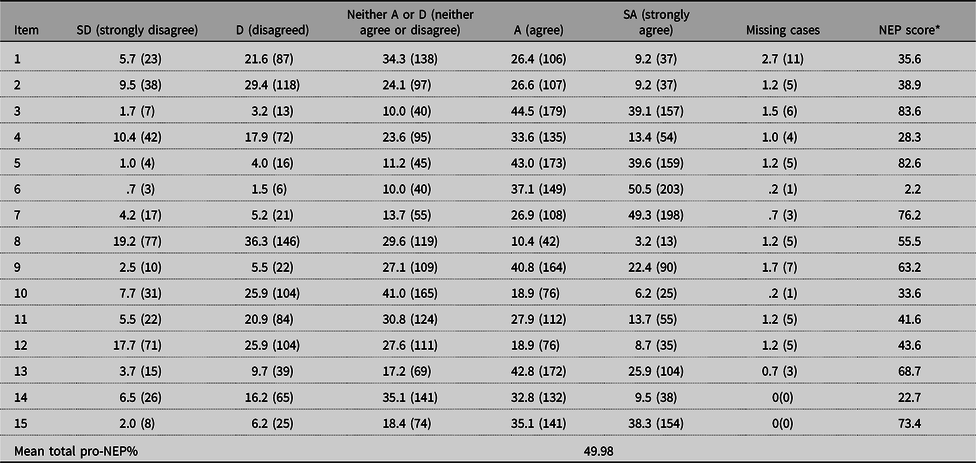
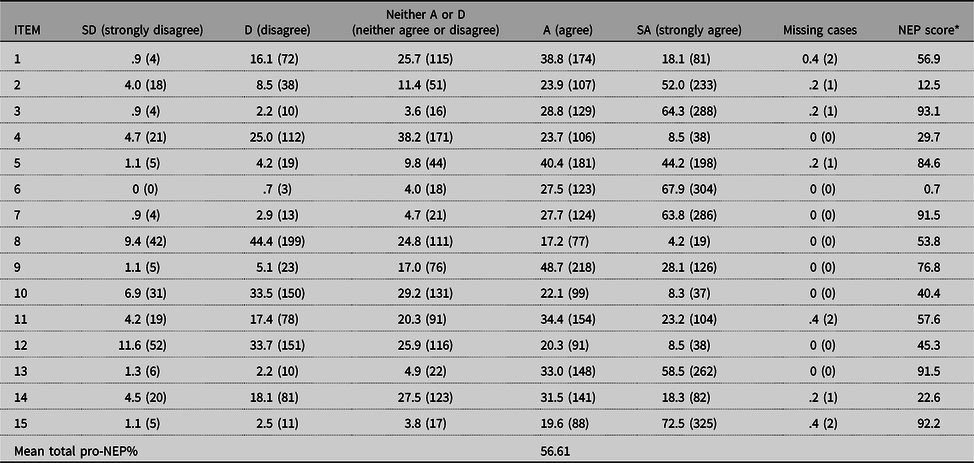
The students’ environmental worldviews were determined by providing the frequency distribution of their responses. The students’ NEP scores were included to facilitate comparison with other research on school student’s worldviews. The NEP score was calculated as the sum of the positive response frequencies for each item: SA (strongly agree) plus A (agree) for the ecological (odd-numbered) items, and D (disagree) plus SD (strongly disagree) for the anthropocentric (even-numbered) ones. The total NEP score was defined as the sum of the scores of the 15 items (mean total pro-NEP percentage). The boundary between a pro-ecological perspective and a human-dominance one is generally held to be a NEP score of 45 (Rideout et al., Reference Rideout, Hushen, McGinty, Perkins and Tate2005). People scoring below 45 tend to be more in favour of the DSP worldview, whereas those with scores higher than 45 tend to be more in favour of the NEP worldview.
Tables 7 and 8 show the response frequency distribution of the school students for both datasets respectively. As we can see, the Macedonian school students are more in favour of the NEP worldview (mean NEP score of 56.61 or 2.83) than the school students in Serbia (mean NEP score of 49.98 or 2.50). This indicates that the Macedonian school students display more pro-ecological conceptions than their Serbian peers.
Frequency distributions for the revised NEP scale for the Serbian dataset (N = 402; frequency displayed in percentages, counts noted in brackets)

Note: *The NEP score was calculated as the sum of the positive response frequencies for each item: SA plus A for the ecological items (1, 3, 5, 7, 9, 11, 13, 15); D plus SD for the anthropocentric items (2, 4, 6, 8, 10, 12, 14)
Frequency distributions for the revised NEP scale for the Macedonian data-set (N = 448; frequency displayed in percentages, counts noted in brackets)

Note: *The NEP score was calculated as the sum of the positive response frequencies for each item: SA plus A for the ecological items (1, 3, 5, 7, 9, 11, 13, 15); D plus SD for the anthropocentric items (2, 4, 6, 8, 10, 12, 14)
Discussion and conclusion
Despite the fact that there is a diversity of meaning around environmental education theory and practice, we support the idea for a change in environmental education from a perspective that is focused on conservation, positivism and scientism approaches to an interdisciplinary, proactive, holistic, critical, action-oriented and participatory approach. According to our opinion, education for sustainable development concept is very similar to the education for the environment approach. Palmer (Reference Palmer2003) developed an integrated model for teaching and learning in environmental education that includes all essential elements and dimensions of environmental education. The core of this model is formative influences. From such formative influences, through a combination of life (i.e., further significant experiences) and formal education programs, it is hoped that individuals may acquire the necessary range of knowledge and understanding, skills, attitudes and values that foster personal concern and enable the ability to act in pro-environmental ways (Palmer, Reference Palmer2003).
Dunlap and colleagues’ (Reference Dunlap, Van Liere, Mertig and Jones2000) NEP Scale is widely used and thus merits testing to determine whether it should be treated as one scale or a set of (independent and correlated) subscales. There is no consensus on the question of whether the NEP Scale measures a single construct or is inherently multidimensional. Although the dimensionality of the original NEP Scale was examined by many studies (e.g., Bechtel et al., Reference Bechtel, Corral-Verdugo and Pinhiero1999; Geller & Lasley, Reference Geller and Lasley1985; Ji, Reference Ji2004), that of the revised NEP scale was only examined by a few (Dunlap et al., Reference Dunlap, Van Liere, Mertig and Jones2000; Floyd & Noe, Reference Floyd and Noe1996; Hunter & Rinner, Reference Hunter and Rinner2004; Thapa, Reference Thapa2001). Hence, the first objective of this study was to test the dimensionality of the NEP Scale revised by Dunlap et al. (Reference Dunlap, Van Liere, Mertig and Jones2000) by assessing the students’ environmental worldviews in the Serbian and Macedonian cases. This study has found all items load onto four dimensions: Balance of Nature, Humans over Nature, Limits to Growth and Environmental Philosophy. We named the fourth dimension ‘Environmental Philosophy’ as it consists of three different items: religious perspectives or philosophy (item 12), human domination (item 2) and balance of nature (item 13). As seen in Table 4, for the fourth factor, items from many hypothesised factors ended up together with vastly different factor loadings. It might be that one or more of these items does not work well — either due to the wording of the translation or because the concept does not work well for this group of students.
There were statistically significant differences for the three factors Balance of Nature, Limits to Growth and Environmental Philosophy (p < .001) between Serbian and Republic of North Macedonian school students (Table 6). Profound differences can be seen in the Balance of Nature (Figure 1). The students from the Republic of North Macedonia appear to be more convinced than Serbian students of the importance of nature being in balance, and that human interference endangers this balance. On the other hand, there was no statistically significant difference for the factor Humans over Nature. This means that the two subgroups share similar views about human dominance and the right to use natural resources to fit human needs. The lowest mean for this factor suggests a DSP worldview for both subgroups. In terms of dimensions, the deepest differences exist between the two subgroups for the Possibility of Eco-Crisis and Fragility of Nature’s Balance, while the smallest difference exists for Limits to Growth dimension. Also, from this figure we can see that there is little disagreement between ‘high’ and ‘low’ environmental responders for items 14, 13, 8, and 9 (humans will eventually learn enough about how nature works to be able to control it, the balance of nature is very delicate and easily upset, the balance of nature is strong enough to cope with the impacts of modern industrial nations, despite our special abilities humans are still subject to the laws of nature), and that the biggest differences are for items 2, 15, 1, and 3 (humans have the right to modify the natural environmental to suit their needs; if things continue on their present course, we will soon experience a major ecological catastrophe; we are approaching the limit of the number of people the earth can support, and despite our special abilities humans are still subject to the laws of nature).
Since researchers present different numbers of dimensions — for example, Edgell and Nowell (Reference Edgell and Nowell1989) and Noe and Snow (Reference Noe and Snow1990) found all items loaded onto a single factor; Bechtel et al. (Reference Bechtel, Corral-Verdugo and Pinhiero1999), Gooch (Reference Gooch1995), Nooney et al. (Reference Nooney, Woodrum, Hoban and Clifford2003), and Wu et al. (Reference Wu, Zi, Liu, Wang, Yang, Li and Li2012) found two dimensions; Albrecht et al. (Reference Albrecht, Bultena, Hoiberg and Nowak1982), Geller and Lasley (Reference Geller and Lasley1985), Manoli et al. (Reference Manoli, Johnson and Dunlap2007), Noe and Snow (Reference Noe and Snow1990), and Van Petegem and Blieck (Reference Van Petegem and Blieck2006) found three dimensions; Erdogan (Reference Erdogan2009), Furman (Reference Furman1998), La Trobe and Acott (Reference La Trobe and Acott2000), and Roberts and Bacon (Reference Roberts and Bacon1997) found four dimensions; Amburgey and Thoman (Reference Amburgey and Thoman2012) and Lück (Reference Lück2003) found five dimensions — some of the researchers see unidimensionality as an unrealistic goal. As Dunlap originally assumed, the NEP is best represented as correlated scales involving five facets. Amburgey and Thoman (Reference Amburgey and Thoman2012) recommend that future research with the NEP use confirmatory factor analysis (CFA) within a structural equation modelling approach to accurately represent the five interrelated facets structure, and if CFA is unavailable, treating the scale as five correlated subscales is preferred over treating the NEP as a single score reflecting environmental concern (Amburgey & Thoman, Reference Amburgey and Thoman2012).
As Dunlap et al. (Reference Dunlap, Van Liere, Mertig and Jones2000) suggested, the decision to break the NEP Scale items into two or more dimensions should depend on the results of the individual study. If two or more distinct dimensions emerge that have face validity and are not highly correlated with one another, then it is sensible to employ them as separate variables. If substantively meaningful dimensions do not emerge, however, and the entire set of items (or at least the majority of them) are found to produce an internally consistent measure, then we recommend treating the NEP Scale as a single variable (Dunlap et al., Reference Dunlap, Van Liere, Mertig and Jones2000).
Results indicate that there is no widespread adoption of the NEP orientation by the students. Confirmation of this is a relatively high percentage (20%) of respondents who had neutral attitudes. Some items cause hesitation among respondents (e.g., item 11), because some people may agree with one part of the item (e.g., ‘limited room’), but do not agree with another part of the same item (e.g., ‘limited resources’). This item seems to confuse respondents, which may be the reason for stronger support for this item (25.15% of students were unsure, and 19.2% disagreed, while only 18.45% strongly agreed). On the other hand, the problem with item 1 is because human population growth is everybody’s concern for different reasons (30% of students were unsure, and 18.9% disagreed, while only 13.65% strongly agreed). As we have already pointed out, the respondents probably misinterpreted item 6. These three items should be revised, reconsidered or eliminated. Erdogan (Reference Erdogan2009) points out similar results from a sample in Turkish culture.
Aside from the obvious variations in the samples (e.g., place, time, population), several other methodological reasons may also contribute to the cross-study variation: variations in sample type and scale length (Hawcroft & Milfont, Reference Hawcroft and Milfont2010), form of exploratory factor analysis (e.g., Brennan, Binney, Aleti, & Parker, Reference Brennan, Binney, Aleti and Parker2014; Woodworth, Steen-Adams, & Mittal, Reference Woodworth, Steen-Adams and Mittal2011), and practices when interpreting results (e.g., Nooney et al., Reference Nooney, Woodrum, Hoban and Clifford2003).
The multidimensionality of the NEP Scale suggests that environmental views are more complex than originally thought, but it certainly does not impair its usefulness. However, it seems that there is a need for its upgrading, as its application within different contexts is an ongoing process. Therefore, this instrument will never reach its final form and content. Finally, when we consider the dimensions of the NEP Scale, it becomes clear that there could be more at stake.
Another objective of this study was to examine the environmental worldviews of young people in Serbia and the Republic of North Macedonia using the revised NEP Scale. Keeping in mind the boundary between a pro-ecological perspective and a human-dominance one (NEP score of 45), we can consider our students in favour of the NEP worldview. However, the mean score for the 15 items was found to be 2.83 (out of a possible 5) in the Republic of North Macedonia (Table 8) and 2.50 in Serbia (Table 7), indicating that the overall orientation of samples belongs to the lowest rank of the pro-NEP worldview.
Like many other developing countries, the Republic of North Macedonia and Serbia have a lower pro-NEP score than developed countries (e.g., Belgium; Hodis & Pereira, Reference Hodis and Pereira2014; Van Petegem & Blieck, Reference Van Petegem and Blieck2006). The most pro-environment countries, which include the Scandinavian countries and the Netherlands, are grouped together, followed by the three ‘Germanic’ countries, Germany, Austria and Switzerland. These are followed by their close central European neighbours, the post-socialist, economically developed Czech Republic and Slovenia; then the less environmentally mobilised Southern European countries of Spain and Portugal; and finally, the post-socialist, eastern peripheral European countries of Bulgaria and Latvia (Kelly, Kennedy, Faughnan, & Hilary, Reference Kelly, Kennedy, Faughnan and Hilary2006). Compared with other countries such as the United Kingdom (3.31 —Pahl, Harris, Todd, & Rutter, Reference Pahl, Harris, Todd and Rutter2005), the United States (3.57 — Kortenkamp & Moore, Reference Kortenkamp and Moore2006), Australia (3.96 —Blaikie, Reference Blaikie1992), Turkey (3.50 — Erdogan, Reference Erdogan2009), and Brazil (3.55 — Schultz et al., Reference Schultz, Gouveia, Cameron, Tankha, Schmuck and Franek2005), the findings of this study suggest that ecological attitudes among the sample are more closely characterised by the DSP.
In the Macedonian sample (Table 8), the total mean score for eight pro-NEP items was 4.02, whereas the mean score for seven DSP items was 1.46. Frequency distributions on the pro-NEP items show that four-fifths of the sample (80.63%) agreed with these statements. Distributions on the pro-DSP items reveal that 70.71% of the sample agreed with the statements, while there were considerable numbers of disagreeing and undecided portions of the sample. In the Serbian sample (Table 7), the total mean score for eight pro-NEP items was 3.28, whereas the mean score for seven DSP items was 1.61. Frequency distributions on the pro-NEP items show that two-thirds of the sample (65.61%) agreed with these statements. Distributions on the pro-DSP items reveal that 67.89% of the sample agreed with the statements. In both samples, there were no clear differences between NEP and DSP views.
In industrialised societies, there is a very clear difference between NEP and DSP views. This means that acceptance of the NEP implies a clear rejection of the anthropocentric views of the DSP. On the other hand, in less industrialised societies, the distinction between the two worldviews may not be as clear-cut, implicating a holistic view of the human-environment relationship (Bechtel et al., Reference Bechtel, Corral-Verdugo and Pinhiero1999; Corral-Verdugo & Armendáriz, Reference Corral-Verdugo and Armendáriz2000). Dualism was found in many other communities such as Zimbabwean (Van Petegem, & Blieck, Reference Van Petegem and Blieck2006), Mexican and Brazilian ones (Bechtel et al., Reference Bechtel, Corral-Verdugo and Pinhiero1999; Corral-Verdugo & Armendáriz, Reference Corral-Verdugo and Armendáriz2000). In these societies, people believe in the profound connection between humanity and nature; that is, they find compatibility between a natural balance and the needs of humans in using natural resources.
The appropriateness of the NEP for any society absolutely depends on whether or not the aforementioned society’s values are connected with the post-materialist values. Watson and Halse (Reference Watson and Halse2005) pointed out that there may be problems with aggregating data when using the NEP questionnaire to determine environmental attitudes in non-Western cultures. The reason for this phenomenon is that the conceptual framework underpinning the NEP reflects a developed, Western cultural perspective, and may not be adequate for assessing environmental attitudes in non-Western or developing countries. An example of this is the study conducted in a Mexican city, which indicated that individuals held both pro-NEP and pro-Human Exception Paradigma (HEP) attitudes at the same time (Corral-Verdugo & Armendariz, Reference Corral-Verdugo and Armendáriz2000), even though the conceptual framework underpinning the instrument would hold that these two paradigms are mutually exclusive. According to Watson and Halse (Reference Watson and Halse2005), the NEP Scale is unable to distinguish responses from individuals who hold both views simultaneously because such a synergy of environmental attitudes is not consistent with the underlying assumptions of the instrument. Thus, probing environmental attitudes in non-Western communities may require revision of the instrument and its conceptual underpinnings, or alternate data collection methods, including scrutiny of why views are held in any given community (Watson & Halse, Reference Watson and Halse2005).
Pro-environmental behaviour is that which is generally (or according to knowledge of environmental science) judged within the context of the considered society as a protective type of environmental behaviour or a tribute to the healthy environment (Krajhanzl, Reference Krajhanzl2010). Pro-environmental attitudes rise and fall with current events and vary with age, gender, socioeconomic status, nation, urban-rural residence, religion, politics, values, personality, experience, education and environmental knowledge (Hawcroft & Milfont, Reference Hawcroft and Milfont2010). Thus, the difference in NEP acceptance between Serbian and Macedonian school students could be explained by many points of view: social, media and literature, and institutional (environmental) education. Serbia and the Republic of North Macedonia are very socio-economically and industrially similar. We can also see that the education systems of both countries have similar characteristics and are faced with similar problems. Where can we find the reasons for the differences in the environmental worldviews of Serbian and Macedonian school students?
Within this study, there is evidence to support the link between place of residence on the one side, and environmental concern on the other side. Taking into consideration that some of the Macedonian students come from rural areas, we can expect a more expressed nature-extractive tradition. Hence, one factor that is positively correlated with environmental attitudes in children is having experience of direct contact with nature (Kellert, Reference Kellert, Kahn and Kellert2002). The participants residing in the rural, mountainous setting had more ingrained pro-environmental attitudes than those in the urban and agricultural areas. That means we must not omit ‘the wealth of formative influences or significant life experiences that individuals bring to their further learning. Research has demonstrated that these may indeed be more significant than planned formal educational programs in the development of environmental understanding and concern’ (Palmer, Reference Palmer2003, p. 270). To support the hypothesis that early childhood encounters with nature are crucial for the development of positive environmental values is supported by environmentalists’ retrospective reports, which are replete with stories of early and memorable encounters with pristine nature (Kahn & Kellert, Reference Kahn and Kellert2002). Some authors point out that there is a correlation between the urbanisation of the place where an individual lives and environmental worldviews (Berenguer, Corraliza, & Martín, Reference Berenguer, Corraliza and Martín2005; Corraliza, Collado, & Bethelmy, Reference Corraliza, Collado and Bethelmy2013; Freudenburg, Reference Freudenburg1991). People living in a rural context present more attitudes of environmental responsibility and greater consistency when expressing behavioural intentions that are compatible with the protection of the environment (Berenguer, Corraliza, & Martín, Reference Berenguer, Corraliza and Martín2005). Children from rural areas exhibit a more ecocentric worldview than those from urban areas (Corraliza, Collado, & Bethelmy, Reference Corraliza, Collado and Bethelmy2013). Thus, the higher NEP score of the Macedonian students is probably due to the fact that some of them (34%) live in rural areas (Table 2). The Serbian sample does not include children who live in villages.
Literature on the relationship between gender and environmental concern is inconclusive where different studies have yielded different outcomes. According to some authors (see Hunter, Hatch, & Johnson, Reference Hunter, Hatch and Johnson2004; Milfont, Reference Milfont2007; Stern, Dietz, & Kalof, Reference Stern, Dietz and Kalof1993; Uyeki & Holland, Reference Uyeki and Holland2000; Zelezny, Chua, & Aldrich, Reference Zelezny, Chua and Aldrich2000), girls have higher pro-environmental attitudes than boys and seem to be socially responsible and make a significant contribution to environmental protection. For example, some studies found that women reported significantly more general environmental concern than men, although the effect of gender on NEP environmental attitudes was small (Zelezny et al., Reference Zelezny, Chua and Aldrich2000). Why are females more environmental? Compared to males, females are socialised to value the needs of others, and exhibit more helping behaviour and altruism (Gilligan, Reference Gilligan1982). Hence, the Macedonian students’ higher NEP score is perhaps due to the fact that the Macedonian sample includes more girls than the Serbian sample (Table 2). But empirical findings suggest that no firm and clear conclusions can be drawn about the effects of gender on (NEP) environmental concern in a sample of Macedonian students (Srbinovski, Reference Srbinovski2016).
The education systems of both countries have similar characteristics and are faced with similar problems. Many surveys conducted in these two countries in the preceding period show that the attitudes of young people toward the environment are mainly influenced by the family and school. Consequently, future research studies should take into account the following specifics: (1) the family is the strongest factor influencing children’s environmental worldviews in both countries (see Andevski, Reference Andevski1997; Kilibarda, Reference Kilibarda1998; Kundačina, Reference Kundačina2006; Mišković, Reference Mišković1997; Srbinovski, Reference Srbinovski2001, Reference Srbinovski2003a, Reference Srbinovski2005a); (2) environmental activities are mainly related to scientific facts and concepts (see Stanišić & Maksić, Reference Stanišić and Maksić2014; Srbinovski, Reference Srbinovski2001, Reference Srbinovski2005a, Reference Srbinovski2013; Srbinovski & Palmer, Reference Srbinovski and Palmer2008; Srbinovski et al., Reference Srbinovski, Palmer, Ismaili, Abazi and Zenki2007; Srbinovski, Erdogan et al., Reference Srbinovski, Erdogan and Ismaili2010; Srbinovski, Ismaili et al., Reference Srbinovski, Ismaili and Abazi2010), and the development of environmental attitudes emerged from the ‘natural’ science subjects (biology, geography, physics, chemistry); (3) teachers who demonstrate pro-environmental behaviours tend to come mainly from a scientific background and the training of teachers to achieve the goal of environmental education is inadequate (see Kundačina, Reference Kundačina2006; Mišković, Reference Mišković1997; Srbinovski, Reference Srbinovski2001, Reference Srbinovski, Atanasova-Vukova, Ignatovski and Toceva2004b, Reference Srbinovski2005a; Srbinovski & Palmer, Reference Srbinovski and Palmer2008, Stanišić, Reference Stanišić2008, Reference Stanišić and Arnaut2011; Stanišić & Maksić, Reference Stanišić and Maksić2014); and (4) approaches to teaching are essentially formal and traditional in the schools of the Republic of North Macedonia and Serbia (a dominating frontal form of teaching, lacking active methods of learning, the student is a passive recipient of knowledge, learning is mainly focused on memorising facts instead of understanding the content; see Komlenović & Stanišić, Reference Komlenović, Stanišić and Bagoly-Simó2009, Srbinovski, Reference Srbinovski, Slavova, Lorinkov, Mincev and Bozkova2003b, Reference Srbinovski2004c, Reference Srbinovski2005a; Srbinovski & Palmer, Reference Srbinovski and Palmer2008; Stanišić & Maksić, Reference Stanišić and Maksić2014).
In conclusion, the results of this study stress the importance of analysing the dimensionality of the NEP Scale when it is used to research and compare environmental worldviews. Dimensions are often sample specific. This study has found that all items to load on four dimensions, thus the NEP Scale items should be taken cautiously as a single (unidimensional) internally consistent measuring device. There is not enough evidence for a definite number of dimensions and further research in that area is recommended.
Both subgroups in the Republic of North Macedonia and Serbia are (slightly) environmentally conscious with an ecological view of the environment. Macedonian school students have a slightly higher NEP score than their peers in Serbia, indicating more environmentally protective attitudes among the Macedonian students. Macedonian and Serbian school students are concerned with the negative human impact on ecological systems and, at the same time, their responses suggest they believe in limited human usage of nature, perhaps because of their nature-extractive tradition.
Differences between subgroups occur in three out of four dimensions. This difference in NEP acceptance at the level of human-nature interaction could be explained by distinct experiences of the natural world acquired in early childhood as these significantly influence environmental concern.
The participants did not see the two paradigms as mutually exclusive, as do members of some industrialised societies. The rejection of the DSP by the NEP is a phenomenon that could well only be present in Western societies, whereas in less industrialised societies the NEP and DSP could coexist in a comprehensive environmental view. With minor alterations such as word substitutions to facilitate easy comprehension of items by the respondents, the NEP Scale will show more universal applicability outside developed communities.
There were several limitations to this study that should be considered before any generalisation of the results. First, our sample was not representative (convenience samples of school students), nor was the amount of variance we were able to explain in our analysis. So, we cannot generalise our results until we and other researchers have conducted further studies with children from other backgrounds and in other locations. Second, as this was the first thorough examination of students’ environmental attitudes in these two countries by means of the NEP Scale, we were limited in terms of our discussion of the results. Some studies seem to suggest that the items are not always ‘translatable’ outside of Western countries and there is greater difficulty with the respondents’ understanding of some items than for those studies conducted in the United States and Western European nations. It seems that the children’s comprehension of the items on the NEP Scale needs further testing before the standardised answers can be usefully interpreted (Kopnina, Reference Kopnina2012). Third, some of the discussions and conclusions are based on conjectures that will require further research to confirm.
Despite these limitations, our results provide an intriguing insight into institutional (environmental education) differences in students’ worldviews. Further analysis of the effects of personality and ethnic background on worldviews would undoubtedly bear fruit. We need to consider theories about the influence of the social context (the influence of parents and peer groups on the children’s worldviews) and political and institutional context (the role of government-sponsored information, media and education) on children’s ecological attitudes.
Sources of information, as well as affective feelings, need closer examination. To do so, lengthier methodology, such as participant observation of the children at home, school and in other contexts, is needed (Kopnina, Reference Kopnina2012).
Financial Support
This research was funded by the Ministry of Education, Science and Technological Development of the Republic of Serbia (Contract No: 451-03-68 / 2020-14 / 200018).
Mile Srbinovski is an associate professor at the Faculty of Technical Sciences, Mother Teresa University in Skopje, Republic of North Macedonia. He is involved in a number of activities in the field of environmental educational theory and practice. He is also active in developing implementation strategies concerning environmental education and education for sustainability.
Jelena Stanišić is a research associate at the Institute for Educational Research, Belgrade, Serbia. She deals with environmental education within the projects taken on by the Institute for Educational Research. She carries out research into the importance and role of schools, teachers and parents, with special emphasis on the teaching process and the use of different methodical systems to handle environmental content.