Introduction
The incidence of Alzheimer’s disease (AD) is rising (Alzheimer’s Disease International, 2010), as is the number of people who regularly speak two or more languages (European Commission, 2006). Yet, little is known about disease progression in bilinguals with AD, and specifically about how the disease affects their two languages. This issue merits investigation to benefit the increasing population of bilinguals suffering from AD, and because it can be more generally informative about bilingualism, language processing, and the cognitive effects of AD. Here, we focus on one aspect of bilingual patients’ linguistic performance – picture naming.
Monolinguals with AD are disproportionally impaired relative to controls when naming pictures with low-frequency, low-familiarity, low-imageability, and late-acquired names (Cuetos, Gonzalez-Nosti, & Martínez, Reference Cuetos, Gonzalez-Nosti and Martínez2005; Cuetos, Rosci, Laiacona, & Capitani, Reference Cuetos, Rosci, Laiacona and Capitani2008; Gaillard, Girard, Lemarchand, Eustache, & Hannequin, Reference Gaillard, Girard, Lemarchand, Eustache and Hannequin1998; Ivanova, Salamon, & Gollan, 2013; Kemmerer & Tranel, Reference Kemmerer and Tranel2000; Kremin et al., Reference Kremin, Perrier, De Wilde, Dordain, Le Bayon, Gatignol and Arabia2001; Thompson-Schill et al., 1999). Thus, words that are weakly represented may decline more quickly and at an earlier stage of disease progression than more robustly represented words.
On this basis, we can derive hypotheses about naming performance in bilinguals with AD. If their two languages are similarly robust, as in balanced bilinguals (who are similarly proficient in their two languages), the two languages should decline at the same rate and within the same time course of disease progression. Extant evidence is consistent with these predictions. Costa et al. (Reference Costa, Calabria, Marne, Hernández, Juncadella, Gascón-Bayarri and Reñé2012) studied picture naming and word translation in highly-proficient balanced Catalan-Spanish bilinguals with AD (24 with mild and 23 with moderate AD) and found that their two languages were similarly affected by the disease relative to those of a control group consisting of 24 bilinguals with Mild Cognitive Impairment (MCI).
Conversely, if one language is less proficient and more weakly represented than the other, as in non-balanced bilinguals, then it should decline more quickly than the dominant language. Similar predictions would be derived for non-balanced bilinguals on the assumption that producing words in the non-dominant language requires greater executive control to overcome competition from translation equivalents in the dominant language (Bialystok, Craik, Green, & Gollan, Reference Bialystok, Craik, Green and Gollan2009; Green, Reference Green1986, Reference Green1998). Since executive control declines in AD (Backman, Jones, Berger, Laukka, & Small, Reference Backman, Jones, Berger, Laukka and Small2004, Reference Backman, Jones, Berger, Laukka and Small2005; Bradley et al., Reference Bradley, O’Sullivan, Soper, Nagy, King, Smith and Shepstone2002; Mickes et al., Reference Mickes, Wixted, Fennema-Notestine, Galasko, Bondi, Thal and Salmon2007; Perry & Hodges, Reference Perry and Hodges1999), production in the non-dominant language should be more impaired throughout the course of the disease than the dominant language.
Consistent with these proposals are the results of Mendez, Perryman, Pontón, and Cummings (Reference Mendez, Perryman, Pontón and Cummings1999) who studied 51 first-language-dominant bilinguals with various dementia types (31 with probable or possible AD). Bilinguals’ non-dominant language (English, learned after age 13) showed greater deterioration than the dominant language. This was found by interviewing patients’ caregivers, who reported that the patients reverted to using their dominant and first-learned language with disease progression and had more intrusions from it when speaking the non-dominant language. Thus, for these bilinguals, the non-dominant language appeared to be particularly vulnerable to the effects of AD, consistent with our predictions.
A different pattern was reported by Gollan, Salmon, Montoya, and Da Pena (2010) for non-balanced bilinguals, which is inconsistent with the theoretical frameworks outlined above. These authors compared the picture-naming performance of 16 English-dominant bilinguals with AD, who had acquired Spanish at birth and English in early childhood, and 13 Spanish-dominant bilinguals with AD, who had acquired Spanish at birth and English in adulthood, to 42 matched controls. English-dominant bilingual patients exhibited greater decline relative to controls in the dominant than the non-dominant language (a pattern opposite to both the one predicted here and the one found by Mendez et al., Reference Mendez, Perryman, Pontón and Cummings1999). Spanish-dominant bilingual patients exhibited a similar pattern, although statistically equivalent decline of the two languages relative to controls (also not predicted here and different from the pattern reported by Mendez et al., with the same type of bilinguals). Equivalent decline of the two languages was also found by Salvatierra et al. (2007), who conducted a verbal fluency task with 11 Spanish-English non-balanced bilinguals with AD and 11 controls. Thus, neither bilingual group in the studies of Gollan et al. and Salvatierra et al. exhibited the predicted pattern, in which the dominant language should be less vulnerable to disease effects. Instead, either the dominant language was more affected, or the two languages were equally affected.
Several methodological differences might explain the apparent discrepancy between the results of Mendez et al. (Reference Mendez, Perryman, Pontón and Cummings1999), and Gollan et al. (Reference Gollan, Salmon, Montoya and Da Pena2010) and Salvatierra et al. (2007). Mendez et al. relied on caregiver reports of decline in connected speech over time, Gollan et al. assessed ability to name pictures in the two languages at a single time point, and Salvatierra et al. assessed the ability to generate exemplars from a semantic or a letter category; thus, language was assessed in different ways across studies. To reconcile this apparent discrepancy, it would be necessary to examine cross-sectional and longitudinal decline using the same dependent measure. In the current study, we investigated both longitudinal and cross-sectional patterns of linguistic decline in non-balanced bilinguals with AD by measuring picture-naming ability in both languages on the Boston Naming Test (BNT: Kaplan, Goodglass, & Weintraub, Reference Kaplan, Goodglass and Weintraub1983) over a period of 3 years. Participants included a subset of the bilinguals tested in Gollan et al. (Reference Gollan, Salmon, Montoya and Da Pena2010) that we were able to follow longitudinally. If the difference in outcomes between prior studies reflects a difference in the dependent variable, and the non-dominant language declines more than the dominant language only when language functions are assessed with spontaneous and connected speech, then the results of Gollan et al. (employing picture naming) should be replicated in the current study both longitudinally and cross-sectionally. Alternatively, it is possible that the prior studies reflect a difference in the patterns of decline observable longitudinally and cross-sectionally. If so, the current study should replicate the pattern reported by Mendez et al. longitudinally, and the pattern reported by Gollan et al. cross-sectionally at the initial testing session (Session 1).
To further elucidate the pattern of decline of the two languages, and specifically what factors predicted such decline, we correlated five BNT item characteristics (frequency, familiarity, etc.) with measures of longitudinal and cross-sectional decline.
Methods
Participants
Twenty-six Spanish-English bilinguals, 12 diagnosed with probable AD and 14 cognitively healthy, participated. Most of the patients (10/12) and all 14 controls were also tested in Gollan et al. (Reference Gollan, Salmon, Montoya and Da Pena2010) (who tested 29 patients and 42 controls). At Session 1, four patients were mildly impaired (DRS scores between 115 and 124), seven were moderately impaired (DRS scores between 95 and 114), and one was severely impaired (a DRS score of 94). Diagnoses were made using criteria developed by the National Institute of Neurological and Communicative Disorders and Stroke (NINCDS) and the Alzheimer’s Disease and Related Disorders Association (ADRDA; McKhann et al., Reference McKhann, Drachman, Folstein, Katzman, Price and Stadlan1984).
Participants were tested on the BNT during their annual evaluation as part of a longitudinal study at the University of California, San Diego (UCSD) Alzheimer’s Disease Research Center (ADRC). Patients are recruited to the ADRC mostly via San Diego neurologists who refer patients with possible memory deficits to the center.
Participants were selected for analysis if they (a) were tested on the same 30-item version (see below) of the BNT for three consecutive testing sessions; (b) had a diagnosis of probable AD or were cognitively healthy in all three sessions; (c) had naming scores above 20% (i.e., named six or more pictures) in the non-dominant language at Session 1, because their classification as bilinguals is potentially questionable with lower scores, and low scores also leave little room for further decline; and (d) had naming scores in the two languages at Session 1 which differed by at least 10% (to justify their classification as non-balanced bilinguals). Criterion (c) led us to exclude three Spanish-dominant patients, and one English-dominant and two Spanish-dominant controls. Criterion (d) led us to exclude one Spanish-dominant bilingual patient, and two Spanish-dominant controls.
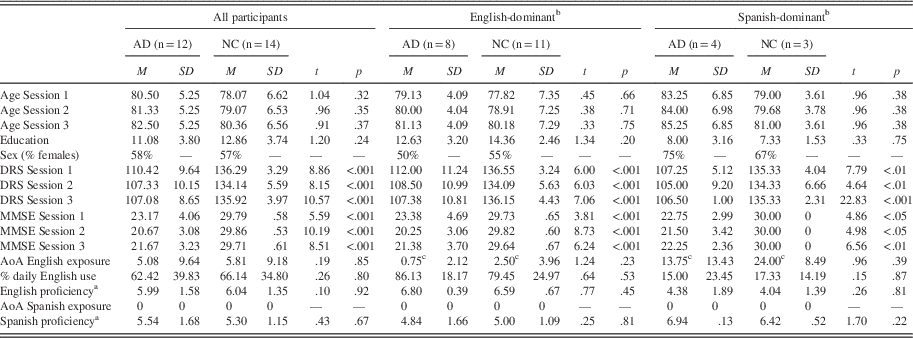
Participants’ characteristics obtained via language history questionnaires are summarized in Table 1 (completed with a caregiver’s help, if needed, for patients). To achieve matching for age and education, we excluded two of the youngest, most highly educated controls who had acquired English latest. After this matching procedure, the patients and controls did not differ significantly in age, education (anchored by degree level completed, e.g., 12 years for high school, 16 for a BA, etc.), age of exposure to English, age of regular use of English, amount of daily English use, English proficiency and Spanish proficiency (for t-tests see Table 1).
Means, standard deviations and comparisons for all participants’ characteristics

Note: AD=patients with Alzheimer’s disease; NC=cognitively healthy controls; DRS=the Dementia Rating Scale (Mattis, Reference Mattis1988); MMSE=the Mini Mental State Examination (Folstein et al., Reference Folstein, Folstein and McHugh1975); Dom. lang.=dominant language; Non-dom. lang.=non-dominant language.
a Proficiency level is averaged across self-ratings for four types of language use (speaking, comprehension of spoken speech, reading, writing) using a scale of 1–7 (1 means “little to no knowledge” and 7 means “like a native speaker”).
b Established on the basis of preferred language of testing.
c 14 English-dominant participants (7 patients and 7 controls) and 1 Spanish-dominant patient with AD stated that they acquired English from age 0.
All participants reported being exposed to Spanish from birth. They were classified into language dominance groups using their self-reported preferred language for neuropsychological testing which coincided in all cases with their self-reported average daily use of the two languages (the dominant language was used more often than the non-dominant language, p<.001), their language proficiency ratings (the dominant language was more proficient than the non-dominant language, p<.001) and their relative performance in each language on the BNT (scores in the dominant language were higher than in the non-dominant language for all three sessions, all ps<.001). Eight patients and 11 controls were English-dominant, and 4 patients and 3 controls were Spanish-dominant. English-dominant participants’ country of origin was USA for 17 individuals (7 patients, 10 controls), Puerto Rico for 1 patient, and Mexico for 1 control (who stated having lived in Mexico for 8 years). Spanish-dominant participants’ country of origin was the United States for two patients with AD, and Mexico for five individuals (two patients, three controls).
The study procedures conformed to Federal guidelines for the protection of human subjects and were approved by the UCSD Institutional Review Board. Informed consent was obtained from controls and from patients and caregivers before neuropsychological testing and after the procedures of the study had been fully explained.
Materials
Participants named 30 BNT pictures (Kaplan et al., Reference Kaplan, Goodglass and Weintraub1983). The English-dominant patients and controls were tested in all 3 years on a 30-item version of the BNT that consisted of the odd-numbered items from the standard 60-item version of the test. The Spanish-dominant patients and controls were tested in all 3 years on a 30-item version developed for use with Spanish speakers (Acevedo et al., Reference Acevedo, Krueger, Navarro, Ortiz, Manly, Padilla-Velez and Mungas2009; Weintraub et al., Reference Weintraub, Salmon, Mercaldo, Ferris, Graff-Radford, Chui and Morris2009) as part of the NIA Alzheimer’s Disease Centers’ Uniform Data Set (UDS; Morris et al., Reference Morris, Weintraub, Chui, Cummings, Decarli, Ferris and Kukull2006). Seventeen of the 30 items were the same in the two test versions.
Procedure
Each test session was completed by a proficient Spanish-English bilingual psychometrist at the ADRC or in participants’ homes. Sessions were separated by 12.83 months on average (SD=3.44). At each session, participants were instructed to name pictures first in their dominant and then in their non-dominant language. This testing order was adopted to match procedures as closely as possible to other ADRCs in the USA (in which bilinguals are tested only in the dominant language), and to minimize testing-order modulation of between-language interference effects which can affect the dominant language more than the non-dominant language (Guo, Liu, Misra, & Kroll, 2011; Misra, Guo, Bobb, & Kroll, 2012; Van Assche, Duyck, & Gollan, Reference Van Assche, Duyck and Gollan2013).
The BNT was administered in the middle of a 2- to 3-hour neuropsychological battery according to standardized instructions (testing was discontinued after 6 failed naming trials, which included semantic or phonemic cueing for pictures not named spontaneously). Naming accuracy was recorded during testing.
Scoring
We calculated the proportion of pictures named correctly for each participant and item in their dominant versus non-dominant languages on each test session, including pictures named spontaneously and those requiring a semantic (but not a phonemic) cue. In our main analyses, we included both English-dominant and Spanish-dominant bilinguals to maximize power for investigating possibly differential patterns of longitudinal versus cross-sectional decline. We also considered if the results held for English-dominant participants alone (excluding Spanish-dominant bilinguals who were too few to be considered in separate analyses).
Data Analyses
Patterns of longitudinal and cross-sectional decline
We analyzed the data with logistic mixed-effects regression (LMER) modeling (Baayen, Reference Baayen2008; Jaeger, Reference Jaeger2008). We implemented the models in the statistical software R (version 2.15.2; The R Foundation for Statistical Computing, 2012). All models described below had random intercepts and slopes for both subjects and items, unless otherwise specified. The fixed predictors in all models were assigned the numerical values of −0.5 and 0.5.
Relationships between item characteristics and decline for English-dominant bilinguals
To further elucidate the factors determining the patterns of decline we correlated five item characteristics with measures of longitudinal and cross-sectional decline, for BNT items administered to English-dominant bilinguals (but not Spanish-dominant bilinguals who were underpowered for such analyses).
Item characteristics included frequency, age of acquisition (AoA), familiarity, and imageability, which predict decline in monolinguals with AD (e.g., Cuetos et al., Reference Cuetos, Gonzalez-Nosti and Martínez2005, Reference Cuetos, Rosci, Laiacona and Capitani2008; Ivanova et al., Reference Ivanova, Salmon and Gollan2013). We also included phonological neighborhood density, which is a measure of similarity to other words in the language (specifically, the number of words which can be made by modifying target words by the addition, deletion, or substitution of a single phoneme; Luce & Pisoni, Reference Luce and Pisoni1998). Neighborhood density predicts picture naming speed and accuracy in healthy individuals (Vitevitch & Sommers, Reference Vitevitch and Sommers2003).
Correlations were done with proportional measures of longitudinal and cross-sectional decline for the fact that lower scores leave less room for decline than higher scores. Proportional longitudinal decline was calculated as patients’ proportion correct for Session 1 minus Session 3 divided by patients’ proportion correct for Session 1, for each item. Proportional cross-sectional decline was calculated as controls’ proportion correct in Session 1 minus patients’ proportion correct in Session 1 divided by controls’ proportion correct in Session 1, for each item. We report separate correlations for the English and Spanish names (which have different item characteristics).
Collection of Item Characteristics
Item characteristics were obtained from the following sources. Frequency values were extracted from the SUBTLEX-US corpus for American English (51 million words; Brysbaert & New, 2009; http://expsy.ugent.be/subtlexus/) and SUBTLEX-ESP corpus for Spanish (40 million words; Cuetos, Glez-Nosti, Barbon, & Brysbaert, Reference Cuetos, Glez-Nosti, Barbon and Brysbaert2011; http://crr.ugent.be/archives/679).
Values for AoA for English and Spanish, familiarity, and imageability of all 60 BNT itemsFootnote 1 were obtained from 38 UCSD Spanish-English bilingual undergraduates (age: M=20.68, SD=2.68; age of English exposure: M=3.20, SD=3.58; age of Spanish exposure: M=.50, SD=1.83; % daily English use: M=83.27; SD=10.31; English proficiency: M=6.66; SD=.57; Spanish proficiency: M=5.90, SD=.72; all ps<.001). Familiarity and imageability ratings were collected only for items in English on the assumption that such ratings are based on concepts which are shared between translation equivalents (e.g., Kroll & Stewart, Reference Kroll and Stewart1994). Instructions for the imageability ratings were adapted from those in Cortese and Fugett (Reference Cortese and Fugett2004). The order of the different rating tasks was counterbalanced between participants.
Phonological neighborhood density for English items was obtained from N-Watch (Davis, 2005), and for Spanish, from B-Pal (Davis & Perea, Reference Davis and Perea2005).
Results
Patterns of Longitudinal and Cross-sectional Decline
Longitudinal decline
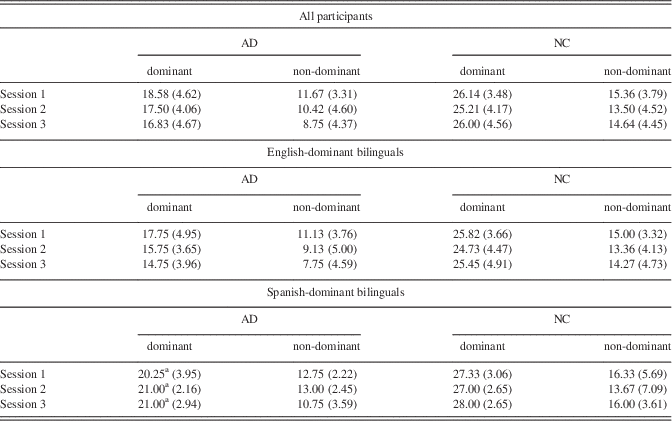
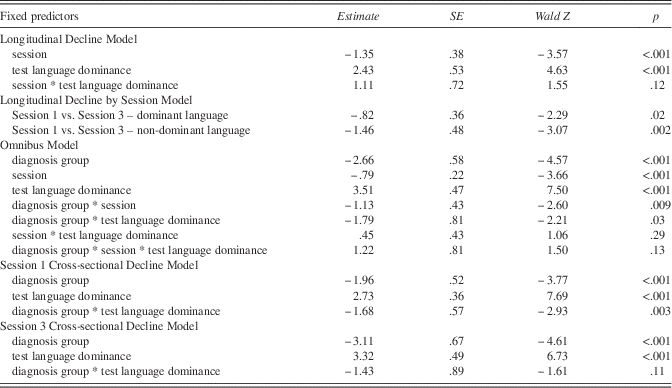
The pattern of longitudinal decline from Session 1 to Session 3 for bilinguals with AD is plotted on Figure 1a, which suggests that both the dominant and non-dominant languages declined across sessions, but that this decline was greater for the non-dominant than the dominant language. We report in Table 2 the raw mean naming scores and standard deviations by diagnosis group (AD, control), and in Table 3a, the results of all LMER analyses.
Naming performance in the dominant and the non-dominant language across the three testing sessions. (a) All patients; (b) English-dominant patients; (c) Spanish-dominant patients. Error bars represent standard error. Dom. lang.=dominant language; Non-dom. lang.=non-dominant language.
Raw BNT picture-naming scores by participant group and session
Note: Standard deviations are given in brackets.
a For this group, in some cases accuracy increases, rather than declines, across sessions (although this effect is not significant [both ps >.3]). This was likely due to the inevitable fluctuation of naming scores over time, since naming performance is influenced by a host of different factors, including participants’ general state of mind and health condition on the test day. Moreover, we had a very small number of patients in this group, which was not enough to level out individual fluctuations in naming scores. For this reason, we do not discuss this result further.
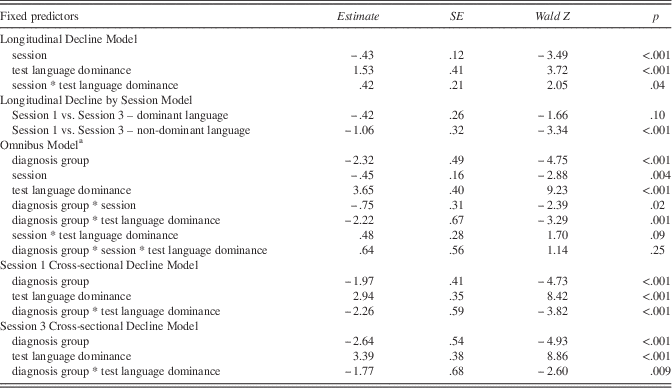
Results from main LMER analyses
a The model with the maximal random effects structure did not converge. Here, we report the results from a model specified by the formula: data~diagnosisgroup * session * testlangdom+(1+diagnosisgroup+session+testlangdom+diagnosisgroup:testlangdom+session:testlangdom+diagnosisgroup : session : testlangdom | subj)+(1+diagnosisgroup+testlangdom+diagnosisgroup : session+diagnosisgroup : testlangdom+session : testlangdom+diagnosisgroup : session : testlangdom | item)
To statistically test patterns of longitudinal decline, we fitted an LMER model on the data of the AD group alone. This Longitudinal Decline Model (see Table 3a) had session (Session 1, Session 3), test language dominance (dominant language, non-dominant language) and their interaction as fixed predictors (Session 2 was omitted to simplify the analyses; specifically, Session 1 was coded as −0.5, Session 3 as 0.5, and Session 2 as 0). Different patterns of longitudinal decline for the two languages would be indexed in this model by a significant interaction between session and test language dominance. This interaction was indeed a significant predictor, suggesting that the difference between Session 1 and Session 3 was larger for the non-dominant (.10) than for the dominant language (.04). Follow-up comparisons in a Longitudinal Decline by Session model further investigated whether performance in each language separately differed from Session 1 to Session 3 (testing for the simple effects of session for each level of the test language dominance factor). In this model, the simple effect of session was significant for the non-dominant language, but not for the dominant language (see Table 3a). In other words, the non-dominant language of bilinguals with AD seemed to decline more than the dominant language from Session 1 to Session 3 (matching results of Mendez et al., Reference Mendez, Perryman, Pontón and Cummings1999, and mismatching Gollan et al., Reference Gollan, Salmon, Montoya and Da Pena2010).
Cross-sectional decline
Naming scores of patients and controls for Sessions 1 and 3 are plotted on Figure 2a. An examination of Figure 2a suggests that controls had higher naming scores than patients, and that the patient-control differences were larger for the dominant than for the non-dominant language at Session 1 (the opposite of the pattern found in the longitudinal analyses, and matching results in Gollan et al., Reference Gollan, Salmon, Montoya and Da Pena2010).
Cross-sectional comparisons of the naming performance of patients and controls in the dominant and the non-dominant language, presented separately for Session 1 and Session 3. (a) All participants; (b) English-dominant participants; (c) Spanish-dominant participants. Error bars represent standard error. Dom. lang.=dominant language; Non-dom. lang.=non-dominant language; AD=Alzheimer's disease.
To test the patterns of cross-sectional decline statistically, we fitted a model to the naming data of both patients and controls in the dominant and non-dominant languages at Session 1 and Session 3. This Omnibus Model thus examined cross-sectional decline at the first and last sessions, and included diagnosis group (AD, control), session (Session 1, Session 3), test language dominance (dominant language, non-dominant language) and their interactions as fixed predictors.
The outcome of this model (see Table 3a) indicated that more pictures were named correctly by controls (.70) than by patients (.47), on Session 1 (.61) than Session 3 (.57), and in the dominant (.73) than in the non-dominant language (.44). The interaction between diagnosis group and session was a significant predictor, indicating that patients’, but not controls’, naming scores declined from Session 1 to Session 3. Importantly, the interaction between diagnosis group and test language dominance was also significant, indicating that the differences between patients and controls were larger in the dominant (.27) than in the non-dominant language (.18). The 3-way diagnosis group×session×test language dominance interaction did not reach significance.
However, separate LMER models fitted to subsets of the data produced significance patterns consistent with the contrast between the patient-only longitudinal analyses (presented at the beginning of the Results section), and cross-sectional comparisons. Specifically, Cross-sectional Decline models fitted separately to the data from Session 1 and Session 3, and with diagnosis group (AD, control), test language dominance (dominant language, non-dominant language) and their interaction as fixed predictors, produced significant interactions between diagnosis group and test language dominance for both sessions, suggesting that differences between groups were larger for the dominant than for the non-dominant language. In addition, there was some indication that this tended to be more robust in Session 1 than in Session 3. LMER models dividing the data by language instead of by session revealed a non-significant interaction between diagnosis group (AD, control) and session (Session 1, Session 3) for the dominant language [Estimate=−.29, SE=.39, z=−.73, p=.46], indicating that the patient-control difference remained statistically similar across the two sessions (Session 1: .26; Session 3: .30). However, for the non-dominant language, the interaction was significant [Estimate=−1.02, SE=.40, z=−2.57, p=.01], indicating that the patient-control difference was larger at Session 3 (.20) than at Session 1 (.12; see Figure 2a), that is, that the non-dominant language significantly declined across sessions.
In sum, the results from the models specifically targeting longitudinal and cross-sectional decline revealed different patterns of decline. Longitudinally, picture naming in the non-dominant language of bilinguals with AD declined more than picture naming in the dominant language (matching the pattern reported by Mendez et al., Reference Mendez, Perryman, Pontón and Cummings1999). However, cross-sectional comparisons suggested that the dominant language showed greater decline, that is, a larger difference between patients and controls, than the non-dominant language (matching the pattern reported by Gollan et al., Reference Gollan, Salmon, Montoya and Da Pena2010). This was so especially at Session 1, which could suggest a change as to which language is most sensitive to AD with disease progression.
Subset analyses
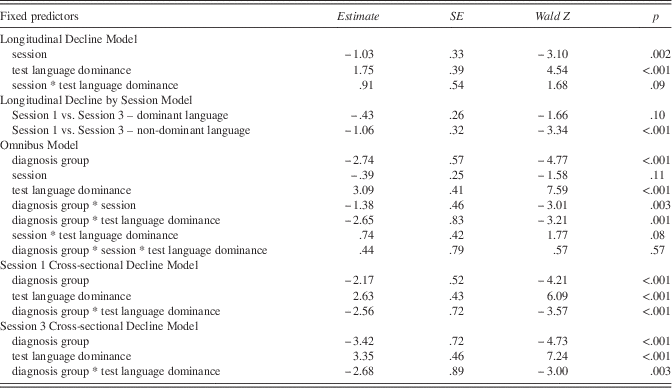
The same five LMER models were fitted on data from only the 17 items shared between the two versions of the BNT (administered to the English-dominant and Spanish-dominant bilinguals, respectively). The results of these analyses were similar to the main analyses and are reported in Table 3b.
Results from LMER analyses for the 17 items shared between the two BNT versions
Additionally, education level did not interact with the patterns we observed; an LMER model with diagnosis group, test language dominance, education level, and their interactions as fixed predictors revealed no significant main effect or interactions involving education [all ps≥.1].
We also considered separately the performance of the English-dominant group (Spanish-dominant bilinguals were not analyzed separately, but we have plotted their results for completeness; see Figures 1b and c, and 2b and c). The LMER analyses of the English-dominant group alone (Table 3c) produced almost identical results to the main analysis, with the exception that, longitudinally, decline was statistically equivalent for both languages from Session 1 to Session 3 (although note that the coefficient for the dominant language decline was smaller than the one for the non-dominant language decline). Cross-sectionally, the patient-control differences were larger for the dominant than the non-dominant language at Session 1, but similar at Session 3. These results thus confirm the differential pattern across analysis approaches: longitudinally, the two languages declined to a similar extent but cross-sectionally at Session 1, the dominant language had declined more relative to controls.
Results from LMER analyses for English-dominant bilinguals
Relationships between Item Characteristics and Decline for English-Dominant Bilinguals
The correlations are reported in Tables 4a and 4b. Cross-sectional decline in the dominant language (Table 4a) was correlated with several item characteristics (items declined more if they were later learned (AoA), and less frequent and familiar), while longitudinal decline was not correlated with any variable. This seems consistent with our conclusion that the dominant language is sensitive to decline in earlier stages of the disease, and further suggests that, as the disease progresses, it is more difficult to predict which dominant language words will decline. In contrast, in the non-dominant language (Table 4b), no variables predicted cross-sectional decline (except imageability, which was positively correlated with decline, but we do not interpret this effect as it is in the opposite from the predicted direction), whereas longitudinal decline was negatively correlated with frequency and familiarity. The observation of significant correlations between various item characteristics and cross-sectional decline in the dominant language, but longitudinal decline in the non-dominant language, is generally consistent with our above-reported conclusion of different decline trajectories for the dominant versus non-dominant languages in initial versus later stages of the disease.
Correlations between BNT item characteristics and proportional decline scores for the pre-UDS items (administered to English-dominant bilinguals), in English (dominant language)

Correlations between BNT item characteristics and proportional decline scores for the pre-UDS items (administered to English-dominant bilinguals), in Spanish (non-dominant language)

Note: longitudinal decline=(AD S1 – AD S3) / AD S1; cross-sectional decline=(NC S1 – AD S1) / NC S1; Phon. density=phonological neighborhood density.
** denotes p<.01; * denotes p<.05; † denotes p<.1.
Discussion
The current study used picture naming to examine dual-language decline in non-balanced bilinguals with AD. The main finding was that decline of the dominant and non-dominant languages followed different patterns cross-sectionally and longitudinally, thus replicating seemingly discrepant previous findings (Gollan et al., Reference Gollan, Salmon, Montoya and Da Pena2010; Mendez et al., Reference Mendez, Perryman, Pontón and Cummings1999; Salvatierra et al., 2007), but with a single methodology. Specifically, longitudinal analyses of patients’ naming scores over time—without comparison to controls—showed the non-dominant language declining more steeply than the dominant language. By contrast, cross-sectional comparisons revealed greater differences between patients and controls for the dominant than for the non-dominant language, especially at the first testing session; thus, cross-sectional data differed most from longitudinal data at the first testing session. Taken together, these results suggest that both the non-dominant and the dominant language are affected by AD but might follow different decline trajectories over the course of the disease.
Correlations between cross-sectional and longitudinal decline measures for the English-dominant bilinguals (the majority of bilinguals tested herein) and different item characteristics exhibited additional evidence along these lines. Specifically, the two languages seemed to follow different trajectories cross-sectionally and longitudinally (even though both languages showed significant decline over time for these bilinguals): cross-sectional but not longitudinal decline in the dominant language was correlated with several item characteristics, whereas the non-dominant language exhibited the opposite pattern. The absence of significant correlations in these analyses may indicate less stable decline patterns, and significant correlations emerged in a manner consistent with different decline trajectories for the dominant versus the non-dominant language.
To reconcile the different patterns of longitudinal and cross-sectional decline obtained both in the current and previous studies, we propose that the dominant language may be affected by AD before the non-dominant language. This might occur if decline begins with the most difficult—and, therefore, most weakly represented—words in the lexicon (Ivanova et al., Reference Ivanova, Salmon and Gollan2013). Because bilinguals know more words in their dominant than in their non-dominant language, the most difficult and most weakly represented words for these bilinguals might belong to the dominant language and be unknown in the non-dominant language.
Conversely, some words in the non-dominant language (e.g., high-frequency words) might be represented in a relatively robust way, for example, because they are used more often, than the most difficult words in the dominant language. Thus, very weakly represented words in the dominant language decline earliest in AD, words weakly represented in the dominant and non-dominant languages decline next (there would be more such words in the non-dominant language), and words robustly represented in either the dominant or non-dominant language decline last (there would be more such words in the dominant language).
To consider this possibility, we selected those words which most controls knew only in the dominant language—that is, presumably difficult words for cognitively healthy individuals (no words were known only in the non-dominant language). For English-dominant bilinguals, there were four dominant language words not known by any control in the non-dominant language, and three words each known by only one control. We looked at the magnitude of cross-sectional and longitudinal decline for these words alone (according to our proposal, these words are supposed to decline more steeply relatively earlier in the disease, i.e., show greater cross-sectional than longitudinal decline). Accordingly, these most difficult words showed an average cross-sectional decline of .38 (raw) and .56 (proportional), but an average longitudinal decline of .02 (raw) and −.01 (proportional).
According to this interpretation, the same underlying mechanism explains the patterns of linguistic decline in bilinguals and monolinguals with AD: weakly represented words decline before robustly represented words (Ivanova et al., Reference Ivanova, Salmon and Gollan2013). The difference between this explanation and the “whole non-dominant language declines faster” hypothesis outlined in the Introduction is in assuming that the dominant and non-dominant languages both contain robustly and weakly represented words, rather than assuming that all non-dominant language words are more weakly represented than all dominant language words. This proposal remains speculative, however, until additional studies with greater numbers of bilinguals, and at earlier stages of disease progression, are carried out. In our study, some bilinguals were in a moderate (and one was in a severe) stage of disease progression already at Session 1; thus, our cross-sectional comparison occurred at a specific point during disease progression, and though longitudinal analyses illustrate naming deterioration from that point in the subsequent 3 years, important information from initial stages of the disease was not measured for most participants.
Our interpretation of the results is inconsistent with the hypothesis that production of all words in the non-dominant language requires greater executive control ability than production of words in the dominant language (Bialystok et al., Reference Bialystok, Craik, Green and Gollan2009; Green, Reference Green1998), and with the notion that executive control ability determines the pattern of dual-language decline in AD. Executive control abilities decline from preclinical AD (Mickes et al., Reference Mickes, Wixted, Fennema-Notestine, Galasko, Bondi, Thal and Salmon2007) onward (e.g., Perry & Hodges, Reference Perry and Hodges1999). If executive control is needed to suppress the dominant language to allow production in a non-dominant language, decline of executive control in AD would predict that the ability to speak the non-dominant language would also uniformly decline throughout the disease, and more so than the ability to speak the dominant language (which is not what we found).
A potential caveat to our reasoning, and to all conclusions based on cross-sectional comparisons, comes from the fact that the cross-sectional method relies on accurate matching of patients and controls on several characteristics (e.g., AoA of each language, proficiency), most of which are based on subjective reports. Although self ratings are highly correlated with performance on objective proficiency measures (Gollan, Weissberger, Runnqvist, Montoya, & Cera, Reference Gollan, Weissberger, Runnqvist, Montoya and Cera2012; Marian, Blumenfeld, & Kaushanskaya, Reference Marian, Blumenfeld and Kaushanskaya2007), it is unclear to what extent such procedures are easily applied to bilinguals with AD. Thus, the results reported here highlight the importance of longitudinal approaches to studying language impairments in AD.
Conclusions and Future Directions
The current study demonstrated different patterns of bilingual language decline in longitudinal and cross-sectional comparisons. Future investigations of longitudinal decline in bilinguals with milder AD than considered here are needed to test the possibility that the dominant language declines more than the non-dominant language at initial stages of AD. Direct comparisons of the patterns of language decline in bilinguals versus monolinguals with AD are needed to test the hypothesis that similar mechanisms underlie decline in these two groups. Also, the possibility that robustness of representation, rather than language membership, determines vulnerability to disease effects in bilinguals with AD provides a different way to test the hypothesis that executive control has only a limited role in maintaining bilingual language proficiency in cognitively intact bilingual speakers (Weissberger, Wierenga, Bondi, & Gollan, Reference Weissberger, Wierenga, Bondi and Gollan2012). Even though our study included both English- and Spanish-dominant bilinguals, our analyses demonstrated similar results and led to similar conclusions for English-dominant bilinguals alone. Still, given evidence that the effect of bilingualism on dementia might be influenced by variables such as education, country of origin, time spent in the country of immigration (Zahodne, Schofield, Farrell, Stern, & Manly, Reference Zahodne, Schofield, Farrell, Stern and Manly2013) and immigration status (Fuller-Thomson & Kuh, Reference Fuller-Thomson and Kuh2013), future research is needed to study the possible effects of these variables on dual-language decline in AD. Lastly, even though we replicated with picture naming the longitudinal decline pattern observed by Mendez et al. (Reference Mendez, Perryman, Pontón and Cummings1999), it would be useful to evaluate more complex forms of language ability at early stages of bilingual AD.
Acknowledgments
This research was supported by an R01 from NICHD (HD050287) and an R01 from NIDCD (R01 DC011492) awarded to Tamar H. Gollan, and by a P50 (AG05131) from NIH/NIA to the University of California. The authors declare no conflict of interest. We are grateful to Sarah Espinoza, Eileen da Pena and Sandra Jerkins for collecting the data, and to Rosa Montoya for coding the data.
APPENDIX A
ANOVA Analyses of the Longitudinal and Cross-sectional Results
A 2×2×2 repeated measures analysis of variance (ANOVA) was carried out with the factors diagnosis group (AD, control), test language dominance (dominant language naming, non-dominant language naming) and session (Session 1, Session 3) on the mean proportion correct responses for each participant and item. There was a main effect of diagnosis group [F1(1,24)=23.74, MSE=.053, p<.001, ηp 2=.50; F2(1,42)=71.86, MSE=.052, p<.001, ηp 2=.63], a main effect of test language dominance [F1(1,24)=151.22, MSE=.016, p<.001, ηp 2=.86; F2(1,42)=118.45, MSE=.085, p<.001, ηp 2=.74] and a main effect of session [F1(1,24)=7.01, MSE=.006, p=.01, ηp 2=.23; F2(1,42)=6.88, MSE=.016, p=.01, ηp 2=.14]. Evidencing the pattern of longitudinal decline, simple main effects indicated that, for the AD group, there was a significant decline between Session 1 and Session 3 for the non-dominant language [F1(1,24)=13.72, p=.001, ηp 2=.36; F2(1,42)=10.60, p=.002, ηp 2=.20] but no significant decline for the dominant language [F1(1,24)=1.49, p=.23, ηp 2=.06; F2(1,42)=1.85, p=.18, ηp 2=.04]. Evidencing the pattern of cross-sectional decline, there was a significant interaction between diagnosis group and test language dominance [F1(1,24)=5.72, MSE=.016, p=.03, ηp 2=.19; F2(1,42)=7.36, MSE=.036, p=.01, ηp 2=.15], reflecting the fact that the differences between patients with AD and controls were larger for the dominant than the non-dominant language. There was also a group by session interaction significant by items [F1(1,24)=2.92, MSE=.006, p=.10, ηp 2=.11; F2(1,42)=4.56, MSE=.011, p=.04, ηp 2=.10], reflecting the fact that patients’ naming scores declined across sessions while controls’ scores did not. No other main effects or interactions reached significance.
For the group of English-dominant participants alone, ANOVA analyses produced an identical pattern of results regarding longitudinal and cross-sectional decline, except that the simple main effect of session for the dominant language was significant by items [F1(1,24)=2.73, p=.12, ηp 2=.14; F2(1,42)=10.92, p=.003, ηp 2=.27].