INTRODUCTION
Communication in oncology and palliative care is a widely researched area. One essential topic is truth-telling, discussions of which date back at least to the 1960s (Glaser & Strauss, Reference Glaser and Strauss1965). A central issue was and remains patients’ awareness or ignorance of their disease (Kostopoulou & Katsouyanni, Reference Kostopoulou and Katsouyanni2006). Physicians and their teams have always tried to act to the benefit of the patient, but the concept of “beneficence” has changed over years, from the withholding of unpleasant truths to an emphasis on information (Novack et al., Reference Novack, Plumer and Smith1979). Nowadays truth telling is considered as a duty — a cornerstone in the area of cancer care.
Truth and truth-telling have been studied from numerous perspectives, including those of healthy adults, cancer patients, cancer patient's families, nurses, and physicians (Costello, Reference Costello2000; Georgaki et al., Reference Georgaki, Kalaidopoulou and Liarmakopoulos2002; Lorensen et al., Reference Lorensen, Davis and Konishi2003; Miyata et al., Reference Miyata, Takahashi and Saito2005; Jiang et al., Reference Jiang, Li and Liu2006, Reference Jiang, Liu and Li2007; Ozdogan et al., Reference Ozdogan, Samur and Artac2006). But what is included in the vocabulary around truth telling remains undefined. Costantini et al. (Reference Costantini, Morasso and Montella2006) declared that a poor prognosis refers to “the impossibility for the patient to obtain a radical cure for the disease.” Surbone (Reference Surbone2006) defined truth-telling as “a dynamic, iterative and interactive process that takes place between the oncologist and the patient, sharing many provisional truths in view of a common therapeutic goal.” Despite this dynamic provisional nature (Surbone, Reference Surbone2006) we still do not know what really constitutes “the truth” for terminally ill cancer patients. Prognosis may be a prediction of the truth, the intellectual analysis, and the expectation, based on previous experience and statistics, whether or not the patient is aware of it. Surbone's definition of truth-telling is ideal but not always realistic, as truth-telling may or may not be dynamic, iterative, or interactive. It may not even include a prognosis. The truth is fundamental in most humans and can be both objective and subjective. Objective truths are static and in agreement with fact or reality, whereas subjective truths are based on a person's experience and are continuing and dynamic. Only a few studies have declared what they actually mean when they are asking patients about the truth in prognostic discussions (Clayton et al., Reference Clayton, Butow and Arnold2005a, Reference Clayton, Butow and Arnold2005b). What does it mean to patients when they are given a terminal prognosis? These questions have received relatively little research attention. Some studies have asked specific questions about what patients need to know (Clayton et al., Reference Clayton, Butow and Arnold2005a, Reference Clayton, Butow and Arnold2005b, Reference Clayton, Butow and Tattersall2005c). Others have studied patients’ preference about truth and truth-telling (Tang et al., Reference Tang, Liu and Lai2006; Jiang et al., Reference Jiang, Liu and Li2007), but only a few have asked for the meaning of truth among patients. Even though doctors might be reluctant and judge it as a difficult existential challenge to deliver bad news (Friedrichsen et al., Reference Friedrichsen, Strang and Carlsson2002; Gordon & Daugherty, Reference Gordon and Daugherty2003; Friedrichsen & Milberg, Reference Friedrichsen and Milberg2006; Hancock et al., Reference Hancock, Clayton and Parker2007) patients with advanced cancer prefer realistic bad news but want it communicated in a sensitive and caring manner (Butow et al., Reference Butow, Dowsett and Hagerty2002; Clayton et al., Reference Clayton, Butow and Arnold2005 a, Reference Clayton, Butow and Arnold2005b; Hagerty et al., Reference Hagerty, Butow and Ellis2005; Schroepfer, Reference Schroepfer2007). For example, one study (Schofield et al., Reference Schofield, Beeney and Thompson2001) showed that 69% of melanoma patients wanted to know “everything” about diagnosis and 61% wanted to know how cancer would affect life expectancy. What “everything” stands for was not explained in the study, but is supported in other studies (Hagerty et al., Reference Hagerty, Butow and Ellis2004, Reference Hagerty, Butow and Ellis2005). There are, however, contrasting results. Another study (Eggly et al., Reference Eggly, Penner and Greene2006) analyzed all questions asked during 705 bad news sessions in an oncology setting and the most frequently asked questions were about treatment and diagnostic testing. Only 6% of the patients asked about the prognosis. Why did so few patients ask about the prognosis, when several studies support open communication in relation to bad news, death, and dying? Different study results may be the result of using different research populations, such as patients receiving a primary cancer diagnosis versus terminally ill patients. To date, there are only a few studies focusing on terminally ill patients’ thoughts about truth and truth-telling. The aim of this study was therefore to explore the experiences and preferences of terminally ill cancer patients regarding truth-telling in the communication of poor prognoses, with focus on their definitions of truth-telling and coping strategies.
METHOD
Setting and subjects
The study was performed in two advanced palliative hospital-based home care units (HBHC) in the southeast of Sweden. These units provide a 24-hour service in the patients' own homes and a palliative hospital ward is accessible when needed.
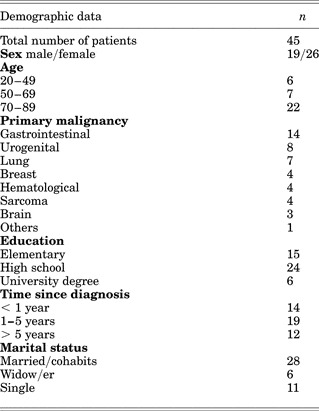
This study is based on 31 previous interviews conducted during a study focused on disclosure about the termination of active tumor-specific treatment, and on 14 additional interviews, with special attention to patients’ experiences of and preferences for truthful information. Prospective subjects were sampled in order to obtain a variety of demographics, such as gender, age, status, education, occupation, patients’ diagnoses and when patients were admitted to HBHC (Patton, Reference Patton2002). Inclusion criteria required that participants were adults >18 years of age admitted to a palliative hospital-based home care unit, aware of their prognosis, and in satisfactory physical and mental condition according to their own judgment. Respondents were also required to agree to tape recording the interviews and to be able to communicate in Swedish. The data were collected between 2003 and 2005. To summarize, 45 patients admitted to palliative home care participated. Participants’ ages varied between 29 and 84 years (mean = 66) (Table 1).
Patient characteristics

Overview of the categories (existential survival vs. truth)

Data Collection
The palliative care teams approached patients with verbal and written information about the aim and design of the study. Those patients who gave both their verbal and written consent were then telephoned by one of the interviewers. One of the interviewers was an experienced nurse with specific education in communication and interview techniques. The other was a senior researcher skilled in interviewing in a palliative care setting. A date and a place for the interview were agreed upon according to the patients’ wishes. The majority of the interviews were conducted in the patient's home. Only three were conducted at the palliative care unit. The interview was much like a conversation although an interview guide approach was used. The first 31 interviews only focused on the patient's bad news experience; however the patients also told about the importance or unimportance of truth disclosure. The other 14 interviews started the same way as the previous ones; questions were posed about patients’ experiences of bad news, but then deepened on the significance of truth disclosure and what constitutes “the truth”. Notes were written down after the interviews. The interviews varied from 40 to 120 minutes and they were tape recorded and transcribed verbatim. The study was approved by the Regional Ethics Committee (Dnr 03-650).
Analysis
Data were analyzed by using hermeneutics. When choosing a hermeneutic approach to analyzing a text, the aim is to get a deeper understanding of the meaning and implicit issues that are expressed but sometimes hidden in the text (Ödman, Reference Ödman1994; Kvale, Reference Kvale1996). In addition, the applicability of hermeneutics within a medical context has been illuminated recently (Sveneus, Reference Sveneus2000; Mak & Elwyn, Reference Mak and Elwyn2003). The analyzing process is described below.
1. The transcribed material was read through several times in order to get a general picture of what the participants were recounting.
2. Significant text segments (meaning units), that had anything to do with the aim of the study were marked and preliminarily coded.
3. Preliminary categories emerged through the clustering of meaning units with matching codes. In the preliminary categories the researchers made a comparison of similarities and differences.
4. Meaning units were scrutinized for any further potential underlying meaning. A process back and forth between the whole and the parts of the text continued in order to understand the text.
5. Final categories emerged and these categories were compared with the text from which the initial units of meaning were collected. A final text and modification of the new understanding was made to illustrate both the parts and the whole. “As a whole” concerns the deeper meaning on a more abstract level and constitutes the interpretation of the whole. The analysis was ended when the interpretation seemed coherent without logical contradictions.
Coding and development of categories were mainly performed by the first author, and the co-author concentrated on the validation of the results. Involvement of several researchers is a way of reducing the risk of investigator bias, by researchers supplementing and contesting each others’ readings, corresponding to reflexivity (Malterud, Reference Malterud2001). In addition this study involved two researchers representing different professional backgrounds (nursing and medicine) and preconceptions. To further strengthen the validity of the study, a peer debriefing was conducted and the results were presented at a research seminar involving clinically experienced physicians and nurses as well as palliative researchers.
RESULTS
The Truth Differs
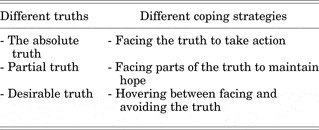
Patients meant that the truth in this context was based on the physician's medical knowledge and personal thoughts. The physician provided something objective that could or should be in concordance with reality. The truth could also originate from the patients’ own thoughts and from symptoms from their body. All patients wanted to know the truth, but their definitions of truth varied. Three different kinds of truth were identified (Table 2).
Absolute Truth
This kind of truth was described as an unquestionable truth about what would happen in the future; it was the factual truth that the patient was dying and would die within a limited time. There was nothing more to do to stop the progress of the disease. This type of truth contained a clear time limit and definite expectations of what the future would hold, including expected symptoms and plans for their management. The physician was expected to make an assessment that was conclusive and absolutely reliable.
The truth for me is to know what it is there for me in the future. That's most important. I’ve been given the knowledge that there is no return… and I have to live and do the best I can for the rest of my life …That's what they told me. There are no false expectations.
Partial Truth
Some patients preferred a truth that was not quite the whole truth. They wanted partial truths and particular facts, but not all of the information. Patients meant that this truth should be positive information that they could benefit from, such as biopsies, blood tests, and practical help. An abnormal blood test could be perceived as helpful, because it conveyed facts about their disease that were vital for their understanding. A blood test or diagnostic imaging could also be experienced as positive if it was not worse than the previous one. But hard facts with too detailed information such as having a limited time to live or possibly intolerable symptoms were not included in preferred half-truths.
It must be that kind of truth that gives me some joy, so to say. Not information about that my life soon will be over. Clearly, it must be details that benefit me. It's not that fun to hear that I have a limited time left. I don’t think that the truth should be too… well it has to be a little bit modified// I don’t want to know, I have never asked if I’ll live a full life time, because I don’t want to know that.
Desirable Truth
Some patients made a distinction between the truth that was provided by their physician and what they wanted to hear, their inner desirable truth. This truth included a positive message about being healthy and that the tumor miraculously had disappeared, the opposite of their real situation. This kind of truth was always present in their inner reality and gave them hope, even if they knew that they were dying. They had to believe in something even though it was unrealistic. Some patients described a more realistic desirable truth; they wanted to hear information about a better situation without symptoms or a longer life or a tolerable situation until the end of their life.
I don’t want to hear that I have one year left. I want him (the physician) to say, “ it didn’t go as we planned, but we continue anyway (with treatment)”. Then you still have the carrot in front of you. I want him to say that I still have 10-12 year, that's what I really want.
Different Coping Strategies
All patients were aware of the absolute truth, but chose how to act when communicating with their physician about it. The different types of truths required or elicited the different coping strategies identified (Table 2).
Facing the Truth to Take Action
Patients who said that they wanted to hear the absolute truth preferred that because they thought that it was not possible to escape from the truth, as the truth always would be disclosed. They meant that they were realists and that the truth gave them a feeling of being in control that made them secure and calm. It gave clear facts about the reality of their situation and they wanted to live in this reality even if it hurt. It gave them a chance to plan for their remaining time in a way that they could choose themselves, for example to prepare their family. They did not want to be hidden behind false expectations that were created haphazardly just to protect them. This way of protecting would hurt them more than it would help.
I: Is there a limit to what a physician can say, speaking in terms of truth?
P: No, there's no limit. Because… lets say that the tumour will be growing fast. Then I know that I got less time left.// If I know that it’ll (the tumour) spread like wildfire, then I can tell my children and grandchildren that “now I haven’t got much time left. You have to be prepared”. And that's why I want this brutal truth.
Facing Parts of the Truth to Maintain Hope
Some patients wanted to hear partial truths to maintain some hope. They meant that the inevitable truth was more worrisome than helpful because it was too frightening. These patients tried to avoid such content and chose partial truths in their communication with their physician, e.g., by avoiding certain questions or specific subjects, such as pain and nausea. Some patients claimed that an objective truth about limited time left was impossible to predict as this was something no one knew anything about and doctors could only guess. Others decided to leave the knowledge about the “real truth” to family members or friends, as they believed that the “real truth” was too much for them. The previous message about discontinuation of tumor treatment was more than enough. They wanted to live in a positive frame of mind, to maintain their desirable truth, as this way of thinking helped them to continue living. They felt that physicians should provide information that benefits the patient, not frightening details.
You should not know more than you can take, so to say. Otherwise you can be really frightened and depressed. // physicians knows exactly, they have seen the last phase of life. I don’t think it's necessary for them to tell patients every detail about the future. You can give some doses now and then.
Hovering between Facing and Avoiding the Truth
Some patients had been informed that their disease was untreatable and would continue to progress, but they were afraid to discuss this again, not wanting to hear unpleasant information about the future. At the same time, they knew there must be other truths to be aware about, such as when and how they would die, but they were too afraid to ask. They hovered between wanting to know and not wanting to know as they had difficulties judging the consequences of receiving this knowledge. They weighed pros and cons in an effort to decide whether this information would help them to cope or tip them over into despair. Their thoughts about this could be very frustrating.
No, I don’t want to talk about it (the truth)// I think it's possible to suppress this (the disease), maybe years. Not really, but… but a little bit of time. But I don’t want to know, and they (the physicians) can’t tell you “whether you’ll live two months or one year”. I know that too// It's not easy for physicians to know. Like me, I want to know and do not want to know (about the time left). How shall physicians’ know then?
Existential Survival versus Truth
Patients’ awareness of the truth of their forthcoming death was something they could neither escape nor ignore, but had somehow to cope with. Although there were differences in their preferences of mode of truth and coping strategy, there was a similar aim. Regardless of their specific preference, the overriding goal of their preferences concerned existential survival despite the awareness of approaching death. That is, despite the information about their approaching death — their nonexistence — that the doctor communicated, they struggled to find ways to cope with thoughts about their continuing to exist as a person and a self.
The preferred type of truth and corresponding coping strategy impacted on their preferences concerning truth disclosure and physicians’ communication of bad news. Some patients preferred a more brutal confrontation with the whole truth in meetings with their doctor, to understand the facts in order to take action and feel secure with the knowledge. In contrast, others wanted to pause and be in “mental exile” for a while, cognitively and existentially separated from the truth and on an emotional vacation, also in order to survive the truth. Although they already knew that they were dying, the meeting with the doctor and the confrontation with the truth disturbed their inner balance. From the patients’ perspective the process of preferring a type of truth and coping strategy was a matter of trying to survive. This was done through the selection of one truth and one way of coping on certain occasions, and another on other occasions, being in mental exile or being mentally present, whichever state contributed best to stabilize their situation.
DISCUSSION
This study shows that terminally ill patients want to know the truth but the content or definition of this truth might vary. Although patients say, when directly asked, that they want to be told the truth by their doctor, their preferences change when they receive bad news in real life. Therefore, in clinical practice, it could be helpful to ask patients how much and what kind of information they prefer to know about their illness, because the truth is different to different patients. This study illuminates important aspects of truth as seen by patients as a dynamic concept with quantitative aspects, i.e., how much of the truth they want to know. It also contains qualitative aspects, i.e., what kind of truth they prefer their physicians to communicate as well as how they cope with this. Moreover, our results showed that patients’ preference about truth depends upon their present, situational needs in relation to coping with existential survival. Although they want the truth, this may also be a substantial threat to their existence. It is a challenge to understand the impossibility of obtaining a radical cure for terminal disease and to understand that you will no longer exist. These results are similar to Salander's study (Salander et al., Reference Salander, Bergenheim and Bergström1998) about the creative illusion, that humans create illusions to cope with reality. However, terminally ill patients, unlike other cancer patients, do not always have something achievable to hope for, such as a response to chemotherapy or radiation. Even though they may harbor an illusion of escape, they are usually aware of the reality of their closeness to death.
Previous studies have shown that patients want to know “everything”, believing that as much information as possible is helpful (Schofield et al., Reference Schofield, Beeney and Thompson2001; Hagerty et al., Reference Hagerty, Butow and Ellis2005). But this “everything” is not a standard, especially not in the last phase of life. When talking about death and dying with patients for the first time, it is very important to be careful. When talking about it for the second or third time one still has to be sensitive as patients might be ambivalent and fluctuate between wanting to discuss the absolute truth or just partial truths or the desirable truth. It is important to check where patients’ thoughts, understandings, and inner realities are, even if there has been previous discussion about their approaching death.
These findings can also be interpreted by using Stroebe and Schut's theory of “the Dual Process Model of Coping with Bereavement” (Stroebe & Schut, Reference Stroebe and Schut1999). Even though this model was developed within a bereavement context, it also seems appropriate when discussing terminal prognosis, because dying adults will, just like bereaved family members, face different kind of losses. The model suggests that an optimal and adaptive coping with bereavement includes both the confrontation and avoidance of stressors related to the bereavement, in this study related to awareness about the truth of the forthcoming death. Moreover, they also argue that it is important to dose the grief, which is important as an integral part of the bereavement, to take a break from the confrontation of the stressors.
Our study shows that some terminally ill patients, although aware of their approaching death, prefer to limit their confrontation with the threatening truth that they are dying by avoiding asking their physician certain questions or by refraining from all further prognostic discussions. It seems important to acknowledge both such patient-chosen dosing of bad news and patients’ needs for mental exile. Rest from repetitive exposure to the “truth” may be a normal and important part of patients’ coping with their awareness of forthcoming death, not merely a symptom of pathological denial.
To provide information without destroying a patient's hope is a very delicate task. How can a physician learn or divine what the patient wants to know without asking questions that may in themselves divulge too much information? If one cannot ask patients if they want to hear the truth that they are dying, what can one ask? One way to elicit the truth preferences of terminally ill patients is to use indirect speech, and to relate to one's own experience in counseling other patients, saying, for example, “Some people are worried about things that may or may not happen in the future,” and asking if they too have wondered about the this (Clayton et al., Reference Clayton, Hancock and Butow2007b; Rodriguez et al., Reference Rodriguez, Gambino and Butow2007). If they answer yes on this question, they have probably started thinking about the future. If they answer no, one has to go on further asking if they want to discuss the future. Another way of helping terminal patients cope is to prepare all patients to recognize when treatment goes from curative to palliative care (Friedrichsen & Strang, Reference Friedrichsen and Strang2003). This strategy will prevent surprises, as the patient will already know what to expect. An Australian research group (Clayton et al., Reference Clayton, Hancock and Butow2007b) has made an extensive guide for when and how to discuss end-of-life issues with an evidence level for each recommendation. Another study (Clayton et al., Reference Clayton, Hancock and Butow2007b) evaluated a prompt list for advanced cancer patients. This list included questions about physical, psychological, social, and existential issues. Patients, family members, and physicians highly valued this list.
Sustaining optimism and hope when breaking bad news about the truth in-end-of life situations is ideal but rarely realistic. Patients who are confronted with the truth about a terminal prognosis cannot and should not be expected to react with optimism. Usually they will react with sorrow and tears, although some may feel relieved when worries are confirmed. Clinicians naturally expect that news of terminal illness will be very painful to their patients, but they also tend to assume that full disclosure is necessary and ethical. The opportunity to discuss the prognosis is seen as an opportunity for the patient to form a realistic picture of the truth that they can then choose how to cope with. However, just as all patients have the right to know, all patients should also have the right not to know if that is their wish. It is the physician's duty to inform, but it is not always patient's wish to be informed.
Limitations of this study include a risk of recall bias. There is also a risk for selection bias because these patients only represent patients who are aware of their disease and prognosis. We do not know what “nonaware” patients may think about truth and truth telling. However these data represent rich descriptions that are the strength of this study.
In conclusion, this study shows that truth-telling in the communication of bad news entails much more than merely providing information related to the forthcoming death. It also concerns how physicians or other healthcare staff can support the patient's existential survival by fine-tuning the communication of “truth” according to the individuals’ preferences. Further studies should investigate how many patients prefer which kind of truth-telling or how they choose to cope afterwards.
ACKNOWLEDGMENTS
This study was supported by grants from The Swedish Cancer Foundation. The funding source had no involvement on the research. We gratefully acknowledge all the participants interviewed for this study.