Introduction
Tonsillectomy is one of the most common operations performed by otolaryngologists. In the USA, 399 000 tonsillectomies were carried out in 2010 and 27 500 were conducted in the UK in 2014.Reference Hall, Schwartzman, Zhang and Liu1, 2 The National Prospective Tonsillectomy Audit, carried out in England and Northern Ireland between 2003 and 2004, found that around one-third of all tonsillectomies included were performed by surgical trainees.Reference Lowe, van der Meulen, Cromwell, Lewsey, Copley and Browne3 The audit also showed that trainees had statistically higher complication rates than experts.Reference Lowe, van der Meulen, Cromwell, Lewsey, Copley and Browne3
Tonsillectomy is one of the first operative procedures that otolaryngology trainees are exposed to and expected to perform independently. It requires knowledge of anatomy and various generic technical skills such as hand–eye co-ordination, two-handedness, tying at depth, and sound tissue handling. All UK otorhinolaryngology training programmes require trainees to be competent in performing tonsillectomy operations independently, prior to completion of training. Complications such as primary or secondary haemorrhage arising from tonsillectomy can be potentially disastrous. Therefore, quality assurance of the trainee performing tonsillectomy is critically important, but this can be very difficult to assess objectively.
Cumulative sum (‘CUSUM’) analysis is a statistical technique, which was initially proposed in 1954 as a quality control method.Reference Page4 Cumulative sum analysis tables are used to generate a control chart to monitor outcomes of a procedure performed over time by an individual operator. This allows a judgement to be made as to whether a variation in performance is significant or the result of a random variation.Reference Chen, Vamos, Dailey and Jiang5 It has flexibility in allowing the analysis of a dynamic sample size. In addition, the chart can be updated after every performance, facilitating ‘real-time’ feedback.
Cumulative sum analysis is being increasingly used as a strong adjunct to surgical training. The performance of a trainee can be compared to that of experts as a surrogate marker of competence.Reference Steiner and Woodall6 The analysis has been applied to training in several surgical procedures, including thyroidectomy,Reference Duclos, Carty, Peix, Colin, Lipsitz and Kraimps7 parotidectomy,Reference Sharp, Cozens and Robinson8 oesophagectomy,Reference Roberts, Tang, Harvey and Kadirkamanathan9 robotic-assisted laparoscopic colorectal surgeryReference Bokhari, Patel, Ramos-Valadez, Ragupathi and Haas10 and sentinel lymph node biopsy.Reference Lerch, Donald, Olivotto, Lesperance, van der Westhuizen and Rusnak11
Our primary objective was to assess the applicability of cumulative sum analysis control charts in demonstrating trainees’ progress and competence with regard to tonsillectomy operations, in addition to highlighting any concerns relating to performance.
Materials and methods
Study design and participants
Eight junior otolaryngology surgical trainees in their first 6–12 months of training within the specialty were selected. The trainees were observed in operating theatres by their supervising trainers. Two outcome measures were used: operative time and post-operative complications. The results were compared to those of experienced surgeons who had performed more than 150 tonsillectomies.
Generating cumulative sum analysis curves
The mean and standard deviation (SD) of the experts’ performance was used to draw the cumulative sum analysis curve, applying the standard formula (Cn = 0, Cn − 1 + Xn − k) on consecutive procedures, where C = trainee's performance, n = number of procedures in a chronological order, Xn = outcome measure for the nth procedure and k = target value (pre-specified standard of performance).
A positive performance (success) was recorded for completion within 1 SD of the experts’ time, and denoted as Xn = 0. If operative time was more than 1 SD of the experts’ completion time, then Xn = 1 (failure). When charted on the y-axis (against the number of cases on the x-axis), this then allows interpretation of training progress by the direction and trajectory of the curve. Performance in line with the experts will move the curve downwards by accumulation of scores of Xn = 0. Conversely, an upwards curve denotes performance moving away from the experts’ level. Acceptable failure or permitted error is corrected for by k = 0.2; as such, prolonged performance time in one of every five cases is considered allowable based on departmental data.
Post-operative complication data obtained from medical records, and by contacting the patients or parents, were also recorded. Complications included bleeding, delayed hospital discharge, delayed return to school or work, hospital re-attendance, or visiting a doctor for pain or infection. Complications were combined because of their low incidence and the usual overlap between them. Tonsillectomy patients presenting with post-operative bleeding will usually require additional hospital stay, and those who return to hospital or visit doctors often do so because of excessive pain or infection, and tend to require antibiotic prescriptions.
Each complication was regarded as a negative episode (Xn = 1). Charting negative episodes over a number of cases produced a similarly interpretable curve, whereby a downward slope indicates performance approaching that of the experts’ level. Allowable failure was set at k = 0.1 based on the experts’ data, which showed 10 per cent incidence of such complications.
Ethical considerations
Local research and development department approval was obtained for the purpose of data collection and protection. All trainees consented to be enrolled in the study. No new interventions were instigated and no changes to clinical practice were made.
Statistical analysis
The statistical analysis was performed with SPSS software, version 23.0 (IBM, Armonk, New York, USA), with statistical significance set at p < 0.05. The Mann–Whitney U test was used to compare the means of non-parametric data. Diagramming of the cumulative sum analysis charts for the learning curves was performed in Microsoft Office Excel 2007 spreadsheet software (Microsoft, Redmond, Washington, USA).
Results
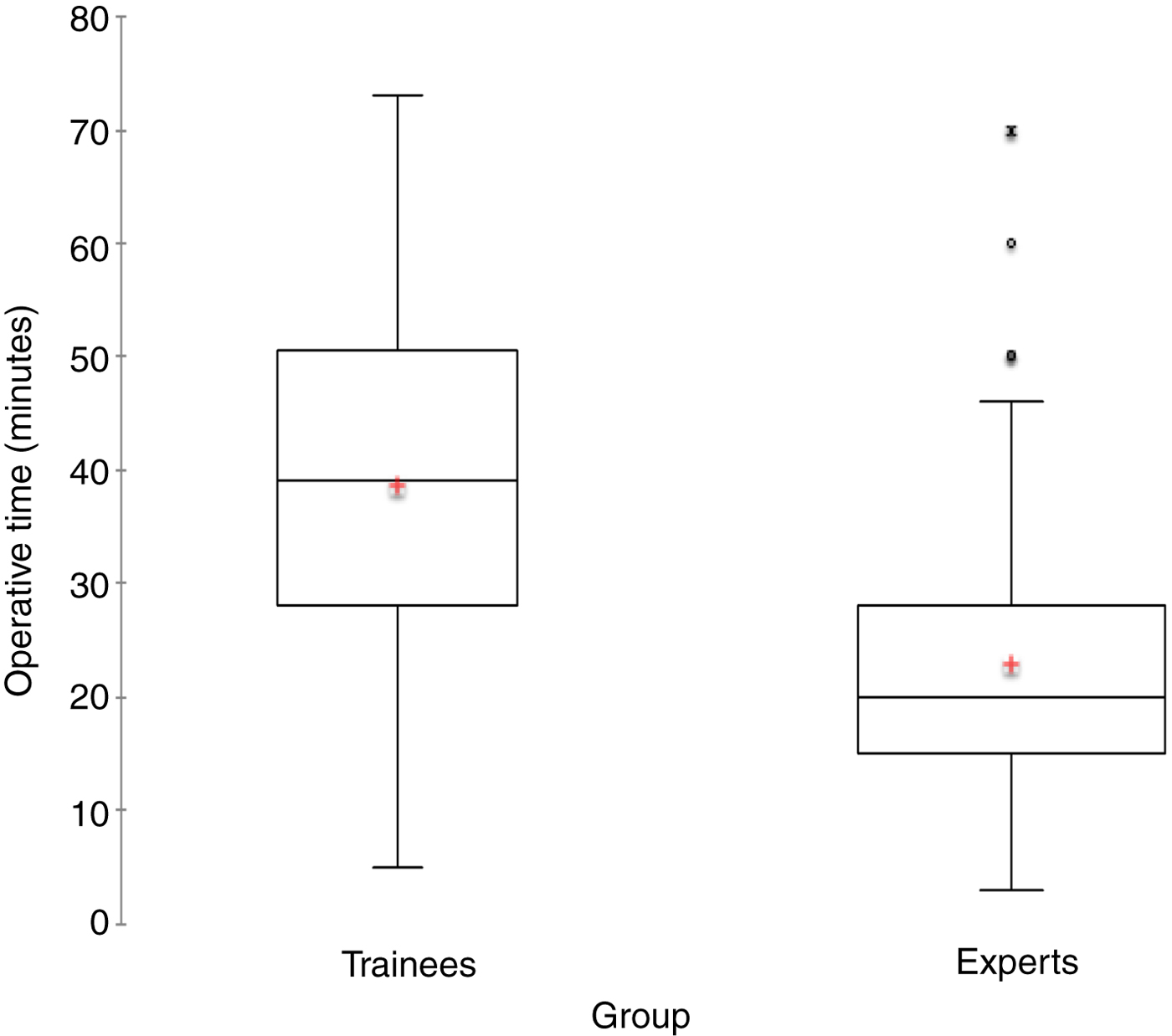
All of the 8 trainees performed 14–50 tonsillectomies each. The mean (± SD) operative time for experts, who completed over 150 procedures, was 23 ± 11 minutes. Trainees’ operative time was significantly longer, at 38 ± 16 minutes (p < 0.0001), as demonstrated in Figure 1.
Box-and-whisker plot of time taken to perform tonsillectomy, comparing trainees to experts (Mann–Whitney U test p < 0.0001).

Operative time failure was judged by the criteria described above, where Xn = 0 if performance was within 1 SD of the experts’ completion time (34 minutes) and Xn = 1 if longer than 34 minutes. The presence of complications gave a score of Xn = 1, and the absence of complications was scored as Xn = 0.
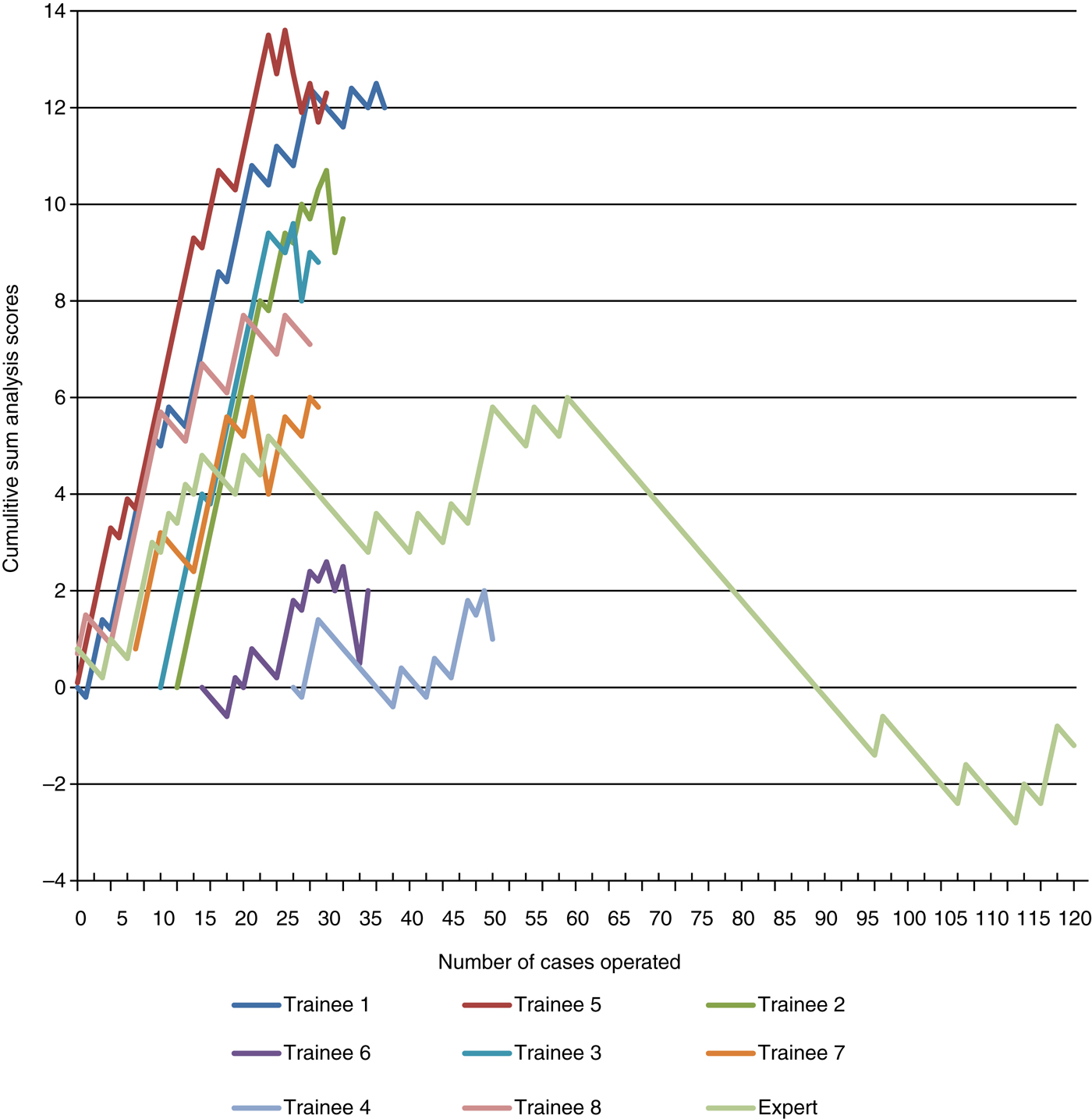
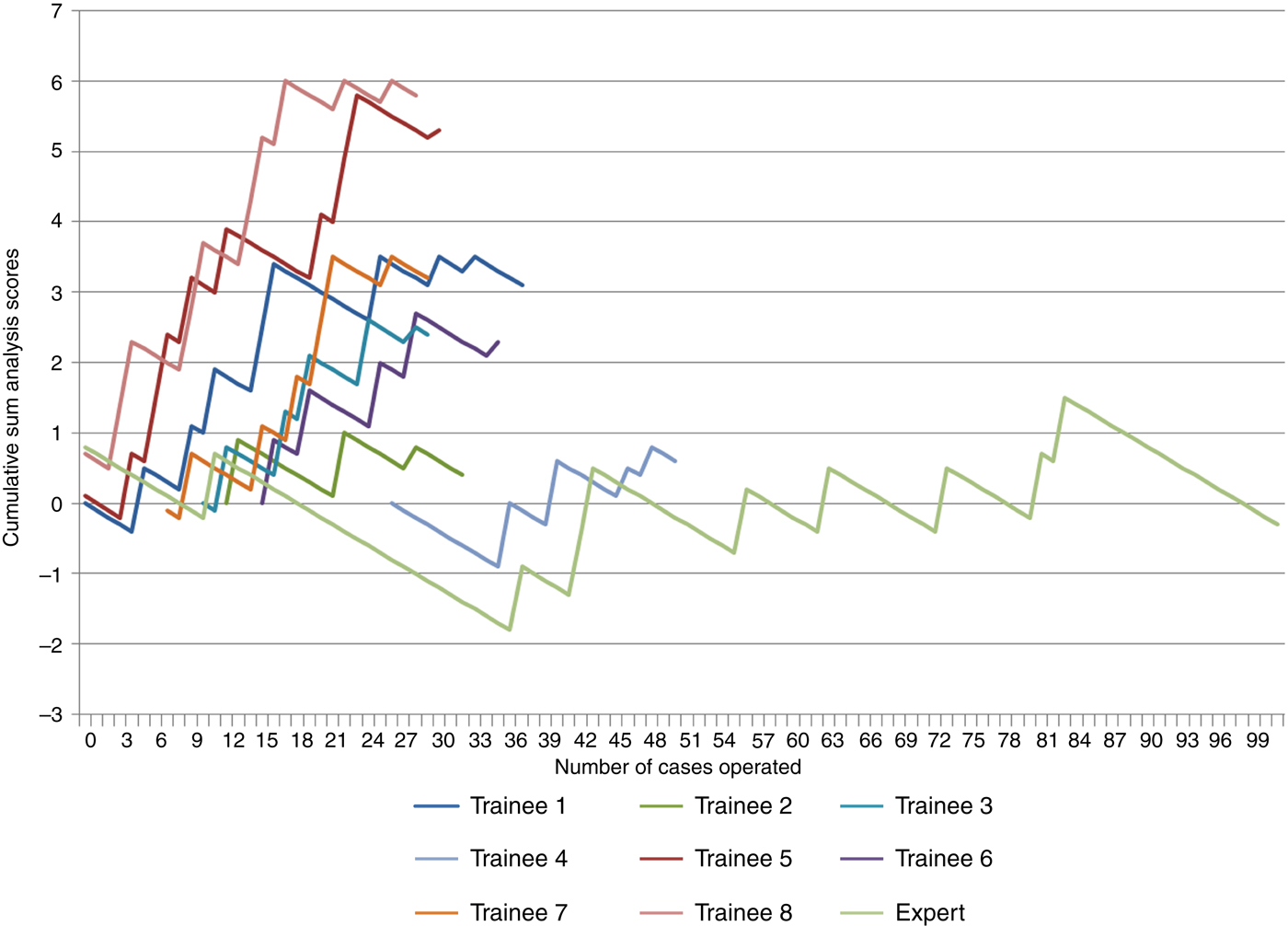
For trainees who had never performed a tonsillectomy before, their operative time and complications cumulative sum analysis curves rose as they accumulated failures, and then started to plateau after a variable number of cases (range, 25–30) (Figures 2 and 3). Some trainees had performed tonsillectomies prior to this study and this is presented as a delayed start in their curves. By contrast, the operative time and complications cumulative sum analysis curves of experts stayed flat, as demonstrated in Figures 2 and 3.
Diagram showing cumulative sum analysis curves of individual trainees versus expert with regard to operative time.

Diagram showing cumulative sum analysis curves of individual trainees versus expert with regard to post-operative complications.

Discussion
It has long been known that training and practice are key factors for improving clinical skills and achieving mastery in surgical procedures.Reference Chen, Vamos, Dailey and Jiang5 Recent research has shown that practice significantly reduces operative time and improves surgical outcomes.Reference Rogers, Elstein and Bordage12, Reference Awad13 However, the time available for training and ‘on-the-job’ learning has reduced considerably, and there is an emerging need for alternative methods of learning, and, more importantly, monitoring for progress and competence.
In the UK, assessing competency in surgical practice has been performed by a number of tools, such as workplace-based assessments and objective structured clinical examinations.Reference Memon, Brigden, Subramanya and Memon14 These assessment tools are considered essential for training progression and are widely adopted by surgical trainers. However, these tools have been criticised for being subjective, and they require an adequate allocation of time and resources.Reference Massie and Ali15, Reference Wilkinson, Crossley, Wragg, Mills, Cowan and Wade16 Cumulative sum analysis is a new emerging assessment tool focused on technical competency that permits a dynamic, objective and reliable assessment of a trainee's performance. It can be used to evaluate the quality of surgical skills accumulated over the training period, provide individualised feedback and potentially benchmark training programmes.Reference Hu, Jolissaint, Ramirez, Gordon, Yang and Sawyer17, Reference Campbell, Hecker, Biau and Pang18
This study highlights the potential role of cumulative sum analysis curves for mapping the performance of trainees in relation to the number of procedures performed. It addresses three key issues in surgical training. Firstly, the number of procedures alone is not a reliable indicator of competence.Reference Jowell, Baillie, Branch, Affronti, Browning and Bute19 Secondly, individual learning curves can give trainees insight and allow direction towards appropriate training opportunities. Thirdly, cumulative sum analysis curves have the potential to create a feasible and reliable measure of competence achievement, which, in time, can be validated.
Our results demonstrate that cumulative sum analysis curves can be drawn to describe trainees’ learning curves for performing tonsillectomy operations. For most of the surgical trainees, their learning resulted in a curve that initially deflected steeply upwards, and which then began to plateau as their performance improved with increasing surgical experience. The point at which this plateau was reached varied between trainees, but generally occurred after operating on between 25 and 30 cases. As the cumulative sum analysis curve plateaued, it mirrored the expert's curve, and it is reasonable to extrapolate that this equates with competence in performing tonsillectomy.
It is important to highlight that skills progression and attainment of competence usually varies depending on the individual. Cumulative sum analysis curves can be used to monitor and predict inter-individual variability in performance, and to create individualised learning curves. These curves can be updated after every performance as data increase, and agreed outcomes can be optionally included in the analyses. In addition to the assessment of post-operative complications included in this study, other indirect markers of performance, such as patient-reported outcome measures and post-operative analgesia requirements, can also be included.
Understanding and interpreting the cumulative sum analysis curves in a mutually agreed way between the trainer and any trainee is important for their effectiveness. It is mandatory to maintain close supervision on new trainees when their curves are deflecting upwards. This close monitoring should aim to provide immediate feedback on the technique, to improve fluency and reduce complications. A plateau in the curve should be an anticipated milestone, and should be ideally associated with a reduction in the degree of supervision and guidance needed. A consistent plateau for a predetermined number of cases over a reasonable period of time can be safely interpreted as competency. Achieving competency is a benchmark by which trainees are permitted to perform the procedure independently without supervision, with occasional acceptable failure expected, comparable to the experts’ level.Reference Li, Wang and Ferguson20
Trainees should never be allowed to operate without supervision if their cumulative sum analysis curves have not yet plateaued, as patients’ safety can be jeopardised. If no plateau is achieved after a reasonable period of time and number of cases, the supervisor and the trainee have a responsibility to identify areas of weakness, revise the technique and construct a mutually agreed action plan. The same process should be instigated if cumulative sum analysis curves deteriorate after a period of plateau, to ensure consistent patient safety.
A further application of cumulative sum analysis is as a quality control for trained ENT surgeons. There is much current debate around surgeon-specific outcomes and revalidation of the quality of care provided after completion of training. Cumulative sum analysis could provide one way of objectively demonstrating performance within agreed expert parameters, enabling consultants to map their outcomes against the control curve throughout their careers.
Study limitations
Potential limitations of this study include the inability to correct for complex cases using current parameters. As surgical trainees progress, they are exposed to cases that are innately more difficult or time consuming (e.g. procedures conducted for histological examination or on a background of coagulopathy). At present, there is no stratification system that quantifies the complexity of tonsillectomy cases. If, in the future, such a system was to be developed, it would allow the standard cumulative sum analysis to be converted to a risk-adjusted cumulative sum analysis, with more nuanced evaluation.
• Tonsillectomy is one of the most common operations performed by otolaryngology trainees
• Tonsillectomy performed by trainees results in more complications than that performed by experts
• Cumulative sum analysis is an emerging statistical method used to monitor outcomes of a procedure performed over time by an individual operator
• This study is the first to show the potential of cumulative sum analysis curves for mapping trainees’ performance in tonsillectomy operations
• The analysis curves can also be used to monitor and predict inter-individual variability in performance, and individualised learning curves can be created
Another study limitation is that only 8 trainees were included, who performed less than 50 cases each. A larger number of trainees and cases over a longer timeframe would improve the accuracy of the time taken to achieve a plateau in the cumulative sum analysis curve and allow for the degree of variability between trainees. In addition, complications such as bleeding are rare after tonsillectomy, and hence larger numbers are important to confirm improvement.
Conclusion
Cumulative sum analysis can be used as an evaluation tool to monitor performance and draw learning curves for tonsillectomy. The flexibility of the cumulative sum analysis makes it adaptable to any outcome, which gives it an advantage over existing assessment techniques. Moreover, cumulative sum analysis curves can be utilised to give trainees real-time feedback of their performance using an objective measure, and can alert trainers to a potential trainee in difficulty.
Competing interests
None declared.