There is a growing subfield in public policy analysis devoted to moral conflicts or what is commonly known as morality policy.Footnote 1 Moral conflicts engage contested values, are highly salient for ordinary people, and easily polarize the debate into nonnegotiable positions. Because religious beliefs often underlie these policy debates, moral conflicts have occurred more frequently in the United States than in the more secular countries of Europe,Footnote 2 though the presence of religious-based parties also accounts for the emergence of such conflicts there.Footnote 3 Moral conflicts have been popularized as “culture wars” between mainstream and fundamentalist worldviews,Footnote 4 and, as such, pose threats to consensus-building, political stability, and even public civility.Footnote 5 If the emergence of moral conflicts is a worthy topic for scholarly inquiry, then surely the ability of our political system to end moral conflict without social trauma is equally important for policy analysis. This article focuses on why long-standing political debates over moral conflict sometimes fall off the policy agenda. In our search for explanations of why moral conflicts die, we draw on the agenda-setting literature in public policy and communications studies as well as sociological research on social movements and social problems.
Agenda-Setting
Agenda-setting is the process by which a select number of social problems are elevated from the “systemic” agenda onto the “institutional” agenda, where a policy decision is made. Issues on the “systemic” agenda are defined by public opinion, interest groups, and social movements, whereas the “institutional” agenda involves legislative, executive, and judicial actors who make policy decisions. The “stages” model popularized by political scientist James Anderson gave only scant attention to how programs are terminated.Footnote 6 Political scientist Barbara Nelson adapted the stages model to explain the growth in media coverage about “child abuse” through 1980, but she offered little speculation about its long-term prospects.Footnote 7 A more contemporary “streams” model of policymaking by political scientist John Kingdon also neglected how policies are terminated,Footnote 8 although his oversight was remedied by Iris Geva-May, another policy analyst, who argued that policy “termination occurs in opportunity windows, which open and close as political, policy, and problem streams converge.”Footnote 9 But none of her examples involved morality policies.
A recent and more ambitious framework by policy analysts Frank Baumgartner and Bryan Jones borrows heavily from political scientists Anthony Downs and E. E. Schattschneider to focus on both the upside and downside dynamics of agenda-setting.Footnote 10 Downs had postulated that an “issue-attention cycle” affects public opinion toward the environment, which evolved through five stages: (1) the pre-problem stage, (2) then alarmed discovery and euphoric enthusiasm, followed by (3) a realization that the costs of significant progress would be very high, then (4) the gradual decline in the intensity of public interest, and a (5) post-problem stage.Footnote 11 An early study applied the Downsian logic to the issue of criminal victimization of the elderly, which within a decade reached the congressional agenda but as rapidly eroded from public concern when this social problem became redefined as a nonissue.Footnote 12
A cognate body of sociological research argued that a “natural history” demarcated the evolution of social problems.Footnote 13 Armand Mauss was one of the first sociologists to delineate the five stages of incipiency, coalescence, institutionalization, fragmentation, and demise, but the sociological perspective argued that social problems were “social constructions” insofar as this “life-cycle occurs independently of objective reality [italics in original] for the most part.”Footnote 14 Others refined that developmental sequence, but generally none defined an end point in this natural history when a social problem was actually solved. Rather, demise was the result when the goals of the social movement were co-opted or repressed, or when new groups arose that contested the policy modus operandi.Footnote 15 In contrast, policy analysts like Anthony Downs believed that social problems have a basis in reality (which is why the policy studies look for “triggering events” that dramatize their seriousnessFootnote 16).
The agenda-setting paradigm also influenced media studies, beginning with the classic study of the 1968 presidential campaign by Maxwell McCombs and Donald Shaw, both journalism professors.Footnote 17 While the primary objective of this research is to explain fluctuations in media coverage, more studies in this genre did link issue decline to policy enactments. One by sociologist James Jasper argues that Down’s “issue-attention cycle” is correct, but not from media and public boredom but because “sometimes issues are resolved by government actions, or political organizations themselves fight to a standoff or some sort of understanding.”Footnote 18 Media analysts Allan Mazur and Jinling Lee documented how newspaper coverage of the dangers from aerosol sprays dropped after federal agencies prohibited nonessential uses of chlorofluorocarbons.Footnote 19 In another study sociologist Valerie Gunter showed that “there is a substantial decrease in coverage of pesticides following the passage of the FIFRA [Federal Insecticide, Fungicide and Rodenticide Act] amendments. . . , thus conveying the sense that amendments have ‘solved the problem,’ and no further action is needed.”Footnote 20 And with respect to the demise of the “Limits to Growth” debate, policy analyst Francis Sandbach similarly observed that the National Environment Protection Act of 1970 and creation of the EPA alleviated much of the public concern about the environment.Footnote 21
Political Opportunity Structures
In its theoretical development,Footnote 22 social movement theory initially focused on internal “resource mobilization” strategies but merged that perspective with external “political process” models to yield a more integrated explanation of the emergence and impact of social movements.Footnote 23 It is not enough for social movements to mobilize supporters or “frame” their objectives in terms that appeal to cultural values, because the receptivity or hostility of the political regime also matters. No other political regime is as permeable as the U.S. separation of powers and federal system. Federalism offers the potential for “venue shopping” to the subnational levels when the federal “political opportunity structure” is closed to counter-movements. The social justice movement adopted this strategy when the Reagan administration threatened severe budgetary cutbacks for social-welfare programs,Footnote 24 and lobbying state legislatures and courts was the strategy employed to decriminalize antisodomy laws.Footnote 25 At the national level the key variables are the permeability of the polity, the stability of political alignments, the presence or absence of allies, divisions within the elites or its tolerance for protest, and the policymaking capacity of the government.Footnote 26 But also relevant is public policy.
“Policy is a critical component of political opportunity,” argues sociologist David S. Meyer in his study of antinuclear protests,Footnote 27 as he explains: “Movements subsided when an administration institutionalized at least part of its opposition, narrowing the public debate and defusing public concerns and activism. This institutional accommodation entailed symbolic concessions, and sometimes real changes in policy.”Footnote 28 Historian Paul Boyer agrees that a marked shift from the “nuclear fear” of the 1940s–1950s to “the sudden fading of the nuclear-weapons issue after September 1963” was due to many factors, but notably the series of U.S. and Soviet test-ban and arms limitation treaties.Footnote 29 During the 1980s the antinuclear activism prompted by the bellicose rhetoric of the Reagan administrationFootnote 30 eased markedly when the Reaganites embraced “new arms control initiatives and the resumption of U.S.-Soviet summitry.”Footnote 31 And most recently, the pacific overtures of a newly elected Barack Obama led to the decline of antiwar mobilization largely because Democratic Party activists abandoned those peace protests.Footnote 32 All these examples support the observation by political scientist Douglas Imig and sociologist David Meyer that “public rhetoric is a critical component of policy that also influences political opportunity.”Footnote 33
Other studies verify how policy enactments, whether substantive or symbolic, can preempt social movement goals. Policy success largely explains the decline in the feminist antirape campaign, according to sociologists Janet Gornick and David Meyer.Footnote 34 In his study of black insurgency from 1930 to 1970, sociologist Doug McAdam similarly concluded: “After peaking in 1965, black insurgency dropped off sharply in 1966 and continued to decline steadily thereafter.”Footnote 35 That decline McAdam attributed to four factors, of which two are relevant to our discussion. One was that the political opportunity structure “contracted in the late 1960s” due mainly to “the mobilization of a strong conservative ‘backlash’ in this country,” and the second was the “stepped-up campaign of repression designed both to destroy the ‘black power’ wing of the movement and to put down forcefully the urban rebellions.”Footnote 36
Success in enacting women’s suffrage in 1920 ended the first wave of the women’s movement,Footnote 37 or at least forced its remnants into an “abeyance” or organizational hibernation, according to sociologist Verta Taylor,Footnote 38 whereas second-wave feminism suffered a decline after the failure to gain ratification of the Equal Rights Amendment (ERA). Building on McAdam’s work, political scientist Anne Costain argues that “the increasingly single-minded focus on passage of the ERA set the stage for a dramatic decline in movement visibility in the 1980s. The movement lost its main issue when ERA failed to win ratification by the 1982 deadline.”Footnote 39
In sum, the agenda-setting and social movement literatures suggest a two-pronged theory about why moral conflicts die, and fall off the policy agenda. First, the endpoint of moral conflict ought to follow the enactment stage of the agenda-setting process, on the assumption that policy adoption would diffuse public interest and dissipate media coverage. But the logic of collective action suggests that the endpoint of moral conflict does not necessarily follow a policy enactment if alternative political venues exist that can be exploited by counter-movements to reverse or erode the policy status quo. Thus, an authoritative legal enactment is a necessary but not a sufficient condition for ending moral conflict. Second, therefore the demise of moral conflict depends upon how “permeable” the political system will be to counter-movements. In other words, at what point are policy windows “closed” and political opportunity structures “blocked” to counter-mobilization efforts? To end moral conflict, what is required is an authoritative legal resolution of the moral conflict coupled with alternative political opportunity structures being blocked from usage by counter-movements.
Now we consider the policy histories of Prohibition, school prayer, abortion, and gun control, with one important caveat: Our concern is the life or death of moral conflicts at the national level, knowing full well that pockets of resistance may fuel those controversies at the state or local level for years to come. Even today communities continue to debate a strict ban on liquor consumptionFootnote 40 or religious exercises in schools.Footnote 41
Validating the Two-Pronged Hypothesis
Case studies are especially appropriate for understudied areas of research. Well-formulated case studies can generate hypotheses and identify key process variables that can be tested using larger-N statistical analysis.Footnote 42 The policy debate over Prohibition was ended at the national level with the adoption of the Twenty-First Amendment. The Supreme Court banned state-sanctioned school prayer in Engel v. Vitale (1962), constitutionalized a right to abortion in Roe v. Wade (1973), and in United States v. Miller (1939) upheld the National Firearms Act of 1934 and paved the way for stronger state gun laws.
Prohibition, gun control, abortion, and school prayer (or more broadly, church-state relations) were identified among the array of moral conflicts experienced in the United States,Footnote 43 and many countries across Europe and North America.Footnote 44 While some European based scholarship alleges that gun control has more instrumental qualities than other moral conflicts,Footnote 45 that claim is highly problematic for the United States. Nowhere else is the debate over “first principles” with respect to gun control or gun rights embodied in a Bill of Rights, as well as the bills of rights of the vast majority of states, and among the Anglo-American frontier societies, the “gun culture” is by far the strongest in the United States as compared to Canada, New Zealand, or Australia.Footnote 46
Other moral conflicts were not included here because an authoritative legal enactment came too late to assess its impact or not at all. On capital punishment, the Supreme Court’s Furman v. Georgia (1972) decision imposed a moratorium on the death penalty, during which states could reenact their death statutes, but four years later the high court ruled in Gregg v. Georgia (1976) that capital punishment is not inherently a violation of the Cruel and Unusual Punishment Clause of the Eighth Amendment. The precedential Supreme Court ruling on same-sex marriage came only recently in Obergefell v. Hodges (2015), whereas the battle over same-sex relations was previously waged in the legislative and judicial arenas of states, with the definitive Supreme Court ruling in Lawrence v. Texas (2003) simply invalidating sodomy laws in a small number of laggard states. One can argue that the historic policy consensus banning pornography was upended in the 1957 case of Roth v. United States,Footnote 47 but Roth did not end the policy debate over pornography. While restrictions on access to adult pornography have been liberalized in the United States and abroad, this issue has been reframed as child pornography, where a new policy consensus has emerged to virtually prohibit its use.Footnote 48 The issue of gambling has also been redefined, from what was once considered sinful behavior to being reframed in instrumental terms as a revenue enhancement for public services, notably education.Footnote 49 Re-definition can bring about the death of a morality policy, but that outcome would not be the result of an authoritative legal enactment.
It has been standard practice to measure the “systemic” agenda by analyzing media coverage of social problems and monitoring the content of public opinion.Footnote 50 We also record the coverage of each moral conflict in the New York Times,Footnote 51 but the content of public opinion is not reported here systematically. Instead, from the Roper Center for Public Opinion Research archives we derive the number of polls taken on these moral conflicts as a measure of the “saliency” of each issue.Footnote 52 In addition, two measures of the “institutional” agenda are included. Like previous studies of the policy process,Footnote 53 we utilize the Proquest Congressional database to track the number of congressional hearings held on each moral conflict.Footnote 54 But unlike previous agenda-setting research, which largely ignored the judiciary, from the Supreme Court Data BaseFootnote 55 we identify the stream of cases since 1946 to reach the high court on each moral conflict except Prohibition (for which we relied on law review articles and “Shephardized” the case law using the LexisNexis Academic search engine), because the Supreme Court is without doubt a critical policymaker on morality policy.Footnote 56 Together, plotting these four agenda-setting measures over time will delineate the beginning and endpoint (if any) for each of our four moral conflicts. We utilize a sixty-year time frame: 1900–1959 for Prohibition and 1950–2009 for the others. These four indicators are summarized by decade in Tables 1–4.
Agenda-Setting on the Prohibition Controversy, 1900–1959

Agenda-Setting on the School Prayer Controversy, 1950–2009

Agenda-Setting on the Abortion Controversy, 1950–2009

Agenda-Setting on the Gun Control Controversy, 1950–2009

Ending Moral Conflict: Prohibition
The lead-up to Prohibition in 1920 favored the “dry” forces, whereas the advantage shifted to the “wets” by 1933, with Repeal. It was fifty years earlier when the Prohibition Party adopted its 1869 platform that condemned alcoholic beverages as violating good government and religious precepts. It resolved that “the traffic in intoxicating beverages is a dishonor to Christian civilization, inimical to the best interests of society, a political wrong of unequaled enormity, subversive of the ordinary objects of government, not capable of being regulated or restrained by any system of license whatever, but imperatively demanding for its suppression effective legal Prohibition by both State and National legislation.”Footnote 57 Although no public opinion polls existed before the 1930s, there are strong indications that a majority favored the ban on alcoholic beverages. A detailed legal history (albeit by an activist in the Anti-Saloon League) found that by 1913 “more than 50 per cent of the population and more than 71 per cent of the area of the United States were under [state-wide or local ‘option’] prohibitory laws.”Footnote 58 The Anti-Saloon League was the pivotal “dry” pressure group at this time, a single-issue group that adopted a nonpartisan approach to lobbying,Footnote 59 and its effective grass-roots mobilizing of public opinion likely explains why the states ratified the Eighteenth Amendment so rapidly.
Most important, except for the brewery and distilled spirits industry, there was no organized opposition to Prohibition prior to 1919, though afterward an entirely “new” counter-movement was spearheaded by single-issue groups, notably the million-member Women’s Organization for National Prohibition Reform (WONPR) and especially the Association Against the Prohibition Amendment, “abetted by labor unions, trade and bar associations, medical societies, and veterans groups, [which] retrieved the idea of repeal from the realm of assumed impossibility and made it a serious matter of public discussion.”Footnote 60 At its 1930 national convention WONPR adopted a resolution that repudiated Prohibition for causing many of the social and political problems of that day. It stated in part:
We are convinced that National Prohibition, wrong in principle, has been equally disastrous in consequences in the hypocrisy, the corruption, the tragic loss of life and the appalling increase of crime which have attended the abortive attempt to enforce it; in the shocking effect it has had upon the youth of the nation; in the impairment of constitutional guarantees of individual rights; in the weakening of the sense of solidarity between the citizen and the government which is the only sure basis of a country’s strength.Footnote 61
This counter-movement could also exploit a changed political opportunity structure, one aided by the onset of the Great Depression.Footnote 62 Democrats became identified with the “wet” forces, especially after nominating New York governor Alfred E. Smith as their 1928 presidential candidate, whereas the incumbent Republicans had to enforce an increasingly unpopular “dry” status quo against calls for policy reform (allowing home consumption of near-beer or wine). Thus, whereas the Eighteenth Amendment had virtually equal partisan support in the House (69 percent of Republicans and Democrats) and the Senate (78 percent of Republicans and 75 percent of Democrats) in a Republican-controlled Congress, Repeal obtained more support in the “lame-duck” session of the 72nd Congress from Democrats than Republicans in the Senate (79 percent to 67 percent) and especially in the House (85 percent to 55 percent). Repeal was the only amendment to utilize the option of special state-ratifying conventions, the purpose being to insulate the political process from “dry” forces and to neutralize the influence of rural state legislatures that likely favored continuing the ban. Historian David Kyvig reported that thirty-seven states had elected delegates to state ratifying conventions by November of 1933 and 72.9 percent of the votes cast favored repeal.Footnote 63
A spring 1932 Literary Digest poll showed 73.5 percent of Americans favoring Repeal, though it likely exaggerated majority opinion. In December 1936 through December 1939, Gallup asked its national sample this question five times: “If the question of national prohibition should come up again, would you vote to make the country dry?” The percentages saying “no” ranged from 63 percent to 67 percent. In December 1939, Gallup asked this alternative question twice—“If the question of national prohibition should come up again, would you vote for prohibition or against it?”—and only marginally fewer (61 percent and 64 percent) would have voted against Prohibition. In sum, these eight Gallup Polls showed that 31 to 34 percent of the population favored “dry” policies despite Repeal.Footnote 64 After 1933 the U.S. population under state-wide or local “option” Prohibition laws shrank markedly. In 1935, following Repeal, 37.7 percent of the population still lived in areas that prohibited the sale of distilled spirits, but this declined to 18.3 percent by 1940 and further dropped and stabilized at six percent in 1970.Footnote 65 Protestant churches and especially the “pietistic” or evangelical denominations were always in the forefront of the Temperance Movement,Footnote 66 and research on the further decrease of “dry” counties between 1970 and 2008 showed that the key factor was the “decline in a religious atmosphere dominated by Evangelical Christians.”Footnote 67
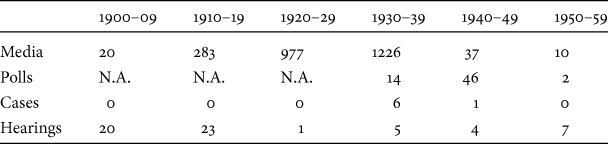
Prohibition got scant coverage in the New York Times from 1900 through 1909, and then not much more until 1919, when the issue became more salient after Prohibition was enacted through Repeal in 1933, after which coverage dropped to pre-1920 levels and became a nonissue after World War II (see Table 1). Nonetheless, its policy legacy was important enough during the 1930s and 1940s to warrant regular scrutiny of public attitudes by pollsters, but Prohibition also became a nonissue for pollsters by 1950. Surveys were taken in 1950 and 1954 but, since then, were repeated only twice through 2010. In 1950 Gallup found that “if the question of national prohibition should come up again,” 72 percent would vote against Prohibition and 23 percent would vote in favor. In December 1954, Gallup posed the same question without referencing Prohibition, asking “Would you vote to outlaw the sale of alcoholic beverages, or not?” and 63 percent answered in the negative. Table 1 shows the number of articles in the New York Times, the number of polling questions, the number of Supreme Court cases decided, and the number of congressional hearings held.
This policy history points to one key institutional difference between Prohibition and our three contemporary moral conflicts. Repeal brought final legal closure at the national level because there was no organized campaign to overturn the Twenty-First Amendment. The debate over Prohibition had fueled numerous congressional hearings during the first two decades of the twentieth century, but after Repeal relatively few were held on this subject (with only one more during the extended period of from 1960 to 1970). The few hearings typically were concerned with administrative specifics (like Prohibition or alcohol regulation in the wartime military or in the District of Columbia). In contrast, although reformers also seek to “nationalize” contemporary moral conflicts in order to achieve victory across the entire country, the biggest institutional difference is that they have turned to the Supreme Court, not Congress, to overturn state morality policies. That occurs when the Supreme Court “incorporates” one precise constitutional standard for the entire nation (as with school prayer and abortion).
However, a judicial strategy was not viable either, after 1933, though Section 2 of the Twenty-First Amendment did invite legal challenges about the scope of state regulatory powers and the relationship between state and federal authority (the Commerce Clause). Section 2 read: “The transportation or importation into any State, Territory, or possession of the United States for delivery or use therein of intoxicating liquors, in violation of the laws thereof, is hereby prohibited.” Beginning with State Board of Equalization v. Young’s Market Co., 299 U.S. 59 (1936) through the ruling in Liquormart v. Rhode Island, 517 U.S. 484 (1996), fourteen Supreme Court decisions “support[ed] the view that the Twenty-First Amendment grants to each state the power to prohibit entirely or to limit and regulate traffic in intoxicating liquors within the state.”Footnote 68 Not until 1964 did the Supreme Court show greater deference to the federal Commerce Clause and begin to accommodate federal authority with state prerogatives on a case-by-case basis,Footnote 69 most recently its decision in Granholm v. Heald, 544 U.S. 460 (2005), which nullified discriminatory regulations against imported liquor.Footnote 70 In sum, there has been a recent doctrinal debate over the relationship between the Twenty-First Amendment and the Commerce Clause, and indeed other constitutional provisions including the Bill of Rights, but no subsequent high court case involved an effort to limit the authority of states to permit the retailing of intoxicating liquors. Other than yet again attempting the constitutional amending process, opponents of intoxicating liquors have no viable alternative to overturn the policy status quo at the national level. The battleground between “wets” and “dry” forces has shifted permanently to the states and localities.
Ending Moral Conflict: School Prayer
In the debate over school prayer, opponents defended the principle of church-state separation, whereas proponents argued that the Constitution does not explicitly prohibit the practice. The former was expressed by Jimmy Carter in 1980: “The thing that I’m against . . . is the Government telling people they have to worship at a certain time and in a certain way. To me that violates the constitutional separation of church and state. But as long as the Government stays out of it and permits people to worship as we see fit, including in the schools, that’s what I want. But I am not in favor of the Government telling a child ‘You’ve got to worship a certain God in a certain way in the classroom.’ That’s where I draw the line.”Footnote 71 The latter view was held by President Ronald Reagan, who early in his first term took exception to judge-made law and referenced the school prayer ban, saying “I happen to believe that the court ruled wrongly with regard to prayer in schools. The First Amendment doesn’t say anything about that. The First Amendment says the Congress shall do nothing to abridge the practice of religion or to create a religion.”Footnote 72
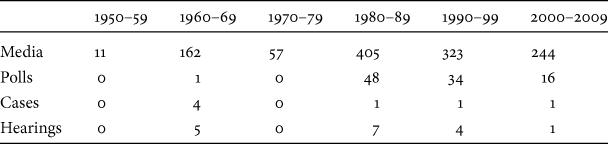
Despite the landmark ruling in Engel v. Vitale (1962) nullifying state-sponsored school prayers, polls consistently show that upward of three-fourths of Americans favor a constitutional amendment to restore the practice.Footnote 73 Nonetheless, by any objective criteria the school prayer controversy has died. Political historian Bruce Dierenfield agrees: “The emotional reaction to Engel . . . has largely spent its force. Congress is not tied up in knots over school prayer, and . . . no known election has ever been decided by it. Politicians need only mention their endorsement of school prayer to retain conservative support; they need not do anything about it.”Footnote 74 Most noteworthy is that the school prayer controversy engaged the Supreme Court only seven times since 1962, though it did so decisively (see Table 2). Table 2 shows the number of articles in the New York Times, the number of polling questions, the number of Supreme Court cases decided, and the number of congressional hearings held.
The legal certainty of its precedential rulings that state-sponsored school prayer violated the Establishment Clause of the First Amendment was so conclusive that opponents could not mount a frontal attack but rather had to settle for “symbolic” acts to express their displeasure with that jurisprudence. The first ruling in Engel v. Vitale (1962) nullified a school prayer written by the New York State Board of Regents. Then the next year the Supreme Court struck down state-mandated Bible reading at the opening of each public school every day in the Pennsylvania case of Abington School District v. Schempp (1963) and its companion case from Maryland, Murray v. Curlette (1963). Then Chamberlin v. Public Instruction Board (1964) nullified state-mandated prayer and devotional Bible reading in Dade County public schools. Since then, the primary legal strategy employed by the counter-movement favoring school prayer was to enact state “moment of silence” laws. By the time Wallace v. Jaffree (1985) nullified an Alabama law authorizing one-minute for “meditation or voluntary prayer,” twenty-five states had enacted similar statutes. Finally, in Lee v. Weisman (1992), the high court prohibited clergy-led prayers at public school graduation ceremonies, a precedent that led to Santa Fe Independent School District v. Doe (2000), which banned student-led, student-initiated prayer at high school football games.
Media coverage about school prayer was negligible during all but five years of the 1950s, 1960s, and 1970s, showing heightened interest only during 1962–66, when the Supreme Court rulings against school prayer fueled a congressional backlash (Table 2). Yet only one survey was taken on this issue from 1950 until the 1980s, when more sustained polling began, after which somewhat fewer surveys were conducted during the 1990s and especially after 2000. School prayer also got its most intense media coverage during the 1980s, which no doubt reflected the efforts by President Reagan and congressional conservatives to gain approval of a constitutional amendment.
Engel v. Vitale (1962) provoked a backlash in Congress, which subsequently held seventeen congressional hearings devoted wholly or partly to the issue of school prayer. There were none during the 1950s, but the Supreme Court cases prompted one hearing in 1962, three more in 1964, and another one in 1966. Two decades later the renewed congressional debate over a school prayer constitutional amendment prompted seven hearings during 1980–85, but then no further hearings were held until the mid-1990s. Since 1962, “nearly a hundred such [pro-school prayer] measures have been introduced in the Senate, and several hundred have been introduced in the House.”Footnote 75 And there have been recorded votes in Congress to amend the Constitution; none were successful, though all garnered majority support: S.J. Res. 148 in 1966; H.J. Res. 191 in 1971; S.J. Res. 73 in 1984; and H.J. Res. 78 in 1998. No further congressional hearings were held except one in 2004. In sum, the four failed attempts to enact a constitutional amendment meant that the opposition had no effective means for reversing the landmark 1962 Supreme Court ban on state-sponsored school prayer.
Moral Conflict without End: Abortion
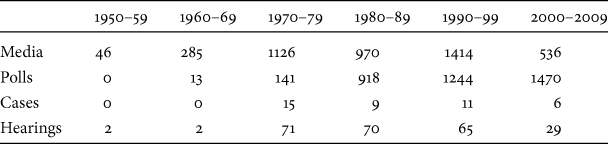
Abortion represents the limiting case of moral conflict without end, despite the assumption by pro-choice advocates that the Supreme Court in 1973 had delivered to them a final victory (see Table 3). The terms of this debate have persisted for more than four decades. For pro-lifers, abortion is simply destroying innocent life. Congressman Henry Hyde (R-Ill.), who authored the Hyde Amendment, restricting the use of federal funds for abortions, reportedly said: “You don’t compromise on this issue of abortion. How do you compromise when the issue is human life—not your life, somebody else’s life.”Footnote 76 In sharp contrast is the view of Lawrence Lader, who was a founder of the National Abortion Rights Action League. In an interview with The Body Politic magazine in 1991, he declared: “Here is the crux of the issue. What they are really saying is that women must be the slave of men and when a man wants to make love to them and produce a child, that’s a man’s right. Woman has no role in it. Basically, the opposition really hates women, which I think come out of a fear of women’s sexuality. They fear women’s independence—women no long chained to the home wait for the man with a rose in their teeth.”Footnote 77 Table 3 shows the number of articles in the New York Times, the number of polling questions, the number of Supreme Court cases decided, and the number of congressional hearings held.
Since 1950, various polling organizations asked a total of 3,786 questions about abortion, and their substantive findings are three: (1) that public support for abortions under “hard” therapeutic conditions are higher than under “soft” socioeconomic conditions and less than a majority approves of abortions as a purely elective procedure, (2) that many restrictions (like waiting periods, informed consent) that pro-choice advocates find onerous are perfectly reasonable for most Americans, and (3) that although most people support Roe v. Wade as the law of the land, a sizable minority does not.Footnote 78 These contours of public opinion have not changed much over several decades, leading to the scholarly conclusion that “the Court’s opinions in cases on abortion subsequent to Roe have not significantly affected public opinion on abortion.”Footnote 79
Our trend data show no polling questions on abortion during the 1950s and roughly one question per year during the 1960s, which rose to just over one per month during the 1970s and then ballooned during the 1980s, 1990s, and the first decade of the twenty-first century. With respect to abortion coverage in the New York Times, beginning from a trivial baseline of fewer than five articles every year during the 1950s, media coverage increased six times during the 1960s, when fourteen states “reformed” their abortion laws more or less along the therapeutic guidelines recommended by the American Law Institute. The Roe decision and subsequent high court rulings coupled with intense congressional activity caused a surge in abortion coverage during the 1970s, which declined slightly during the 1980s before escalating to the highest level during the 1990s. Given the average of slightly more than four stories per month since 2000, this is not the portrait of a moral conflict in decline.
Roe did not bring final legal closure to abortion policy, because open-ended questions remained about implementation and funding that a pro-life counter-movement exploited through alternative policy venues, notably the states and Congress, which were more sympathetic to anti-choice arguments. The surge in congressional abortion hearings during the 1970s (see Table 3) showed that an immediate political consequence of Roe was to encourage pro-life forces and their congressional allies to add anti-abortion restrictions onto every conceivable public policy: health care for the indigent, foreign aid, legal services for the poor, health benefits for federal employees or military personnel, family-planning grants, and trying to limit federal court jurisdiction with respect to abortion cases as well as opposing the confirmation of pro-choice federal judges and Supreme Court justices. Very few hearings made any mention of abortion during the 1950s (two, which pertained to the District of Columbia criminal code) or the 1960s (two more, with respect to foreign aid, birth control, and population growth), whereas abortion was partially or wholly the subject of seventy-one hearings during 1970s and not many fewer during the 1980s and 1990s before falling to twenty-nine hearings between 2000 and 2009. In the three years since then, however, twenty more hearings were held, many this time prompted by the debate over the prospect of mandatory birth-control coverage under Obamacare.
The famous Hyde Amendment, first adopted in 1976 and continued thereafter, that restricted public funding of abortions for Medicaid recipients was copied by several states, and all these various funding restrictions were upheld by the Supreme Court in Beal v. Doe (1977), Maher v. Roe (1977), Poelker v. Doe (1977), Williams v. Zbaraz (1980), and the landmark decision in Harris v. McRae (1980). Because more states attempted to regulate the timing, method, and procedures for abortions, this backlash led to further litigation that reached the Supreme Court for additional clarifying decisions. No abortion case reached the Supreme Court until its ruling in United States v. Vuitch (1971) mandated that the law governing the District of Columbia allow therapeutic abortions. One case followed in 1972, and then the landmark Roe v. Wade and its companion case Doe v. Bolton (which invalidated the “reformed” Georgia abortion law) were followed by eleven more decisions during the 1970s. The 1980s brought nine more Supreme Court rulings, then eleven in the 1990s, but only four from 2000 through 2009. The high court would not rule on another abortion case until Whole Woman’s Health v. Hellerstedt (2016).
Moral Conflict Without End: Gun Control
Gun control directly implicates the Second Amendment to the Constitution, and an emotional policy debate has long raged over its meaning. The National Rifle Association believes that the right to “bear arms” is virtually absolute, a view expressed by Executive Vice President Wayne LaPierre a few years ago: “What I am confident of is the fact that the American public stands solidly in overwhelming numbers behind the Second Amendment, behind their freedom to own a firearm, to protect themselves, protect their families under the Constitution, and they want the full measure of the freedom the Second Amendment provides them.”Footnote 80 But pro-gun-control advocates like former vice president Joe Biden argue that the right to “bear arms” can be regulated by government: “It is an individual right, but it is also clear constitutionally that the government can limit the type of weapon you can own. For example, if the idea was to be able to repel a tyrannical government, then you should be able to own an F-15 if you have the money to buy it, with full ordinance. But you’re not allowed to do that, and the court says you can deny certain weapons available for individual ownership.”Footnote 81
Gun control in the United States involves state, local, and national governments, but the states historically were most important, not that state gun laws were uniformly restrictive.Footnote 82 The Justice Department under Franklin D. Roosevelt once advocated national handgun registration, and opinion polls suggest the public is highly receptive to the idea. A Gallup Poll reported in 1938 that 79 percent believed that “all owners of pistols and revolvers should be required to register with the government,”Footnote 83 a finding confirmed by numerous other Gallup Polls taken from the 1950s through the 1970s, and there has been no lessoning of public support in the three decades since for “more strict” laws governing the sale of firearms or for “a police permit” to buy a gun.Footnote 84 To summarize these trends, according to public opinion specialist Hazel Erskine: “The vast majority of Americans have favored some kind of action for the control of civilian firearms at least as long as modern polling has been in existence.”Footnote 85
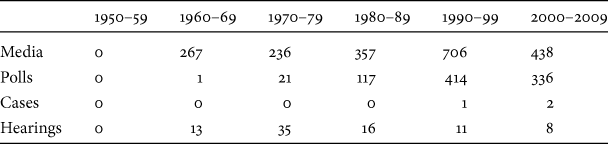
But sustained media coverage of gun control had to await the assassinations of Senator Robert Kennedy and Dr. Martin Luther King in 1968 (see Table 4). During the 1950s and early 1960s, there was virtually no media coverage in the New York Times prior to the November 22, 1963, assassination of President John F. Kennedy by Lee Harvey Oswald in Dallas. Some increased media coverage followed that tragic event, which rose sharply in 1968 before dropping and fluctuating at modest levels throughout the 1970s and 1980s. The highs in media coverage came during the 1990s. Table 4 shows the number of articles in the New York Times, the number of polling questions, the number of Supreme Court cases decided, and the number of congressional hearings held.
The 1950s and 1960s also showed the complete absence of polling on gun control, and as late as the 1970s only 2.1 questions were asked per year, increasing to 11.7 questions per year during the 1980s. The real surge in opinion polling on gun control came in the 1990s, when an average of 41.4 questions were asked annually, and from 2000 to 2009, when about 34 were asked per year. By this measure, gun control has markedly increased its saliency on the systemic agenda, but only since 1990, long after the political assassinations of the 1960s and the attempted assassinations of Presidents Ford and Reagan. This macro-indicator mirrors the New York Times coverage of gun control (see Table 4), which also showed increased media coverage during the 1990s compared to previous decades.
Since the the country’s founding, only seven cases that directly implicate gun control and the Second Amendment have reached the U.S. Supreme Court and since 1950 only two, albeit arguably the most controversial two rulings, were decided within the last decade.Footnote 86 The cases were United States v. Cruikshank (1876), Presser v. Illinois (1886), Miller v. Texas (1894), Robertson v. Baldwin (1897), United States v. Miller (1939), District of Columbia v. Heller (2008), and McDonald v. Chicago (2010). One non–Second Amendment case also included in Table 4 is Printz v. United States (1997). This moral conflict is exacerbated by a constitutional debate over the meaning of the Second Amendment, which reads: “A well regulated Militia, being necessary to the security of a free state, the right of the people to keep and bear Arms, shall not be infringed.” Historically gun-control advocates emphasized the Militia Clause, arguing that having firearms is tied to the “collective” right of the state to defend itself, whereas the National Rifle Association (NRA) and gun-rights supporters give primacy to the Keep and Bear Arms Clause, which implies an “individual” right to possess firearms for self-defense. But until 2008, the leading precedent was United States v. Miller (1939), which argued that a “collective” right to firearms may be regulated by government. In the decades since, that interpretation was underscored by numerous lower federal courts. Says political scientist Robert Spitzer: “So many lower federal court rulings’ unanimous acceptance of the militia view buttresses the conclusion that the 1939 Miller case did indeed embrace the militia view and that it was the accepted legal interpretation.”Footnote 87
Virtually a paradigm shift resulted when that seventy-year precedent was overturned by the Supreme Court in District of Columbia v. Heller (2008) and McDonald v. Chicago (2010). In Heller, the high court struck down the Firearms Control Regulations Act of 1975, which banned handguns in the District of Columbia, arguing that the law infringed upon an individual’s right to possess a firearm for lawful purposes such as self-defense in the home. But since it only applied to the District and other federal enclaves, the NRA moved quickly to find a state law similar to the handgun ban nullified in Heller. They found a similar law in Chicago, though technically this lawsuit was brought by the Second Amendment Foundation and the Illinois State Rifle Association on behalf of several Chicago residents, including seventy-six-year-old retiree Otis McDonald. By striking down the Chicago ban on handguns, McDonald “incorporated” the Second Amendment to the states and their subdivisions through the Due Process Clause of the Fourteenth Amendment. These rulings paved the way for a new round of lobbying and litigation against state and local laws restricting lethal and nonlethal firearms.Footnote 88
In Congress, during the 1950s there were no hearings devoted wholly or partially to gun control (see Table 4), but that increased during the 1960s and especially the 1970s and into the 1980s before falling during the 1990s and markedly so from 2000 to 2009. In terms of actual legislation, however, there have only been eight national gun laws. The first two were the National Firearms Act of 1934 and the Federal Firearms Act of 1938. Title IV of the Omnibus Crime Control and Safe Streets Act of 1968 banned the transportation of pistols and revolvers across state lines and forbade the purchase of handguns in a state where the buyer did not reside. Its key provisions were incorporated into the Gun Control Act of 1968, which also restricted interstate shipment of firearms and ammunition and prohibited the sale of guns to minors and other high-risk individuals, among other provisions. The NRA supported enactment of the Firearms Owners Protection Act of 1986, which allowed the interstate sale of rifles and shotguns so long as the sale is legal in the states of the buyer and the seller, ended recordkeeping for ammunition dealers, and allowed gun dealers to transact business at gun shows.
The Brady Handgun Violence Prevention Act of 1993 provided for a five-day waiting period before anybody could purchase a handgun, but, after 1998, the waiting period would expire, at which time the law required a background check of any individual purchasing a firearm from a federally licensed dealer. Part of the 1993 Act was nullified by the Supreme Court in Printz v. United States (1997), though the constitutional issues involved the Tenth Amendment and not the Second Amendment. The high court ruled that the provision that compelled state and local law-enforcement officials to perform background checks was unconstitutional, violating both federalism and the “unitary executive” principle that the president should oversee the administration of public policy. It is problematic whether we should include Title XI of the Violent Crime Control and Law Enforcement Act of 1994 (technically the Public Safety and Recreational Firearms Use Protection Act, commonly known as the Assault-Weapons Ban), because the law had a “sunset” provision whereby the legislation would expire in 2004 unless reauthorized. It was not. And finally, the NRA also endorsed the 2005 Protection of Lawful Commerce in Arms Act, which shields from lawsuits licensed manufacturers, dealers, and sellers of firearms and ammunition.
In sum, no new gun legislation except the pro-gun 2005 law has cleared Congress since, even during the Obama tenure. Critics such as Spitzer blame the NRA for the failure to enact a strong gun-control regime, and he calls the interest-group battle “asymmetrical” because the NRA’s main opponents—the Brady Campaign to Prevent Gun Violence and the National Coalition to Ban Handguns—are out-gunned in terms of leadership, resources, and commitment.Footnote 89 But the fact that opinion polls consistently show a public opposed to the policy status quo only begs the question of why the NRA has gone unchallenged for so long on the political scene. On that, policy analyst Kristin Goss argues that the failure of gun-control proponents to organize a counter-movement is simply the “collective action” problem recognized decades ago by political economist Mancur Olson.Footnote 90 While the NRA membership and gun owners are fighting for their own immediate self-interest, its opposition faces the “free rider” problem of trying to mobilize individuals to fight for a “public good” like gun safety or reduced violent crime. Free riders are individuals who are unwilling to volunteer their time, energy, and resources to addressing a social problem that does not immediately and directly affect their own self-interest.
Conclusion
A legislative enactment or judicial ruling must be authoritative such that no ambiguities would allow future challenges by the opposition, but there also has to be an opposition organized into a counter-movement to challenge the policy status quo. This is the primary lesson to be learned from comparing Repeal and the school prayer ban against the ongoing political warfare that resulted from the open-ended abortion decision in Roe v. Wade. With gun control, the Supreme Court’s latest rulings in Heller and McDonald have actually breathed new life into the pro-gun lobby, while the perpetual free-rider problem explains why no effective anti-gun counter-movement has been established in the United States. The result is that massacres and shooting sprees continue to this day, are routinely condemned by liberals and many Democrats, including President Obama, but Congress refuses to act. Legislative inaction on gun control is the persistent pattern of American politics, unlike Canada.Footnote 91
The next step in advancing this research agenda is to use multivariate analysis to verify the key variables identified here and to promote a more robust theory about when and why moral conflicts die. Four pivotal variables were identified by our case studies: an authoritative legal enactment, the political opportunity structure, the potency of counter-movements, and also the organized interests that support the policy status quo. Any multivariate analysis would have to track a sufficient number of moral conflicts over time, not an easy task, but there is also a conceptual thicket that must be addressed. Our cases involved a precise type of de jure resolution of morality policies, whereas the de facto “death” of moral conflicts may be caused by other factors. Research on social problems shows that social indicators that elevated an issue onto the policy agenda may have been flawed or wrong, causing its later demise.Footnote 92 And redefinition may lead to the death of a moral conflict in its original form but its resurrection as a new issue. Thus, snapshots of regulatory regimes in the United States and Europe since 1960 show that historic restrictions on adult pornography have become liberalized, whereas recent policies against child pornography are increasingly more punitive.Footnote 93
Morality policy scholars are well aware of the importance of the political opportunity structure, because research on issue “ownership” show that Republicans and Democrats hold widely divergent positions on abortion and gun control,Footnote 94 as well such other issues as gay rights.Footnote 95 It is for that reason that state-level studies of morality policy often include party control of government as a proxy for the political opportunity structure as well as measures of supportive interests or counter-movements.Footnote 96
Another variable used in state-level morality policy research is public opinion. Our case studies suggest that public opinion is not a determining factor in why certain moral conflicts die and others persist but, to the contrary, give credence to the body of research that views public opinion as overrated.Footnote 97 Public opinion turned against Prohibition in concert with the large counter-movement that backed Repeal, and polls show that Prohibition never regained its popularity with the American people. But federal gun laws are few in number and stretched far between in years despite the fact that public opinion has regularly and consistently favored stronger gun controls. Public opinion also is reliably pro-school prayer but has not produced a counter-movement capable of reversing the Supreme Court rulings of the 1960s. And finally, despite Roe v. Wade, the American people have not rallied behind a permissive regime of abortions-on-demand, and that ambiguity in public opinion likely has given added energy to fuel the pro-life counter-movement that persists four decades after the 1973 landmark decision.