Introduction
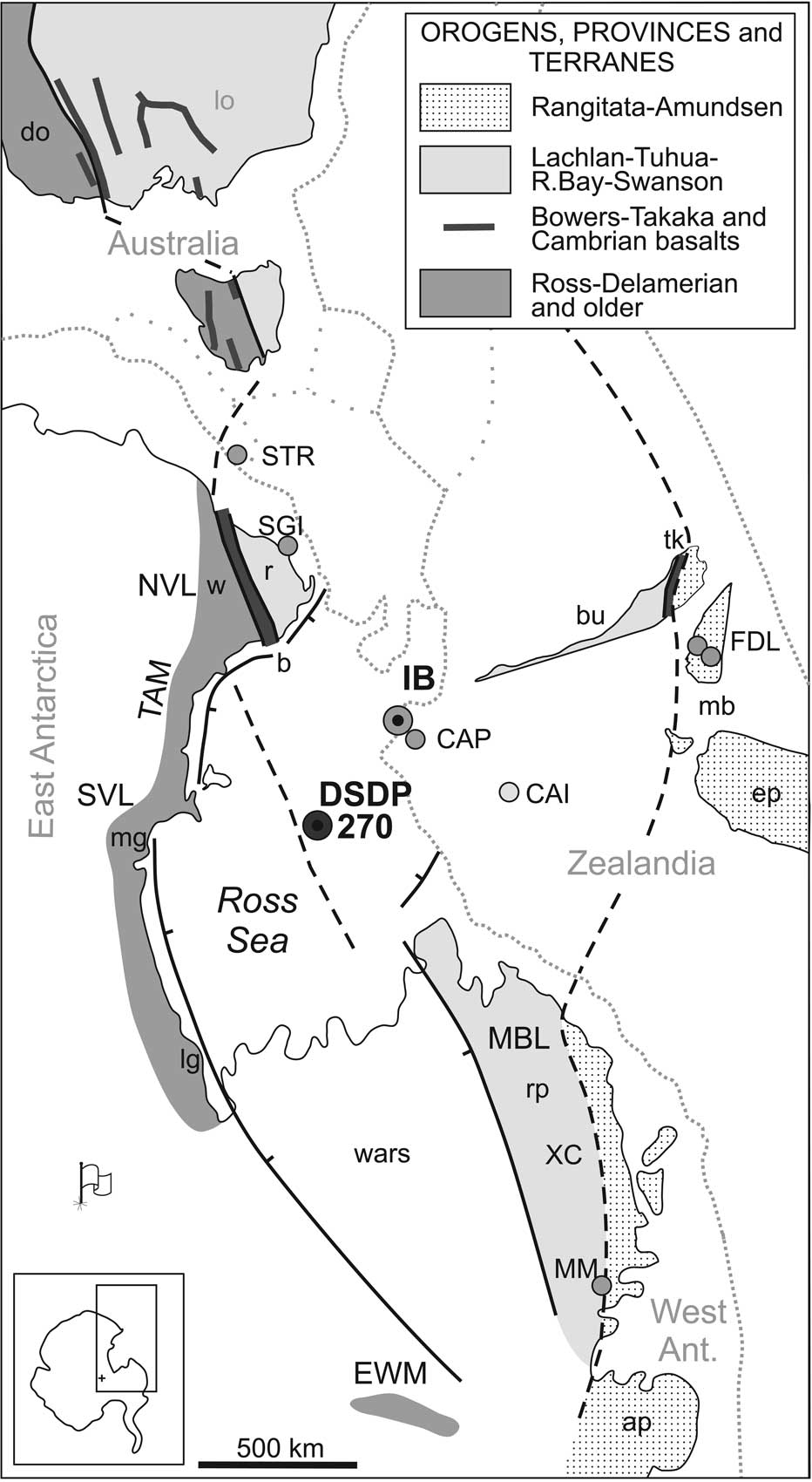
The Ross Sea lies between East and West Antarctica (Fig. 1). Most of the East Antarctica-Ross Sea margin is bordered by rocks of the Ross Orogen (Stump Reference Stump1995), which comprise Late Proterozoic siliciclastic, carbonate and minor igneous protoliths (Wilson Terrane and Skelton Group; Laird Reference Laird1991, Cook & Craw Reference Cook and Craw2002 and references therein). These rocks underwent deformation, greenschist to (mainly) amphibolite facies metamorphism and intrusion by granitoid plutons in the Cambrian. Similar rocks are found along strike in the Delamerian Orogen of Australia with which the Ross Orogen was formerly continuous (Fig. 1). In contrast, the West Antarctica-Ross Sea margin is bordered by a younger orogen comprising protoliths of comparatively monotonous greenschist facies Ordovician siliciclastic rocks (Swanson Formation), that were intruded by granitoids of Devonian–Carboniferous age. These West Antarctic rocks are similar to rocks of the Robertson Bay Terrane in northern Victoria Land, Buller Terrane of New Zealand and Lachlan Orogen of Australia in that they are all arguably part of the same Early Palaeozoic Gondwana orogenic belt with protoliths, deformation and metamorphism largely younger than the rocks of the Ross Orogen (Wade & Couch Reference Wade and Couch1982, Laird Reference Laird1991, Bradshaw Reference Bradshaw2007, Bradshaw et al. Reference Bradshaw, Gutjahr, Weaver and Bassett2009). Figure 1 shows this interpretation. Between the Ross–Delamerian orogens, and also occurring as fault bounded slices within each, are Cambrian boninitic-basaltic rocks with clastic and minor carbonate elements (e.g. Bowers Terrane & Takaka Terrane, Fig. 1). Collectively, all the aforementioned tectonic elements are part of the wider Terra Australis Orogen of Cawood (Reference Cawood2005). The youngest and most Pacific-ward orogen in Fig. 1, which is not the subject of this paper, is the Mesozoic Amundsen–Median Batholith–Rangitata Orogen.
Location map of the two sample sites: DSDP 270 and RV S.P. Lee dredge site 17 on the edge of the Iselin Bank. East and West Antarctica are shown in present-day co-ordinates with Zealandia and Australian restored to their approximate pre-Gondwana breakup locations. Palaeogeography and geology are adapted from Challis et al. (Reference Challis, Gabites and Davey1982), Pankhurst et al. (Reference Pankhurst, Weaver, Bradshaw, Storey and Ireland1998), Fioretti et al. (Reference Fioretti, Black, Foden and Visona2005a, Reference Fioretti, Capponi, Black, Varne and Visona2005b), Glen (Reference Glen2005), Adams (Reference Adams2007) and Bradshaw (Reference Bradshaw2007). Geographic features and sample sites: STR = South Tasman Rise, SGI = Surgeon Island, TAM = Transantarctic Mountains, NVL = northern Victoria Land, SVL = southern Victoria Land, IB = Iselin Bank, CAP = Campbell Plateau, CAI = Campbell Island, FDL = Fiordland, MBL = Marie Byrd Land, XC = Executive Committee Range, MM = Mount Murphy, EWM = Ellsworth Mountains. Geological units: do = Delamerian Orogen, lo = Lachlan Orogen, w = Wilson Terrane, b = Bowers Terrane, r = Robertson Bay Terrane, bu = Buller Terrane, tk = Takaka Terrane, mb = Median Batholith, ep = Eastern Province, wars = West Antarctic Rift System, mg = Mulock Granite, lg = Liv Group, rp = Ross province (Pankhurst et al. Reference Pankhurst, Weaver, Bradshaw, Storey and Ireland1998; not to be confused with Ross Orogen), ap = Amundsen province.

A topic of ongoing interest in the Ross Sea region is to track the interpolated and extrapolated extent of the aforementioned orogenic belts between West Antarctica, East Antarctica, Australia and Zealandia. When present-day onland outcrops are restored on a Gondwanaland continental reconstruction (Fig. 1) they are still separated by distances of up to thousands of kilometres. The purpose of this short paper is to report the results of geochronological, petrochemical and tracer isotopic data from two remote offshore localities in the Ross Sea: 1) Deep Sea Drilling Project (DSDP) site 270, and 2) Iselin Bank, and to discuss with which orogenic belts samples from these features correlate.
Analytical methods are given in the table captions. Complete sample data have also been lodged in the PETLAB database (http://pet.gns.cri.nz, see P50869 and P78670).
DSDP 270
DSDP 270 was drilled in the central Ross Sea (77.441°S, 178.503°W) in 1973. After penetrating 413 m of Cenozoic sedimentary rocks, it bottomed in 10 m of calcsilicate gneiss and marble, 25% of which was recovered. In their initial report, Ford & Barrett (Reference Ford and Barrett1975) correlated DSDP 270 basement with the Skelton Group of the Ross Orogen. Subsequently, Fitzgerald & Baldwin (Reference Fitzgerald and Baldwin1997) reported a mean fission track age of 103 ± 22 Ma (2σ) from 16 apatite grains. So far as we are aware, there has been no other analytical work done on the basement material from DSDP 270.
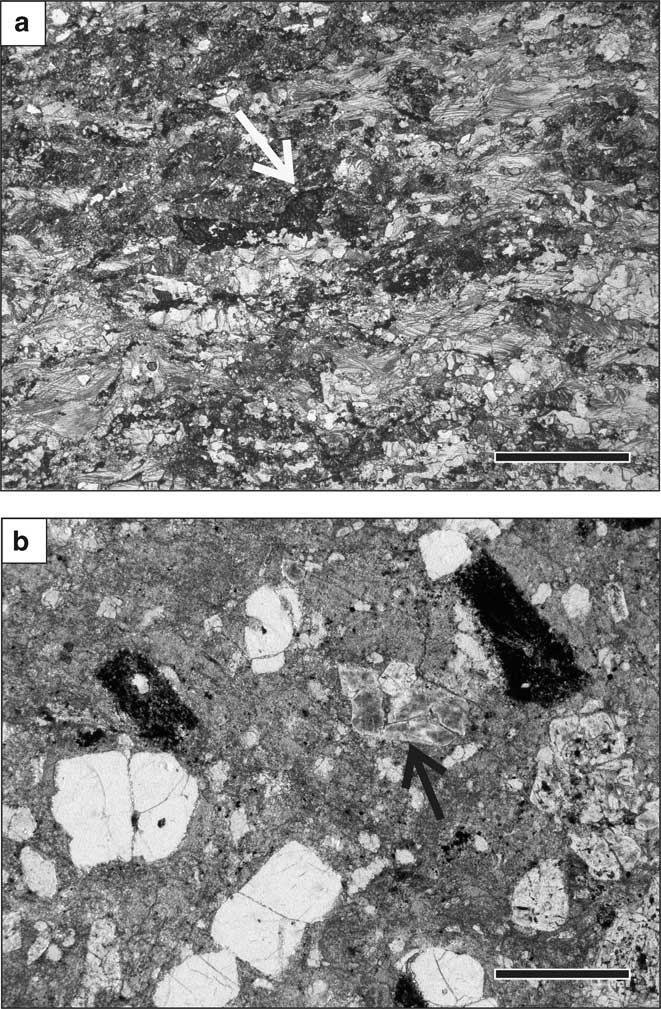
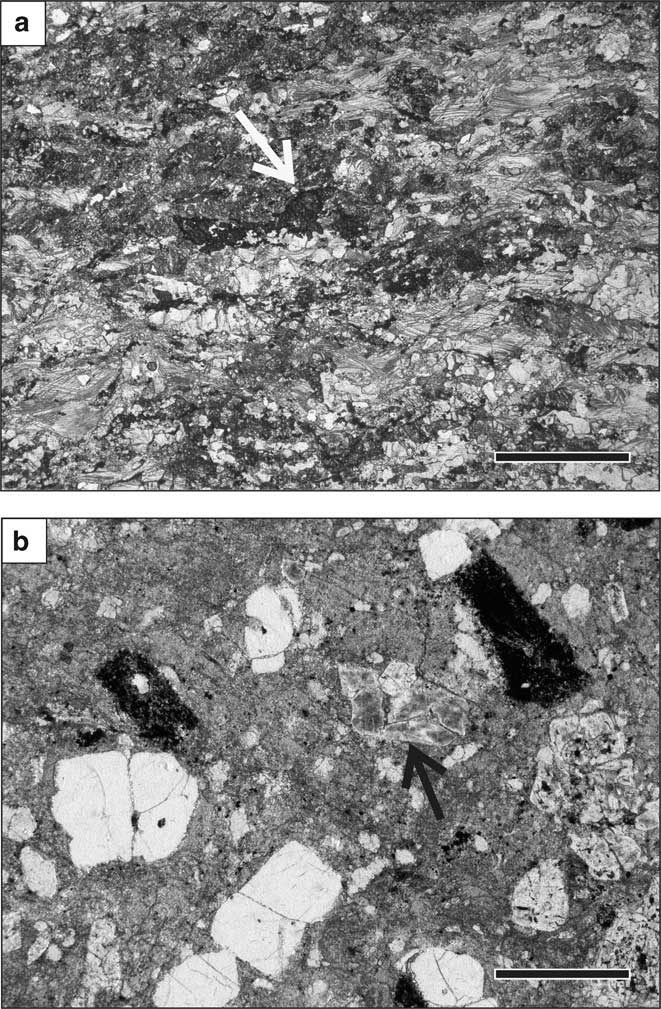
We obtained a piece of calcsilicate gneiss from the International Ocean Drilling Programme repository with the sample designation Leg 28, Site 270, Core 49R, Section 01W, Interval 125–132 cm. This was given the GNS Science (Institute of Geological and Nuclear Sciences) sample number P78670 and a thin section and mineral separate were made. We can add little to the petrographic description given by Ford & Barrett (Reference Ford and Barrett1975). In summary the main minerals (in descending order of abundance) are calcite, quartz, chlorite (probably after biotite), feldspar, clinozoisite, titanite and diopside (Fig. 2a). The rock shows a gneissic texture and is visibly altered and retrograded. The heavy fractions of the mineral separate contained no zircon, but yielded good, large titanite grains.
Thin section images of a. P78670, calcsilicate gneiss from DSDP 270 with feldspar (pale), calcite (dark grey) and titanite (arrowed), and b. P50869, metarhyolite from Iselin Bank, with phenocrysts of quartz (white), K-feldspar (arrowed), plagioclase (mottled, right hand side) and altered biotite (black). Both images plane polarized light, scale bar = 1 mm.
U-Pb titanite data
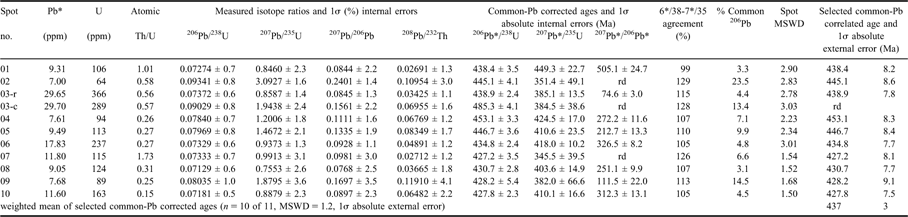
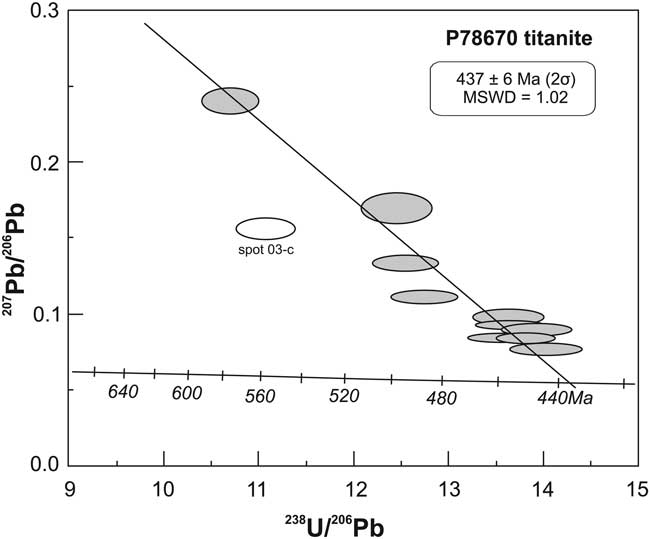
Ten grains of titanite from P78670 were analysed for U-Th-Pb isotopes by LA-ICP-MS (Table I). The data for all grains are discordant on a Tera-Wasserburg plot (Fig. 3) and one core analysis, spot 03-c, fell away from the rest of the group. A number of different ways of calculating a U-Pb titanite age give essentially the same result. The weighted mean of ten out of eleven analyses is 437 ± 6 Ma (2σ), the same as the lower intercept age of ten out of eleven analyses projected from common Pb. Linear regression of all 11 analyses, not projected from a common Pb point, is 432 ± 18 Ma (2σ). Thus the estimated age is not sensitive to the choice of common Pb isotopic composition and no resolvable age variation within grains is indicated by the scatter of the observed data. We interpret calcsilicate gneiss P78670 to record an age of amphibolite facies metamorphism of 437 ± 6 Ma (early Silurian).
U-Th-Pb isotope data for ten titanite grains from sample P78670, DSDP 270 calcsilicate gneiss.

Analyses perfomed at Australian National University using a pulsed LambdaPhysik LPX 120I UV ArF excimer laser. Analytical methods described by Scott et al. (Reference Scott, Cooper, Palin, Tulloch, Kula, Jongens, Spell and Pearson2009) and references therein. All errors are 1σ, * = radiogenic component only, d = discordant, rd = reversely discordant, r = rim, c = core. Spot-MSWD calculated on basis of scatter of observed data with increasing depth during individual spot measurement.
Tera-Wasserburg plot of uncorrected U-Pb analyses of titanite from P78670. Intercept line is projected from common Pb at 207Pb/206Pb = 0.81 ± 0.05.

Iselin Bank
The Iselin Bank lies at the edge of the Ross Sea continental shelf at water depths < 2000 m (Fig. 1). In 1984, during cruise L2-84-AN of the RV S.P. Lee, rocks were dredged from two locations on the Iselin Bank (Wong et al. Reference Wong, Barrett, Gamble and Howell1987). The dredges were dominated by glacially-transported debris, but one rhyolitic sample, sample 17-3b-10, had a freshly broken surface and was the only rock thought to be possibly in situ. The dredge-on-bottom co-ordinates of RV S.P. Lee dredge 17 were 73°40.8′S, 176°25.1′W, water depth 2250 m. A photograph of sample 17-3b-10 (Wong et al. Reference Wong, Barrett, Gamble and Howell1987, fig. 7A) shows a subangular slab, c. 40 x 20 x 5 cm in size. A 5 x 5 x 3 cm trimmed piece of this rock was lodged in the New Zealand Geological Survey (later GNS Science) Petrology Collection at the time, and numbered P50869. From this sample we made a thin section, powder for whole rock analysis, and some mineral separates.
Wong et al. (Reference Wong, Barrett, Gamble and Howell1987, fig. 7B) described sample 17-3b-10 as a “meta rhyolite/tuff”, an opinion with which we basically agree. Phenocrysts of quartz, oligoclase and microcline microperthite up to 1 mm in size are set in a microcrystalline matrix of quartz, feldspar, sericitic muscovite, titanite and biotite. The K-feldspar is turbid and consists of patchy intergrowths of simply twinned sanidine and cross-hatched microcline (Fig. 2b). One or two small pelitic xenoliths are present in the thin section. We cannot be sure if the original rock was a lava, tuff or shallow intrusion as there is a weak but distinct metamorphic foliation that anastomoses around the phenocrysts (technically porphyroclasts) and, of course, field relations are absent. The scattered fine-grained biotite in the matrix is clearly metamorphic but no other metamorphic index minerals are present. The fine grain size of the matrix and relict phenocrysts indicate to us that the porphyritic rhyolite probably underwent no more than greenschist facies recrystallization.
Petrochemical data
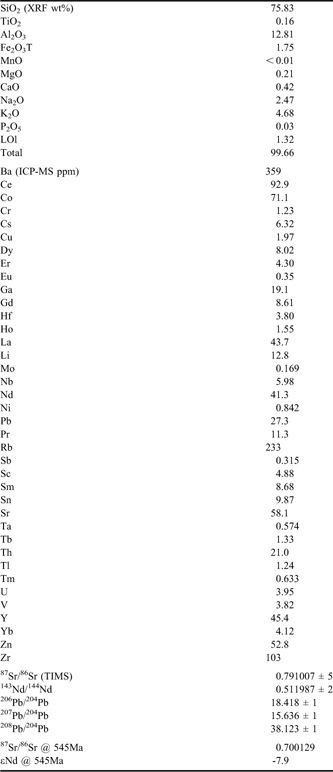
The chemical analysis (Table II) reveals the rock to be a subalkaline high-K rhyolite. Given the analysis of a small and metamorphosed sample, we are reluctant to interpret its geochemistry too much. The analysis is fairly typical for a rhyolite and, on the Y+Nb vs Rb granite tectonic discrimination diagram of Whalen et al. (Reference Whalen, Currie and Chappell1987) (not shown), plots very close to the mutual boundary of syncollisional, volcanic arc and within plate granites, i.e. the chemistry of this single sample is not especially distinctive. The chemistry is I-type to marginal A-type as it has low CaO/FeO* and Mg number, slightly high Ga/Al and rare earth elements and a large negative Eu anomaly. In these respects it is somewhat similar to two suites of siliceous igneous rocks in the Transantarctic Mountains: the 546 Ma Mulock Granite (Cottle & Cooper Reference Cottle and Cooper2006), and rhyolite porphyries of the 516–525 Ma Liv Group (Wareham et al. Reference Wareham, Stump, Storey, Millar and Riley2001) (Fig. 1).
Whole rock geochemical and isotopic data for P50869 meta-rhyolite.

Methods: XRF = X-ray fluorescence (Kennedy et al. Reference Kennedy, Roser and Hunt1983), ICP-MS = inductively coupled plasma mass spectrometry (Garbe-Schönberg Reference Garbe-Schönberg1993), TIMS = thermal ionization mass spectrometry (Hoernle et al. Reference Hoernle, Hauff and van den Bogaard2004).
U-Pb zircon data
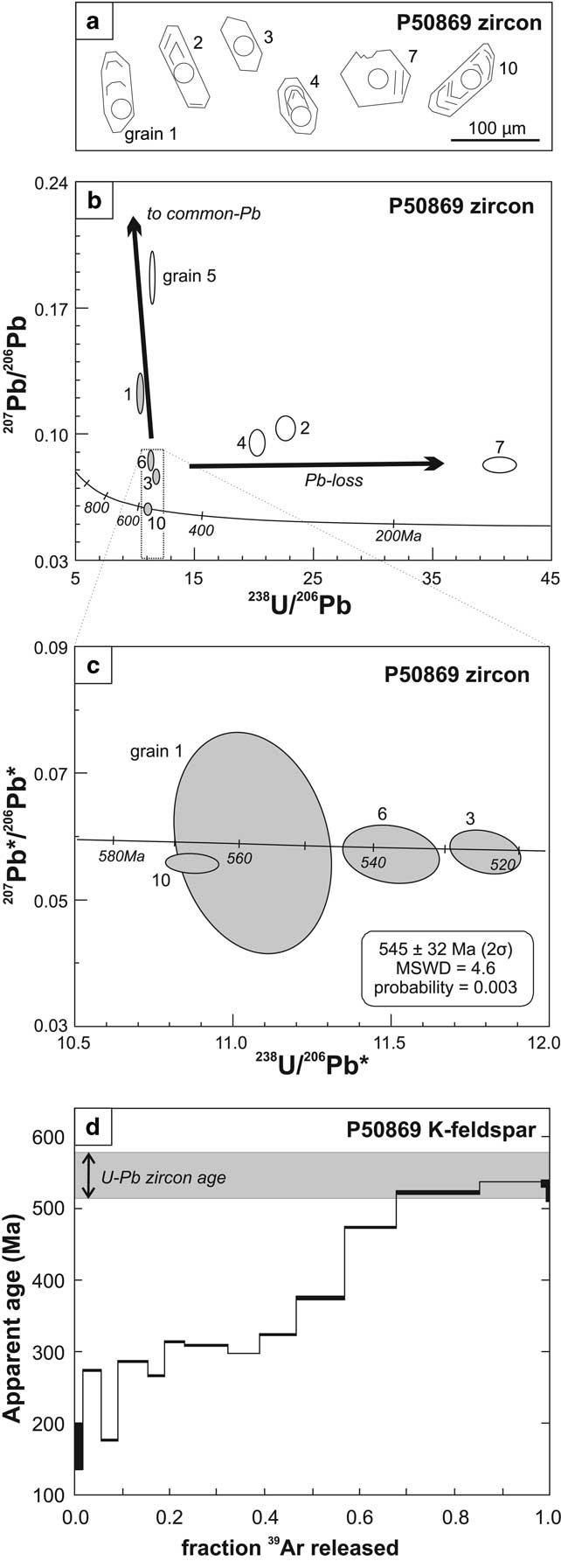
Due to the small available sample size, P50869 yielded very few zircon grains, most of which were themselves too small (< 30 μm wide) to analyse. Eight grains were analysed by LA-ICP-MS methods (Table III) and most of the analysed spots can be considered core or composite core-rim analyses (Fig. 4a). All grains plot as discordant on a Tera-Wasserburg plot (Fig. 4b). Discordance of the four oldest grains appears to be due to common Pb contamination and the three youngest grains scatter to lower 238U/206Pb ratios indicative of possible Pb loss. Correction of the analyses using the 208Pb procedure of Compston et al. (Reference Compston, Williams and Meyer1984) resulted in four analyses shifting to the concordia (Fig. 4c). The mean weighted age of these four zircons is 545 ± 32 Ma (2σ error) which we interpret as the age of crystallization of the rhyolite magma. We acknowledge that our pooled age for P50869 is based on few grains and is low precision, but believe it is adequate for the purposes of this study. The alternative hypothesis, that the Proterozoic–Cambrian zircons were inherited by a Mesozoic rhyolite, is less likely because: 1) the three youngest zircons have very high U concentrations and would have experienced lattice damage from a high time-integrated alpha dose, consistent with their observed major Pb loss and their higher spot MSWD values as compared to the five oldest zircons (Table III), 2) the observed xenoliths in P50869 are pelitic and would not have contributed 30–100 μm zircon grains to the rhyolite, and 3) the K-feldspar Ar-Ar data and the Sr and Nd isotope data also support a Proterozoic–Cambrian age (see below).
U-Th-Pb isotope data for eight zircons from sample P50869, Iselin Bank meta-rhyolite.

Analytical methods described by Scott & Palin (Reference Scott and Palin2008) and references therein.
All errors are 1σ, * = radiogenic component only (common-Pb calculated using 208Pb according to Compston et al. Reference Compston, Williams and Meyer1984), d = discordant, rd = reversely discordant. Spot-MSWD calculated on basis of scatter of observed data with increasing depth during individual spot measurement.
Geochronology of P50869. a. Line drawings of zoned zircon grains based on cathodoluminescence images (circles are analysed spots, no image for grains 5 or 6). b. Tera–Wasserburg plot of eight uncorrected U-Pb zircon analyses. c. Tera-Wasserburg plot of four common Pb corrected zircon analyses used for age determination. d. Ar-Ar step heating spectrum of K-feldspar; U-Pb zircon age of the sample is also shown.

Ar-Ar K-feldspar data
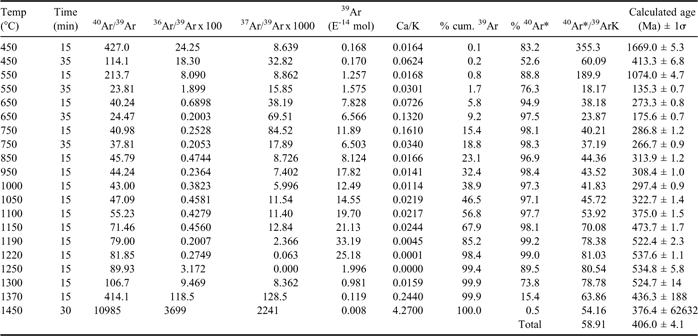
The K-feldspar step heating results for P50869 are shown in Table IV and the argon release spectrum is plotted in Fig. 4d. Low temperature steps (about half the total gas) give ages from 270–300 Ma, after which the steps rise monotonically to a maximum of 540 Ma at high temperatures. No plateau is present and it is not possible to make a diffusion model of the spectrum to get a temperature-time history. The ages of the high temperature steps of the K-feldspar support the Precambrian–Cambrian age interpretation of the zircons. The lowering of argon age steps is consistent with the greenschist facies metamorphism of P50869. Greenschist facies metamorphic temperatures are sufficient to lower the ages of all except the most retentive domains of K-feldspars, and this age spectrum pattern is typical of argon loss induced by such thermal histories. Final closure to argon loss occurred in the Late Palaeozoic–Mesozoic, a feature also seen in Ar-Ar K-feldspar ages from plutonic rocks of southern Victoria Land (Calvert & Mortimer Reference Calvert and Mortimer2003).
40Ar/39Ar step heating data for K-feldspar from sample P50869 Iselin Bank meta-rhyolite.

Methods follow McLaren et al. Reference McLaren, Dunlap, Sandiford and McDougall2002. Sample weight 23.30 mg, Irradiation ANU 119, J = 0.0042844 ± 0.4%. Data corrected for mass spectrometer discrimination, line blanks, and for the decay of 37Ar and 39Ar during and after irradiation. 40Ar* is radiogenic 40Ar, and 39ArK is potassium-derived 39Ar. Corrections for interfering isotopes have only been applied to 40Ar*/39ArK. Amounts of 39Ar are derived from the measured sensitivity of the mass spectrometer. Relative isotope amounts are precise, but absolute amounts may have uncertainties of c. 10%. Totals are the %39Ar weighted means of the analyses. Flux monitor: Australian National University GA1550 Biotite (98.5 Ma, J determined by interpolation). l = 5.543 × 10⁻¹⁰ a-1. Correction factors were derived from analysis of CaF2 and synthetic K-glass: (40/39)K = 0.027, (36/37)Ca = 0.00035, (39/37)Ca = 0.000786.
Sr, Nd and Pb isotope data
The Precambrian–Cambrian age of the meta-rhyolite is further supported by Sr and Nd isotopic ratio calculations (Table II) which indicate time of closure of the isotopic systems. Using a model age of 513 Ma (the lower 2σ limit of the zircon age) gives 87Sr/86Sri = 0.7055 and εNdi = -8.2. Although these values appear decoupled (Sr is far less radiogenic than Nd on typical crustal arrays (not shown), possibly because of sensitivity to Rb/Sr ratio, e.g. by alteration or small sample size bias) they are not unreasonable for Precambrian–Cambrian Ross Orogen siliceous igneous rocks (Cox et al. Reference Cox, Parkinson, Allibone and Cooper2000, Wareham et al. Reference Wareham, Stump, Storey, Millar and Riley2001). In contrast, a model age of 100 Ma gives unreasonably high radiogenic isotopic ratios of 87Sr/86Sr = 0.7744 and εNdi = -11.8 for siliceous igneous rocks that have I- and A-type characteristics. The Pb isotope ratios of P50869 resemble those reported for the DV1b suite of Cox et al. (Reference Cox, Parkinson, Allibone and Cooper2000) from the Transantarctic Mountains.
Discussion
DSDP 270 correlation
The closest onland occurrence of calcsilicate gneisses and marble to DSDP 270 is in the Skelton Group of southern Victoria Land and this is what influenced Ford & Barrett (Reference Ford and Barrett1975) to correlate the DSDP 270 basement with the Ross Orogen. However, it is problematic that carbonates and calcsilicates are so rare in all the peri-Ross Sea orogenic belts and yet this rock type constitutes all ten metres of sampled DSDP 270 basement. We agree, that on the basis of abundance of marble and calcsilicate, and in the absence of any geochronological data, a Ross Orogen correlation was probably the best choice. However, calcareous rocks do occur within the Bowers Terrane (Bradshaw et al. Reference Bradshaw, Weaver and Laird1985 and references therein) and scattered calcsilicate nodules, sometimes with quartz–calcite–pyroxene–garnet assemblages have been reported from the Swanson Formation and from the Lachlan Orogen (Bradshaw et al. Reference Bradshaw, Andrews and Field1983, Adams Reference Adams1986, Morand Reference Morand1994). Rare marbles have also been reported from Robertson Bay Group and Swanson Formation (Wade & Couch Reference Wade and Couch1982), and scattered, rare limestones are present in the Lachlan Orogen. Because calcareous rocks are present in small amounts in both the orogenic belts under consideration, the age and grade of metamorphism becomes relevant when making a correlation.
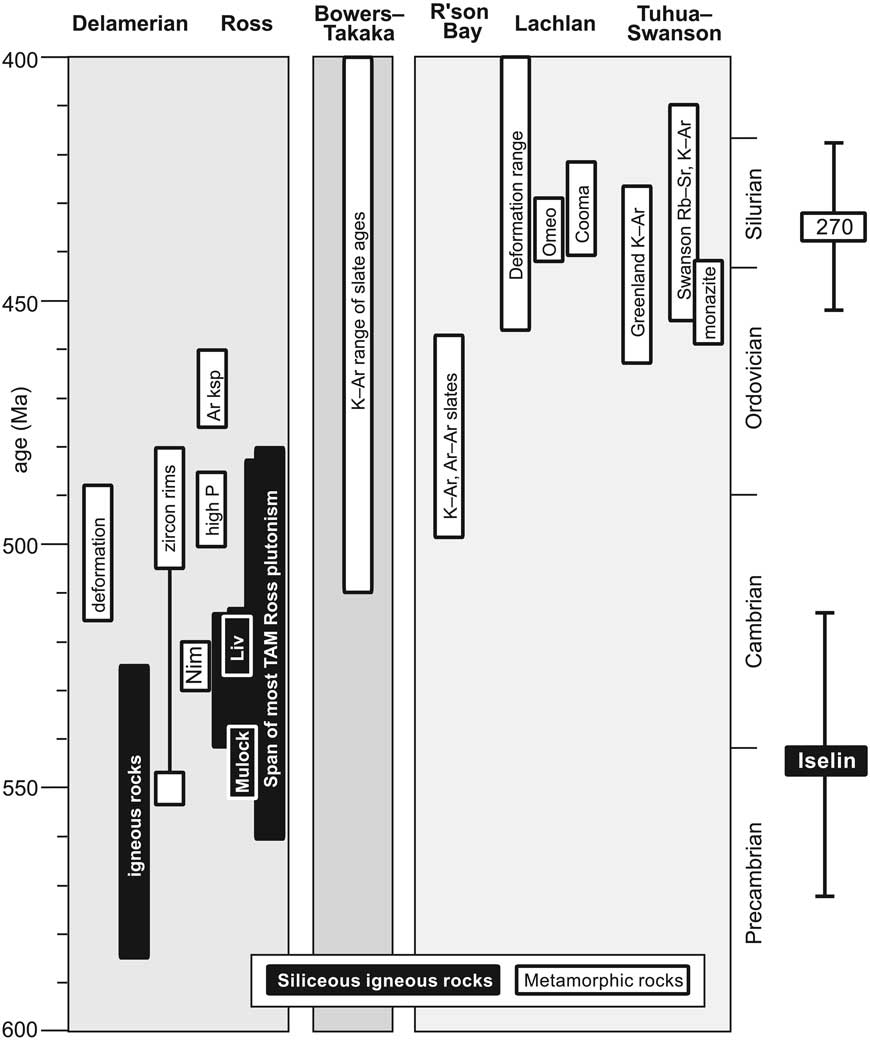
Based on a (representative but non-exhaustive) compilation of metamorphic ages from the relevant orogens (Fig. 5), the 437 ± 6 Ma age of amphibolite facies metamorphism seems too young to be typical Ross Orogen as the youngest argon ages (which represent cooling in the greenschist facies) in the Ross Orogen are 460 Ma or older. In contrast, deformation was continuing and/or active in the Silurian in the more Pacific-ward Lachlan–Tuhua–Robertson Bay–Swanson Orogen and in the Bowers Terrane between the two orogens (Adams Reference Adams2006). On this basis, we provisionally interpret the DSDP 270 metamorphic basement as probable Lachlan–Tuhua–Robertson Bay–Swanson Orogen, with an even more speculative correlation to the Bowers Terrane.
Time space plot comparing new geochronological data from DSDP 270 and Iselin Bank with other data from the Ross–Delamerian, and Lachlan–Robertson Bay–Swanson orogens. Reference data from Morand (Reference Morand1990), Dallmeyer & Wright (Reference Dallmeyer and Wright1992), Ghiribelli et al. (Reference Ghiribelli, Frezzotti and Palmeri2002), Goodge (Reference Goodge2002), Calvert & Mortimer (Reference Calvert and Mortimer2003), Wysoczanski & Allibone (Reference Wysoczanski and Allibone2004), Adams (Reference Adams2004, Reference Adams2006), Glen (Reference Glen2005) and Cooper et al. (Reference Cooper, Maas, Scott and Barber2010).

Iselin Bank correlation
Although the 545 ± 32 Ma age for the Iselin Bank meta-rhyolite is not especially precise, the U-Pb, Ar-Ar and tracer isotope data are all consistent with a latest Neoproterozoic to earliest Cambrian eruptive/intrusive age. Most siliceous igneous rocks of this age around the Ross Sea area are plutonic (e.g. Granite Harbour Intrusives and constituent suites) (Stump Reference Stump1995, Allibone & Wysoczanski Reference Allibone and Wysoczanski2002), although eruptive equivalents such as the Liv Group are also known (Stump Reference Stump1995, Wareham et al. Reference Wareham, Stump, Storey, Millar and Riley2001). The Ross Orogen appears to be the only feasible Antarctic source as Late Proterozoic–Cambrian siliceous igneous rocks are unknown from Bowers Terrane and/or the Lachlan–Tuhua–Robertson Bay–Swanson Orogen (Fig. 5).
The complex zircon systematics (variable inheritance and variable Pb loss) of P50869 are typical of 500–550 Ma pre- and syn-kinematic Ross granitoids (e.g. Cox et al. Reference Cox, Parkinson, Allibone and Cooper2000, Allibone & Wysoczanski Reference Allibone and Wysoczanski2002, Cottle & Cooper Reference Cottle and Cooper2006). Ross zircons contrast with those from the Admiralty Intrusives that intrude Robertson Bay Terrane and the Ford Granodiorite that intrudes Swanson Formation, both of which are Devonian–Carboniferous (340–380 Ma) and have well-clustered zircon spectra with very little inheritance or Pb loss (Pankhurst et al. Reference Pankhurst, Weaver, Bradshaw, Storey and Ireland1998).
We interpret the Iselin Bank meta-rhyolite P50869 to correlate with similar igneous rocks in the Ross Orogen. As previously mentioned, Wong et al. (Reference Wong, Barrett, Gamble and Howell1987) regarded the meta-rhyolite as the only dredge sample from the Iselin Bank that could have been in situ. A till provenance study by Licht et al. (Reference Licht, Lederer and Swope2005) showed ice stream directions from the southern Transantarctic Mountains towards the Iselin Bank during the last glacial maximum. We acknowledge the possibility remains open that P50869 could have been glacially transported. The remaining discussion in this paper assumes that the Iselin Bank meta-rhyolite is in situ.
Definition and extent of the Ross-Delamerian Orogen
Bradshaw (Reference Bradshaw2007) noted that many papers treat the Robertson Bay Terrane (RBT) of northern Victoria Land as part of the Ross Orogen, but that: 1) the RBT lacks a demonstrable Early Cambrian deformation, and 2) the Ordovician–Silurian penetrative deformation of the RBT cannot be shown to extend into the Wilson Terrane. Figure 1 follows Bradshaw (Reference Bradshaw2007) in defining three major orogenic belts in the Transantarctic Mountains–Ross Sea–Marie Byrd Land area. In this context, Bradshaw (Reference Bradshaw2007) drew attention to a few outliers of Ross Orogen (or older) rocks that were outside the generally recognized Ross–Delamerian Orogen (Fig. 1): a 512 Ma granite at Surgeon Island, a 505 Ma orthogneiss at Mount Murphy, > 1100 Ma peridotite xenoliths from the Executive Committee Range, and calcsilicate gneiss at DSDP 270. To this can be added some 480–510 Ma orthogneisses in Fiordland, New Zealand (Gibson & Ireland Reference Gibson and Ireland1996, Allibone et al. Reference Allibone, Jongens, Turnbull, Milan, Daczko, De Paoli and Tulloch2010). As shown above, we do not now regard the DSDP 270 rocks as being part of the Ross Orogen. However, assuming it is in situ, the Iselin Bank meta-rhyolite may be another example of an occurrence of Ross Orogen rocks outside the main linear belt of the Ross–Delamerian Orogen.
In addition, possible Bowers Terrane equivalents on Campbell Island, a 1119 Ma Grenville Orogen syenite dredged from the western South Tasman Rise and a 1167 Ma granite dredged from the edge of the Campbell Plateau (Challis et al. Reference Challis, Gabites and Davey1982, Fioretti et al. Reference Fioretti, Black, Foden and Visona2005a, Adams Reference Adams2007; Fig. 1) may also be tectonically allochthonous pieces of older orogens but, as with the Iselin Bank, it is far from certain that the two dredged samples are in situ. On the basis of Hf isotope studies of zircons, Flowerdew et al. (Reference Flowerdew, Millar, Vaughan, Horstwood and Fanning2006) inferred the presence of late Mesoproterozoic crust underneath parts of the Antarctic Peninsula. The size, mechanism and timing of dispersal of pieces of Precambrian–Cambrian crust into younger parts of Cawood's (Reference Cawood2005) Terra Australis Orogen, remains speculative. Options include Ordovician rifting (Bradshaw Reference Bradshaw2007), strike-slip faulting oblique to the orogen, and/or orogen-subperpendicular low-angle extensional exhumation of Ross basement.
Conclusions
Titanite from a calcsilicate gneiss in DSDP 270 gives an early Silurian U-Pb age, that we interpret to be the age of amphibolite facies metamorphism. This age is too young for typical Ross Orogen high-grade metamorphism and we suggest a correlation with the Lachlan–Tuhua–Robertson Bay–Swanson Orogen, possibly the Bowers Terrane.
A meta-rhyolite from the Iselin Bank, Ross Sea, Antarctica, is of latest Neoproterozoic to earliest Cambrian age. We correlate it with rocks of similar age and composition in the Ross–Delamerian Orogen of the Transantarctic Mountains. If the material is not ice-rafted debris, then the Iselin Bank sample represents an additional occurrence of Ross Orogen basement found outside the main Transantarctic Mountains.
Acknowledgements
We thank the International Ocean Drilling Program Gulf Coast Repository for providing material from DSDP 270, and John Simes and Belinda Smith Lyttle for rock crushing and mineral separation. Earlier versions of the manuscript were improved by comments from Andy Tulloch, Ian Turnbull, Anna Fioretti, Michael Flowerdew, Teal Riley, Ed Stump, Alan Vaughan and Richard Jongens. Funded by the New Zealand Foundation for Research, Science and Technology.