Introduction
Within social gerontology the differentiation of third and fourth ages represents an achievement in overcoming the stereotyping of old age as a period of decline and dependency. The agency and choice of third-agers contrasts with the loss of agency, associated with the fourth age, which until recently has been paid less attention by gerontologists. This article seeks to add to an understanding of the fourth age through an analysis of findings from an empirical research project by reference to emergent theoretical models. The idea of successful ageing, associated with the third age, is open to criticism for a failure to acknowledge its inevitable end. In Twigg's view (Reference Twigg2006), optimistic accounts of the third age that have emerged have been made possible only by projecting into a dark fourth age all the problems and difficulties associated with ageing, while Gilleard and Higgs (Reference Gilleard and Higgs2010) referred to the fourth age as the ‘bitter fruit’ of the victory of the third age over association with old-age decline. It is timely, therefore, to pay attention to the ways in which the fourth age is understood in terms of old-age identity. The article traces key theoretical ideas concerning the fourth age, discusses data from a study of dignity in later life and considers how the data can contribute to a fuller understanding of older people's identity in the fourth age.
Theorising the fourth age
For Gilleard and Higgs, far from being a stage of the lifecourse that follows sequentially from the third age, it is it is when others determine that an individual is no longer able to manage their everyday lives that they become subjects of the fourth age. They developed the metaphor of the black hole to describe how the fourth age exerts a gravitational pull and generates an event horizon – a point beyond which there is no return and in which the absence of light renders it unknowable. Through this dramatic metaphor, Gilleard and Higgs emphasise the fear of institutionalisation, of ‘passing beyond the possibility of agency, human intimacy or social exchange’ (2010: 125). It is within the power of others – professionals and carers – to determine when an individual has lost the capacity for self-care and management of everyday life and thus makes the transition over the event horizon into the fourth age. In contrast, longitudinal research in Finland by Heikkinnen (Reference Heikkinnen2000) identified how older people described their own perception of having crossed a boundary into old age. Participants referred to this boundary as defined by their chronological age (85 appeared to be an important marker) in combination with deterioration in functional health, senses, memory and mobility as well as bereavement. Heikinnen referred to the markers of functional limitations (canes, walkers, wheelchairs) as a prelude to the end of life and regarded these as marking a separation between how older people see themselves and how others see them. Coleman and O'Hanlan (Reference Coleman and O'Hanlan2004) argued that positive meanings are needed for the last stage of life for the sake of older people but also, more broadly, to overcome the contemporary cultural failure to engage with conditions of physical decline and the end of life. However, Gilleard and Higgs maintained that such attempts have proved futile and that the fourth age is better understood as a ‘social imaginary’, a place that is ‘stripped of the social and cultural capital that is most valued’ (2010: 123).
Twigg called for a wider perspective that highlights the diversity of people's experiences and that will ‘wrestle the account of old age out of the hands of experts’ (Reference Twigg2006: 53). However, Gilleard and Higgs (Reference Gilleard and Higgs2010) questioned whether the fourth age can be properly understood from personal experience, because it is impossible to separate what occurs within it from what is projected into it, since it is framed by the institutional structures associated with modernity. The view that the fourth age is shaped by the institutional practices of welfare also draws attention to the influence of demographic trends and the contemporary concentration of morbidity and mortality in the oldest age groups (Lloyd 2010; Vincent Reference Vincent2003). Concerns about rising levels of demand from higher numbers of people living to very old age has resulted in greater restrictions on eligibility for help and support from health and care services in most welfare systems. The perception of older people as burdensome is reinforced by such developments and adds to the pressure on older people not to be seen as having lost their capacity for self-reliance.
The concept of the ‘arc of acquiescence’ developed by Higgs and Rees-Jones (Reference Higgs and Rees-Jones2009) describes metaphorically the trajectory of ageing, tracing the process of gradual withdrawal from successful body maintenance and acceptance of bodily limits. Higgs and Rees-Jones (Reference Higgs and Rees-Jones2009) drew on Bourdieu's observations about the process of social ageing as ‘nothing other than the slow renunciation or disinvestment (socially assisted and encouraged) which leads agents to adjust their aspirations to their objective chances, to espouse their condition, become what they are and make do with what they have’ (1984: 110–1). In popular discourse this might be described as ‘growing old gracefully’, which sees dignity in acceptance of the material reality of bodily ageing. Within gerontology, the terms ‘renunciation’, ‘disinvestment’, ‘withdrawal’ and ‘adjustment’ are contentious, calling to mind the much-rebuked disengagement theories proposed by Cumming and Henry (Reference Cumming and Henry1961). However, they also denote a degree of choice and control over decisions and behaviour. If, as Higgs and Rees-Jones (Reference Higgs and Rees-Jones2009) argue, it is the loss of agency over the body that characterises the fourth age, the process of renunciation requires careful analysis.
The end of life: social and biological death
Discussion of the fourth age often concerns the contrast between third and fourth age. A focus on mortality generates a shift of perspective. In Twigg's view it is the closeness of the fourth age to death that provides one reason why this period lacks meaning and is understood simply as a period of decline, since death in modern secular societies is without meaning. Lawton (Reference Lawton2000) referred to the extended period of ‘liminality’ experienced by older people in contemporary Western societies – a form of social death that is experienced prior to physical death. The characteristics of a social death need to be understood by reference to the meaning of social life in any cultural context. In contemporary Western cultures the high value placed on individual autonomy and independence inevitably exacerbates the impact of the loss of these. Hence, Lloyd described the conditions of dependency experienced by older people in the period prior to death as ‘an abyss into which each of us must avoid falling’ (2000: 175), which also points to the moral obligation placed on individuals to maintain a self-sufficient existence. Lloyd (Reference Lloyd2000) drew on Bauman's observation that dependency on one's mortal body is the ultimate dependency, the ultimate limit of autonomy and the reason why, in the end, the battle for mastery over the body cannot be won (Bauman Reference Bauman1992). From this perspective, the fourth age needs to be understood by reference to the relationship between social and biological death.
Lawton (Reference Lawton2000) pointed to a sense of existential fatigue, associated with the loss of a sense of self, which was evident among her research participants in the period of decline prior to death. She described how participants often divested themselves of possessions and argued that this behaviour emerged from a decline in their ability to act in embodied ways. There was a marked contrast between this behaviour and what had become an expectation on dying people to live until they die through a heroic battle against impending death. The existential fatigue Lawton observed was characterised by hospice staff as ‘apathy’ or ‘withdrawal’ and was considered to be a problem. Such heroic ideas about dying, which hold that the end of life can mark an integration of the self, have largely been developed in the context of cancer care where a terminal diagnosis enables the agentic individual to exert control over the conditions of their dying. With long-term and complex health conditions, older people frequently do not fit this ideal (Gott et al. 2008).
Identity, autonomy and dignity
The typification of the fourth age in terms of decline and dependency suggests that older people would be likely to have their dignity, in the sense of their identity and autonomy, threatened both collectively as citizens and individually in everyday interactions (Nordenfelt Reference Nordenfelt and Nordenfelt2009; Woolhead et al. Reference Woolhead, Calnan, Dieppe and Tadd2004). However, the characteristic of the fourth age, at least according to Higgs and Rees-Jones (Reference Higgs and Rees-Jones2009), is the loss of agency over the body and more crucially in terms of the implications for identity, the impact of cognitive decline. It is claimed that when the body fails, the ageing experience becomes more manifest as caring for oneself becomes problematic. Thus the concept of dignity is closely associated with the fourth age and with death itself because the potential for loss of dignity at this time is strong (Nordenfelt Reference Nordenfelt and Nordenfelt2009; Tadd and Calnan Reference Tadd, Calnan and Nordenfelt2009). The combined effects of ageing, illness and disability characteristic of the fourth age change irreversibly a customary way of life and call into question one's sense of self. Dignity is central to understanding older people's accounts of such changes in their circumstances and the effects these have on their identity.
The dignity of identity was described by Nordenfelt (Reference Nordenfelt and Nordenfelt2009) as the dignity that ‘we attach to ourselves as integrated and autonomous persons, with a history and a future’ and with relationships to other human beings (2009: 33). For Wainwright and Gallagher (Reference Wainwright and Gallagher2008), the tying of the dignity of identity to autonomy and bodily integrity is problematic, since it would mean that changes associated with ageing will inevitably lead to a loss of dignity. In response, Nordenfelt (Reference Nordenfelt and Nordenfelt2009) argues that his conceptualisation of the dignity of identity is underpinned by the more fundamental concept of Menschenwurde, or the dignity of human value. Menschenwurde, according to Nordenfelt, relates to the dignity of being human and pertains to all human beings to the same extent. The basis for it derives from the core human capacities of consciousness and self-consciousness, self-determination and autonomy. However, the idea of human value as contingent on these core capacities raises questions about how dignity can be sustained when they are lost. If, as Gilleard and Higgs (Reference Gilleard and Higgs2010) argue, the fourth age is characterised by a loss of agency and shaped by institutional practices, it would follow that dignity in the fourth age becomes dependent on the behaviour of those who assume responsibility for older people.
Nordenfelt's typology is also open to criticism from an ethics of care perspective (Held Reference Held2006) in which the self is understood as relational rather than as individualistic. Within the ethics of care, it is argued that the ideal of the human being as autonomous, conscious and self-determining allows no room for the conditions of dependency that all human beings experience at different stages of the lifecourse, infancy and dying providing the clearest examples. The key point in the ethics of care is that conditions of dependency should not be understood as an aberration but as integral to human life. As a consequence of this cultural rejection of human dependency, it is argued, the giving and receiving of care has been excluded from public life and confined to the private sphere, in which the norms of citizenship are attenuated or cease to apply entirely. From this perspective, that ‘the battle for mastery over the body cannot be won’ (Bauman Reference Bauman1992) is a social not merely an individual or professional concern. Relational autonomy holds that it is through engaging in relationships with others that identities are formed. Changes in identity across the lifecourse need to be understood as inextricably linked with changes in intimate and wider social relationships. In old age, this includes increasing relationships with professionals and carers.
Certainly, evidence from recent studies (Woolhead et al. Reference Woolhead, Calnan, Dieppe and Tadd2004) suggests that it is in contact with health and welfare services where dignity, identity and independence are most threatened, thus lending support to Gilleard and Higgs’ view that institutional practice shape the conditions of the fourth age. However, institutional practices are capable of being manipulated and changed. There is also evidence (Baldock Reference Baldock and Walker2005; Lawton Reference Lawton2000; Twigg Reference Twigg2006) that older people manage to negotiate and maintain a fragile sense of self in the face of increasing illness and disability and struggle to be seen as having lost their autonomy. Higgs and Rees-Jones (Reference Higgs and Rees-Jones2009) suggested that the impact of individualisation and consumerism within health and social care generate points of conflict in the relationship between the public, on the one hand, and health-care systems on the other. They depict three, which are likely to affect the transition from third to fourth age: first, pursuing claims and questioning institutional discretion and rationing; second, becoming more resistant to decisions by outside parties to move them into formal categories of the fourth age; and third, becoming more vulnerable to exploitation and abuse within welfare markets because of their compromised autonomy.
Maintaining dignity in later life: an empirical study
This section outlines selected findings from a recently completed study in the New Dynamics of Ageing Programme: ‘Maintaining Dignity in Later Life’ (ESRC RES-352-25-0016). This study examined the experiences of a group of 34 people aged 75 and over (with one exception aged 70). All had health problems that had generated varying degrees of need for support and care. The overarching aim of the project was ‘to identify factors perceived to promote or undermine a sense of dignity in older people in need of support and care’. The research focused on four questions:
• What do participants' accounts of their everyday life and relationships tell us about dignity?
• What factors are perceived to support or undermine a sense of dignity?
• How do they manage the transition from self-reliance to dependence when circumstances change?
• How do they see the future?
These questions are central to developing an understanding of changed identities in the fourth age, since they focus on the conditions that challenged participants’ independence and self-reliance and placed them in a position of increased dependency on others. Moreover, because of their health problems they faced increasing bodily decline and loss of independence as they faced death at a near but uncertain time. Through a longitudinal qualitative methodology, participants’ accounts of their lives and their experiences of care were explored. This provided a means by which we could examine how participants’ changing circumstances generated changes in their sense of self and identity. Ethical approval was obtained through the Frenchay NHS local research ethics committee (LREC). Participants had the capacity to consent to be interviewed throughout the study.
The participants
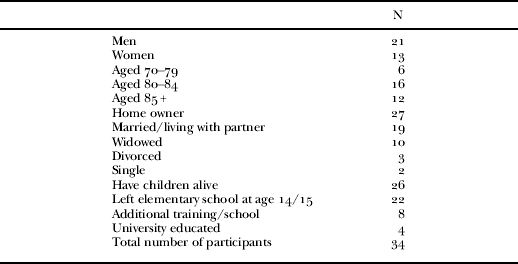
The 34 participants (Table 1) were based in Bristol (20) and Nottingham (14). During the course of the study six participants died.
Participant characteristics
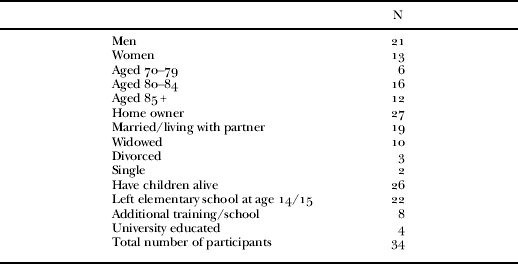
All but one woman of South Asian origin were White British. All had been employed previously, or had run their own business, occupations including mining, factory work, fire-fighting, skilled engineering, clerical work and the law. Twenty-eight of the participants were recruited from three general practitioner (GP) surgeries and six from a day centre.
Methods
In-depth interviews focused on day-to-day events and decisions, participants’ recollections of the past and their thoughts about the future. With some exceptions (such when a death occurred) each participant was interviewed in depth four times between May 2008 and December 2010 and was contacted by telephone from time to time between interviews. Nine participants were visited on a fifth occasion because there were particular events or decisions occurring that we wanted to capture. Participants were invited to nominate a supporter for the duration of the study and most of these were spouses or partners. The longitudinal qualitative methodology enabled us to adopt a relatively unstructured approach to interviewing, to raise sensitive topics at appropriate times and to enable participants to raise issues of importance to them. This was particularly valuable in relation to talking to participants about their thoughts about the future and their preparations for the end of life.
Data analysis was informed by the approach outlined by Spencer, Ritchie and O'Connor (Reference Spencer, Ritchie, O'Connor, Ritchie and Lewis2009). Interview transcriptions were analysed throughout the fieldwork process to identify emergent themes. After field work was completed all transcripts were re-read and conceptual themes developed. It should be emphasised that although the topic of dignity was introduced in the first interview, it became evident that the most productive way to explore the concept was indirectly rather than directly. For example, the interview data that focused on participants’ increasing need for help and their perceptions of their loss of self-reliance were analysed by reference to the concept of the dignity of identity.
In the following discussion of findings, pseudonyms are used and participants’ ages at the outset of the study are given in brackets.
Dealing with ageing and changed health
During the course of the study the circumstances of every participant changed in ways that posed a challenge to their identity. All participants’ health changed for the worse, overall, although there were also examples of recovery and remission within the overall picture. Twelve had serious falls that required hospital treatment and seven had new diagnoses of serious illnesses such as cancer and heart and kidney failure. Some who were seriously ill at the outset had periods of relative stability whilst others experienced complications or developed new and troubling symptoms (including paralysis, bleeding and severe pain) that were not diagnosed satisfactorily. Eight participants gave accounts of improvements in health as a result of treatment or changed circumstances. One broke his shoulder in a fall on the ice but through exercise recovered his ability to drive. Two came off medication after reviews and found that their health improved as a result. Another had poor health overall and felt she was ‘going downhill slowly’ but described the effect of her cataract removal as ‘amazing’, as it meant she could watch the cricket.
Five participants moved to a care home or to more sheltered housing as a result of poorer functional health and failing mobility. Most faced decisions such as whether or not to have surgery on hips, knees and ankles or to use walking sticks, Zimmer frames or electric wheelchairs. One participant used an electric wheelchair so that he could continue to do his supermarket shopping but hated having to ask for help to get items from the higher shelves. He was unable to use the wheelchair to go to the post office because other customers complained about the space it took up. How participants made adjustments to their daily round thus depended on their view of themselves, how they should present themselves in public places and how others behaved towards them as well as how easy it was to get around the built environment.
Several participants were faced with decisions about medical treatment and whilst the majority opted to go ahead with it, others refused. Some took the view that the treatment entailed more trouble than the disease itself while others felt that as they were approaching the end of their time further treatment was pointless. Three decided against chemotherapy for that reason, while another said he would prefer to die of a heart attack than live for a longer period with Parkinson's disease and so refused heart medication.
Maintaining a focus on participants’ perceptions of their experiences over the course of the study also shed light on the significance of changes and decisions that might at a superficial level appear relatively unimportant but which evidently affected their sense of self. For example, seven out of 16 participants who were drivers at the start of the study had to give up because of failing eyesight or worries about safety. Others described the loss of cherished long-standing activities, including theatre-going, gardening, knitting, walking and dancing. The sense of identification with these activities was sometimes carried over into newly adapted ways of living. For example, one described himself as ‘a walker’ who would like to be fit enough still to be walking around the coast-path of Britain but who instead used his Nordic walking poles for support on his daily walk around the park. On the whole, though, it was a sense of loss that came across most strongly.
Close relationships changed significantly for several participants and worries and concerns about families featured strongly. Examples included when a son or daughter was bereaved or divorced or faced a serious health problem, when their relationship with their son or daughter was strained or when a grandchild stopped visiting them. One participant separated from her husband. Eight participants were bereaved of close family members or friends. One participant died shortly after his wife's admission to a care home. At times the deaths of friends served as a sharp reminder of impending mortality. Referring to the death of a neighbour, Daniel (83) described how he was thinking of ‘somebody sitting in a very big high chair … with a shortlist, ticking us off’.
Participants’ accounts often encapsulated a sense of precariousness about the present and great uncertainty about the future. As Doreen (80) expressed it:
Well … I'd be quite happy if we could stay as we are, but … I mean as things go, I mean I realise uh … what's happened in the last five years has sort of uh … there's quite a bit changed for us – had to change. And in the next five, I don't know what will happen, or the next one or two really.
This sense of precariousness was reflected in participants’ language, which was peppered with expressions such as ‘any more’ (as in ‘I can't manage the garden any more’) and ‘still’ (as in ‘I can still cook my own food’ or ‘I've still got my marbles’). The term ‘still’ was generally used about their continuing physical abilities but was also used in reference to relationships, beliefs, desires and preferences. An associated term ‘as long as’ links what they are still able to do with what this means for the future, including, crucially whether or not they can remain living in their own home. The term ‘as long as’ conveys a great deal about participants’ own health and capacities but also their relationships and their resources. For example, some managed everyday things as long as they were part of a couple and this led them to ponder what would happen when one of them died. Terms used about the future were often quite non-specific: ‘when the time comes’, was a common phrase, as in ‘when the time comes we would have to get help’. Participants quite frequently would touch wood when talking about the future or describing the effort that went into still being able to do something. The concept of the ‘social imaginary’ is highly relevant here, as some participants were reluctant to elaborate on their thoughts about ‘when the time comes’. Fatalistic attitudes were not universal, however: some participants had given quite a lot of thought to whether it would be preferable for self or spouse to die first and had discussed the advantages and disadvantages of different possible scenarios. Others had discussed with their sons and daughters whether or not they wished to be resuscitated, although only a small minority had committed their wishes to writing officially.
The precariousness of participants’ lives was also reflected in the way in which they talked about the onset of health problems. Most regarded their illness as representing a step-change in their age identity and they often expressed surprise about how their lives had changed so completely.
Funnily enough, I didn't think about [ageing] a lot until the stroke happened. (Graham, 78)
It's a complete reversal of my life. (Andrew, 80)
I feel like a fish out of water. (Lena, 80)
I was fine until I was about 75 and then everything fell apart, you know. (Howard, 83)
Most referred to ageing as something that had happened to them, had come upon them from outside and for which nothing could have prepared them, so reinforcing their sense of precariousness:
Getting older: it's just sort of sprung on us isn't it. (Doreen, 80)
You turn around and … gosh I'm 88 – how did it happen? (May, 88)
[Referring to his knee problems] That's when I knew old age was upon me and no two ways about it. (Brian, 89)
Comments about ageing were almost entirely negative, with only one exception, when a participant commented that in old age ‘you can do what you like’ (Frederick, 81). At the time Frederick also said that he did not really feel old anyway, although comparing himself with his older neighbour made him anxious about the future. Functional health was the dominant theme in discussions about old age with several commenting that ageing did not bother them as long as they could ‘get about’. Several expressed a strong desire to face up to old age with determination and willpower and a belief in exercising mind over matter. ‘Not letting it beat me’ was one expression, ‘it’ being an abstract way of describing how sickness posed a threat to one's way of life and to life itself. For some, being determined (as opposed to giving up) was an important affirmation of individuals’ will to live and their sense of moral identity.
Participants’ views were not always consistent but taken as a whole reflected a sense of turbulence and instability. At times they differentiated between desire and realism, describing a reluctant and growing awareness that their wish to continue life as they wanted to was unrealistic and they had to be sensible. Bourdieu's observation about adjusting aspirations to objective chances is highly relevant to this phenomenon and the accounts given by our participants reveal how complex and demanding a task this is.
I suppose we're independent to the point of being daft about it … The things I could do I know I can't now. We've just had this house painted because it's no good getting the ladders out. I can't run up and down ladders now. (Peter, 78)
I know I've done the right thing [moving to a care home] but there's still that little ‘I wish I wish’, you know. (Brenda, 83)
These examples illustrate the imperative to adapt to changing circumstances over which, ultimately, participants would have no control. Being sensible was a way of accepting the inevitable but this was not the same as giving in to illness. Edward (85) said, ‘I don't sit in a chair all day and stay there, you know’. Despite his serious illness and his need to use a motorised wheelchair, he did not identify himself with the ‘old dears’ – mainly women – at the club where he played the dance records, although he saw himself as ‘hampered’ by his tendency to fall.
The bodily effects of ageing
Participants described the effect of illness on their bodily appearance and how this made them feel. Examples include having to wear bandages, not being able to wear shoes, facial swelling, rashes and sweating as well as concerns about body odours associated with incontinence. There were also effects on personal relationships, including for one the effect of a colostomy on his sex life, for another his inability to bring his wife a cup of tea because of tremors and one couple the need to sleep in separate rooms because of disturbed nights. All participants referred to their loss of strength and energy – typically described as ‘slowing down’ – and to the need to adapt the timing of their everyday activities accordingly in order to maintain self-reliance and independence.
All participants were health-conscious in the classic sense of preventing illness. None smoked, although most had in the past. Their close attention to diet and exercise was much as might be expected in any age group although for some it was the onset of illness that had encouraged this closer attention. All participants described the things they did to keep ‘with it’ and mentally alert, including word puzzles, jigsaws and reading.
Participants monitored their health carefully, attending clinics for tests of blood, urinary and faecal samples as well as blood pressure, vision and hearing tests. These were regular occurrences for some and part of the process of diagnosis for others. Participants also monitored their medication and there were several examples of decisions to stop medication because of its side-effects. Information to support decisions was obtained from doctors but also from friends and family, the internet or in one case from contact with the pharmaceutical company. Of the 28 participants alive at the end of the study 15 had refused, changed or stopped prescribed medication and a further five had discussed with their doctors their wish to change. These decisions were sometimes relevant to participants’ sense of self. As Margaret (82) said, ‘I've never been a pill-taker’. Participants also managed the functional limitations arising from their illness in ways that required ingenuity and skill. Examples included stoma care, management of continence problems, limb massage, eye drops, ear drops, mouthwashes and injections. There were also new activities to be learnt arising from impaired memory, including the use of medication organisers, notepads and pre-set dialling on telephones.
In addition there were changes related to what Archer (2000), drawing on Merleau-Ponty (1968), referred to as the ‘habitual body’. This term describes those activities associated with a deeply ingrained memory, which differs from cognitive thought and which is lost through illness and incapacity. The descriptions participants gave of the loss of balance, their failing abilities to hear and see what is going on around them as well as the changes in their bodies as a result of colostomies, mastectomies or hernia can all be understood as disruptions to the habitual body. There were numerous instances of re-learning everyday habitual activities, including standing up from a sitting position, using the lavatory, walking up and down stairs, bending over to pick things up from the floor, lifting the arms to hang the washing and stirring a cup of tea.
Asking for help
Participants’ views on whether or not to get help varied in terms of whom they turned to, for what reason and in what circumstances. Having to ask for help was regarded by most as wholly out of character. Four expressed a strong preference not to have any help at all and when they did receive help they did not always perceive it as such. Andrew (80) paid for a driver when he became unable to drive his own car but still maintained that he ‘managed everything’ himself. Frederick (81) changed his view about asking for help during the icy winter of 2010, when he realised for the first time that neighbours were willing to lend him a hand, which gave him more confidence about asking for help more generally.
Most participants placed conditions on being helped whilst others were more relaxed because the help they received improved their quality of life. Most resisted asking for help for as long as possible, seeing virtue in self-reliance and independence. One participant, indignant about the idea that she could sit and watch someone else doing ‘her work’, sacked the cleaner that had been employed by her daughter following knee surgery. Some opted for technological solutions, such as on-line shopping, talking microwave ovens and adaptations to the home in order to retain their self-reliance for as long as possible.
Participants’ choice of where they turned for help highlighted differences between them. Whilst some dreaded becoming dependent on their families others dreaded the thought of having strangers in the house. For the majority (21 of the 34), a mixture of family and paid help was the usual pattern. The manner in which help was given was very important, as came over clearly in participants’ accounts but again, personal preferences highlighted differences. One man hated it when people helped him to his feet when he fell while others appreciated the kindness of strangers in similar situations. Paradoxically, help from families was often described not as help at all but as protecting participants’ independence. For example, when a wife helped her husband out of bed so that he was ready for the care workers, this was described as ‘helping him to keep a bit of independence’.
A typical pattern was that help was accepted for particular activities, generally the heavy jobs, such as shopping, gardening and decorating. The prospect of being helped with personal care and of strangers seeing their naked bodies was unimaginable for some and when the topic of dignity was raised in the interviews it was often this that participants talked about. Reflecting an awareness of the impact of institutional practices, Adrian (81), said: ‘They don't think about it but you think about it’. Andrew (80) declared at the outset that when he reached the point of needing personal care he would carry out his planned suicide. On the other hand, Harry (90) described how it was not as bad as he had thought it would be and that the care workers were so kind and thoughtful that he and his wife grew very fond of them. Others described how they would accept help in particular circumstances for ‘a proper reason’, as one expressed it, highlighting the moral nature of such decisions. Bouts of illness, broken limbs or post-operative weakness provided acceptable circumstances for asking for help and there was no guilt attached to receiving it. ‘I had no choice’ was a sentiment commonly expressed in such circumstances.
Reciprocity was also an important element in participants’ accounts of help and support. Some – both men and women – were or had recently been carers to their spouses, involved in all aspects of care, including bathing and food preparation. The majority talked in more general ways about what they were able to give their families and friends, which included advice, financial help and accommodation. Typically, those who gave up driving gave their car to a family member who in turn would give them a lift when needed. Decisions about whether or not to give up the family home and move to sheltered housing or a care home also took into account the emotional and financial needs of sons and daughters.
Relationships with families and friends
For most, help received from families and friends meant a great deal more than merely practical assistance. Participants’ descriptions of their close relationships conveyed the importance of the sense of security and protection they provided. Some referred to the family members and friends that could be relied upon to act on their behalf, such as when the time came for decisions about whether or not to go ahead with medical treatment. Families and friends were also a valued source of support in making decisions about when help was absolutely necessary or what constituted a proper reason for help. Usually this entailed family members pushing participants towards receiving help sooner than they wanted to. Bearing in mind the conflict described above between ‘being sensible’ and being independent ‘to the point of being daft about it’, the role of families can be understood as a kind of foil or a sounding board that enables the individual to settle on an acceptable solution to problems associated with illness or disability. Families thus play a central role in maintaining agency and a sense of self through the process of change and adaptation. Families and friends could also often be relied upon to know and understand a participant's needs and at times this could smooth the difficulties or embarrassment associated with loss of capacity in public situations, such as the need to use a lavatory or to have food cut up in a restaurant.
The accounts of participants’ positive relationships with families and friends stand in stark contrast to the negative accounts of the small minority who were isolated, estranged from family or whose family relationships were unhappy. Strained or lost family relationships exacerbated feelings of precariousness and vulnerability. For example, Dorothy (75) left her husband to go into sheltered housing for the sake of her health. Jonathan (85) became depressed at his growing dependence on his wife and anxious about his loss of power in the relationship because he knew he was in a position where she could bully him, while May (87) felt she had to guard her tongue in case her son stopped visiting as he had before. The unhappy family relationships that came to light in the study were without exception a continuation of problems earlier in life, such as estrangements from sons, daughters and grandchildren caused by divorces or rows over money. On occasion, when reflecting on how things had gone wrong, these participants were emotionally overwhelmed by regret or a continuing sense of injustice.
Brian (89) was discharged from hospital into a care home when it was decided that this was in his best interests because he was unable to care for himself and there was no-one who could provide the kind of care he needed at home. He complained bitterly about this decision, describing how he was all alone ‘fighting a battle with very poor ammunition’. He died within weeks of this move, describing his life as ‘pointless’. He harboured the vain hope that the right person would turn up who could be his housekeeper and enable him to leave the care home.
Health care
The argument that biomedicine has come to define the fourth age, as argued by Twigg (Reference Twigg2006), was borne out by this research, but perhaps in more complex ways than is sometimes acknowledged. Arguably, it was their engagement with treatment, health maintenance and the management of illness that helped to maintain their agency and provided shape and direction to their everyday lives. Most participants said they were happy on the whole with their experiences of the health system. However, they also described the demanding levels of activity entailed in visits to GP surgeries or hospital outpatient departments. Visits to hospitals often meant long bus trips or expensive taxi rides. Only a small minority had access to hospital or community transport. Hospital appointments went wrong fairly frequently, medical notes were lost and transport arrived after the time of appointments. In one extreme case a participant was kept waiting for five hours in a waiting room because the receptionist failed to log her attendance. In all, 22 participants gave specific examples of unacceptable treatment, which at times dealt a severe blow to their self-esteem. For example, James (81) was laughed at when he raised questions about the effect of proposed medication on his sex life while Frederick (81) was told by an eye specialist that he was ‘not very bright’ when he became confused in his description of his eye problems.
Conclusions
This study highlights the problems associated with trying to pin down the features that are characteristics of the fourth age. The physical, mental and emotional labour demanded of participants to enable them to manage the changes in their lives was immense. The term used by some, which encapsulates what was described by most, was ‘perseverance’, a term that arguably lies somewhere between resistance and acquiescence (Gilleard and Higgs Reference Gilleard and Higgs2010). The term persistence conveys participants’ engagement in a continuous reflexive process between mind and body, a process that was punctuated by episodes of change in individual health and abilities and which occurred within familial, social and cultural contexts as well as by reference to earlier lifecourse experiences. All were conscious that decline was inevitable but they had not given up on the exercise of will and self-determination. The decisions they made to maintain their health, to manage their illness and to get help were carefully and thoughtfully made. The need to accept the realities of life, to be sensible and make the most of what they had was recognised but adjusting to the inevitable did not necessarily lead to a loss of control. Hence there was a continuation of individual identity, even in their recognition of how dramatically their lives had changed. Adaptation was essential to survival and could only be achieved through perseverance.
Gilleard and Higgs (Reference Gilleard and Higgs2010) considered it impossible to understand the fourth age in terms of individual experience. This study lends support to the view that the fourth age cannot be defined by reference to specific characteristics, such as the combination of chronological age and declining health. Examination of their accounts of their day-to-day experiences highlights participants’ continuing agency in maintaining their sense of self and their dignity of identity, including in situations that posed a serious threat to it. Thus, it was certainly not the case that a loss of agency, in the sense of increasing subjection to the will of professionals, could be traced over the period of the research. It is important to note that all participants retained mental capacity throughout the study and this probably goes some way to explaining how they retained a sense of self and a degree of control over their lives, despite the episodes of poor treatment most had experienced. Brian's experience of being obliged to accept a move to a care home was unique and even in these circumstances he did not lose his sense of identity. He was acutely conscious that his life had been stripped of social and cultural capital, as described by Gilleard and Higgs (Reference Gilleard and Higgs2010).
The question of the role of professionals and carers in determining when participants had crossed the event horizon is highly complex and the differences between professionals, as described by participants, were striking. Some doctors offered treatment beyond the point when participants had expected it and participants were thus able to exercise choice. In contrast, the blatantly ageist attitudes of others highlighted participants’ vulnerability to the abuse of power. However, the indignation expressed by participants suggests that while such encounters shook their sense of self and personal dignity they did not destroy it.
The depiction of the fourth age as a dark and unknowable place (Gilleard and Higgs Reference Gilleard and Higgs2010) was reflected in the vague and fatalistic expressions participants made about the future and the concept of an event horizon was evident in the use of terms such as ‘still’ and ‘as long as’. Arguably, participants’ perseverance was necessary to keep themselves on the right side of the event horizon and from being sucked into the black hole. These expressions might also be interpreted as a deliberate decision to ‘shelve’ concerns about the future in order to maintain their capacity for day-to-day perseverance. Even when compromises were made or decisions about accommodating their functional decline were taken these were seen as having the effect of maintaining their identity and dignity. Within participants’ references to their functional abilities in temporal terms (such as ‘still’ or ‘as long as’) there was recognition that at some stage in the future the capacities that gave their lives shape and meaning would be lost.
Within participants’ accounts of perseverance were hints and suggestions that a process of existential fatigue was beginning. The weariness and exhaustion that many talked about was frequently expressed in general not specific terms. As Jonathan (85) expressed it: ‘I've still got my life about me but the flame is getting less’. As in Lawton's (Reference Lawton2000) study discussed above, there were several examples of participants making decisions and divesting themselves of possessions, which could be understood as marking a shift in their identity as they prepared for the end of life. Although their dying trajectories might not conform to the script of a heroic death, they were in control of their decisions and actions.
The differences between professionals also highlight how the circumstances of social death described by Lawton (Reference Lawton2000) are socially constructed and capable of modification. This raises the question of whether, as Gilleard and Higgs (Reference Gilleard and Higgs2010) argued, attempts at overcoming cultural failure to engage with conditions of physical decline at the end of life are futile. The findings from this study lend considerable support to the concept of relational autonomy. The changes to existing relationships, the loss of old friends and spouses as well as the increasing contact with doctors, community nurses and care staff highlighted the fluctuating nature of identity. Participants’ relationships were about a great deal more than support and help with the daily round and the maintenance of dignity through respectful and attentive interactions. They were the means by which participants were able to maintain their capacity for autonomous decision-making. It was through their current relationships that they could see a way of continuing to be themselves and to maintain social life in the context of bodily decline.