I. INTRODUCTION
Employing metallic components in aggressive conditions or in high temperature applications is restricted due to their corrosion and degradation. Ceramic coatings are often used to improve the surface behavior of metals in high temperature applications such as thermal barrier coatings (TBCs). Reference Sadowski and Golewski1,Reference Ghosh and Mohamed2 TBCs are being used in propulsion turbines and power plants not only for reducing heat transfer but also for protecting metallic components from hot corrosion and oxidation. Reference Ghosh and Mohamed2–Reference Evans, Mumm, Hutchinson, Meier and Pettit4 Yttria stabilized zirconia (YSZ) and alumina (Al2O3) coatings are currently considered as TBCs. They can be produced by air plasma spray (APS), electron beam physical vapor deposition (EBPVD) and electrophoretic deposition (EPD). In comparison with APS and EBPVD, EPD has some advantages where capability of producing controllable thicknesses, especially on complex shaped substrates, controllable microstructure, and simplicity of the process, lower equipment cost, and high deposition rate are only some of the examples. Reference Cao, Vassen and Stoever5–Reference Zhang, Zhao, Wang, Li and Zhang7
A major problem in joining a TBC to a metallic substrate is the very different thermal expansion coefficients which leads to high residual stresses. Reference Bao and Cai8 Inconel super alloys are usually with MCrAlY as bond-coat (where M is Ni or Ni, Co). Bond-coat has two main functions in TBC systems. The first function is to increase the adherence between the top-coat (e.g., YSZ) and the substrate. The second function, which cannot be performed by a top-coat due to its porous structure, is to protect the underlying material from chemical attacks such as oxidation. Additionally, this intermediate layer reduces thermal expansion coefficient mismatch and decreases residual stresses. Reference Bruce, Schaeffer, Rosenzweig, Viguie, Rigney, Maricocchi, Wortman and Nagaraj9–Reference Yoshiba, Abe, Aranami and Harada12
According to recent studies, YSZ/Al2O3 composites have considerable mechanical strength. Reference Wiederhorn, Fields, Low, Bahng, Wehrstedt, Hahn, Tomota, Miyata, Lin, Freeman and Aihara13,Reference Lu and Xiao14 It is also claimed that YSZ/Al2O3 composites can effectively prevent crack growth and increase toughness. Reference Keyvani15,Reference Kaya, Kaya, Atiq and Boccaccini16 Actually, YSZ/Al2O3 composite coatings are of attraction due to the combination of advantageous mechanical properties (mechanical strength of Al2O3 and toughness of YSZ). Furthermore, the presence of alumina commonly improves the oxidation resistance and temperature limit of YSZ, since alumina can act as an oxygen barrier and inhibit high temperature oxidation. Reference Strangman and Solfest17–Reference Kalinina, Efimov and Safronov19
High temperature sintering process of a ceramic/metal is challenging. Apart from increasing production cost, high temperatures may damage metallic parts. Moreover, the volume shrinkage of the coatings leads to the formation of cracks during sintering. To overcome the disadvantages of high sintering temperatures, reaction bonding can be considered as a solution. Reference Vaßen, Jarligo, Steinke, Mack and Stöver20
In the present investigation, the authors combine EPD and the reaction bonding process for the first time and fabricate relatively dense, crack-free coatings by maintaining sintering temperatures lower than usual ones. Reference Wang, Shemilt and Xiao21–Reference Khanali, Ariaee, Rajabi and Baghshahi25 Al particles served as the secondary phase and the reactive bonding agent. Al basically increased bonding between the coating and the metallic substrate and promotes sintering at relatively low temperatures. It also compensated for the volume shrinkage of the coating during sintering by forming Al2O3. Reference Wang, Xiao, Schmidt and Li26–Reference Karimi, Khalil-Allafi and Khalili30
In this paper, reaction bonding between Inconel substrate and Al was investigated. The microstructure and mechanical properties of the composite coatings were investigated.
II. EXPERIMENTAL
A. Materials and processing
To prepare EPD suspensions, 10 g/L of YSZ powder (3YSZ, >99%, Star Chemical Ltd., Ganzhou, China), 0.08 g/L Iron(III) oxide (>99.5%, Alfa Aesar, Karlsruhe, Germany) as sintering aid and 0.1 g/L Al powders (>99.5%, PMC, Mashhad, Iran, with D < 60 μm particle size) were used. Mixture of ethanol (Et > 99%, Sigma-Aldrich, Haverhill, United Kingdom) and acetyl-acetone (ACAC, >99%, Sigma-Aldrich, Haverhill, United Kingdom) solvent with a volume ratio of 1:1 was used and iodine (Merck, Darmstadt, Germany) was added as the dispersant. Reference Bai, Guo and Xiao31 To obtain homogeneous suspensions before co-depositing YSZ and Al particles on substrate, suspensions was magnetically stirred for 45 min and ultrasonically dispersed for 30 min. TBC samples were consisted of Inconel super alloy substrate and NiCrAlY bond-coat. Inconel 718 (MAPNA Group, Tehran, Iran) was used as substrate. Bond-coat powder was a commercially available NiCrAlY (KF-343, BGRIMM, Beijing, China). It was chosen due to its higher heat resistance and higher chance of survival in the sintering process. The EPD cell consisted of Inconel and stainless steel electrodes. The electrodes had a surface area of (25 × 10 mm2). Stainless steel sheet was used as the anode, and the two electrodes were vertically set into the suspension with a separation distance of 2 cm. The voltage was applied at between 40 V. The coatings surfaces were carefully examined under an optical microscope for cracks after overnight drying in ambient air. Reference Yuan, Wang and Xiao32,Reference Guo, Javed and Xiao33
B. Characterization methods
Particles size and zeta potential of the suspensions were measured by means of Dynamic light scattering (DLS) technique (Microtrac, Campus Fichtenhain, Germany). Differential thermal analysis (DTA) and thermo gravimetric analysis (TGA) were also conducted to study the Al powder reactions, for which the composite coating were heated in air ambient up to 800 °C at a rate of 5 °C/min. Structure of YSZ/Al2O3 nano-composite coatings and the variation of phases were also investigated by X-ray diffractometry (XRD; Siemens D-500, Siemens, Dallas, Texas) before and after sintering. The X’pert Highscore software (PANalytical B.V., Almelo, the Netherlands) with PDF2 database was used to analyze the XRD patterns. The microstructure and composition of the surface of sintered coatings were investigated by the field emission scanning electron microscope (FE-SEM; MIRA3, Tescan, Brno, Czech Republic) and energy dispersive X-ray spectrometry (EDS) respectively.
III. RESULT AND DISCUSSIONS
A. Zeta potential and particle distribution in suspension
Zeta potential is one of the most important factors in EPD process. The parameter strongly affects (i) suspension stability, (ii) direction of the particles migration, and, (iii) density and homogeneity of the coatings. Reference Thosin34
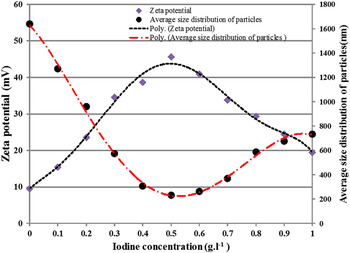
Figure 1 shows the effect of iodine addition on zeta potential and its correlation with the particles average size distribution. Without iodine addition, zeta potential was about 9.6 mV. As iodine concentration increased from 0 to 0.5 g/L, zeta potential of the suspension increased from 9.6 to 45.7 mV, which is considered to be suitable. By increasing iodine concentration to 1 g/L, zeta potential decreased to 19.5 mV. Reactions between acetyl-acetone and ethanol with iodine are expected to release H+ ions:
 $${\rm{C}}{{\rm{H}}_3}{\rm{COC}}{{\rm{H}}_2}{\rm{COC}}{{\rm{H}}_3} + 2{{\rm{I}}_2} {\largerlarrows{15}}{\rm{IC}}{{\rm{H}}_2}{\rm{COC}}{{\rm{H}}_2}{\rm{COC}}{{\rm{H}}_2}{\rm{I}} + 2{{\rm{H}}^ + } + 2{{\rm{I}}^ - }\quad .$$
 $${\rm{C}}{{\rm{H}}_3}{\rm{C}}{{\rm{H}}_2}{\rm{OH}} + {{\rm{I}}_2} {\largerlarrows{15}}{\rm{IC}}{{\rm{H}}_2}{\rm{C}}{{\rm{H}}_2}{\rm{OH}} + {{\rm{H}}^ + } + {{\rm{I}}^ - }\quad .$$
Effect of iodine content on the zeta potential and the average size distribution of the particles in EPD suspension.

H+ adsorption onto the particle surface enhances strong electrostatic repulsive force. It prevents the particle agglomeration and increases the stability of the particles in the suspension. For higher iodine content (>0.5 g/L), the stability was not affected so much. Because by increasing H+ from the optimum point, particles’ surface charge saturates and the corresponding zeta potential diminishes. The average size distribution of the particles without iodine was found to be 1.6 μm (Fig. 1). It is confirmed that for lower zeta potentials (without iodine addition), the electrostatic repulsive force is not strong enough to overcome the attractive van der Waal force between the particles. It leads to the destruction of the colloidal stability and creates larger agglomerates. It can also be seen, at maximum zeta potential (for 0.5 g/L iodine addition), the agglomerates average particle size distribution is 232.5 nm. Thus, it can be concluded that adding an optimum content of iodine in the suspension increases zeta potential and helps to reduce the average size distribution of the particles. Reference Das and Basu35–Reference Das, Bagchi and Basu38
B. EPD process
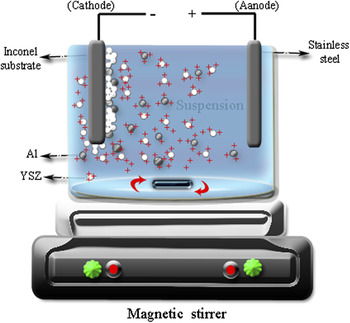
EPD was carried out by applying an electric field of 40 V for 3 min between a stainless steel electrode (anode) and an Inconel substrate (cathode). During EPD, YSZ, and Al particles are co-deposited on Inconel substrate. The suspension was stirred with a magnetic stirrer. During EPD, the suspension was kept stirred slowly using a monotone magnetic stirrer to disperse the powders in the suspension and obtain a homogeneous colloidal suspension. Green composite coatings were dried at room temperature for 24 h before they were sintered at 1150 °C for 4 h, which are referred to as-sintered coatings. Experimental set up of EPD cell is shown schematically in Fig. 2. Reference Farrokhi-Rad39,Reference Khanali, Rajabi, Baghshahi and Ariaee40
YSZ/Al green composite formation on the cathode in an EPD cell.

C. Current density and deposition weight
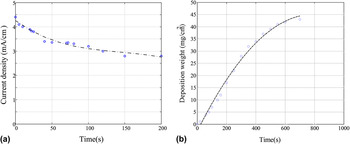
Current density variation during deposition time (200 s) is shown in Fig. 3(a). The initial current density of the suspensions was 4.3 mA/cm2. As can be seen, a uniform descending trend is the prevalent behavior for the current density, which can be attributed to the gradual formation of electric insulator on the substrate surface. Reference Bhosale, Kadam, Joshi, Pawar and Pawar41,Reference Fleckenstein, Mochales, Frank, Kochbeck, Zehbe, Fleck and Mueller42 Figure 3(b) illustrates the weight variation of the YSZ/Al green composite coatings for different deposition times. It is evident that the deposited weight changes in a linear manner during the initial deposition stage. However, as more time passes, the rate of deposition decreases gradually and it flattens at the final stage. This behavior can be explained by the propagated formation of YSZ/Al green coat on the electrode’s surface. Previous experimental results suggest low current densities to achieve smoother coatings. It is also believed that increasing applied current density leads to rougher coatings. The probability for crack formation is higher in larger applied current densities and higher deposition rates. Reference Fleckenstein, Mochales, Frank, Kochbeck, Zehbe, Fleck and Mueller42,Reference Ren, He and Wang43
(a) Current density variations for constant electric potential of 40 V, (b) YSZ/Al green composite deposited weight as a function of time.

D. Sintering process
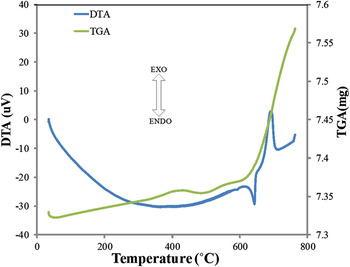
Present work is needed to understand the mechanisms controlling the coating reaction bonding. To study the oxidation behavior of the embedded Al powder in the matrix, thermal analysis is used. DTA and TGA analysis was carried out to determine the reactions with oxygen during sintering process. Figure 4 shows the DTA and TGA curves of 10 h milled-Al powder. The endothermic peak at 637.8 °C and the exothermic peak at 690.40 °C correspond to the melting and the oxidation temperatures, respectively. According TGA curve it can be seen, the gained weight starts to increase drastically from the melting temperature to higher ones due to the completion and the initial stages of the smaller and larger Al particles oxidation, respectively. Reference Li, Wang, Tan and Song18,Reference Wang, Shemilt and Xiao21,Reference Ren, He and Wang43
DTA and TGA curves of Al powders after milling for 10 h.

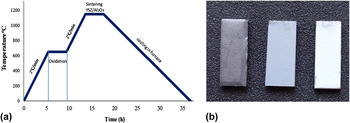
The coatings were subjected to a multi-step sintering process in an electrical tube furnace after drying (Fig. 5). The sintering cycle was chosen according to the DTA/TGA curves, shown in Fig. 5(a). First, they were heated up to 650 °C for 5 h. Al particles were melted and their oxidation increased the bonding strength of the coatings. This, in turn, suppressed the cracks propagation in the coatings, which would be created due to the thermal coefficient mismatch between YSZ and the substrate. And also Al particles melted and made connections between particles and refine bonding strength. In Fig. 5(b), from left to right can be seen uncoated, green composite coating and sintered composite coating. From the green color of the composite coatings it can be concluded that Al with YSZ particles was deposited on the surface substrate. Reference Swadźba, Hetmańczyk, Wiedermann, Swadźba, Moskal, Witala and Radwański44
(a) Sintering cycle of YSZ/Al composite coatings (b) from left to right: uncoated (substrate), green coated (YSZ/Al) sample and sintered (YSZ/Al2O3).

E. XRD analysis
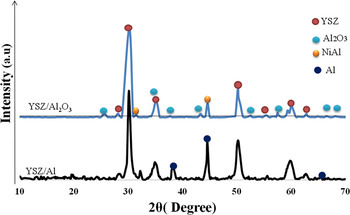
Phase investigation results of the coatings (before and after sintering) are shown in Fig. 6. It can be seen that the crystalline phase changed from YSZ/Al to YSZ/Al2O3. Al diffraction peaks disappeared after sintering at high temperature in air and Al2O3 peaks were substituted. This means Al was perfectly turned to Al2O3 and formed YSZ/Al2O3 nano-composite coatings. It is also worthwhile to note that the sharp diffraction patterns were perfectly matched with the crystal structure for Al2O3 and YSZ. Reference Aaron, Chan, Harmer, Abpamano and Caram45
XRD patterns of composite coating before and after sintering in 1150 °C.

F. Microstructural study of YSZ/Al2O3 nano-composite coatings
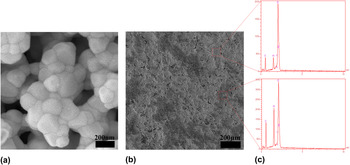
Figure 7 shows FE-SEM images of the surface morphology of the top surface YSZ/Al2O3 nano-composite coating produced by EPD process after sintering at 1150 °C. The presence of Al in the green coating is essential for producing dense and adherent coatings on the metallic substrate after sintering. Previous experimental studies showed that in the absence of Al in the green form of the coating, the tendency for peeling off is increased during oxidation and sintering. The presence of Al not only does compensate the volume shrinkage of green form coatings, but also promotes the adherence of the coatings to the metallic substrates.
(a, b) FE-SEM micrographs of the top surface YSZ/Al2O3 nano-composite coating and (c) EDS spectrum of the focused area.

Figure 7(a) reveals that the size of grains was about 80–150 nm. Also, it can be seen that the dense nano-structured YSZ/Al2O3 nano-composite has lower pinholes, voids, and micro-cracks. According to the EDS analysis [Fig. 7(c)], the darker phase and the brighter one were identified as Al2O3 and YSZ, respectively. Al2O3 grains surrounding YSZ matrix developed at the composite phase of YSZ/Al2O3 allows the ceramic coating to maintain strong adherence to the Inconel substrate.
The relatively high density and uniformity of these coatings makes them suitable for applications such as thermal barrier and/or anti-corrosion protection layers for metallic substrates in high temperature components. Reference Zhu, Javed, Li, Yang, Liang and Xiao46
G. Cross-section
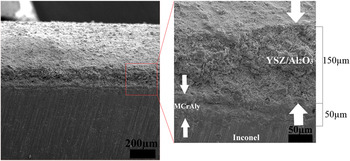
Figure 8 shows the FE-SEM micrographs of the cross-section of YSZ/Al2O3 nano-composite coatings, applied in voltage 40 V for 3 min and sintered at 1150 °C for 4 h. The two smooth and crack-free MCrAlY and TBC layers are evident. It can be observed that the thickness of the YSZ/Al2O3 nano-composite coatings is about 150 µm and that of the MCrAlY layer is about 50 µm. The coatings were bonded to the metal substrate via a MCrAlY layer. The coating maintained the dense, crack-free morphology and it had a good adherence with bond-coat layer. It appears that a strong bonding between the coating and substrate was achieved. Lower coating roughness improves its workability due to less stress concentration at the surface/interface. Reference Yao, He, Wang and Lin47
Cross-section of the fractured as-sintered YSZ/Al2O3 EPD coating sintered at 1150 °C for 4 h.

IV. CONCLUSION
YSZ/Al2O3 nano-composite coatings were successfully applied on the Inconel substrate as TBC. The addition of iodine reagent to mixer acetyl-acetone and ethanol solvents caused controlled deagglomeration of particles in suspensions and promoted the formation of YSZ/Al on the substrate.
-
(1) The zeta potential values and the particle size distribution of the particles showed that the best stability was obtained by using iodine concentration of 0.5 g/L.
-
(2) The oxidation of the Al powder in the green form is affected by the thermal processing regime. Thermal analyses indicated that Al particles were oxidized at about 660 °C and the coatings were sintered at 1150 °C.
-
(3) The addition of Al to the green form composites, not only led to the formation of crack-free composite coatings, but also promoted the sintering of the ceramic coatings at relatively low temperatures.
-
(4) EDSs analysis revealed Al2O3 diffusion around the YSZ matrix. It verifies that the bonding in the material is very strong. By put on the composite ceramic material technique, the experiments were successful in reducing the sintering temperature of YSZ to 1150 °C.
The EPD top-coat had a more desirable microstructure and stronger interfacial bonding. The results indicated that EPD is an effective method for the fabrication of TBCs.
ACKNOWLEDGMENTS
This work was supported by MAPNA industrial group. Authors also want to declare their gratefulness to Dr. Hamidreza Zarei (Aeronautical University of science and technology, Iran, Tehran) for their fruitful help and discussions during this research work.