1 Introduction
Stress preservation can sometimes be seen in English complex words. Under stress preservation, the morphological structure of complex words is reflected in their stress patterns. For example, with stress-shifting suffixation, the primary stress of the base may be subordinated, but nevertheless retained, in the derived word: e.g. oríginal → orìginálity, antícipate → antìcipátion, sensátional → sensàtionálity.
Stress preservation results in the stress patterns of complex words differing from those of monomorphemic words when other stress-determining factors like syllable weight are held constant: orìginálity cp. àbracadábra (both with three pre-tonic light syllables – ‘#LLL’); antìcipátion cp. Lùxipalílla (both with a pre-tonic sequence of a heavy syllable followed by two light syllables – ‘#HLL’); sensàtionálity cp. Tìconderóga~Ticònderóga (both with a pre-tonic sequence of two heavy syllables followed by a light syllable – ‘#HHL’). (These examples are given following arguments made in the following works: Halle & Kenstowicz Reference Halle and Kenstowicz1991; Hammond Reference Hammond1989; Kiparsky Reference Kiparsky1979; Pater Reference Pater1995.)
The Sound Pattern of English (SPE; Chomsky & Halle Reference Chomsky and Halle1968) proposed that stress-subordinating stress preservation was handled by the phonological cycle; indeed, the cycle was introduced for this purpose. The phonological cycle could predict stress preservation by allowing phonology to reapply at each stage of morphosyntactic embedding: stress would first be assigned to an embedded word like oríginal, and then again to the embedding word – [[oríginal]ity] → orìginálity. Because stress was assigned in this recursive, serial fashion, the stress patterns of embedded words could be taken into account when assigning stress to their embedding words.Footnote 2
Kiparsky (Reference Kiparsky1979) explicitly argued that metrical tree structure is cyclically preserved, with the implication that the relative prominence contours of feet are preserved from one cycle to the next, not merely the locations of these feet. Under Kiparsky's argument, the relative prominence contours of #HHL words like sènsátional and #HLL words like ìcónoclast would be preserved in their embedding words, sensationality and iconoclastic (Kiparsky Reference Kiparsky1979: 423). As a result, secondary stress would only ever fall on the second syllables of the embedding words, the initial syllable being less prominent: sĕ nsàtionálity and ĭcònoclástic.Footnote 3 If this process of relative prominence preservation did not occur, but rather only the locations of foot heads were cyclically preserved, secondary stress would be free to fall on either syllable in the embedding word, as in monomorphemic Tìcŏnderóga~Tĭcònderóga.
There has been opposition to Kiparsky's argument for relative prominence preservation. Kiparsky's (Reference Kiparsky1979) proposal is itself a response to Liberman & Prince (Reference Liberman and Prince1977), who argued that only the locations of foot heads, and not their relative prominences, are preserved under embedding (‘Deforestation’): in Liberman & Prince's argument, the two feet of (sèn)(sátio) < nal> would be preserved under embedding, but the first foot would not be guaranteed to be less prominent than the second in the embedding word – both sènsătionálity and sĕnsàtionálity would be possible. This is because, unless the relative prominences of the foot heads are preserved in addition to their locations (i.e. which syllables are stressed), either of the first two syllables of the word may have greater relative prominence (i.e. may be more stressed than its neighbour).
A similar argument against relative prominence preservation is made in Halle & Vergnaud (Reference Halle and Vergnaud1987), supported by a number of examples from Kenyon & Knott (Reference Kenyon and Knott1944/53) which indicate a failure to consistently preserve relative prominence: e.g. ìnférior → ìnfĕriórity~ĭnfèriórity; ìmprégnable → ìmprĕgnabílity~ĭmprègnabílity. The issue of relative prominence preservation has been given little further attention in the literature on stress preservation.
In this article, it is shown that relative prominence preservation does occur, but not without exception. Importantly, it will be demonstrated that word frequency probabilistically predicts the variable success of relative prominence preservation.
The probabilistic nature of relative prominence preservation has an important theoretical implication. The phonological cycle that has previously been proposed to handle stress preservation is not a probabilistic mechanism: the cycle predicts that, in the environments where stress preservation is permitted,Footnote 4 stress preservation will occur whenever it is predicted by morphosyntactic structure. A version of the cycle is argued to occur internal to stratum one in stratal theories like Lexical Phonology (e.g. Giegerich Reference Giegerich1999; Kiparsky Reference Kiparsky and Yang1982) in order to handle stress-subordinating stress preservation. In the face of probabilistic relative prominence preservation, this stratum-internal cycle cannot achieve the correct results.
This article will demonstrate that a new stratal theory – the version of Stratal Optimality Theory (OT) proposed by Bermúdez-Otero (in preparation) and Bermúdez-Otero & McMahon (Reference Bermúdez-Otero, McMahon, Aarts and McMahon2006) – can, through its revision of stratum one, handle probabilistic relative prominence preservation. In this stratal model, the cycle which has been argued to occur internal to stratum one is rejected: recursive passes through the stratum one phonology are not required. All stratum one outputs are argued to be listed, meaning that just a single pass through the stratum one phonology is needed to generate preserving stress patterns: it is not necessary to have a cycle which assigns stress to unmetrified anticipate give àntícipate before a second cycle which gives ăntìcipátion – the stress of àntícipate is already known because it is stored as a stratum one output, so that only the latter cycle (àntícipate → ăntìcipátion) is required. And, because ăntìcipátion must logically also be listed, this single pass through the phonology is akin to a ‘redundancy rule’ (Jackendoff Reference Jackendoff1975). This new proposal is called ‘fake cyclicity’. This article shows that, through its combination of listing and redundancy rules, fake cyclicity can capture the probabilistic nature of relative prominence preservation in a way that the stratum-internal cycle cannot.
This article is structured as follows. In section 2, the data taken from English pronouncing dictionaries, which indicate that relative prominence preservation is a probabilistic phenomenon, are presented. In section 3, the analysis, which indicates that the probabilistic nature of relative prominence preservation is due, in part, to word frequency effects, is given. Finally, in section 4, the theoretical implication of the findings from sections 2 and 3 is discussed: the rejection of the stratum-internal cycle in favour of fake cyclicity.
2 Pronouncing-dictionary data
2.1 Method
The data set consists of five- and six-syllable #HHL and #HLL words with three pre-tonic syllables where relative prominence preservation is expected on the second syllable – words like anticipation (from àntícipate) and sensationality (from sènsátional). These words have been taken from an English pronouncing dictionary, Jones (Reference Jones2003) (approx. 80,000 entries). The aim was for the data collection to be exhaustive, and the data set is the most extensive for relative prominence preservation of which I am aware.
The goal was to find examples of what is termed here ‘genuine’ preservation failure – variability in the success of stress preservation which occurs when all other sources of stress variation, like pan-dialectal variation, have been factored out. As the data have been taken from a dictionary, an artificial idiolect of English is being modelled.Footnote 5 Nevertheless, using pronouncing-dictionary data does have its advantages for this particular study. Any pronunciations indicated as British regional or American in the dictionary have been excluded – stress placement shows regional variation in English. Therefore, the resulting artificial idiolect is likely to exclude pan-dialectal variation which could be confused with genuine preservation failure. The dictionary entries are also citation forms, and so should exclude variation that results from connected-speech phenomena like rhythmic readjustment, which could, again, be confused with genuine preservation failure.
An important part of collating the data was determining from which word relative prominence is potentially preserved. In some instances, a word can be argued to have more than one possible embedded word: e.g. for demodulation, either demódulate or mòdulátion. As long as there was a primary stress on the second syllable in at least one of the potentially embedded words, the embedding word has been included in the analysis here.
In the case of obscure words which native speakers could perceive as monomorphemic or as containing a bound root,Footnote 6 the following steps were taken to establish whether they were morphologically complex:
(i) If a morphophonologically similar word that could plausibly be embedded was in the same pronouncing dictionary, and Oxford English Dictionary (OED) definitions (consulted when I was unfamiliar with one or both words) indicated that the two words were also semantically similar, a word was treated as complex.Footnote 7
(ii) Where the pronouncing dictionary did not contain a plausibly embedded word, the OED was checked for any likely candidate.
(iii) Where a plausibly embedded word located under (ii) was in the OED, but was marked as ‘rare’, ‘obsolete’ or not naturalized, it was disregarded.
A final issue relating to morphological complexity is at what point the cut-off for complexity is with respect to stress preservation (Kager Reference Kager1995: 22). Sometimes, there were examples of longer words which have strong morphosemantic relationships with shorter, potentially embedded words, but where morphological embedding is not uncontroversial. An inclusive approach to morphological embedding has been taken here: there has been no exclusion of examples where the embedded word has been truncated in any way, e.g. totálity → totalitarian, and/or where the terminal element of the embedding word is not a suffix of English, e.g. accélerate → accelerando, as long as OED definitions indicated a strong semantic relationship between the putatively embedding and embedded words. (The issue of which pairs of words can be considered as preservation candidates is an interesting and complex one – see section 4.3 below.)
Finally, issues of segmental structure and syllabification were considered. Prefixed words were not excluded from the data set – to do so would exclude a great deal of the data. However, where the syllabification of a prefix could alter the weight of the initial syllable, e.g. dissatisfaction, the example was only included where the prefix was shown to syllabify separately from the rest of the word (e.g. [dɪs.sætisfaction). An embedding word was also only included as having variable secondary stress if both variants occurred with a heavy initial syllable.
2.2 Results
A total of 198 #HLL and #HHL words from Jones (Reference Jones2003) were collected (the full data set is presented in the Appendix). Out of this total, a minority of words exhibited failure of relative prominence preservation some or all of the time: 51 (25.8%) words had variable secondary stress, e.g. authórity → àuthoritárian~authòritárian, impéccable → ìmpeccabílity~impèccabílity, and 8 (4.0%) had consistent initial syllable secondary stress, e.g. decónsecrate → dèconsecrátion, repátriate → rèpatriátion. The majority of words – 139 (70.2%) – had secondary stress consistently on their second syllables, e.g. accéptable → accèptabílity, coágulate → coàgulátion, as anticipated under successful relative prominence preservation.Footnote 8
The picture we are presented with is neither fully in favour of relative prominence preservation, nor fully against it. In quantitative terms, there appears to be a bias in favour of successful relative prominence preservation – we do not get the totally random behaviour we would expect if relative prominence preservation did not occur. Nevertheless, there are a sizeable number of exceptions to relative prominence preservation. It will now be shown that word frequency appears to be one factor which causes the variable success of relative prominence preservation.Footnote 9
3 Word frequency and relative prominence preservation
Stress preservation is a morphophonological phenomenon: by preserving stress, complex words show that they have a relationship with their embedded words. Stress preservation has been argued to aid lexical access: preserved stress aids morphological transparency by aiding perception of the embedded word (Cutler Reference Cutler1980, Reference Cutler1981; Kenstowicz Reference Kenstowicz, Durand and Laks1996).
Psycholinguistic research shows that speakers do not perceive morphological relationships between words as binary – i.e. as either simply present or absent. Morphological complexity forms a cline: embedded words can be perceived inside embedding words to greater or lesser degrees (e.g. Hay Reference Hay2003). One factor which affects the perception of embedded words inside embedding words is word frequency.
Here, with respect to relative prominence preservation, it is proposed that it may not be enough for a speaker to simply know the word from which the relative prominence contour may be preserved. Rather, word frequency will affect how likely the embedded word is to be perceived inside its embedding word, and thus how likely the embedding word is to preserve the stress contour of its embedded word. Evidence which supports this hypothesis is presented in the following sections.Footnote 10
3.1 Word frequency, lexical access and stress preservation
Word frequency has been argued to affect the perception of morphological complexity in more than one way.
The general and longstanding argument (e.g. Bybee Reference Bybee1985) is that embedding words become less like their embedded words in terms of their phonology and semantics the greater the absolute frequency of the embedding word. That is, we would expect preservation to be more likely to fail the more frequent the embedding word is, as embedded words are less likely to be perceived inside high-frequency embedding words.
A different argument has been put forward by Hay (Reference Hay2001, Reference Hay2003). Hay argues that whether or not an embedded word is likely to be perceived inside an embedding word depends upon the frequency of the embedded word relative to that of the embedding word – absolute frequency is not the issue. Hay (Reference Hay2003) presents a study of semantic drift which supports her proposal. This study shows that high-frequency embedding words are no more likely to drift from their embedded words’ semantics than low-frequency embedding words. However, embedding words which are more frequent than their embedded words are more likely to undergo semantic drift than embedding words which are less frequent than their embedded words (Hay Reference Hay2001, Reference Hay2003: 110–14).
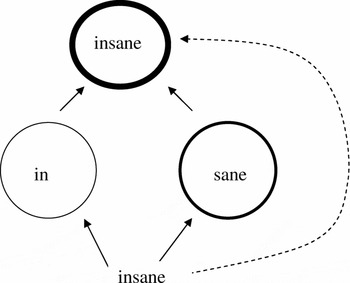
Hay's argument for relative frequency can be understood in the context of the dual-route model of lexical access she adopts (figure 1).
Schematized dual-route model from Hay (Reference Hay2001: 1045, Reference Hay2003: 11). The solid line indicates the decomposed route. The dashed line indicates the direct route. A thicker circle outline indicates a higher resting activation level for a particular lexical entry

The dual-route model does not propose that a speaker's use of his memory is maximally economical: a speaker may store complex words in his memory, as well as their constituent parts. A complex word may therefore be accessed in two ways: (i) by decomposition, shown by the solid arrows in figure 1; (ii) by accessing the memory of the whole word directly, shown by the dashed arrow. Importantly, accessing a complex word via the decomposed route strengthens the word's relationships with its constituents, but whole-word access weakens these relationships. Under whole-word access, the complex word is more likely to become independent of its constituents in its meaning and form (Hay Reference Hay2003: 8).
For a morphologically complex word where both the direct and decomposed routes of access are available, which of the routes wins depends upon the strength of the memories of the lexical entries involved. The strength of the memory of a lexical entry is itself dependent upon word frequency. Every time a lexical entry is accessed, a trace is left in the memory which strengthens the memory of the lexical entry: the lexical entry has a higher ‘resting activation’ level. A high-frequency lexical entry will therefore have a high-resting activation level, and a low-frequency lexical entry a low-resting activation level. The higher a lexical entry's resting activation, the quicker it is accessed. In figure 1, the word insane has a higher resting activation level than sane. It is therefore probable that insane will be accessed directly, via the whole-word route, rather than via decomposition – whole-word access will be quicker than decomposed access. Dual-route models, particularly models where the two routes are in a race against one another, have proven to be very successful in capturing empirical observations (Anshen & Aronoff Reference Anshen and Aronoff1988: 647; McQueen & Cutler Reference McQueen, Cutler, Spencer and Zwicky1998; Schreuder & Baayen Reference Schreuder, Baayen and Feldman1995).
Under Hay's hypothesis, we would expect relative prominence preservation to fail if the embedding word is more frequent than the embedded word, irrespective of the absolute frequency of the embedding word. When the embedding word is more frequent than the embedded word, the embedding word is likely to be accessed via the whole-word route, rather than by reference to its embedded word under the decomposed route. The result of this will be that, over time, the relationship of the embedding word with the embedded word will weaken, and the expression of this relationship – relative prominence preservation – will become less likely to occur.
Importantly, Hay (Reference Hay2003) argues that the trend noticed by previous researchers for embedding words with high absolute frequency to drift from their embedded words may be symptomatic of relative frequency effects. High-frequency words are significantly more likely to be more frequent than their embedded words than low-frequency words (Hay Reference Hay2003: 101).
In section 3.2, statistical support for the effects of both relative and absolute frequency upon relative prominence preservation is given.
3.2 Frequency analysis of relative prominence preservation
3.2.1 Method
Not all of the 198 words collected from Jones (Reference Jones2003) have been used in the word frequency analysis. Hay (Reference Hay2003) shows that relative frequency effects result in different suffixes being decomposable to different degrees. It is therefore very important that all of the words in any particular frequency analysis have the same suffix. The first suffix which is examined is -ion: it is the most common suffix in the data set, and is found in 86 embedding words.
Hay (Reference Hay2003) and Hay & Baayen (Reference Hay and Baayen2004) also show that morpheme juncture phonotactics play a role in how likely a word is to be decomposed: phonotactics which are less likely to occur morpheme-internally, like certain consonant clusters, prompt decomposition more than CV sequences which are more likely to occur morpheme-internally. Virtually all of the 86 -ion words have a low-probability CV juncture between the embedded word and suffix. No further attempts have been made to control for phonotactics by differentiating between different CV sequences, as this would reduce the size of the data set too much for statistical analyses to be carried out.
Embedding words were coded as exhibiting either ‘prominence-preserving’ or ‘non-prominence-preserving’ stress. Words which exhibited variable and consistent failure of relative prominence preservation were collapsed into a single category. There were not enough words with consistent initial-syllable secondary stress for this to constitute a category on its own, but nor was it desirable to exclude any more tokens from the analysis. The collapsing of the categories seems reasonable, given that both categories are genuine subsets of non-prominence-preserving stress.
The frequencies of both the embedding and embedded words were collected from the CELEX lexical database (Baayen, Piepenbrock & Gulikers Reference Baayen, Piepenbrock and Gulikers1995). The frequencies used in the analysis are lemma frequencies – they include frequencies of inflected forms. Following Hay & Baayen (Reference Hay, Baayen, Booij and van Marle2002: 208), the CELEX frequencies were log-transformed (as logex) so that they bear a greater resemblance to the way ‘humans process frequency information’.
3.2.2 Results
For -ion, statistical analyses to test for effects of both absolute and relative frequency were carried out.
In order to test for the effects of absolute frequency, binary logistic regression (forced entry) was performed upon the log-transformed CELEX frequencies. Regression is a statistical test which can be used to test the strength of the linear relationships between independent variables – in this case, frequencies of the embedding and embedded words – and dependent variables – here, the behaviour of relative prominence preservation. Logistic regression was used because the dependent variable is categorical – relative prominence preservation is either consistently successful, or it is not.Footnote 11 For the regression analysis, the prominence-preserving category was coded as 0 and the non-prominence-preserving category as 1.
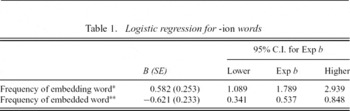
The results of the regression analysis are given in table 1.
Logistic regression for -ion words

Note R2 = .085 (Hosmer & Lemeshow); R2 = .098 (Cox & Snell); R2 = .140 (Nagelkerke). Model χ 2 = 8.851, p < .025. Wald statistic significance: *p < .025; **p < .01.
Overall, log frequency is a significant predictor of relative prominence preservation behaviour in -ion words (χ 2 = 8.851, 2df, p < .025). Log-embedding and log-embedded frequency are individually significant predictors of relative prominence preservation behaviour (Wald statistic significance p < .025 for embedding-word frequency, and p < .01 for embedded-word frequency). Non-prominence-preserving stress becomes more likely as the log frequency of the embedding word increases (Exp b > 1, 95% Confidence Interval does not cross 1). Non-prominence-preserving stress becomes less likely as the log frequency of the embedded word decreases (Exp b < 1, 95% Confidence Interval does not cross 1).
The observation that relative prominence preservation becomes less likely with an increase in the absolute frequency of the embedding word fits with the traditional argument that high-frequency words are more likely to drift from their embedded words. But interestingly, it has also been observed here that a decrease in the frequency of the embedded word makes relative prominence preservation more likely to fail: an embedding word is more likely to preserve stress if its embedded word is high frequency, regardless of the frequency of the embedding word itself. This appears to hint at Hay's relative frequency hypothesis.
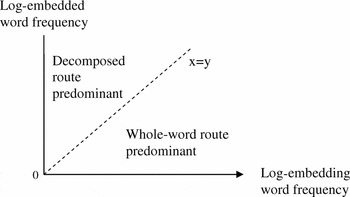
Relative prominence preservation in -ion words was examined for relative frequency effects. Hay (Reference Hay2001, Reference Hay2003) calls the point at which an embedding word is frequent enough, relative to its embedded word, to be accessed via the whole-word route the ‘parsing line’. In Hay (Reference Hay2001, Reference Hay2003), the parsing line is defined as the point at which the frequency of the embedding word equals the frequency of the embedded word, as shown in figure 2.
The x = y parsing line (Hay Reference Hay2001, Reference Hay2003). The line x = y is an approximation to the parsing line. Words falling above the x = y line are hypothesized to be more prone to access via the decomposed route: the frequency of the embedded word is higher than the frequency of the embedding word. Words falling below the x = y line are hypothesized to be more prone to direct access: the embedding word is more frequent than the embedded word

The x = y line proposed by Hay (Reference Hay2001, Reference Hay2003), although very intuitive, was without independent empirical justification. The exact ratio of relative frequency at which decomposition and whole-word access are equally likely has since been refined by Hay & Baayen (Reference Hay, Baayen, Booij and van Marle2002). (Hay & Baayen Reference Hay, Baayen, Booij and van Marle2002 follows Hay Reference Hay2003 in real time.) Hay & Baayen (Reference Hay, Baayen, Booij and van Marle2002) use a psycholinguistic model for morphological parsing, Matcheck (Baayen & Schreuder Reference Baayen and Schreuder2000; Baayen, Schreuder & Sproat Reference Baayen, Schreuder, Sproat, van Eynde and Gibbon2000), to empirically establish the location of the parsing line. Unfortunately, due to differences in the frequency distributions, this line cannot be reliably fitted to the current data.Footnote 12 Establishing a revised parsing line compatible with the current data would require further empirical research, presumably a further experiment with Matcheck.
For now, we can work with the idea that there will be a higher ratio of embedding-word frequency to embedded-word frequency in words accessed by the whole-word route than in words accessed by decomposition. Consequently, we expect a higher ratio of embedding-word frequency to embedded-word frequency in words which are categorized as having non-prominence-preserving stress than in words which are categorized as prominence-preserving.
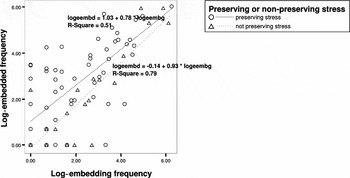
Relative frequency effects appear to hold in the analysis of -ion. The scatterplot in figure 3 shows log-embedding and log-embedded frequency plotted against one another, with the relative prominence-preservation behaviour of the embedding word indicated by the marker.
Frequency and preservation behaviour for -ion

As we would expect under the relative frequency hypothesis, the non-prominence-preserving group has a higher ratio of embedding-word frequency to embedded-word frequency than the prominence-preserving group. The linear regression line for non-prominence-preserving stress has a lower y-intercept than that for words with prominence-preserving stress.Footnote 13 The steeper slope of the line for non-prominence-preserving stress than for prominence-preserving stress (.93 versus .78) somewhat reduces the contrast between the two groups: a steeper regression slope means more of the points in the non-preserving category are likely to fall above the x = y line (Hay & Baayen Reference Hay, Baayen, Booij and van Marle2002: 210). But, overall, the lines are in the positions we would hope: the regression line for the non-prominence-preserving category is consistently lower on the graph than the line for the prominence-preserving category.
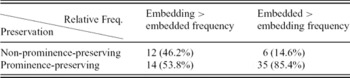
Chi-square of relative frequency and preservation in -ion wordsFootnote a

χ 2 = 9.045, 1df, p = .005.
a 19 words were excluded where embedding and embedded frequencies were equal. All percentages are to one decimal place.
From the regression analysis, we can draw the following conclusion about stress preservation and word frequency: lower embedding frequency and higher embedded frequency favour stress preservation. This relationship follows if it is the case that morphologically related words are also phonologically related. As noted by an anonymous reviewer, this observation leads to a number of interesting hypotheses, for example, that more productive morphological processes should not display preservation failure (productive processes are characterized by low-frequency embedding forms).
Although it has been acknowledged that a more precise parsing line needs to be established for the current data set, it was still worth seeing how the data fared with Hay's intuitive x = y line. When the line x = y was taken as an approximate parsing line, there was a significant relationship in a chi-square analysis between relative frequency and whether or not -ion words were classed as prominence-preserving. (Chi-square tests whether the actual observed frequency for a particular category is significantly different from the frequency expected under the null hypothesis. In this case, the null hypothesis is that there is no relationship between relative frequency and relative prominence-preservation behaviour.)
There is a significant relationship between whether embedding frequency is greater than embedded frequency or vice versa, and whether a word belongs to the prominence-preserving or non-prominence-preserving stress category. Embedding words which are more frequent than their embedded words are significantly more likely to belong to the non-prominence-preserving category than embedding words which are less frequent than their embedded words (χ 2 = 9.045, 1df, p = .005).
In conclusion, in the analysis of a single suffix, -ion, there is statistical support for effects of both absolute embedding and embedded frequency upon relative prominence preservation, and also a good indication that word-specific relative frequency effects play a part in determining whether or not relative prominence preservation is successful. These results support our hypothesis that relative prominence preservation is probabilistically dependent upon token word frequency.
3.3 Another suffix: -ity
The obvious question is whether the frequency analysis holds with any single suffix other than -ion. After -ion, the suffix for which there are the most tokens is -ity (66 -ity words in total, 53 with consistently preserving stress, 13 without), and so the analyses were repeated with CELEX frequencies for -ity. No further suffixes were analysed, as the occurrences of any other single suffix in the data set are very small.
To test for effects of absolute frequency, a logistic regression analysis was performed on the log frequencies of the -ity examples. The result was not significant (model χ 2 = 0.591, 2df, p < 1). There are insufficient data for a chi-square analysis of relative frequency with x = y for -ity words (only 9 non-prominence-preserving -ity words have embedding and embedded frequencies which are not the same, and a minimum of 10 words is required). However, impressionistically, there is no obvious effect of relative frequency which could account for the relative prominence-preservation behaviour of these words: all of the -ity words have an embedded frequency higher than their embedding frequency, including those in the non-prominence-preserving category.
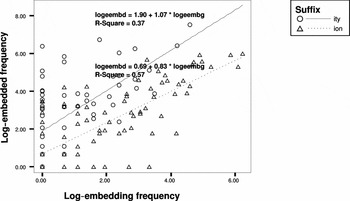
We need to explain why frequency can account for some of the prominence-preservation behaviour of -ion words, but for none of the prominence-preservation behaviour of -ity words. The scatterplot in figure 4 compares the relative frequency distributions of -ion and -ity words.
Comparison of frequency distributions for -ion and -ity

In figure 4, the linear regression line for -ity is higher and has a steeper slope than that for -ion. From this, we can conclude that, with respect to frequency, -ity words are more likely to be decomposed – and therefore exhibit successful relative prominence preservation – than -ion words. In light of this observation, it is plausible that frequency effects account for the prominence-preservation failure in the -ion group, but not in the -ity group. However, something else aside from frequency must be causing the prominence-preservation failure in the -ity group. This is not a problem – we already knew that frequency is not the only factor to contribute to prominence-preservation failure. The regression analysis given for -ion (table 1) shows that frequency effects account for, at best, less than 15 per cent of relative prominence- preservation behaviour (the model R2 ranges from .085 to .140).Footnote 14 I leave the research into which other factors contribute to the failure of relative prominence preservation for future work.
4 The argument for fake cyclicity
In Lexical Phonology and Morphology (LPM), the highest morphophonological stratum has been argued to be internally cyclic. Bermúdez-Otero & McMahon (Reference Bermúdez-Otero, McMahon, Aarts and McMahon2006) propose a model of Stratal OT which differs fundamentally from previous stratal models in this respect: under the proposal of ‘fake cyclicity’, the highest morphophonological stratum is proposed to be internally noncyclic. Here, I show that the demonstrated probabilistic nature of relative prominence preservation supports the fake cyclicity analysis (section 4.2). I also argue that another showpiece argument for the stratum-internal cycle – Trisyllabic Shortening – can be handled by the fake cyclicity analysis (section 4.3).
4.1 Introduction: fake cyclicity
In standard LPM (e.g. Kiparsky Reference Kiparsky and Yang1982), stratum one is argued to be internally cyclic. This stratum-internal cycle provides a mechanism for modelling the type of stress-subordinating stress preservation discussed here. The addition of each stratum one suffix triggers a pass though the stratum one phonology: every stratum one ‘morphological construction – not just the outermost – constitutes a phonological domain’ (Bermúdez-Otero & McMahon Reference Bermúdez-Otero, McMahon, Aarts and McMahon2006: 396). This is shown in (1) (based on Bermúdez-Otero & McMahon Reference Bermúdez-Otero, McMahon, Aarts and McMahon2006: (14)):
- (1)
(a) Phonological domain structure if stratum one is internally noncyclic
[aanticipation]
[aoriginality]
(b) Phonological domain structure if stratum one is internally cyclic
[b[aanticipate]ion]
[c[b[aorigin]al]ity]
Under cyclicity, as in (1b), stress is first assigned to the embedded word anticipate, giving àntícipate. Following the addition of the suffix -ion, stress reapplies, giving antìcipátion. If stratum one was not internally cyclic, as in (1a), anticipation would not have a complex phonological domain structure. Consequently, stress could not be assigned to anticipate in advance of stress assignment to anticipation, and stress preservation would be impossible.
As Bermúdez-Otero & McMahon (Reference Bermúdez-Otero, McMahon, Aarts and McMahon2006) note, not all stratum one processes indicate that the stratum-internal cycle is appropriate. The stratum-internal cycle causes serious problems for nasal-cluster simplification. Nasal-cluster simplification applies word-finally – damn [dæm] – and overapplies before word-level affixes – [dæmɪŋ], not *[dæmnɪŋ] – thus confirming its stratum one status.Footnote 15 Problematically, nasal-cluster simplification does not overapply before stratum one suffixes: we get [dæmneɪʃn], not *[dæmeɪʃn]. This is not predicted by the stratum-internal cycle, as shown in (2) (from Bermúdez-Otero & McMahon Reference Bermúdez-Otero, McMahon, Aarts and McMahon2006: (18)):Footnote 16
(2)


Bermúdez-Otero & McMahon argue that the problem of nasal-cluster simplification on stratum one can be eradicated by rejecting the stratum-internal cycle. The phonological domain structure of stratum one outputs will therefore be as in (1a), not (1b). However, Bermúdez-Otero & McMahon argue that the rejection of stratum-internal cyclicity need not require the rejection of the stratum one stress preservation generalization. The solution lies in their notion of fake cyclicity.Footnote 17
Under fake cyclicity, all outputs of stratum one are listed in the permanent lexicon.Footnote 18 I will refer to these stored outputs as ‘lexical entries’. Because these lexical entries are the outputs of the stratum, they will contain all the phonology assigned on stratum one, including stress. This lexical storage obviates the stratum-internal cycle for stress preservation, as shown in (3) (based on Bermúdez-Otero & McMahon Reference Bermúdez-Otero, McMahon, Aarts and McMahon2006: (21)):Footnote 19
(3) The stratum-internal cycle versus fake cyclicity
– Max-FootHead
The output correspondent of an input foot must be a foot head
– Align(ω, L; Σ, L)
For every prosodic word ω, the left edge of ω must coincide with the left edge
of some foot Σ
– NonFin
The final syllable in the prosodic word must not be a member of a foot
– Align-R
Main stress is on the rightmost syllable of the word
(a) Stratum-internal cycle
Phonology: first cycle
Phonology: second cycle Footnote 20
(b) Fake cyclicity analysis
Phonology: only cycle
In (3b), cp. (3a), the preserving stress of phenòmenólogy is derived in a single cycle. Phe(nómen)on is listed in the speaker's permanent lexicon as a lexical entry. When the speaker has need to use phenomenology for the first time, -ology will be added to the lexical entry [phe(nómen)on]n. A previous cycle in which the stress of [phe(nómen)on]n is derived from an unmetrified underlying representation, /phenomenon/, need not occur – [phe(nómen)on]n is already known.
Remember, however, the starting argument that all stratum one outputs are listed as lexical entries in the speaker's permanent lexicon. This means that [phe(nòme)(nólo)gy]n will itself be listed as a lexical entry. The phonological computation in (3b) is therefore a ‘redundancy rule’ (Jackendoff Reference Jackendoff1975): the speaker will not perform the derivation in (3b) when he wants to use phenomenology in future, but will go straight to the stored stratum one output [phe(nòme)(nólo)gy]n. Nevertheless, the persistence of this redundancy rule is vital – it ensures that the stress-preservation generalization need not be sacrificed along with the rejection of stratum-internal cyclicity.
Therefore, under Bermúdez-Otero & McMahon's proposal of fake cyclicity, the stratum one constraint hierarchy is anticipated to do very little online work: well-formed outputs are already listed on stratum one ready-to-go. Nevertheless, as described, the stratum one constraint hierarchy is vital for retaining the stress-preservation generalization: morphophonological relationships between stratum one forms are not rejected along with stratum-internal cyclicity.
4.2 Probabilistic prominence preservation as support for fake cyclicity
In section 4.1, we saw that fake cyclicity can solve the ‘domain mismatch’ that exists between stratum one stress preservation and nasal-cluster simplification. This was achieved through fake cyclicity's key combination of lexical storage and redundancy rules. It is these characteristics of fake cyclicity which equip it to handle the probabilistic nature of relative prominence preservation on stratum one; fake cyclicity is not simply a stipulation that must be made in order to deal with phonological domain mismatches.
The dual-route model of lexical access that was argued for in section 3.1 requires that complex words are memorized by the speaker, along with their phonological and semantic characteristics, once coined or heard for the first time. It is only by this whole-word storage that direct access – the whole-word route – is possible.Footnote 21 Vitally, I argued in section 3.1 that it was this whole-word storage which could account for the failure of relative prominence preservation. When an embedding word is more frequent than its embedded word, the embedding word will be accessed directly through the whole-word route.Footnote 22 Over time, access via the whole-word route will weaken the embedding word's relationship with its embedded word, facilitating the failure of relative prominence preservation.
There is a notable correspondence between the assumptions of the dual-route model of lexical access and those of fake cyclicity. Like the dual-route model, the fake cyclicity analysis does not place a premium upon storage – fake cyclicity also requires that predictably complex forms are redundantly memorized by the speaker. Additionally, like the dual-route model, the fake cyclicity analysis does not assume that, just because complex words are memorized, they cease to have any relationship with their constituent parts: both the dual-route model and fake cyclicity propose redundant links between complex words and their constituents which are vital for maintaining similarities of meaning and form. These parallels mean that fake cyclicity is equipped to cope with the probabilistic nature of stratum one relative prominence preservation.
Fake cyclicity handles relative prominence preservation and its failure as follows. If anticipation were less frequent than anticipate, anticipation would be probabilistically more likely to be accessed via decomposition, and the relationship between anticipation and anticipate would be reinforced. This would be manifested in the fake cyclicity analysis by the lexical entry [(àn)(tíci)pate]v being visible in the input of anticipation – /(àn)(tíci)pate-ion/ – so that preservation is maintained through a redundant phonological generalization, as in (4) (see also (3b) above):
(4) Successful prominence preservation: embedded word in input
- StressIdent
For every degree of prominence by which the main stress of the embedded word is demoted in the embedding word, score one violation.Footnote 23
However, if anticipation were more frequent than anticipate, the strength of the relationship between the two words would weaken, and anticipate would not be present in the underlying representation of anticipation – /anticipation/, not /(àn)(tíci)pate-ion/. Weakening of this relationship will not automatically result in preservation failure in the word in question: fake cyclicity proposes that an embedding word is stored along with its stress pattern, and that this stress pattern will still be stored even under access via the whole-word route. Access via the whole-word route will make the stress pattern of the embedding word vulnerable to regularization as a result of lexically gradual change. Regularization would lead to the failure to preserve relative prominence preservation from àntícipate, and a stress pattern which parallels monomorphemic Lùxipalílla – ànticipátion.
Unlike fake cyclicity, the stratum-internal cycle proposed in standard LPM does not have the ability to capture the probabilistic nature of relative prominence preservation. Under the cycle, words like anticipation have a complex phonological domain structure – [b[aanticipate]ion] – which must be strictly respected. In this sense, the cycle may be argued to correspond to the decomposed or ‘online’ route of lexical access alone – morphological complexity cannot be bypassed, as under the whole-word route. Therefore, under the stratum-internal cycle, any instances of stress-preservation failure must be accounted for by an alternative morphological analysis which predicts the ‘failing’ stress. However, as we will now see, accounting for the failure of stress preservation through an alternative morphological analysis is stipulative, and, unlike the frequency and fake cyclicity analysis, gives no reason as to why stress preservation fails.
Anticipation is an ideal candidate for an alternative morphological analysis explanation of preservation failure. As well as an affixation of the free form antícipate, anticipation could be argued to be an affixation of a bound root – [[anticip]ration]n. This is because -ation can function as a fused suffix (e.g. [[deforest]vation]n, *deforestate v), and can attach to unstressable bound roots (e.g. [[dur]ration]n). Therefore, when relative prominence preservation from antícipate fails, it could be argued that the ‘failing’ stress pattern is, in fact, perfectly accounted for by the bound-root morphological analysis [[anticip]ration]n, and is therefore predicted by the cycle.
Unfortunately for the cyclic analysis, the bound root explanation is no more than stipulative. As pointed out by Ricardo Bermúdez-Otero (personal communication), any traditional cyclic analysis must stipulate that -ation in [[anticip]ration]n is a single fused suffix, and not two separate suffixes as in [[anticip]rate]vion]n: if the latter was the morphological analysis of anticipation, then a traditional cyclic analysis would predict that stress had to be preserved from the form created en route – antícipate. The fake cyclicity analysis suffers no such problem. Whether the structure of -ation is indeed fused -ation, or -ate + -ion, if the lexical entry antícipate is not sufficiently frequent to be present in the underlying representation of the lexical entry anticipation, relative prominence preservation may fail.
4.3 Trisyllabic Shortening
In LPM, it was argued that Trisyllabic Shortening (TSS) also required the stratum one cycle. Under TSS, a vowel is shortened when it is in a stressed open syllable that is followed by two unstressed syllables, evidence for which comes from the vowel-length contrasts in pairs like nátion and nátional, sincére and sincérity. As cyclic stress assignment bled TSS in LPM (Giegerich Reference Giegerich1999: 101), it is particularly important that TSS can be reanalysed under fake cyclicity.
The highly convincing argument for the cyclicity of TSS is made by Kiparsky (Reference Kiparsky and Yang1982: 42) and Giegerich (Reference Giegerich1999: 101) on the basis of forms like nationality and hypocrisy. Both of these words have short vowels in their initial syllables, but neither is a candidate for TSS; instead, these short vowels must be inherited from their embedded words which are candidates for TSS – national and hypocrite. In suprasegmentally comparable words where there is no embedded word from which the short vowel may be inherited, the vowel remains long, e.g. hypochondria (cp. nationality), and hypothesis (cp. hypocrisy). However, this argument is not fatal to the fake cyclicity analysis. The fake cyclicity formulation of stratum one does not rule out the possibility that nationality and hypocrisy inherit their initial-syllable short vowels from national and hypocrite – we saw in section 4.2 that fake cyclicity still allows morphophonological relationships between stratum one forms.
There is also evidence which indicates that the fake cyclicity analysis is more appropriate than the stratum-internal cycle for the general handling of stratum one vowel shortening. It has been argued that TSS can be subsumed under a more general stress-sensitive vowel-shortening process of Trochaic Shortening (Bermúdez-Otero & McMahon Reference Bermúdez-Otero, McMahon, Aarts and McMahon2006: section 4; Kager Reference Kager1993: 425; Lee Reference Lee1996; Prince Reference Prince, Ziolkowski, Noske and Deaton1990). Trochaic Shortening can also be seen in stratum one -ic adjectives, e.g. conic versus cone, cyclonic versus cyclone. Apparent evidence for the cyclicity of Trochaic Shortening can be seen in the word cyclicity itself! Trochaic Shortening in cyclic is variable – pronunciations with both shortened and long vowels occur (Jones Reference Jones2003).Footnote 24 A short vowel in the initial syllable of cyclicity, itself not in the Trochaic Shortening environment (cp. again hypothesis), can be attributed to Trochaic Shortening in embedded cyclic – this is shown in (5b). Similarly, if shortening does not occur in cyclic, the initial-syllable vowel of cyclicity should be long – (5a). However, Ricardo Bermúdez-Otero (personal communication) has also noted the speaker-internal paradigm (5c) among colleagues at Manchester University – the ‘Manchester Paradigm’.
(5) Stratum one Trochaic Shortening and the ‘Manchester Paradigm’
Speakers who have (5c) cannot be respecting a stratum-one internal cycle – cyclicity has the same vowel as cycle, rather than immediately embedded cyclic. In contrast, (5c) is tolerable under fake cyclicity. Fake cyclicity allows stratum one morphophonological relationships to be probabilistic, and so could accommodate the Manchester Paradigm where a speaker does not associate cyclic and cyclicity.
The Manchester Paradigm indicates an important area for future research with respect to stress preservation. In this article, the empirical analyses have examined preservation relationships between a derivative and its base, where the base is the immediately embedded word (i.e. the derivate minus the affix under discussion). However, as illustrated by the ease with which it handles the Manchester Paradigm, fake cyclicity permits identity relationships with more deeply embedded words. In light of work in psycholinguistic theory, it is also plausible, for example, that there may be morphological family effects upon preservation (for work on morphological family effects see e.g. Bertram, Baayen & Schreuder Reference Bertram, Baayen and Schreuder2000 and De Jong, Schreuder & Baayen Reference De Jong, Schreuder and Baayen2000). This article therefore represents a first step towards untangling what is anticipated to be a complex web of preservation relationships. (For a more detailed discussion of the variety of possible preservation relationships, see Collie Reference Collie2008: section 10.3.) The initial exploration presented here indicates that fake cyclicity will be able to handle such complex relationships, unlike traditional cyclicity.
5 Conclusions and discussion
Relative prominence preservation is a probabilistic phenomenon that is partially attributable to word-frequency effects. The fake cyclicity formulation of stratum one proposed in Bermúdez-Otero & McMahon (Reference Bermúdez-Otero, McMahon, Aarts and McMahon2006) and Bermúdez-Otero (in preparation) can handle the probabilistic nature of relative prominence preservation, whereas the stratum-internal cycle of previous stratal models cannot. There is also an indication that the fake cyclicity analysis may be appropriate for the handling of the closely related stratum one process of Trochaic Shortening. These results constitute an important step forward in understanding the nature of morphology–phonology interaction on the highest stratum of stratal models of English phonology and morphology.
The data and analyses presented here set forth a clear case for rejecting the stratum one cycle in models of Stratal OT and Lexical Phonology, but do they have wider implications for such stratal models? Precisely the type of probabilistic approach to morphophonology adopted here has been used by Plag in his decidedly anti-stratal, affix-specific accounts (e.g. Plag Reference Plag1999; Hay & Plag Reference Hay and Plag2004). Collie (Reference Collie2008) presents a number of reasons why a stratal model is vital, the most important of which comes from the theory of phonological opacity that is required to handle stress preservation, among other phonological phenomena. Models which attempt to handle phonology opacity without strata, instead using paradigmatic identity constraints, provide an incomplete and unconstrained account of phonological opacity (Collie Reference Collie2008: Chapter 7). Stratal OT, combined with fake cyclicity, can capture the probabilistic nature of morphophonological identity while simultaneously providing a restrictive, complete account of phonological opacity.
Appendix
Where the embedding word exhibits nonpreserving behaviour, the entry is shown in bold.