It is well established that the offspring of clinically depressed parents are more likely to exhibit depressive symptoms and depressive disorder than healthy comparison groups (e.g., Rice, Harold, & Thapar, Reference Rice, Harold and Thapar2002; Weissman et al., Reference Weissman, Wickramaratne, Nomura, Warner, Pilowsky and Verdeli2006). Similar findings have been reported in community studies examining depressive symptoms in parents and children (e.g., Connell & Goodman, Reference Connell and Goodman2002; Kane & Garber, Reference Kane and Garber2004). It is widely accepted that the etiology of depression in young people is multifactorial, involving both genes and environment. Specific mechanisms implicated in the intergenerational transmission of depression include compromised parenting behavior and exposure to a stressful family environment. Many studies have shown that depression in a parent is associated with disruptions in the parent–child relationship and increased levels of stress in the domains of social relationships, finances, and employment (Hammen, Brennan, & Shih, Reference Hammen, Brennan and Shih2004; Lovejoy, Graczyk, O'Hare, & Neuman, Reference Lovejoy, Graczyk, O'Hare and Neuman2000). For instance, depressed mothers report feelings of rejection and hostility toward their children, perceive themselves to be less effective parents, and show elevated levels of negative and disengaged parenting (Downey & Coyne, Reference Downey and Coyne1990; Hammen et al., Reference Hammen, Gordon, Burge, Adrian, Jaenicke and Hiroto1987; Lovejoy et al., Reference Lovejoy, Graczyk, O'Hare and Neuman2000). Difficulties in the parent–child relationship are associated with child depressive symptoms in both cross-sectional and longitudinal studies (Branje, Hale, Frijins, & Meuus, Reference Branje, Hale, Frijins and Meeus2010; Hale, Van der Valke, Akse, & Meuus, Reference Hale, Van der Valk, Akse and Meeus2008; Hipwell et al., Reference Hipwell, Keenan, Kasza, Loeber, Stouthamer-Loeber and Bean2008; Jacobvitz, Hazen, Curran, & Hitchens, Reference Jacobvitz, Hazen, Curran and Hitchens2004; Stice, Ragan, & Randall, Reference Stice, Ragan and Randall2004). There is also a consistent link between social adversity and depression whereby recent stressful life events have been implicated in the onset of depression in adults (Kendler & Gardner, Reference Kendler and Gardner2010; Kendler, Gardner, & Prescott, Reference Kendler, Gardner and Prescott2002, Reference Kendler, Gardner and Prescott2006) and young people (Goodyer, Cooper, Vize, & Ashby, Reference Goodyer, Cooper, Vize and Ashby1993; Monroe, Rohde, Seeley, & Lewinsohn, Reference Monroe, Rohde, Seeley and Lewinsohn1999; Repetti, Taylor, & Seeman, Reference Repetti, Taylor and Seeman2002). Moreover, families where a parent is depressed are often exposed to chronic stressors in the form of financial and employment stress as well as stress in the marital and parent–child relationships. Thus, it is possible that the children of parents with depressive disorder or depressive symptoms may develop psychopathology in part because of the stressful context of their lives.
One difficulty with disentangling genetic and environmental pathways involved in the intergenerational transmission of psychopathology is gene–environment correlation (rGE), which simply refers to the fact that genetic and environmental influences on a trait are correlated. Three types of rGE have been differentiated (passive, active, and evocative), which are described in detail elsewhere (Eaves, Last, Martin, & Jinks, Reference Eaves, Last, Martin and Jinks1977; Plomin, DeFries, & Loehlin, Reference Plomin, DeFries and Loehlin1977; Plomin, DeFries, McClearn, & McGuffin, Reference Plomin, DeFries, McClearn and McGuffin2008; Scarr & McCartney, Reference Scarr and McCartney1983). The focus of this report is on passive rGE. In brief, however, active and evocative rGE arise because the child's genetically influenced characteristics and behavior correlate with the environment that they “create,” evoke, or select while passive rGE arises because parental genes are correlated with the environments they provide for their child, and those parental genes and environments in turn influence the child's trait. In most circumstances, parents provide both genes and environment for their children (Jaffee & Price, Reference Jaffee and Price2008; Plomin et al., Reference Plomin, DeFries, McClearn and McGuffin2008), which means that the rearing environment is correlated with genetic characteristics in the parental generation; and because parents pass genes on to their offspring, this is also the case in the child generation. Studies have shown that many environmental factors that have important risk effects on psychopathology in children, such as parenting style, parent–child affiliation, and stressful life events, are influenced by parents' heritable characteristics (Jaffee & Price, Reference Jaffee and Price2008; Reiss, Neiderhiser, Hetherington, & Plomin, Reference Reiss, Neiderhiser, Hetherington and Plomin2000). Passive rGE can therefore be said to refer to the possibility that, in the parental generation, a seemingly environmental risk factor (e.g., family stress or parenting style) is a marker of parental genetic predisposition (e.g., to psychopathology or personality style), and these same genes are then expressed in the parent's offspring. Identifying whether passive rGE is present is important because it gives insight into the nature of the relationship between individuals and their social environments. Passive rGE has implications for whether environmental risk factors are likely to have true causal effects on offspring outcomes or are markers of genetic risk (Jaffee & Price, Reference Jaffee and Price2008; Lahey, D'Onofrio, & Waldman, Reference Lahey, D'Onofrio and Waldman2009; Rutter, Reference Rutter2007; Thapar & Rutter, Reference Thapar and Rutter2009). Evidence suggests that passive rGE does contribute to the association between environmental variables and childhood psychopathology: For instance, the association between maternal smoking in pregnancy and offspring conduct problems and attention-deficit/hyperactivity disorder has been shown to be due to genes shared between mother and child in an in vitro fertilization (IVF) design and in discordant sibling designs (D'Onofrio et al., Reference D'Onofrio, Van Hulle, Waldman, Rodgers, Harden and Rathouz2008; Rice et al., Reference Rice, Harold, Boivin, Hay, van den Bree and Thapar2009; Thapar et al., Reference Thapar, Rice, Hay, Boivin, Langley and van den Bree2009). Passive rGE is particularly important to detect when genetic factors completely account for the relationship between the putative environmental factor and the child outcome. However, passive rGE may make a contribution to environment–psychopathology associations while not fully accounting for observed effects. Although the role of passive rGE in child and adolescent depression has not been well examined, there is converging evidence that it is likely to be important.
First, observations that depression in a parent is related to family functioning (Downey & Coyne, Reference Downey and Coyne1990; Goodman & Gotlib, Reference Goodman and Gotlib1999; Lovejoy et al., Reference Lovejoy, Graczyk, O'Hare and Neuman2000), which in turn affects child depressive symptoms (Goodyer et al., Reference Goodyer, Cooper, Vize and Ashby1993; Hipwell et al., Reference Hipwell, Keenan, Kasza, Loeber, Stouthamer-Loeber and Bean2008; Jacobvitz et al., Reference Jacobvitz, Hazen, Curran and Hitchens2004; Repetti et al., Reference Repetti, Taylor and Seeman2002), are consistent with the possibility that passive rGE may be involved in the generational transmission of depression. Studies have examined the genetic and environmental etiology of a range of factors, including parenting style and negative life events, which are thought to be involved in the development of depression, and found that genetic factors contribute (Kendler & Baker, Reference Kendler and Baker2007).
For instance, many studies have demonstrated that aspects of parenting style (e.g., warmth, positivity, negativity, and control) are influenced by genetic factors (Feinberg, Neiderhiser, Howe, & Hetherington, Reference Feinberg, Neiderhiser, Howe and Hetherington2001; Kendler & Baker, Reference Kendler and Baker2007; McGue, Elkins, Walden, & Iacano, Reference McGue, Elkins, Walden and Iacono2005; Neiderhiser et al., Reference Neiderhiser, Reiss, Pedersen, Lichtenstein, Spotts and Hansson2004). This therefore raises the possibility that parental genotype affects the kind of parenting provided (passive rGE) or that children's own behavior somehow evokes particular behaviors from parents (evocative rGE). One study used a combination of a sample of child twins and a sample of twin mothers to disentangle the contribution of passive and nonpassive (active and evocative) rGE (Neiderhiser et al., Reference Neiderhiser, Reiss, Pedersen, Lichtenstein, Spotts and Hansson2004). As described by Neiderhiser and colleagues, passive rGE indicates that “a parent's genetically influenced characteristic influences the way he/she treats the child independent of the characteristics of the child.” In contrast, nonpassive rGE (active or evocative) occurs when parental behavior is at least partly due to the parent responding to genetically influenced characteristics of the child. Thus, child-based twin designs examine the role of genetic factors in the elicitation of parental behavior, and parent-based designs examine how inherited factors contribute to the provision of parental care (Kendler & Baker, Reference Kendler and Baker2007). Evidence for passive rGE would be found if, in the a study of twin parents, the “environmental” factor was influenced by genetic factors, while in a child-based twin design, univariate analysis of the environmental factor instead emerged as due to shared environmental factors (because both monozygotic and dizygotic twins share 50% of their genes with their parents, meaning that exposure to the putative environmental risk factor is not contingent upon twin zygosity in the child generation). Neiderhiser and colleagues examined maternal parenting behavior and found evidence supporting passive rGE for maternal positivity and monitoring (genetic influences in the twin mother sample and shared environmental influences in the child twin sample), while there was evidence of nonpassive rGE for maternal negativity and control (genetic influences in the child twin sample and environmental influences in the twin mother sample). Bivariate twin studies of child and adolescent depression and dimensions of parenting have also shown evidence of rGE (though they do not distinguish between passive or nonpassive types) in that shared genetic influences significantly contribute to associations between these putative environmental measures and child depression symptoms (Neiderhiser, Reiss, Hetherington, & Plomin, Reference Neiderhiser, Reiss, Hetherington and Plomin1999; Pike, McGuire, Hetherington, Reiss, & Plomin, Reference Pike, McGuire, Hetherington, Reiss and Plomin1996).
Twin studies of stressful life events have also illustrated genetic influences (Kendler & Baker, Reference Kendler and Baker2007; Rice, Harold, & Thapar, Reference Rice, Harold and Thapar2003; Thapar & McGuffin, Reference Thapar and McGuffin1996) and shown that there is rGE between negative life events and depression (Rice et al., Reference Rice, Harold and Thapar2003; Thapar, Harold, & McGuffin, Reference Thapar, Harold and McGuffin1998). In general, genetic influences on stressful life events are thought to involve either active or evocative rGE, given observations that genetic contributions are greater for events that are controllable and dependent (where dependent is defined as probably attributable to the respondent's own behavior) than for those that are uncontrollable and independent (where independent is defined as probably unrelated to the respondent's own behavior; Kendler & Baker, Reference Kendler and Baker2007). In adults, recent evidence using a discordant identical twin design and propensity-score matching methods suggests, however, that dependent life events have modest causal environmental risk effects on depression when genetic factors are taken into account (Kendler & Gardner, Reference Kendler and Gardner2010). However, with the exception of the specific life event of divorce (McGue & Lykken, Reference McGue and Lykken1992; Middeldorp, Cath, Vink, & Boomsma, Reference Middeldorp, Cath, Vink and Boomsma2005), rGE for life events experienced by children that are at least partly the result of parental behavior has not previously been examined.
Second, another important source of evidence to support the possibility that passive rGE may be operating for child and adolescent depression is the observation that twin, adoption, and other genetically informative studies of child and adolescent depression report contrasting findings. Passive rGE is thought to be removed in adoption studies, whereas in a classic twin design, passive rGE will tend to be subsumed within the heritability estimate (Jaffee & Price, Reference Jaffee and Price2007). Thus, if adoption studies show no evidence of genetic transmission while twin studies do show evidence of genetic contributions, this could suggest the role of passive rGE (although additional factors may contribute; see the Discussion Section). Although precise heritability estimates vary across different twin studies, twin studies within generations (e.g., of adults or of adolescents) generally report evidence of moderate genetic influence (Glowinski, Madden, Bucholz, Lynskey, & Heath, Reference Glowinski, Madden, Bucholz, Lynskey and Heath2003; Rice, Harold, & Thapar, Reference Rice, Harold and Thapar2002; Sullivan, Neale, & Kendler, Reference Sullivan, Neale and Kendler2000) with heritability estimates of approximately 30% for both adults and adolescents. In contrast, results from adoption studies of child and adolescent depression show little evidence of significant genetic contributions (Eley, Deater-Deckard, Fombonne, Fulker, & Plomin, Reference Eley, Deater-Deckard, Fombonne, Fulker and Plomin1998; Tully, Iacono, & McGue, Reference Tully, Iacono and McGue2008; van den Oord, Boomsma, & Verhulst, Reference van den Oord, Boomsma and Verhulst1994). All three adoption studies of childhood/adolescent depression have found evidence for the importance of environmental factors in the etiology of depression with only one reporting evidence that genetic factors also contributed to intergenerational transmission (Tully et al., Reference Tully, Iacono and McGue2008).
Other types of parent–offspring research design have implicated the importance of environmental factors in the intergenerational transmission of depression. Two independent studies have used the children of twins design to examine this question. The rationale of the children of twins design is that the offspring of adult identical (monozygotic) twins will be social cousins but genetic half siblings. To take the example of depression, if parental depression involves a genetically mediated risk to offspring, the risk should apply as much to the offspring of the monozygotic cotwin as to the children reared by the monozygotic twin with depression. In contrast, this will not apply to the same extent to the offspring of fraternal (duzygotic) twins because they share only 50% of their genes on average, whereas monozygotic twins share 100% of their genes. Two studies have used this approach and found evidence consistent with environmental transmission of depression within families (Silberg, Maes, & Eaves, Reference Silberg, Maes and Eaves2010; Singh et al., Reference Singh, D'Onofrio, Slutske, Turkheimer, Emery and Harden2011), and one found evidence of passive rGE (Silberg et al., Reference Silberg, Maes and Eaves2010).
One study used an IVF design to examine the transmission of maternal depression to child internalizing problems (Lewis, Rice, Harold, Collishaw, & Thapar, Reference Lewis, Rice, Harold, Collishaw and Thapar2011). In this design, parents differ in genetic relatedness to their children as a result of assisted reproductive technologies. That study found support for environmental transmission of depression although there was evidence that child gender may contribute to the generational transmission of maternal depression. Using the same IVF design, Harold and colleagues (Reference Harold, Rice, Hay, Boivin, van den Bree and Thapar2011) examined the intergenerational transmission of depression and tested the mediating role of parenting. That study reported that findings differed for mothers and fathers and according to the particular aspect of parenting measured. Measures of warmth and hostility were examined as potential mediators of the generational transmission of depression. In related mother–child pairs, maternal–child hostility partly mediated the relationship between maternal depression and child depression. However, in unrelated mother–child pairs, this mediated pathway was not present, potentially suggesting passive rGE since the effect was only observed when mothers were genetically related to their children. This same pattern was not seen for fathers, suggesting that it is important to examine associations separately according to parent gender. The importance of examining generational associations separately for mothers and fathers is emphasized by reports of stronger deleterious effects of maternal depression in younger children compared to greater associations of paternal depression with adolescent psychopathology (Connell & Goodman, Reference Connell and Goodman2002). In addition, there is a relative paucity of research examining the effects of paternal depression (Ramchandani & Psychogiou, Reference Ramchandani and Psychogiou2009) as well as reports that child outcomes are partly dependent on both parent and child gender (Davis & Windle, Reference Davies and Windle1997; Ramchandani & Psycholgiou, Reference Ramchandani and Psychogiou2009).
In this study, we use the same IVF research design mentioned previously, where mothers and fathers differ in genetic relatedness to their children as a result of assisted reproductive technologies, in order to examine passive rGE. We examine passive rGE for two measured variables (stressful life events and parental positivity) thought to be important in the etiology of childhood and adolescent depression. We also distinguish between two types of stressful life events: life events dependent on parental behavior, where passive rGE might be expected to be present, and life events independent of parental behavior, where passive rGE should not be present. Here we aim to extend previous work by testing a number of specific predictions about the role of passive rGE in child depression. We examined intergenerational transmission of maternal and paternal depression separately. We also examined whether patterns of association differed by child gender, given previous suggestions that this may be important (Lewis et al., Reference Lewis, Rice, Harold, Collishaw and Thapar2011). If passive rGE is present, we would expect to observe the following patterns of association:
1. Parental depression will be associated with measured aspects of the caregiving environment (parental positivity and parentally imposed life events) regardless of parent–child relatedness.
2. Associations between aspects of the caregiving environment (positivity and parentally imposed life events) and child depression will be stronger when parent and child are genetically related.
3. Measured aspects of the caregiving environment will mediate the association between parental and child depression only when parent and child are genetically related.
Method
Sample
Families who had a live birth between 1994 and 2002 after successful IVF treatment were recruited from 19 UK clinics and one US clinic. Children included in this report were conceived via one of four IVF methods: homologous IVF (genetically related to both parents), sperm donation (genetically related to mother only), egg donation (genetically related to father only), or embryo donation (genetically related to neither parent). All gamete donors were unrelated to parents. One child from each family participated. Parents were invited to report only on the index child for whom information on the method of conception was available. In the case of multiple births, parents were asked to report on the firstborn child only. Data were collected by postal questionnaires from mothers and fathers.
Responses were received from 852 families (852 mothers, 592 fathers). The numbers in each conception group were as follows: homologous IVF (436 mother reports, 307 father reports), sperm donation (208 mother reports, 148 father reports), egg donation (173 mother reports, 115 father reports), and embryo donation (35 mother reports, 22 father reports). Comparisons with UK national norms show that this sample does not differ from the general population in terms of psychological adjustment and that there are minimal differences between the conception groups (Rice et al., Reference Rice, Harold, Boivin, Hay, van den Bree and Thapar2010; Shelton et al., Reference Shelton, Boivin, Hay, Boivin, van den Bree and Thapar2009). Children were aged 4–10 years (mean = 6.7 years), mothers were aged 28–62 years (mean = 41.72 years), and fathers were aged 21–76 years (mean = 44.6 years). The majority of children (91%) resided with both parents.
Measures
Parent depressive symptoms
Mothers and fathers completed the seven-item depression subscale of the Hospital Anxiety and Depression Scale (Zigmond & Snaith, Reference Zigmond and Snaith1983). Internal consistency was good for both mother and father reports (α = 0.75 for mothers, α = 0.76 for fathers). Scores range from 0 to 21, with higher scores representing greater depressive symptoms, and clinical cut-points have been validated (Bjelland, Dahl, Haug, & Neckelmann, Reference Bjelland, Dahl, Haug and Neckelmann2002).
Child depressive symptoms
Mothers and fathers completed the shortened version of the Mood and Feelings Questionnaire about their child's depressive symptoms (Angold et al., Reference Angold, Costello, Messer, Pickles, Winder and Silver1995). This is a 13-item questionnaire that assesses the presence and severity of Diagnostic and Statistical Manual of Mental Disorders (3rd edition, revised) symptoms with items rated on a 3-point scale. It is recommended as a screening questionnaire for depression in nonclinical populations (National Institute for Clinical Excellence, UK, 2005) and is well validated (Angold et al., Reference Angold, Costello, Messer, Pickles, Winder and Silver1995). Internal consistency was good (α = 0.78 for mothers, α = 0.79 for fathers).
Stressful life events
Mothers and fathers completed a 35-item checklist (Johnson & McCutcheon, Reference Johnson, McCutcheon, Sarason and Spielberger1980) about the occurrence of a range of significant family life events in the past 12 months. Maternal and paternal responses were combined such that if one parent endorsed a life event as having occurred it was deemed present. This approach has been used in previous research and has been found to result in more accurate estimates of exposure to adversity than single informant measures (Gest, Reed, & Masten, Reference Gest, Reed and Masten1999). Two scores were calculated: 8 items reflected parentally imposed recent life events and 6 items reflected negative independent life events that were likely to have been outside either the parent or the child's control. Items included in the parentally imposed life events composite were (a) parents divorced or separated, (b) increased quarreling between parents, (c) father away from home more often, (d) mother away from home more often, (e) parent getting into trouble with the police, (f) mother going back to work or starting work for the first time, (g) mother losing job, and (h) father losing job. The maternally imposed life events composite score omitted items (a) and (c), which were clearly due to paternal behavior, and the paternally imposed life events composite score omitted items (d), (f), and (g), which were clearly due to maternal behavior. Items included in the negative independent life events composite were of a more serious nature: (a) serious illness or injury to parent, brother, or sister; (b) death of parent, brother, or sister; (c) death of grandparent; (d) death of a close friend; (e) serious illness or injury in a close friend; and (f) death of pet.
Parental positivity
Mothers and fathers completed the Parental Affiliative Style Questionnaire (Davies et al., Reference Davies, Harold, Goeke-Morey, Cummings, Shelton and Rasi2002; Rohner, Reference Rohner1984). This is a 12-item scale that measures the level and quality of parental engagement with the child and assesses three dimensions of parental positivity: verbal positivity (e.g., I say nice things to my child), positive engagement (e.g., I enjoy having my child around me), and parental warmth (e.g., I talk to my child in a warm and affectionate way). We use the term parental positivity throughout given that this measure indexes both positive parental affect and positive parental behaviors. Items are scored on a 4-point scale ranging from almost always true to almost never true, with low scores representing greater levels of warmth. Internal consistency of the scale was good (mothers α = 0.78, fathers α = 0.86).
Statistics and analytical approach
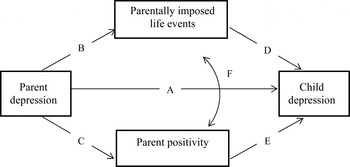
Path analysis was used for primary analyses. Correlation coefficients between parent and offspring depressive symptoms and between parent depressive symptoms and measures of the caregiving environment were first calculated separately in related and unrelated parent–child dyads. Potential mediation of the association between parent depression and child depression by the measured environmental factors was examined using the path analysis model outlined in Figure 1. The significance of indirect paths linking parental and child depressive symptoms via parental positivity (paths C and E) were tested while controlling for the effect of parental depression on parentally imposed life events and vice versa. The difference in the magnitude of paths via positivity and life events (Figure 1) in related and unrelated groups was evaluated using stacked modeling procedures. This involves comparison of the chi-square (χ2) statistic derived from a model where a specific pathway is treated as equivalent across groups to that derived from a model where the path in each subgroup model (related or unrelated) is allowed to freely vary. The magnitude of difference per degree of freedom change in these χ2 statistics provides an estimate of the significance of the difference between related and unrelated parent–child pairs. In order to address potentially inflated correlations due to shared method variance, cross rater associations were examined where mothers and fathers reported on their own depressive symptoms and the other parent reported on child symptoms. Therefore, only two-parent families were included in the analyses presented. Child depressive symptoms were adjusted for age and gender by regressing depressive symptoms on age and gender and analyzing the unstandardized residuals. Where analyses were carried out separately for boys and girls, age was adjusted for in the same way.
The path analysis model.

In the related group, association between parent and child variables can be due to both genetic and environmental factors. In the unrelated group, association can only be due to environmental factors. Therefore, if association is seen in both related and unrelated pairs, this suggests environmental factors underlie the association. In contrast, if association is seen only in the related group (and not in the unrelated group), this suggests that genetic factors account for the association. Where both genetic and environmental factors contribute, the association will be present in both groups but greater in the genetically related parent–child dyads. A significant difference in the magnitude of an association in related and unrelated groups would indicate that genes predominantly account for the association. For instance, a significant group difference in the association between parent depression and child depression via parental positivity would indicate that association was due predominantly to parental genotype. However, as discussed above, passive rGE can exist in cases where it fully accounts for an association and in cases where it only partly accounts for an association. Thus, a significant group difference in association for related and unrelated pairs is not necessary to show the presence of passive rGE but rather to show that passive rGE dominates the observed association.
Results
Descriptives
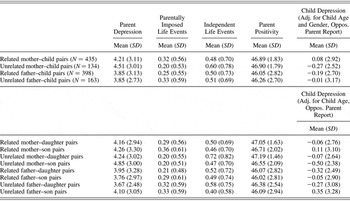
Conception group differences for key study variables were examined through one-way analysis of variance with child gender and age included as covariates. There were no significant differences according to relatedness group for any of the variables examined (all Fs < 2.78, all ps >.10). Means and standard deviations are shown in Table 1.
Means (standard deviations) for genetically related and unrelated mother–child and father–child pairs

Correlational analysis
Intergenerational similarity
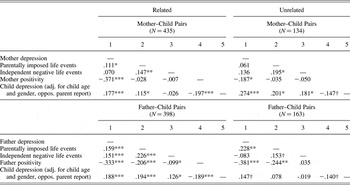
Table 2 illustrates correlations between key study variables according to parent–child relatedness separately for mothers and fathers. Results of analyses suggest that the intergenerational similarity of depression is largely due to environmental factors, given that associations are similar when mothers and fathers are unrelated to their children as described previously (Harold et al., Reference Harold, Rice, Hay, Boivin, van den Bree and Thapar2011; Lewis et al., Reference Lewis, Rice, Harold, Collishaw and Thapar2011; related mother–child pairs r = .177, p < .001; unrelated mother–child pairs r = .274, p < .001; related father–child pairs r = .188, p < .001; unrelated father–child pairs r = .147, p = .06).
Correlations for genetically related and genetically unrelated mother–child and father–child pairs

†p < .1. *p < .05. **p < .01. ***p < .001.
Partial correlations examining the association between parent–child depression, adjusting for the other parent's depressive symptoms, were calculated. In line with previous studies (Silberg et al., Reference Silberg, Maes and Eaves2010), we assume that assortative mating for depression is based on the measured phenotype for the trait. These partial correlations also attempt to adjust for shared reporter variance (e.g., between maternal depression and mother-rated child depression). Adjusting for assortative mating did not alter results substantially for mothers (related partial r = .117, p = .02; unrelated partial r = .206, p = .02), but the association for unrelated fathers was attenuated and nonsignificant when maternal depression symptoms were adjusted for (related fathers partial r = .139, p = .005; unrelated fathers partial r = .069, p = .381).
Parent depression and the caregiving environment
Correlations in Table 2 show that maternal and paternal depressive symptoms were significantly associated with reduced positivity toward the child regardless of genetic relatedness (related mother–child pairs r = –.371, p < .001; unrelated mother–child pairs r = –.187, p < .05; related father–child pairs r = –.333, p < .001; unrelated father–child pairs r = –.381, p < .001). Maternal and paternal depressive symptoms were also correlated with parentally imposed life events in all groups with the exception of unrelated mother–child pairs (related mother–child pairs r = .111, p < .05; unrelated mother–child pairs r = .061, p >.1; related father–child pairs r = .159, p < .001; unrelated father–child pairs r = .228, p < .01). Negative independent life events reported to have been experienced by the child were not associated with maternal or paternal depression, the exception being genetically related father–child pairs (r = .151, p < .01).
Associations between the caregiving environment and child depression
As an initial indication of passive rGE, correlations between the caregiving environment and child depression were examined in related and unrelated parent–child dyads. For both maternal and paternal positivity, there was some indication of passive rGE, given that the association with child depression was attenuated in unrelated parent–child pairs (related mothers r = –.197, p < .001; unrelated mothers r = –.147, p < .1; related fathers r = –.189, p < .001; unrelated fathers r = –.140, p < .1). For parentally imposed life events and child depression, there was no evidence of passive rGE for mothers, in that associations were present in related (r = .115, p < .05) and unrelated (r = .201, p < .05) mother–child pairs. For fathers the association was slightly greater in related (r = .194, p < .001) than unrelated (r = .078, p > .1) father–child pairs. For independent negative life events, as expected, there was no clear pattern of association contingent upon parent–child genetic relatedness.
Child gender
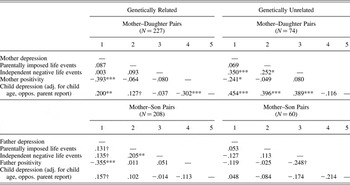
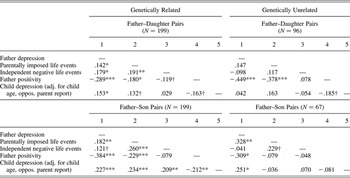
Correlations by parent and child gender are shown in Table 3 and Table 4. The contribution of genetic and environmental processes to the intergenerational transmission of depression differed by both parent and child gender. Mother–son transmission was only significant in related mothers and sons (related r = .157, p < .05; unrelated r = .048, p > .1). However, this pattern of results was not seen for father–son transmission with environmental factors contributing (related father–son pairs r = .227, p < .001; unrelated father–son pairs r = .251, p < .05). Mother–daughter transmission was present in both relatedness groups, implying environmental processes as previously reported (Lewis et al., Reference Lewis, Rice, Harold, Collishaw and Thapar2011; related r = .200, p < .01; unrelated r = .454, p < .001). Father–daughter transmission was present only in related father–daughter pairs (related r = .153, p < .05; unrelated r = .042, p > .1). Thus, environmental factors appeared to contribute in same-sex parent–child pairs.
Correlations for genetically related and genetically unrelated mother–daughter and mother–son pairs

†p < .1. *p < .05. **p < .01. ***p < .001.
Correlations for genetically related and genetically unrelated father–daughter and father–son pairs

†p < .1. *p < .05. **p < .01. ***p < .001.
Path analysis
Table 5 presents results from path analysis (Figure 1) carried out separately in related and unrelated parent–child pairs. Standardized path coefficients are presented, which are interpreted in the same way as standardized regression coefficients (see Bollen, Reference Bollen1989).

Maternal positivity
For genetically related mother–child pairs, significant paths were found between maternal depression and maternal positivity (path C, β = –0.37, p < .01). Maternal positivity was also significantly associated with child depression (path E, β = –0.15, p < .05). The correlation between maternal positivity and parentally imposed life events was nonsignificant (path F, β = 0.01). There was also a significant direct path linking maternal depression and child depression (path A, β = 0.11, p < .05). Thus direct and indirect paths through maternal positivity were observed for genetically related mother–child pairs.
In genetically unrelated mother–child pairs, a significant path was again found between maternal depression and maternal positivity (path C, β = –0.19, p < .05); however, there was no significant path between maternal positivity and child depression (path E, β = –0.09, p > .10). Thus, maternal positivity partially mediated the link between maternal depression and child depression only in genetically related mother–child pairs, which is consistent with passive rGE. The significance of the indirect path linking maternal depression to child depression via positivity was assessed. This indirect path was significant for related (β = 0.06, p < .01) but not unrelated (β = 0.02, p > .1) mother–child pairs. Stacked modeling procedures also showed that the pathway between maternal depression and maternal positivity was significantly greater in related than unrelated mother–child pairs (Δdf = 1, Δχ = 3.63, p < .05), although the magnitude of other parameter estimates for pathways shown in Figure 1 did not differ significantly between related and unrelated mother–child pairs.
Paternal positivity
In genetically related fathers, paternal depression was associated with paternal positivity (path C, β = –0.33, p < .01). The correlation between life events and positivity was also significant (path F, β = –0.15, p < .05). Paternal positivity significantly influenced child depression (path E, β = –0.12, p < .05). Finally, the direct path between paternal and child depression was significant (path A, β = 0.13, p < .05). Thus, there was evidence that paternal positivity partly explained the link between father and child depression in the related group. In genetically unrelated father–child pairs, paternal depression was associated with paternal positivity (path C, β = –0.38, p < .01). However, paternal positivity did not influence child depression (path E, positivity β = –0.09). The correlation between parentally imposed life events and positivity was non significant (path F, β = –0.13), and there was no significant direct path between father and child depression (path A, β = 0.10). Consistent with this, the indirect path linking paternal depression and child depression via paternal positivity was significant only in the related group (related β = 0.04, p < .05; unrelated β = 0.03, p > .1). However, stacked modeling procedures showed no significant differences in the magnitude of parameter estimates between related and unrelated father–child pairs.
Parentally imposed life events and maternal depression
For genetically related mother–child pairs, significant paths were found between maternal depression and parentally imposed life events (path B, β = 0.11, p < .05). Parentally imposed life events were also significantly associated with child depression (path D, β = –0.10, p < .05). However, the indirect effect via parentally imposed life events fell short of significance (β = 0.01, p > .1). In genetically unrelated mother–child pairs, maternal depression did not influence parentally imposed life events (path B, β = 0.06, p > .10), but parentally imposed life events did influence child depression (path D, β = 0.18, p < .05) and the indirect path was not significant (β = 0.01, p > .1). The correlation between parentally imposed life events and maternal positivity was nonsignificant in both related and unrelated mother–child pairs. Finally, there was a significant direct path linking maternal depression and child depression in unrelated mother–child pairs (path A, β = 0.25, p < .05). Thus, an indirect pathway from maternal depression to child depression via parentally imposed life events was observed only in the related mother–child pairs, consistent with passive rGE. However, the indirect path was small, and formal testing revealed it was not significant in related or unrelated mother–child pairs.
Parentally imposed life events and paternal depression
In genetically related fathers, paternal depression was associated with parentally imposed life events (path B, β = 0.16, p < .05). Life events in turn influenced child depression (path D, β = 0.15, p < .05). In genetically unrelated father–child pairs, paternal depression was associated with parentally imposed life events (path B, β = 0.29, p < .05) but did not influence child depression (path D, life events β = 0.03; path E, positivity β = –0.09). The indirect path via life events showed a trend toward significance for the related fathers (β = 0.02, p < .1) but no significant association in the unrelated fathers (β = 0.01, p > .1). To summarize, consistent with results for mothers, both paternal positivity and parentally imposed life events partially mediated the link between paternal depression and child depression only in genetically related father–child pairs, which is consistent with passive rGE. Paternally imposed life events were associated with a significant reduction in paternal positivity only in genetically related fathers.
Independent negative life events
As expected, there was no evidence that negative independent life events mediated the association between parental depression and child depression in either related or unrelated parent–child pairs (results available from first author).
Child gender
Path analysis was carried out separately by parent and child gender (Table 5). Correlations separated by parent and child gender are presented in Tables 3 and 4. In general, the pattern of correlations did not show large differences in the association between parent depression and parent positivity according to child gender, with similar results for boys and girls separately to that observed in the full sample (Tables 3 and 4). The pattern of association between parental positivity and child depression and between parentally imposed life events and child depression did not differ markedly by child gender. Results of path analyses showed evidence of greater passive rGE for same-sex parent–offspring pairs. For fathers, there was evidence of passive rGE via parentally imposed life events for father–son transmission only (related father–son pairs, path B, β = 0.18, p < .05; path D, β = 0.18, p < .05; related father–daughter pairs, path B, β = 0.14, p > .1; path D, β = 0.13, p > .1). Nevertheless, there was also a direct path between paternal depression and son depression in both related and unrelated father–son pairs, which indicates that passive rGE with life events did not fully account for intergenerational transmission. For mothers, there was evidence of passive rGE via maternal positivity for mother–daughter pairs only. For genetically related mother–daughter pairs, there was an indirect effect of maternal depression on child depression via maternal positivity (path C, β = –0.39, p < .01; path E, β = –0.26, p < .01), whereas this indirect effect was not observed in genetically related mother–son pairs (path C, β = –0.35, p < .01; path E, β = 0.01, p > .1). This indirect path was not present in unrelated mother–daughter or mother–son pairs. This result is therefore consistent with greater passive rGE for mother–daughter pairs than for mother–son pairs. There was no evidence of significant intergenerational transmission through the hypothesized pathways (Figure 1) in father–daughter or mother–son pairs.
Discussion
This study utilized a sample of children who differed in degree of genetic relatedness to their rearing parents as a result of assisted reproductive technologies in order to examine passive rGE for child depression. We examined the intergenerational transmission of depressive symptoms and tested for passive rGE with parentally imposed life events and parental positivity.
Intergenerational similarity
Intergenerational similarity of depressive symptoms was largely due to environmental factors, in that associations were present in both related and unrelated parent–child dyads. This finding is consistent with a previous study of this cohort that examined child internalizing symptoms as an outcome measure (Lewis et al., Reference Lewis, Rice, Harold, Collishaw and Thapar2011) and with two previous studies that used a children of twins design (Silberg et al., Reference Silberg, Maes and Eaves2010; Singh et al., Reference Singh, D'Onofrio, Slutske, Turkheimer, Emery and Harden2011). The similarity of findings across studies with differing age ranges of participants and different measurements of depression is noteworthy and affords greater confidence in results as they converge across study designs, measurements, and age groups.
We then examined whether environmental transmission differed according to child gender and found evidence for genetic contributions to mother–son transmission consistent with a previous analysis of this sample (Lewis et al., Reference Lewis, Rice, Harold, Collishaw and Thapar2011). However, no genetically sensitive study to date has examined father to child transmission separately for boys and girls. Here, we found evidence to support a greater environmental contribution to father–son than father–daughter transmission. This finding of reduced environmental transmission for opposite-sex parent–child pairs seems likely due to either passive rGE or rater effects. There are at least two plausible biological explanations for gender differences in genetic transmission: (a) qualitative sex differences (i.e., different sets of genes influence the phenotype in males and females) or (b) quantitative sex differences (i.e., genes influence the phenotype to different extents in males and females). The first type of explanation would have the effect of increasing genetic influences in same-sex compared to opposite-sex parent–child dyads, which is opposite to the pattern we observed. The second explanation would have the effect of increasing genetic effects in, for instance, boys compared to girls. Although we do observe a greater genetic contribution for opposite-sex parent–child pairs, this is not consistently observed for a single child gender (e.g., boys). Given that girls and boys inherit an equal proportion of maternal and paternal genes, our observed pattern of results does not seem to be biologically plausible. Instead, it seems likely that this result is attributable to passive rGE, rater effects, or chance. Results of path analysis were not consistent with greater passive rGE via parental positivity and/or parentally imposed life events for opposite-sex parent–child pairs. Although we attempted to take shared method variance into account in our intergenerational similarity analysis by using the opposite parent to report on the child's symptoms, it is known that mother and father ratings of child psychopathology are influenced by different parent and offspring characteristics (Hay et al., Reference Hay, Pawlby, Sharp, Schmucker, Mills and Allen1999), and mother and father ratings of child psychopathology are not completely independent of each other. Thus, it is possible that some kind of rater effect may explain the pattern of greater environmental transmission observed for same-sex parent–offspring pairs. Finally, because separate analyses by child gender and by parent–offspring relatedness included small sample sizes, we cannot rule out the possibility that this is a chance finding and it merits attention in additional types of genetically sensitive designs. Additional work is needed to identify the specific environmental factors that contribute to the intergenerational transmission of depression.
Passive rGE
We expected to observe the following pattern of association if passive rGE was present. Parental depression would be associated with measured aspects of the caregiving environment regardless of the child's genetic characteristics, associations between aspects of the caregiving environment and child depression would be stronger when parent and child are genetically related, and measured aspects of the caregiving environment would mediate the association between parental and child depression only when parent and child are genetically related.
Parental positivity
Maternal positivity
Maternal depression was associated with reductions in maternal positivity to child regardless of parent–child relatedness. There was evidence of passive rGE from correlations and path analysis conducted separately in related and unrelated mother–child pairs. Correlations between maternal positivity and child depression were greater in related compared to unrelated mother–child pairs. Consistent with passive rGE, results of path analysis showed an indirect path linking maternal and child depression via maternal positivity that was present only in related mother–child pairs. Formal testing of the significance of the indirect path from maternal depression via reduced positivity to child depression showed that this was significant only in genetically related mother–child pairs. The path linking maternal depression and positivity was also significantly greater in related than unrelated mother–child pairs. There was also evidence that this passive rGE via maternal positivity was greater for mother–daughter pairs than for mother–son pairs.
Paternal positivity
Results were very similar to those observed for maternal positivity. Paternal depression was associated with reduced positivity regardless of the father's genetic relatedness to the child. Paternal positivity influenced child depression more strongly in related father–child pairs than in unrelated father–child pairs although there was a trend toward association in the unrelated pairs, which implies that this association is not entirely due to passive rGE. Results of path analysis indicated that paternal positivity partially mediated the link between paternal depression and child depression only in related father–child pairs, and this indirect path was significant only in related father–child pairs. Thus, there was evidence of a contribution of passive rGE for paternal positivity, although it did not fully account for the association between paternal and child depression (as there was still a significant direct path from parent to child depression, consistent with the results for mothers). The indirect path between paternal depression and child depression via paternal positivity was nonsignificant when analyses were run separately by child gender.
Parentally imposed life events
There was evidence that passive rGE made a contribution to the link between parent depression, parentally imposed life events, and child depression for both mothers and fathers with evidence of a stronger effect in father–child pairs. When analyses were run separately by child gender, this was only significant for father–son transmission. The correlation between parentally imposed life events and positivity was significant only in fathers, so it is also possible that stressful life events may have a greater influence on expressed positivity to children in fathers than in mothers. Nevertheless, it is important to note that the contribution of passive rGE via life events was smaller than that observed for parental positivity (indirect effects of parent depression on child depression via parentally imposed life events fell short of statistical significance in related mother and related father–child pairs). This is consistent with evidence that stressful life events exert a modest causal effect on depression when genetic influences on life event exposure are taken into consideration (Kendler & Gardner, Reference Kendler and Gardner2010).
The present study used a genetically sensitive design that made it possible to disentangle inherited and environmental contributions to the intergenerational transmission of depression. Very few types of study design are able to address questions of genetic and environmental contributions to intergenerational transmission processes. Nevertheless, there are a number of limitations and issues in this study that warrant discussion. In this study, we examined rGE and did not consider the possibility of gene–environment interaction. Children may differ in genetic susceptibility to the same environmental risk, and it should be recognized that rGE and gene–environment interaction may not be independent and may simultaneously influence risk for depression (Eaves, Silberg, & Erkanli, Reference Eaves, Silberg and Erkanli2003).
One of the reasons we outlined for examining passive rGE for depression is the discrepancy between findings from twin and adoption studies. However, differences in the results of twin and adoption studies could also be attributable to factors other than passive rGE. In particular, twin studies compare siblings of exactly the same age whereas adoption studies do not, thus any developmental differences in the etiology and phenomenology of depression will be controlled for in twin but not adoption studies. Thus, if there were genetic heterogeneity between childhood and adult depression, this would affect the ability of a parent–offspring adoption design to detect significant genetic influences. Longitudinal twin studies do suggest that genetic influences on depression differ between childhood, adolescence, and adulthood (Kendler, Gardner, & Lichenstein, Reference Kendler, Gardner and Lichtenstein2008; Lau & Eley, Reference Lau and Eley2006; Scourfield et al., Reference Scourfield, Rice, Thapar, Harold, Martin and McGuffin2003). Thus, it is possible that genetic heterogeneity between generations could make it difficult to detect genetic transmission. A limitation of our study is that we focused on a restricted set of family variables that might not be capturing either those constructs that are mediating risk through environmental mechanisms or those that most strongly contribute to passive rGE. For example, alternative variables that might be tested in the future could include measures that assess modeling of parental depressive behaviors, negative cognitive style, or parental withdrawal.
We took the approach of utilizing parent self-reports of depressive symptoms and the opposite parent's report of child depressive symptoms in order to address potentially inflated correlations due to shared method variance. However, maternal and paternal reports of child psychopathology each provide unique information, and intercorrelations among different informants are often low (Cantwell, Lewinsohn, Rohde, & Seeley, Reference Cantwell, Lewinsohn, Rohde and Seeley1997; Des Los Reyes & Kazdin, Reference De Los Reyes and Kazdin2005; Hay et al., Reference Hay, Pawlby, Sharp, Schmucker, Mills and Allen1999), meaning that using the cross-informant approach could have influenced results (Rutter, Pickles, Murray, & Eaves, Reference Rutter, Pickles, Murray and Eaves2001). We also relied on questionnaire measures of parenting behavior, which differ from direct observations of behavior. Our measure of parentally imposed life events examined life events potentially due to both parents' behavior (e.g., quarreling) as well as behaviors primarily due to one parent's behavior (e.g., mother losing job). Thus, although when examining maternally imposed life events we dropped behaviors that were due to paternal behavior (and vice versa), we were unable to separately examine the effect of maternally and paternally imposed life events, which could have affected our results. Cell numbers were small for some comparisons especially when examining the influence of child gender in the unrelated parent–offspring groups, so the influence of child gender on intergenerational transmission processes requires examination in other genetically sensitive study designs. The sample includes fewer unrelated than related parent–child pairs. It is possible that the difference in sample size between related and unrelated groups may contribute to nonsignificant findings in the unrelated group when effect sizes are small. We examined the transmission of depressive symptoms, and results may differ for more severe symptomatology. Finally, although mean levels of warmth and positivity do not differ markedly between families with children conceived via a range of types of assisted reproductive technologies compared to naturally conceived children (Golombok & MacCallum, Reference Golombok and MacCallum2003; Golombok et al., Reference Golombok, Murray, Jadva, Lycett, MacCallum and Rust2006; Shelton et al., Reference Shelton, Boivin, Hay, Boivin, van den Bree and Thapar2009), the effects of parent positivity in families of wanted children conceived through assisted reproductive technologies might be very different to higher risk families. This may therefore limit the generalizability of these findings to naturally conceived families.
Conclusion and Future Directions for Translating Research on rGE Into Intervention
It is essential to recognize the contribution of rGE, including passive rGE, where the goal is to identify causal environmental risk factors on child psychopathology. If prevention and early intervention strategies for child and adolescent depression are to be effective, they need to be targeted at risks that are likely to be causal. The use of different types of research design that include genetically informative studies, randomized controlled trials, and quasiexperimental studies can help elucidate likely causal factors (Rutter, Reference Rutter2007). The present study suggests that although improving parent positivity and reducing parent-related stressors might be helpful for some aspects of child adjustment and family life, they do not appear to be priority targets for reducing child depression symptoms. Further work needs to be undertaken to identify environmental contributors to the intergenerational transmission of depression.