INTRODUCTION
HIV−Associated Neurocognitive Disorders (HAND) affect approximately one-third to half of persons living with HIV disease (e.g., Heaton et al., Reference Heaton, Clifford, Franklin, Woods, Ake and Vaida2010). HAND is major risk factor for problems in both real-world (e.g., unemployment) and health-related (e.g., medication non-adherence) activities (see Gorman, Foley, Ettenhofer, Hinkin, & van Gorp, Reference Gorman, Foley, Ettenhofer, Hinkin and van Gorp2009), which in turn increase risk of disability and reduce quality of life (Wilson & Cleary, Reference Wilson and Cleary1995). One overlooked aspect of everyday function that plays an increasingly fundamental role in daily life is Internet navigation skills. Advances in Internet technology over the past 15 years have transformed the ways in which people navigate their day-to-day world. Persons living with HIV disease are often tasked with using the Internet to obtain essential health information (e.g., symptoms), manage their healthcare (e.g., schedule medical appointments), access psychosocial support resources (e.g., social networking), and perform various household activities (e.g., manage finances). Approximately two-thirds of HIV−infected individuals require assistance in using the Internet (Mayben & Giardino, Reference Mayben and Giordano2007), which may be driven by a host of medical, psychiatric, and psychosocial factors.
There are considerable risks involved when using the Internet for daily activities, including obtaining erroneous information about healthcare (e.g., Kunst, Groot, Latthe, Latthe, & Khan, Reference Kunst, Groot, Latthe, Latthe and Khan2002) and financial mismanagement (e.g., banking scams). Accordingly, Internet navigation difficulties can represent a serious barrier to optimal daily functioning, particularly for underserved HIV−infected populations from disadvantaged backgrounds, who may have difficulty using this increasingly ubiquitous technology.
It is also plausible that mild neurocognitive deficits could interfere with Internet navigation. Many of us have experienced the frustrations of forgetting Internet log-in passwords or difficulty navigating complex Web sites to find information and perform transactions. To date, however, only four studies have examined the association between Internet navigation and neurocognitive functions. In 2010, Goverover et al. reported that 21 persons with multiple sclerosis (MS) performed significantly worse than 18 healthy adults on a task in which participants were asked to use the Internet to purchase a round-trip airline ticket. Internet navigation was not related to verbal fluency, disability, or quality of life. However, within the MS group, Internet navigation was associated with information processing speed, episodic memory, and novel problem-solving, as well as with working memory and visuoperception (see also Goverover, Chiaravallloti, & DeLuca, Reference Goverover, Chiaravalloti and DeLuca2016).
More recently, Goverover & Deluca (Reference Goverover and DeLuca2015) observed that 10 persons with moderate-to-severe traumatic brain injury performed significantly worse than 10 healthy adults on a task requiring them to use the Internet to purchase baked goods. Once again, online task performance was associated with information processing speed, episodic memory, and executive functions. Slower Internet task completion speed was related to higher levels of self-reported depression and lower quality of life. Finally, a recent study from our group demonstrated poorer health-related Internet navigation (i.e., pharmacy refill and online health records) in 19 persons with HAND as compared to 27 HIV+ persons without HAND and 21 seronegatives (Woods et al., Reference Woods, Iudicello, Morgan, Cameron, Doyle and Smith2016). Poorer performance on these health-related Internet tasks was specifically associated with worse episodic memory, executive dysfunction, lower education, higher plasma HIV RNA, and lower health literacy, including poorer performance on the Medication Management Test-Revised. Thus, there is compelling evidence to suggest that neurocognitive functions may play a role in Internet navigation.
Accordingly, the aim of this study was to examine the effects of HAND on Internet navigation skills for household shopping and banking. As compared to the voluminous prior research on the role of HIV−associated neurocognitive impairment in other ADLs, relatively little is known specifically about financial management and shopping. Our review of the available literature revealed five studies that examined the neurocognitive aspects of financial management in HIV disease, most of which used the paper and pencil version of the modified Direct Assessment of Functional Status (Loewenstein et al., Reference Loewenstein, Amigo, Duara, Guterman, Hurwitz, Berkowitz and Gittelman1989). These studies generally show that HAND is associated with medium-to-large deficits in financial management (i.e., Ghandi et al., Reference Gandhi, Skolasky, Peters, Moxley, Creighton, Roosa and Sacktor2011; Heaton et al., Reference Heaton, Marcotte, Mindt, Sadek, Moore and Bentley2004; Mindt et al., Reference Mindt, Cherner, Marcotte, Moore, Bentley and Esquivel2003), with poorer performance being associated with greater executive dysfunction (e.g., Thames et al., Reference Thames, Kim, Becker, Foley, Hines, Singer and Hinkin2011) and possibly IADL dependence (Heaton et al., Reference Heaton, Marcotte, Mindt, Sadek, Moore and Bentley2004, cf. Thames et al., Reference Thames, Kim, Becker, Foley, Hines, Singer and Hinkin2011).
A recent study by Rosenthal et al. (Reference Rosenthal, Skolasky, Moxley, Roosa, Selnes, Eschman and Sacktor2013) used a computerized ATM task that asked participants to make several typical transactions, but revealed no apparent effects of HIV serostatus or HAND. This computerized task represents a recent trend toward developing more modern, digital versions of traditional everyday functioning tasks in various clinical populations (e.g., Ruse et al., Reference Ruse, Davis, Atkins, Krishnan, Fox, Harvey and Keefe2014). With regard to the shopping literature in HIV disease, we identified only three prior studies. Heaton et al. (Reference Heaton, Marcotte, Mindt, Sadek, Moore and Bentley2004) observed large effects of HAND on a role-play shopping task, performance on which was most strongly associated with executive dysfunction (but not IADL dependence). In contrast, Mindt et al. (Reference Mindt, Cherner, Marcotte, Moore, Bentley and Esquivel2003) did not see an association between role-play shopping and HAND status in a very small sample of 16 Spanish-speaking adults. Finally, Rosenthal et al. (Reference Rosenthal, Skolasky, Moxley, Roosa, Selnes, Eschman and Sacktor2013) observed adverse effects of HAND on a virtual reality shopping task, which were largely obviated when the covaried for hepatitis C and depression. Nevertheless, performance on the virtual reality shopping task was correlated with clinician rated disability and medication management in the HIV+ sample.
Considering this literature review, the current study sought to evaluate the hypothesis that persons with HAND would demonstrate deficits in navigating Internet-based household tasks (i.e., financial management and shopping) as compared to HIV+ persons without HAND and HIV− comparison participants. Furthermore, we anticipated that poorer Internet-based task performance would be associated with worse episodic memory, executive dysfunction, and psychomotor slowing, as well as worse everyday functioning as measured by performance-based laboratory tests and standardized questionnaires.
METHODS
One hundred thirty-four participants were enrolled from ongoing studies at the UC San Diego HIV Neurobehavioral Research Program (HNRP), which recruits potential participants from the local community, HIV clinics, and community-based organizations. This study was approved by the human research ethics board at UC San Diego. Exclusion criteria for this study included medical conditions that might interfere with neurocognitive functions (e.g., seizure disorders, closed head injury, and stroke), severe psychiatric conditions (e.g., psychosis), positive Breathalyzer for alcohol or urine toxicology for illicit drugs, and use of the Internet<5 times over the past 5 years.
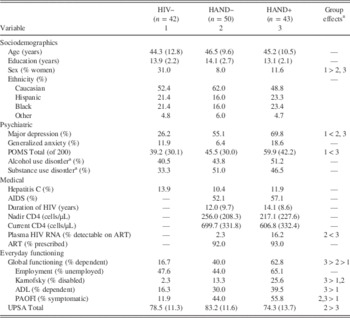
HIV serostatus was determined with Medmira rapid tests. Participants were classified into three primary study groups: HIV− (n=42), HIV+ without HAND (HAND−; n=50), and HIV+ with HAND (HAND+; n=43). Note that the 63 participants described in the health-related Internet study recently published by Woods et al. (Reference Woods, Iudicello, Morgan, Cameron, Doyle and Smith2016) were included as a subset of the current cohort of 134 participants (21 HIV−, 24 HAND−, and 18 HAND+). The demographic, psychiatric, and medical characteristics of the cohort are shown in Table 1. The three study groups were broadly comparable on age, education, race/ethnicity, substance use disorders, and hepatitis C infection (ps>.10). However, there was a higher proportion of men and diagnoses of lifetime major depressive disorder in the two HIV+ groups (ps<.05). The HAND+ participants had higher current levels of affective distress as compared to the HIV− group (p<.05) and higher plasma HIV RNA levels as compared to the HAND− group (p<.05). The HIV+ groups with and without HAND did not differ in any other disease or treatment variables (ps>.10).
Demographic and clinical characteristics of the study groups

Note. POMS=Profile of Mood States; AIDS=acquired immune deficiency syndrome; ART=antiretroviral therapy; UPSA=UCSD Performance-Based Skills Assessment; PAOFI=Patient Assessment of Own Functioning Inventory.
a Denotes any lifetime disorder.
Clinical Characterization
In the HIV+ groups, diagnoses of HAND were based on the results of comprehensive neuropsychological, psychiatric, and medical evaluations that were derived from the HNRP parent study. The neurocognitive batteries used to derive HAND classifications were constructed in accordance with Frascati research diagnostic criteria (Antinori et al., Reference Antinori, Arendt, Becker, Brew, Byrd, Cherner and Gisslén2007). Details regarding the specific tests that comprise these batteries are available elsewhere (Woods et al., Reference Woods, Iudicello, Morgan, Cameron, Doyle and Smith2016) and are also summarized below. In brief, raw scores were converted to demographically adjusted t scores, which were then used to generate a Global Deficit Score for which a cutpoint of ≥0.5 was used to designate persons with global neurocognitive impairment for determination of HAND (Carey et al., Reference Carey, Woods, Gonzalez, Conover, Marcotte and Grant2004). Among the 43 HIV+ participants with HAND, 16 were diagnosed with asymptomatic neurocognitive impairment (37.2%), 23 had minor neurocognitive disorder (53.5%), and 4 met criteria for HIV−associated dementia (9.3%).
A neuromedical exam, history, and phlebotomy/labs provided information on HIV disease severity. Hepatitis C virus (HCV) was determined by clinical interview and based on current or prior infection (NB. no participant was undergoing interferon-based therapy for HCV). Lifetime mood and substance use disorders were determined with the Composite International Diagnostic Interview (Version 2.1) (World Health Organization, 1998). Current mood was assessed using the Profile of Mood States (POMS) (McNair, Lorr, & Droppleman, Reference McNair, Lorr and Droppleman1981).
Online Assessment of Everyday Functioning
Participants were assessed using two Web-based tests, the Simulated Market Task (S-MarT), and the Web-based Evaluation of Banking Skills (WEBS), which were developed in PHP and Javascript. Raw data on participant actions (i.e., page loads and what triggered them) were stored in a MySQL database and later analyzed via a scoring script.
S-MarT
The S-MarT is a Web-based measure of online household shopping skills. In brief, participants are asked to independently navigate a simulated online superstore (see Supplementary Figure 1) to purchase eight specific items (e.g., cold/allergy medicine, and a shirt appropriate for a job interview) within a predetermined budget. The task instructions were printed on a sheet of paper placed in front of participants during the entire examination. To enhance familiarity and ecological relevance, the design of the S-MarT Web site was modeled after major Internet shopping sites (e.g., Amazon.com). In total, the S-MarT site includes over 60 pages that contain approximately 325 individual items.
At the home page, there were six different browsing categories (i.e., personal care and pharmacy, women’s clothing, men’s clothing, electronics, gifts, and home products), as well as a virtual shopping cart. Participants were asked to independently navigate the site to identify the correct items to be purchased. Before the task began, participants were instructed to attend to any instant messages that appear during the task, as the content of one of those messages may change their shopping list. A total of five instant messages appeared at pre-prescribed times during the task and one message instructed the participants to modify their shopping list. Participants were also presented with advertising “pop-ups” that occurred at pre-determined times during the task. Once participants identified an item they wished to purchase, they could place it in a virtual shopping cart by clicking on the appropriate prompts.
At any time during the task, participants could check-out using a mock credit card and associated mock personal and shipping information (e.g., address). Primary metrics of interest for this study were S-MarT failures (i.e., inability to successfully check out within the 40-min time limit), total correct (i.e., the number of correct shopping list items placed in the cart), total time to completion, and error rates (e.g., log-in, credit card).
WEBS
The WEBS is a measure of online financial management skills that was adapted and modernized from existing paper and pencil tasks (e.g., Heaton et al., Reference Heaton, Marcotte, Mindt, Sadek, Moore and Bentley2004; Mausbach, Harvey, Goldman, Jeste, & Patterson, Reference Mausbach, Harvey, Goldman, Jeste and Patterson2007). We modeled the design of the WEBS Web site (see Supplementary Materials) after major online banks (e.g., Wells Fargo) to maximize its familiarity and naturalistic appeal. To integrate WEBS with S-MarT, we used the mock Southern California National Bank name, which was on the credit card that subjects used in S-MarT paradigm described above.
Participants begin at the login page of the online bank in which they were asked to enter a mock user name and account number, which were provided for them by the examiner. They were also required to create a unique access code for their account. Once successfully logged in, participants were directed to the online home page on which their online accounts are displayed, including two cash accounts (i.e., savings and checking), two credit accounts (i.e., Visa and MasterCard), and two loans (i.e., automobile and personal). On the top of the page were links to various actions that are available to take on the site, including funds transfer, messages, bill pay, account services, statements and documents, and products (e.g., refinancing). Each of these subcategory links contains multiple relevant sublinks (e.g., an email interface for “messages”). The WEBS site includes four main sections (including login page) and six sub-pages.
Participants independently navigated the site using the computer mouse to complete the following tasks (in a maximum of 20 min): (1) transfer $175 from checking to pay an energy bill; (2) set an automatic bill pay on the energy account for $175 to occur on the 4th Thursday of the month; (3) transfer at least $150 from checking to pay down the balance of the credit card, to ensure that there are sufficient credit funds to pay for the S-MarT shopping items; (4) leave a balance of $1000 in their checking account, which required them to transfer $250 from their savings account; and (5) scrutinize their account transactions for the past month to determine if any errors were present, in which case they were instructed to send a message to customer support to inform the bank of the problem and request that it be corrected. Note that we embedded an apparent error in the transaction list (i.e., a charge that was duplicated five times in a row). WEBS outcomes of interest included task failure (i.e., inability to complete the prescribed tasks within the 20-min time limit) and measures of accuracy (e.g., correct tasks completed, log-in errors) and speed (e.g., time to completion).
Neurocognitive Correlates
Domain-based raw neurocognitive test scores were generated for correlational analyses with S-MarT and WEBS. The seven domains were constructed using sample-based Z-scores and included: (1) Motor: dominant and non-dominant hands of the Grooved Pegboard Test (Kløve, Reference Kløve1963); (2) Processing speed: WAIS-III Digit Symbol total (Psychological Corporation, 1997), Trailmaking Test Part A total time (Reitan & Wolfson, Reference Reitan and Wolfson1985), and detection (reaction time) and identification (reaction time) subtests of the CogState (www.cogstate.com); (3) Attention/Working Memory: PASAT-50 (Gronwall, Reference Gronwall1977) and the one-back (accuracy) and two-back (accuracy) subtests from the CogState; (4) Learning: Hopkins Verbal Learning Test-Revised (HVLT-R) Total 1-3 (Brandt & Benedict, Reference Brandt and Benedict2001), Brief Visuospatial Memory Test – Revised (BVMT-R) Total 1–3 (Benedict, Reference Benedict1997), and CogState one-card learning (accuracy); (5) Memory: HVLT-R Delayed Recall (Brandt & Benedict, Reference Brandt and Benedict2001), BVMT-R Delayed Recall (Benedict, Reference Benedict1997), and CogState continuous paired associates (accuracy); (6) Verbal Fluency: animals and letter/FAS (Delis, Kaplan, & Kramer, Reference Delis, Kaplan and Kramer2001); and (7) Executive Functions: Wisconsin Card Sorting Test (WCST-64; Heaton, Reference Heaton1993) perseverative responses, Trailmaking Test Part B total time (Reitan & Wolfson, Reference Reitan and Wolfson1985), and the Iowa Gambling Task (Bechara, Reference Bechara1994) total.
Everyday Functioning Correlates
Global functional impairment was operationalized using a composite approach (Blackstone et al., 2013). Participants were classified as “functionally dependent” if they met two or more of the following criteria: (1) unemployed; (2) reported two or more declines from “best” to “now” on the modified version (Heaton et al., Reference Heaton, Marcotte, Mindt, Sadek, Moore and Bentley2004) of the Activities of Daily Living Scale (ADL; Lawton and Brody, Reference Lawton and Brody1969); (3) scored<90 on the Karnofsky Scale of Performance Status (Karnofsky and Burchenal, Reference Karnofsky and Burchenal1949); or (4) endorsed three or more items as “fairly often” on the Patient’s Assessment of Own Functioning Inventory (Chelune, Heaton, & Lehman, Reference Chelune, Heaton and Lehman1986).
Note that inclusion of unemployment in the global score is somewhat controversial given its multifactorial nature and the high prevalence of unemployment in HIV disease and subsequent possible inflation of functional decline rates. However, its inclusion here reflects: (1) our belief that its high prevalence actually warrants its inclusion to avoid Type II error; (2) its reliable associations with neurocognitive impairment and inclusion in the diagnosis of HAND (Antinori et al., Reference Antinori, Arendt, Becker, Brew, Byrd, Cherner and Gisslén2007); (3) the fact that prior research includes unemployment in global functional indexes (e.g., Blackstone et al., 2013); and (4) that its exclusion from the current index did not change the pattern of findings.
All participants were administered the brief version of the UCSD Performance-Based Skills Assessment (UPSA; Mausbach et al., Reference Mausbach, Harvey, Goldman, Jeste and Patterson2007), which is a well-validated performance-based measure of functional capacity. Participants are asked to role-play activities that are designed to mimic two areas of everyday functioning: Finances (e.g., balance a checkbook to pay household bills) and Communication (e.g., reschedule a medical appointment).
Finally, since both Internet tasks had strong mathematical elements, we were interested in their association with numeracy. Participants were administered the Expanded Numeracy Scale (Lipkus, Samsa, & Rimer, Reference Lipkus, Samsa and Rimer2001), which assesses participants’ familiarity with health-related probabilities, percentages and proportions, and has previously been used in HIV (Morgan et al., Reference Morgan, Iudicello, Cattie, Blackstone, Grant and Woods2015). We also administered the numeracy scale of the Test of Functional Health Literacy in Adults (TOHFLA; Parker et al., 1995), which uses applied health-related numerical problems. In an effort to minimize Type I error, we created a composite numeracy score using the mean of the sample-based raw total Z-scores on these two measures.
Internet Use and Anxiety Correlates
Finally, participants completed a brief self-report questionnaire regarding their Internet use habits, including whether they own (or have regular access to) a personal computer, and how often and for what purposes they use the Internet (e.g., shopping and banking). Participants were asked about the frequency and severity of any difficulties they experience performing everyday functioning tasks online. In addition, participants completed items from the Computer Anxiety Scale (CAS), which asks about general anxiety related to using computers and the Internet.
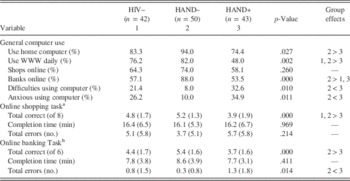
As can be seen in Table 2, participants with HAND were less likely to use a home computer, use the Internet daily, use the Internet for ADLS, and were more likely to report computer-related anxiety and difficulties using the Internet (ps<.05). Anxiety was related to total correct, but not time to completion on both tasks (ps<.05). Note that, for all of the measures that differed across the groups, inclusion in the primary statistical models did not meaningfully alter the effects of HAND on the S-MarT or WEBS outcomes.
Computer and Internet use characteristics of the study groups

Note: HAND=HIV-associated neurocognitive disorders; WWW=World-Wide Web.
a HIV− n=41, HAND− n=50, and HAND+n=42.
b HIV− n=40, HAND− n=49, and HAND+n=35
RESULTS
Online Shopping: The S-MarT
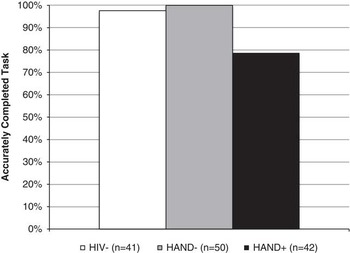
We first sought to determine relevant clinical covariates for planned analyses examining the effects of HAND group on the primary S-MarT variables of interest. None of the variables in Table 1 that differed across the three study groups (i.e., sex, MDD, POMS total, and HIV RNA in plasma) were significantly associated with primary S-MarT variables (all ps>.05). Moreover, exploratory regressions including these variables as covariates did not alter the significant HAND effects described below. As such, we used simple analyses of variance (ANOVAs) with planned post hoc comparisons using Tukey-Kramer HSD and Hedges g effect sizes for continuous S-MarT variables and chi-square tests and odds ratios for the primary dichotomous outcome (S-MarT failure). Results are displayed in Table 2 and Figure 1.
Proportion of the study groups who successfully completed the online shopping task.

HAND was associated with a significantly higher failure rate on S-MarT (p<.05), with odds ratios of 10.9 (95% confidence interval, 1.9–206) and 13.6 (1.6–110) as compared to the HIV− and HAND− groups, respectively (See Figure 1). Individuals in the HAND group also had fewer items correct at check-out as compared to the HAND− (p=.0002; g=−0.88) and HIV− (p=.027; g=−0.52) groups. There were no overall group effects on S-MarT time to completion or error rates nor between the HIV− and HAND− groups on any variable (ps>.10).
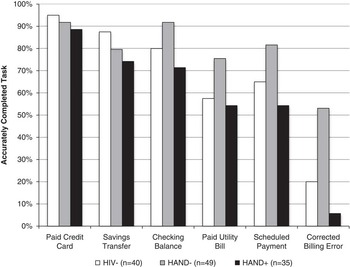
Proportion of the study groups who successfully completed the individual online banking items.

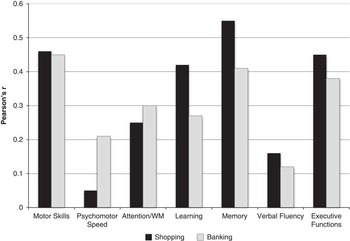
Neurocognitive correlations were conducted only in the HAND+ group. Figure 3 shows that S-MarT total items correct had medium-to-large correlations in the expected direction with several of the neurocognitive domains (ps<.05), including learning, memory, executive functions, and motor skills. S-MarT performance was not associated with verbal fluency, attention/working memory, or information processing speed (ps>.05). S-MarT total items correct was also positively correlated with the numeracy composite (r=.53; p=.0003). Note that this same pattern of associations with neurocognitive outcomes was observed if we used S-MarT failure rather than total correct items at check-out (data not shown).
Correlations between neurocognitive domains and online shopping (n=42) and banking (n=35) total scores in the HAND group.

To examine the everyday functioning correlates of S-MarT, a series of univariate ANOVAs, Pearson product-moment correlations, and chi-square analyses were undertaken in the HIV+ group as a whole (N=92). This allowed us to include conceptually relevant covariates (i.e., neurocognitive impairment, major depressive disorder, and AIDS status) to examine the unique variance in everyday functioning outcomes that could be explained by online shopping skills. Results showed that S-MarT failure was uniquely associated with UPSA-Brief (adjusted R 2 =0.13; B=−.35; p=.0007) and self-reported declines in shopping (adjusted R 2 =0.18; B=−.308; p=.003), but not global manifest functioning (p>.10). S-MarT items correct at check-out was only associated with UPSA-Brief (adjusted R 2 =0.26; B=4.37; p<.0001), but not self-reported declines in shopping or global manifest functioning (ps>.10).
Online Banking: WEBS
Potential covariates for analysis of HAND effects on WEBS were evaluated using the same approach detailed above for S-MarT. Of the variables in Table 1 that differed across the HAND groups, only sex and HIV RNA were associated with WEBS outcomes. Inclusion of these variables alongside HAND in multiple regression models did not alter the primary HAND effects detailed below and neither of the covariates was significant in these models. As such, we again used simple ANOVAs with planned post hoc comparisons using Tukey-Kramer HSD and Hedges g effect sizes.
Unlike findings for S-MarT, no participant in any group failed to complete the WEBS task within the allotted time limit (see Figure 2). Table 2 shows that the HAND group had significantly fewer total WEBS items correct than the HAND− group (p<.0001; g=−1.05), but did not differ significantly from the HIV− group (p=.110) despite a medium effect size (g=−0.46). The HAND+ group also had significantly more WEBS errors as compared to the HIV+ group without HAND− (p=.010; g=0.69). There were no overall between-group effects on total completion time or differences between the HIV− and HAND− groups on any variable (p>.10). Note that, exclusion of the four participants with dementia did not alter the primary SMarT or WEBS results.
Neurocognitive correlations were conducted only in the HAND+ group. Figure 3 shows that WEBS total correct had medium-to-large correlations in the expected direction with memory, executive functions, and motor skills (ps<.05). WEBS total correct was not significantly associated with learning, verbal fluency, attention/working memory, or information processing speed (ps>.05). Consistent with the findings described above for S-MarT, WEBS was also correlated with numeracy (r=.39; p=.020).
In parallel to the analyses detailed for S-MarT above, everyday functioning correlates of WEBS were conducted in the entire HIV+ group and included identical covariates. Results showed that WEBS total was uniquely associated with UPSA-Brief (adjusted R 2 =0.07; B=2.12; p=.038), self-reported declines in banking (adjusted R 2 =0.06; B=2.5; p=.015), but not global everyday functioning (p>.10). WEBS errors were not significantly associated with any of the everyday functioning outcomes (ps>.10).
Correlations Between Online Banking and Shopping Tasks
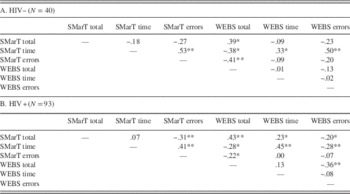
Table 3 displays the correlations between the online banking and shopping tasks in the HIV+ and HIV− groups. Across tasks, we observed moderate associations between the total scores and total completion times for the S-MarT and WEBS measures (ps<.05). The error scores on the two tasks were not significantly related to one another (ps>.10).
Correlations between online shopping and banking in the HIV− (panel A) and HIV+ (panel B) groups

SMarT=Simulated Market Task; WEBS=Web-based Evaluation of Banking Skills.
* p<.05.
** p<.01.
DISCUSSION
Findings from the current study suggest that persons with HAND struggle to perform fundamental Internet-based tasks, which may have detrimental downstream effects on their day-to-day household management. Specifically, HAND status was independently associated with poorer scores on Internet-based tasks of shopping and financial management that required participants to independently navigate Web sites to perform typical transactions, such as purchase goods and pay household bills. The adverse affects of HAND were broadly associated with medium-to-large effect sizes that were not better explained by sociodemographics (e.g., education), computer familiarity or anxiety, medical and psychiatric comorbidities, or HIV disease severity. Thus, these data converge with prior studies to suggest that mild-to-moderate neurocognitive impairment can interfere with Internet navigation (e.g., Goverover, O’Brien, Moore, & DeLuca, Reference Goverover, O’Brien, Moore and DeLuca2010).
Individuals with HAND were approximately 10–14 times more likely to fail the online shopping task as compared to their HIV+ counterparts without HAND and persons who were HIV−. In fact, task failure was quite rare in the comparison groups. Taken together, these findings align with prior studies showing large effects of HAND on role-play (e.g., Heaton et al., Reference Heaton, Marcotte, Mindt, Sadek, Moore and Bentley2004) and virtual reality (Rosenthal et al., Reference Rosenthal, Skolasky, Moxley, Roosa, Selnes, Eschman and Sacktor2013) shopping tasks and extend that work into the realm of Internet navigation. In terms of their pattern of performance, participants with HAND were not necessarily slower or more errorful in completing the check-out process. Instead they were simply less likely to purchase items on their list, even though the shopping list was displayed in front of them at all times during the task. Thus, one possibility is that the multitasking inherent to online activities (e.g., pop-ups) may have been more cognitively taxing for HAND participants (Scott et al., 2011). Whether such difficulties are remediable by eliminating (or minimizing) distractions remains to be determined.
A broadly similar adverse influence of HAND was observed on the online financial management tasks. Participants with HAND had marked difficulties accurately completing this task as compared to HIV+ participants without neurocognitive disorders. Once again, HAND was not associated with slower performance; however, HAND participants were significantly more likely to make overt errors (e.g., log-in mistakes) in addition to prescribed task failures. Although there was a medium effect size difference in the same direction in comparing the HAND group to HIV− participants, this difference was not statistically significant.
Nevertheless, these overall findings extend prior work showing that HAND is associated with at least moderate difficulties on paper-and-pencil financial management among persons living with HIV disease (e.g., Heaton et al., Reference Heaton, Marcotte, Mindt, Sadek, Moore and Bentley2004). Interestingly, however, the effects of HAND on online banking conflict with null findings recently observed for HAND on a simpler computerized ATM task (Rosenthal et al., Reference Rosenthal, Skolasky, Moxley, Roosa, Selnes, Eschman and Sacktor2013). Consistent with the online shopping data detailed above, such results may suggest that task complexity may play an important role in the expression of technology use deficits among persons with HAND.
Consistent with this hypothesis, Internet navigation skills were strongly correlated with higher-order neurocognitive functions, including executive functions (i.e., cognitive flexibility and novel problem solving), but not basic attention and fluency. This pattern of correlations was also observed in the prior Internet studies in clinical samples (e.g., Goverover et al., Reference Goverover, O’Brien, Moore and DeLuca2010). In contrast to those studies, however, Internet navigation skills were not related to information processing speed. As noted above, our Internet tasks were timed but not speeded, so as to reflect typical Internet use in the real-world. This is not to say that more basic neuropsychological functions are not involved in Internet navigation. In fact, we observed associations between Internet navigation and numeracy, as well as more basic fine motor coordination and speed.
Of interest, we did not find significant associations between Internet-based shopping and banking tasks and the manifest functional dependence composite. This is consistent with findings from previous research using Internet-based tasks of ADLs (e.g., Goverover & DeLuca, Reference Goverover and DeLuca2015) and with research that has demonstrated inconsistencies between self-reported and actual performance of ADLs (e.g., Blackstone et al., 2013). Given that the study was reasonably powered to detect such associations, one possible interpretation of these results is that these Internet tasks lack functional relevance; however, this seems unlikely given the parallel results showing that the Internet tasks were related to domain-specific functional declines.
An alternate interpretation of these null findings is that these Internet-based tasks may provide unique diagnostic information regarding functional problems in daily life that is not being captured by the global self-report measures, which were originally developed in the pre-Internet era and, therefore, may be insensitive to some functional problems that occur in modern daily life. Future research is needed to determine whether adding such technology-based assessments of capacity and manifest functioning improves the detection of syndromic HIV−associated neurocognitive disorders. Moreover, questions remain regarding whether an Internet platform for ADLs exacerbates difficulties with analogue tasks, which are affected in many clinical populations (see Ruse et al., Reference Ruse, Davis, Atkins, Krishnan, Fox, Harvey and Keefe2014).
There are several limitations to this study. First, it is difficult to determine the actual interplay between HAND and Internet-navigation skills based on our exclusion criteria (i.e., we excluded persons who had not used the Internet recently) and cross-sectional design. It is possible that the observed effects of HAND may have been different (either amplified or mitigated) if we had included persons who had not used the Internet. Future studies examining the role of neurocognition in Internet navigation training and site development may be informative. A second limitation of this study was the use of a moderately confounded seronegative comparison group. This may have dampened our ability to detect HAND effects (e.g., on the banking task), but concurrently represents a conservative bias that gives us greater confidence that significant differences are attributable specifically to HAND rather than clinicodemographic factors (e.g., depression) that might also play a role in Internet navigation.
Despite these limitations, findings from this study have considerable potential clinical relevance. Household Internet-based navigation skills were significantly, and uniquely, related to a well-validated performance-based measure of functional capacity and self-reported declines in shopping and banking in daily life. Thus failure on these laboratory Internet tasks may represent an increased risk for real-world difficulties on parallel activities. Of course, the path from a deficit observed in the laboratory to the actual occurrence of a real-world problem is fraught with complications that warrant exploration in future research, including examination of salient mediating/moderating factors such as clinicodemographics (e.g., age), task complexity, compensatory strategy use, and motivation. Such research efforts may be conducted with an eye toward the development and validation of Internet navigation training and compensatory rehabilitation strategies that are maximally effective for persons with neurocognitive disorders. Findings may also inform the creation, deployment, and local testing of Web designs that consider the potential pitfalls experienced by persons with neurocognitive disorders (e.g., clinic scheduling utilities).
ACKNOWLEDGMENTS
This study was supported by NIH grants R21-MH098607, R01-MH073419, L30-DA034362, L30-DA032120, K23-DA037793, P50-DA026306, U24-MH100928, and P30-MH62512. The authors report no conflicts of interest. The authors thank John DeLuca and Yael Goverover for their guidance in the early conceptualization of the Internet tasks, Richard Seghers and Roberto Gallardo for their assistance with participant identification and scheduling, and Donald Franklin and Stephanie Corkran for their help with data processing.
Supplementary Material
To view supplementary material for this article, http://dx.doi.org/10.1017/S1355617717000431