INTRODUCTION
Estuaries and lagoons that communicate with the sea constitute transition environments, namely a morphological and dynamic change between two adjacent ecosystems (Cognetti & Maltagliati, Reference Cognetti and Maltagliati2000). Coastal lagoons are very productive and are also very sensitive to both climatic and human activities (Knoppers, Reference Knoppers and Kjerfve1994). Their main characteristic is the instability of the chemical–physical parameters, above all the salinity. Mediterranean lagoons are subjected to many anthropogenic impacts, mainly due to permanent and seasonal population density increases, tourism activity expansion, aquaculture and agriculture (Mouillot et al., Reference Mouillot, Laune, Tomasini, Aliaune, Brehmer, Dutrieux and Do Chi2005). The species living in these environments, both of marine or continental origin, follow a gradient of resistance to the increasing environmental stress. Benthic organisms that characterize the ecological quality of their habitats (Pearson & Rosenberg, Reference Pearson and Rosenberg1978; Cruz-Motta & Collins, Reference Cruz-Motta and Collins2004) were used to assess the human impact on the lagoon ecosystem. As mentioned by previous workers, most of macrobenthic fauna is sessile or has limited mobility and thus, the community structure directly depends mainly on environmental conditions (Olsgard & Gray, Reference Olsgard and Gray1995; Rosenberg, Reference Rosenberg2001; Shin et al., Reference Shin, Huang and Wu2004; Cooksey & Hyland, Reference Cooksey and Hyland2007). Responses to environmental disturbance of certain species are thought to depend on specific sensitivity and tolerance levels (Lancellotti & Stotz, Reference Lancellotti and Stotz2004).
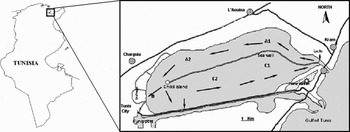
The lagoon of Tunis, located in the neighbourhood of Tunis city, was undoubtedly one of the most polluted and eutrophic Mediterranean lagoons. Urbanization and the development of infrastructure (roads, buildings, hotels and Tunis port), domestic waste, as well as the loss or degradation of wetlands have been the major factors in increasing environmental stress and nutrient load in the northern lagoon. Consequently, the basin has undergone progressive marine eutrophication in the shallow areas and suffered severe evaporation in particular, the formation of fluidized, black, sewage-derived organic muds are widespread to the west of the protection dam located near the Chikli island (Figure 1). Thus, strong human impact culminated in a series of crises (Bruun, Reference Bruun1940; Heldt, Reference Heldt1952, Reference Heldt1953; Crouzet, Reference Crouzet1973; Zaouali, Reference Zaouali1977; Belkhir & Hadj Ali Salem, Reference Belkhir and Hadj Ali Salem1981; Zaouali & Baeten, Reference Zaouali and Baeten1984). Serpulids (Ficopomatus reef) populating the lagoon have significantly reduced water circulation (Keene, Reference Keene1980). Eutrophication caused frequent fish and benthos kills as well as nauseating H2S odours which permeate the capital mainly during the summer (Van Berk & Oostinga, Reference Van Berk and Oostinga1992). In the period 1984–1988, a national programme aimed at the remediation of the northern lagoon, along with the urban extension of the capital was organized (Van Berk & Oostinga, Reference Van Berk and Oostinga1992). The sanitation works improved the hydrological balance and tidal mixing, with a 19 to 27 days residence time of waters (Ben Maiz, Reference Ben Maiz1992, Reference Ben Maiz, Boudouresque, Avon and Pergent-Martini1993). Dredging and deepening of the Kheireddine channel has facilitated the exchange of open-marine waters with the neighbouring gulf.
Location of the northern lagoon of Tunis after management and of sampling Stations (A2, A1, B, C1 and C2).

Several aspects of lagoonal benthic fauna (Zaouali, Reference Zaouali1981; Zaouali & Beaten; Reference Zaouali and Baeten1983, Reference Zaouali and Baeten1984), phytobenthic communities (Ben Maiz, Reference Ben Maiz, Boudouresque, Avon and Pergent-Martini1993; Trabelsi et al., Reference Trabelsi, Shili and Ben Maiz2001), worm reefs (Vuillemin, Reference Vuillemin1952; Heldt, Reference Heldt1953) as well as physical and chemical factors (Crouzet, Reference Crouzet1973; Zaouali, Reference Zaouali1977; Belkhir & Hadj Ali Salem, Reference Belkhir and Hadj Ali Salem1981) were studied in the past, but the detailed interactions between those biotic and abiotic factors are not clearly understood yet. The majority of previous studies took place during the period of eutrophication crises in the 1980s and early 1990s.
This study aims to contribute firstly to an increased knowledge of the biotic dynamics in the northern lagoon of Tunis, to detect the spatio-temporal variations and structure of the benthic community, since fauna can be used as reliable indicator of potential environmental disturbance due to eutrophication, as well as chemical contamination and physical disturbance (Pearson & Rosenberg, Reference Pearson and Rosenberg1978; Gray, Reference Gray1979); secondly, to clarify the progess of sanitation works in the lagoon. In fact, it is unclear whether or not the ecological equilibrium is being re-established since the substantial sanitation works of the 1980s. Lagoon hydrodynamics have certainly improved and this study aims to determine how the living conditions and benthic communities have changed inside the lagoon.
Study area
The lagoon of Tunis is among the largest Mediterranean lagoons in Tunisia. It is artificially subdivided into two lagoonal bodies: the southern and the northern (Figure 1), the latter (2600 ha) lies to the east of Tunis with an artificial water entrance, the Kheireddine channel (Van Berk & Oostinga, Reference Van Berk and Oostinga1992). This lagoon is limited by the cities of Berges-du-Lac, l'Aouina and Carthage to the north, by the La Goulette–Kheireddine–Le Kram urban zones to the east, by a ship canal to the south and farther the southern lagoon of Tunis (Figure 1). The Tunis-Marine District lies to the west, with its old port and esplanade. The northern lagoon of Tunis is an exorhoeic basin extending east–west between the capital and the Mediterranean coast in the east. After sanitation works, the lagoon water depth averaged 2 m, reaching a maximum of approximately 4.5 m to the north-east and north-west. The basin presents a maximum length of 9.6 km, and a maximum width of 3.1 km (Figure 1).
Climatic conditions
The local climate is Mediterranean arid, with two major contrasting seasons: the wet (September–April) and the dry (May–October). The north-westerly winds of the wet season, often accompanied by rainfall, may reach up to 60 km/h, and the easterly sea winds rather dry, dominate in summer (Ben Maiz, Reference Ben Maiz1992, Reference Ben Maiz, Boudouresque, Avon and Pergent-Martini1993). The mean monthly windspeeds lie in the range of 7–27 km/h. January has been the wettest and July the driest months over three decades, with 460 mm per year average rainfall. The maximum daily rainfall may exceed 100 mm which may cause flooding. An average water temperature of 19.2°C and salinity of 39 ppt were measured; salinities varied from 20 ppt in the wet season to 46 ppt in the dry season (Zaouali, Reference Zaouali1977). High nutrient contents of up to 1.8 mg/l phosphorus (Keene, Reference Keene1980), measured near the esplanade, were thought to generate approximately 100,000 metric tons of the macroalga Ulva rigida per year (Belkhir & Hadj Ali Salem, Reference Belkhir and Hadj Ali Salem1981).
MATERIALS AND METHODS
Sampling
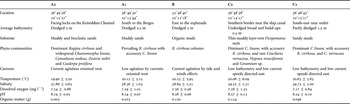
Samples of benthic fauna were collected by diving using a boat at approximately 2.5 km spaced stations. The sites of the sampling stations (A1, A2, B, C and C2) indicated in Figure 1 were defined with respect to bathymetry, substrate components and spatial position with regard to human disturbance, as well as hydrodynamic improvements due to sanitation (Table 1).
Physico-chemical characterization of sampling stations; showing mean and standard deviation of some parameters.

At each of these stations, three replicates of benthos were collected with a quadrat (0.1 m2). Sampling took place seasonally in five periods from November 1999 to November 2000. A total, of 75 quadrats were collected during the study period.
The samples collected were filtered immediately, using a sieve of mesh size 1 mm. The resulting filtrate was fixed in a 5% formalin solution. In the laboratory, a subsample of benthic fauna from each replicate was sorted, identified to species level, classified and counted under a microscope (with the exception of the bryozoan Zoobothryon verticillatum) with the use of suitable illustrated guides.
At each station we have measured the depth, determined the sediment type, calculated the sediment organic matter content and recorded the values of temperature, salinity, dissolved oxygen and pH.
Data analysis
The two null tested hypothesees were: (i) absence of a relationship between the lagoon restoration works and the structure of macrobenthic communities; and (ii) absence of a relationship between the restoration works and the ecosystem functioning. Thus, ecological coefficients are used to provide an estimate of how the benthic community is structured. The species richness measures the number of species encountered in a given sample; the abundance of species is also expressed as the number of individuals (mean values from three replicates), whereas, the density of individual species is expressed as the total number of individuals per square metre, gathered in a given station (Zenetos & Palathanassiou, Reference Zenetos and Palathanassiou1989; Tagliapietra et al., Reference Tagliapietra, Pavan and Wagner1998; Lercari et al., Reference Lercari, Defeo and Celentano2002; Cooksey & Hyland, Reference Cooksey and Hyland2007; Young-Seuk et al., Reference Young-Seuk, Mi-Young, Young-Cheal, Kyung-Hee, Eungchun and Tae-Soo2007). The analysis of diversity index carried out on a seasonal basis also helps clarify species richness. To evaluate species diversity, Shannon–Weaver diversity index (Shannon & Weaver, Reference Shannon and Weaver1963) and Pielou evenness index (Pielou, Reference Pielou1966) were computed. Significant differences in these univariate measures between treatments were tested using a one-way analysis of variance (ANOVA).
Multivariate analysis
Multivariate techniques help to identify the similarities in community structure and draw their temporal trends (Warwick & Clarke, Reference Warwick and Clarke1991). Multivariate methods also rendered it possible to analyse spatial similarities/dissimilarities of the composition and structure of the benthic community. The transformation log (x+1) was applied for each species abundance (Nanami et al., Reference Nanami, Saito, Akita, Motomatsu and Kuahara2005) before each analysis.
A cluster analysis measures the faunal affinity between stations regrouped on the basis of Euclidian distance (Legendre & Legendre, Reference Legendre and Legendre1998). The agglomeration method of Ward (Reference Ward1963) also helps calculate distances between clusters.
Ordination according to correspondence analysis (CA) method was applied to a data matrix including all species and five stations. The correspondence method best indicated for matrices of data with a high number of zeros (Hill, Reference Hill1974), displays both species and stations in a reduced space. The canonical correspondence analysis (CCA) was also applied to discriminate inter-group variations. The statistical analysis was carried out with the use of R2.2.0 ADE4 software.
RESULTS
The mean and standard deviation values of physico-chemical parameters and organic matter of each station are recorded in Table 1. The temperature mean value reached 20.2 (minimum: 19.9, maximum: 20.5) whereas the salinity mean value was 38.9 (mininimum: 37.9, maximum: 39.7). The mean value of dissolved oxygen was 7.4 (minimum: 7.2, maximum: 7.6) and the pH reached 8.2 (minimum: 8.2, maximum: 8.3).
Species richness
In total, 93,738 macroinvertebrate individuals belonging to 90 species were identified. Mollusca had the highest number of species (51.1% of total species) and Crustacea were sub-dominant (26.6%). Annelida totalled 7.8%, Cnidaria, 6.7%, Ascidiacea, 5.6% and Echinodermata, 2.2%. The Crustacea were numerically dominant (63.7%) followed by Mollusca (32.2%); the dominance percentages of other taxa were low (0.48–2.1). Nevertheless, the dominance of species was found to be variable with Crustacea being the highest in Station B (78.9%), whereas Mollusca were the highest in Stations A2, C1 and C2. Echinodermata dominate the remaining fauna, with the highest proportion (3.6%) in Station A2.
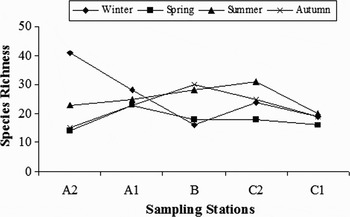
The highest species richness (59) occurs in Station A2 and the lowest (38) in Station C1 (Table 3). Species richness decreases in spring (48 species), slightly increases in autumn (53 species) and summer (55 species), and reaches a maximum in winter (60 species). A comparison of richness values among stations and seasons (ANOVA) showed significant difference (Fisher test = 1.97 > 0.15). In winter, Station A2 revealed the highest (41), and Station B the lowest (19) species richness (Figure 2); in spring, a maximum (23) occurred in Station A1 and a minimum, in Station A2 (14 species). In summer, the highest species richness (31) was counted in Station C2, and the lowest (20), in Station C1. In autumn, Station B showed as high as 31 species, in contrast with Station A2.
Spatial and temporal variation of the species richness in the northern lagoon of Tunis.

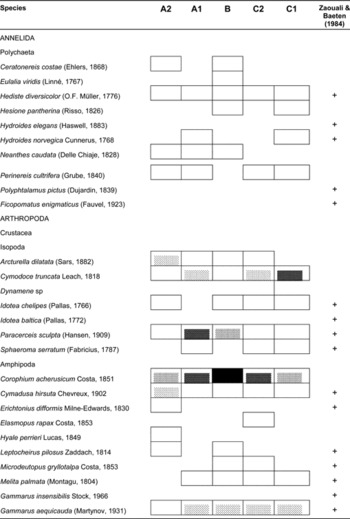
Distribution of species identified in the northern lagoon of Tunis before (+: found by Zaouali & Baeten, (Reference Zaouali and Baeten1984)) and in the present study (Stations: A1, A2, B, C1 and C2; percentages in relative abundances: 

Biological data (mean (minimum–maximum)).

Distribution of species and relative abundances
Samples taken (Table 2) were characterized by the presence of: Corophium acherusicum, Cymodoce truncata, Gammarus aequicauda, Paracerceis sculpta, Cymadusa hirsuta, Hediste diversicolor, Cerithium vulgatum, Gibbula adonsoni, Gibbula varia, Haminea hydatis, Hydrobia ulvae, Abra tenuis, Loripes lacteus and Raphia rhomboides. These species sampled at each one of the stations, comprise the quasi-totality of the community; in contrast, other species are limited in distribution. In particular Erichtonius difformis, Sclerochilus contortus, Hyale perrieri, Oncaea mediterranea, Monodonta articulata, Muricopsis cristatus, Nassarius mutabilis, Cantharus dorbignyi and Asterina gibbosa show quasi-exclusivity in the north-eastern zone proximal to the pass (Station A2) with a strong open-marine water influence. In addition, Station A1 includes Sepiola steennstruppuna. Station B gave a less diversified benthic population with notably Ascidia mentula, Ascidia virginia and Ciona intestinalis. Other species are more restricted: Elasmopus rapax and Callochiton laevis (Station C2); Antopleura ballii, Actina equina, Diadumen cincta, Peachia hastata and Cereus pedunculatus (Station C1).
Density
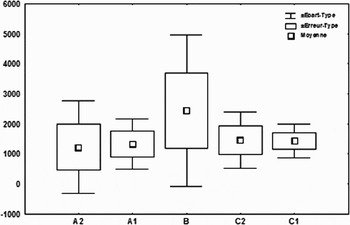
The average faunal density varies, with an average total density of 1361.59 ind m−2 in the lagoon; the maximum average of 2414.75 ind m−2 was registered in Station B (Figure 3; Table 3). Station A2 revealed the greatest species richness (60), which also corresponds to the lowest average density of 1225.75 ind m−2.
Spatial variations of average density (ind m−2) of macroinvertebrates in the northern lagoon of Tunis.

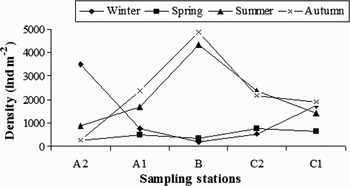
Significant difference was calculated for mean seasonal values of density (ANOVA) among stations (F = 0.95 > 0.46). A low average density of 503.2 ind m−2 was measured in spring contrasting with the high averages of 2131.6 ind m−2 in summer and 2321.6 ind m−2 in autumn (Figure 4). In winter, a maximum average of 3499 ind m−2 characterizes Station A2 but a marked reduction to 191 ind m−2 was registered in Station B. In addition, low spring, summer and autumn densities (264.864 and 276 ind m−2 respectively) at Station A2 contrast with the highest 4352 ind m−2 in summer, and 4884 ind m−2 in autumn densities of Station B.
Spatial and temporal variations in density (ind m−2) of macroinvertebrates in the northern lagoon of Tunis.

Diversity indices
Comparison of diversity among stations (ANOVA) revealed significant difference (F = 0.85 > 0.51). In winter, the diversity (0.97–2.69) indices and evenness (0.33–0.74) varied in wide ranges, with the lowest evenness value of 0.33, and diversity of 0.97 computed for Station C1. In spring variations of diversity were moderate: 1.95 (Station A2) to 2.25 (Station B), and further, evenness values always exceeded 0.71 (Table 3).
In summer, diversity indices were the highest for Station A2 (H′ = 2.29), and the lowest for Station B (H′ = 1.26); whereas, evenness decreased progressively from Stations C1, A1 and A2 (range: 0.67–071), to Station C2 (0.61), to Station B (0.33). In autumn, diversity ranged from 2.21 in Station B to 2.50 in Station C2, and evenness fluctuated from 0.65 to 0.84.
Multivariate analysis
HIERARCHICAL CLASSIFICATION
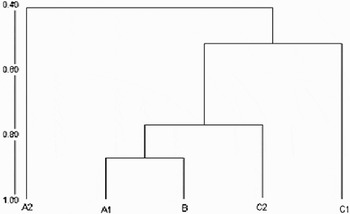
Stations and species were both classified. Among the stations, hierarchical classification distinguishes two main station groups: (i) Station A2 characterizes a lagoon zone influenced by open marine waters; and (ii) a second group (A1, B, C1 and C2) comprises a sub-group (A1, B and C2), and a lagoonal Station C1 (Figure 5).
Dendrogram obtained from hierarchical ascendant cluster analysis of stations studied in the northern lagoon of Tunis.

Factorial correspondence analysis
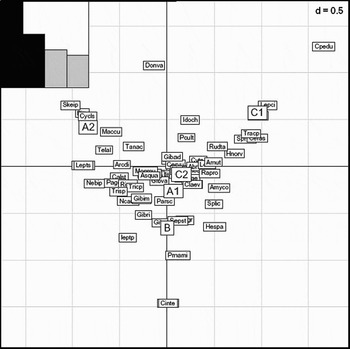
The plot on the plane of the first two factorial axes F1/F2 which explain 66.7% of the total variance of the data is given in Figure 6. Stations and species were simultaneously plotted in this plane. The axis F1 (41%) is divided by Station A2 on the negative part, and by Station C1 on the positive part. The second axis (25%) is principally determined by Station B on the negative part.
Dendrogram obtained from hierarchical ascendant cluster analysis of macroinvertebrate species studied in the northern lagoon of Tunis.

Figure 6 also shows the species which contributed to the inertia of each axis. Species which have the most positive contribution on the first axis are Cymadusa truncata, Gammarus aequicauda, Corophium acherusicum and those of the most negative contribution are Hyale perrieri, Erichtonius difformis, Diogenes pugilator, Oncaea mediterranea, Sclerochilus contortus, Hadriana craticuloides and Hinia reticulata. The axis F2 is principally determined by Idotea chelipes, Mysis oculatus, Dynamene sp., Gibbula adonsoni on the positive part and Eulalia viridis, Paracerceis sculpta, Gibbula philberti and Gibbula richardi on the negative one.
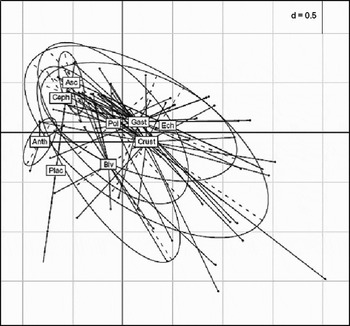
Figure 7 illustrates a CCA and shows the groups that contributed most to the canonical component 1 (AC1); these are the Anthozoa, Placophora, Cephalopoda, Ascidia and Echinodermata. The taxa which contributed most to the canonical component 2 (AC2) are the Ascidia, Cephalopoda, Placophora and Bivalvia.
F1/F2 plot of the factorial correspondence analysis (CA). Simultaneous projections of both stations and species according to their mean abundances.

DISCUSSION
The present study showed the improvement of water quality in the northern lagoon of Tunis, compared to extreme values previously recorded (Crouzet, Reference Crouzet1973; Belkhir & Hadj Ali Salem, Reference Belkhir and Hadj Ali Salem1981). Nowadays, marine water influence causes water temperature fluctuation in a narrow range during the dry season and a warming action during the wet season.
Moreover, moderate seasonal salinity ranges measured in the northern areas (Stations A2 and A1) are thought to be attributed to marine water renewal and consequently lowering of the salinity during the dry season and wet season, thus, acting against important continental water run-off. In contrast, elevated salinities to the south (C1 and C2) invoke limited marine influence and active evaporation (low bathymetry) as well.
Management has been the master key to preventing recurrent anoxic crises (Belkhir & Hadj Ali, Reference Belkhir and Hadj Ali Salem1981) and has resulted in sufficient oxygenation of waters in the lagoon.
Hydrogen potential in the lagoon (range: 8.11–8.41) shows an improvement in hydrological conditions since restoration (Vuillemin, 1965; Ben Charrada, Reference Ben Charrada1992). Limited fluctuations in pH values among stations may be attributed to circulating waters and tidal exchanges with open marine waters from the Gulf of Tunis.
Therefore, smaller ranges of hydrological parameters estimated in this work can be attributed to the greater exchange with the Mediterranean Sea. This is in agreement with the results of Reizopoulou & Nicolaidou (Reference Reizopoulou and Nicolaidou2007) in Vivari lagoon (eastern Mediterranean).
A total of 90 species of benthic macroinvertebrates belonging to seven taxa were collected (Table 2). The dominance of molluscan (especially gastropod) species, observed in this lagoon, compared with the other taxa, could be explained by the hydrodynamics, sediment characteristics (e.g. organic carbon content in the sediment) and the dense vegetal cover (Rueda & Salas, Reference Rueda and Salas2003). These results are similar to those reported by Clanzig (Reference Clanzig1991) in Biguglia lagoon (Corsica). Considering the relative importance of the most dominant zoological taxa (molluscs, crustaceans and polychaetes), it is worth noting that the dominance of the above-mentioned taxa are variable in the Mediterranean lagoons. In the lagoon of Prévost (France), the taxonomic structure was dominated by polychaetes, followed by molluscs and crustaceans (Amanieu et al., Reference Amanieu, Guelorget and Michel1977). As for the lagoon of Smir (Morroco), crustaceans were the most dominant taxon, followed by polychaetes and molluscs (Chaouati & Bayed, Reference Chaouati and Bayed2005).
On the other hand, the lagoon macrobenthic community appeared more rich and diverse than the one described before sanitation works. In fact, a total of 90 faunal species were recognized, exceeding the 55 species in the period 1980–1984, with stations totally devoid of fauna described by Zaouali & Baeten (Reference Zaouali and Baeten1984).
The greater the marine influence, the greater the number of species (59) recognized in Station A2, especially species with a marine affinity. Spatially, the species richness decreases in zones remote from the Keireddine tidal locks, with only 38 species in Station C1. Seasonally, the species richness fluctuates, but reaches a maximum during the wet season, due to fresh water run-off and a greater tidal-marine influence in winter (Ben Maiz, Reference Ben Maiz1992, Reference Ben Maiz, Boudouresque, Avon and Pergent-Martini1993), thus inducing intrusion of a greater number of marine species in to the lagoon. This ecosystem becomes a refuge against severe winter conditions and water turbulence.
According to ecological affinity species (Glemarec & Grall, Reference Glemarec and Grall2000), three main types of fauna (Table 2) were identified: (i) a group (most dominant) of tolerant eurythermic and euryhaline species, specifically lagoonal, such as Abra tenuis, Cerastoderma glaucum, Loripes lacteus, Ruditapes decussatus, Cerithium vulgatum, Hydrobia ulvae, Tricolia pullus, Gammarus insensibilis, Corophium acherusicum and Idotea chelipe; (ii) a mainly marine fauna group of environmentally sensitive species (Mytilus galloprovincialis, Donax variegatus, Arca noae, Chlamys varia, Pinctada radiata, Modiolus barbatus and Asterina gibbosa); and (iii) a fauna which includes either marine or lagoonal species (indifferent). The studied community compared with the results of Zaouali & Baeten (Reference Zaouali and Baeten1984), revealed a change in the lagoon macrofauna composition and distribution (Table 2). It indicates as many as 75 species that have recently entered the lagoon (a majority being marine species), while 22 others have disappeared and 33 species were preexisting. We also notice the extinction of opportunist annelids inhabiting polluted environments: Capitella capitata, Malacoceros (Scolelepis) fuliginosus and Ficopomatus enigmaticus (Glemarec & Grall, Reference Glemarec and Grall2000; Tagliapietra et al., Reference Tagliapietra, Pavan and Wagner1998), following sanitation works, and particularly dredging of organic muds. Nevertheless, this has enforced those species which tolerate organic excess, including Neanthes caudate, Hediste diversicolor, Gammarus aequicauda, Tanais cavolini, Macoma cumana, Abra tenuis Cerastoderma glaucum and Hydrobia ulvae. Thus, there is evidence that the lagoon ecosystem presents dominant tolerant species adapted to the stress of the type environment and a tendency towards disturbance as noticed by Tlig-Zouari et al. (Reference Tlig Zouari, Mami and Maamouri Mokhtar1999). The taxonomic structure is in agreement with the results of studies carried out in other lagoons (Koutsoubas et al., Reference Koutsoubas, Arvanitidis, Dounas and Drummond2000; Mistri et al., Reference Mistri, Ghion, Modugno and Rossi2002; Blanchet et al., Reference Blanchet, Montaudouin and Bachelet2005; Basset et al., Reference Basset, Galuppo and Sabetta2006) and showed that the lagoon was characterized by a majority of species typical of brackish water lagoons.
During the period of study, overall values of species density at Stations A2 to C1, increase with respect to a decrease in species richness. It is likely that moderate species richness might be compensated for by a proliferation of species with the larger ecological distribution. These results are similar to those reported after water management carried out in the lagoon of Valle di Gorino, in the north-east of Italy (Mistri et al. Reference Mistri, Ghion, Modugno and Rossi2002) and in Smir lagoon, Morroco (Chaouati & Bayed, Reference Chaouati and Bayed2005).
The density of species also varied seasonally with two contrasting periods: one with a reduction in density during winter and spring, and a period of density increase in summer and autumn. These variations suggest species–trophic interactions and depend on natural dominance of certain characteristc species to those seasonal environmental changes. The total number of individuals decreases gradually in the beginning of winter, but increases presumably by recruitment toward the dry season. The elevated densities of Station B in summer and autumn were caused by the dominance of three main characteristic species of crustaceans. Corophium acherusicum reached densities of 3316 and 1312 ind m−2 in summer and autumn, respectively. Values of 1360 ind m−2 for Paracerceis sculpta and 780 ind m−2 for Gammarus aequicauda, were also measured for Station B in autumn. These species are typically eurythermic and euryhaline and their increased abundances may correlate with severe evaporation and high salinity gradients of the dry season, thus, suggesting evidence for disturbance. Moreover, there is a still contaminated Station B located in a zone of predominantly organic muds inherited from sewage sludge prior to sanitation works. Even if the lagoon was deeply dredged in the 1980s to prevent organic pollution contributing to eutrophication, bottom sediments at Station B displayed rather fluidized black oozes invaded by a community of Ruppia cirrhosa. Casagranda et al. (Reference Casagranda, Dridi and Boudouresque2006) mentioned that the abundance of the crustaceans G. aequicauda and Sphaeroma hookeri in Ichkeul lagoon (Tunisia) was significantly related to Ruppia cirrhosa biomass. The functional relationship between those species and macrophytes may be nutritional. The grass beds provide a nursery and some refuge against predation, salinity and temperature variations (Casagranda et al., Reference Casagranda, Dridi and Boudouresque2006). In the Venetian lagoon, Tagliapietra et al. (Reference Tagliapietra, Pavan and Wagner1998) stated that the benthic community fluctuations, in Palude della Rosa, is ruled by the overgrowth (cycle) of the green macroalga Ulva rigida.
Spatio-temporal variations of the Shannon diversity (H′) and evenness (J) values point to an ecological stress exerted on the macroinvertebrate community and confirms the adaptations approach (Cognetti & Maltagliati, Reference Cognetti and Maltagliati2000) and the responses and indicators approach (Reizopoulou & Nicolaidou, Reference Reizopoulou and Nicolaidou2004). Overall values recorded (Table 3) indicate that the environment is moderately polluted. The lowest diversity value (0.97) was recorded in the southern lagoon zone (Station C1) whereas the highest (2.69) was recorded at Station A2. Seasonally, at each one of the stations, notably during winter, the evenness (range: 0.33–0.74) and diversity (range: 0.97–2.69) indices vary considerably; the lower the confinement derived evenness 0.33 (Station C1), the higher the disturbance of the benthic community. In the remaining stations, higher evenness values (range: 0.65–0.80) corroborate a limited stress coinciding with the wet season. In addition, in spring there is a moderate spatial range in diversity: 1.95 (Station A2) to 2.25 (Station B), and furthermore, evenness values which always exceed 0.7, in accordance with a minimum disturbance.
The low diversity and evenness indices computed for Stations B, C1 and C2 in summer may be accounted for by a high salinity gradient far from the Kheireddine marine waters entry. The higher autumnal diversity and evenness indices of these stations can be attributed to a refreshment and hydrodynamics regulation of the ecosystem at the beginning of the rainy season. Consistently high diversity and evenness indices computed seasonally for Stations A2 and A1, lend support to the proposition that these stations are the less disturbed. This is witnessed by marine currents oriented west in these stations, above a bottom of muddy calcareous sands inhabited by Ruppia cirrhosa, Zostera noltii, Cymodocea nodosa and Caulerpa prolifera.
The comparison of the northern lagoon of Tunis with other Mediterranean lagoons (lagoon of Prévost in France, lagoon of Sacca di Goro in the north-east of Italy and lagoon of Smir in Morroco) showed that these ecosystems are characterized by different biotic and abiotic features (geomorphology, surface, hydrodynamics, hydrology, bathymetry and sediment compostion). This seems to be matched with the variations in their respective species richness (S) and diversity (H′) (e.g. Prévost: S varies between 8 and 22 species, H′ between 1.43 and 2.74 (Amanieu et al., Reference Amanieu, Guelorget and Michel1977); Sacca di Goro: S between 5 and 21 species, H′ between 0.52 and 2.56 (Mistri et al., Reference Mistri, Rossi and Fano2001); Smir: S between 7 and 37 species, H′ between 1.33 and 1.84 (Chaouati & Bayed, Reference Chaouati and Bayed2005)).
Reizopoulou & Nicolaidou (Reference Reizopoulou and Nicolaidou2007) mentioned in three Greek brackish water lagoons, with different degrees of disturbance (Vivari, Tsopeli and Papas) that the number of species, diversity and eveness did not vary according to the degree of disturbance. The lowest diversity value was found in Vivari, which had the highest degree of communication with the sea, characterized by total absence of vegetation, while the highest number of individuals was noted in Papas, the most eutrophicated lagoon. In the same way, Salas et al. (Reference Salas, Patricio, Marcos, Pardal, Pérez-Ruzafa and Marques2006) indicated that those measures (species richness, Shannon–Weaver and evenness indices) counted among the most widely used and popular measures of diversity but can be highly influenced by different sample sizes, sampling effort, habitat type or complexity and do not show monotonic behaviour in response to environmental degradation. Thus other new indices were recently developed as a tool for quantifying the degree of disturbance in lagoons using the zoobenthos quality element such as the AMBI index (Borja et al., Reference Borja, Franco and Pérez2000), the BENTIX index (Simboura & Zenetos, Reference Simboura and Zenetos2002) and the ISD index (Reizopoulou & Nicolaidou, Reference Reizopoulou and Nicolaidou2007).
Clustering and factorial correspondence methods were applied to reflect faunal similarities. Clustering led to two main zonation patterns. The north-eastern Station A2 differs from those inner intra-lagoonal Stations (A1, B, C2 and C1) in the course of a continuously tide-driven water motion. In contrast, confinement appears to be the key factor for Station C1 (subgroup) with a low bathymetry and biological organization as proposed by Guelorget et al. (Reference Guelorget, Perthhuisot, Frisoni and Monti1987) for Mediterranean lagoons, by Tagliapietra et al. (Reference Tagliapietra, Pavan and Wagner1998) for the Venetian lagoon (Italy), by Koutsoubas et al. (Reference Koutsoubas, Arvanitidis, Dounas and Drummond2000) for the Gialova lagoon (south-western Greece) and by Paganelli et al. (Reference Paganelli, Sconfietti and Marchini2005) for the two Adriatic Sacca di Goro and Lesina lagoons.
Correspondence results also testify to a gradational distribution of benthic species in close relation with hydrological and edaphic (organic matter) factors, from the open marine towards the lagoonal environments and also distinguished three main groups of stations. The first group (A2, undisturbed zone) is associated with the marine species. The local flora is dominated by the phanerogame Ruppia cirrhosa. This station is sufficiently influenced by marine currents, with salinities always lower than those of the entire lagoon. The second group of Station C1 (disturbed zone) is an homogeneous community including lagoonal, eurythermic and euryhaline species which usually proliferate under high gradients of salinity and temperature. The flora is dominated by Chaetomorpha linum. This Station remote from the sea, suffers warm currents, with a reduced velocity and increased salinities. Station B behaves differently; it is almost devoid of endofauna but bears rare epifauna attached to Ruppia cirrhosa. In this station, Cerastoderma glaucum occupies a muddy substrate, along with an heterogeneous benthic population composed of stress tolerant species: Gammarus aequicauda, Corophium acherusicum, Cymodoce truncata, Gibbula ardens, Hydrobia ulvae, and Tricolia pullus. This Station is more remote from the sea but responds to those perennial effects of human disturbance imposed by the neighbouring city.
These results suggest that these macrofaunal assemblages obey to several ecological factors among which the hydrological and climatic ones vary seasonally in Mediterranean coastal lagoons (Perez-Ruzafa & Marcos Diego, Reference Perez-Ruzafa and Marcos Dego1993; Bazairi et al., Reference Bazairi, Bayed and Hily2005).
In summary, this work has elucidated the management impact and a typical pattern of changes of macrobenthos composition along with environmental conditions in the northern lagoon of Tunis, as well as the response of the macrobenthic community and structure to those environmental changes. Our results seem to indicate that management plays a beneficial role in the structure and functioning of this ecosystem. However, a significant disturbance of the benthic communities is detected in the shallow southern lagoon and in its westernmost areas. Thus, the environmental characteristics of these areas should be taken into account during environmental impact assessment.
ACKNOWLEDGEMENTS
This study benefited financially by support from the Tunisian Ministry for Higher Education (DGRST) and help from the ‘Société de Promotion du Lac de Tunis. The authors thank the referees who helped to improve the quality of the paper. We are also grateful to other persons, in particular Professor Nomiki Simboura (Hellenic Centre of Marine Research, Greece) who corrected the English text.