

1. IntroductionFootnote 1
The study of meaning and changes in meaning has enjoyed varying levels of popularity within linguistics. There have been periods during which the exploration of meaning was of prime importance. For instance, in the late 19th century scholars considered the exploration of the etymology of words to be crucial in their quest to find the ‘true’ meaning of lexemes (Geeraerts, Reference Geeraerts2010; Malkiel, Reference Malkiel1993). There have also been periods where semantic analysis was considered redundant to linguistic investigation (Hockett, Reference Hockett1954: 152). In the past 20–30 years semantics has enjoyed a period of revival. This has been mainly led by the advances in cognitive linguistics (and to some extent, historical linguistics) as well by the innovations associated with the development of electronic corpora and computational methods for extracting and tracing changes in the behaviour of the lexicon (cf. Geeraerts, Reference Geeraerts2010: 168ff, 261ff). However, there are still areas of linguistics which hardly involve lexis in their theoretical and epistemological considerations. One such area is sociolinguistics.
Sociolinguistics as a distinct field began to emerge in the US in the late 1950s as a response to some weaknesses of the then-prevailing structuralist models in accounting for variability within the linguistic system. With the foundational paper of Weinreich et al. (Reference Weinreich, Labov, Herzog, Lehmann and Malkiel1968) and pioneering studies carried out in the US (Labov, Reference Labov1963, Reference Labov1966) and Europe (Trudgill, Reference Trudgill1974), sociolinguistics established itself as one of the most dynamically developing areas of linguistics, and has since revolutionised the way we think about language use. However, it has done so by investigating mainly phonological and to some extent morpho-syntactic variation. Lexis has been mainly studied descriptively and semantic variation has been rarely addressed within sociolinguistics. As a consequence, the past 40 years of sociolinguistic research has focused on exploring the meaning of variation (cf. Eckert, Reference Eckert2012), while leaving the variation of meaning aside.
A possible reason for this situation may be related to methodological issues in capturing the complexity of meaning. Sociolinguistic variationist techniques require rather defined segments of language that can be objectively derived and compared. Phonological and morpho-syntactic variables comply with this criterion relatively well. However, the fuzzy nature of meaning can be seen as a problem when the methodologies demand clear boundaries. Sociolinguists themselves have admitted that investigating meaning is problematic since semantic variables do not ‘fit’ into the notion of a variable proposed by sociolinguistics (Labov, Reference Labov and Labov1972; cf. Lavandera, Reference Lavandera1978) and they have expressed doubts about the benefits of studying lexical change within the variationist paradigm (Labov, Reference Labov1978: 8, 2001: 123).
There are some exceptions to the generalisation that lexical (both onomasiological and semasiological) variation has been overlooked within sociolinguistics. For instance, interest in lexis has continued in studies of regional variation (Llamas, Reference Llamas1999; Finnegan, Reference Finnegan2011). There have also been several attempts to investigate meaning variation within functional paradigms (Hasan, Reference Hasan1989, Reference Hasan, Bolton and Kwok1992, Reference Hasan2009) or discourse analysis frameworks (Cheshire, Reference Cheshire2007; Macaulay, Reference Macaulay2005, Reference Macaulay2006; Stenström, Reference Stenström and Kirk2000; Wong, Reference Wong, Campbell-Kibler, Podesva, Roberts and Wong2002, Reference Wong2006). It is also worth highlighting that consideration of meaning variation surfaces in studies that examine styles and indexical fields (Eckert, Reference Eckert2008).
The current paper contributes to this modest body of research by showing the value of sociolinguistic methods in the study of semantic change. Specifically, I implement here the variationist construct of apparent time, which proposes that generational differences in language use reflect actual real-time changes in language. The apparent-time construct relies on the assumption of the stability of vernaculars. This means, for instance, that an older person's language use to a large extent reflects forms this person acquired when they were much younger, say in their twenties. The validity of the apparent-time construct has been shown in investigations of language change in a number of existing (Bailey, Reference Bailey, Chambers, Trudgill and Schilling-Estes2002; Sankoff, Reference Sankoff and Brown2006) and past communities (Nevalainen & Raumolin-Brunberg, Reference Nevalainen and Raumolin-Brunberg2003).
In recent work (Robinson, Reference Robinson, Geeraerts, Kristiansen and Piersman2010a, Reference Robinson2010b, Reference Robinson, Allan and Robinson2012) I have demonstrated how the apparent-time construct can also successfully be applied to researching semantic variation and change, and the current study is based on my findings in these earlier papers. The aim of the current paper is to apply this established method of tracing semantic change-in-progress to the investigation of an already well-researched word which is conceptually complex, and which indexes a range of socio-cultural attitudes and stereotypes. There is no better example to choose for this task than gay. I demonstrate that a variationist analysis can provide more insights into the variation and change of the adjective gay in comparison to what we already know from other sources and through using other investigative paradigms. By doing so I am able to assess the added value of using variationist sociolinguistics, and ultimately answer the question of why sociolinguistics should bother with semantics. After introducing the history of gay, I present and discuss my findings to conclude that taking a sociolinguistic perspective is beneficial in the investigation of semantic variation and change.
1.1 Gay as a salient example of semantic change
Gay is one of those words that is frequently mentioned in discussions of semantic change. Gay is the classic single example of semantic change that is used to illustrate relevant theories in textbooks such as Campbell (Reference Campbell2004: 281), Carter et al. (Reference Carter, Goddard, Reah, Sanger and Bowring2001: 98), Crowley (Reference Crowley1997: 154), Culpeper et al. (Reference Culpeper, Katamba, Kerswill, Wodak and McEnery2009: 307), McMahon (Reference McMahon1994: 174–5), Meyerhoff (Reference Meyerhoff2011: 59–62), and O'Grady et al. (Reference O'Grady, Archibald, Aronoff and Rees-Miller2005: Ch.7). A range of other academic publications also use gay to illustrate their arguments. References to gay are used as an example by scholars working in various areas of linguistics, such as Cherry (Reference Cherry1986), Cook & Hirst (Reference Cook, Hirst, Gao and Dong2011), Cymbalista (Reference Cymbalista, Kleparski, Kiełtyka and Więcławska-Szymańska2009), Kay & Allan (forthcoming 2013), Lehrer (Reference Lehrer and Pütz1992), Leith (Reference Leith1997: 76–7); and in encyclopaedias, compendia and surveys, such as Frawley (Reference Frawley2003: 395), Gramley & Pätzold (Reference Gramley and Pätzold2004: 35), and Millward & Hayes (Reference Millward and Hayes2010: 336). Sometimes these studies reflect shifts in the meaning of gay that were 'current' for the authors themselves. Thus, scholars publishing in the early 1990s mention the change between gay ‘happy’ and gay ‘homosexual’ (Radwanska-Williams, Reference Radwanska-Williams1990: 99; Algeo, Reference Algeo and Polomé1990: 404; Leith Reference Leith1997: 76), while others focus on the change between gay ‘homosexual’ and gay ‘lame’ (Lalor & Rendle-Short, Reference Lalor and Rendle-Short2007). Finally, there is a body of linguistic research that discusses gay more widely or considers gay as the subject of investigation. Since one of the meanings of gay is ‘homosexual’, such studies focus on gay in the context of gay slang (Coleman, Reference Coleman2012), gender identity at both synchronic (Rasmussen, Reference Rasmussen2004) and diachronic levels (Curzan, Reference Curzan2003), homophobic discourse (McCormack, Reference McCormack2011), and political correctness (Hughes, Reference Hughes2009), just to name a few examples.
Considering the range of linguistic contexts in which gay has been discussed, it makes an interesting case study for the current investigation. However, before researching the variation and change of this word in apparent time, let us briefly summarise the real-time evidence on its historical development.
1.2 Etymology of gay
The adjective gay is currently used in several senses that roughly belong to one of the umbrella sense groups of: gay ‘happy, cheerful, bright’, gay ‘homosexual’, and gay ‘boring, lame, stupid, weird’. The history of gay has never been straightforward, and this may relate to the fact that from quite early on the denotations of gay have been on the border of sexual taboo.Footnote 2
Although etymologically gay can be traced to Old High German, meaning ‘rapid, fast, surprising’, gay entered English as a borrowing from Middle French, in which it was already used with a range of meanings including ‘happy’, ‘carefree’, ‘bright’, or ‘lewd’, among many others. According to the Oxford English Dictionary Online (hereafter, the OED Online), the first documented use of the word (a1310) describes to persons, their actions and attributes, and is defined as ‘merry, cheerful and forward’. The history of English demonstrates that the ‘merry, cheerful and forward’ use of gay easily yielded itself to various metonymic extensions. From the 14th century gay started to signify ‘bright or lively-looking, especially with reference to colours’. A range of more pejorative sense extensions that usually relate to sexual activity also developed. Thus, from the 16th century, we see that gay was used to mean ‘frivolous’ or ‘addicted to social pleasures and dissipations’, which led to the development of the meaning ‘promiscuous’ or even ‘prostitute’, as in gay girls, which was used in early 20th-century England.
A recent significant change in the meaning of gay led to the development of a specialised sense ‘homosexuals, especially male’. According to the OED Online, the first record of this use comes from 1935, although other scholars speculate that gay could have been used to mean ‘homosexual’ as early as the 1880s (Hughes, Reference Hughes1991; Burridge, Reference Burridge2004: 59) or the 1920s (Butters, Reference Butters1998). There is also some debate about the emergence of gay ‘homosexual’ and its relationship to earlier senses of gay. The OED Online indicates that gay ‘homosexual’ derived from gay ‘addicted to social pleasures’. On the other hand, Burridge (Reference Burridge2004: 59) seems to suggest that gay ‘homosexual’ derived from gay ‘prostitute’ by arguing that it is ‘common for contemptuous terms for females to turn into terms of abuse for male homosexuals’. Another perspective is put forward by Butters (Reference Butters1998), who demonstrates that the contexts of the emergence of gay ‘homosexual’ were highly complex and both the meanings gay ‘addicted to social pleasures’ and gay ‘prostitute’ impacted on the development of gay ‘homosexual’. Butters (Reference Butters1998) also argues that gay ‘homosexual’ was initially a self-reference term that was exclusively used by homosexuals. However, even in the 1950s, gay ‘homosexual’ was not at all an entirely accepted established term for those groups, as for some speakers gay had far more derogatory and unpleasant connotations than, for instance, queer or a more euphemistic my kind/his kind (Butters, Reference Butters1998: 192, 197). During the 1950s, gay ‘homosexual’ emerged from more bohemian, cosmopolitan, homosexual, and subcultural circles, and entered into more general slang usage (Butters, Reference Butters1998). By the 1970s, gay had become the preferred term of self-reference for homosexuals, and this was affected by the gay/lesbian/bisexual/transsexual rights movement. These developments led to a ‘polysemic clash’ (Algeo, Reference Algeo and Polomé1990: 404) and as a consequence, the new semantics of gay has largely ousted previous ‘happy’ meanings.
Gay is currently used to refer to homosexual males and females. More recently, the adjective gay has undergone yet another sense development. The OED Online indicates that in the late 1970s gay started being used in slang American English as meaning ‘foolish, stupid, socially inappropriate or disapproved of; “lame”’. The OED Online's first British English quotation of this use is not until 2002:
At last – the first official confirmation that the term gay has now ousted ‘pants’ as the popular youth slang for ‘naff’. (Independent, 2002)
Various sources report that the use of gay ‘lame’ is now widespread, especially among young people (Lalor & Rendle-Short, Reference Lalor and Rendle-Short2007).Footnote 3 However, this particular use of gay is not uncontroversial in the context of wider public discourse. In 2006, when Chris Moyles told his BBC Radio 1 breakfast show audience of 6.3 million that he thought a ringtone was ‘gay’, the BBC was bombarded with criticism and complaints about homophobic language use. The BBC Body of Governors defended Moyles, saying that ‘Children and students use gay as a shorthand for “rubbish”’ (June 6, 2006), ‘and [it] may be used in a pejorative sense without insulting homosexuals’ (Telegraph.co.uk 2006).
The claim that Moyles used gay in the sense ‘rubbish’ could be supported by Lalor & Rendle-Short (Reference Lalor and Rendle-Short2007), who show that indeed certain speakers interpret gay as ‘lame’, especially when it is used with inanimate subjects (e.g. ringtone), albeit in Australian English. There is also some research into gender identity and homophobic discourse in American, Australian (e.g. Rasmussen Reference Rasmussen2004) and English secondary schools (McCormack Reference McCormack2011) suggesting that gay ‘lame’ is not used with homophobic undertones. On the other hand, there are also studies which argue otherwise and consider gay to be part of a homophobic discourse, e.g. Lalor & Rendle-Short (Reference Lalor and Rendle-Short2007: 168). Another perspective is presented by one of the anti-homophobia campaigns launched in the UK which uses a slogan ‘Homophobia is gay’. Its founders claim that they ‘are not advocating the use of the word “gay” as a derogatory term' but use the word gay ‘ironically’.Footnote 4 In any case, gay ‘lame’ is an interesting development, which, so far, has been recorded in various sense instantiations.Footnote 5 We should certainly keep an eye on this variant for more changes to come.
1.3 Corpus evidence
In order to complement this chronological picture of the semantic change of gay, it is worth looking at available evidence for learning about quantificational aspects of the change. The obvious place to gain knowledge about measurable aspects of linguistic usage is via corpora. Such an investigation of the meaning variation and change of individual words usually involves studying the frequency and types of collocations the given expression takes over a period of time. This idea rests on the assumption that if the meaning of a word changes, its collocates are also likely to change. For example, Davies (Reference Davies2010: 461) demonstrates that between 1990–94 and 2005–09 gay/gays started being used with a new set of collocates (cowboys, union), reflecting socio-cultural changes in American society. There are also studies that investigate change on the basis of collocates which are derived via the use of automatic detection algorithms. For example, Wijaya & Yeniterzi (Reference Wijaya and Yeniterzi2011) provide quantitative evidence that the significant change of context in which gay has been used since 1954 occurs around the 1970s, which is when the word started being used to refer to homosexuals. Another way of investigating meaning in corpora is to explore synonyms of a given item (and their change). Comments on gay derived from such a methodological approach appear in Aaron's (Reference Aaron2010: 27–8) investigation of the adjective lame. The last, most time-consuming, but perhaps most intuitive method of investigating the meaning of words in corpora involves simply going through hundreds of concordances and manually coding data for different types of senses and then establishing the frequency of use of different senses across time. This has been the methodology employed in the present study.
The distribution of individual senses of the adjective gay has been traced across two corpora of British English: the British National Corpus (hereafter the BNC) and the Oxford English Corpus (hereafter the OEC). While all the data from the BNC (1960–1974) and the BNC (1975–1984) are analysed, the analysis of data from the BNC (1985–1993) is restricted to several text types: spoken demographic, spoken context-governed, and written-to-be-spoken. For the purpose of the current project I also selected a sub-corpus from the OEC. This sub-corpus includes data from British English which are tagged as spoken and written-unedited.Footnote 6 While all the concordances from the BNC are used, a random sample of 500 concordances has been selected from the OEC. Tables 1 and 2, respectively, demonstrate the counts of tokens and the relative frequency of the senses of the adjective gay in the corpora (for an explanation of the coding of senses, refer to Section 2).
Number of tokens of senses of the adjective gay in corpora

Relative frequency of tokens of senses of the adjective gay in corpora

The corpus evidence indicates that the adjective gay is undergoing semantic change. The use of the older sense gay ‘happy’ is diminishing, balanced by the increase of use of gay ‘homosexual’. The real-time data also evidences novel uses of the adjective gay, such as gay ‘unmanly’ and gay ‘lame’.
1.4 Research questions
The brief account of the meaning of gay presented so far illustrates that a number of interesting and intricate issues revolve around this polysemous category. Only within the last three generations has the adjective gay changed its meaning dramatically from roughly gay ‘happy’ to gay ‘homosexual’ and now to gay ‘lame’. This is not to say that any of these changes are completed, as available evidence clearly indicates that all of these senses of gay are still in active use. A recent survey carried out by Lalor and Rendle-Short (Reference Lalor and Rendle-Short2007) suggests that the key difference in understanding gay as ‘happy’ as against ‘homosexual’ and ‘lame’ is the age of speakers.Footnote 7 Since Lalor and Rendle-Short (Reference Lalor and Rendle-Short2007) focus mainly on exploring the usage of the most recent sense gay ‘lame’, in this paper I examine the current use of the older senses of gay as well. The analysis of the usage of gay could also consider including more socio-demographic information on speakers.
The question of the innovation and diffusion of change could be addressed when investigating such an interesting case of polysemy. How does change progress at the level of the community? Who are the innovative speakers and who are the most conservative ones? Also, one may consider to what extent the processes of change are accompanied by an awareness of different meanings of gay, their positive/negative evaluation, and other overt comments. Perhaps answers to these questions could help in finding out how it is possible for a word to change its meaning to the opposite within a relatively short space of time.
A multiplicity of issues that have been affecting gay at the levels of age, gender, and overt and covert attitudes makes this word a suitable candidate for testing the value of a sociolinguistic paradigm and assessing whether this paradigm can add to previous insights in understanding the variation and change of gay.
2. Method and data
The data for the current investigation of the adjective gay comes from a larger project in which I explored the usage of polysemous adjectives that have been undergoing change in present-day British English (Robinson, Reference Robinson2010b). In order to collect data suitable for variationist research I carried out a survey among speakers who were all born and bred in South Yorkshire, UK. Although I interviewed more than 100 speakers, in my quantitative analysis I could only include a sample of 72 participants who were representative of different age groups (age range: 11–94), genders and socio-economic classes. The interviews took place in 2005–2006.
In order to elicit the salient usage of all investigated adjectives (including gay) for each participant, I asked a series of carefully designed questions. The questions followed the format of asking for a referent that could be described by that adjective and then asking for a justification for the use of a given referent. In this way, I managed to obtain suitable usage data without explicitly asking for definitions of the adjectives. The following example illustrates how the usage of the adjective gay was elicited:
Question: Who or what is gay?
Answer: My school.
Question: Why is your school – gay?
Answer: Because it is boring.
There were on average three referents elicited per speaker and the overall corpus of gay responses comprises 223 examples of use of gay. All of these uses are the most salient senses for each individual and not necessarily all the senses of gay that the given participant knew. In order to ensure that speakers were using gay in the way that was most natural to them, I tried to make them feel comfortable, encouraged them to reply to my questions quickly and spontaneously, and assured them that there were no ‘bad’ answers.
The individual uses of gay were afterwards classified into sense clusters on the basis of grouping similar usage (referents and explanations of use for these referents) and matching usage with dictionary definitions. However, the use of gay ‘unmanly’ did not correspond to a separate dictionary definition.
The usage of gay in apparent-time data and in corpora is grouped in the following way:
• gay ‘lame’: often used to describe something as ‘stupid’ or ‘boring’. For example, in the interviews a number of younger participants describe their school as gay.
• gay ‘unmanly’: refers to activities or objects which may traditionally be associated with females; ‘effeminate’. For example, eating salads, or carrying an umbrella. Although dictionaries do not provide explicit evidence for this use of the adjective gay, there are several instances evidencing this usage in interview and corpus data.
• gay ‘homosexual’.
• gay ‘happy’: uses of gay ‘happy, merry’ and gay ‘bright’.
• gay ‘other or not applicable’: overlapping uses of the adjective and uses which cannot be coded as any of the above, e.g., Gay, the female personal name; gay in Gay Gordons, a type of traditional dance; or in nosegay, a flower.
Additionally, so-called ‘reported’ uses of the adjective were recorded. These uses indicate that participants admit to knowing gay ‘lame’ or gay ‘homosexual’ or gay ‘happy’, but deny using the adjective gay in this way at all or admit using it with some stylistic-pragmatic constraints.
The structured part of the interview was followed by a more relaxed conversation about the use of the word and its meanings during which a range of perceptions and attitudes to variation and change was expressed. These comments turned out to be invaluable data in explaining the observed variation in usage.
In the following sections I present results from the variationist sociolinguistic analysis of the data and interpret them in the context of the discussion of the semantic change of the adjective gay.
3. Gay: the variationist analysis
3.1 Gay and age
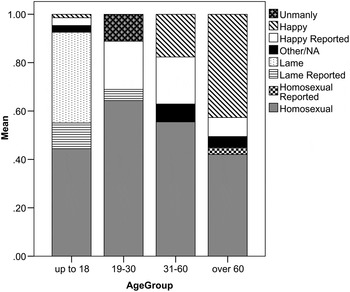
The age of speakers is arguably one of the most important factors used in systematising and analysing language change. A number of studies have shown that by looking at generational differences in linguistic usage (variation in apparent time), we can draw conclusions about linguistic change in progress (for a summary, see Sankoff, Reference Sankoff and Brown2006). Thus, the analysis of the adjective gay starts from considering age-related variation. The mean frequency of use of individual senses of the adjective gay has been recorded and plotted across a horizontal axis representing the age of participants, and this is represented in Figure 1.
Distribution of senses of the adjective gay across age groups

An initial inspection of Figure 1 indicates that the individual senses of the adjective gay are non-randomly distributed across different age groups. In order to verify whether the differences between groups are actually statistically significant I carried out Kruskal-Wallis non-parametric tests.Footnote 8 The results indicate that significant age-related differences are observed in the uses gay ‘lame’ (p < .001), gay ‘lame reported’ (p = .004), gay ‘unmanly’ (p = .015), gay ‘happy’ (p < .001), and gay ‘happy reported’ (p = .02). Although gay ‘homosexual’ is the central sense for the community as a whole, each generation uses a different range of additional senses of gay. Thus, ‘happy’ uses of gay are most prominent for older speakers and the recent sense gay ‘lame’ is most frequently used by younger generations. This observation not only reflects the trends that are recorded in real-time data, but also allows for more fine-grained conclusions on how semantic change takes place in a community.
However, before we plunge into a discussion of the observed age-related variation, it is worth investigating whether other social categories, such as gender and social status, play any role in the semantic variation and change of the adjective gay.
3.2 Gay: social class and gender
Since a number of variationist studies point to the significance of gender and social class alongside age in explaining change (see the review in Coates, Reference Coates2004, Eckert, Reference Eckert and Coates1998, or Kerswill, Reference Kerswill, Llamas and Stockwell2006), the importance of these factors must be considered in the context of the usage of gay.
The socio-economic status of participants was established on the basis of their education, occupation and current place of residence. Speakers’ occupation is measured against the National Statistics Socio-Economic Classification (hereafter NSEC) system, which is used for official surveys in the United Kingdom.Footnote 9 The professional status of speakers was assigned to one of three NSEC groups, with 1 referring to higher-level professions and 3 to lower-level occupations.Footnote 10 The value of the current place of residence was measured on the basis of postcode information provided by each participant. These postcodes were used to obtain the average house prices within the respective areas from the Land Registry House Prices Database (2008). In this way, the relative status of each neighbourhood was determined and speakers were divided into those living in more and less affluent areas.
Figure 2 presents the difference in the use of gay between males and females in each generation. In order to assess whether sense extensions of the polysemous adjective gay are used significantly differently by a particular gender or a socio-economic group, Kruskal-Wallis statistical tests have been carried out.Footnote 11 While gay ‘lame’ is used by young males (p = .001) who are still in education, gay ‘lame reported’ is used by young females who are still in education (p = .012)*. Gay ‘unmanly’ is used by males who are in the <19–30> age group (p = .015)*. Gay ‘happy’ is used by speakers who completed their education by the age of 16 (p = .000), especially if they are males (p = .004), as well by speakers occupying lower occupations (NSEC3) in the <31–60> age group (p = .027)*. Gay ‘happy reported’ is only marginally significantly used by educated speakers (p = .054), especially educated females (p = .059). Females also report on all senses of gay taken together (p = .011). Gay ‘other’ is used by professionals (p = .019).
Distribution of senses of the adjective gay across gender and age

The quantitative analysis of the sociolinguistic variation of the adjective gay indicates that the use of individual sense variants relates to the age, gender and the socio-economic status of speakers. In the following sections, these results will be interpreted in the context of patterns of semantic change of the adjective gay.
4. The changing meanings of gay from the variationist perspective
4.1 The overall pattern of change of the adjective gay
In order to provide greater insight into how semantic variation and change happens in a community, I have closely inspected the variation in the use of different senses of gay in the context of the age, gender, and social class of participants, and supplement this discussion with a range of qualitative comments provided by participants of the study. After commenting on the general findings of the survey, I focus on a detailed analysis of each sense of the adjective gay.
The variation in gay presented in Figure 1 indicates that different senses of gay are active for different generations. Although gay ‘homosexual’ is the key sense for every generation, there is variation in how other senses of gay are used. For instance, while for the youngest speakers gay ‘happy’ is a peripheral sense, the oldest speakers would consider gay ‘happy’ as the central reading of gay. Additionally, within each generation differences in the use of gay relate to the gender or social class of speakers. For instance, gay ‘unmanly’ is only used by males, whereas educated females more frequently report on using gay ‘happy’. These findings already demonstrate that the variationist paradigm provides a more fine-grained look into the variation and data for the analysis of this variation. But what about the change?
In this analysis we are drawing on the assumption that age-related differences in use are indicative of real linguistic changes (the apparent-time construct). Thus, in order to make conclusions about the diachronic development of gay we can examine how the frequency of use of individual senses changes from generation to generation (Figure 1). It is clear that the use of different senses of gay across different generations is not random, but seems to be structured. The use of individual senses gradually alters with decreasing age, forming clear trends of increased or decreased use of gay, cf. gay ‘lame’ and gay ‘happy’, respectively. These trends correspond to the general trends for the semantic development of gay presented in the real-time data, with gay ‘happy’ being historically an older sense and gay ‘lame’ a more recent innovation.
It is worth adding that apart from giving detailed information about types of senses used and indicating the general directions of change, the variationist analysis presents us with information on the relative frequency of use of gay in each generation, and thus allows us to measure the rate and pace of change. Thus, while gay ‘happy’ is the central sense for speakers over 60, its frequency of use drops by an overall amount of 20% for the next younger age group and maintains even more peripheral status for the remaining generations. This quantitative information allows us to build a usage profile for each speaker and each generation, consisting of information on the central and peripheral senses of a given polysemous category expressed quantitatively. Comparison of this information for speakers of different ages allows us to demonstrate more precisely how semantic change happens. So I turn now to discussing the details of how the change happens by surveying the change of individual senses.
4.2 Gay ‘happy’
Figure 1 clearly indicates that the use of gay ‘happy’ diminishes with the age of speakers. While the oldest generation used gay as ‘happy’ in nearly 50% of cases, this ‘happy’ usage of gay diminishes gradually to 5% among the youngest speakers. On the one hand, this trend is unsurprising since it conforms to the general observations from real-time data which indicate a diminishing use of gay ‘happy’. On the other hand, it may be surprising to find that so many speakers (including the youngest ones) use a sense that pragmatically clashes with gay ‘homosexual’ (cf. Algeo, Reference Algeo and Polomé1990: 404). Closer inspection of the responses provides more context for this situation. Alongside the spontaneous uses of gay ‘happy’ in each generation, there are a proportion of responses that are stylistically constrained and presented here as ‘reported’ uses. So there are speakers from each age group who mention gay ‘happy’, but they explicitly distance themselves from using this sense. Reporting on gay ‘happy’ is evidenced in each generation. However, the proportion of reported vs. non-reported uses of gay ‘happy’ decreases with increasing age of speakers.
Language change is not only reflected in quantitative differences in uses of gay ‘happy’ but also in additional comments provided by participants of the survey. A number of speakers from older age groups admitted that they hardly use gay ‘happy’ or that they do not use it now that it has developed the sense gay ‘homosexual’, which happened in a time that many of them can precisely locate, e.g. ‘gay “homosexual” has been used from 1970s’, ‘in the past 30 years’. There is a mixed reaction to this change. Some speakers say that they are now ‘conscious' of other senses of gay and are careful when they use gay ‘happy’. There are older speakers who seem to be upset about the fact that gay ‘happy’ has ceased to be commonly used, at the expense of gay ‘homosexual’. These speakers would often comment on the change, saying ‘it is a pity that gay changed its meaning’, ‘[the change] is sad. It is a pretty word’, ‘[gay] has only one meaning. And it's sad. We've lost a good word.’ Sometimes they continue to express negative opinions on the change of gay from ‘happy’ to ‘homosexual’ by saying ‘gay homosexual has taken over’; ‘I really fight against the use of this word [as ‘homosexual’]. I object strongly to hijacking of the word’, ‘[gay] has been hijacked’.Footnote 12 On the other hand, there are older speakers who continue to use gay ‘happy’ but they use it only in appropriate contexts and situations, depending on audience. For example, certain speakers say they use gay ‘happy’ only with older people. An elderly middle-class woman says ‘With my group of friends we say “let's have a gay day”, but we know what gay means so we make a play on the word.’ To summarise these comments, it is apparent that for older speakers a common, nostalgic narrative emerges. The English language used to have a ‘good’, ‘pretty’Footnote 13 word which then we ‘lost’ because this word was ‘hijacked’ and this is a ‘sad’ thing. Certain speakers object strongly and even ‘fight against the use of this word [as ‘homosexual’]’, whereas others still use it, but in a very ‘conscious’ manner.
For the vast majority of younger speakers, gay ‘happy’ has not been part of the usual usage. In fact, the large majority of them only report on gay ‘happy’. So while they seem to know that gay can mean ‘happy’; they often discuss it in a temporal frame, e.g. by saying ‘the term phased out’, ‘now it means’, ‘it used to mean’, ‘older meaning’. They often point to hearing this use from older generations, e.g., ‘my grandparents say “Gay old time”’, ‘people over 50 use gay “happy”’, ‘people 60–80 use gay “happy”’, ‘my grandma does’. It is interesting to see that while in the <19–30> age group all of the uses of gay ‘happy’ are reported, in the youngest age group there are speakers who use gay ‘happy’ in an unconstrained manner. One of the users of this sense is the youngest participant, an 11-year-old girl, who most likely uses the meaning that she had heard from older family members. Apart from orienting themselves towards adult norms, younger speakers may also be influenced by the way gay is used in children's literature. A quick review of more recent children's stories (available via the OEC) indicates that gay ‘happy’ is used in this genre unexpectedly frequently.
Statistically distinct socio-demographic groups who use gay ‘happy’ or report on this sense emerge only among the two older groups. While the use of gay ‘happy’ is mainly associated with older uneducated males, reporting on gay ‘happy’ is most frequent among educated females. One could argue that educated females report more frequently because they are more sensitive to overt linguistic norms than uneducated males (cf. Trudgill, 1994). This finding can also provide insights into how semantic change happens. The apparent-time interpretation of the observed variation suggests that these females reporting on gay ‘happy’ are also the first speakers in the community who ‘break from’ the uniform use of this sense. They are the first ones among their peers to start putting constraints on their usage of gay ‘happy’. This process may be motivated by the emergence of the newer gay ‘homosexual’. Their suppressing of the older sense could be interpreted as the first signs of change happening. It arguably makes educated females the most innovative speakers among their peers, while males are the most conservative ones. What now remains to be seen is how ‘the new’ sense gay – ‘homosexual’ – is incorporated into the speech community while gay ‘happy’ disappears.
4.3 Gay ‘homosexual’
Although gay ‘homosexual’ is the sense that is used most frequently in the community as a whole, it is the central meaning only for the two middle generations (19–30 and 31–60). This is unsurprising when one considers the historical contexts of the emergence of gay ‘homosexual’ discussed in Section 1.2. It was not until the 1970s that gay ‘homosexual’ entered the mainstream discourse and adolescent speakers living at this time would be the first ones to be growing up with the homosexual sense of gay being openly used. The use of gay ‘homosexual’ is still very frequent in the fringe generations, but it competes with gay ‘lame’ for the youngest speakers and gay ‘happy’ for the oldest ones.
However widespread the use of gay ‘homosexual’ is currently, this sense is marked for certain speakers, usually the older speakers. To some extent, reservations about its use are related to the taboo sphere of sexuality that gay belongs to. For example, during the interviews, a number of participants reacted with (what I interpreted as) slight embarrassment when asked about gay. Sometimes their responses were preceded by laughter, hesitation and laughter, or a long pause. Occasionally, they talked for a while about the current and past use of gay ‘homosexual’ without explicitly referring to sexuality but saying ‘these things’, or ‘People are now gay in the way that they weren't before.’ One participant did not even mention gay ‘homosexual’ as one of the uses, which would not be odd apart from the fact that he mentioned that he hears children using gay ‘lame’. In addition, several participants mentioned gay ‘happy’ in the first response to my questions, despite then admitting that they normally would not use that sense. I interpreted these reactions as a way for these speakers to manage their face when confronted with a taboo sense in this semi-formal situation they found themselves in. They also may think of the earlier meaning as somehow more ‘correct’ because it is older.
Other constraints emerge from the fact that the social and legal acceptance of homosexual orientation in society does not always translate to individual acceptance of the ‘homosexual’ usage of gay. This is visible in the comments quoted in the previous section in which participants express dissatisfaction with the development of gay ‘homosexual’. Several participants distance themselves from gay ‘homosexual’ to the extent that they deny using this sense altogether. For example, a 79-year-old lower-working-class female says:
I mean, this is a new word to me in the other sense of being gay. We always said ‘They look nice and gay’, clothes; and people who are happy. That is what I think of this gay. I think they spoiled the word. Wrong choice of a word, but I am a bit old fashioned. Homosexuals used to be called queers, pansies. To be quite honest a lot of these things I have learnt as I got older. I knew nothing about it when I was young. The other words become fixed in my mind for certain things.
These ‘reported’ uses of gay ‘homosexual’ came up solely among the oldest generation of speakers, which is actually an unsurprising finding if we consider this synchronic usage to represent a stage in the diachronic development of gay (cf. the apparent-time construct). It is during their adult life that gay changed its meaning from a relatively neutral sense ‘happy’ to a taboo sense ‘homosexual’, and the evaluative reaction to this change emerges in the form of reported usage.Footnote 14 Tracing the sociolinguistic contexts of the more conservative usage events allows us to pinpoint those sections of the community in which semantic change is perhaps most resisted.
4.4 Gay ‘lame’
Tracing semantic change in apparent time also allows us to track innovations in the language as they are happening. One such innovation is the use of gay as a general term of displeasure or disapproval, whose meaning, according to the participants of this survey, ranges from ‘boring’ (in reference to school, lessons, writing, reading, friends, dad), and ‘not interesting’, to ‘weird’ (in reference to various politicians), ‘annoying’ (in reference to ‘my sister’), ‘bad’, ‘rubbish’, and ‘stupid’.Footnote 15 It can also be heard in the phrase ‘Stop being gay’, which means ‘Stop annoying me.’ Although there is some concern in the literature (Lalor & Rendle-Short Reference Lalor and Rendle-Short2007) and also in educational circles (e.g. in guides for teachers)Footnote 16 that this new sense of gay projects homophobic undertones, the data I obtained do not seem to support this assumption in a straightforward way. The types of referents that can be described as gay refer to the key areas in a young person's life such as school, family and friends, and it is not obvious that all of those would evoke the notion of homosexuality. Also, during and between individual interviews at one secondary school, I occasionally asked students whether the new uses of gay carry any homophobic meaning, and they denied this. This finding corroborates McCormack's (Reference McCormack2011: 347–8) observations that teenage boys in England maintain that using gay as in ‘That is so gay’ is not homophobic and that the word gay in general is never used in an aggressive manner as an insult.
Overall, these observations suggest that gay now functions as a non-homophobic term of disapproval or an insult (see below) and can be read as ‘ironic, self-referential, habitual, or even deployed without a “knowing” relation to gayness as a sexual signifier’ (Rasmussen, Reference Rasmussen2004: 304). Gay ‘lame’ can have various socio-psychological functions, including one of social bonding (McCormack, Reference McCormack2011: 349). This awareness of the multiple instantiations of gay in the speech of younger generations (including references to homosexuality) can actually provide the basis for more socio-culturally sensitive pedagogies, especially since recent evidence suggests that cultural homophobia (Anderson, Reference Anderson2009) and actual homophobic discourses are diminishing in English secondary schools (McCormack, Reference McCormack2011).
Apart from age, significant gender differences also emerge in the use of gay ‘lame’. While this sense most frequently occurs in the speech of young men, who can arguably be considered innovators of this sense, young females who are still in education tend to report on gay ‘lame’. These women and girls distance themselves from using gay ‘lame’ by saying that it is an insult that is used by 13–16-year-old teenagers and that it can often be heard in the speech of boys. These perceptions reinforce the idea that gay ‘lame’ could have been innovated among teenage boys, but perhaps not very young boys: there was one 12-year-old middle-class boy who said that he heard gay being used at school, but he did not really know what it meant.
When it comes to females, again we see a situation where they report on a pragmatically ‘risky’ sense that is undergoing a change (cf. discussion of gay ‘happy’). In a way, this observation is unsurprising in the context of a range of sociolinguistic studies which indicate that women tend to be more sensitive to overt norms (cf. Trudgill, Reference Trudgill1974). This sensitivity to pragmatically and also stylistically risky uses can surface as (conscious) distancing from these uses, and this is what happens via reporting in this case study.
4.4.1 Gay ‘lame’ on the Internet
Although usage evidence from the OEC indicates that gay ‘lame’ is used rather infrequently in British English, a quick look at the interview data presents a different picture. The apparent-time data indicates a much higher frequency of the use of gay ‘lame’. Gay ‘lame’ occurs mostly in the language of the youngest age group (up to 18 years old). Eleven out of 18 of the speakers use gay ‘lame’ in 60% of their total responses (18 out of 28). Five out of the remaining seven speakers in this group report on knowing this meaning, although they deny using it. So why does the corpus usage differ so much from the interview usage?
One possible explanation may be related to the composition of the corpora. Any corpus is just a sample of language used in a given period and there is a chance that this sample might not be very representative in some cases. However, after probing this issue further, both in the OEC and after using Google as a corpus, I discovered that gay ‘lame’ is usually spelled in on-line sources in more cryptic ways. For example, gay can be spelled as gh3y, g4y, jey, g@y, ghey. The idea behind this cryptic spelling is that such words are not picked up by taboo and sensitive word filters on internet forums.Footnote 17 By using advanced Google search options, gh3y was searched on websites from the United Kingdom, and a vast majority of the results returned used gh3y in the sense ‘lame’. Many of the examples come from gaming and computer equipment forums, such as digitalspy.co.uk, gameon.co.uk, euro-chimaera.co.uk, forums.multiplay.co.uk, and techangel.co.uk.
The real-time evidence obtained from the Internet indicates that gay ‘lame’ may be more frequently used than the OEC suggests. This finding would corroborate the apparent-time usage data obtained from the interviews.
4.5 Gay ‘unmanly’
While teenage boys use gay ‘lame’ frequently, the analysis of responses from young adult males indicates that they employ gay in a slightly different way. These males use gay to describe activities, such as ‘eating salads’, ‘carrying an umbrella’, or to describe looks, such as ‘wearing two earrings’. These activities, according to participants, are gay because they are ‘effeminate, not masculine’ (hence we use a reference tag of gay ‘unmanly’).
It is clear that gay ‘unmanly’ projects connotations of the speakers' masculinity through distancing from anything that can be seen as feminine or not masculine enough (cf. Pollack, Reference Pollack1998). Gay ‘unmanly’ demarcates the borders of masculinity and disapproves of the transgressing of those borders. It is used and was probably innovated by males to challenge the masculinity of other men, and it is noticeable that in this survey gay ‘unmanly’ does not surface in the speech of women. However, one could wonder to what extent gay ‘unmanly’ builds on the stereotypes of heterosexual masculinity and even homosexuality. Previous studies suggested that because homosexuality is stigmatised, men can use homophobic discourse as a central mechanism in the maintenance of their heterosexual identities (Mac an Ghaill, Reference Mac an Ghaill1994). So should the use of gay ‘unmanly’ perhaps be considered as an instantiation of a homophobic discourse?
When analysing the change of the adjective gay in apparent time (Figure 1) one can observe that the ‘unmanly’ sense of gay followed on from gay ‘homosexual’. Considering that semantic change typically involves some overlap between an older and a newer meaning, we cannot exclude the possibility that gay ‘unmanly’ reflects and encourages homophobic attitudes in the community. However, the data obtained in the current survey do not provide support for that usage. Participants in the survey who used gay ‘unmanly’ clearly indicated that they do not think this sense is used as a homophobic pejorative. Indeed, the referents that they describe as gay, such as ‘carrying an umbrella’ and ‘eating salads’, are not traditionally discussed in the context of sexuality. What these examples of the use of gay may project, though, is behaviour that goes beyond traditionally-understood masculinity. These examples may promote the idea of masculinity as based on the culturally salient archetypes of local (here northern) toughness. This idea of masculinity can be described as (regionally) localised masculinity. For example, one can argue that while in the south of England eating salads would project positive cultural connotations of ‘healthy eating’, in the north it is often referred to with a more derogatory phrase, rabbit food. References to carrying an umbrella can also be interpreted in the context of not being manly/tough enough to get on with what are not unusual weather conditions in that area.
4.6 Gay ‘other’
Several middle-class speakers (older participants in the <31–60> and <over 60> age groups) used gay in reference to flowers (nosegay), the girl's name Gay, or to a local coach company called Gay Tours. Although these examples were lumped together in the gay ‘other’ category, their use is no less important. The presence of these uses in the older generations could actually be predicted from the apparent-time hypothesis. Employing Gay as a name could only be a pragmatically safe choice in historical periods and for speakers whose major senses of gay are also ‘happy’, ‘bright’, ‘cheerful’, etc. And this is precisely what emerges in the variationist analysis of the adjective gay. Although the use of gay ‘other’ is infrequent, the applied method located it and showed that it sits in the predictable place on the demographic map of gay.
5. Discussion: semantic change through a sociolinguistic lens
The sociolinguistic analysis of the semantic variation in the adjective gay provides a number of insights into why different speakers in the same community use different senses of the same polysemous word. The key finding of this analysis is that the usage of different senses of the adjective gay is not random, but relates to the socio-demographic characteristics of speakers (cf. Robinson, Reference Robinson2010b, Reference Robinson, Allan and Robinson2012). This non-randomness of usage can be explained in terms of the experiential nature of meaning which surfaces at the socio-demographic level in the form of varying frequencies of the use of individual senses of gay (cf. Pütz et al., Reference Pütz, Robinson and Reif2012, Reif et al., Reference Reif, Robinson and Pütz2012).
The investigation of the semantic variation in gay also yields a range of observations that enhance our understanding of how semantic change happens. This is carried out by employing the apparent-time construct, which assumes that generational differences in linguistic use reflect the actual diachronic developments in language.
The key finding that the older generations retain older meaning variants of gay, while younger generations innovate, is not surprising. However, what this analysis has additionally shown is that an observation of more subtle usage differences helps to point to areas of linguistic innovation and conservatism in that speech community. These areas of conservatism/innovation surface in relation to such factors as gender, social class, the education of speakers, the conscious constraining of usage contexts, attitudes to change, attitudes to the usage of other speakers, perceptions of change in terms of timing, perceptions of innovative and conservative groups, and finally the actual referential meaning of a particular variant and speakers’ (subconscious) assessment of the pragmatic need for using that variant. In order to contextualise these observations, in this section I summarise the key findings of how the semantic change of gay happens. I first focus on gender, age, and socio-economic status, the classic sociolinguistic categories for learning about language change.
Among the older generations, the ‘happy’ uses of gay are retained among speakers belonging to lower socio-economic classes, especially males. These speakers are less mobile in socio-geographic terms and probably belong to more established, stronger networks which are not easily penetrable by more innovative uses of language (cf. Milroy and Milroy, Reference Milroy and Milroy1992). On the other hand, more educated speakers (especially females) are most clearly distancing themselves from the older senses and doing what I have referred to as reporting on gay ‘happy’. However, there is no clear evidence that these speakers are also the ones leading in the use of a newer sense (gay ‘homosexual’).
Among the younger generations, males, rather than females, are innovating gay ‘unmanly’ and gay ‘lame’. Why might this be the case? Let us look again at the demographic distribution of senses in Figure 1. Men's conservative and innovative uses of gay are present in generations that are at both ends of the <31–60> age group, which is the generation representing the highest frequency of gay ‘homosexual’. Perhaps, the increased rates of retention or innovation of non-homosexual senses of gay (‘happy’, ‘unmanly’, ‘lame’) could be read as a way for these speakers to react to, draw upon, or create distance from the notion of homosexuality (cf. Anderson, Reference Anderson2009).
The current study also provides empirical evidence for the gradual nature of semantic change, and argues for a more fine-grained analysis of polysemy in investigating semantic change. Data show that many changes that seem to be abrupt are in fact preceded by a phase of overlapping uses (cf. Nerlich & Clarke, Reference Nerlich and Clarke1992), with newer meanings often retaining elements of older senses (cf. Bybee and Pagliuca's (Reference Bybee, Pagliuca, Giacalone-Ramat, Carruba and Bernini1987) ‘retention' or Hopper's (Reference Hopper, Traugott and Heine1991) ‘persistence’). For instance, the development of gay ‘homosexual’ to gay ‘lame’ has been accompanied by the emergence of gay ‘unmanly’. Figure 3 illustrates how this change, which emerged at the demographic level, could have taken place on a conceptual level. The change from gay ‘homosexual’ to gay ‘unmanly’ was marked by the shift of focus from homosexuality to masculinity. This stage was probably preceded by the development of negative attitudes or even homophobic uses of gay (marked with a question mark) which I have not accounted for in my survey. The indication of ‘disapproval’ is the key conceptual element for further development of gay ‘unmanly’ and ‘lame’. By the time gay ‘lame’ develops, connotations of sexuality are lost and gay remains to be used as a negative evaluative adjective. Since gay ‘lame’ has a considerable pragmatic impact, it is probable that in time this negative intensifier will continue to widen its range of contexts. However, judging by the fate of other frequently used intensifiers, gay ‘lame’ may start losing the pragmatic impact it has now (cf. Macaulay, Reference Macaulay2006; Jing-Schmidt, Reference Jing-Schmidt2007). Alternatively, gay ‘lame’ may start being used to mean the opposite (as awesome, wicked, sick have), which would certainly be an interesting development to witness!
The ‘chain' of semantic change from gay ‘homosexual’ to gay ‘lame’

The apparent-time analysis of recent changes of gay allows for less frequent uses of this adjective to emerge ‘in between’ gay ‘lame’ and gay ‘homosexual’. An awareness of the existence of these bridging senses helps to explain how semantic change from ‘homosexual’ to ‘lame’ happened at the socio-conceptual level. These findings also show that the emergence of gay ‘lame’ did not necessarily have its roots in gay or even homophobic discourse, as at the diachronic conceptual level gay ‘lame’ and gay ‘homosexual’ do not seem to be directly related, as they are mediated by other sense(s).
A wealth of information on how semantic change happens is available in the metalinguistic comments provided by participants of the survey. The analysis of ‘reported' uses of sense variants is particularly useful for learning about the types of meaning change that are happening as well as learning about the direction of change. Another interesting observation comes from examining the demographic distribution of ‘reported' senses presented in Figure 1. ‘Reported' senses appear in those ‘places' in the socio-demographic structure which are sensible or even predictable from the point of view of the historical development of the word. Reporting on a change seems to be demographically ‘adjacent’ to the actual change going on. Thus, one can observe that as gay starts being used to mean ‘homosexual’, the oldest generation reacts by reporting on it. They often refer to gay ‘homosexual’ as the ‘new’ meaning of gay. On the other hand, the majority of these speakers are not aware of the newer meaning ‘lame’ and certainly none of them report on gay ‘lame’. The analysis of the reporting on usage further supports the idea of the social grounding of semantic change. There needs to be some contact, e.g. at the demographic level, between speakers for the change that is taking place to be noticed and commented upon. A final observation here is that overall females comment upon pragmatic or stylistic restrictions of the usage of gay significantly more frequently than males do. This observation can lead to the conclusion that females in this speech community exhibit an increased awareness/responsiveness to overt sociolinguistic norms. This finding is unsurprising if one considers a range of sociolinguistic studies carried out at other levels of language and in different communities which corroborate these conclusions (cf. Coates, Reference Coates2004).Footnote 18 Finnegan's (Reference Finnegan2011) recent study carried out among speakers from Sheffield also demonstrates that females are leading phonological change in that city.
Apart from reporting on the contexts of use of the adjective gay, which then help in locating the type and the direction of change, participants provided a range of metalinguistic comments that allow us to situate the change in time and social space. Thus, speakers point to particular socio-demographic groups that use gay in a characteristic way, and also provide comments on the timing of the change. For instance, speakers of all ages comment on the timing of the key changes gay has gone through during their life. For example, a young middle-class teenager notices that he heard gay ‘lame’ for the first time ‘five years ago’, while another teenager says that gay ‘lame’ is used by year 7 and 8 teenagers. Older participants mainly comment on the change from gay ‘happy’ to ‘homosexual’, e.g. gay ‘homosexual’ is used ‘from 1970s’, gay changed its meaning ‘in the past 30 years’. These perceptions correspond to real-time information on the change of gay. This very accurate reporting may be related to the fact that this adjective is exceptionally salient in that speech community as it evokes sexual taboo, prejudices, stereotypes, politically shaped usage, etc.
Metalinguistic comments also indicate that the evaluative load that accompanies the usage of gay also leads speakers to consciously alter the way they use gay. In the analysis of gay ‘happy’ and gay ‘homosexual’ we have seen that some people change the way they speak during their lifetime by adopting new senses (gay ‘homosexual’) or reducing the use of older senses (e.g. gay ‘happy’), sometimes concurrently. At first sight, this goes against the apparent-time hypothesis, which largely assumes the stability of vernaculars. Here, I would like to suggest that changes in individual semantic usage provide evidence to further strengthen the validity of the apparent-time hypothesis (cf. Boberg, Reference Boberg2004). Older speakers who adopt innovative variants actually contribute to the acceleration of semantic change. In the same way, shedding older variants can accelerate the disappearance of some uses. This age-graded behaviour can explain why semantic change can sometimes be rather abrupt and why cases of a change to an opposite meaning (such as gay ‘happy’ to ‘lame’) can occur within just a couple of generations.
6. Conclusions
Sociolinguistics has rarely investigated semantics, and semantics has rarely considered sociolinguistic insights into the variation and change in meaning. In this paper, I have challenged this research ‘custom’ by placing one of the most iconic examples of semantic change onto the socio-demographic map. By employing the apparent-time construct I was able to trace a semantic change as it happens, and take account of all sorts of evaluative comments and perceptions accompanying the change. The conclusions of this study contribute to analyses of an already well-investigated word, by providing insights into how semantic change emerges from the interaction of individual and community usage. The key finding of this study is that meaning variation and change is a complex socio-conceptual phenomenon, and therefore semantics and sociolinguistics can and should inform one another in future research.
 JUSTYNA A. ROBINSON is a Lecturer in English Language and Linguistics at the University of Sussex, United Kingdom. Her research focuses on semantic variation and change, sociolinguistics, cognitive linguistics, corpus linguistics and how these interact. Recent publications include the co-edited volumes Current Methods in Historical Semantics (de Gruyter Mouton 2012), Variation in Language and Language Use: Sociolinguistic, Socio-cultural and Cognitive Perspectives (Peter Lang 2012), Polysemy and Synonymy. Corpus Methods and Applications in Cognitive Semantics (John Benjamins, forthcoming) and a special issue of Review of Cognitive Linguistics entitled Cognitive Sociolinguistics: Variation in cognition and language use (John Benjamins, 2012). Email: justyna.robinson@sussex.ac.uk