INTRODUCTION
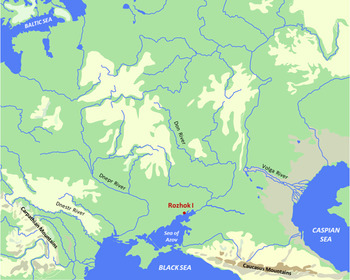
Rozhok I is located on the Sea of Azov coast in Taganrog Bay, approximately 45 km west of the city of Taganrog, at 47°08ʼ56.2249"N, 38°25ʼ49.6160"E. The open-air site is found on the east bank of ravine (Bulina Ravine) that formerly emptied into the bay (Figure 1).
Location of Rozhok I.

Rozhok I was discovered and investigated in 1961–1962 by N. D. Praslov, who excavated approximately 100 m2. Praslov (Reference Praslov1968: 66–69) encountered 6 occupation horizons (Cultural Horizons 1–6) buried in a sequence of more than 4 m of loam deposits containing traces of buried soils. All of the artifact assemblages from the occupation horizons were assigned to the Middle Paleolithic. The artifacts were associated with several hundred well-preserved mammal remains, primarily representing steppe bison (Bison priscus), although giant deer (Megaloceros sp.) and wild ass (Asinus hydruntinus) also were present in significant numbers (Praslov Reference Praslov1968: 71).
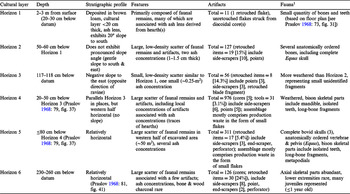
As described by Praslov (Reference Praslov1968), Rozhok I is an unusual, perhaps unique, multi-layered Middle Paleolithic site on the southern margin of the East European Plain. Despite repeated occupation of the site, the cultural horizons are dominated by heavily fragmented large mammal remains; most layers yield small quantities of artifacts and limited evidence of extended habitation (see Table 1).
Rozhok I cultural layers (based on Praslov Reference Praslov1968: 72–93).

1 Supplemented with notes made by one of the authors (JFH) who examined several hundred faunal remains from Horizons 4–6 through the courtesy of I. E. Kuz’mina (Zoological Institute, Russian Academy of Sciences) in November 1988.
The Middle Paleolithic industry is non-Levallois with a low blade index but contains some Upper Paleolithic tool types; although complete bifaces are lacking, three of the horizons (2, 4, and 5) yielded partially bifacially flaked items, including an asymmetric Keilmesser-like tool (Horizon 2) (Praslov Reference Praslov1968: 74–90). The presence of small thinning flakes also indicates bifacial technology, and the industry currently is viewed as Micoquian, which is widespread in Eastern Europe (Kolesnik Reference Kolesnik2003, Reference Kolesnik2018).
In addition to the artifacts and nonhuman faunal remains, Praslov (Reference Praslov1968: 83, fig. 43) recovered a human tooth (upper second molar) from Cultural Horizon 4, which was initially examined by A. A. Zubov, who noted some archaic features (Praslov Reference Praslov1968: 83–84; Gerasimova et al. Reference Gerasimova, Astakhov and Velichko2007: 162). Recently, the Rozhok I tooth was analyzed by Khaldeeva et al. (Reference Khaldeeva, Kharlamova and Ocherednoy2020), who described both archaic and modern features; they emphasized the similarities to European Neanderthals but cautioned that definitive taxonomic assignment was problematic. On the other hand, A. V. Zubova (pers. comm., 2021) concluded that the tooth could be classified as Neanderthal, based on enamel-dentine junction topography and the volumetric characteristics of the enamel and dentine.Footnote 1
Praslov (Reference Praslov1968: 67–69, fig. 29) recorded the following stratigraphic profile from the north wall of the 1961–1962 excavations:
-
1. Modern soil (thickness = ∼50 cm).
-
2. Brown loam, calcareous with rodent burrows (thickness = ∼70 cm).
-
3. Dark brown loam, humified, wedging out to the west (thickness = ∼50 cm).
-
4. Light gray-brown loam, calcareous, penetrated by rootlets and occasional rodent burrows (thickness = ∼80 cm).
-
5. Reddish-brown loam, deposited in two bands subdivided by light brown loam (thickness = ∼70 cm).
-
6. Brown and light brown loam, in places grayish brown; the latter is associated with the 6 cultural layers (thickness varies from ∼40 to ∼150 cm).
-
7. Dark grayish brown sandy loam, humified (buried soil) (thickness = ∼40 cm).
-
8. Dark brown loam (thickness = ∼130 cm).
-
9. Limestone (Sarmatian formation).
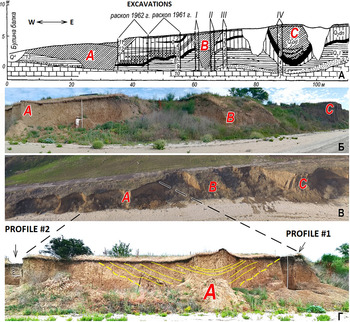
New field investigation was undertaken at Rozhok I in 2016 as part of a wider program of long-term research on Middle Paleolithic sites of the East European Plain with a focus on geochronology (Ocherednoi et al. Reference Ocherednoi, Salnaya, Voskresenskaya and Vishnyatsky2013; Vishnyatsky et al. Reference Vishnyatsky, Ocherednoi, Hoffecker, Voskresenskaya, Nehoroshev, Pitul’ko and Holliday2015, Reference Vishnyatsky, Nehoroshev and Otcherednoi2019; Hoffecker et al. Reference Hoffecker, Holliday, Nehoroshev, Vishnyatsky, Otcherednoy, Salnaia, Goldberg, Southon, Lehman and Cappa2019). Examination of the site and its immediate vicinity revealed that, despite several local ground-disturbing activities in the area during the intervening half century, Rozhok I remained intact and largely undisturbed. The margins of the 1961–1962 excavations were identified, and two new stratigraphic profiles were recorded on the exposed bluff face (Figure 2).
A: Rozhok I excavations 1961–1962 (adapted from Praslov Reference Praslov1968: 66, fig. 28). Б–Г: Rozhok I field investigations 2016, showing location of 1961–1962 excavations (between “A” and “B”) and stratigraphic profiles recorded in 2016.

Profile #1 was located on the western margin of the original excavations. A 6.5-m-thick stratigraphic profile was recorded, and sediment and soil micromorphology samples were collected and analyzed. Most of the units between 1.7 and 3.7 m below the surface exhibited a pronounced negative slope (ranging from 5° to 20°) towards the west (i.e., towards the ravine).
A second profile (Profile #2) was recorded 21.7 m west of Profile #1, where large mammal remains were observed eroding out of the bluff face during initial inspection of the site in 2016 (see Figure 2). A scatter of large mammal bones associated with one chert flake, occupying an area of ∼9 m2, was encountered at a depth of 1.2–1.3 m below the surface (a total area of ∼15 m2 was exposed on this level).Footnote 2 Small quantities of bone also were encountered at 3.6–3.7 and 4.30–4.36 m below the surface, respectively. It is unclear if any of these finds represent one or more of the 6 cultural horizons described by Praslov (Reference Praslov1968).
On the basis of soil stratigraphy, Praslov (Reference Praslov1984: 32) concluded that the Middle Paleolithic occupations probably dated to the end of the Last Interglacial or early Last Glacial. Praslov (Reference Praslov1968: 71) also concluded that the 6 occupation levels, all of which are contained in Unit 6 (see above), were deposited over a relatively brief interval of time.
As part of a study of raw material procurement, Doronicheva et al. (Reference Doronicheva, Nedomolkin, Kulkova and Gerasimenko2017: 289) obtained a radiocarbon (14C) date on bone (rib and long bone fragments) from the lowermost cultural level (Horizon 6) of >43,000 BP (Spb-1077).
MATERIALS AND METHODS
In 2016, the senior authors found a set of bone and teeth samples excavated by Praslov during 1961–1962 stored at the Taganrog Museum. In 2018, we received funding from the Leakey Foundation to obtain 14C dates on bone from several major Paleolithic sites on the East European Plain, including Rozhok I. The bone and teeth samples from the Taganrog Museum were transported to the University of California-Irvine (UC-Irvine) in the USA in August 2018 and dated by AMS during 2018–2020.
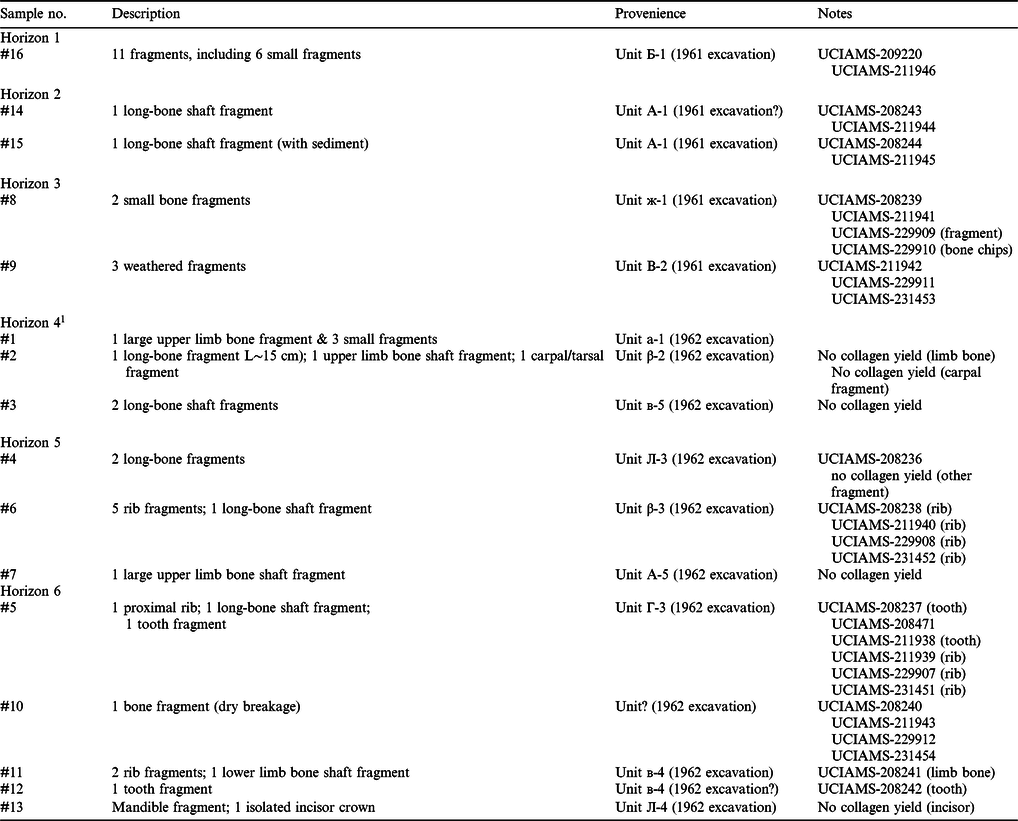
A complete list of the Taganrog Museum samples is presented in Table 2. Although 16 numbered samples are listed, more than half of them contain multiple items. The total number is 42 bones and bone fragments and 3 tooth fragments. The bones represent both the axial and appendicular portions of the ungulate skeleton and include fragments of ribs and limb-bones and of at least one mandible and foot-bone.
List of bone samples from Rozhok I collected from the Taganrog Museum in 2016 for 14C dating.

1 Note: Samples #1–3 in one bag with a general label: Taganrog Museum, Rozhok I – 1961/1962 Horizon 4; 8 frags (rib & massive long-bone shaft).
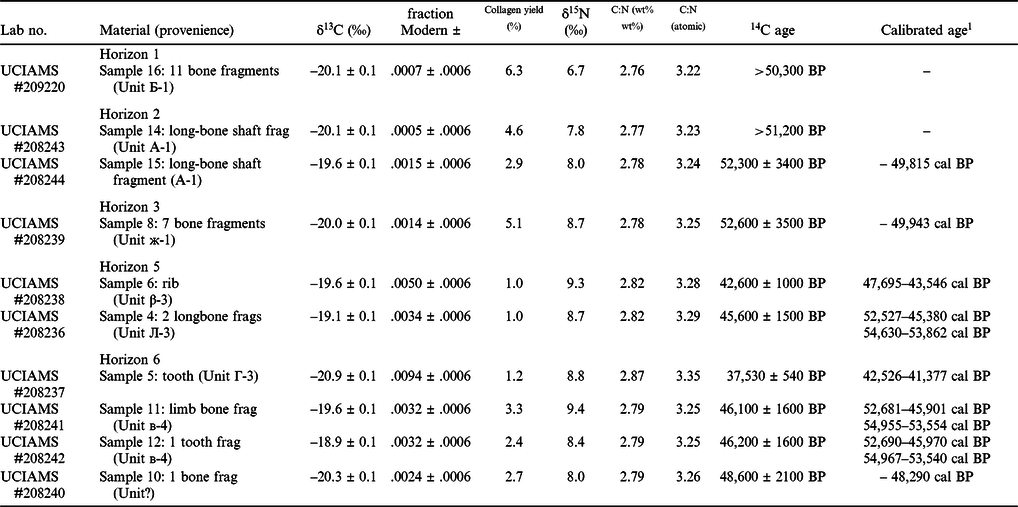
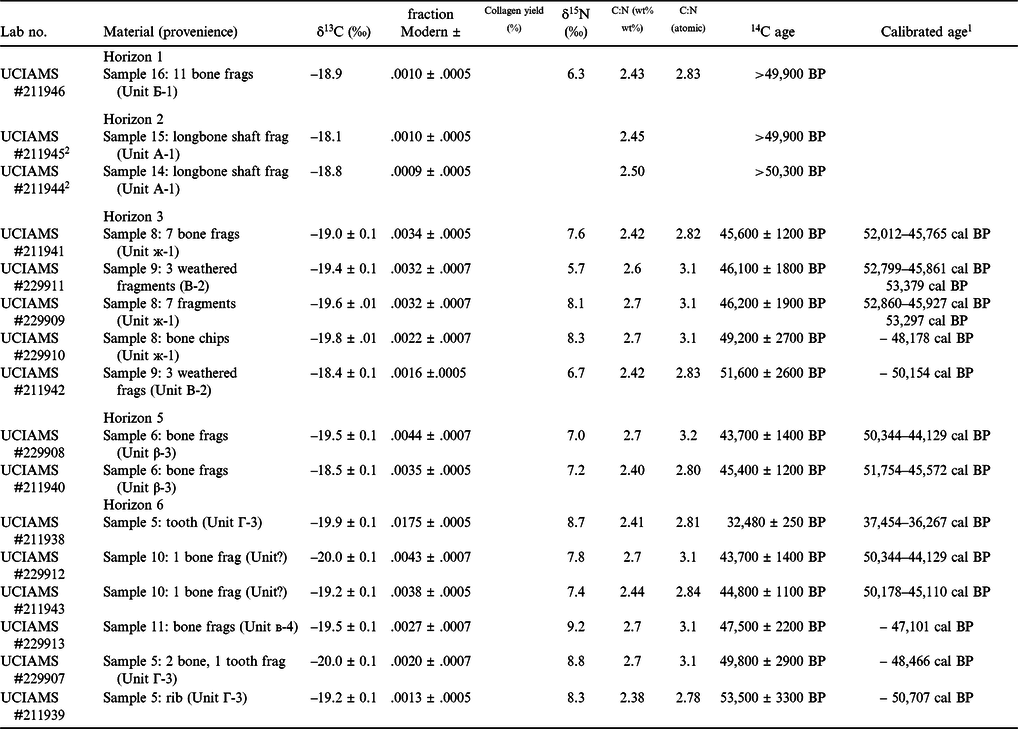
Although some fragments are weathered, overall preservation of bone was excellent, given the fact that Rozhok I is a Middle Paleolithic open-air site (possibly occupied by Neanderthals) in the middle latitudes (47ºN). The low degree of weathering among the sample bones is consistent with observations on the bulk of the faunal material recovered during 1961–1962 made by one of us in 1988 (see Table 1 footnote). It is further supported by the results of the dating: most of the samples yielded sufficient collagen for dating (see Table 1). Moreover, the C:N atomic ratios, which are given in Tables 2 and 3, indicate good quality collagen (i.e., they fall within the recommended range [e.g., Calabrisotto et al. Reference Calabrisotto, Fedi, Caforio, Bombardieri and Mando’2013]) (see Figures 3 and 4).
14C dates on ultra-filtered collagen samples from Rozhok I, obtained in 2018–2020 (by Keck Carbon Cycle AMS Facility, Earth System Science Department, University of California-Irvine).

1 95.4% probability (OxCal 4.4) IntCal20 atmospheric curve (Reimer et al. Reference Reimer, Austin, Bard, Bayliss, Blackwell, Ramsey, Butzin, Cheng, Edwards, Friedrich, Grootes, Guilderson, Hajdas, Heaton, Hogg, Hughen, Kromer, Manning, Muscheler, Palmer, Pearson, van der Plicht, Reimer, Richards, Scott, Southon, Turney, Wacker, Adolphi, Büntgen, Capano, Fahrni, Fogtmann-Schulz, Friedrich, Köhler, Kudsk, Miyake, Olsen, Reinig, Sakamoto, Sookdeo and Talamo2020).
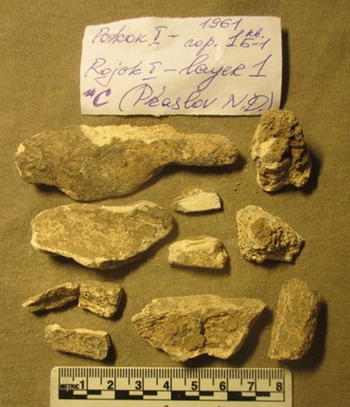
Bone fragments recovered from Horizon 1 (sample #16) at Rozhok I. See Table 2 for details.

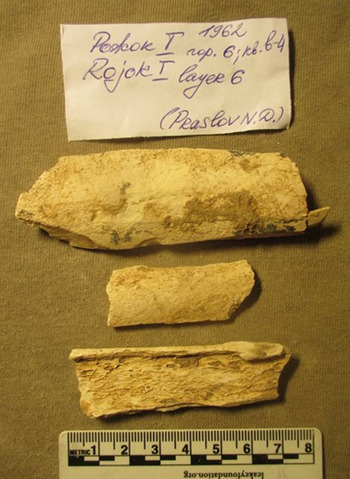
Bone fragments recovered from Horizon 6 (sample #11) at Rozhok I. See Table 2 for details.

Two methods were applied to the sample preparation at UC-Irvine: (1) gelatin extraction/ultra-filtration, and (2) treatment with XAD resin.
Bone and tooth fragments from 10 samples were prepared in accordance with the following gelatin extraction/ultra-filtration protocols, described in detail in Beaumont et al. (Reference Beaumont, Beverly, Southon and Taylor2010). The samples were physically cleaned and sub-sampled with a rotary Dremel tool, and samples of 150–200 mg were crushed to ∼1 mm powder and decalcified for 24–36 hr at room temperature in 0.5N HCl. The resulting collagen was washed with MQ water and gelatinized overnight in 0.01N HCl at 60°C. The high molecular weight fraction (>30 kDa) of the gelatin solution was selected using precleaned ultra-filters and then lyophilized for subsequent combustion, graphitization, and 14C measurement by AMS (on the Keck Carbon Cycle facility at UC-Irvine).
Nine samples were dated following treatment with XAD resin, described by Stafford et al. (Reference Stafford, Brendel and Duhamel1988). Aliquots of ∼200 mg of cortical bone were cleaned mechanically and sampled with a high-speed rotary Dremel tool, crushed to mm-sized chips, and placed in preweighed 13-mm screw-top vials with vented caps. Samples were treated to remove contaminating conservation materials by sonication in acetone, methanol and MQ water (1 hr each) in a water bath cooled to ∼45°C, well below the melting point of collagen. The bone was decalcified overnight with 1N HCl at room temperature, using a measured amount of acid calculated as just sufficient to dissolve all of the bone mineral if no collagen was present, and the samples were then sonicated in acidified methanol (5% 0.2N HCl) and in MQ water (1 hr each) to remove any contaminating polymerized shellac that might be present. The water was then pipetted off and the samples were vacuum-dried and the vials weighed to determine decalcified bone yields.
The vials were sealed with Teflon-lined screw caps under He after addition of 1 mL of 6N HCl, and the samples were hydrolyzed overnight at 120°C. The hydrolyzate was then purified by passing it through SPE cartridges containing precleaned XAD-2 resin, following activation with 2 column volumes (2 × 3 mL) of methanol, washing with 1 CV of MQ water, and preconditioning with 2 CV of 6N HCl. The hydrolyzate was pipetted into the SPE cartridges using fine-tip pipets to avoid transferring solids and flushed into 13-mm culture tubes with two consecutive additions of 1 mL of 6N HCl. The hydrolyzate samples were then vacuum-dried for 24 hr, with gas-tight closures punctured with 1 or 2 sub-mm holes on the culture tubes to inhibit boiling and prevent fluid loss if it did occur. The samples were then redissolved in 1 mL of MQ water and dried for another 24 hours to further reduce the acid content of the final product.
The dried hydrolyzate samples were taken up in measured volumes (∼mL) of MQ water, based on the yields of decalcified bone and the mass requirements for 14C and stable isotope measurements. Aliquots of 0.3 mL containing ∼2 mg of amino acids for 14C dating were pipetted into 6-mm quartz combustion tubes containing preweighed amounts of CuO and silver wire and dried overnight in a vacuum centrifuge. The tubes were sealed in vacuo and combusted at 900°C for CO2 graphitization and 14C measurement by AMS at the Keck AMS laboratory at UC-Irvine. 0.1 mL aliquots containing ∼0.7 mg of amino acids were pipetted into 5 × 9 mm tin cups, dried overnight in air and double-wrapped in a second cup, and placed in the carousel of a Fisons NA1500NC elemental analyzer interfaced to a Finnigan Delta Plus isotope ratio mass spectrometer for elemental analyses and d13C and d15N measurements.
RESULTS
We obtained a total of 26 14C dates on our bone and tooth samples from the 1961–1962 excavations at Rozhok I. Ten of the dates were obtained on samples of ultra-filtered collagen (see Table 3) and 16 dates were obtained on samples treated with XAD-2 resin (see Table 4). All of the 14C ages have been calibrated with the recently published IntCal 20 curve (Reimer et al. Reference Reimer, Austin, Bard, Bayliss, Blackwell, Ramsey, Butzin, Cheng, Edwards, Friedrich, Grootes, Guilderson, Hajdas, Heaton, Hogg, Hughen, Kromer, Manning, Muscheler, Palmer, Pearson, van der Plicht, Reimer, Richards, Scott, Southon, Turney, Wacker, Adolphi, Büntgen, Capano, Fahrni, Fogtmann-Schulz, Friedrich, Köhler, Kudsk, Miyake, Olsen, Reinig, Sakamoto, Sookdeo and Talamo2020). However, the uncalibrated ages are shown in Figures 5–8. Below, we discuss the dates by individual cultural horizon, followed by a brief summary of results.
14C dates on bone samples treated with XAD-2 resin from Rozhok I, obtained in 2018–2020 (by Keck Carbon Cycle AMS Facility, Earth System Science Department, University of California-Irvine).

1 95.4% probability (OxCal 4.4) IntCal20 atmospheric curve (Reimer et al. Reference Reimer, Austin, Bard, Bayliss, Blackwell, Ramsey, Butzin, Cheng, Edwards, Friedrich, Grootes, Guilderson, Hajdas, Heaton, Hogg, Hughen, Kromer, Manning, Muscheler, Palmer, Pearson, van der Plicht, Reimer, Richards, Scott, Southon, Turney, Wacker, Adolphi, Büntgen, Capano, Fahrni, Fogtmann-Schulz, Friedrich, Köhler, Kudsk, Miyake, Olsen, Reinig, Sakamoto, Sookdeo and Talamo2020).
2 The nitrogen peak over-scaled on this sample and d15N and C:N ratios could not be measured.
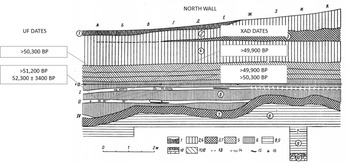
Stratigraphic context of 14C dates from Horizons 1 and 2 (adapted from Praslov Reference Praslov1968: 67, fig. 29).

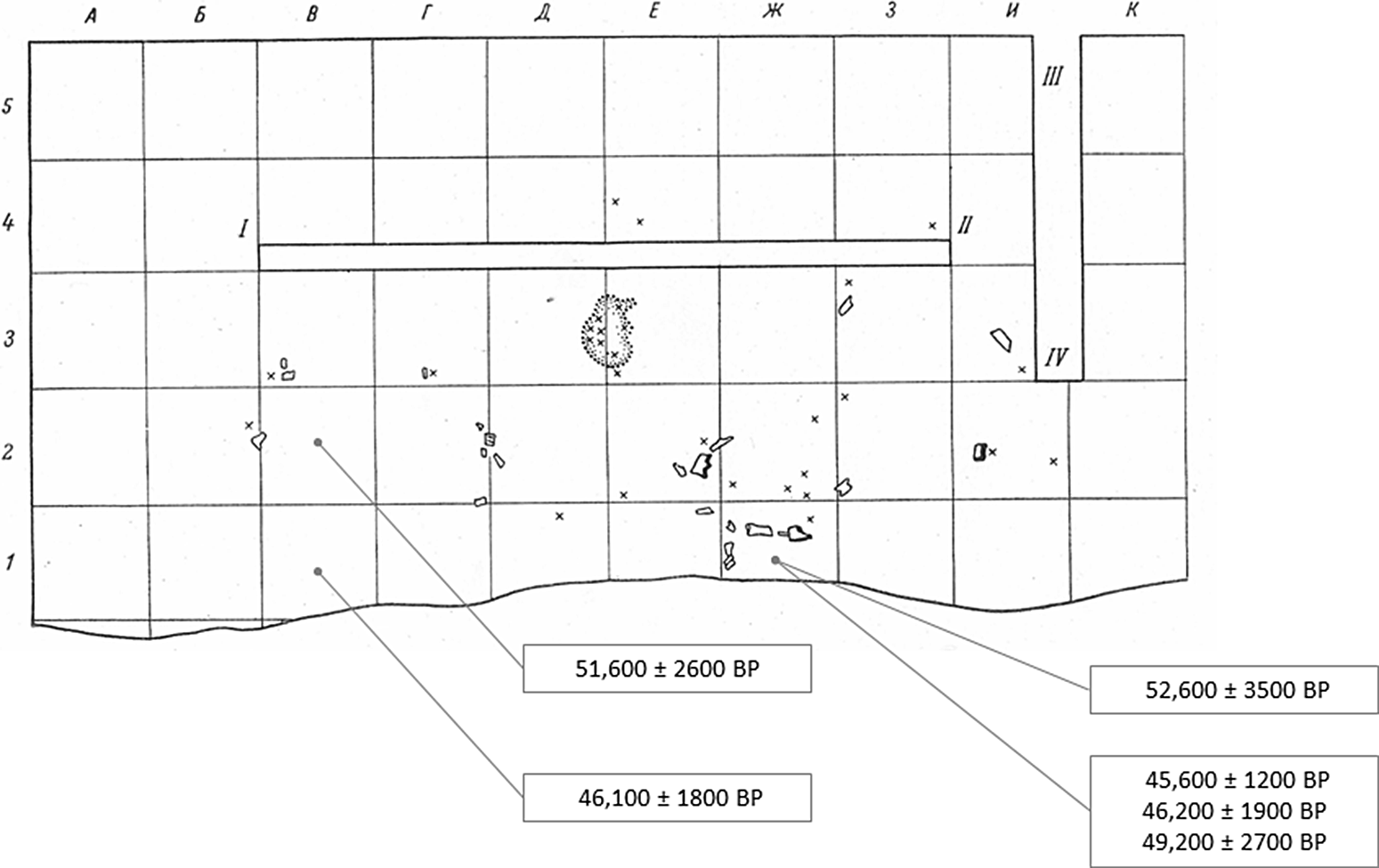
Spatial provenience of samples that yielded 14C dates from Horizon 3 (adapted from Praslov Reference Praslov1968: 78, fig. 36).

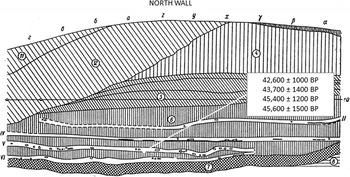
Stratigraphic context of 14C dates from Horizon 5 (adapted from Praslov Reference Praslov1968: 67, fig. 29).

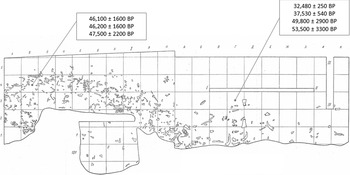
Spatial provenience of samples that yielded radiocarbon dates from Horizon 6; provenience data for three of the dated samples is unknown (adapted from Praslov Reference Praslov1968: fig. 49).

Horizon 1 . Only one sample, containing 11 bone fragments, was recovered for the uppermost cultural layer. We obtained one date with the use of each method, and both were minimum dates near the limit of 14C dating (∼50,000 14C years ago). Praslov (Reference Praslov1968: 72) reported that the horizontal distribution of this layer was limited, and it yielded only isolated artifacts (see Table 1).
Horizon 2 . We obtained four dates on bone samples from the second horizon, three with the use of each method. The dates were comparable to those for Horizon 1: three were minimum dates in the ∼50,000 14C years range, and one was a finite date near the limit of 14C dating (52,300 ± 3400 BP). Paradoxically, our dates on both this layer and Horizon 1 are older than most of the dates received on the underlying layers (Horizons 3, 5, and 6). There is no evidence of redeposition and stratigraphic reversal of this layer (Praslov [Reference Praslov1968: 72] described Horizon 2 as “relatively horizontal, with a slight negative slope towards the south and east”), and the pattern is unexplained (see Table 1).
Horizon 3 . We obtained 6 dates on this layer, all finite dates and all but one with the use of XAD resin pretreatment. The dates exhibited a bimodal distribution, clustering around 46,000 BP and 51,000 BP, respectively. Only the younger end of the age range could be calibrated for the older group. The suite of dates is similar to those obtained on the two lowermost horizons (see below) and suggests—contrary to the pattern seen in the uppermost two horizons—that the site dates to the earlier part of the MIS3-age equivalent or “early Stage 3.” Praslov (Reference Praslov1968: 79) reported that the horizontal distribution of Horizon 3 was limited to one area (southeast) of the 1961–1962 excavations (see Figure 6), and that bone preservation was poor in comparison the overlying horizon (see Table 1).
Horizon 4 . We were unable to obtain any dates from this layer; the bone samples did not yield any collagen. The result was disappointing, given the uncertainties about the lower layers (Horizons 3–6) and the presence of a human tooth in this horizon. Horizon 4 also yielded the largest artifact assemblage (see Table 1).
Horizon 5 . Bone samples from this layer yielded four dates, two obtained with each pretreatment method. The dates are all finite and range between 42,600 BP and 45,600 BP, and they calibrate to roughly 43,500–51,750 cal BP (95.4% probability). The pattern is similar to that for Horizon 3 (Figure 7).
Horizon 6 . The lowermost cultural layer yielded no less than 10 dates, 6 of which were obtained with XAD resin treatment. All dates were finite and ranged widely between ∼32,500 BP and 53,500 BP; most dates clustered in the range 43,700–49,800 BP, which calibrate to between ∼44,130 cal BP and beyond the range of 14C dating (>55,000 cal BP). Again, the pattern is similar to Horizon 3 (Figure 8).
Summary . A total of 26 14C dates were obtained on nonhuman bone and tooth samples recovered during the 1961–1962 excavations at Rozhok I. Despite the age and context (open-air) of the site, most of the samples yielded sufficient collagen for dating (see Tables 2–4) and with the exception of Horizon 4, a minimum of two dates were obtained from each of the 6 cultural layers. The dates fell into two groups, based on their provenience, i.e., cultural layer. The dates from the uppermost two layers (Horizons 1 and 2) were all infinite ages with the exception of one date near the limit of the 14C method. By contrast, the dates from Horizon 3 and the two lowermost layers (Horizons 5 and 6) are all finite ages and, although several of these dates are near the limit of the method, some are less than 45,000 BP (uncalibrated).
DISCUSSION
The dating of Rozhok I is important in the context of the Neanderthal-modern human and Middle-Upper Paleolithic transitions in northern Eurasia, which took place between 50,000 and 40,000 years ago. This is especially true with respect to the East European Plain for two reasons. The first is that human skeletal remains associated with Middle Paleolithic sites, while present in Crimea and the Northern Caucasus, are extremely rare on the plain itself (Gerasimova et al. Reference Gerasimova, Astakhov and Velichko2007). The isolated tooth in Horizon 4 at Rozhok I potentially represents the only diagnostic Neanderthal remain on the East European Plain (although it is found on its southernmost margin).
Secondly, the archaeological record of the latter for the transitional period (i.e., 50,000–40,000 years ago) is anomalous for northern Eurasia. The Initial Upper Paleolithic (now associated with modern humans at Bacho Kiro) is extremely rare and currently known only in the westernmost area of the plain (i.e., Kulychivka). Instead, the archaeological record of the transitional period is dominated by Middle Paleolithic industries, many or most of which are Levallois blade industries. Because Middle Paleolithic human remains are so rare on the East European Plain, it remains unclear if these sites were occupied by modern humans or Neanderthals.
The unusual character of the Rozhok I site introduces another element of uncertainty into the interpretation of the artifacts and the wider context of the Middle-Upper Paleolithic transition. As Praslov (Reference Praslov1968: 92–93) noted, the pattern of the features, artifacts, and faunal remains is consistent with short-term occupations and a limited range of activities. Rozhok I appears to have been occupied repeatedly for the hunting and carcass-processing of several large mammal taxa, perhaps in conjunction with the large ravine located west of the site. The artifacts may therefore provide a limited or heavily biased sample of the stone industry produced by its occupants.
Given the importance of this unusual and interesting site for understanding the Neanderthal-modern human and Middle-Upper Paleolithic transitions in northern Eurasia, it is unfortunate that the results of the 14C dating are ambiguous and difficult to interpret. The dates obtained on the two uppermost occupation horizons are infinite (with the exception of one date near the limit of the 14C method) while the dates from Horizon 3 and the two lowermost horizons are finite and some are less than 45,000 BP (i.e., uncalibrated ages).
There are at least three possible explanations for the results. The first is that the stratigraphy has been partially reversed by slope processes that post-date the initial deposition of the artifacts and faunal remains, i.e., that the contents of the uppermost layers (Horizons 1 and 2) have been redeposited over younger occupation horizons (Horizons 3–6). This possibility is supported by the steep slope angles exhibited by some of the horizons (see Table 1), as well as evidence for post-depositional disturbance reported by Praslov (Reference Praslov1968). We view this possibility as highly unlikely, based on the observation that both uppermost layers contain concentrations of ash derived from hearths and Horizon 2 contains anatomically ordered large-mammal bones (Praslov Reference Praslov1968: 72–79).
The other two explanations for the dating results are that either (1) older carbon contaminated bones in the uppermost two horizons, or (2) younger carbon was introduced to the lower horizons and contaminated bones and teeth in Horizons 3–6. Some simple mass balance calculations suggest that (2) is more likely than (1).
If the true age of the bone in Horizons 1 and 2 is roughly 45,000 cal BP, but residual contamination by old carbon (containing no 14C) has biased the ages by 5000–6000 years, i.e., by one 14C half-life, 50% of the carbon in the material dated would have to be derived from the contaminant. The collagen C:N ratios and stable isotope values are not consistent with this possibility. If the contaminated material was old but not completely devoid of 14C, it would necessarily represent an even higher percentage of the material dated (i.e., would be even less likely).
By contrast, if the true age of the bones and teeth in Horizons 3–6 is roughly 50,000 14C years BP, and they are biased 5000–6000 years younger by deglacial contamination from, for example, 17,000 BP, the amount required is only 1.5%. If the contamination is essentially modern, the amount is even less (approximately 0.2%).
The simplest explanation for the seeming reversal of ages between the uppermost two horizons and Horizons 3–6 is that groundwater containing younger carbon has contaminated the bones and teeth in the lower layers. Five of the 6 dates obtained on Horizons 1 and 2 are infinite, while the finite date is 52,300 ± 3400 BP (i.e., at the limit of 14C dating). We conclude that the uppermost horizons antedate 50,000 cal BP and probably lie beyond the range of 14C dating.
Although all of the dates from Horizons 3–6 are finite and two dates are less than 40,000 BP, we conclude that these dates reflect contamination from young carbon and are invalid. In the absence of evidence for a stratigraphic reversal of the cultural layers, we conclude that the lower layers also antedate 50,000 cal BP and lie beyond the range of 14C dating. Following Praslov (Reference Praslov1968: 71), we note that the lower layers may not significantly antedate the uppermost layers. The human tooth recovered from Horizon 4, which now appears likely to represent a Neanderthal (A. V. Zubova, pers. comm., 2021), thus probably antedates 50,000 cal BP.
ACKNOWLEDGMENTS
This research was supported by the Program of Fundamental Scientific Research of the State Academies of Sciences, State Assignment No. FMZF-2022-0012. The 14C dating was funded by a Leakey Foundation 2018–2019 general grant (“Modern human dispersal on the East European Plain”). The authors are grateful to the Directorate of the Taganrog State Historical and Architectural Museum-Reserve, and especially to senior researcher Oksana Olikh, who organized our work with Rozhok I assemblages in 2016.