A major question in the field of second language (L2) acquisition concerns whether children and adults acquire a second language in the same way. Traditionally, the focus of much literature on critical periods in L2-acquisition has been on ultimate attainment: whether L2-learners who began acquiring the L2 in childhood (early learners) outperform those who did not begin the acquisition until adulthood (late learners). The general finding has been that early L2-learners tend to outperform late L2-learners on tests of L2-grammar, although researchers disagree as to whether the source of this difference is biological, social, or input-driven, with evidence against critical periods coming from the cases of near-native late L2-learners (see, among many others: Johnson and Newport, Reference Johnson and Newport1989, Reference Johnson and Newport1991; Lee and Schachter, Reference Lee and Schachter1998; DeKeyser, Reference DeKeyser2000; and the papers in Singleton and Lengyel, Reference Singleton and Lengyel1995, and in Birdsong, Reference Birdsong1999; see Herschensohn, Reference Herschensohn2007, for an overview).
More recently, L2-researchers have begun to examine the processes at work in child vs. adult L2-acquisition (see, for instance, Lazarova-Nikovska, Reference Lazarova-Nikovska2005; Unsworth, Reference Unsworth2005; Blom and Polišenská, Reference Blom, Polišenská and Vliegen2006; Song and Schwartz, Reference Song and Schwartz2009; and the discussion in Schwartz, Reference Schwartz1992, Reference Schwartz, Beachley, Brown and Conlin2003, Reference Schwartz, Kampen and Bauuw2004). The focus of these studies has been on whether child L2-learners and adult L2-learners exhibit similar patterns during the course of acquisition. This issue has important implications for the discussion of whether L2-learners have access to Universal Grammar (UG). L2-researchers working in the generative framework generally agree that child L2-learners have access to UG, while there is much more debate concerning whether adults do as well. As laid out by Schwartz (Reference Schwartz1992, Reference Schwartz, Beachley, Brown and Conlin2003, Reference Schwartz, Kampen and Bauuw2004), similar patterns of development of child and adult L2-learners, with the L1 held constant, provide evidence that adult L2-acquisition, like child L2-acquisition, is UG-constrained.
Child/adult parallels have typically been investigated in the domains of syntax (or syntax/semantics interface) and morphology, such as object scrambling (Unsworth, Reference Unsworth2005) and inflectional morphology (Blom and Polišenská, Reference Blom, Polišenská and Vliegen2006). To our knowledge, there has been no work directly examining the acquisition of fine-grained semantic distinctions by child vs. adult L2-learners. The main goal of the present paper is to add to the existing literature on age effects in L2-acquisition by examining whether child and adult L2-learners exhibit similar patterns in their acquisition of English articles.
Article choice is a particularly fruitful area for this investigation, for several reasons. First, articles are notorious for being quite difficult for L2-English learners to master. Second, nearly all investigations of article meaning (as opposed to just article use/omission) in L2-acquisition that we are aware of have been done with adult learners (an important exception, discussed below, is Zdorenko and Paradis, Reference Zdorenko and Paradis2008), so there is little or no information of how age might affect acquisition of article semantics. And finally, Ionin, Ko and Wexler (Reference Ionin, Ko and Wexler2004) have specifically argued that L2-English learners whose L1s lack articles have direct, UG-mediated access to semantic universals underlying article use. This argument for UG-involvement would receive support if the same patterns were found with child as with adult L2-learners, on the assumption that child L2-learners have access to UG.
Building on the Ionin et al. (Reference Ionin, Ko and Wexler2004) study, we will compare article (mis)use among adult and child L2-English learners from the same article-less L1 (Russian), and show that there are both similarities and differences between the two age groups. The data reported here are part of a larger study comparing L2-English article use among adult and child speakers of Russian and Spanish (see also Ionin, Zubizarreta and Bautista Maldonado, Reference Ionin, Zubizarreta and Bautista Maldonado2008).
On the one hand, we will show that the effects of specificity that Ionin et al. (Reference Ionin, Ko and Wexler2004) found in adult L2-English article use are also present for child L2-English learners, supporting the view that learners’ patterns of article (mis)use are UG-related. On the other hand, we will show that the patterns exhibited by child L2-learners are more consistent with natural language data than those exhibited by adult L2-learners. We will propose that while both children and adults have domain-specific linguistic knowledge of definiteness and specificity, adults also make use of explicit strategies, to a greater extent than children. We will discuss the implications of these findings for the study of article use in child L1, child L2, and adult L2-acquisition, and for explicit and implicit knowledge more generally.
This paper is organized as follows. In section 1, we discuss previous findings with adult L2-English learners, and reconsider the original proposal of Ionin et al. (Reference Ionin, Ko and Wexler2004) in light of new cross-linguistic data. Section 2 provides an overview of studies on the acquisition of English articles by young children, and discusses the motivation for doing child–adult comparisons. In section 3, we present the methods and results of the present study. Section 4 discusses these findings and puts forth our proposal. Section 5 concludes the paper with a discussion of how L2-acquisition of articles compares to L1-acquisition of articles.
1. Adult L2-acquisition of English articles
The acquisition of English articles by adult L2-learners has been much investigated (see, among many others, Huebner, Reference Huebner1983, Reference Huebner1985; Parrish, Reference Parrish1987; Thomas, Reference Thomas1989; Young, Reference Young, Bayley and Preston1996; Murphy, Reference Murphy1997; Robertson, Reference Robertson2000; Trenkic, Reference Trenkic2000, Reference Trenkic2007, Reference Trenkic2008; Leung, Reference Leung, Bonch-Bruevich, Crawford, Hellermann, Higgins and Nguyen2001; Goad and White, Reference Goad, White, Foster-Cohen, Sharwood Smith, Sorace and Ota2004; Ionin et al., Reference Ionin, Ko and Wexler2004, Reference Ionin, Zubizarreta and Bautista Maldonado2008). In this paper, we focus in particular on recent work examining the patterns for article (mis)use in L2-English (as opposed to article omission), and on the reasons behind these patterns.
1.1 L2-English articles and specificity
Many of the early studies on L2-English articles used Bickerton's (Reference Bickerton1981) framework for classifying articles on the basis of the features of specific reference and hearer knowledge. However, these features were not given precise semantic entries. Ionin (Reference Ionin2003), adopting existing semantic analyses of definiteness and specificity (see Heim, Reference Heim, von Stechow and Wunderlich1991; Lyons, Reference Lyons1999), proposed that L2-English article choice should be viewed in terms of specificity as speaker intent to refer and definiteness as presupposition of uniqueness. Informal definitions of these semantic features (from Ionin et al., Reference Ionin, Ko and Wexler2004) are given in (1). The formal definition of definiteness adopted in these studies is the Fregean analysis of definiteness, from Heim (Reference Heim, von Stechow and Wunderlich1991), while the formal definition of specificity was developed by Ionin (Reference Ionin2003, Reference Ionin2006), based on Fodor and Sag's (Reference Fodor and Sag1982) concept of referentiality.
(1) If a Determiner Phrase (DP) of the form [D NP] is . . .
a. [+definite], then the speaker assumes that the hearer shares the presupposition of the existence of a unique individual in the set denoted by NP.
b. [+specific], then the speaker intends to refer to a unique individual in the set denoted by the NP, and considers this individual to possess some noteworthy property.
Ionin et al. (Reference Ionin, Ko and Wexler2004) proposed that definiteness and specificity are semantic universals which underlie article choice cross-linguistically.Footnote 1 English and many other western European languages morphologically encode definiteness in their article systems, but not specificity. This is illustrated by the examples in (2), which show that the is used in contexts that are [+definite], as in (2a–b), and a in contexts that are [−definite], as in (2c–d), regardless of whether the context is [+specific] or [−specific].
- (2)
a. [+definite, +specific] context
I want to talk to the winner of this race – she is a good friend of mine.
b. [+definite, −specific] context
I want to talk to the winner of this race – whoever that happens to be.
c. [−definite, +specific] context
Professor Robertson is meeting with a student from her class – my best friend Alice.
d. [−definite, −specific] context
Professor Robertson is meeting with a student from her class – I don't know which one.
On the other hand, colloquial/spoken English does encode specificity on indefinites, with a destressed form of the demonstrative this (see Prince, Reference Prince, Joshi, Webber and Sag1981; Maclaran, Reference Maclaran1982; Ionin, Reference Ionin2006). The use of this as a specificity marker on indefinites is illustrated in (3). Note that this is interchangeable with a in (3b), supporting the proposal that it marks indefinites. At the same time, the distribution of indefinite this is more restricted than that of a: while both examples in (3) allow a, only (3b) allows this. Ionin (Reference Ionin2006) analyzes such contrasts as follows: the speaker intends to refer to a particular stamp in (3b), where the stamp carries a noteworthy property of being worth a fortune; however, the speaker does not intend to refer to a particular stamp in (3a), where there is nothing noteworthy about the stamp under discussion. As a result, the conditions on specificity, as given in (1b), are met in (3b) but not in (3a).
- (3)
a. He put on ✓a/#this 31 cent stamp on the envelope, so he must want it to go airmail.
b. He put on ✓a/✓this 31 cent stamp on the envelope, and only realized later that it was worth a fortune because it was unperforated. (Maclaran, Reference Maclaran1982, p. 88)
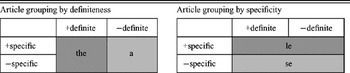
While indefinite this marks specificity on indefinites only, Ionin (Reference Ionin2003, Reference Ionin2006) proposed that languages may in principle encode the specificity distinction with both definites and indefinites. Drawing on Samoan data from Mosel and Hovdhaugen (Reference Mosel and Hovdhaugen1992), Ionin (Reference Ionin2003, Reference Ionin2006) suggested that the Samoan articles le and se encode the specificity distinction regardless of definiteness: le is used in both [+definite, +specific] and [−definite, +specific] contexts, while se is used in both [+definite, −specific] and [−definite, −specific] contexts. This difference between English and Samoan is represented in Table 1.
Article grouping cross-linguistically: two-article languages (from Ionin et al. Reference Ionin, Ko and Wexler2004).

In a series of studies, Ionin, Ko and Wexler (Reference Wexler2003) and Ionin et al. (Reference Ionin, Ko and Wexler2004) formulated and tested predictions of how the semantics of specificity is relevant for L2-acquisition of English articles by speakers whose L1s lack articles. Ionin et al. proposed that in such cases, UG provides the learners with the options for article semantics that are available in natural language, including those options that are not instantiated in either the learners’ L1 or their L2. Ionin et al. hypothesized that in the absence of articles in their L1, L2-English learners would have access to both definiteness and specificity but would not, at least initially, know that English articles encode definiteness rather than specificity.
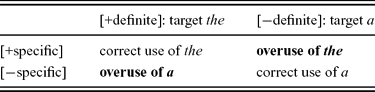
The predicted result would be fluctuation between these two semantic options: some of the time, learners would treat the as marking definiteness (and a indefiniteness), and some of the time they would treat the as marking specificity (and a non-specificity) – essentially, treating English as if it were Samoan. According to the predictions of this Fluctuation Hypothesis (Ionin et al., Reference Ionin, Ko and Wexler2004), learners should perform accurately on the categories of specific definites and non-specific indefinites, where the two options give the same results. When definiteness and specificity are in conflict, on the other hand – on the categories of specific indefinites and non-specific definites – learners are predicted to use the and a interchangeably. The four relevant categories are illustrated in (4)–(7), with the predictions for L2-article use stated.Footnote 2 The predicted pattern of article use is schematized in Table 2. Crucially, the pattern in Table 2 is non-random: learners are predicted to make errors in only two out of four different environments. (For more discussion of the role of optionality in L2-acquisition, see Sorace, Reference Sorace2000.)
(4) [+definite, +specific]: target the
predicted learner pattern: correct use of the

(5) [+definite, −specific]: target the
predicted learner pattern: overuse of a
(6) [−definite, +specific]: target a
predicted learner pattern: overuse of the Grandfather comes for a visit
(7) [−definite, −specific]: target a
predicted learner pattern: correct use of a Mother comes home

Patterns of English article use by speakers of article-less L1s: predictions (from Ionin et al. Reference Ionin, Ko and Wexler2004).

Ionin et al. (Reference Ionin, Ko and Wexler2004) tested the predictions in Table 2 with two groups of adult L2-English learners residing in the U.S.: L1-Russian speakers and L1-Korean speakers. As predicted, both definiteness and specificity had significant effects on article (mis)use, and article errors were largely confined to the contexts of specific indefinites and non-specific definites, as predicted. Since Russian and Korean both lack articles but are typologically very different, Ionin et al. concluded that the results could not be attributed to L1-transfer. Rather, they argued, the patterns of article (mis)use supported the view that L2-English learners have access to semantic universals, through Universal Grammar. Ionin et al.'s findings have since been to some degree replicated with speakers of other article-less L1s, such as Japanese (Hawkins et al., Reference Hawkins, Al-Eid, Almahboob, Athanasopoulos, Chaengchenkit, Hu, Rezai, Jaensch, Jeon, Jiang, Leung, Matsunaga, Ortega, Sarko, Snape, Velasco-Zárate, Foster-Cohen, Medved Krajnovic and Mihaljević Djigunović2006) and Mandarin Chinese (Trenkic, Reference Trenkic2008; but see section 1.3 for discussion of Trenkic's interpretation of the findings), further strengthening the conclusion that specificity effects with L2-learners from article-less L1s are not a result of L1-transfer. In contrast, L1-transfer effects have been found for L2-English learners coming from L1s with articles, such as Spanish (Ionin et al., Reference Ionin, Zubizarreta and Bautista Maldonado2008) and Greek (Hawkins et al., Reference Hawkins, Al-Eid, Almahboob, Athanasopoulos, Chaengchenkit, Hu, Rezai, Jaensch, Jeon, Jiang, Leung, Matsunaga, Ortega, Sarko, Snape, Velasco-Zárate, Foster-Cohen, Medved Krajnovic and Mihaljević Djigunović2006).
1.2 New cross-linguistic evidence
Ionin et al.'s (Reference Ionin, Ko and Wexler2004) view of L2-English article use was closely tied to a particular view of article distribution in natural language: they argued that a language which has only two articles uses these two articles to encode either the definiteness distinction (as in English) or the specificity distinction (as in Samoan).Footnote 3 Furthermore, they proposed that a language like Samoan makes the specificity distinction with both definites and indefinites, resulting in the pattern in Table 1. This proposal was supported by Samoan data from Mosel and Hovdhaugen (Reference Mosel and Hovdhaugen1992).
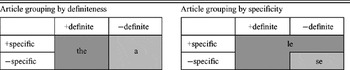
However, as acknowledged at the time by Ionin et al. (Reference Ionin, Ko and Wexler2004), the available data from Samoan were quite limited, and at best suggestive, not conclusive. Ionin et al.'s proposal has since then led to two papers independently investigating the nature of specificity marking in Samoan in more detail. Fuli (Reference Fuli2007) and Tryzna (Reference Tryzna, Mayo and Hawkins2009) have both shown convincingly that Samoan marks the specificity distinction with indefinites but not with definites, contrary to what the Mosel and Hovdhaugen (Reference Mosel and Hovdhaugen1992) data, cited by Ionin et al. (Reference Ionin, Ko and Wexler2004), had suggested. This is illustrated in (8) and (9), from Fuli (Reference Fuli2007). As shown in (8), specific indefinites are marked with le ((8a), where the speaker has a particular movie in mind), whereas non-specific indefinites are marked with se ((8b), where the speaker has no particular movie in mind).Footnote 4
(8)
In contrast, definites are always marked with le, as shown in (9), which is based on a famous English example from Donnellan (Reference Donnellan, Steinberg and Jakobovits1966). Donnellan argued that the sentence Smith's murderer is insane is ambiguous between two readings: a referential (specific) reading, on which the speaker intends to refer to a particular person (e.g., Jones), such that Jones is the murderer of Smith and Jones is insane; and an attributive (non-specific) reading, on which the speaker states that whoever murdered Smith is insane. If Samoan made a specificity distinction with definites, we would expect le to be used on the specific reading of the murderer of Smith, and se on the non-specific reading. However, Fuli (Reference Fuli2007) shows that this is not the case: le is obligatorily used with definites, as in (9a), regardless of whether the speaker has a particular individual in mind. Use of se in (9b), like use of a in a murderer of Smith, has the pragmatically odd implication that Smith had multiple murderers.
(9)
The correct representation of article distribution in English vs. Samoan thus appears to be that in Table 3: the only context type in which English and Samoan differ is [−definite, +specific]. Thus, Samoan joins a number of other languages that morphologically mark specificity with indefinites only, such as Modern Hebrew (Givón, Reference Givón1981, Reference Givón2001) and Sissala (Blass, Reference Blass1990) (see Lyons, Reference Lyons1999; Ionin, Reference Ionin2006, for more discussion).Footnote 5 While languages such as colloquial/spoken English, Modern Hebrew and Sissala use different morphemes to mark definites (the in English, ha in Hebrew, ná in Sissala) and specific indefinites (indefinite this in English, xad in Hebrew, nέ in Sissala), Samoan, as we saw above, marks definites and specific indefinites with the same morpheme, le.
Article grouping cross-linguistically: two-article languages (revised).

Samoan is not alone in this: there is much cross-linguistic evidence outside the article system of languages marking definite and specific indefinite DPs in the same way. One example is the Spanish dative preposition a, which marks direct objects which are definite or specific indefinite as well as animate (see Torrego, Reference Torrego1998; Aissen, Reference Aissen2003; Leonetti, Reference Leonetti2004). Another is accusative-Case marking in Turkish, which similarly applies to definites and specific indefinites, but not to non-specific indefinites (see Enç, Reference Enç1991; Kelepir, Reference Kelepir2001). The issues surrounding both the Spanish a and the Turkish accusative-Case marking are quite complex (see the references cited above for detailed discussion), not least because it is not always clear what type of specificity is under discussion: for instance, Enç (Reference Enç1991) proposes that Turkish accusative Case-marked specific indefinites are partitive, denoting members of a previously mentioned set; however, Kelepir (Reference Kelepir2001) shows that wide-scope indefinites which are not partitive may also bear accusative Case-marking (see also Ko, Ionin and Wexler, Reference Ko, Ionin and Wexler2006, for the relevance of partitivity to L2-acquisition).
Another example, which is perhaps more straightforward than the Spanish and Turkish cases, is that of the initial vowel in the Bantu language of Luganda. Ferrari-Bridgers (Reference Ferrari-Bridgers2004) shows that the initial vowel is used with nominals that are referential, but not with those that are non-referential. Referentiality here is used as a term that unites definites and specific indefinites.
Thus, there is cross-linguistic evidence that languages may mark definites and specific indefinites in the same way (see also Lyons, Reference Lyons1999, for more cross-linguistic data). This suggests that there is a core property that definites and specific indefinites have in common, despite the semantic differences between these concepts. One candidate for such a core property is the semantic type of individual. At least on some analyses of definites (such as the Fregean analysis adopted here), definites have the semantic type of individual (see Heim, Reference Heim, von Stechow and Wunderlich1991): a definite determiner such as the applies to a property (e.g., the property denoted by student) and returns an individual (e.g., the unique referent of the student).Footnote 6 On the view of specificity discussed in this paper (see Ionin, Reference Ionin2006, for more discussion), specific DPs are similarly individual-denoting: a specific indefinite DP such as this one student (with this used as a specific indefinite marker in colloquial English) denotes a specific individual that the speaker has in mind. In contrast, indefinites which do not bear specificity marking, such as a student, are typically treated as quantificational (Heim, Reference Heim, von Stechow and Wunderlich1991) or cardinal (Diesing, Reference Diesing1992), but crucially not individual-denoting.
Thus, it is possible that languages such as Samoan and Luganda, which use the same marker for definites and specific indefinites, are using that marker to encode individual-denoting (as opposed to quantificational) DPs.Footnote 7
1.3 Implications for L2-acquisition
In light of the new data on Samoan, discussed above, we can no longer claim that L2-English learners who overuse a with definites and overuse the with indefinites are adopting the “Samoan” option. While overuse of the with specific indefinites in L2-English is consistent with natural language data, overuse of a with non-specific definites does not appear to have natural language parallels (see Lyons, Reference Lyons1999). Yet Ionin et al. (Reference Ionin, Ko and Wexler2004, Reference Ionin, Zubizarreta and Bautista Maldonado2008) found that adult L2-English learners from article-less L1s made both types of errors. At the same time, in Ionin et al. (Reference Ionin, Zubizarreta and Bautista Maldonado2008), we found that specificity effects with indefinites were stronger than specificity effects with definites, for L1-Russian L2-English learners, at both individual and group levels.
In Ionin et al. (Reference Ionin, Zubizarreta and Bautista Maldonado2008), we had no explanation to offer for why some learners would make the specificity distinction with indefinites only. Now, in light of the new Samoan data, we have such an explanation: L2-English learners who make the specificity distinction only (or primarily) with indefinites are following natural language patterns, as indicated in Table 3. However, the question is now turned on its head: why do other L2-English learners make the specificity distinction with both definites and indefinites, given that this does not appear to be an option available to natural language?
One possible answer would be to say that L2-English learners’ errors have nothing to do with options available to natural languages: learners’ patterns of article use are traceable to explicit strategies, rather than to semantic universals. A proposal along these lines is put forth by Trenkic (Reference Trenkic2008), who questions Ionin et al.'s (Reference Ionin, Ko and Wexler2004) view that specificity can be morphologically encoded with definites as well as indefinites in natural language; as we saw above, the new data available from Samoan lend support to Trenkic's critique. Trenkic puts forth an alternative proposal, on which L2-English learners’ article misuse is due not to the linguistic universal of specificity, but rather to an explicit strategy linking the and a to the presence vs. absence, respectively, of “explicitly stated knowledge”. We will discuss Trenkic's proposal in detail in section 4.1, and provide a response to it in section 4.2. But first, before considering why adult L2-English learners use articles the way they do, we discuss relevant data from children acquiring English articles.
2. Acquisition of articles by children vs. adults
The study of how articles are acquired is certainly not restricted to the study of adult learners. There has been much work investigating articles in monolingual first language acquisition (Brown, Reference Brown1973; Maratsos, Reference Maratsos1976; Karmiloff-Smith, Reference Karmiloff-Smith1979; Schaeffer and Matthewson, Reference Schaeffer and Matthewson2005, among many others), and, more recently, articles in bilingual first language acquisition (Serratrice, Reference Serratrice2000; Kupisch, Reference Kupisch2006) and child second language acquisition (Dirdal, Reference Dirdal2005; Zdorenko and Paradis, Reference Zdorenko and Paradis2008).
2.1 Articles in monolingual and bilingual language acquisition
Interestingly, many studies of child acquisition of English report overuse of the in indefinite contexts – a phenomenon that, as discussed in the previous section, has also been attested in adult L2-acquisition. In the case of child L1-acquisition, Brown (Reference Brown1973) reports overuse of the in naturalistic production data of very young (2–3-year-old) children, while Warden (Reference Warden1976), Maratsos (1977) and Schaeffer and Matthewson (Reference Schaeffer and Matthewson2005), among others, found overuse of the in elicitation experiments (as did Karmiloff-Smith, Reference Karmiloff-Smith1979, for overuse of definite articles in child French). In these studies, overuse of the was largely confined to contexts where the child could in principle have a specific referent in mind. For example, the two-year-olds in Schaeffer and Matthewson's study would say “Mickey Mouse drew the house” to a listener who had no previous familiarity with this house.
Studies of bilingual early language development have similarly found some overuse of the definite article with specific referents in naturalistic data. For instance, Kupisch (Reference Kupisch2006), studying an Italian–German bilingual child (as well as a German–French child) longitudinally, found some cases of overuse of definite articles with specific referents in Italian, but not in German (it should be noted that the child on the whole used articles more in Italian than in German). Serratrice (Reference Serratrice2000) found potential errors of definite article overuse in an Italian–English bilingual child.Footnote 8
When very young children make errors of article use, a standard explanation is that they lack relevant pragmatic knowledge: Maratsos (Reference Maratsos1976), for instance, argued following Piaget that young children are egocentric and ignore hearer knowledge. Schaeffer and Matthewson (Reference Schaeffer and Matthewson2005) proposed, in a similar vein, that children have difficulty separating speaker and hearer assumptions. The same explanation has been used for young bilingual children's overuse of the (Serratrice, Reference Serratrice2000; Kupisch, Reference Kupisch2006). On the other hand, some researchers (Matthewson, Bryant and Roeper, Reference Matthewson, Bryant and Roeper2001; Wexler, Reference Wexler2003) have proposed linguistic rather than psychological accounts of the overuse by young children.
2.2 Articles in child L2-acquisition
A recent study that has examined articles among child L2-English learners in some detail is Zdorenko and Paradis (Reference Zdorenko and Paradis2008), which followed 17 L2-English children from several different L1s over the period of two years (mean ages 5;4 at the start, and 7;4 at the end of the study), using an oral elicitation task with picture books.
Zdorenko and Paradis argued that all the noun phrases produced by the children in this task were [+specific]: the children were describing individuals and objects visually present in the pictures, so the speaker (the child) always had a specific referent in mind. The pictures were not visible to the experimenter, and the children were reminded that the experimenter could not see the pictures. Therefore, use of the upon the first mention of the noun was coded as infelicitous, as in the example in (10), while use of the upon second mention was coded as felicitous. Errors of the overuse such as those in (10) were considered to be errors with specific indefinites, since the child was intending to refer to a particular elephant or ball (EXP = experimenter, CHI = child).
(10)
Incorrect the in indefinite context
*EXP: how do you start?
*CHI: # mm # the elephant throw the ball.
(JHHN 5;11)(should be: an elephant and a ball)
(Zdorenko and Paradis, Reference Zdorenko and Paradis2008, p. 238)
Interestingly, Zdorenko and Paradis found overuse of the with indefinites for children from both article-less L1s and L1s which have articles (only children from article-less L1s exhibited article omission). As children's exposure to English increased, rates of the overuse with indefinites decreased, for both L1-groups, from 40–50% error rate in session 1 to 10–30% error rate in session 5. Overuse of a with definites, in contrast, was practically non-existent, in both L1-groups, from the earliest sessions.
Zdorenko and Paradis interpreted their findings as providing support for Ionin et al.'s (Reference Ionin, Ko and Wexler2004) Fluctuation Hypothesis, and as evidence that for L2-English children, fluctuation overrides transfer: even children from L1s which have articles were showing the overuse with indefinites. In contrast, Ionin et al. (Reference Ionin, Zubizarreta and Bautista Maldonado2008) found that transfer overrides fluctuation for adult L2-English learners: L1-Spanish L2-English learners were uninfluenced by specificity in their article use.
Zdorenko and Paradis did not consider the possibility that the children's errors of article misuse could stem from age-related egocentricity: that the children focused on the individual in the pictures and did not consider whether the experimenter was equally familiar with the pictures. This explanation can be fully ruled out only if age-matched native English-speaking children performed the same task and did not overuse the with indefinites. Unfortunately, Zdorenko and Paradis did not include such a control group in their study. However, relevant evidence can be found in Warden (Reference Warden1976), who used a similar picture-based elicitation test with L1-English children ages 3–9, as well as native English adults. Overuse of the with first-mention referents was 54% for the 3-year-olds, down to 38%-39% for 5-year-olds and 7-year-olds, 18% for 9-year-olds, and 0% for adults (Warden, Reference Warden1976, p. 109, Experiment III).
Note that the L2-English children in Zdorenko and Paradis's (Reference Zdorenko and Paradis2008) study were between 5 and 7 years old during the first testing session, and that their rates of the overuse are fairly similar to, perhaps just a little higher than, rates of the overuse among the 5- and 7-year-old native English children in Warden (Reference Warden1976). Thus, it is possible that the L2-English children as well as the native English children were being egocentric, ignoring the state of the listener's knowledge. Alternatively, it is possible that both the L2-English children and the native English children were influenced by linguistic factors, optionally using the to mark specificity.
2.3 Motivation for the present study
To sum up, we have two unresolved issues when we consider article (mis)use across different populations. First, the error of the overuse with indefinites, in the presence of a specific referent, can in principle be explained equally well by a psychological explanation (egocentricity, ignoring hearer assumptions) and a linguistic explanation (an association of the with specificity). While the psychological explanation is applicable to children (at least those below six or seven), it is not applicable to adults; the linguistic explanation, in contrast, is in principle applicable to all populations.
Second, we know that adult L2-English learners overuse a with non-specific definites, but that children do not. As discussed in section 1.3 above, this error appears to lack parallels in natural language, and thus cannot be easily accounted for via a linguistic explanation. Note that a overuse, unlike the overuse, also cannot be explained through egocentricity. The absence of a overuse errors in child (L1- and L2-)acquisition may indicate that this error in fact is never made by children. Alternatively, it could simply point to a difference in methodology between studies with children vs. adults: while adults were tested using highly controlled written elicitation tasks, studies with children rely on naturalistic or elicited oral production data, where [−specific] definite contexts may simply be non-existent.
The goal of the present paper is to resolve these issues, by examining article use in [+specific] indefinite and [−specific] definite contexts by both child and adult L2-English learners, with the L1 held constant. Our ultimate aim is to tease apart three different explanations of article misuse: egocentricity, an association of the with specificity, and explicit strategies. Given previous findings on L1-acquisition (Maratsos, Reference Maratsos1976; Warden, Reference Warden1976; Karmiloff-Smith, Reference Karmiloff-Smith1979), we can say that the egocentricity explanation is applicable to children age four or five, and possibly those as old as seven or eight, but definitely not those older than nine. In contrast, the specificity explanation is in principle applicable to learners of all ages, depending on one's view of UG-availability in L2-acquisition. And the explicit strategies explanation is applicable to adults and possibly older children, i.e., learners with sufficient cognitive maturity and metalinguistic ability to make conscious decisions about article use.
In light of these considerations, we see two distinct possibilities for how article (mis)use might play out across different populations. The first possibility is that there is no effect of specificity in developing grammar, contrary to what Ionin et al. (Reference Ionin, Ko and Wexler2004, Reference Ionin, Zubizarreta and Bautista Maldonado2008) proposed. Young L1-English and L2-English children (below age 8 or 9) overuse the as a result of egocentricity, while adult L2-English learners are governed by explicit, non-UG-based strategies, which lead to both overuse of the and overuse of a. Importantly, child L2-English learners past the age of 9 should no longer be egocentric; at the same time, such older children may, like adult learners, make use of explicit strategies. These strategies, in turn, should lead to both overuse of the with indefinites and overuse of a with definites.Footnote 9
An alternative possibility is that specificity does play a role in developing grammar, and that marking the specificity distinction with indefinites is an option made available to L2-learners by UG. If we assume, along with many other L2-researchers (Schwartz, Reference Schwartz, Beachley, Brown and Conlin2003, Reference Schwartz, Kampen and Bauuw2004; Unsworth, Reference Unsworth2005, among others) that child L2-acquisition is UG-constrained, then we expect child L2-English learners to overuse the with indefinites but not to overuse a with definites. Importantly, we expect to find such a pattern in child L2-English learners past the age of nine, to whom the egocentricity explanation does not apply. If in fact we find that (non-egocentric) L2-English children overuse the but not a, while adult L2-English learners overuse both articles, this would point to an important difference between the two populations, and suggest that explicit strategies play more of a role in adult than in child L2-acquisition.
Thus, in order to tease apart three different explanations for article misuse – egocentricity, specificity, and explicit strategies – it is absolutely crucial to test child L2-English learners, and to do so using the same methodology as has been used with adult L2-English learners, namely the written elicitation tasks used in Ionin et al. (Reference Ionin, Ko and Wexler2004, Reference Ionin, Zubizarreta and Bautista Maldonado2008). We therefore focus on child L2-learners between the ages of 10 and 12: old enough to complete a written test, old enough not to be influenced by egocentricity, yet still young enough to be clearly child and not adolescent or adult learners.
We leave open at present the issue of whether child L1-learners (monolingual or bilingual) resemble (child and/or adult) L2-learners in their article errors. In section 5, we will come back to this issue and discuss the implications that our findings have for theories of article (mis)use in first language acquisition.
3. The study
Our study was designed to answer the following research questions:
- (11)
a. Do child and adult L2-English learners from an article-less L1 make the same error of the overuse with specific indefinites?
b. Do child and adult L2-English learners from the same article-less L1 make the same error of a overuse with non-specific definites?
We investigated these research questions by comparing child and adult L1-Russian L2-English learners. Russian was chosen as the L1 to test because it was one of the L1s of learners tested by Ionin et al. (Reference Ionin, Ko, Wexler, Garding and Tsujimura2003, Reference Ionin, Ko and Wexler2004).
3.1 Tasks
All of the participants, L2-learners as well as native-speaker controls, took a written elicitation test of English article use; additionally, all of the adult L2-learners took a cloze test of L2-proficiency (the details of this test, which was created by William Rutherford, can be found in Ionin et al., Reference Ionin, Zubizarreta and Bautista Maldonado2008). Child participants did not take the cloze test, which was deemed to be too difficult for children.Footnote 10
The elicitation test consisted of 60 short dialogues, each designed to elicit a particular target word. This task was modeled after elicitation tests used by Ionin et al. (Reference Ionin, Ko, Wexler, Garding and Tsujimura2003, Reference Ionin, Ko and Wexler2004), but with two important changes. First, while the previous studies’ tests gave the participants a choice of target words (e.g., the and a), the present task contained a blank in the target sentence; the participants were instructed to fill in the blank with any word they considered appropriate for the context (including a dash if no word was necessary). Second, unlike the previous tests, the present test included fillers targeting items other than articles.
Of particular relevance for us are 24 target items which elicited articles in the four singular contexts given in Table 2, six items per category: [+definite, +specific], [+definite, −specific], [−definite, +specific] and [−definite, −specific]. The [+definite] and [−definite] items were designed to elicit the and a, respectively, from native English speakers. Examples of the four categories can be found in (4)–(7) above. In the actual test, the target article was replaced by a blank.
In addition to the 24 target items, the test contained 12 other items testing article use in other contexts (not reported here) and 24 fillers. The fillers targeted function words other than articles, such as prepositions, pronouns, and auxiliaries; a few filler items also had a “dash” (i.e., no word) as a possible target response. Most filler items were compatible with more than one response; performance of adult native English speakers was taken as indicative in deciding which responses were appropriate.
Performance on fillers was used as a cut-off: participants had to give an appropriate response to at least two thirds of the fillers (16 out of 24) in order to be included in the final analysis. In this way, we could be certain that learners knew English well enough to understand the test dialogues; participants who performed poorly on fillers were deemed to either have serious difficulties with the vocabulary and grammar of the test, or else to be unfamiliar and uncomfortable with the test format (this was particularly an issue for the child participants, who were not as used as adults to taking standardized tests). Either way, test difficulties would potentially obscure the learners’ performance on the target items.
3.2 Participants
The L2-participants were adult and child Russian speakers living in Orel, Russia, and learning English at school. We tested 26 adults, all but one of whom were university students studying English in the classroom (the remaining learner had previously studied English at university and now used it at work), and 58 children between the ages of 10 and 12, all of whom were studying English at school (see section 2.3 above on the importance of using this age range). Forty-three of the children attended specialized English schools, where English instruction began in second grade (age 7 or 8), and where English lessons took place every day of the week. Fifteen of the children attended regular schools, where English was taught only starting in fourth grade (age 9 or 10), and only two days a week.
As described in the previous section, participants had to meet a cut-off in their performance on filler items in order to be included in the final analysis. Twenty-one of the 26 adult L2-learners met this cut-off, but only 18 of the 58 children did, all of them from specialized schools. The test was clearly too difficult for all of the children from regular schools as well as many of the children from specialized schools; in addition to failing to meet the cut-off, these children performed quite randomly on the test items. Of the 18 children who did meet the cut-off, 15 were from the same specialized school, which may have had more rigorous English instruction. Of the 18 children, 16 were in fifth grade at the time of testing, and two were in sixth grade.
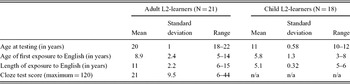
Table 4 reports the background information on those adult and child L2-learners who met the cut-off and were included in the data analysis. The two populations were fairly uniform in terms of their length of exposure to English, with the adults having had more exposure, on average, than the children.
Background of L2-learners included in the data analysis.

In terms of age of first exposure, we divided the participants into two groups: the “early exposure” group were those participants who began studying English at age 8 or earlier, in preschool or elementary school; the “late exposure” group were those participants who began studying English at age 9 or later, in middle school or high school. Schwartz (Reference Schwartz, Kampen and Bauuw2004) argues that true child L2-learners are those whose exposure to the target language began before age 8, and this age has been used as a cut-off in much subsequent literature on child L2-acquisition (e.g., Unsworth, Reference Unsworth2005; Song and Schwartz, Reference Song and Schwartz2009).Footnote 11 Given this classification, all 18 child L2-learners included in the analysis were early-exposure learners (and hence true child L2-learners). As for the adults, nine were early-exposure learners and 12 were late-exposure learners; we will come back to this distinction within the adult group in section 3.3.
The control groups consisted of 12 native English adults and 11 native English children (12 native English children were tested originally, but one failed to meet the cut-off). The mean age of the adult controls was 22.7 (standard deviation 1.1, range 19–31), and the mean age of the child controls was 10 (standard deviation 0.27, range 9–12). The native English adults and children were thus roughly matched with the L2-English adult and child groups in terms of age (four additional adult native English participants were excluded from analysis due to being much older, in their 40s and 50s). Of the 11 native English children, three were in fourth grade, six were in fifth grade, and two were in sixth grade, at the time of the testing.
3.3 Group results
Throughout this section, we report the results of native English speakers (adults + children) separately from the results of the L2-English learners (adults + children). We do not combine the two groups because our research question is not concerned with differences between native speakers and L2-English speakers (which are expected, given the nature of L2-acquisition). Our research question, rather, is concerned with the patterns within the L2-English group, and with child–adult differences in particular. For comparison, we report the results of the native English group.
The figures in this section report the means and standard deviations of the and a use for each test category. We also report separate statistical analyses for use of the vs. use of a, following the practice in Ionin et al. (Reference Ionin, Ko and Wexler2004). Our rationale for this is as follows. Each test item could potentially receive one of four responses: the, a, “no article”, or “other” (such as some, a demonstrative, a possessive pronoun, etc.). Given that our predictions concern both the use and misuse, and a use and misuse, we need to examine the effects that definiteness and specificity had on both article types.
Native English speakers
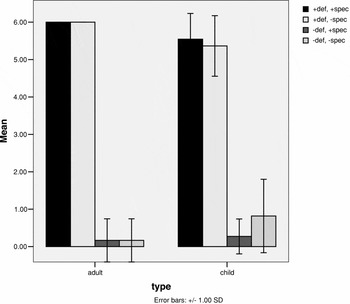
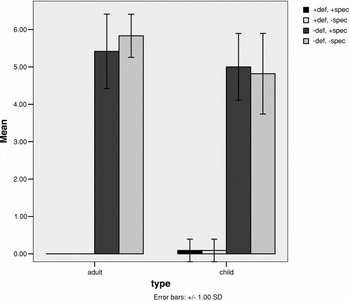
Figures 1 and 2 compare the and a uses, respectively, among adult and child native English speakers. As the figures show, the adults were near ceiling in their performance. The children were less accurate, but most of their errors were constrained to the category of non-specific indefinites, and even there the error rate was only 14%. A repeated-measures ANOVA was run on the group of native English speakers, with definiteness and specificity as the within-subjects variable, and age group (adult vs. child) as the between-subjects variable. Separate ANOVAs were conducted on use of the vs. use of a. The results are given in Table 5.
Mean use of the by category and age group (native English speakers).

Mean use of a by category and age group (native English speakers).

Results of repeated-measures ANOVAs for native English speakers (N = 23: 12 adults and 11 children).

***p < .001; **p < .01; *p < .05
As Table 5 shows, definiteness had a highly significant effect on both the and a suppliance, as expected, and specificity had no effect. The only significant interaction was between definiteness and age group. This was due to the adults making a stronger distinction between definites and indefinites than did the children – the adults were generally more accurate in their article use. Age group did not otherwise have any significant effect.
L2-English learners: overall accuracy
Before proceeding to a discussion of how definiteness and specificity influenced L2-English children and adults, we first consider the extent to which these two groups are comparable in their overall article use. On the one hand, there is much literature suggesting that children outperform adults when other factors (such as length of exposure) are held constant. On the other hand, the children in our study had on average less exposure to English than did adults; given that both children and adults are studying English in a classroom EFL context, it is quite possible that the adults, with more classroom exposure than the children, would perform better.
In order to assess these issues, we first computed overall accuracy scores for both groups, an “absolute accuracy” score and a “relative accuracy” score, using the formulas in (12). As an illustration, consider adult learner A2, who supplied an article in 20 of the 24 items (the other 4 items received a “no article” or “other” response), and who was furthermore correct on 14 of those 20 articles (using the with definites and a with indefinites), but exhibited article misuse on the other 6. The learner's absolute accuracy score would be 14/24 = 58%, whereas this learner's relative accuracy score would be 14/20 = 70%.
- (12)
a. absolute accuracy score = # of learner's correct article uses (the with definites and a with indefinites) / total number of test items (N = 24)
b. relative accuracy score = # of learner's correct article uses (the with definites and a with indefinites) / total number of items in which the learner supplied an article
The mean accuracy scores for the adult group were 72% absolute accuracy and 78% relative accuracy; for the child group, the scores were 76% absolute accuracy and 81% relative accuracy. The children and adults did not differ from each other significantly on either accuracy score (t(1,37) = .95, p = .38 and t(1,37) = .83, p = .43, respectively; equal variances not assumed). Thus, even though the adults had on average more exposure to English, they did not outperform the children.
In order to find out how overall accuracy was influenced by individual differences between subjects, we computed bivariate correlations between the two accuracy scores and the following factors: age at the time of testing; age of first exposure to English (as self-reported by the subjects); length of exposure to English (calculated by subtracting age of first exposure from age at testing); and the cloze test proficiency score, for adult subjects only. The only variable among these that correlated significantly with article accuracy was age of first exposure to English, which had a significant inverse correlation both with the absolute accuracy score (r = −.43, p < .01) and the relative accuracy score (r = −.32, p < .05). Thus, as age of exposure to English increased, overall accuracy decreased, consistent with what we know about the advantages of early exposure. Importantly, age at the time of testing did not correlate at all with either accuracy score (r = −.10, p = .55 and r = −.06, p = .71, respectively). This shows that being a child or an adult at the time of the study did not significantly affect the learner's accuracy.
Given that the two groups were not significantly different from one another in overall accuracy, we can now examine whether the patterns exhibited by these two groups are also similar.
L2-English learners: effects of definiteness and specificity
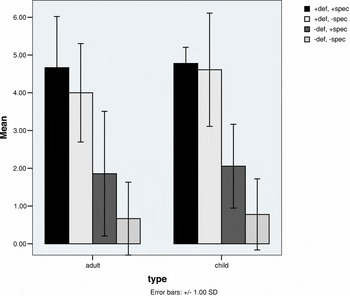
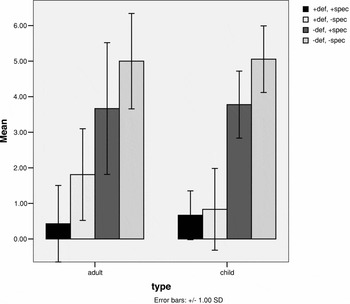
Figures 3 and 4 compare the child and adult L2-English learners on use of the vs. use of a, respectively. As the large standard deviations show, there was much variation among individual L2-learners – a point that we will come back to in section 3.4.
Mean use of the by category and age group (L2-English learners).

Mean use of a by category and age group (L2-English learners).

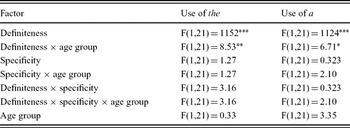
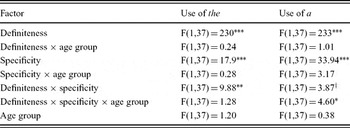
A repeated-measures ANOVA was run on the L2-English group, with definiteness and specificity as within-subjects variables, and age group (adult vs. child) as the between-subjects variable. Separate ANOVAs were conducted on use of the vs. use of a. The results are given in Table 6.
Results of repeated-measures ANOVAs for L2-English learners (N = 39: 21 adults and 18 children).

***p < .001; **p < .01; *p < .05; †p = .057 (marginal)
As Table 6 shows, both definiteness and specificity had highly significant effects, regardless of whether the or a was measured. At the same time, the interaction between definiteness and specificity was significant when use of the was measured and marginal when use of a was measured. These interactions were due to the fact that the specificity distinction was stronger with indefinites than with definites: specific and non-specific indefinites differed more from each other with respect to the overuse (and hence correct a use) than specific and non-specific definites differed from each other with respect to a overuse (and hence correct the use). Furthermore, when use of a was measured, there was a significant interaction between definiteness, specificity, and age group. This was due to the fact that the “definiteness by specificity” interaction existed for the child group only: adults made the same specificity distinction for definites and indefinites on use of a, while children made a much greater distinction with indefinites than with definites. To put it more simply, children exhibited much overuse of the with specific indefinites, but little in the way of a overuse with non-specific definites. Adults, by contrast, made both kinds of errors.
3.4 Individual results
In order to determine how the specificity distinction played out with definites and indefinites for individual participants, we classified the adult and child L2-learners into different patterns.
The classification procedure was as follows. We considered only errors, overuse of a with definites and overuse of the with indefinites, since these are true indications of article misuse. Given the fairly low rate of article omission or use of “other” responses, correct use of the and a with definites and indefinites, respectively, is nearly a mirror image of article misuse for most participants. We then computed the number of specificity-related errors for both indefinites and definites, using the formulas in (13).
- (13)
a. Specificity distinction with indefinites
# of specificity-related errors on indefinites =
# of the uses with specific indefinites – # of the uses with non-specific indefinites
b. Specificity distinction with definites
# of specificity-related errors on definites =
# of a uses with non-specific definites – # of a uses with specific definites
Next, we classified learners into five patterns based on how their specificity distinction with definites compared to that with indefinites. These patterns are described in (14). Three of the patterns were for learners who exhibited fluctuation on at least one category (see (14a)) and two of the patterns were for learners who did not exhibit fluctuation (see (14b)).Footnote 12
(14)
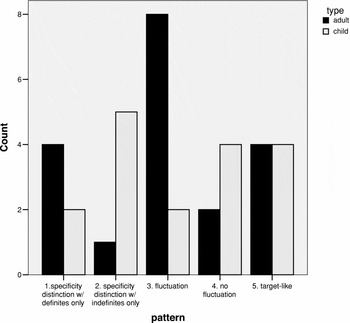
Figure 5 shows the number of subjects falling into each of the five patterns in the adult vs. child L2-groups. Figure 5 points to a striking difference between children and adults: the single most frequent pattern for adults is Pattern 3 – fluctuation with both definites and indefinites – while the single most frequent pattern for children is Pattern 2 – fluctuation with indefinites only. Additionally, a greater proportion of children than of adults is target-like (Pattern 5) or otherwise uninfluenced by specificity (Pattern 4), although members of both groups are represented in both patterns. Pattern 1 (fluctuation with definites only) is the least frequent pattern in the data, and it is exhibited primarily by adults.
Number of L2-learners in individual patterns.

Finally, we consider the role that age of first exposure has on the patterns of article (mis)use. We already saw, in section 3.3, that earlier age of exposure (for both children and adults) correlates significantly with performance. We next ask whether the patterns of individual article (mis)use were different for the nine adult L2-learners with early first exposure (age 8 or younger) vs. the 12 adults with late first exposure (age 9 or older). (Recall that all of the children had early first exposure.) We found that the single adult subject who patterned with the children, in making the specificity distinction with indefinites only (Pattern 2), had early exposure, like the children. However, three other early-exposure adults patterned with five of the late-exposure adults in making the specificity distinction across the board (Pattern 3), while one early-exposure adult patterned with three late-exposure adults in showing fluctuation with definites only (Pattern 1). The “no fluctuation” patterns (4 and 5) were exhibited by four early-exposure and two late-exposure adults. In light of these findings, we cannot reach any definitive conclusion about the role of age of exposure on performance.
4. Discussion
In this study, we found the following patterns. First, we saw that child L1-Russian L2-English learners, like adult L1-Russian L2-English learners, are influenced by specificity in their patterns of article (mis)use. At the same time, however, we saw that adult L2-learners exhibit specificity effects with both definites and indefinites, whereas child L2-learners exhibit specificity effects with indefinites to a much greater degree than with definites. At the individual level, most adult subject who were non-targetlike made the specificity distinction with both definites and indefinites, and a few did so with definites only, while most of the children who were non-target-like made the specificity distinction with indefinites only (see Figure 5).
As discussed in section 1.2, many natural languages make the specificity distinction with indefinites, whereas (in light of new data from Samoan) no language appears to make a specificity distinction with definites. The L2-English children are thus within the bounds of what is possible in natural language: they appear to (optionally) use the to mark the semantic type of individual, and hence to mark both definites and specific indefinites. Note that the egocentricity explanation, discussed in section 2.2, cannot apply to the L2-English children in our study, who are between 10 and 12 years of age. Importantly, the control group of age-matched native English children did not exhibit any effects of specificity. Since egocentricity is related to cognitive maturity, and hence to age, if egocentricity were still influencing article use in 10-year-old children, we would expect it to influence both native English and L2-English children. The clear differences between the two groups provide evidence in favor of a linguistic explanation of L2-English children's data.
The adult L2-English learners, on the other hand, follow a different pattern, making errors of a overuse with definites as well as the overuse with indefinites – the same pattern that has been found for adult L2-English learners in earlier studies (Ionin et al., Reference Ionin, Ko and Wexler2004, Reference Ionin, Zubizarreta and Bautista Maldonado2008; Trenkic, Reference Trenkic2008). Since this pattern is not consistent with natural language, what is it due to? In the rest of this section, we address this question.
4.1 Trenkic (Reference Trenkic2008): strategies underlying L2-English article use
As discussed in section 1.3, Trenkic (Reference Trenkic2008) proposed that adult L2-English learners’ errors of the overuse and a overuse are not related to the semantic universal of specificity, but rather arise from an explicit strategy. Trenkic (Reference Trenkic2008) takes issue with Ionin et al.'s operationalization of specificity as “explicitly stated knowledge”: in items designed as [+specific], like those in (4) and (6) above, there is an explicit statement of the speaker's familiarity with the referent, while in items designed as [−specific], like those in (5) and (7) above, such familiarity is explicitly denied. According to Trenkic, the fact that L2-English article use is influenced by explicitly stated knowledge (ESK) does not show that the semantic universal of specificity is in fact at work, since specificity as “speaker intent to refer” is not the same concept as ESK.
In light of this critique, Trenkic provides an alternative explanation, namely that L2-English learners are misanalyzing the and a as adjectives, and assigning to them the meanings of “identifiable” and “unidentifiable”, respectively. When the discourse contains a statement of ESK, as in (4) and (6), learners consider the referent to be identifiable, and use the. When the discourse does not contain a statement of ESK, as in (5) and (7), learners consider the referent to be unidentifiable, and use a. Thus, the pattern of article misuse found by Ionin et al. is accounted for without an appeal to semantic universals.
In order to further support this proposal, Trenkic replicated the study of Ionin et al. (Reference Ionin, Ko and Wexler2004) with L1-Mandarin learners of English in the UK, adding two new categories to the categories in (4)–(7). These categories, exemplified in (15) and (16), are argued to be [+specific], because the speaker is intending to refer to a particular individual, but [−ESK], because the speaker is denying knowledge of this individual.
(15) [−definite] [+specific, −ESK]: The speaker has a specific referent in mind, but she explicitly denies that she knows the identity of the person being talked about.
Office gossip
(16) [+definite], [+specific, −ESK]: The speaker has a specific referent in mind, but she explicitly denies that she knows the identity of the person being talked about.
Trenkic found that (15) and (16) were treated by learners just like the [−specific] categories in (5) and (7), and not like the [+specific] categories in (4) and (6). Trenkic concluded that L2-English learners are influenced by ESK rather than by specificity, and that the source of article errors is a misanalysis of determiners as adjectives, rather than access to semantic universals.
4.2 A response to Trenkic: against articles as adjectives
Trenkic is quite right to point out that specificity has been operationalized as ESK in our studies. However, we disagree with Trenkic's proposal that articles in L2-English are misanalyzed as adjectives. Below, we discuss three reasons for our disagreement: (i) evidence that operationalization of specificity as ESK is in fact warranted by natural language data; (ii) evidence that L2-English learners pay attention to specificity, rather than ESK, in deciding which articles to use; and (iii) lack of support for Trenkic's proposal that articles are adjectival in L2-English.
Specificity as ESK: evidence from natural language data
We argue, contra Trenkic (Reference Trenkic2008), that the operationalization of specificity as ESK is supported by specificity marking with indefinites in natural language. Ionin (Reference Ionin2003, Reference Ionin2006) showed that native English speakers find use of the specific indefinite marker this more felicitous precisely in those contexts where a statement of ESK provides an indication that the speaker considers the referent noteworthy. Furthermore, Ionin (Reference Ionin2006) showed that native English speakers’ judgments of the acceptability of indefinite this coincides with L2-English learners’ overuse of the with indefinites. In a small pilot study, native English speakers were provided with the indefinite contexts from an elicitation test administered to L2-English learners (the test whose results are reported in Ionin et al., Reference Ionin, Ko and Wexler2004), and asked to rate the acceptability of specific indefinite this in each context. As reported in Ionin (Reference Ionin2006), native English speakers rated indefinite this significantly higher in those indefinite contexts set up as [+specific] than as those set up as [−specific]. This finding suggests that the operationalization of specificity as ESK influenced not just L2-English learners’ judgments, but those of the native English speakers as well.
Evidence from L2-English learners’ self-reports
There is also independent evidence that L2-English learners are influenced by specificity rather than ESK in their article use. This evidence comes from Yang and Ionin (Reference Yang and Ionin2009), who partially replicated Trenkic's (Reference Trenkic2008) study with adult L1-Mandarin speakers learning English in China. Like Trenkic, Yang and Ionin compared performance on contexts such as (15) and (16) to contexts such as (4)–(7), and like Trenkic, they found that use of the was greater in [+ESK] than in [−ESK] contexts. To supplement these findings, Yang and Ionin also asked their subjects to provide the reason for their response, in written form.Footnote 14 They then classified these reasons into several different types, including “uniqueness”, “specificity”, and “ESK”. An example of a subject's response falling into the “specificity” category was “Because the speaker has a particular reference [sic] in mind”, while an example of an “ESK” response was “Because the speaker said that he doesn't know the person”. Specificity was by far the most frequent reason given by the L2-learners for their article choice, accounting for 69% of the overall responses, while ESK was given as a reason only 9% of the time (Yang and Ionin, Reference Yang and Ionin2009). Even when the context was set up as [−definite, +specific, −ESK], L2-learners overused the (nearly as often as in the [+ESK] variant) and explained their overuse by the presence of a particular referent in 73% of the instances; and conversely, when the context was set up as [+definite, +specific, −ESK], L2-learners overused a and explained this by the absence of a particular referent in 62% of the instances. The statement or denial of ESK did not appear to be the determining factor in learners’ article misuse, contrary to Trenkic's claims.
Lack of evidence for the adjectival nature of articles
Finally, a problem with Trenkic's proposal is that it rests on the assumption that L2-English learners from article-less L1s misanalyze English determiners as adjectives. Given the typological variety of languages (Russian, Mandarin Chinese, Korean and Japanese) whose speakers have been found to exhibit specificity effects in L2-English, it is unlikely that every single one of these languages treats determiners as adjectival. Trenkic (Reference Trenkic2004, Reference Trenkic2007), citing Corver (Reference Corver and Broderick1992), Zlatić (Reference Zlatić1997), and Bošković (Reference Bošković2005), among others, makes a persuasive case for the adjectival nature of Serbian determiners. A case can also be made for the adjectival nature of determiners in Russian, another Slavic language, in which determiners share morphological and syntactic properties with adjectives (but see Pereltsvaig, Reference Pereltsvaig2007, for arguments that the Determiner functional category exists in Russian). Importantly, however, Trenkic provides no evidence that determiners in Mandarin Chinese – the L1 under investigation in her 2008 paper – or, for that matter, Korean or Japanese, are adjectival. She simply assumes that this is the case, stating (p. 12) that “It goes without saying that Mandarin, Russian and Korean would all have ways of signalling the identifiability of referents in discourse (all languages do), and that they would differ in how they achieve this. But all that matters for the present discussion is that none of them has articles . . . For our own proposal, it means that they all are assumed not to have the syntactic category determiner in their L1.”
We believe that this assumption is quite controversial: first of all, it has not been convincingly shown that all article-less L1s have adjectival determiners; second, there is little or no direct evidence that speakers of article-less L1s really do consider the and a to be adjectives. The only evidence comes from Trenkic (Reference Trenkic2007), who found that L1-Serbian L2-English learners omitted articles more with adjectivally modified nouns than with unmodified nouns (e.g., the same learner might correctly say the forest but also say dark forest without an article). Trenkic (Reference Trenkic2007) proposed that L2-learners have limited attentional resources, and therefore produce only one adjective at a time: treating articles as adjectives, they drop them when a more informative adjective (such as dark) is required by the context. Even assuming that the empirical findings of article drop can be generalized to other L1-groups, such as Russian and Mandarin Chinese, it is far from clear that they provide support for articles being adjectival in nature. Trenkic's explanation in terms of attentional resources works perfectly well without the further stipulation that learners treat articles as adjectival: when learners’ attentional resources are taken up with the retrieval of a noun (forest) and an adjective (dark), learners fail to retrieve functional elements, such as articles. Even if they have correctly analyzed articles as being determiners – rather than adjectives – limited attentional resources could still cause article drop.
4.3 Semantic universals and strategies in adult L2-English
The findings with adult and child L2-English learners present a conundrum. On the one hand, overuse of the with indefinites in L2-English is exhibited by both children and adults, is tied to the semantic universal of specificity, and finds parallels in natural language (notably, in native speakers’ judgments of specific indefinite this). On the other hand, overuse of a with definites is exhibited by adult learners only, and finds no natural language parallels.
One way to solve this conundrum would be to say that adult L2-English learners employ explicit strategies in their article use, and are not influenced by the semantic universals of definiteness and specificity. Child L2-English learners, on the other hand, do access semantic universals, making the specificity distinction with indefinites only, much as natural languages do.
This explanation faces a number of difficulties, however. First of all, the same phenomenon – overuse of the with specific indefinites, in the same contexts – is given different explanations depending on whether it occurs among children or among adults. Second, this explanation fails to capture the similarities between overuse of the in adult L2-English and specificity marking with indefinites cross-linguistically. And finally, it leaves open the question of why learners should adopt the particular strategy that they do; as discussed in the previous section, the particular strategy-based explanation proposed by Trenkic (Reference Trenkic2008) is problematic, in that it makes unwarranted assumptions about learners’ misanalysis of determiners as adjectives.
We put forth an alternative proposal, which combines domain-specific linguistic knowledge and explicit strategies. Access to semantic universals, namely definiteness and specificity, constitutes domain-specific linguistic knowledge, which we argue is available to both child and adult L2-learners. At the same time, however, learners may formulate explicit strategies for how articles are used; we argue that adult learners are more likely to do so than child learners.
When child L2-learners respond to the elicitation task in our study, they use their domain-specific linguistic knowledge directly, attending both to definiteness and to specificity in the discourse context: they pay attention both to whether uniqueness has been established (use the with definites) and to whether the speaker has a specific referent in mind (use the with specific indefinites). In contrast, adult L2-learners formulate an explicit strategy based on specificity, along the lines of “use the when the speaker has a particular referent in mind, use a when the speaker does not have a particular referent in mind” – i.e., precisely the strategy verbalized by the learners in Yang and Ionin's (Reference Yang and Ionin2009) study.
Adult learners, then, use contextual cues, such as the presence or absence of ESK, to deduce whether the speaker has a particular referent in mind: for instance, in (6), where the speaker describes a particular girl (stating her name, etc.), the learner deduces from the context that the speaker has a particular referent in mind, and therefore overuses the. In contrast, in (5), where the speaker denies all knowledge of who the principal is, the learner decides that the speaker does not have a particular referent in mind, and therefore overuses a. In this way, this explicit strategy overextends the specificity distinction to definites as well as indefinites, and results in overuse of the with specific indefinites as well as overuse of a with non-specific definites. Thus, we agree with Trenkic (Reference Trenkic2008) that adult L2-learners employ an explicit strategy in their article use, paying attention to the presence or absence of ESK in the context. However, where we disagree with Trenkic is in the source of this strategy: we argue that this strategy is based on learners’ underlying sensitivity to specificity.
In indefinite contexts, domain-specific sensitivity to specificity and the explicit strategy of “use the with a particular referent” have the same result: overuse of the in indefinite contexts involving ESK. While ESK is by no means equivalent to specificity, it is a way of indicating specificity even for native English speakers, as discussed in section 4.2. Thus, whether a learner is paying attention to inherent specificity, or using an overt specificity-based strategy, the learner will pay attention to the presence or absence of ESK.
In definite contexts, on the other hand, a difference emerges. On the one hand, domain-specific linguistic knowledge tells learners that the specificity distinction is applicable to indefinite contexts only: definiteness (the presupposition of uniqueness) must always be marked with the, regardless of whether the speaker has a particular referent in mind. The explicit strategy of “use the with a particular referent”, on the other hand, has a reverse side to it, namely “use a when there isn't a particular referent” – i.e., when the lack of ESK makes clear that the speaker has no particular referent in mind. While (most) child learners make use of domain-specific linguistic knowledge, and hence do not make a specificity distinction with definites, (most) adult learners are guided by explicit strategies, and therefore overextend the specificity distinction to definites.
In order to understand the difference between child and adult performance more fully, we now turn to a discussion of explicit and implicit knowledge.
4.4 Explicit and implicit knowledge
Studies of second language acquisition have long been concerned about the distinction between more implicit, integrated and automatized knowledge, and more explicit, metalinguistic knowledge. In the generative framework, implicit knowledge corresponds to domain-specific linguistic knowledge provided to the learner by Universal Grammar, and hence to true linguistic competence (e.g., Gregg, Reference Gregg1989). Native speakers are, by definition, competent in their native language, possessing implicit knowledge; the acquisition of a second language entails the acquisition of implicit knowledge (Ellis, Reference Ellis2005). However, L2-learners also possess much explicit knowledge about the language, in the form of explicitly learned rules, memorized constructions, metalinguistic knowledge, etc. See Ellis (Reference Ellis2005) for an overview of the debate concerning the relationship between explicit and implicit knowledge.
A particular point of interest has been the extent to which particular experimental tasks tap into implicit vs. explicit knowledge (Birdsong, Reference Birdsong1989; Ellis, Reference Ellis2005, among others). Ellis (Reference Ellis2005) argues that more implicit tasks (such as oral narration and timed grammaticality judgments) are those that involve time pressure and/or focus on meaning, while more explicit tasks (such as untimed grammaticality judgments) focus on form and do not involve time pressure. Furthermore, learners are likely to be aware of what rules are being tested only in the more explicit tasks.
We believe that the distinctions between explicit and implicit knowledge, and between explicit and implicit tasks, are quite relevant for our data. As discussed above, we propose that learners have both explicit and implicit knowledge about articles: the implicit, domain-specific knowledge takes the form of access to semantic universals, while the explicit knowledge takes the form of an explicit strategy which overextends the semantic distinction to definites as well as indefinites. Evidence that adult learners do in fact have both types of knowledge available to them comes from two sources: adult learners’ performance on a more implicit task, and differences among adult learners in different studies.
Evidence from an implicit task
The adult L1-Russian and L1-Korean L2-English learners whose results are reported by Ionin et al. (Reference Ionin, Ko and Wexler2004) took a written narrative task as well as an article elicitation task. The written narrative task asked learners to write short narratives about important events and objects in their lives, and did not explicitly target articles. According to Ellis's (Reference Ellis2005) criteria, discussed above, this task would be classified as implicit: it targeted meaning rather than form, and didn't encourage conscious awareness of linguistic rules. In contrast, the article elicitation tasks used in Ionin et al. (Reference Ionin, Ko and Wexler2004) as well as in the present study would be classified as explicit, like other fill-in-the-blank or forced choice tasks.
Interestingly, the finding of the overuse with specific indefinites was supported by the more implicit written narrative production task, while overuse of a with non-specific definites was not. In the narration task, L1-Russian L2-English learners overused the with 28% of specific indefinites, compared to only 4% of non-specific indefinites, and L1-Korean speakers similarly overused the with 13% of specific indefinites, compared to only 2% of non-specific indefinites.Footnote 15 At the same time, overuse of a with singular definites was relatively low for both groups: 1% for L1-Russian speakers, and 6% for L1-Korean speakers; it was furthermore not clear whether this overuse of a was tied to non-specificity.
These data on definites may be interpreted in two ways. One possibility is that learners do not morphologically mark non-specificity on definites in narrative production: learners use the with definites regardless of whether specificity has been established, i.e., they do essentially what natural languages do. The other possibility is that nearly all definite DPs which are found in narratives are [+specific], which means that the occasion for a overuse does not even arise. Depending on which of these two possibilities is correct, we either find evidence that L2-English learners do not make a specificity distinction with definites (the strong view), or we find no evidence that learners do make such a distinction (the weak view).
In contrast, we find compelling evidence that learners do make a specificity distinction with indefinites in production data. Overuse of the with specific indefinites is clearly not an artifact of the elicitation task format, while overuse of a with non-specific definites may be such an artifact. We suggest that the explicit nature of the elicitation task leads adult learners to formulate an explicit strategy which overextends the specificity distinction to definites; in contrast, in a more implicit task, narrative production, adult learners make the specificity distinction with indefinites only, and are therefore more consistent with cross-linguistic data.
A comparison across studies
Importantly, we would argue that the overextension of the specificity distinction to definites is not a necessary feature of every adult learner's article misuse – and conversely, that not every child learner makes the specificity distinction with indefinites only. In our present study, we did find two children who showed the “adult” pattern, making the specificity distinction with indefinites as well as definites, and we similarly found one adult who showed the “child” pattern, making the specificity distinction with indefinites only.
Nor is this one adult so unusual: if we look across multiple studies testing specificity effects on article choice in adult L2-English, we find that specificity effects often tend to be greater with indefinites than with definites. For example, Ionin et al. (Reference Ionin, Ko and Wexler2004) found that, in a forced-choice elicitation test, adult L1-Korean learners of English made a greater specificity distinction with indefinites than with definites while adult L1-Russian speakers made specificity distinctions of similar magnitude with both indefinites and definites. Since the two groups took the same test, this could not be an effect of task type. Nor could it be an effect of the native language: Ionin et al. (Reference Ionin, Zubizarreta and Bautista Maldonado2008) found greater specificity effects with indefinites than with definites in a group of L1-Russian learners of English, using the same task that we used in our present study.
Factors that may, to some extent, relate to the differences across subject populations, are exposure and proficiency. In the Ionin et al. (Reference Ionin, Ko and Wexler2004) study, the Korean speakers had more intensive exposure to English than the Russian speakers: the Korean speakers were living in an English-speaking environment as well as studying English intensively, whereas the Russian speakers came from various walks of life, and often did not have very intensive exposure to English. Possibly as a result of this increased exposure, the Korean speakers had, on average, a significantly greater proficiency in English (as measured by the Michigan test of L2-proficiency) than did the Russian speakers.
Similarly, if we compare the adult L1-Russian population tested by Ionin et al. (Reference Ionin, Zubizarreta and Bautista Maldonado2008) to the one in the present study, we find that the former had both more exposure to English (by virtue of living in the U.S., rather than in Russia) and greater English proficiency (as measured by a cloze test). While most adult subjects in the present study had low proficiency, and not a single subject was advanced, the subjects tested by Ionin et al. (Reference Ionin, Zubizarreta and Bautista Maldonado2008) were distributed across three different proficiency levels (low, intermediate and advanced).
Thus, it is possible that adult L2-learners with greater proficiency and/or greater immersion in the target language are more likely to make the specificity distinction with indefinites only, whereas learners with lower proficiency and/or less immersion are more likely to make the specificity distinctions with both indefinites and definites. These are fairly weak tendencies, and exceptions can be found with individual learners across studies. In contrast, the child L2-learners in the present study showed a strong tendency to make the specificity distinction with indefinites only, even though the children were not immersed in English, were studying it only in the classroom, and in fact had less exposure than the adults in the same study.Footnote 16
Explicit vs. implicit knowledge, and the role of age
To sum up the above discussion, we can make the following generalizations: (A) child L2-learners are more likely than adult L2-learners to be guided by domain-specific linguistic knowledge, and thus make the specificity distinction with indefinites, but not with definites; in contrast, (B) adult L2-learners make use of an explicit strategy, overextending the specificity distinction to definites, when responding to an explicit elicitation task; yet (C) if we look at a more implicit written narrative task, we find evidence that adult L2-learners are also guided by domain-specific knowledge of specificity; and furthermore, (D) some adult L2-learners (generally those with greater proficiency and/or greater exposure to the target language) show evidence of being guided by domain-specific mechanisms, rather than explicit strategies, even in an explicit elicitation task.
We argue that children, even ones studying the target language in a classroom setting, are less likely than adults to formulate explicit strategies, and more likely to be guided by domain-specific linguistic knowledge. It is well-known that explicit knowledge about language is acquired by children later than implicit knowledge: for instance, children under the age of five have not yet acquired metalinguistic awareness (e.g., Karmiloff-Smith, Reference Karmiloff-Smith1979). While the children in our study are certainly old enough to have explicit linguistic and metalinguistic knowledge, we argue that they still make less use of such knowledge than do adults, and are more guided by domain-specific linguistic knowledge.
However, we are not arguing for a qualitative distinction between how children and adults learn language, as proposed under the Fundamental Difference Hypothesis of Bley-Vroman (Reference Bley-Vroman1989, Reference Bley-Vroman1990). We saw that some children do appear to rely more on explicit strategies, while some adults rely more on domain-specific knowledge. We are not in a position to state exactly what individual differences (of exposure, proficiency, etc.) are responsible for a given subject's behavior.
Note that while there is much literature arguing that explicit knowledge can, through practice, become implicit knowledge (cf. the strong interface position – Sharwood Smith, Reference Sharwood Smith1981; DeKeyser, Reference DeKeyser, Doughty and Williams1998, among others), we are in a sense proposing the opposite: that explicit knowledge is actually based on implicit knowledge. We argue that learners come to the language-learning task equipped with domain-specific knowledge, but that, at least in the case of adult learners, they also make use of explicit strategies. However, these strategies do not come out of thin air, but are based on learners’ intuitive understanding of what languages are like – in our case, of what distinctions articles can in principle mark. The domain-specific knowledge of how articles work is still there, in the learners’ minds, but this knowledge is not accessed in an explicit task, being instead overridden by an explicit strategy that the learner has formulated. However, when the task is made more implicit, the domain-specific knowledge may come to the fore; furthermore, we reported suggestive evidence that learners immersed in the target language to a greater extent, and/or learners with greater L2-proficiency, may abandon explicit strategies altogether and rely on implicit knowledge.
5. Conclusion
We began this paper by asking whether children and adults from an article-less L1 (Russian) exhibit similar patterns in their acquisition of English articles. We found that the answer is both yes and no: on the one hand, both adult and child L2-learners are sensitive to specificity in the discourse context; on the other hand, adults overextended the specificity distinction to definites as well as indefinites, while children made the specificity distinction with indefinites only, thus paralleling natural language data more closely. We have argued that this difference is due to the role that strategies play in language-learning: while (most) child L2-learners are guided by domain-specific mechanisms, (at least some) adult L2-learners formulate explicit strategies, which, however, are based on the underlying sensitivity to specificity. Evidence from narrative production data (Ionin et al., Reference Ionin, Ko and Wexler2004, Reference Ionin, Ko, Wexler, Liceras, Zobl and Goodluck2007) further suggests that this explicit strategy is active only in an explicit elicitation task, and not in a more implicit narrative task. We argue that there is no qualitative difference between adult and child L2-learners, because some adults (possibly those with more intensive exposure to English) do appear to rely more on domain-specific knowledge than on explicit strategies, and hence make the specificity distinction with indefinites only. And of course, we should not forget that some L2-learners in our study, children as well as adults, are entirely target-like in their article use. These learners have apparently settled on definiteness, rather than specificity, as the semantic universal underlying English article choice (see Ionin et al., Reference Ionin, Zubizarreta and Bautista Maldonado2008, for a discussion of how the input may lead learners to this decision).
We are now in a position to pinpoint the role that age plays in the acquisition of English articles: namely, that older learners are more likely to let explicit strategies override domain-specific linguistic knowledge. Note that what appears to matter here is age at the time of testing, not age of exposure. Many of the adult L2-learners in this study, as well as in our previous studies, were first exposed to English as children; however, they still used explicit strategies to a greater extent than the child L2-learners in this study. Note further that both child and adult L2-learners in the present study were learning English in a classroom setting, and were not immersed in the target language; in a sense, the adults in the present study are the children in the present study eight years from now (barring these children's move to an English-speaking country). Thus, we would actually expect that the children tested in the present study would use explicit strategies to a greater extent if they are tested again in about eight years.
Finally, we come back to the issue of first language acquisition. In this paper, we have argued that child L2-English learners make use of domain-specific knowledge, which involves accessing the semantic universals of definiteness and specificity. Clearly, the same domain-specific knowledge should be available to the first language learners. If using the to mark specificity is part of the acquisition of English articles, then we would expect child L1-learners, like child L2-learners, to exhibit the overuse with specific indefinites. In fact, as discussed in section 2.1, there is ample evidence that young English-acquiring children do overuse the with specific reference; in contrast, overuse of a is not attested in L1-acquisition, consistent with what we saw in the case of child L2-acquisition – both in our work with 10–12-year-old L2-learners, and the work of Zdorenko and Paradis (Reference Zdorenko and Paradis2008) with 5–7-year-old L2-learners.
As discussed earlier, errors of the overuse with specific reference may be given an egocentricity explanation. While this explanation appears quite appropriate for three-year-olds, it becomes less plausible for six-year-olds and is entirely implausible for 10-year-olds. Thus, we are left with two possibilities. Either overuse of the among very young children is due to egocentricity, while overuse of the with older children is due to domain-specific linguistic knowledge; or the linguistic explanation applies to both populations. The latter possibility is more parsimonious, as it allows us to advance the same explanation for what appears to be same phenomenon in different populations.
However, until children of various ages and in different learning situations are tested using the same methodology, we cannot be entirely certain that in fact we are dealing with the same phenomenon across populations. We have to remember that overuse of the among young monolingual children is typically found in naturalistic production (e.g., Brown, Reference Brown1973) or in oral elicitation tasks involving visual referents (e.g., Warden, Reference Warden1976; Schaeffer and Matthewson, Reference Schaeffer and Matthewson2005). Overuse of the in the presence of a visual referent was found among children as old as seven or eight – both L2-learners (Zdorenko and Paradis, Reference Zdorenko and Paradis2008) and native speakers (Warden, Reference Warden1976). In contrast, our study involved a written elicitation task with no visual referents, and found overuse of the among 10–12-year-old child L2-English learners, but not among age-matched L1-English children. Thus, reviewing the studies so far, age and the presence of a visual referent appear to be confounded. It is an open question as to whether six-year-old L1-English children would overuse the in the absence of a visual referent, and conversely, whether 10-year-old L2-English learners would have increased overuse of the in the presence of a visual referent. Until children of a variety of ages are tested with several different methodologies, we cannot know for certain whether we are dealing with a single phenomenon or different phenomena (overuse of the tied to visual salience vs. overuse of the tied to the linguistic concept of specificity).
At the same time, the child L2-data discussed in the present paper close an important gap: all previous studies of article acquisition focused either on young children or on adults, while our study presents data from somewhat older, pre-adolescent children. We now know that overuse of the with indefinites is attested across a variety of ages, and are in a position to explore the reasons behind this overuse further.
Yet another fruitful direction for future study is the testing of different populations, children as well as adults, using a variety of methodologies. If in fact adult L2-learners are influenced both by implicit, domain-specific knowledge and by explicit strategies, we would expect that different tasks would be able to tap more into one type of knowledge vs. the other. We already saw an indication of this in the comparison of narrative production data and elicitation test data with adults. Testing both adult and child learners using a variety of both oral and written tasks would shed further light on the types of knowledge that learners possess. This is true in all grammatical areas, not only articles, as shown by studies such as Ellis (Reference Ellis2005). In fact, recent work by Montrul, Foote and Perpiñán (Reference Montrul, Foote and Perpiñán2008) found that adult L2-Spanish learners perform differently on explicit vs. implicit tasks testing the same aspects of Spanish grammar, and that furthermore L2-Spanish learners pattern differently from heritage speakers of Spanish.
In the present paper, we have suggested that even in a fairly explicit task, children do not make use of explicit strategies to the same extent as adults. This provides a possible answer to how children and adults differ in their language-learning abilities. We hope that further work will be able shed more light on exactly how children and adults make use of explicit and implicit knowledge in their language development.