A recurring complaint in French operatic criticism of the eighteenth century concerned the absence of ‘rules’ comparable to those established in dramatic theory to guide the composition and aesthetic judgement of opera. Jean-Jacques Rousseau, in an early unpublished letter on French and Italian opera written before he turned against the French form, argued that had Aristotle or Horace established such rules, modern critics such as Boileau, Jean de La Bruyère and André Dacier might have revised or altogether abandoned their attacks on opera.Footnote 1 Rousseau's engagement with opera, particularly as advanced through the articles on vocal forms and operatic aesthetics in the Dictionnaire de musique, may be seen in part as a search for such rules, although the models he held up for emulation shifted radically in the early 1750s from operas in the French tradition to works by Italian composers such as Pergolesi and Galuppi.
The absence of a poetics of opera was also signalled in the Avertissement de l'éditeur to Gabriel Bonnot de Mably's Lettres à Madame La Marquise de P*** sur l'opéra. This Preface suggests that without the guidance of poetic theory, Jean-Baptiste Lully's librettist, Philippe Quinault, must have worked from ‘genius’ – and by implication, instinct – rather than by ‘meditations on his art’.Footnote 2 Given that ‘we lack neither reflections nor even poetic treatises on the rules [Poëtiques dans les régles] for much less important poems’, it is all the more surprising that such a theory for opera had yet to be produced.Footnote 3 Operas in consequence appeared to have been made merely by chance rather than according to rules of dramatic composition, leaving Boileau's condemnation of the tragédie en musique unchallenged. A comprehensive poetics, which the Avertissement observes will not be found in the letters that follow, would stimulate poets and composers to perfect opera rather than continuing to copy, without distinction, the techniques of Quinault.Footnote 4
Mably's principal ‘poetic’ argument in the Lettres sur l'opéra is that the three unities of time, space and action – among the central rules shaping the practice of spoken theatre – could usefully inform opera as well. Strikingly, Mably advocates a conception of spatial unity in the tragédie en musique: his proposal of a single dramatic space charged with the arrivals of gods and demons at once fulfils the requirements of ‘spectacle’ and preserves spatial unity.Footnote 5 By contrast, scenic transformations in the tragédie en musique generally occurred during the entr'actes, with typically one change of setting for each act. Musical continuity was achieved through the use of instrumental music from the previous act, while off-stage events were understood to transpire in an unfixed temporality distinct from objective time. To support the argument for spatial unity, Mably's text partly appropriates Pierre Corneille's theories by citing excerpts from his third discourse on dramaturgy and poetics, the Discours des trois unités, d'action, de jour, et de lieu of 1660. The Avertissement frames these references as appeals to authority; they highlight ‘rules’ or techniques that opera shares with theatre, though Mably does not discuss their dramaturgical basis in detail.
Mably's extension of dramaturgical theory into operatic aesthetics includes a consideration of the entr'acte in spoken tragedy. The topic emerges through a critique of the chorus in Greek tragedy, which prompts a brief discussion of the entr'acte in modern theatre. Striking out against N***, who serves as a defender of the ancients and an implacable critic of opera, Madame de C*** finds fault with the use of the chorus in ancient tragedy: by ‘moralizing on what has passed before the eyes of the spectator’, choral singing in the entr'actes ‘steals from me the pleasure of thinking for myself’.Footnote 6 These choruses ‘tire’ the spectator and fail to ‘advance the action’.Footnote 7 A note cites Corneille's comparison of Greek choral interludes with entr'actes in spoken theatre of his time. The principal concern in the cited passage is to establish the importance of the spectator's experience of reflection and mental repose while the action is suspended. The choral entr'actes of Greek tragedy fail to offer the spectator the necessary mental relaxation during intervals, argues Corneille; alternatively, spectators' minds may wander because of the length of an entr'acte, and this then requires the force of memory in order to re-enter the drama once the action begins again.Footnote 8 Corneille argues that the modern treatment of the entr'acte, which he metonymically refers to as ‘our violins’ (the instrumental pieces that filled the temporal gaps in the absence of stage action), enables both relaxation of mind and reflective thought linked to the action itself; significantly, the audience member is referred to as a listener rather than spectator.Footnote 9 The aspects of experience invoked by Corneille reveal the nuanced implications of the entr'acte: they include mental tension and relaxation, imagination, reflection and recollection.Footnote 10 Mably does not develop these issues further or pivot to examine the operatic entr'acte in turn, yet this digression on Corneille's theory of the entr'acte, placed in the context of an essay on opera, introduces the critical notion of ‘reflection’ as a potential mode of spectatorship. The citation suggests that a framework from spoken theatre is relevant to the tragédie en musique, opening a path to consider whether the function of entr'actes in opera may include the spectator's ruminative or imaginative experience.
Alfred Richard Oliver counted the entr'acte as one of the ‘minutest details of opera’ treated among the musical articles of the Encyclopédie.Footnote 11 Viewed in theoretical terms, the entr'acte in fact involves far-reaching issues of spectatorship, illusion, and the representation of fictional actions and worlds. As a dramaturgical device, it operates as a powerful instrument of temporal and spatial activity. Accounts of the operatic entr'acte by Rousseau in his Dictionnaire de musique and Louis de Cahusac in the Encyclopédie place its operations of temporality and representation within a perspective shaped by classical poetics. In what follows, I seek to define the dramaturgical operations of the entr'acte, extending Lois Rosow's insight that in the operas of Quinault and Lully it was ‘an essential part of the drama’ and maintained the ‘general symbolic effect’ of implying unseen action.Footnote 12 I locate a conceptual model to describe these operations in Mikhail Bakhtin's essay of 1937–1938, ‘Forms of Time and of the Chronotope in the Novel’.Footnote 13 Bakhtin characterized the entr'acte, with its fusion of time and space, as a ‘chronotope of theatrical space’, the only element from theatre thus distinguished in an essay otherwise centred on narrative fiction. I extend Bakhtin's theory in arguing that for spectators of spoken and lyric tragedy, the chronotopes of both act and entr'acte helped to construct fictional time and space. Spectators' awareness of these spatiotemporal dynamics is implied by poetic and musical texts, through entrance and exit discourses, embedded narrative reports and instrumental music that alludes to off-stage action. These dramaturgical features emerge in readings of two livrets by the abbé Simon-Joseph Pellegrin: Jephté, his 1732 collaboration with Michel Pignolet de Montéclair, and Hippolyte et Aricie, produced with Jean-Philippe Rameau the following year. Two parodies of Hippolyte et Aricie not only targeted Pellegrin's use of off-stage space but reveal how revisions of the opera renegotiated the equilibrium of presence and concealment in its original version.
Musical Interludes and Off-stage Space
Before examining these issues, I will consider two accounts of the entr'acte and off-stage space in the tragédie en musique that present a challenge to any attempt at drawing connections between theatrical and operatic entr'actes. The work of Catherine Kintzler, notably her Poétique de l'opéra français de Corneille à Rousseau and Théâtre et opéra à l'âge classique: une familière étrangeté, has offered the most sustained and systematic picture of the tragédie en musique within the contexts of French classical poetics, dramaturgy and aesthetic thought.Footnote 14 Kintzler's distinctive analysis of representation and theatrical space denies the constructive use of off-stage space in the tragédie en musique. For Kintzler, lyric tragedy functions as both the ‘double’ and ‘inverse’ of spoken tragedy; it inverts the mimetic constraints of tragedy and shows what is ‘forbidden’ in it, particularly violence and manifestations of the merveilleux.Footnote 15 Opera is distinguished from tragedy by the necessary ‘passage into action’ (passage à l'acte) of its central events: the ‘tragic moment’, for instance, must be presented ‘within the order of the visible and representable’.Footnote 16 This inexorable appeal to spectacle renders the entr'acte superfluous as a means of implicating off-stage action or temporal flux. Whereas in spoken tragedy each act is ‘inscribed within the series of hidden time’ fashioned by entr'actes, in lyric tragedy ‘entr'actes almost always bind together [soudent] the acts, or else one restarts at zero’.Footnote 17
Kintzler has more recently sharpened her distinction between spoken and lyric tragedy in terms of opera's dependency on spectacle. She argues for ‘the distinction between an aesthetic of the event that works in the voids and avails itself of absence [in spoken theatre] and an aesthetic of showing [monstration] that is linked to presence and plenitude [in opera]’, thus conceiving lyric tragedy as a form that immediately enacts events that in spoken tragedy transpire off stage.Footnote 18 Opera's ‘fierce imperative of presence’ is one of a series of inversions between the dramatic forms: ‘Lyric tragedy shows what dramatic tragedy does not (marvellous actions and agents, the representation of violence, dreams and hallucinations). It shows it by other means (music and dance in a poetic situation, machines, changes of place). It produces another effect, that of enchantment and poeticized horror.’Footnote 19 For Kintzler, the types of actions necessarily mediated through discourse in spoken tragedy are invariably drawn into opera's mimetic space. The result is a theatrical form wholly given over to spectacle, incapable of the ‘exteriorization’ of events: ‘Because one must change place and because one must show that which in theatre is hidden, exteriority becomes impossible, and because there is no exterior there cannot be any temporal breath [respiration].’Footnote 20 The merveilleux, which for eighteenth-century theorists such as Charles Batteux and Cahusac grounded the autonomy and logic of the tragédie en musique within classical poetics, in Kintzler's account saturates the stage space and eliminates any intimations of a spatiotemporal field transcending it.
Kintzler's thesis draws upon ideas voiced by the stage director Jean-Marie Villégier.Footnote 21 In his paper ‘Atys, une tragédie sans extérieur’, Villégier rejects any equivalence in the treatment of space in spoken and lyric tragedy, with particular reference to the entr'acte. He proposes a syntax for each act of a tragédie en musique that leads from dramatic scenes toward a spectacular manifestation or other significant event at its end, after which the process of accumulating energy begins anew. The entr'acte does not posit an imaginary space beyond the limitations of the stage: ‘Each act charges itself little by little to lead to a final “boom”, which is an apparition, glory, etc., and then one begins again, one recharges. The entr'acte is significant only as the end of the explosion and not as an interval of time during which exterior events may have accumulated and modified the situation.’Footnote 22 This picture of the entr'acte underpins a broader account of opera's reliance on visible actions at the expense of the off-stage actions communicated through narratives, or récits, that are so critical to representation in classical tragedy. Opera is a ‘“tragedy without an off”, filled up, without an exterior’ (‘ce que j'appellerai “la tragédie sans off”, la tragédie pleine, la tragédie sans extérieur’).Footnote 23 For Villégier, this unavailability of off-stage space renders the tragédie en musique ‘a contradiction in terms’, with ‘tragedy’ defined by such works as Jean Racine's Bérénice.Footnote 24 According to the Racinian model, ‘tragedy’ is necessarily characterized by spatial unity, which entails at once the temporal restriction of stage space in individual acts and the compensatory proliferation of concealed actions and indeterminate time in the off-stage space.
This denial of spatiotemporal depth to the tragédie en musique by Kintzler and Villégier invites a re-examination of the entr'acte within a broader interrogation of how poets and composers dealt with representation and spectacle. Two issues in particular merit closer scrutiny than they have received in studies of the tragédie en musique: the spectator's imaginative reflection as an available mode of experience and the unfolding of events in the off-stage space of individual works through musical and discursive references. It is precisely the frequent saturation of spectacle as emphasized by Kintzler – the exhibition of gods, allegorical beings, dancers, machines and dazzling, noisy meteorological phenomena and catastrophes – that lends particular significance to the suspension of spectacle and the displacement of action to imaginary spaces in operatic dramaturgy.
Chronotopes of French Classicism
Conceptions of theatrical space in French classical poetics were linked to imperatives of illusion and dramatic plausibility (vraisemblance). The unities of action, time and place, which formed a regulative paradigm for French tragedy in the wake of the Querelle du Cid in the late 1630s and early 1640s, were interrelated through assumptions about illusion, mimesis, agency and spectatorship.Footnote 25 Even when strict spatial unity was not observed, characters were assumed to circulate within a larger continuous space extending beyond the stage and delimited by a plausible timeframe. Changes of stage properties, when required, generally occurred in entr'actes to maintain the continuity of action within the act, while instrumental music filled the time and off-stage events were understood to transpire in an unfixed temporal modality.Footnote 26 Although theorists offered competing interpretations of the rules and unities, undermining any notion of a single ‘classical doctrine’, as John D. Lyons has noted, dramatic theory beginning with Jean Chapelain and the abbé d'Aubignac in the first half of the seventeenth century was marked by a pervasive recognition that space and time were mutually dependent on the stage.Footnote 27
Bakhtin's dramaturgical application of the ‘chronotope’ offers a theoretical model to express this mutual dependency. In his formulation, the ‘chronotope’ describes ‘the intrinsic connectedness of temporal and spatial relationships that are artistically expressed in literature’.Footnote 28 The content of chronotopes, ultimately rooted in specific historical conditions and revealed in distinct, evolving literary forms, is the spatiotemporal aspect of human experience. As Bakhtin's object of study is narrative prose, questions of dramatic enactment and embodiment are less relevant to his analysis than the depiction of character through plot and incident. These concerns led him to privilege the representation of time over space in the novelistic chronotope.Footnote 29 Yet the terms of Bakhtin's characterization of narrative point to related structures or dynamics in theatre: ‘In the literary artistic chronotope, spatial and temporal indicators are fused into one carefully thought-out, concrete whole. Time, as it were, thickens, takes on flesh, becomes artistically visible; likewise, space becomes charged and responsive to the movements of time, plot and history.’Footnote 30
Bakhtin fleetingly invokes the ‘chronotope of the entr'acte, the chronotope of theatrical space’, yet his references to theatre are laconic and suggestive of a range of possible applications.Footnote 31 The brief account of the entr'acte in the essay takes as an implicit model the comic intermède of clowns and fools. This conception mirrors Bakhtin's analysis of the ‘carnivalesque’: the entr'acte offers a ludic opening or liberating pause in the drama of social relations. If applied to theatre in seventeenth- and eighteenth-century France, the term may seem more suited to describe the intermèdes of Molière's comédies-ballets than the entr'actes of French classical tragedy and the tragédie en musique. The comic intermezzos in the Italian operatic tradition likewise enact a ludic breach within a serious or tragic framework.Footnote 32
Dissociating the concept of the theatrical chronotope from comedy and the carnivalesque, however, leaves it intact as a means of formulating with a single term characteristic strategies of temporal and spatial representation. With their foregrounding of embodiment and space, theatre and opera are ideal mediums for the depiction and analysis of chronotopes. Patrice Pavis, for instance, has described theatrical chronotopes as ‘spatiotemporal wholes that correspond with specific types of corporeality’.Footnote 33 Extending this characterization, we may note how invocations of place such as forests, gardens and grottos in the tragédie en musique feature present-oriented and somatic engagements of characters within specific settings. The entr'acte, defined through temporal dilation and the mutability of imagined spaces, is in turn a powerful ‘time-space’ gesture through its retraction of such modes of embodiment. By structuring plots within ‘virtual spaces’, it is comparable to chronotopic narrative techniques as analysed by Bakhtin.Footnote 34 Furthermore, the operatic entr'acte implicates the spectator's presence – as these narrative techniques imply situated readers – by the simultaneous assertion of stage mechanics and the withdrawal of dramatic agents, transposed at this point into a notional or imaginary existence. This interaction of presence and absence is essential to the operation of entr'actes and reflects the dialogic nature of chronotopes. Bakhtin stressed this aspect of the chronotope in a later addition to his essay, where he introduces the distinction between ‘minor’ and ‘major’ chronotopes that enter into dialogic relations within the same work.Footnote 35
The spatiotemporal field of action in lyric tragedy is realized through the interplay of both the act and the entr'acte. The typically fixed fictional space of the act maintains the illusion of the correspondence of visible action and objective time, widely understood as a condition for vraisemblance in classical poetics.Footnote 36 The mobile space of the entr'acte is marked by two distinct yet related functions: on the one hand, it allows for the implication of a deeper spatiotemporal field than is available to the act, and on the other hand, it foregrounds music as the medium through which spectators experience mental repose, reflection or imaginative projection. These chronotopes operate within the generic chronotope of what may be characterized as ‘tragic time’, by analogy with Bakhtin's conception of the ‘adventure chronotope’ and ‘adventure-time’ of the Greek romance.Footnote 37 The act and entr'acte are ‘minor’ or ‘local’ chronotopes whose dialogical relationship establishes a higher-level structure of ‘tragic time’. The entr'acte is only one means of fabricating off-stage action – on-stage diegetic reference may situate it at any point before or during dramatic time, including the suspensions between acts – that belongs to the fabula (story), whose unity is abstracted from the immediately enacted as well as narrated constituents of the sjuzet (plot).Footnote 38
In his Dictionnaire de musique, Rousseau outlines a conception of the ‘acte’ and ‘entr'acte’ based on the interlocking relationship of these chronotopes. This relationship operates at a basic level in formal terms, as the act is ‘the part of opera separated from another in performance by a space called the entr'acte’.Footnote 39 Beyond this structural articulation, the act and entr'acte shape temporal experience in distinctive ways. For Rousseau, unity of time and place must be maintained within acts, just as in spoken tragedy. In stating that the ‘hypothetical duration’ of the fiction should equal actual time, Rousseau applies to opera the ‘literalization’ of represented and dramatic time deliberated over in classical poetics.Footnote 40 The accomplishment of this temporal levelling is the task of the poet, whereas the composer may use music to ‘precipitate or slow down’ the action in order to achieve greater ‘vraisemblance or interest’, guided by the depiction of passions and the sustained engagement of the spectator.Footnote 41 Musical time is therefore flexible in ways that discursive time or objective action is not: by arguing that music may transform the experience of temporality, Rousseau suggests that it is separable from the unfolding of dramatic action and involves what may be characterized as the ‘psychological’ time of interiority.
This temporal expansion is intensified between acts. Rousseau confirms that off-stage action was assumed to occur in the operatic entr'acte in describing it as the ‘space of time which passes between an act of an opera and the beginning of the following act, and during which the representation is suspended, while the action is imagined to continue elsewhere’.Footnote 42 The first imperative of entr'acte music is functional in nature, as continuous music supports the enduring fiction of dramatic space:
Although the stage remains empty during the entr'acte, this is not to say that the music must be interrupted: because at the opera, where music forms a part of the existence of things, the sense of hearing must have a connection with the sense of sight such that as long as one sees the place of the scene, one hears the harmony that is imagined to be inseparable from it, so that their combination does not appear strange or new with the singing of the actors that follows.Footnote 43
This passage proposes a kind of spatial music that covers the notional temporal and spatial expansion created by the entr'acte. Rousseau here carries over a model of ‘continuity’ from Louis de Cahusac's Encyclopédie entry on the ‘entr'acte’. Cahusac had asserted that uninterrupted music was necessary to maintain illusion in the spectator's mind: the ‘continuity of the spectacle is favourable to the illusion, and without illusion there is no longer any charm in a musical spectacle’.Footnote 44 To a certain extent Cahusac's notion of continuity simply raised the practical function of music as a means of covering stage noise into a mode of reception (the experience of illusion), a feature that links the tragédie en musique to the pièce à machines.Footnote 45 The implication in Cahusac is that instrumental music, more than simply fulfilling a technical requirement, reinforces the autonomy of a continuous fictional world distinct from actual theatre space. It effects a liaison de présence of sonority while fictional space is recast through changes of set and decor.
Rousseau moves beyond Cahusac in attributing greater significance to the role of instrumental music and by more closely examining the relationship between musical representation and spectatorship. Although the entr'acte ‘is made to suspend the attention and rest the mind of the spectator’, Rousseau argues that it must also sustain the affective state of the spectator.Footnote 46 He examines the question of the spectator's experience in musical terms. Theorists of tragedy, of course, tasked the poet with guiding the spectator's experience through dramatic speech placed before and after entr'actes. Although such poetic activity marks the tragédie en musique as well, Rousseau's concern is with the shaping of this experience by the composer. The complication, however, is that music between acts no longer appears with an immediate verbal text or action to give it referential significance. As Rousseau presents the problem: ‘What must [the orchestra] do when no one is speaking? What must it do when there is no action?’Footnote 47 In the absence of simultaneous objects of imitation, the composer must either evoke prior emotional states or prepare for new states that will emerge in the action that follows:
Although the stage may be empty, the heart of the spectators is not; a strong impression of that which they have seen and heard must remain with them. It is for the orchestra to nourish and sustain this impression during the entr'acte, so that the spectator does not find himself as cold at the beginning of the following act as he was at the beginning of the work, and so that interest may be, so to speak, connected in his soul as the events are connected in the represented action.Footnote 48
Rousseau's account of this process, expressed in terms that recall Corneille's conception of uninterrupted dramatic involvement during the entr'acte, is remarkable in shifting action from plot and visible incident to the spectator's mind and affective state as sustained by instrumental music.Footnote 49 The entr'acte's length is limited only by the spectator's attention and the presumed fictional action, itself relative to the ‘imagined limits [bornes de supposition] of the hypothetical duration of the complete action, and the real limits relative to the duration of the performance’.Footnote 50
Although accounts of opera attendance often describe the astonishment and pleasure taken in stage transformations, Rousseau establishes that the entr'acte was an important site of musical activity and audience reflection.Footnote 51 He describes the transformation of the entr'acte's music from conventional continuity and illusion, as in Cahusac, into an active poetic element – in Kintzler's terms, a ‘poetic occurrence’ or a part of the ‘morphology itself of the poetic text’, as opposed to a mere expedient of musical continuity.Footnote 52 Rousseau may also have been engaging with recent developments in opéra comique that grounded the music of entr'actes more directly within the dramatic action. David Charlton has described the development of the ‘functional entr'acte’ in this period with reference to André Grétry's operas of the 1770s.Footnote 53 Rousseau's view that music is not merely a complement or an accessory but that it ‘forms part of the existence of things’ extends as well into the tragédie en musique with the functional entr'actes of Rameau, and it is to works of the 1730s that I will turn in considering the role of the entr'acte in operatic dramaturgy.Footnote 54 Rousseau's writings on opera, particularly those appearing as late as the Dictionnaire de musique (1767–1768), should not, of course, be assumed to offer a neutral description of the tragédie en musique, given his open hostility toward French operatic practices by this date. His comments on the entr'acte, however, point to techniques already present in the tragédie en musique; indeed, where Rousseau offers censure, it is directed toward the insertion of intermèdes between the acts of Italian tragic opera. Rousseau's discussion of musical representation must, however, be augmented with a consideration of how the livret interpolates unseen events within the entr'acte. Whether musical interludes attain a semantic value through newly composed music or the strategic recollection of previously heard music, or whether they merely repeat an earlier dance air without any allusions, dramatic discourse on either side of this absence must disclose hidden action if it is to enter into the spectator's awareness of the fabula.
Concealment and Recuperation in Jephté and Hippolyte et Aricie
The constructive use of off-stage activity is demonstrated by the work of Simon-Joseph Pellegrin, who exploited the entr'acte to significant dramatic effect in Jephté (1732) and Hippolyte et Aricie (1733). Each opera emerged from a distinct process of adaptation that transformed narrative (Jephté) and spoken tragedy (Hippolyte et Aricie) into opera. Pellegrin supplied each text with a Preface that offers insight into his strategies of operatic representation, with the Preface to Jephté specifically addressing the entr'acte.
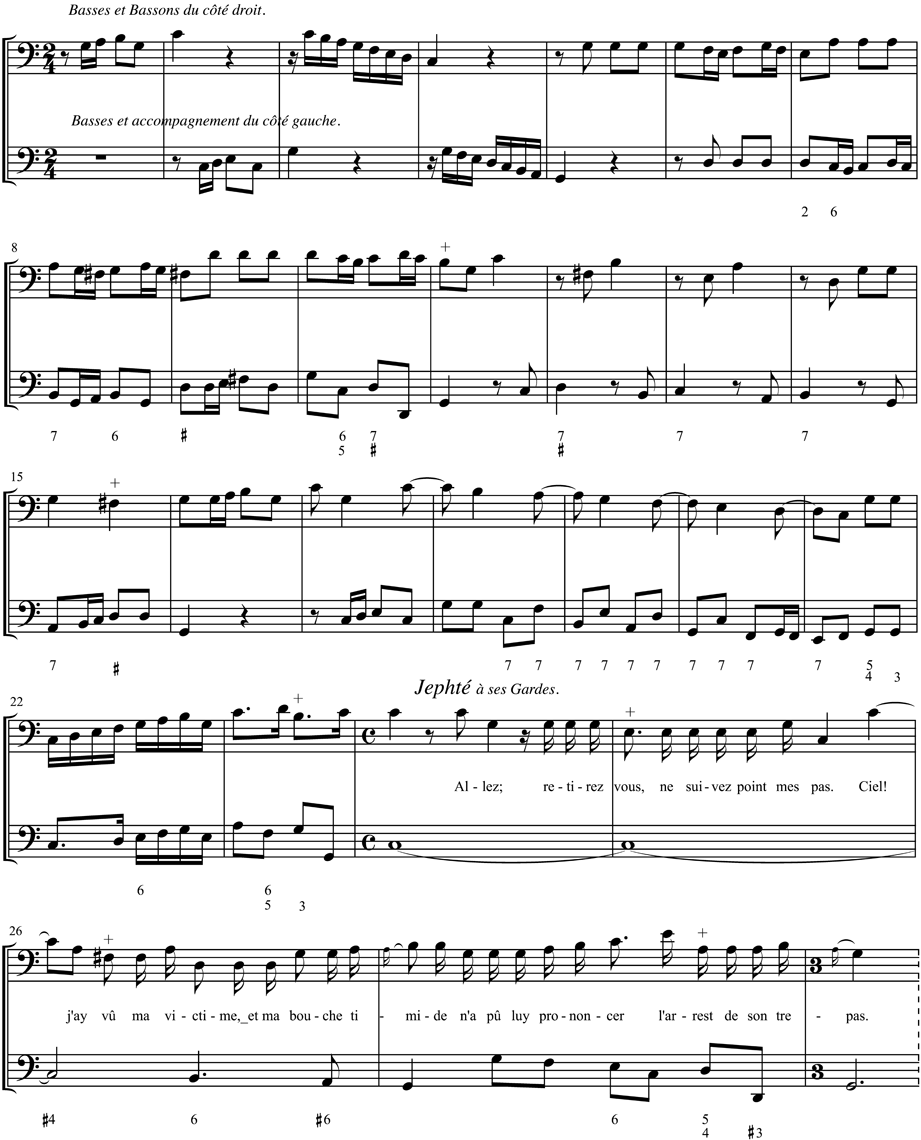
In his livret for Jephté (1732), Pellegrin placed the first encounter between Jephté and his daughter, Iphise, in the off-stage space during the entr'acte between Acts 2 and 3. Jephté, who has made a vow to God to sacrifice whatever being first greets him at his homecoming, should he achieve victory in battle, encounters his own daughter upon his return.Footnote 55 Pellegrin sought to create more than a single, tragic encounter, instead preparing for a recognition scene that is twice delayed. The initial meeting is placed off-stage and is one-sided, for although Iphise recognizes her father, the years of his exile have rendered her unrecognizable to him. Once Jephté returns to the stage space at the opening of Act 3, he dismisses his guards – an action evoked through the imitative shuttling of motives in the divided orchestra – and broods over the fate of his victim. His monologue informs the spectator of this encounter and his emotional response to it (Example 1):

Michel Pignolet de Montéclair, Jephté, Act 3 Scene 1, bars 1–28 (Paris: Boivin, 1732), pages 121–122. Harvard Theatre Collection, Houghton Library, Harvard University, M1500.M773 J4 1732a. Used by permission
The off-stage space figures vividly in his mind, as he imagines what his torment would have been like had he encountered his wife or daughter instead of this unknown victim. He reassures himself with his conviction that both Almasie and Iphise are at the temple and directs the final section of his monologue to his absent victim, unwittingly counselling his daughter to flee from him.
In her following dialogue with Jephté (Scene 2), Almasie informs him that Iphise is at the temple in worship. He sees his unknown victim enter the stage and expresses his dread (Scene 3); it is only when Almasie announces this arrival of their ‘daughter’ that we witness the moment of Jephté's recognition. Whereas Iphise's joyful recognition of her father was concealed from the spectator in the entr'acte, Jephté's anguish is presented immediately on stage in a ‘situation’ that according to the notice in the Mercure de France ‘drew tears’ from the audience.Footnote 57 Pellegrin selected for representation not the single encounter described in the biblical narrative but rather a newly imagined and carefully prepared recognition scene that directly involves Almasie. The role of Jephté's wife is not present in the original narrative, yet it had regularly appeared in modern adaptations of the subject beginning with George Buchanan's Latin college play of 1554, Jephthes, sive Votum (Jephthah, or the Vow).Footnote 58
Pellegrin justified his handling of the recognition scene in his Preface to the livret, a discussion that illustrates the importance of the entr'acte as a site of concealed action. The critical issue concerns this first encounter between Jephté and his daughter. Pellegrin explains that Jephté has not seen his daughter from an early age and thus cannot recognize her, information that Jephté communicates to his confidant, Abdon, in Act 1 Scene 2. Pellegrin relates that an objection was made that the daughter should have announced herself to her father instead of allowing her identity to remain unknown. The first reason for this momentary dissimulation, according to Pellegrin, was one of propriety (bienséance). Iphise was required by the rule of decorum to be announced to her father by Almasie, who at the moment of Iphise's encounter with Jephté is in the temple. Pellegrin shaped her exit discourse to reflect this fact: in an aside, Iphise expresses her impatience to see her father before running off stage to greet him:
Pellegrin's second response to the objection is that once Jephté sees his victim and is overcome with remorse, he commands those around him to leave him alone, and his daughter would necessarily follow this order through her obedience. Pellegrin concedes that he could have presented the encounter on stage at the end of the second act, but his sense of an act's proper length prevented him from expanding it. The stage directions at the close of the act indicate that Iphise is followed by the celebrating Israelites and rushes ahead of them to greet Jephté: ‘Iphise, followed by the people, goes before Jephté to the sound of the tambourins’.Footnote 60 This movement accompanies a set change from Jephté's palace to the front court of the palace in which a throne is visible.Footnote 61 The music of the entr'acte is the ‘Air des Tambourins’, a lively dance in A major with flutes and bassoons that had served as the framework for the air and chorus ‘Tout rit à nos veux’, sung by the inhabitants of Maspha in the Act 2 divertissement. In his Preface Pellegrin justifies the inclusion of dance, required by the tragédie en musique as a theatrical form, by reference to the biblical description of the daughter meeting her father ‘with timbrels and with dances’, as the action is described in the Authorized (King James) Version. Montéclair's use of the ‘Air des Tambourins’ within the divertissement – and then to close it and project the action through the entr'acte – thus realizes in musical terms the daughter's action in the source narrative and evokes her impatience, shared by the chorus, at Jephté's approach. Iphise's exit discourse guides the audience into an imaginative or speculative construction of the off-stage encounter. Spectators may anticipate that Jephté will not recognize her, based on his dialogue with Abdon in Act 1 Scene 2, which establishes that Jephté has been absent for many years and that when he was exiled, his daughter was of ‘too tender an age’ to bring with him. With this knowledge, spectators may further imagine Jephté's distress at meeting his victim, her confusion and the dramatic irony of an encounter that would have been even more appalling had Jephté recognized his daughter.
Pellegrin and Montéclair exploited the entr'acte for other significant events in Jephté. Between Acts 1 and 2, Jephté leads the Israelites into battle against the Ammonites. The music that depicts the rush to battle is the ‘Marche des Guerriers’ that accompanies the entrance of warriors in Scene 4. Both livret and score note that ‘The army assembles around Jephté at the sound of the trumpets; Jephté, at the head of the Israelites, crosses the Jordan to fight the Ammonites’.Footnote 62 Act 2 opens with a dialogue between Ammon, held captive in Jephté's palace, and his confidant Abner. The action under way – the battle between the Ammonites and the Israelites begun during the entr'acte and continuing off stage, implied by the dialogue – compels Abner to prompt Ammon to flee, the latter hesitating out of what will prove to be a fatal passion for Iphise.
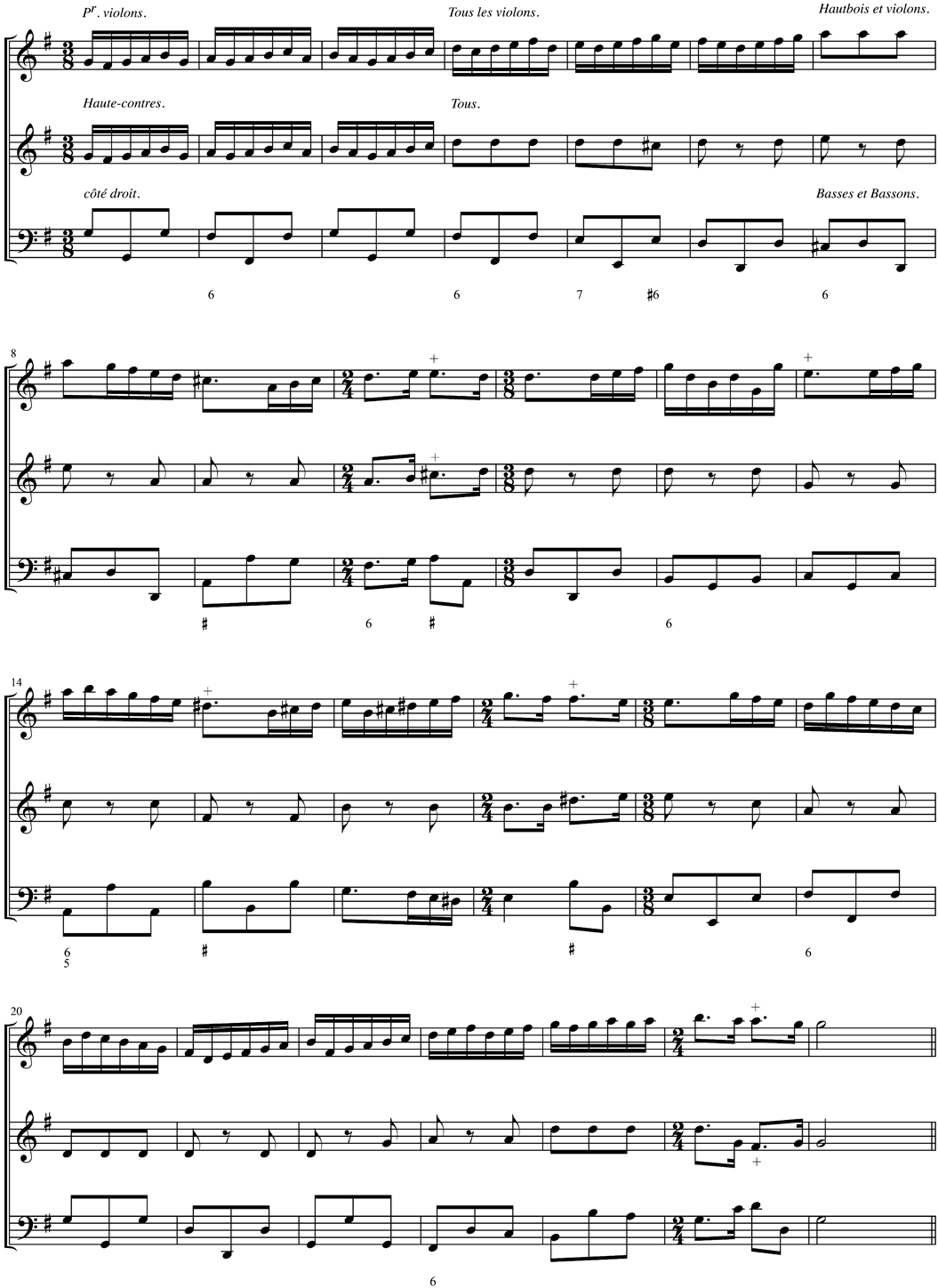
The interval between Acts 3 and 4 is again bridged with a march accompanying military activity announced in the concluding lines of Act 3. The off-stage action is the assault of the Israelites against the rebel Ammon. It is accompanied by the bellicose march of Scene 5, which Montéclair labelled ‘Air des trompettes’.Footnote 63 The dramatic and musical contrasts between Acts 3 and 4 are sharp, as the latter opens in a garden with Iphise lamenting her separation from her father in solitude. She does not yet know that she is to be sacrificed, and instead believes her vaguely intimated punishment stems from her illicit love for Ammon. At the end of Act 4 she rejects Ammon's promise of protection in a scene that ‘connoisseurs’ found to be ‘the most beautiful of the work’, according to the Mercure.Footnote 64 As she prepares to rush to the altar, her exit is clearly signalled in the dialogue: ‘Ah! let me run to the altar to prevent his anger.’ Iphise's action leads the spectator through the fictional space, as Act 5 opens with a view of a restless Almasie inside the temple.Footnote 65 Given that Act 4 is devoted to lamentation and prominently features musettes as part of the pastoral instrumental palette, there were no suitable dances from the act to draw upon for this animated, even frantic action. Montéclair composed a new instrumental piece that captures Iphise's rush to the temple and bridges the G major close of Act 4 with the C major opening of Act 5 (Example 2).
Montéclair, Jephté, ‘Entr'acte’ between Acts 4 and 5, page 209
Both instances in which Iphise's actions are projected into the entr'acte show that Pellegrin's handling of entrance and exit discourse was grounded in classical poetic theory. For instance, d'Aubignac had addressed the question of how characters' discourse should mark the reason for exits before the end of the act. His principal concern was to establish motivation for what might otherwise appear to be an artefact not of the ‘action’ but of the ‘representation’.Footnote 66 Corneille extended this technical justification to include the creation of suspense in the spectator; indeed, the precise nature of off-stage activity in certain cases could be less important than the creation of this suspense.Footnote 67 In his entr'actes, Pellegrin exploits exit discourse to project a speculative continuance of the action that is later defined through discursive reference, as when Jephté broods over his first encounter with his victim at the opening of Act 3.
Pellegrin's strategies for concealing actions link Jephté with Hippolyte et Aricie, his next livret and Rameau's first tragédie en musique. Certain of these strategies were identified and appraised in the opera's reception, beginning with a notice in the Mercure de France on the opera's first run in October 1733. This account of Act 5 points to the off-stage actions disclosed in its first two scenes: Phèdre's revelation of Hippolyte's innocence to Thésée, her suicide, the obstruction of Neptune's attempt to kill Hippolyte as brought about by Destin and the rescue of Hippolyte by Diane.Footnote 68 The Mercure notice clarifies that Phèdre's off-stage actions are prepared in her final address of Act 4, in which she responds to the reported death of Hippolyte. In her hallucinatory on-stage invocation of the gods, whose dense instrumental accompaniment tracks her volatile utterance with a kind of ecphrastic commentary, she senses ‘hell opening up’ beneath her and implores the gods for a momentary reprieve to reveal the truth to Thésée:

With this exit discourse, Phèdre is propelled into the off-stage space of confession and imminent death, while the ‘Air pour les Matelots et Matelotes’ from Act 3 fills time in the absence of a set change. The entr'acte is unusual not only because of the static stage set, but also because the music is drawn from before the prior act, which may have been intended to refer to Thésée's suspicion of Hippolyte's guilt and subsequent invocation of Neptune seeking vengeance, as Geoffrey Burgess has suggested.Footnote 70 Pellegrin makes these off-stage events known through Thésée's monologue at the beginning of Act 5, where the king expresses horror at discovering Hippolyte's innocence through Phèdre's confession of ‘detestable love’ and seeing her commit suicide. In Racine's Phèdre (1677), by contrast, Phèdre's confession and death take place on stage in Act 5 Scene 7. Pellegrin's displacement of violent action and the foregrounding of affective response through diegetic reference in Act 5 mirror the opening of Act 2. As Thésée enters the stage, the action is already under way: he is fleeing the fury Tisiphone in the underworld, and in pleading for mercy describes seeing his friend Pyrithous torn apart by Cerbère. During the divertissement of Scene 3 he disappears off stage and searches in vain for Pyrithous among the tormented souls, as he relays through narrative once he returns in Scene 4.Footnote 71 In his Act 5 monologue, Thésée condemns himself as a monster and calls upon Neptune to hide him forever – like Phèdre, he wishes to flee and return to the underworld. He moves to jump into the sea and thus accomplish through immediate enactment what had, in the case of Phèdre, been concealed beyond the frame of the stage. When Neptune arrives in Scene 2 to prevent this suicide, the god's vision reaches beyond the stage to describe preceding events and evoke the future. Although he prevents Thésée from killing himself, his wish to be ‘concealed’ is fulfilled: before the divertissement that reunites Hippolyte and Aricie, Thésée is consigned permanently to the off-stage space in exile.Footnote 72 Destin has saved Hippolyte yet has also prohibited Thésée from seeing him again.
After Thésée's permanent withdrawal, the scene changes to a garden in which Aricie awakens after being transported away from the site of Hippolyte's apparent death. In revisions made during the first run of performances in October 1733, Rameau and Pellegrin excised the first two scenes of the act after criticism regarding the change of setting between Scenes 2 and 3.Footnote 73 The revision introduced a new dramaturgical problem by removing the narrative content so crucially supplied by Thésée and Neptune in Scenes 1 and 2. As the Mercure noted, Diane was given a new explanatory discourse that she offers to Hippolyte in Scene 6. This passage recuperates information from the now missing narratives of Thésée and Neptune, as Diane explains that Neptune's design to kill Hippolyte was thwarted by Destin. Addressing herself directly to Hippolyte, she offers a pithy summary of Phèdre's fate, closed off in a rhymed alexandrine couplet:

Previous acts of narrative reference in the opera are implicated as off-stage events rather than on-stage performances. Across Acts 1 and 3, for instance, Hippolyte has acquired knowledge of Thésée's reported death, which informs his dialogue with Phèdre in Act 3 Scene 3. In his monologue in Act 4 Scene 1 (‘Ah! faut-il en un jour, perdre tout ce que j'aime!’), he despairs at being exiled, a verbal action that must have occurred during the previous entr'acte. The Mercure notice specifies the placement of this act of banishment: ‘Hippolyte exposes in a monologue what has happened during the entr'acte; that is to say, the exile to which his father has condemned him’.Footnote 75 By withholding these actions from the stage, Pellegrin and Rameau foreground the depiction of affective response; the significance of these expressive ‘actions’ is predicated on the sustained availability of off-stage space as another site of action.
The parody of Hippolyte et Aricie by Antoine-François Riccoboni and Jean-Antoine Romagnesi, premiered by the Comédiens Italiens on 30 November 1733, targets the elimination of on-stage events in Act 5 and their compensation through narrative. Scene 17 corresponds to Phèdre's scene of lamentation and guilt at the end of Act 4, and Scene 18 corresponds to Aricie's monologue in Act 5 Scene 3. Eliminating Thésée's monologue and the appearance of Neptune, the parody thus mirrors the revised structure of the opera. After Aricie's monologue, Diane commands the zephyrs to transport Hippolyte to be reunited with Aricie, yet rather than simply proffering a clarification of Phèdre's and Thésée's fates, she first enquires if Hippolyte desires such an explanation:

Hippolyte replies that none of this is of interest to him; what matters is only his survival and union with Aricie:
Narrative recuperation and dramatic integrity are sacrificed to Hippolyte's indifference and the pressing requirement of the final lovers' duet, which Aricie for her part pre-emptively rejects, characterizing it as a ‘moment of boredom’. At the same time, Hippolyte's refusal cuts off the flow of necessary dramatic information to the spectator. This comic misfire points to the artifice of expository or diegetic speech in what Riccoboni and Romagnesi seem to have considered a dramaturgical flaw in the revision to Act 5 of Hippolyte et Aricie. In classical dramaturgy, the spectator's presence is virtually never acknowledged: within the fictional world, the internal logic of the action is understood to motivate expository discourse, and although the informative function of dramatic speech implictly crosses the stage to include the spectator, the latter is conceived by classical poetics to be an unacknowledged voyeur observing an autonomous action. The tacit prohibition in both lyric and spoken tragedy against direct audience address is the clearest expression of this autonomy, secured through the notion of a ‘fourth wall’.Footnote 78 A character who refuses narrative places an obstacle, a permanent enigma, before the spectator. At the close of the opera's original version, Diane does not offer Hippolyte a full explanation of the fates of Phèdre and Thésée, even though once he has been transported to the garden and reunited with Aricie, he has no knowledge of what has transpired during the entr'acte or Scenes 1 and 2; he only learns from Diane that Thésée is destined never to see him again. In Pellegrin and Rameau's revision, Hippolyte is just as unaware of these events as before; what has changed is not Hippolyte's state of mind but rather the spectator's access to discourses that have now been removed from the stage. The dramatic action thus lacks a compelling internal reason for explanatory narration from Diane directed to Hippolyte after the removal of Scenes 1 and 2. The critical eye of parody exposes this supplementary narrative as a feint, meant not for Hippolyte but the audience. Invoking d'Aubignac's fundamental concepts, this revision was dictated by the requirements of ‘representation’ – the spectator's need for narrative closure after Thésée and Neptune were erased from Act 5 – rather than by the ‘truth of the action’.
The removal of Scenes 1 and 2, with the resulting elimination of Thésée's references to Phèdre's suicide, also provoked sardonic commentary in a parody by the Comédiens Italiens that targeted the opera's 1742 revival. In this parody, which was premiered on 11 October 1742, Diane presents the following explanation of Phèdre and Thésée's disappearance from the stage:
Diane is presented not merely as the goddess of the hunt and protector of Hippolyte but as a critic of dramaturgy. Invoking the term ‘denouement’, she introduces the self-reflexive distinction between the techniques of theatrical representation (artifice) and action (illusion) so often exploited by parody. The credibility of fictional yet real characters dissolves: behind Phèdre and Thésée are actors compelled to ‘play’ unattractive roles who no longer wish to appear before the audience. Both parodies of Hippolyte et Aricie unmask the ruptures of dramatic representation created by the revised configuration of Act 5; by suppressing the perceived violation of spatial unity this revision altered the means by which off-stage incident was made available to spectators. The critiques are predicated on the recognition that off-stage action is a constitutive feature of representation and that the spectator's access to the whole of the fabula is mediated through both on-stage enactment and discursive allusion.
A striking feature of entr'actes in the tragédie en musique is their frequent concision and rapidity, corresponding to the rapid transposition of widely separated mimetic spaces through set changes. Actions that are assumed to occur within their temporal orbit extend well beyond the objective time of the airs and symphonies that bridge these gaps, typically around only a minute or slightly more in length. With its preservation of stage decor across Acts 4 and 5, the first incarnation of Hippolyte et Aricie presents an entr'acte that closely resembles practices in spoken theatre by ‘consuming’ time and establishing a space for unrepresentable or otherwise concealed actions.Footnote 80 The density of events that transpires – as Phèdre reveals her crime to Thésée and commits suicide – suggests that the dynamics of presence and absence are not exclusively the province of spoken tragedy. Furthermore, the unfolding of ‘tragic time’ in opera is not uniform: effects of compression, expansion, embodied presence and imaginary space are achieved through the act and the entr'acte. A chronotopic analysis of these structures helps to clarify the variability and complexity of spatiotemporal representation in the tragédie en musique.
Kintzler's categorical distinction between tragedy and opera at the level of representation, although capturing the undeniable importance of visual display for the tragédie en musique as a dramatic form founded on the merveilleux, neglects significant moments in which spectacle is strategically withheld. The appeal to absolute ‘exteriorization’ reaches an aporia when confronted with not only Pellegrin's Preface to Jephté but also the dramaturgies of Jephté and Hippolyte et Aricie. Adjusting Kintzler's Kantian formulation, it appears that the entr'acte as theorized and practised in spoken tragedy in fact belonged to the ‘conditions of possibility of all theatrical experience’ that circumscribed the ‘invention’ of poets and composers and the ‘expectation’ of spectators.Footnote 81 Operatic entr'actes may simply ‘bind’ acts together, as when Iphise implicitly leads the audience to the sacrificial altar, yet they may also function as a ‘mask’ of hidden (and therefore speculative or imagined) actions.Footnote 82 The livrets of Jephté and Hippolyte et Aricie illustrate these possibilities, and Pellegrin's Preface to Jephté and the parodies of Hippolyte et Aricie confirm that spectators in the opera house possessed some awareness of these practices.
There were probably many ways of experiencing tragédies en musique in performance, then as now. The spectacle of moving flats and backdrops during entr'actes could call attention to itself and provoke astonishment. The suspension of dramatic action could be the occasion of mental relaxation, daydreaming or conversation. Yet it could also involve rumination on previous events in the tragedy, sustained emotional response and the imaginative projection or anticipation of events as shaped by the discourse of characters ‘on the verge of absence’, before exiting the stage space.Footnote 83 Off-stage action is in this sense a function of the poetic text, as it is only through discursive reference or musical allusion that such actions come to be defined. Yet even the ‘non-dramatic’ entr'acte lacking a clear semantic function is not necessarily a dramaturgical weakness, as the recycling of pre-existing music may have allowed for the kind of imaginative reflection that was one possibility of the spectator's experience. Until the demands in the 1760s for increased dramatic integration, the ‘recycled’ entr'acte may have served this function effectively. More directly shaping the intimation of unseen events, the ‘functional entr'acte’, used in Jephté when Iphise rushes to the sacrificial altar, was exploited well before the 1760s to involve the spectator in moments of particular dramatic urgency.