An analysis of Tibetan Buddhism employing social science methodology is a desideratum in the field of Tibetan studies. The field is relatively new, having become an academic discipline around forty years ago and recently burgeoning as a result of the discovery, collection, and preservation of an enormous quantity of original texts.Footnote 1 This paper is an effort to begin to fill this niche using an economics of religion approach to explain the rise of the Geluk school into a state religion.
The economics of religion approach employs economic concepts and principles to different aspects of religion. The basic idea is that religion functions as a market with supply (providers) and demand (believers). Providers of religion, such as schools, sects, and denominations, compete for adherents and wealthy patrons. One way in which they compete is by “pricing” their religious goods, such as merit making or absolving sin, so as to successfully push out other religions in the market. Scholars analyze the nature of religious competition in terms of a plurality of religious providers or a monopoly (Stark and Finke Reference Stark, Finke and Jelen2002). Other scholars discuss the pricing of religious goods and the effects that has on the survival of a religion (Ekelund, Hébert, and Tollison Reference Ekelund, Hébert and Tollison2006).
The tendency of scholars has been to apply the economics of religion approach to monotheistic religions—for example, to explain the rise of Protestantism (Ekelund et al. Reference Ekelund, Tollison, Anderson, Hébert and Davidson1996) or why Roman Catholics and Protestants in Europe engaged in fewer wars during the Ottoman Empire (Iyigun Reference Iyigun2008). In this paper, we break new ground by applying the economics of religion approach to Buddhism. We treat Tibetan Buddhism as a religion market and apply economic analysis to explain the rise of the Geluk school into a monopoly religion.
The Geluk school was one of the last religious groups to form in Tibet, yet it rose to become the state religion around the middle of the seventeenth century. This study examines conditions under which, in the absence of state intervention in the religion market, a religion monopoly develops. Using a market approach to religion in tandem with historical analysis, the argument proceeds in five steps: (1) Mahayana Buddhism formed as a relatively homogenous religion market in Tibet by the eleventh century, with a diversity of religious groups developing. (2) The de facto Chinese policy toward Tibet under the early Ming, who were militarily not in a position to mount a major campaign of conquest, translated into the liberalization of local politics. (3) The rise of the Gelukpa and their success was attributable to technological innovation in the club features of their school. (4) Facing a serious challenge at the hands of their fiercest competitor, the Karmapa, the Gelukpa imitated their rival by introducing the incarnate position of Dalai Lama and competing directly with the Karmapa incarnates for wealthy patrons. (5) As a club, the Gelukpa were willing to counter violence with violence to overcome the Karmapa and rise to become the monopoly religion. Having won, the Geluk school, rather than showing religious tolerance, continued to be an exclusive club. It did so by concentrating resources in its institutions and, to some extent, imposing its organizational structure on other religious groups.
Theory of a Religion Monopoly
Robert J. Barro and Rachel M. McCleary (Reference Barro and McCleary2005) construct a formal model for the choice of a state religion. In an unregulated religion market, a natural monopoly may arise. A critical element of a natural monopoly is the presence of large fixed costs, such as those applicable to the creation and dissemination of a set of religious beliefs (e.g., the construction of monasteries, patronage for the performance of merit-making rituals, the commissioning of editions of sacred texts, and the authoring of biographies). Relative to these fixed costs, the marginal costs of membership and participation are likely to be small and are not be likely to increase substantially. Therefore, if people view alternative religions as close substitutes, a single type of religion might prevail in equilibrium. A religion monopoly succeeds when one provider makes a profit but a second one cannot gain enough adherents to compete successfully.
The economist Adam Smith thought that minimal state intervention (“to keep the peace”) was needed to maintain an open market in which religious groups settled their theological differences through discourse and were not permitted to persecute, abuse, or oppress one another. This minimal state intervention, coupled with impartiality toward all religious groups, created an atmosphere of “good temper and moderation” (Smith 1790, 202, 207). Such an environment, Smith thought, allowed for competition, thereby fostering a plurality of religious faiths in society. Following Smith's theory, Rodney Stark and William Sims Bainbridge (Reference Stark and Bainbridge1996, 94–96) argue that a religion monopoly occurs only when a state engages in coercive behavior on behalf of a religion. Our theory and empirical findings discussed in this paper provide a different model for the rise of a religion monopoly.
A religion monopoly tends to arise naturally when there exists a strong concentration of adherents in a particular religion (Barro and McCleary Reference Barro and McCleary2005). An important contribution to this concentration is the collective nature of religious beliefs and participation (Iannaccone Reference Iannaccone1992). As larger numbers of people adhere to one religion, more people are disposed toward that religion. People not only want to belong and have a shared liturgical experience, but also want to share similar beliefs, doctrines, and worldviews. With many people adhering to a single faith, there is a tendency to form a religion monopoly. In particular, such concentration economizes on the fixed costs of maintaining a large variety of religion types.
Stark and Bainbridge focus on a centralized political authority, which can use its legitimate powers to enforce a religion monopoly on a market that otherwise would be pluralistic if allowed to operate without government intervention. We argue that under conditions where no central political authority exists, religions will compete until one becomes a monopoly. In other words, we contend that there can be a natural tendency toward a religion monopoly in the absence of a central political authority. Contrary to Stark and Bainbridge, we find in the historical development of the Geluk school that, lacking a central political authority, a religion monopoly can be enforced through a willingness on the part of the religion to both sanction and engage in violence. Furthermore, our findings corroborate the club model of Eli Berman (Reference Berman2003), Berman and Laurence R. Iannaccone (Reference Berman and Iannaccone2005), and Berman and David D. Laitin (Reference Berman and Laitin2007). We argue that the club-like nature of a religious group explains why some groups in Tibet were organizationally capable of generating the violence that led to a monopoly outcome.
The Rise of Competition in the Tibetan Religion Market
The Muslim invasion of northern India reached what is now Bihar State toward the end of the twelfth century, and this resulted in the virtual destruction of such well-known institutions of Buddhist learning such as Nalanda, Odantapuri, and Vikramashila. This destruction created a diaspora of Indian Buddhist masters, with a number seeking refuge in Tibet. The destruction of the large Indian monastic centers gave rise to and consolidated a georeligious shift, with Tibet becoming the center of the Buddhist universe, the first known documented instance of which took place in the thirteenth century (Martin Reference Martin and Kvaerne1994, 532, fig. 9; van der Kuijp Reference van der Kuijp and Venturi2004, 54).
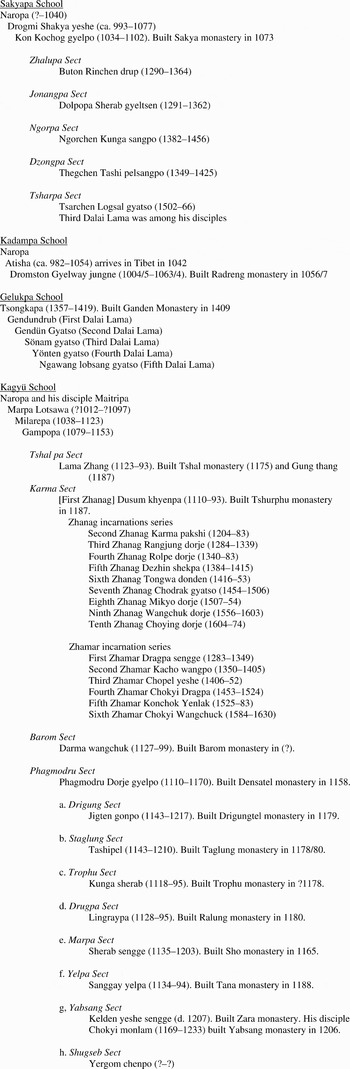
Over the eleventh and twelfth centuries, the Tibetan religion market developed exponentially. The ready availability of Indian ideas initially encouraged the formation of a diversity of Buddhist schools. The competition in Tibetan Buddhism by the thirteenth century allowed for four schools: Old (Nyingma) and the three new schools (Kadam, Kagyü, and Sakya). The market also had room for various quasi-independent sects with some differentiation in religious products (see figure 1).
Historical development of Sarma, lineages, schools, and sects in Tibet.

The Tibetan religion market of the twelfth and thirteenth centuries was characterized by innovation, diversification, and fluidity, with easy entry into a school or sect and many competitors to choose from. The various branches of Buddhism shared a common canon of texts—the Nyingma school additionally considered a corpus of esoteric texts to be canonical as well—but disagreement occurred on the interpretation of those texts. Monks learned from various masters, incorporating aspects of distinct intellectual and meditative traditions and lineages into their own school, all of which were authenticated by various teacher-disciple lineages of transmission. By the thirteenth century, and apart from popular noninstitutionalized religious practices, the only aspects that differentiated the four schools and various sects were, on a practical level, their attachments to different lineages and particular tutelary divinities. However, on a theoretical level, there were numerous conflicting inter- and intrasectarian interpretations of canonical texts. Although quite flexible, serious deviations from traditional teachings and writings became heresy, and such teachings and writings were criticized and marginalized by what had become orthodoxy.
In political economy terms, we can describe the Tibetan religion market of the twelfth century as pluralistic and competitive. Although Buddhism was the dominant religion, various schools and sects competed for patrons and novices (figure 1). In this type of market, each school would “price” its religious products above marginal and average costs. For example, a religious hierarch could command a higher price for his merit-making activities than less experienced lamas. The high price meant that there was a low quantity of religion services demanded but also substantial profit. This profit encouraged other lamas and religious groups to enter the religion market so as to garner patrons and adherents.
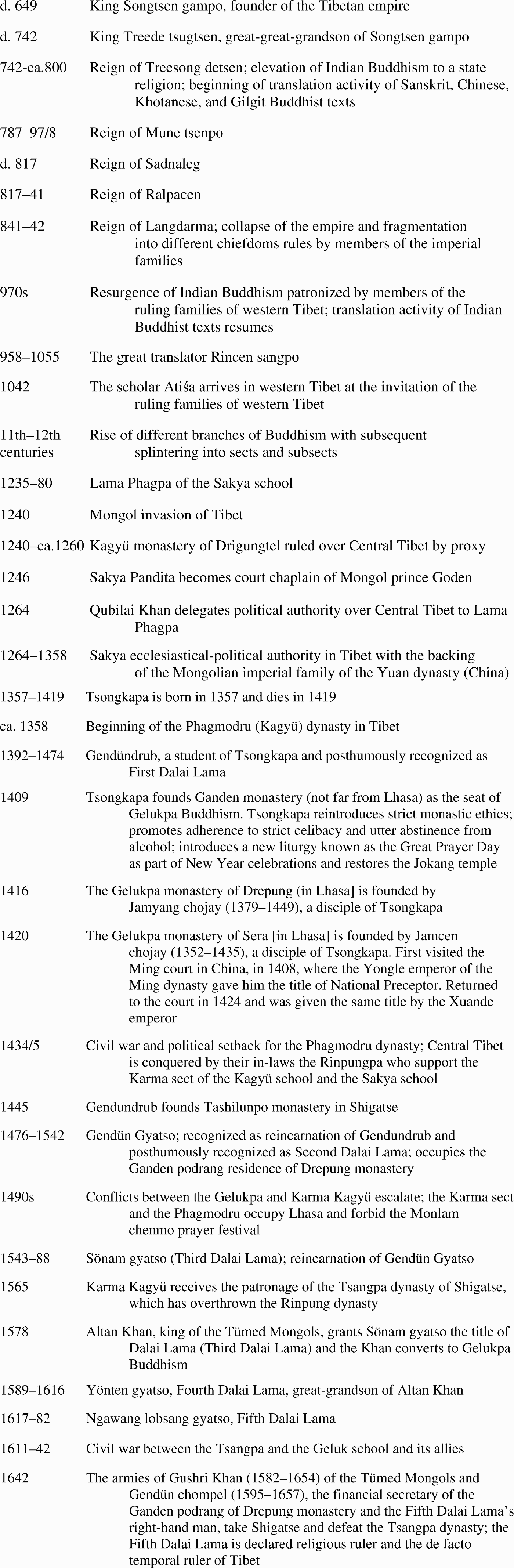
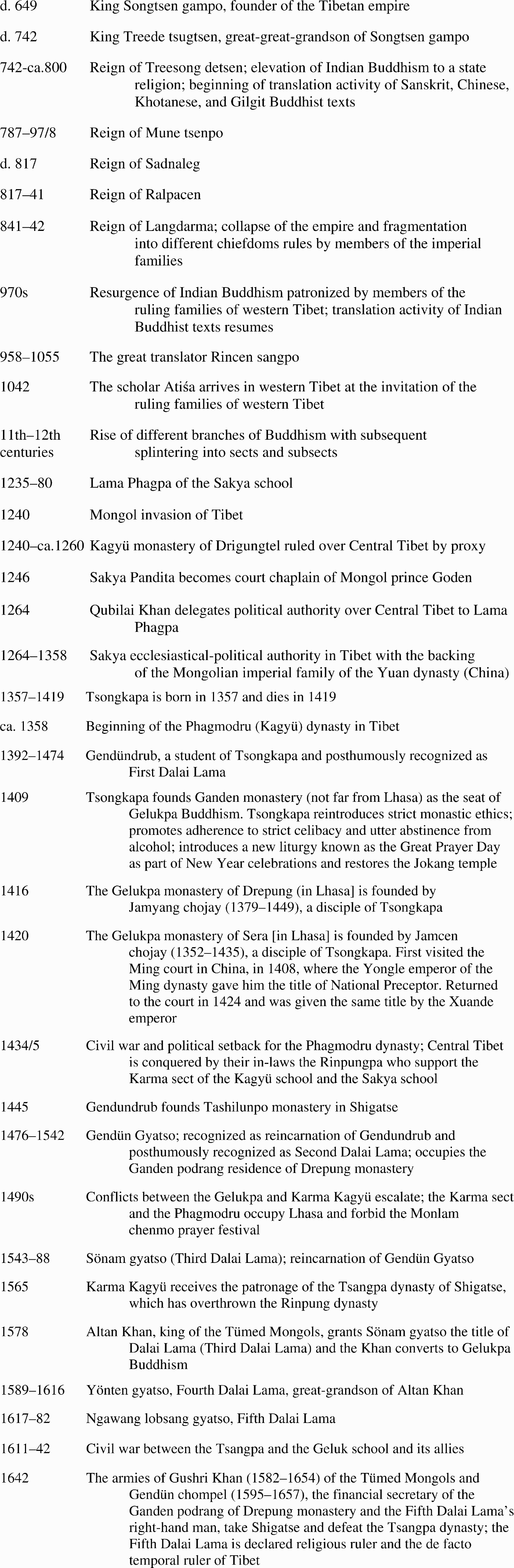
Successful entrants to the religion market were typically those that had relatively low up-front costs. New religions have initial costs (up-front expenses) that they calculate they can pay off later. These costs were especially low for Buddhist groups, which provided a form of religion that had become familiar and popular with the majority of the population. In contrast, Islam would have had high costs of entry through military conquest, and therefore did not participate significantly in the Tibetan religion market when it had slight opportunities to do so. Furthermore, it appears that Muhammed and his successors were focused on conquering the Middle East.Footnote 2 To be sure, next to the native Bon, Islam was the closest religion competitor to Buddhism. A plausible explanation is that Buddhism had already entered Tibet during the eighth and ninth centuries. Even before the Mongols established the Yuan dynasty (1271–1368) and exclusively patronized Tibetan Buddhism, the Tibetan aristocracy patronized Buddhism (see figure 2). Indeed, during the late tenth century and throughout the eleventh century, Tibetan aristocratic families were underwriting an orthodox revival of Buddhism in Tibet. With indigenous aristocratic support, Buddhism was the major religion in Tibet, and any new religion would have had considerable up-front costs to mount successful competition.
Brief chronology of Tibetan history.
The Liberalization of Politics and the Deregulation of Religion
During the early Ming dynasty, the Chinese worldview articulated a garbled version of the georeligious shift, whereby the Tibetan cultural area, not India, was the center of Buddhism (Toh Reference Toh2004, 44–58). Tibet had become “India” as the religious locus of Buddhism. The early Ming rulers continued the Yuan policy of inviting religious hierarchs of the various Tibetan religious schools to court, conferring upon them honorific titles that did much to improve the status of the honorees in Tibet but had virtually no meaning in Ming China.Footnote 3 No longer was Tibetan Buddhism the religion of the entire imperial court. Instead, Tibetan Buddhism was primarily reserved for the emperor and his inner court.
Deregulation of the religion market in Tibet occurred along with the liberalization of politics. The Yuan dynastic title and position of Imperial Preceptor held by Sakya hierarchs was abolished, ending their privileged access to the higher echelons of the imperial court. Sakya monastery no longer served as the administrative seat for the imperial court in Tibet, and the Ming would not replace it with another.
The early Ming military policy toward Tibet, beginning with the Yongle emperor, was one of nonintervention. Certainly, during its last years, the Yuan dynasty decreased its military and political involvement in Tibetan affairs. Yongle's noninterventionist policy toward Tibet was a combination of concentrating resources on military campaigns in Southeast Asia, staging six large-scale naval expeditions led by the eunuch Zheng He, and overseeing the extensive fourteen-year reconstruction of the capital of Beijing (Dreyer Reference Dreyer1982, 173–220; Farmer Reference Farmer1976, 98–133). Rather than mounting a major military offensive to subdue and occupy the troublesome border areas of Qinghai, Gansu, and Sichuan, Yongle's policy was one of using local tribes to maintain order. Given that Yongle was not expending military resources on campaigns in Tibetan border areas, the probability of extending China's reach into Central Tibet was not an issue.
From the perspective of Tibetan political economy, two trends emerged that transformed the political and religious landscapes. Beginning sometime in the early thirteenth century, several schools and sects developed a secular office overseeing administrative and financial matters of monasteries and their landed estates. The institution of a secular administrative office most likely came into being to manage their economic resources, including land that was being acquired from such patronage relationships as those with, for example, landed Tibetan aristocratic families and various Mongol rulers and princes of the blood. The accrual over time of monastic landholdings, along with hereditary tenant families, the control of major roads that were trade routes, and the monopolization of trade by monasteries, required administrative management. The increasing concentration of land and economic wealth in the monasteries gave rise to conflicts, often violent, among these institutions. The abbatial seat, held by a lay person or monk, and the secular office remained distinct and were usually kept separate. Hereditary conflicts arose when male successors were not available or when several contested for the same position. When there was a dearth of male heirs, a lay abbot might hold both the ecclesiastical and secular offices so as to be free to marry and propagate the family lineage. Another option was that a cousin or half brother assumed the secular office.
The other trend that emerged was the disintegration of political unity among the autonomous units. The thirteen myriarchies into which Central Tibet was divided during most of the period of direct or indirect Mongol rule, from 1240 to the early 1350s, were by and large religious aristocracies with monasteries at their centers (Cüppers Reference Cüppers2004; Dung dkar Blo bzang ‘phrin las 1981). With the demise of Mongol control over Central Tibet (and that of its proxy); the myriarchical structure became politically irrelevant, leaving basically a handful of main aristocratic families and their allies in its wake. They formed what amounted to an administrative civil-military system of families that, being nominally affiliated with the Phagmodru rule (ca. 1356–1493), politically and economically replaced the earlier system of myriarchies. The Phagmodru were so called after their home monastery of the same name. This Kagyü monastery and its estates were controlled by the ancient Lang family, which could trace its origins back to Tibetan imperial times. Tai si tu Jangchub gyeltsen (1302–64), one of its scions, was able to undercut Sakya hegemony during the Yuan and established Phagmodru rule in the mid-1350s. Those families who administratively served the Phagmodru soon became themselves increasingly wealthy and militarily powerful, at times challenging the authority of the Phagmodru hierarchs.
From these two trends came a cycle of the earlier myriarch families weakening and splintering as a result of internal conflicts. The families thereby became vulnerable to the rise of new aristocracies out of the administrative families that were allied with the Phagmodru. We have two examples of such families who played key administrative roles, the Zina and Rinpung. These families not only intermarried with the Phagmodru but also successfully challenged their authority, one temporarily and the other more decisively.Footnote 4
Integral to the rise of a new aristocracy was an affiliation with a school or sect, a connection that usually meant abandoning the sect (though not necessarily the school) of one's hegemonic clan.Footnote 5 As the old myriarch political system fell apart, the religion market became more fluid as some religious institutions began to break loose from their family affiliations. Thus, we now begin to witness a greater fragmentation of the almost monolithic structure of many schools, foremost of which is Sakyapa. The fragmentation began with the political and religious conflicts and subsequent schisms within the ruling families of Sakya monastery, the ancient Kön family. One of the first consequences of these internal schisms was, it can be argued, the formation of the Jonang sect (Ruegg Reference Ruegg1963, 75–76; Stearns Reference Stearns1999). These conflicts, competition among religious groups, and the ensuing fluidity in the religion market also made possible the rise of the Bodong sect and, indeed, the Geluk school. For the next two hundred years, Tibetan politics would be characterized by succession conflicts, interfamily wars, and the increasing concentration of wealth and authority in the schools and sects.
The Context for the Rise of the Geluk School
During the period that the Geluk school was forming in the early fifteenth century, the religion market was characterized by diversity and competition among schools and sects, as well as lamas. The Gelukpa soon-to-be rival, the Karma Kagyü sect, had by this time developed into a major Buddhist organization. Because it appears that the majority of schools and sects were more or less teaching a similar religious doctrine, the aspect differentiating them was that they traced their origins to different lines of teachers and evoked specific tutelary divinities, and thus the potential for new religious groups to enter with a distinct product was great. It is unfortunate that we do not have data on how extensively individuals switched from one sect to another and how many monks were affiliated with each sect and their levels of participation. These data would give us a better picture as to whether the sects were providing for a variety of religious products.
Tsongkapa (1357–1419), the founder of the Geluk school, established himself as a charismatic teacher, attracting adherents as well as the attention of the Phagmodru ruling family, which began patronizing him.Footnote 6 At that time, the Phagmodru, who, with their allies, were in full control of Central Tibet, were patrons of hierarchs of various sects of the Kagyü school, including the Karmapa. With the Phagmodru patronizing a number of hierarchs, a separation began to take place between religion and family/clan politics. More generally, we see a tendency in hierarchs and their schools toward transitioning themselves into identities independent of the family/clan structure. The pattern that emerges is one of secular rulers and their families forming alliances with religious hierarchs or teachers. This created a socially unstable situation with no strong, central political structure to counter the growing economic and political resources of the religious schools and their monasteries.
The relationship between the Phagmodru ruler and Tsongkapa continued as his popularity grew. In 1409, Tsongkapa, with the patronage of the Phagmodru ruler and his governor Ne'u Namkha sangpo, who governed the area in and around Lhasa, participated in the Monlam chenmo festival in Lhasa. The Monlam chenmo festival would, over the years, attract a large number of participants and observers.Footnote 7 With the benefit of hindsight, we can perhaps discern that participating in the festival was part of a complex series of acts that furthered Tsongkapa's legitimacy in and around the religious market with Lhasa as its center. The Monlam chenmo also created an opportunity for patronage from Mongol tribes and nomads living to the north of Lhasa and the local landed aristocracy.
During that same year, 1409, the construction of the first of the three major Geluk monasteries, Ganden, began with the patronage of the governor of an adjacent administrative center. For many centuries, the Tibetans had recognized Lhasa not only as a thriving trading center (Beckwith Reference Beckwith1977; Clarke Reference Clarke2004, 39–40; Sørensen and Hazod 2008), but also as an important religious center with the oldest two temples. With the exception of the Kadam school, already on the wane in the fourteenth century, no other school or sect had existing monasteries so close to Lhasa and in such density.
The patronage of the governor encouraged or obliged other noble families to endow lands to the second Geluk monastery, Drepung (1415), and to send their sons to the monastery for religious training. In the absence of archival material, we can only speculate that other nobility and the rising merchant families in Central Tibet were endowing the monastery with land as well. Tsongkapa's small but thriving group was also patronized by the Yongle emperor. Funds from the emperor as well as Ne'u Namkha zangpo were used to establish Sera monastery in 1419. During Tsongkapa's life, a formal monastic organization was beginning that would transform into what became known as the Geluk school. This monastic organization was primarily cenobitic with eremitic practices incorporated into its structure.
The construction of the first Geluk monasteries—Ganden (1409), Drepung (1415), and Sera (1419)—occurred after the other religious schools and sects were well established.Footnote 8 Competition for resources in terms of patrons, land, and adherents must have been strong. By locating monasteries in geographic proximity to Lhasa, the Geluk monasteries were strategically positioned to gain aristocratic patrons and resources. Another significant fact is that the Phagmodru ruler outlived Tsongkapa by thirteen years. The Phagmodru ruler and his associates did not patronize the fledgling Gelukpa to the exclusion of other Buddhist schools, but it is safe to say that his largesse was mainly focused on the former. He continued his patronage of Tsongkapa's disciples, several of whom had become the Phagmodru teachers. One activity the Phagmodru funded was the xylographic printing for some of Tsongkapa's writings. This and other funded activities assured the continued growth of the Geluk school after the death of its founder.
Formation of the Geluk School
The Geluk school, which arose in the early 1400s, was one of the last forms of Buddhism to enter the Tibetan religion market. The Geluks sought to capitalize on the profits (patrons and adherents) that other religious schools and sects were enjoying (more detailed explanation follows). To acquire patrons and adherents, the Geluk school had to differentiate its religion product from existing ones, while nevertheless remaining within the popular and familiar framework of Mahayana Buddhism. Existing schools and sects sought to deter the Geluk school from succeeding—that is, from taking away their patrons and adherents.
Tsongkapa and his disciples were monks trained in the Sakya school. Although he was aware that his writings were going to be controversial, there is no evidence that he interpreted his monastic and scholarly innovations as a schism from the Sakya school.Footnote 9 The religious context of the early fifteenth century, in which Tsongkapa lived, was fluid. Even though there were three main schools, each with various subsects, the fifteenth-century Tibetan religion market is best described as homogeneous. Scholars such as Tsongkapa were initially itinerants studying with teachers in monasteries affiliated with various schools, sects, and lineages.Footnote 10 Sectarian orthodoxy began to appear with the increasing growth of monasteries in terms of patrons, wealth accumulation, and members.
Tsongkapa sought to retain what he considered to be an orthodox version of Buddhism.Footnote 11 He stressed intellectual rigor in religious scholarship in the tradition of the Kadampa and Sakyapa. Tsongkapa's reinterpretation of Indian sources from the first decade of the fifteenth century until his passing was done with the intent of retaining what was, in his view, the original Indian meaning. Although all Tibetan schools accept Nāgārjuna's formulation of the Madhyamaka, Tsongkapa's interpretation of the Madhyamaka became a fully articulated system and, for the Gelukpa, the only one within this school's monasteries to capture fully the meaning of Nāgārjuna's philosophy. Tsongkapa's work became the doctrinal foundation of the Geluk school. This reinterpretation was in many respects a reaction to the earlier reevaluation of Mahayana Buddhism by Dolpopa Sherab gyeltsen (1291–1362).
About twenty years after Tsongkapa's death, one of his disciples, Kedrup Geleg palzang po (1385–1438), sought to create doctrinal orthodoxy whereby dissent from what he and his colleagues considered to be Tsongkapa's opinions was not tolerated. Gyeltsab Darma rinchen (1364–1432) was chosen by his peers to succeed Tsongkapa as the second abbot of Ganden monastery. Primarily a student of Gyeltsab, Kedrup became the third abbot of Ganden monastery after Gyeltsab had served a mere six years. It was Kedrup who created a doctrinal orthodoxy that became the hallmark (brand marketing) of the Gelukpa school (Ary Reference Ary2007). Unlike other schools of Tibetan Buddhism, the Geluk school required a level of orthodoxy and adherence to Tsongkapa's views on exoteric and esoteric Buddhism that was unprecedented in the history of Buddhism in Tibet. This orthodoxy was made possible, in part, by the adoption of a response to the increasing criticisms from other Sakyapa scholars who challenged the legitimacy of Tsongkapa's views, many of which had been formulated under the influence of a series of visions to which he had been privy. For Tsongkapa and his followers, the visions were of Manjushree; for his opponents, they were of an evil demon.Footnote 12
To be sure, the ascendancy of the Phagmodru coupled with the demise of the Yuan dynasty meant the loss of a significant patron for the Sakya school and disastrously undermined its erstwhile prominent position in Tibetan politics. By contrast, Kedrup and the Geluk monasteries—Ganden, Drepung, and Sera—were patronized by the Phagmodru. The financial collapse of the Sakya school and the concomitant rise of the Gelukpa represented a political-economic shift in power. There was also a shift in terms of geography, namely, from midwestern Tibetan Tsang, where the Sakya school had its locus, to Ü, where the three Gelukpa monasteries were situated.
Internally, the Sakya school had already been weakened by kinship rivalry for power and influence in the fourteenth century (Petech Reference Petech1990, 81–82). With a lack of capable leadership, both in its religious and political structures, the Sakya could no longer exert intellectual or political control over Kedrup and his immediate disciples.Footnote 13 Kedrup and the Ganden school (as they were then called) successfully differentiated themselves from the Sakya and thereby created a new school in Tibetan Buddhism.
Club Model Characteristics of the Geluk School
Several organizational aspects of the Geluk school differentiated it from the other religious schools and sects. These characteristics introduced technological innovation into the Tibetan religion market and monastic system.Footnote 14 The characteristics reinforced each other to strengthen the Geluk school: (1) ordained abbots, never lay abbots; (2) an emphasis on monastic discipline, casuistical (vinaya) adherence, and scholastic training; and (3) mass monasticism, which created a competitive advantage in an already crowded and competitive religious market. The primary advantage of these structural features combined is that the Geluk school focused on religious goods, minimizing its organizational involvement in clan politics, particularly conflicts over hereditary leadership.
Unlike the other religious schools, the Gelukpa adhered strictly to the practice of ecclesiastical abbots (no lay abbots). This institutional feature did not prohibit the clan affiliation of an abbot from playing out in the administration of a monastery. Institutionally, the degree of intermingling of secular clan interests with ecclesiastical ones, as found in the other schools, was probably also the situation in Gelukpa monasteries. It does not appear that, in general, abbatial seats of Gelukpa monasteries were directly controlled by clan politics, but this will require much further research. In contrast, in the other schools, the abbatial seat and secular head could be held by the same person, as occurred three times with the Phagmodru. The consequence of this organizational structure was that clan politics and succession conflicts were inherent in monastic life and politics. In contrast, the Gelukpa institutional feature of ecclesiastical abbot tended to reinforce an institutional focus on religious activities and the development of the monastic community.
The practice of cenobitic mass monasticism by the schools and sects permitted their growth to become more inclusive. Certainly Gelukpa monasteries in Central Tibet grew to be very inclusive once Gelukpa religious practice became the religion monopoly as well as the state bureaucracy, with the state-sanctioned policy of mass monasticism. At the time the Geluk school was growing, there were many other well-established schools competing for adherents. In theory, all the schools were practicing mass monasticism. That is, they were accepting any male child admitted to the monastery, except in a few cases. These practices made competition strong for novices.Footnote 15 The Gelukpa school required its monks, eventually including the Dalai Lama, to belong to a monastery and participate in daily communal activities. Monastic life was a form of community with collective religious activities performed in the great hall at least once a day and twice daily during festivals. Communal enforcement restricted outside activities that were not in conformity with the sect's practices. Similar to other sects, the Gelukpa monks maintained kinship ties, especially if they were scholars who could not work and therefore relied on their families for substantial support (Tsybikov Reference Tsybikov, Gonbochzhab Tsebekovick and Shaw1952–53, 151).
Unlike European medieval monastic organizations, the Tibetan monastic system retained kinship as the basic unit of social organization. More often than not, sons were placed in a neighboring monastery so that family ties could be maintained. Although celibate like European monks, Tibetan monks visited their families and their families came to the monastery to visit their sons. Families of nobility purchased rooms for their sons at the local monasteries and underwrote their expenses. Monks of peasant families returned home during harvest season to work in the fields (Tsybikov Reference Tsybikov, Gonbochzhab Tsebekovick and Shaw1952–53, 151).
Celibacy was a high cost not only for each male who joined the monastery but also for society in terms of economic productivity and reproduction. This sacrifice was offset by the social prestige and salvific merit earned by parents for having a son as a monk. The family further reinforced the monastic system by disinheriting the son who became a monk (Goldstein and Tsarong Reference Goldstein and Tsarong1985, 16). By entering the monastery as prepubescent boys (between the ages of seven and twelve), celibacy provided credibility that the religious product was genuine. The monks were engaged in religious activities rather than distracted by worldly ones. Celibacy also ensured that the wealth of the school remained within the school. When the Gelukpa school adopted the practice of reincarnating hierarchs toward the end of the fifteenth century, the combination of celibacy and reincarnation were mutually reinforcing, concentrating wealth in an incarnate's office (labrang or financial estate).
Applying the club model, we can see that by not requiring an optimal monastery size but rather permitting the maximum number of monks, the majority of monks became religiously lax in their participation, though not necessarily in their religious beliefs. The Gelukpa monastic system may have encouraged this laxness by having low selective criteria for novices (if any), by not making a significant financial commitment to the novices and monks, and by only punishing the worst offenses (homicide, larceny, and heterosexual sex) (Goldstein Reference Goldstein, Goldstein and Kapstein1998, 19). Monks received tea and food at the communal prayer assemblies and from the different monastic colleges within the monastery (Goldstein Reference Goldstein1989, 34; Murphy Reference Murphy1961: 440). Monks also received a share of the funds donated to the monastery. The majority of monks were economic assets to the monastery in that they provided an inexpensive form of labor.
The result of mass monasticism was a two-tiered class of monks. The smaller group comprised monks who pursued academic training (pechawa). The larger group consisted of monks (tramang or tragyü) who did not engage in scholarly study but rather assumed practical tasks (as cooks, financial officers, security forces) within the monastic community.Footnote 16 The scholar monks received a small stipend from their seminary and financial support from their families. As their reputations grew in the seminary, the monastery, and later as itinerants engaged in public debates, they received gifts and acquired patrons. All monks were taught basic reading (not writing) as part of their religious obligations to recite prayers. Monks participated in general assemblies in the morning and evening, at which prayers were recited. Only a select group of monks were trained in tantric rituals.
Monastic house codes (cayig) could stipulate sets of rules that regulated the lives of monks living in a community. Just as the Regula Magistri (ca. 480) and the Regula Benedictine (ca. 530–60) provided for the institutional structure and discipline of European monastic life (regulating the spiritual and practical life of a cenobitic community), so, too, Tibetan monasteries had their constitutions.Footnote 17 Similarly, monastic constitutions proliferated during early medieval Europe, as in Tibet, from the fourteenth century onward. However, in Europe, the monastic constitutions, although many and diverse, originated in a common root culture that created homogeneity in monastic organization. This was not the situation in Tibet until the Geluk school in the seventeenth century became the state religion and may have imposed its monastic organizational characteristics on the other schools. In addition, in Europe, a shift from a gift to a profit economy occurred in the early Middle Ages, coming into maturation with the Cistercian order in the twelfth century.Footnote 18 In contrast, the Tibetan economy remained an agrarian, feudal one, based on gift exchange (accompanied by merit making) with commercial activity mainly taking place in the form of bartering—actual currency was introduced in Central Tibet in the late seventeenth or early eighteenth century. The consequence of this system was factionalism and constant warfare over landed estates.
The imposition of Gelukpa doctrinal orthodoxy might have been made possible, in part, by the adoption of xylographic printing by Tsongkapa and his disciples. Xylographic printing began in China in the eighth century, and quickly spread with Buddhism as its vehicle to Korea and Japan in the eighth century and to Vietnam in the eleventh century (Needham Reference Needham1985, 322, 336–37, 350). The earliest notice of a Tibetan xylograph, albeit from blocks carved not in the Tibetan cultural area proper, but in some place in the Xixia empire dates from the second half (1153) of the twelfth century. During Tsongkapa's life, the early Ming dynasty continued printing activity much as it had under the Yuan, with two printing centers employing 107 families (Needham Reference Needham1985, 172). These printings were for merit making, not for reading (a similar situation to the Phagmodru ruler funding the xylographic printing of Tsongkapa's writings). Xylographic printing had an advantage over calligraphy in that a standard text could be mass-produced and distributed to monastic communities. In this sense, xylographic printing could have played a role in the establishment of Gelukpa orthodoxy.Footnote 19 Lacking archival evidence, we can only hypothesize that Kedrup, as abbot of Ganden, exercised the religious and political authority to ensure the proliferation of Tsongkapa's writings while banning the printing of the writings of other disciples of Tsongkapa. Kedrup's successors (part of his transmission lineage) would continue the work of consolidating the Gelukpa “canon” by censoring the works of other Gelukpa scholars.
The manuals (yig cha) for the three major monasteries—Ganden, Drepung, and Sera—were being written at the same time that the disciples of Tsongkapa were consolidating the orthodoxy of the school (Dreyfus Reference Dreyfus2003, 124–25, 143, 282). These monastic manuals are compilations of the Gelukpa's scholasticism from the particular intellectual perspective of the monastery. To consolidate the curriculum, certain texts from other schools were banned from the Gelukpa monasteries. Further doctrinal unification of the Geluk school occurred with the revising of the monastic manuals in the sixteenth and seventeenth centuries.
In summary, those structural features unique to the Geluk school—ordained abbots, an emphasis on monastic discipline (celibacy), casuistical (vinaya) adherence, scholastic training, and doctrinal orthodoxy—were an organizational technological innovation, creating a competitive advantage in an already crowded and competitive religious market. The uniformity of doctrinal orthodoxy, to the degree that no deviation was allowed, might have been possible because of the adaptation of xylographic printing, another technological innovation used by the Gelukpa.
Competition and Consolidation of a Monopoly Religion
In 1432, an internal succession struggle with the Phagmodru began. At this time, the Phagmodru were the established hegemony in Central Tibet. However, the family had intermarried with several landed families that held high positions in the governance of Central Tibet, among them the Rinpung family, who now sought political control. Two changes in the social and economic structures allowed for the rise of new families such as the Rinpung. First, the practice of family allegiance to one school had been weakened by the Phagmodru, who patronized hierarchs of several schools, not just one. Second, landholdings and tenant peasants were bequeathed to monasteries, thereby increasing the economic position of monasteries at the expense of the family/clan structure. Already by the mid-1300s and perhaps even earlier, monasteries had become significant agrarian organizations with extensive landholdings. In addition, the hierarchs of the schools had benefited from the generosity of the Yuan and Ming courts, significantly increasing the wealth of their labrangs. In terms of economics, the institution of an incarnate allowed for wealth to be concentrated in his personal estate (labrang), accumulating from one reincarnation to the next. The birth of an incarnate outside the aristocracy triggered the circulation of land and hereditary households into religious institutions. Labrangs were corporate entities that, upon the death of an incarnate, were managed by stewards until the reincarnation was identified. The shift in resource locus from Tibetan families as well as imperial court patrons to the religious schools was important for the rising political power of new families such as the Rinpung.
After 1432, a new succession pattern began to emerge whereby the abbotship of the monastery of the Phagmodru was occupied, and the position of Supreme Ruler (gong ma) remained vacant. The solution proposed was to permit the abbot to marry, have offspring, and provide heirs. The Rinpung quickly took advantage of this change in political succession. The heir in line to become Supreme Ruler was a minor, and the Rinpung promoted the Fourth Zhamar incarnate (1453–1524) of the Kagyü's Karma sect as the boy's regent. While there is some evidence that the Tibetan practice of recognizing incarnate lamas began in piecemeal fashion in the late twelfth century with the Kadam school, the thirteenth century witnessed a spate of such recognitions in the Kagyü school (van der Kuijp Reference van der Kuijp and Brauen2005, 28–29). The most prominent of these that survived the course of history was that of the Zhanag hierarch of its Karma sect. One of the benefits of having incarnates is that they command higher prices for religious products (performance of rituals, blessings). The Fourth Zhamar was a well-known charismatic hierarch who had been the student of the Phagmodru court hierarchs. In 1485, the Rinpung family, having no male heirs as monks, began patronizing the Fourth Zhamar. In 1493, the Fourth Zhamar abbot of the Phagmodru monastery Densatel, with the backing of the Rinpung family, assumed the position of regent of the Phagmodru. The Fourth Zhamar held both the ecclesiastical and political positions until his death in 1524.Footnote 20
The appointment of the Fourth Zhamar as both abbot and Supreme Ruler of the Phagmodru signaled a radical shift in political power. The Rinpung, through the abbot, now controlled the Phagmodru hegemony in Central Tibet. We cannot tell from archival material how politically involved the Fourth Zhamar was in ruling the Phagmodru. However, the mere fact that the Fourth Zhamar assumed the position of Phagmodru Supreme Ruler was significant. He was an outsider, not a member of the Phagmodru clan. By assuming political office as well as being abbot, the Fourth Zhamar politicized his religious sect, and in so doing gained political leverage and access to resources. By 1498, he and his Rinpung supporters politically controlled Central Tibet.
In the late 1400s, a patron of the Karmapa sect attempted to build a monastery in Lhasa, but the administrator refused permission. In defiance, the patron built the monastery outside Lhasa, but it was quickly destroyed by Gelukpa monks from Sera and Drepung monasteries. The Rinpung retaliated and captured several small districts. The conflict between the Karmapa and Gelukpa continued, with Lhasa being overrun in 1498 by the Rinpung. Troops were stationed so that Sera and Drepung monasteries could not communicate with each other, nor could Gelukpa monks enter Lhasa to celebrate the annual Monlam chenmo prayer festival. This shows inter alia that the use of violence was not the province of the Gelukpa alone. This was a religious offense as well as an economic disaster, as Monlam was a major source of revenue for the Gelukpa monks and monasteries.
To check the activities of Sera and Drepung monasteries, Yangpachen monastery was constructed (1503), which henceforth became the seat of the Zhamar incarnation line. He, together with the Sixth Zhanag incarnate lama and their supporters, took control of the area around Lhasa, in effect blocking the movements of the Gelukpa monks in their three major monasteries. The Ne'u family, supporters of the Gelukpa, had lost their political authority over the region. From 1498 until 1517, Gendün Gyatso, posthumously the Second Dalai Lama, abbot of Drepung monastery, remained an itinerant monk, traveling from monastery to monastery in western Tibet.
The Geluk school assumption of the reembodiment notion (so actively current in their rival Karmapa) was instituted by a disciple of Gendundrub (1391–1474), who proposed Gendün Gyatso as Gendundrub's reembodiment. The Gelukpa adoption of incarnates was an attempt to compete directly with the Karmapa. The increasingly hierarchical structure of Tibetan Buddhism meant that incarnates were charging higher prices than other types of monks for their religious services. Thus, by taking on a unique feature of the Karmapa, the Gelukpa were benefiting from the prestige and economic success of the Karmapa incarnates. Tshurpu monastery, the seat of the Karmapa Zhanag incarnate, is geographically near Lhasa. During the fifteenth century, precisely the time period that the Gelukpa instituted incarnates, the Seventh Zhanag around this time tried to create a number of other incarnation series in his sect.
The policy implication of this system was that land was no longer merely concentrated in the aristocracy but rather circulated into the estates of incarnates, monasteries, and, later on, the families of the Dalai Lamas who were recipients of estates. This automatically entailed that they became members of the new aristocracy. It has been said that the consequence of the land tenure system, once the Geluk school had consolidated its monopoly over Tibet, was that by the middle of the eighteenth century, when the institution of the Dalai Lama had evolved into a powerful political force, all land was in principle owned by the institution. This may have been the case in theory, but it was certainly not the case in practice. The institution bequeathed as well as rescinded property rights. From a market perspective, imitating the practice of incarnate hierarchs by the Geluk school was one of adopting a successful model and directly competing with the Karmapa for wealthy patrons.
By the mid-1500s, the political situation in Central Tibet had become unstable, marred by civil war. In the absence of the Second Dalai Lama (Gendün Gyatso) from his monastic seat, the Rinpung broadened their alliance to include the Kagyü's Drigung sect. In 1542, the last year of the Second Dalai Lama's life, Brigung monastery attacked Ganden monastery but was held back. Nevertheless, Brigung monastery successfully incorporated eighteen Gelukpa monasteries and their estates under its jurisdiction (Shakabpa Reference Shakabpa1967, 92; Ya Reference Ya and Wenjiong1991, 21). Even though the Gelukpa school continued with the support of the Phagmodru Lang family, it was severely weakened as a political power by internal family fighting. These disputes left the Geluk vulnerable. The Rinpung, with hegemonic aspirations, made an alliance with the Fifth Zhamar incarnate. Sönam gyatso (1543–88), one of two main incarnate hierarchs of Drepung monastery and soon to be given the title of (Third) Dalai Lama, with his landed property under siege and his aristocratic patrons in demise, fortuitously was able to turn to a foreign patron.
Sönam gyatso accepted an invitation from Altan Khan, chief of the Tümed Mongols. The visit took place in June 1578 (Elverskog Reference Elverskog2003, 160ff). It was primarily a strategic political move under the guise of religious proselytizing. The Mongol chief converted to Gelukpa Buddhism and conferred upon Sönam gyatso the title of “Vajradhara Dalai Lama.” There are many questions that still need answers: Why was Sönam gyatso invited and not some other Tibetan religious hierarch? Why would these Mongols wish to support these celibate monks? Why were these Mongols intent on the Geluk product and not on the products of the other schools or sects? Sönam gyatso conferred upon the Mongol Khan the title “Religious King, Divine, Great Brahma.” The old pattern of patron-lama was reestablished, thereby ensuring the economic support of the Mongols for the Dalai Lama's labrang. The Third Dalai Lama (Sönam gyatso) spent ten years engaged in missionary activity in Inner Mongolia, proselytizing among the various tribes (Shakabpa Reference Shakabpa1967, 94–95; Ya Reference Ya and Wenjiong1991, 26). His effectiveness in converting the Mongol tribes to his brand of Buddhism allowed him to garner in a short span of time the devotion of most of the Tümed, Chahar, and Khalkha Mongols (Richardson Reference Richardson1958, 155; Reference Richardson1962, 41).
The religious following of the Gelukpa among the various Mongol chiefs and their tribes was critical to building their political base. It must be noted here that after the fall of the Yuan dynasty in 1368, the Mongol tribes were divided into western Mongol (Őlots) and the Khalkha Mongols, who allied with the Manchu dynasty. The western Mongol tribes were the ones who supported the Gelukpa as they struggled for political and religious supremacy. The Mongol Khans in so doing sought to legitimize their authority by reproducing the spiritual relationship that Kublai Khan and his descendants had with Tibetan hierarchs. However, that relationship was never fully achieved again.
The Gelukpa contacts with Mongols increased tensions with the Karmapas. For the time being, the Karmapa sect attacked the Phagmodru, which supported the Gelukpa. For his part, the Third Dalai Lama continued to consolidate his political relationship with the Mongols.
The rebirth of the Third Dalai Lama in a great-grandson of Altan Khan raised the political-religious stakes. In 1603, the Fourth Dalai Lama, Yönten gyatso (1589–1616), was brought at around the age of fourteen or fifteen from Inner Mongolia to Drepung monastery by a large Mongol escort. It appears that the Mongols were reluctant to have the Dalai Lama live in Tibet, but the abbots of the Geluk monasteries were concerned over the Lama's education and his potential deviation from monastic celibacy. Realizing the increasing political-military strength of the Gelukpa school and its ties to several Mongol tribes, the Tenth Zhanag (1604–74) decided to accept invitations from certain Mongol chiefs. But the Tenth Zhanag, who maintained relations with the Chinese emperor and a Mongol chief, could not compete with the Third Dalai Lama's revival of Buddhism among the Mongol tribes. Why this was so still needs to be investigated. By contrast, the ruling family in Shigatse, the so-called Tsangpa dynasty, and its political supporters, in particular the Sixth Zhamar incarnate (1584–1630), took steps to consolidate its authority over Central Tibet.
From 1603 to 1621, Tibetan politics deteriorated into a civil war. The origins of this war, which actually only came to an end in 1642, are as yet far from clear. The Tsangpa and their supporters were temporarily held back by the Phagmodru. Perhaps taking advantage of the death of the highly ineffectual and to some degree tragic Fourth Dalai Lama in 1616, the Tsangpa armies invaded Central Tibet, and this time they were successful, killing several thousand monks at Sera and Drepung monasteries.Footnote 21 It is likely that many of these men had temporarily relinquished their monastic vows so as to be able to take up arms to become militia fighters.
By 1618, the Tsangpa, had established itself over Central Tibet and virtually installed the abbot of Tsurphu monastery, that is, the Tenth Zhanag, who awarded them control over Central Tibet, though this hardly fell within his competence. Sera and Drepung monasteries remained surrounded by Tsangpa troops. At first, the Tsangpa banned the search for the reincarnate of the Fourth Dalai Lama. But the Tümed Mongols, supporters of the Geluk school, reclaimed Lhasa and the province of Ü. A status quo ante bellum peace was established (Ahmad Reference Ahmad1970, 106).
In 1622, the Fifth Dalai Lama Ngawang lobzang gyatso (1617–82) was identified and brought to Drepung monastery. Mongol pilgrims and troops traveled frequently in and out of Lhasa over the next few years. Their presence unsettled the Karma sect of the Kagyüpa and their Tsangpa supporters, as the Mongol Tümed and Őlöts were followers of Gelukpa. Perhaps as a result of this, the Tsangpa leadership actively stepped up its attacks on Gelukpa institutions and its landed holdings, but not just in Central Tibet. It also made an alliance with the Khalkha Mongols who had conquered northeastern Tibet (Amdo), and now prepared to send 10,000 troops into Tibet to eradicate the political and economic aspirations of the Geluk hierarchs. The institution of the Dalia Lama, his labrang, was led by the very clever and ambitious Gendün chompel (1595–1657) (Ahmad Reference Ahmad1970, 116–18). He was its chief financial officer (chamdzö). Arslan was charged by his father Choghtu, khan of the Khalkha Mongols, to eliminate the Gelukpa. But instead of fulfilling his filial promise, he redirected his large army to attack the Tsangpa and the Kagyüpa. It is as yet not known why he went against his father's wishes. Was he impressed by the young Dalai Lama? Was he bribed? Regardless, his forces were defeated by the Tsangpa.
Realizing the precariousness of the situation, the Gelukpa hierarch informed Gushri Khan, the chieftain of the Őlöts, who, after approximately eighteen months of fighting, had defeated the Chahar Mongols, who were persuaded by the Khalkha Khan to fight for the Karmapas. Finally, turning to Central Tibet, a combination of Gushri Khan's and Drepung's troops finally defeated the Tsang dynasty, with its seat in Shigatse, thereby completing the military conquest of Tibet (Ahmad Reference Ahmad1970, 13–14).
In 1642, with the defeat of the Tsang dynasty and its Mongol and Tibetan allies—the latter included the Karma sect of the Kagyü school as well as the Sakya school—Gushri Khan turned the governance of Tibet over to the Fifth Dalai Lama and his right-hand man Gendün chompel (Petech Reference Petech1972, 8; Shakabpa Reference Shakabpa1967, 112–13). The Mongols occasionally returned to Lhasa during the winter to reside at Kangda.
The Dalai Lama acquired and imposed his claim to secular, political authority as a descendant of the ancient Tibetan kings. At the same time, the Dalai Lama claimed sacred authority in his person as the incarnation of Bodhisatta chenrezig. Both secular and sacred authority converged in the person of the Dalai Lama.
The Fifth Dalai Lama quickly moved to consolidate the religious monopoly of the Geluk school. He stripped the Tenth Zhanag of his authority as well as his monastery of Tsurpu and his labrang, much of the contents of which were taken to Ganden podrang in Drepung monastery in Lhasa. The Tenth Zhanag left or fled Central Tibet and lived his remaining years in exile on the Tibetan marshes. However, he apparently was able to reach some sort of an agreement with the Dalai Lama and the Panchen Lama whereby most of the monasteries were restored to his sect. At the same time, a representative of the Geluk school's ecclesiastical court was stationed at the Karmapa's seat of Tsurpu.
The Jonang sect, loyal supporters of the Tsangpa and an offshoot of the Sakya school, incurred a devastating loss when its main monastery, Tagten phuntsholing, was converted into a Gelukpa one in 1650 (Stearns Reference Stearns1999, 71). While it lost its foothold in Central Tibet, this sect continued to flourish in Amdo, the northeastern region of cultural Tibet. The Sakya school was allowed to continue, as were the older religions, Bon and Nyingmapa, but their wealth, lands, and political influence diminished. The hierarch of the Sakya sect, which historically had been hereditary, was now under the authority of the Dalai Lama and selected by the Oracle of his government.
In the end, a strategic alliance—with the right Mongolian faction—and military victory were keys to the ascendancy of the Geluk school in Tibet. They reacted to this triumph by consolidating their religious authority. In particular, only the Geluk school was permitted to have monasteries in and around Lhasa. This triumph was not only attributable to the two main players, Gushri Khan and Gendün chompel. The Khan's troops were seriously weakened when they were unable to take the Shigatse fortress after a siege lasting several months, for it was only when Gendün chompel arrived with a military force from Drepung that Shigatse fell.
Empirical Evidence on the Growth of the Geluk School
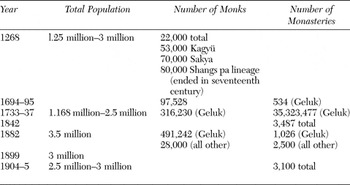
Once the Geluk school was victorious over the Karmapa, the Fifth Dalai Lama and his abbots set about consolidating their sect's religious-political supremacy. Regional Gelukpa monasteries in various parts of Tibet were established and eventually brought into an institutional network of the “three seats,” coinciding with the concentration of political power of the abbots of Ganden, Drepung, and Sera in a central government (Kun dga’ blos gros Reference Dbyangs can seng ge1991). The three Gelukpa monasteries—Ganden, Drepung, and Sera—developed a national network drawing upon the resources of monasteries around Tibet and centralizing them in Lhasa (Dreyfus Reference Dreyfus2003, 47; Miller Reference Miller1961, 201). Eventually, these three monasteries would concentrate considerable national political power in their structures and abbots. Empirical evidence bears out this process of sectarian consolidation in the Geluk school, which was rapidly evolving into a state religion (see table 1).
Tibetan general and monastic populations, 1268–1905.

Sources: Goldstein (Reference Goldstein1989), Huang (1986), Petech (Reference Petech1990), Rockhill (Reference Rockhill1891a, Reference Rockhill1891b), Sperling (Reference Sperling2006).
Note: Both Goldstein (1981) and Richardson (Reference Richardson1962) are of the view that the Tibetan population was substantially larger during the centuries leading up to the Gelukpa monopoly.
Lacking data from the early 1400s to late 1400s, when the Geluk school came into power, one can only guess that over the course of three hundred years, the Geluk school concentrated its authority in the monastic system. Records of the Qing Dynasty (1644–1911) show that in 1694, there were 97,528 monks in Tibet (Dung dkar Blo bzang ‘phrin las 1981, 109). In 1733, the Gelukpa had 3,477 monasteries with 316,230 residing monks. In all, 3,150 of these monasteries with 302,560 monks were under the authority of the Dalai Lama, and 121,438 households (five serfs to each household) supported the Dalai Lama's monasteries. This meant that, including the monasteries and households assigned to the Panchen Lama, 640,000 peasants supported the Gelukpa monasteries in 1733. Melvyn C. Goldstein (Reference Goldstein1989, 21) estimates that based on a population of about 2.5 million, in 1733, 13 percent of the total population and 26 percent of the male population were monks.
William Woodville Rockhill (Reference Rockhill1891a, 295–96), interpreting a 1737 Qing census, estimated the entire Tibetan population to be approximately 1,168,362, with 316,200 of them monks.Footnote 22 The 1737 census recorded 3,150 monasteries under the authority of the Dalai Lama and 327 monasteries under the Panchen Lama (Rockhill Reference Rockhill1891b, 259 n. 3).Footnote 23 We need to be wary of these data. Huang Fensheng (Reference Fensheng1985, 264), relying on the same 1737 census, estimates the Tibetan population under monastic authority to be 957,150, with the total Tibetan population at 1,340,000. Clearly, Goldstein's estimate of the total Tibetan population is high. What is apparent is that the total number of Tibetans under monastic control was significant.
With regard to the number of Gelukpa monasteries, in 1695, there were 534 monasteries and convents. In 1733, 3522 monasteries were under the direction of the Dalai Lama (Sperling Reference Sperling2006). In 1842, a Chinese source recorded 3,487 monasteries in Tibet (Rockhill Reference Rockhill1891b, 259 n. 3). In 1882, the Lhasa government recorded 1,026 monasteries of the Gelukpa, with 491,242 monks. That means that in 149 years, the Gelukpa lost 2,451 monasteries but had close to a 50 percent increase in monks. In other words, the sect was concentrating its monks in fewer monasteries. A slightly larger number of monasteries belonged to all the other seventeen sects. Thus, the total number of monasteries in Tibet by 1882 was 2,500, with an estimated 760,000 monks.
In 1917, it is estimated that 42 percent of the land was owned by monasteries, 37 percent by the central government, and 21 percent by the aristocracy (Carrasco Reference Carrasco1959, 86). Although accurate data are not available, one scholar of Tibet claims that 37 percent to 50 percent of that arable land in Tibet was in the possession of monasteries in 1959 (Goldstein Reference Goldstein, Goldstein and Kapstein1998, 19). Because we lack reliable data, it is difficult to ascertain whether landownership was becoming increasingly concentrated in monastic entities.
The Geluk school secured its hold on the religion market through government subsidies to its monasteries and special privileges, such as the Dalai Lama permitting monasteries to conscript children of hereditary households, especially when the monastery needed novices (Goldstein Reference Goldstein1989, 2). For smaller monasteries with few agricultural resources, the Dalai Lama instituted state subsidies in barley, butter, and tea (Goldstein Reference Goldstein1989, 2). For the New Year's celebrations in Lhasa, the Tibetan government supplied the monks with tea, butter, and cash.
Chapman claims that in the early twentieth century, half of state revenues were allocated to the maintenance of the Geluk monasteries (Reference Chapman1938, 206). Because a monopoly religion has a “captive audience,” so to speak, its major concern is not attracting new members but getting income (tithing) to maintain itself. As we have seen with the Mongols, the Yuan and Ming emperors were sources of income, and so were the Qing emperors and the ambans who, up until their expulsion by the Thirteenth Dalai Lama in 1913, actively subsidized the Geluk monasteries to gain their support.
Although the supremacy of the Geluk school as the religious monopoly firm was established, the struggle for political sovereignty over Tibet would continue. It soon began with the Sixth Dalai Lama, whose legitimacy was questioned by the Mongol Khan, with the backing of the Manchu emperor. The Gelukpa's control of the state would continually be challenged by foreign political entities. Eventually, the Seventh Dalai Lama would consolidate in his office both religious and secular authority, having been given the opportunity to do so by the Manchu court in Beijing (Petech Reference Petech1972, 216ff).
Conclusion
The economics of religion approach to Tibetan Buddhism provides a potentially rewarding model for explaining how the Geluk school was able to become a state religion in a highly competitive market, albeit with more than a little help from their Mongolian allies. The success of the Geluk school was a combination of religious orthodoxy coupled with a willingness to resort to violent means of self-determination. The Tsangpa rulers, by contrast, were laymen, and their violence did not evolve from a natural extension of the economic and political aspirations of one or more labrangs. Clearly, Drepung monastery was the focal point of the organized violence performed by the Gelukpa and their Mongol allies, whereas the seat of the Kagyüpa violence was the Tsangpa secular administration. Religious groups that function on a club model will become violent to protect their membership. Rather than a state engaging in violence on behalf of the religion, the religious “club” is willing to become violent to uphold and maintain its monopoly position. The policy implication of this paradigm is that once a religious group becomes a state monopoly, it must continue to use repressive means to maintain its monopolistic position. Rather than showing religious tolerance, the Geluk school retained its exclusionary club nature, concentrating political and economic resources in its religion monopoly.
Other aspects of Tibetan Buddhism, such as the evolution of monastic institutions, the nature of their corporate labrangs, and so on, can also be analyzed using principles and concepts derived from economic theory. Of course, in so doing, we are faced with a serious dilemma. To date, very few archival documents have been published that shed light on the different kinds of financial transactions involving members of this school. The Lhasa Archives contain several million documents, many of which relate to these kinds of economic activities. Only when a good number of these are published and carefully studied will we be able to pursue in depth the kind of research motivated by this preliminary study. At that point, our understanding of the Tibetan religion market will have the opportunity to dramatically increase and improve.
Acknowledgments
We are grateful for comments by Robert Barro, Eli Berman, Christoph Cüppers, Mark C. Elliott, Jeffry Frieden, Biff Keyes, Robert Hébert, Audrey Kline, Robert I. Mochrie, Elliot Sperling, Robert Tollison, participants in the Society for the Scientific Study of Religion meetings and the Pompeu Fabra Economics Department Labour, Public and Development Seminar Series, and two anonymous reviewers.