

Germany's cooperative movement grew and thrived from its inception in the late 1840s to World War I and beyond. Cooperatives were divided along several lines, and perhaps the most serious point of contention concerned the role of the state in the movement. Cooperative leaders in the two decades before World War I especially debated whether they should accept direct grants and subsidized credit from the Reich and the Länder. The several parts of the cooperative movement construed the question differently; much internecine conflict turned on the answers. The cooperative movement's historiography has largely framed the question as did Hermann Schulze-Delitzsch and other cooperative leaders opposed to state assistance. To him, the issue was whether cooperatives would be based on “self-help” or “state help.”
This article argues that the “self-help” versus “state help” framing has led to overemphasis on what was modest direct assistance while obscuring much larger indirect state contributions to the cooperative movement. The legal framework for cooperatives offered terms unavailable to business enterprises, and the tariff structure created in the last two decades of the nineteenth century assisted rural cooperatives in ways ignored in the literature. Reconsidering Schulze-Delitzsch's framing and the way it has been followed in the historiography allows us to see better how German cooperatives fit into state policy in the period.
Three recent contributions to the cooperatives' historiography all deal in one way or another with the question of state assistance. Each stresses the political motivations behind such assistance, arguing that the German governments had come to view the cooperatives as potential allies and used their financial largesse to promote the types of cooperatives the governments wanted to see. Stress on political motivations, unfortunately, has led to the impression that state assistance was as important to cooperatives as political leaders hoped.Footnote 1 One recent discussion, David Peal's 1988 article in Central European History, implies that state help was critical to the growth and survival of at least the rural branch of the movement. Peal's argument rests in part on a misunderstanding of the institutions in question. Two recent contributions take a more balanced view while stressing different issues. Ian Farr locates the Bavarian State's willingness to support cooperatives in the peasantry's political mobilization and in particular the Bauernbund's challenge to Center Party hegemony in rural parts of that Land. Brett Fairbairn focuses on the role of the Prussian State Cooperative Central Bank (hereafter Preußenkasse), which figures heavily in any discussion of state support for German cooperatives. Fairbairn's important corrective to earlier hagiographical accounts of the Preußenkasse stresses the extent to which this institution's backers hoped to use it to shape and control the cooperative movement.Footnote 2
Framing the issue as “self-help” versus “state help” obscures the importance of broader state policy in the cooperative movement's successes and limitations. A better account acknowledges modest financial support for cooperatives. That support might have played some role in the movement's development, as a signal to the populace that the government approved of cooperatives as an enterprise. One could also argue, more speculatively, that small amounts of money can make a critical difference to small or new enterprises in some circumstances. This idea underlies special government grants and loans to small businesses or start-up firms today. But the actual amounts measured directly and indirectly were tiny in comparison to the overall activities of the cooperatives.
If we back away from Schulze-Delitzsch's too-simple dichotomy, we can consider overall state policy toward cooperatives and how that affected the movement's development. The state most definitely assisted the cooperatives in two distinct ways. By 1889 the law afforded cooperatives organizational privileges not available to private firms, largely the result of Schulze-Delitzsch's own efforts. In addition, tariff policy shifted considerable portions of national product from others, including the industrial working class, to agriculturalists, who by the late nineteenth century made up the most dynamic part of the cooperative movement. The historical actors and more recent historians have all restricted their discussion of state policy to the arena in which it was least relevant. On the other hand, the state could and did use tax policy to punish cooperatives it did not like, most notably the consumer cooperatives that were increasingly associated with Social Democracy.
This aspect of the cooperative movement's history has the potential to inform aspects of the larger literature on the role of liberalism and the political economy of the Kaiserreich. Most accounts view the “Great Depression” of the 1870s as instrumental in a shift from a “liberal” era to one of “organized interests.” Thomas Nipperdey's view is fairly standard:
The principle of state neutrality worked so that legislation did not favor any sector, treating small and large firms similarly; protective tariffs, on the other hand, intervened to differentiate the interests of the various sectors, favoring some and harming others; when the state began to redistribute national income, conflict ensued, with every group seeking to ensure its share by organizing and making its political power felt.Footnote 3
The cooperatives at first seemed to fit neatly into these discussions. Schulze-Delitzsch's founding group loudly proclaimed its exclusive adherence to self-help and contempt for any cooperative that disagreed. Some cooperative groups formed later had no such qualms and sometimes appeared to qualify as just one more of the proliferating Verbände. Yet a closer look suggests a more nuanced judgment. Schulze-Delitzsch's claims reflect a narrow view of his cooperatives and their dependence on a legal, financial, and economic infrastructure largely attributable to the state. The rural cooperatives for their part misconstrued the instruments of state policy that meant the most to their survival. Many came to regret their cooperation with the Preußenkasse.
The cooperatives by themselves would not support a challenge to the overall view of the rise of organized interests and their effect on German politics, nor the larger Sonderweg thesis of which the alleged stunting of German political life forms a part. But the cooperatives' experience suggests we should pay more attention to the way we consider the role of organized interests. Much of the period's economic historiography turns directly or indirectly on state interventions in the economy. Examples include, in addition to the tariff policy, Bismarck's social insurance system; a legal tolerance for industrial combination that led to powerful cartels; and perhaps most notably, a system of company and financial regulation that resulted in large enterprises with close ties to banks that were increasingly powerful both economically and politically. For each of these and other issues, it is worth asking the two questions at the heart of this essay. To what extent is the economically neutral state, the “before” of the shift to “organized interests,” a satisfactory account of German reality? And to what extent were the interventions secured by later interest groups significant primarily for their political motivations, as Farr and Fairbairn suggest, and even misunderstood by their alleged beneficiaries?
To appreciate how the cooperatives fit into the political economy of their day requires a better appreciation of how they functioned as economic institutions. The cooperative movement occupies a curious place in German historiography. Cooperatives certainly qualified as a “mass movement,” as Fairbairn has argued: at the outbreak of World War I, there were over 34,000 registered cooperatives with 6.4 million members. The Social Democratic Party, in contrast, had slightly more than one million members.Footnote 4 Enterprises organized as cooperatives represented significant parts of the banking, retailing, and agribusiness industries in 1914. The cooperatives' shared ideology, to the extent they had one, was a desire to stave off the twin forces of large-scale capitalism on the one side, and social democracy on the other, by organizing farmers, small producers, and others in ways that allowed them to remain independent but at the same time take advantage of the benefits of combination. Given their position in the great economic and social transformation that informed most German political issues in the late nineteenth century, the cooperatives would appear to be relevant to most historical debates about the period. Yet the cooperative movement's history appears only peripherally and sometimes inaccurately in recent historiography, in connection with the fate of the liberal parties, or in discussions of rural antisemitism.Footnote 5 Fairbairn's point warrants emphasis: the cooperatives were ubiquitous, and, for many Germans, central to economic survival.
The Cooperative System
Understanding the role of state assistance to cooperatives requires a brief overview of how cooperatives organized. Some debates about (and misapprehension of) the Preußenkasse in particular rest on misunderstandings about its ties to cooperative institutions, ties that reflect the way cooperatives worked with one another. Under the 1867 Prussian Cooperatives Act (later essentially the Reich law), a cooperative was an organization devoted to the provision of credit to or the advancement of the members' trade or business activities. The legal definition stresses the cooperative's economic mission; the cultural purposes often assigned to cooperatives in other countries were the province of the Verein, which is a distinct entity under German law. A cooperative also had to be “open membership,” a feature that distinguished it from business firms. The broad rubric helps to account for the great variety of cooperatives formed by the end of the nineteenth century. Depending on how one counts, the cooperatives pursued at least ten different lines of business. Cooperatives were a large and growing share of certain sectors (such as urban grocery stores) and in some rural areas constituted the only practical access to larger markets for capital, inputs, and products. I find it simplest to distinguish the various institutions along three different dimensions: their function (their business activity), their “brand” (whether Haas, Raiffeisen, Schulze-Delitzsch, etc.), and their level in the system (whether a local, “primary” cooperative, or a regional “central” cooperative). Each brand held differing views on the proper role of the state in the cooperative movement.
Schulze-Delitzsch's first efforts were credit cooperatives (in his group, called Vorschussvereine), cooperatives for purchasing inputs (Magasingenossenschaften), and artisanal cooperatives (Handwerkergenossenschaften). The two main rural groups, the Raiffeisen and Haas groups, included credit cooperatives as well as several different types of cooperatives that purchased inputs and marketed output for their rural members. The Haas group especially also founded special cooperatives for particular types of producers: for example, cooperative wineries (Winzergenossenschaften) and cooperative creameries (Molkereigenossenschaften). Later cooperatives included the famous consumer cooperatives (Konsumgenossenschaften) as well as cooperatives that aimed to provide low-cost, owner-occupied housing (Baugenossenschaften). Cooperative forms of organization were also tried, often successfully, in other areas. There were, for example, cooperatives for the creation of rural electricity networks and cooperatives to operate grain storage facilities.
We can also distinguish these cooperatives by their “brand” or the group to which they held allegiance. These allegiances often meant more to the leaders of the regional and national associations than they did to anyone on the ground. Schulze-Delitzsch started the first modern cooperatives in the 1840s. His cooperatives are often thought of as the “urban” group, but his association claimed that about one-third of all members were farmers, a statistic we can accept if we remember the late development of the rural cooperatives.Footnote 6 Raiffeisen's cooperatives started, spread, and grew later, in the 1860s. The emergence of Raiffeisen's group brought with it conflict with Schulze-Delitzsch over the proper aims and organization of a cooperative. Schulze-Delitzsch thought that small cooperatives composed overwhelmingly of poor people (a fair view of Raiffeisen's institutions in the 1860s) could not provide effective services to members. Wilhelm Haas began his cooperative work in Hesse, and at first modeled his group after Raiffeisen's. Eventually Haas's cooperatives spread over most of Germany and eclipsed Raiffeisen's in numbers and size. Haas's success reflected the greater decentralization of his association and a willingness to tolerate a diversity of practices within his group. These three groups accounted for the vast majority of all cooperatives in 1914. But there were others. Some cooperatives held themselves aloof from any group. Others were founded outside the three main groups out of regional jealousies or as part of an effort to redirect the cooperatives in a more politically acceptable direction.
The Schulze-Delitzsch cooperatives had two “levels,” while the rural cooperatives all had three. At the regional level (usually a province in Prussia), the cooperatives all had “Unterverbände” that after 1889 were in effect the auditing associations discussed below. At the national level each group had a single organization, although the role of that organization differed across groups. The rural cooperatives, in addition, developed regional “centrals,” specialist cooperative institutions that provided services to their primary cooperatives in a specific area. Raiffeisen's group had one central for all of Germany, and even when that central created regional branches, those branches were controlled by the apex institution. The Haas group, on the other hand, developed “central cooperative banks” (Centralgenossenschaftskassen) that were each individually managed. Central cooperative banks accepted deposits from and made loans to cooperatives in their region. Analogous central cooperatives were created in other branches, such as purchasing and marketing. The Schulze-Delitzsch group was suspicious of cooperative centrals. Many of its members used the Deutsche Genossenschaftsbank von Sörgel & Parisius (DGSP) for purposes analogous to those performed by a central bank in the rural group.Footnote 7
To understand a key channel for state support we must understand how these cooperative institutions interacted with one another. Local (or “primary”) rural credit cooperatives often took in more as deposits than they cared to lend out. This made them important sources of credit for other types of cooperatives. In some cases the credit cooperatives just made direct loans to another cooperative. The Schulze-Delitzsch group established a “correspondence bureau” to match cooperatives that wanted to lend with those that wanted to borrow. But this approach was less than fully desirable.Footnote 8 The formation of centrals changed the way the local credit cooperatives channeled money to other cooperatives. A local credit cooperative with excess cash could place this money on deposit at its central, which could then lend the money to other cooperative institutions. Using primary sources for a number of centrals in the Rhineland, I demonstrated that at least in this region the credit cooperatives were, through the central, collectively net lenders to the rest of the cooperative system in their region. Hugo Jost summarized the balance sheets of the credit cooperatives and centrals that belonged to the main rural groups and came to the same conclusion for Germany as a whole.Footnote 9
Cooperatives and Politics
Cooperatives liked to claim their organizations were above party politics, and this was true in the narrow sense of direct institutional support for candidates. But many national and regional cooperative leaders held elective office, and by the end of the nineteenth century there were cooperatives leaders among the liberals as well as the Center and conservative parties.Footnote 10 Attitudes toward state assistance among the cooperatives were just as diverse. On one extreme stood the Schulze-Delitzsch group, which refused state assistance itself and devoted considerable effort to attacking any cooperative that accepted it. The Schulze-Delitzsch group used the term “state socialism” (Staatssozialismus) to abuse any cooperative group that accepted government assistance, thus (unfairly) equating Raiffeisen with Lassalle. We lack a full-scale biography for Schulze-Delitzsch, so the mix of the personal and the pragmatic in his views toward state assistance remain unclear. He could have concluded, correctly, that his group did just fine without it. His personal experience also gave him reason to view the state as untrustworthy. Prussia prosecuted him for sedition in 1849 (as part of the Steuerverweigerungprozess), and the Prussian justice minister later punished him for oppositional views by denying him appointment to positions in the judiciary for which he was clearly qualified.Footnote 11 Schulze-Delitzsch was one of Bismarck's bêtes noires. He appreciated that Bismarck and other political opponents used state power to undermine his cooperatives when convenient.Footnote 12 In their early days, Schulze-Delitzsch's cooperatives suffered politically motivated harassment, the pretext for which was their lack of legal recognition.Footnote 13 The real reason was his position as a leading liberal figure. The political views of most other cooperative leaders made them less a threat to governments. Raiffeisen's group professed a Christian social mission and stressed its role in combating the growth of social democracy in the countryside, traits that made it appealing to government figures. Haas's association with the National Liberals also placed him in sympathy with most government positions, even after the 1880 split that created the Liberale Vereinigung.
At the end of the century leaders who wanted to make the cooperatives a tool of political life emerged. The most important of these, Baron Edmund von Broich, was a Conservative who embraced a vision of cooperatives openly supported by the state. Von Broich's own cooperative movement did not amount to much, but his efforts helped to set in motion the events that led to the Preußenkasse's creation, and his vision of self-help complemented by state help called into question the basic idea of cooperatives as they had operated to that point.Footnote 14 A related development came in the form of Karl Korthaus's Hauptverband der deutscher gewerblicher Genossenschaften, which were direct alternatives to Schulze-Delitzsch's cooperatives in practice and intent. Korthaus's cooperatives accepted state support and in fact enjoyed close relations with the Preußenkasse. Later leaders of the Schulze-Delitzsch group never wavered from the founder's position. Hans Crüger, who led the group starting in the 1890s, stressed two points. First, if a cooperative was really needed, no state assistance was necessary; all such assistance could achieve was the creation of weak, superfluous cooperatives that could endanger the health and reputation of the cooperative movement overall. Second, state assistance always came with strings attached.Footnote 15 Even in direct conversations with government officials, the Schulze-Delitzsch leaders offered no compromise. Ludolf Parisius, who had worked closely with Schulze-Delitzsch, was included among the Sachverständigen invited by von Miquel to discuss the specifics of the new Preußenkasse. Parisius limited his comments to the remark that his group opposed the entire idea and compared it to a charitable foundation.
Financial Support from the State
Many sources mention direct grants to cooperative organizations by some level of German government. No source reports public aid to cooperatives in a way that allows confident claims about the amount of total assistance. But most examples convey a sense that these grants were small relative to the number of people involved with cooperatives. Most grants went not to a single cooperative, but to the regional Verband. After 1889 these Verbände undertook the external auditing required under the Reich Act, and the grants were sometimes portrayed as efforts to defray the auditing costs imposed by the law. Prior to this the government grants supported efforts to create more cooperatives by paying for regional leaders to canvass towns without one. Thus these grants played some role in “pushing” new cooperatives, just as Schulze-Delitzsch feared. Other government financial support was indirect. Raiffeisen wrote his book on cooperatives in 1866 and was hired in 1868 by the Landwirtschaftliche Verein for the Rheinland in a special department of credit cooperatives. The Kölnische Zeitung may have exaggerated slightly when it claimed that
During the first half of the 1870s, the entire Raiffeisen cooperative movement stood under the influence of the Landwirtschaftliche Verein für Rheinpreußen, and the Raiffeisen cooperatives were therefore tied to the administrative apparatus of this body.Footnote 16
The Verein was not strictly a government body, but it was itself funded by government contributions. David Peal, Ian Farr, and Brett Fairbairn stress correctly that in the late nineteenth century this support was conditioned on political alliances and increasingly intended to reward loyalty to the governing parties. Schulze-Delitzsch's group was left out because of its left-liberal outlook, and at first even the Haas group's cooperatives did not qualify for Prussian support because of its apparent ties to the National Liberals.Footnote 17 In one of his last official appearances, Raiffeisen himself objected to the increasingly political nature of state support. He had long accepted aid to his group, but rejected overtly partisan efforts such as von Broich's.
Governments also provided low-cost credit to cooperative institutions, usually as a sort of starter loan until they could raise credit in other ways. Comparing such loans to other assistance requires care. What matters is not the size of the loan, but the grant from the state implied by a lower interest rate. Suppose a government lent 10,000 marks to a regional cooperative body. How much support is that, really? If the loan really is a loan, then the “gift” does not equal 10,000 marks. One way to value the support for the cooperatives would be to compare the interest charged on this loan to what the cooperatives would have to pay in capital markets. If the government charged two percent and a commercial bank would charge five percent (both realistic figures), then the implicit subsidy is 300 marks per year (that is, (five minus two) percent of 10,000). Viewed in this way, these loans were small potatoes.Footnote 18 Another approach was for the cooperative entity to borrow money from private sources, but with state assistance in the form of a loan guarantee (Burgschaft). Loan guarantees of this sort cost the government nothing, as long as the loan was repaid.Footnote 19
State policy could also be used to punish cooperatives whose leaders or aims the government did not like. The most important example of such punishment is reflected in the tax treatment of Konsumgenossenschaften. Like many questions concerning the cooperatives, the issue has both a practical and a political component. In general cooperatives that dealt only with their members did not pay enterprise taxes. But governments could and did strategically adjust the definition of “deal only with members.” Credit cooperatives competed mostly with moneylenders and other forms of semiformal credit; those at the losing end of the credit cooperatives' expansion could hardly complain to the government. Consumer cooperatives, on the other hand, threatened a variety of small wholesale and retail establishments whose political support was important to the Center and conservative parties. In addition, Konsumgenossenschaften were one area of the cooperative movement with strong connections to Social Democrats. Using the state's taxing power to make life difficult for these institutions offered the chance to assist supporters of liberal and conservative parties while reducing the appeal of social democracy. Prussia, like several other states, used tortured interpretations of the tax law to make consumer cooperatives pay both income and business taxes even when they dealt only with members.Footnote 20
The Preußenkasse
The claim that cooperatives depended heavily on state assistance usually centers on the Preußenkasse (the Prussian State Cooperative Central) founded in 1895. The Preußenkasse was an öffentlich-rechtliche institution whose largest shareholder was the Prussian government. The bank had to pay the government three percent per year for invested capital. The capital started at five million marks, but quickly became more substantial, amounting, by 1909, to seventy-five million marks.Footnote 21 The bank had to cover all its other costs, including salaries, building maintenance, etc. The Preußenkasse's advantages over a private lender consisted of its connection to the Prussian government. Three percent per year was a low return for bank equity at the time.Footnote 22 And while the Preußenkasse had no explicit guarantee against failure, one cannot imagine the Prussian government would have allowed it to fail.
The Preußenkasse was formed on the initiative of Johannes von Miquel, the Prussian finance minister. Miquel supposedly drew his inspiration from a meeting of representatives of agricultural interests convened in 1894, but the Prussian government had compiled the invitation list and the agenda to suit its own ends. The remarks at this meeting, later cited as calling for the new institution, are not nearly that specific.Footnote 23 The institution was controversial from the start. Some backers saw it as a way to offset the natural advantages big business enjoyed in their access to large banks, and they often compared it to the central bank, the Reichsbank. Like the Preußenkasse, the Reichsbank's capital was partly state-owned, and it provided credit facilities to banks and private firms. Under certain circumstances, the Reichsbank's lender-of-last-resort function required it to undertake costly lending operations to prevent financial panics. Thus one could argue that the Reichsbank amounted to a subsidy to the business world in general, and the financial community in particular. One member of the Prussian House of Deputies (Karl Friedrich Oskar Freiherr Gamp-Massaunen) made precisely this point in the debate over the first reading of the law that created the Preußenkasse:
I see the greatest political significance of this draft in the fact that here, for the first time, the state recognizes that the Reichsbank is unable to satisfy the credit needs of agriculture and the handicrafts, and moreover, the state recognizes that these two sectors, agriculture and handicrafts, have the same right to have their credit needs met by the state as do heavy industry, large-scale trade, or the financial markets.Footnote 24
The Reichsbank could lend to any firm or institution that met certain criteria, cooperatives included. But few cooperatives qualified. Cooperatives with unlimited liability rarely had enough paid-in capital to meet the Reichsbank's lending rules, and few held in their portfolios the government bonds and high-quality commercial obligations that the central bank could “discount.” That said, the Reichsbank went to some length to point out its relations with some credit cooperatives. Early proposals for increased state credit to cooperatives envisaged changing the Reichsbank's rules to make the central bank better able to lend to cooperatives.Footnote 25
The Preußenkasse's several advocates stressed various roles for the new bank. Some emphasized its “balancing” (Geldausgleich) function: the bank could take excess funds from some centrals and make them available to others. A few observers mentioned seasonal demands for credit in agriculture, but most stressed the west/east differences in credit availability. Under this interpretation, Ausgleich implied a new bank that was mostly an intermediary among cooperatives. Others saw in the Preußenkasse a lender of last resort for cooperatives, just as the Reichsbank was for business firms. To perform this function, the bank would have to be able to borrow outside the cooperative system. Still others argued that the Preußenkasse would act as a sort of development bank, lending to new cooperatives in regions where it was difficult to collect deposits. This “development” function might require non-cooperative funding sources. Miquel's desire to use the bank to increase dramatically the number of cooperatives in Prussia conforms to this idea:
We must get to the point where we have a credit cooperative in nearly every village in the monarchy. These cooperatives must be connected to production cooperatives and purchasing and marketing cooperatives, creating a great network that will support the small and medium-size farmers, but also in considerable respects, the great holdings.Footnote 26
These different aims were not mutually inconsistent, but they did imply different logics for the new bank.
One common rhetorical tactic at the time was to attribute to the Prussian bank all growth in rural cooperatives and cooperative centrals in the 1890s. Crüger, along with other Schulze-Delitzch leaders, argued that centrals had only been formed because the Preußenkasse preferred to lend to them rather than to individual cooperatives. This claim was not true, at least in the extreme way Crüger stated it. Of the twenty-five centrals reported as members of the Haas group in 1914, eight were created before the Preußenkasse. Crüger also ignored other implications of the 1889 Reich Cooperatives Act. This act improved the organizational law for cooperatives in ways I detail in the next section, and its effects were also at work in the 1890s.Footnote 27
The Preußenkasse as a Subsidy to Cooperatives
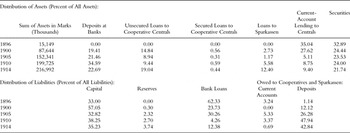
The rural cooperative movement included organizations with varied purposes. Credit cooperatives did not ordinarily need any additional credit from the Preußenkasse. To the extent the rural centrals needed credit from an institution such as the Preußenkasse, it was to support the “other cooperatives” in normal times and the entire group, including the credit cooperatives, in times of crisis. Table 1 presents a summary of the Preußenkasse's balance sheet for selected years prior to World War I.Footnote 28 This table illustrates a simple fact: in most years, the Preußenkasse was a net borrower from cooperatives, not a net lender to them. To the extent it provided “cheap credit,” it did so in the first instance by collecting deposits from cooperative institutions and not paying them as much in interest as would be available elsewhere.
The Preußenkasse's Assets and Liabilities, Selected Years

SOURCE: Annual reports of the Preußenkasse
Individual centrals, of course, faced diverse conditions. Two examples illustrate the range of experience. The Haas group's central in Wormditt (now Polish Orneta) was a net borrower from the Preußenkasse for every year of its existence prior to World War I. Wormditt illustrates the objections to centrals; located in East Prussia, it was created when there were only a few relatively weak local cooperatives in the region. The Wormditt central's money did not necessarily come from the state, however. Some centrals, such as the Kempen Bauernkasse, were net lenders to the Preußenkasse in every year up to 1914. At some level the Wormditt central was borrowing from centrals such as that in Kempen. What was the implication for the Wormditt central of the apex bank's loans? In 1913 its net debt to the Preußenkasse was about 1.135 million marks (of 4.06 million marks in total liabilities). Suppose it had been forced to finance that debt at a higher interest rate. Assume the counterfactual lender charged the Wormditt central an extra three percent per year, a figure that is intentionally high. At this rate, the Wormditt central's debt to the Preußenkasse would have cost it an extra thirty-three thousand marks that year. How large is this figure? At the end of 1913, the Wormditt central had about 2.7 million marks in loans extended to its members (and held 277 thousand marks of their deposits). Raising the interest rate on those loans by one percent would have covered the extra interest due to a counterfactual non-Preußenkasse lender. Raising its own rates would, of course, reduce what its members could do for their members, but it would not have crippled the institution.
If we undertake similar calculations for the Preußenkasse's entire lending portfolio, we reach a similar conclusion. In 1913, the average daily outstanding balance of loans to rural centrals was 67.8 million marks. The centrals paid about 3.2 million marks in interest on those loans. If the centrals had instead borrowed at the Reichsbank's discount rate, which in that year was 5.5 percent, they would have paid about a half-million marks more in interests costs. The implied subsidy is tiny when divided by the millions of members of these cooperatives. Even if we assume that the centrals would have had to pay more than the Reichsbank rate, which seems reasonable, the results are similar. For every extra percentage point in interest they paid, the rural centrals would have lost about 600 thousand marks. The counterfactual borrowing rate would have to be quite implausible to reach an implied subsidy of even three or four marks per member per year.Footnote 29
In the absence of a Preußenkasse, the most likely scenario is that established centrals (such as in Kempen) would have continued as before, while centrals such as in Wormditt would have been harder to form. This was Crüger's complaint: the Preußenkasse's credit had allowed cooperatives in some regions to grow faster than their ability to collect deposits. This fact hardly justifies the claim that the centrals only existed to funnel state aid to local cooperatives. The more interesting speculation is whether a non-state, all-German central-for-centrals could have prospered if not for the Prussians. Haas's group in fact did create such an institution, but it lasted only a few years. The immediate cause of its demise was some spectacular failures in its loan portfolio, but even before that it had been weakened by being forced to play a secondary role alongside the Preußenkasse.
Now return to the idea that the Prussian institution could in effect force cooperatives to lend to it. How was this possible? Dealings with the Prussian institution were supposedly voluntary. Here we see a more subtle and significant reason for unhappiness with the Prussians. A cooperative central could have two types of relationships with the Preußenkasse. The central could deal with the Preußenkasse on a hands-off basis, treating it like any other bank. But most cooperative institutions instead signed contracts that forced them to deal exclusively with the Preußenkasse (signing, that is, an “Ausschliesslichkeitserklärung”). The contract obliged the central to treat the Preußenkasse as its only banker, putting all excess cash there, taking loans only from the Prussian institution, etc.Footnote 30
Cooperatives came up with all kinds of nefarious reasons why the Preußenkasse had this policy. They noted, correctly, that the policy enhanced the Preußenkasse's power over the institutions they dealt with. But a sympathetic observer could justify the exclusivity policy along the same lines as the bank did itself. The Preußenkasse's distinctive value was its ability to support cooperatives during financial crises (as did the Reichsbank for private businesses) and to perform the Ausgleich in normal times. To do this, it needed to bind cooperatives to it in such a way that cooperatives that needed cash in a crisis could find it at the Preußenkasse.Footnote 31 The value of this approach proved itself during the financial panic that began in the United States in 1907 and later spread to Germany. German interest rates climbed, and many financial intermediaries, credit cooperatives included, saw their deposit base evaporate and their loans go sour. The Preußenkasse helped its affiliated cooperatives weather this storm better than the Schulze-Delitzsch cooperatives, which had been forced to rely on the dubious mercies of the capital markets. Helmut Faust, an admirer of the Prussian bank, conceded that “Only the circulation of funds within a closed cooperative system enables the apex institution to extend credit to cooperatives at lowest possible interest rates.”Footnote 32
In closing this discussion let us return to a question not really considered in the recent literature: were cooperatives pleased with their relationship with the Preußenkasse? We cannot answer the question in general, but we do know that soon after its creation, many of its former backers were disappointed. Some of this disappointment just reflected excessive expectations, as the Freie Deutsche Presse put it in an issue dated May 29, 1904.
The displeasure with the Preußenkasse found in agricultural circles is completely unwarranted. But this displeasure can be explained by noting that agriculturalists had thought that in this institute's creation they had found a limitless credit source, one that would satisfy every possible credit demand at the lowest possible interest rate. Whatever the Preußenkasse might do, it cannot give enough or cheap enough credit.Footnote 33
But other unhappiness reflected the way the bank exercised its power. As early as 1898, the Haas group received a rude shock when the Preußenkasse raised its lending rates by nearly two full percentage points.Footnote 34 Many cooperatives (and centrals) had expanded their operations on the basis of the new credit. They probably would not have done so had the higher rates been charged initially, but they were in no position to withdraw their investments when the Preußenkasse raised its rates.
Reactions to the Preußenkasse elsewhere in Germany also reflected regional jealousy. In 1900, for example, the Bavarian government granted the Munich central a loan totaling three million marks at three-percent interest.Footnote 35 This was certainly a subsidized loan; if the alternative cost of credit for the central had cost five percent, then this implicit subsidy would have amounted to sixty thousand marks per year. But the Bavarian government might have felt it had little choice. Bavarian cooperative members were complaining that they did not have access to the Preußenkasse's credit facilities.
The Schulze-Delitzsch group's bitter opposition to the Preußenkasse reflected less real principle than the historiography has appreciated. The DGSP ran into serious financial problems in 1902, problems that eventually led to its takeover by the Dresdner Bank. Before agreeing to that takeover, however, the DGSP's leadership (including Crüger) met with the leadership of the Preußenkasse to explore the possibility of working with the Prussian institution. Nothing came of the meeting, in part because the DGSP wanted terms that the Preußenkasse could not grant. Crüger went on to abuse the Preußenkasse's existence and operations in public.Footnote 36
At this point it is useful to summarize the argument on state financial assistance. Regional governments often made small grants to cooperatives, but, despite the lack of systematic evidence, it seems safe to conclude these were too small to have much impact on the cooperative movement. Much the same can be said of the Preußenkasse. The institution operated primarily as an intermediary, not a grantor. The financial subsidy implicit in its operations consisted of a concessionary rate on the Preußenkasse's equity capital contributed by the Prussian government. As the Schulze-Delitzsch group feared, the Preußenkasse apparently led to the creation of some centrals dependent on its credit, but such centrals were the exception and in any case small. If we imagine a counterfactual world in which no state financial assistance of any form had existed, the best evidence suggests the German cooperative movement would have been only slightly smaller.
In correcting earlier views we should not push too far the other way. One can imagine that in some circumstances even a relatively small financial contribution makes a critical difference. The more important implication of the modest financial assistance, especially via the Preußenkasse, is the government's implicit endorsement of the cooperative movement. The Prussian government was saying that it so valued the cooperatives that it was willing to create a bank just for them. Whatever the Prussian government's motivations, this endorsement doubtless made the cooperatives seem more solid to potential members and depositors. But we must avoid the impression left by some contemporary critics, and unfortunately amplified by Peal. The cooperative system mostly financed itself, via loans funneled through the local cooperative central banks, even after 1895.Footnote 37 The German cooperative movement, was, by 1895, a model for Europe and beyond; the Preußenkasse hardly created it.
State Support for the Cooperative Movement: Law and Tariffs
Schulze-Delitzsch framed the question of state policy as “state help” versus “self-help.” This formulation contains an irony: Schulze-Delitzsch himself was largely responsible for legislation that gave German cooperatives privileges not available to business.Footnote 38 Prior to 1867, cooperatives in most German states faced legal problems because no legislation specifically authorized their existence. Under Prussian law cooperatives were, at best, erlaubte Privatgesellschaften. This status led to two related problems. In some German states this ran them afoul of the authorities' right to control associations in general.Footnote 39 The second and more general problem reflected the cooperative's lack of corporate status: cooperatives had no legal existence independent of their membership as individuals. To be legally valid, all cooperative dealings with the outside world had to use one of several cumbersome and expensive devices, such as having all members grant a power of attorney to some cooperative officials.
Schulze-Delitzsch devoted considerable energy, in his capacity as a member of the Prussian Chamber of Deputies, to creating a legal framework to ameliorate these problems. The 1867 Cooperatives Act for Prussia, which later became Reich law, was an important first step. Cooperatives willing to follow certain rules could list themselves in a registry analogous to the Handelsregister for commercial firms. Such eingetragene Genossenschaften acquired quasi-legal person status, similar to the treatment of commercial partnerships under the Allgemeine Deutsche Handelsgesetzbuch, which was in force in the Bund from 1862. The 1889 Reich Cooperatives Act introduced several changes requested by the cooperative movement. Cooperatives henceforth had to undergo an external audit at least once every other year. This audit could be performed by an individual appointed for that purpose by the Amtsgericht at which the cooperative was registered, or it could be performed by a special cooperative auditing association. The auditing requirement was inserted largely to fend off calls for state audits of cooperatives. Most cooperative groups had been conducting audits of their members for years.Footnote 40
The 1889 Act also created a cooperative form with limited liability. Unlimited liability meant that any cooperative member could lose all of his personal assets if the cooperative failed. The failure of cooperatives was rare, and most that failed were able to satisfy their debts without major impositions on the members. After 1889, few cooperatives changed their charter to the limited-liability form, and the growth of such cooperatives was predominantly among cooperatives outside the “credit” group.Footnote 41 The limited-liability provisions mattered a great deal in two other ways, however. First, cooperatives could now be members of each other. This made life easier for cooperative centrals, which previously had had to organize as a corporation (Aktiengesellschaft). After 1889 the central could be a limited-liability cooperative. Second, because cooperative membership no longer risked placing disproportionate burdens on relatively wealthy members, the law made it easier to expand into regions of great wealth inequality, such as eastern Germany. The introduction of limited liability complicates Crüger's claims that the Preußenkasse was responsible for the growth of cooperatives in eastern Prussia. The new liability form would lead to the growth of cooperatives in those provinces on its own.Footnote 42
Limited liability also promoted the growth of noncredit cooperatives. A credit cooperative needs capital mostly to back up the claims of depositors. Most unlimited-liability credit cooperatives in the nineteenth century had relatively little paid-in capital; the bulk of the institution's capital was in the form of member's farms and other assets. Raiffeisen credit cooperatives tended to have only nominal shares, and other credit cooperatives in the Haas and other groups often started with paid-in capital of less than 100 marks per member. The “capital” of a cooperative of this type could always be tapped in bankruptcy, if need be. Cooperatives that need buildings, machinery, or inventory, on the other hand, must have paid-in capital to work with on a day-to-day basis. Limited liability with significant paid-in capital made more sense for creameries, purchasing and marketing cooperatives, and even consumer cooperatives.
Contemporary critics argued that German law gave the cooperatives a relatively privileged status as against business firms. The critics were right, especially after 1889. Elsewhere in continental Europe, and in the United States, cooperatives were treated as part of the business code, usually as a special type of corporation. Bavaria and Saxony each had cooperative law that took this approach prior to the harmonization of cooperative law across the Reich. Schulze-Delitzsch demanded and received a law in 1867 that would deal with cooperatives alone, making it possible for them to hold their enterprises aloof from any broader legislative developments that might affect corporations and other business entities.Footnote 43 German corporations after 1884 faced new rules on minimum share values, reporting, and governance that made the corporation impractical for all but large business. This 1884 Act was a reaction to the excesses of the Gründerboom of the 1870s, and its strictures were intended to ensure that corporations were large, well-capitalized, and transparent, and that their investors were wealthy enough to bear the risk implied by equity investments. By keeping cooperatives out of the corporation law, Schulze-Delitzsch had protected them from the need to resist reforms aimed at large businesses.
The 1889 law also gave cooperatives an important privilege not available to for-profit enterprises. Before 1892, the only business form with full legal personality and limited liability for investors was the corporation. Even after 1892, with the creation of the Gesellschaft mit beschränkter Haftung (GmbH), the law required a minimum capitalization of 20,000 marks, far in excess of that found in many cooperatives. (Cooperatives had to have at least seven members, but there was no minimum capitalization or similar requirement.) The alternative legal forms for enterprise in Germany prior to 1892 required unlimited liability of at least some investors. The Reich cooperatives Act of 1889 played some role in creating pressure for the GmbH law in 1892, and for good reason: the 1889 law gave the cooperatives legal privileges that their for-profit competitors would not really enjoy even with the GmbH.Footnote 44
Tariffs
One feature of the contemporary debate and recent discussions of state support for cooperatives is puzzling because of an omission. The agricultural tariffs in place from 1879 transferred vast sums from consumers to agricultural producers, many of whom were rural cooperative members. These tariffs constituted an indirect subsidy to rural cooperatives that dwarfed anything the Preußenkasse did, yet Crüger and his group never objected to them on these specific grounds. The story here is so well known that the specifics do not require detailed recitation. In open economies such as Britain and Ireland, reductions in transport costs brought about a “grain invasion” in the 1870s that quickly undermined local farmers' ability to produce grains at competitive prices. Farmers shifted to other output mixes, focusing on meat and dairy production for which overseas competition was not so severe. But even this shift could not stave off a large reduction in labor demand, and with it, depopulation in most rural areas.
This did not happen in Germany because of the high agricultural tariffs first introduced in 1879. Steven Webb estimates that in the early twentieth century, the agricultural tariff regime transferred annually an amount equal to one percent of national income to producers of wheat and rye alone, and another two percent of national income to cattle and hog producers. These producers alone received a subsidy worth about 450 million marks per year, a figure that dwarfs any reasonable estimate of state financial support to rural cooperatives.Footnote 45 The tariff did not support rural cooperatives directly, of course, but it is hard to imagine the lively rural cooperative movement in a countryside experiencing depopulation, the fate of free-trade countries at the time. Curiously enough, I know of no instance in which the urban cooperatives drew this connection. This is instructive about their objections to state support for cooperatives, even though this form of state assistance implied a direct transfer from urban cooperators to rural cooperators.
Conclusions
Peal's discussion of the Preußenkasse and its role in the rural cooperative movement rests on some misapprehensions about the role of rural centrals and rural cooperative finance. More recent discussions, including those by Farr and Fairbairn, have rightly sought to integrate the political movements associated with the cooperative groups into a broader account that emphasizes the state's effort to shape and direct the cooperative movement for political ends. These correctives risk misunderstandings of their own, however. Schulze-Delitzsch's cooperatives were the first, and they stringently rejected the financial assistance at issue in this literature. The later rural cooperatives were less doctrinaire on the matter, but the grants and subsidized loans they accepted were not sufficient to create the vibrant movement that existed in 1895, when the Preußenkasse entered the scene. Some accounts have exaggerated the Preußenkasse's largesse, but even if we attribute to the Prussian entity all the power and influence its admirers (and detractors) ascribe to it, the most we can say is that it pushed the growth of the movement in regions where it was heretofore relatively weak. Focus on financial assistance, however, implicitly follows Schulze-Delitzsch and his dichotomy of “self-help” versus “state help.” This framing allowed Schulze-Delitzsch to ignore a broader set of state policies that aided cooperatives directly and indirectly, most notably, the special cooperatives legislation that Schulze-Delitzsch helped to write.
The larger lesson here concerns the role of interest groups in the Kaiserreich. Schulze-Delitzsch's rejection of state financial assistance reflected an apparently principled stand: no group should be helped or hindered by the state, his cooperatives included. One can seriously doubt whether it would be possible for any regime to adhere to the line Schulze-Delitzsch laid down, and his role in the cooperatives law suggests the difficulty of identifying the boundaries of a neutral state policy. He doubtless saw the cooperatives law not as a special privilege, but as the state providing an appropriate set of organizational rules. This is the problem of classical liberalism; is it really possible for the state to practice true laissez-faire, even if that were desirable? By the standards of their day, German cooperatives received modest state assistance, and their efforts to secure it were restrained. They demanded and received legal forms for their enterprises that allowed them to organize in ways forbidden to for-profit businesses. Much of the other state assistance, including the Preußenkasse and the tariffs, reflected someone else's agenda, even if the cooperatives benefited. They did not adhere completely to the tough line espoused by Crüger and others, but German cooperatives grew and thrived in their first seven decades through self-help, not state help.