INTRODUCTION
Congenital heart disease (CHD) ranks among the most common types of congenital anomalies, affecting over 1 million children and adolescents in the United States alone, and increasing by more than 40,000 new cases each year (Hoffman & Kaplan, Reference Hoffman and Kaplan2002; Reller, Strickland, Riehle-Colarusso, Mahle, & Correa, Reference Reller, Strickland, Riehle-Colarusso, Mahle and Correa2008). With greater than 90% of these children surviving into adulthood, the population of individuals living with CHD has grown substantially over recent years, and with it, an increasing appreciation of the range of persistent neurodevelopmental risks faced by survivors as they progress along the lifespan. Indeed, adolescents with CHD experience higher rates of cognitive, psychosocial, and academic difficulties than their typically developing peers, likely the result of complex interactions among myriad putative contributors including genetic/epigenetic factors, inadequate cerebral perfusion/oxygenation in utero and while awaiting surgery, brain dysmaturity and neurologic complications (e.g., seizures), and other medical/surgical factors (Marelli, Miller, Marino, Jefferson, & Newburger, Reference Marelli, Miller, Marino, Jefferson and Newburger2016).
Many of these factors may also increase the risk for deficits in declarative memory. Broadly characterized problems with declarative memory have previously been reported in children and adolescents with various forms of CHD (Bellinger, Wypij, et al., Reference Bellinger, Wypij, DuPlessis, Rappaport, Jonas, Wernovsky and Newburger2003; Miatton, De Wolf, François, Thiery, & Vingerhoets, Reference Miatton, De Wolf, François, Thiery and Vingerhoets2007a, Reference Miatton, De Wolf, François, Thiery and Vingerhoets2007b; Schaefer et al., Reference Schaefer, von Rhein, Knirsch, Huber, Natalucci, Caflisch and Latal2013), as well as in adolescents with surgically palliated dextro-transposition of the great arteries (d-TGA; Bellinger et al., Reference Bellinger, Wypij, Rivkin, DeMaso, Robertson, Dunbar-Masterson and Newburger2011) and tetralogy of Fallot (TOF; Bellinger, Rivkin, et al., Reference Bellinger, Rivkin, DeMaso, Robertson, Stopp, Dunbar-Masterson and Newburger2015); however, nuanced investigations of this neurobehavioral domain have not been conducted. A fine-grained analysis is important because declarative memory is a multifaceted and material-specific system of encoding, storage, and retrieval processes that is mediated by a widespread neuroanatomical network including hippocampal, temporal, prefrontal, and subcortical structures (Eichenbaum, Reference Eichenbaum2016). It may, thus, be susceptible to disruption in several ways that give rise to a wide range of “memory problems.”
Moreover, because effective clinical management of memory concerns requires careful interrogation and dissociation of memory components, understanding the specific manner and extent to which serious cardiac dysfunction undermines typical memory development represents an important research goal. Three distinctions are particularly salient: (1) memory for verbal versus visual-spatial materials (i.e., modality), (2) memory under free recall versus recognition conditions, and (3) memory for meaningful versus more arbitrary materials.
Children and adolescents with critical CHD are at risk for deficits in visual-spatial processing (Bean Jaworski et al., Reference Bean Jaworski, White, DeMaso, Newburger, Bellinger and Cassidy2017; Bellinger, Bernstein, Kirkwood, Rappaport, & Newburger, Reference Bellinger, Bernstein, Kirkwood, Rappaport and Newburger2003), and like many medical populations, tend to exhibit relatively stronger verbal than perceptual reasoning abilities (Karsdorp, Everaerd, Kindt, & Mulder, Reference Karsdorp, Everaerd, Kindt and Mulder2007). Although the exact neuroanatomical basis of these deficits remains unknown, increased susceptibility of neural systems supporting visual-spatial/perceptual processing to disruption via CHD-related risk factors is plausible, and if in fact true, may suggest relatively greater risk for deficits in visual-spatial than verbal memory abilities as well.
It is also possible that adolescents with CHD may not exhibit frank deficits in memory encoding, but may nonetheless struggle with aspects of memory recall/retrieval. This remains an open question because most prior studies have not expressly distinguished recall from recognition. Recall of previously encountered information, which relies on hippocampal, parahippocampal, and prefrontal networks (Davachi, Mitchell, & Wagner, Reference Davachi, Mitchell and Wagner2003; Eichenbaum, Yonelinas, & Ranganath, Reference Eichenbaum, Yonelinas and Ranganath2007), requires not only that the information be encoded and stored, but also that it can be accessed and retrieved spontaneously, that is, without the assistance of prompting or cues. Failure to recall/retrieve a relevant piece of information is not necessarily indicative of failure to encode that information, but may instead stem from weaknesses in related neurobehavioral domains such as attention/concentration and executive function for which adolescents with critical CHD are at elevated risk (Cassidy, White, DeMaso, Newburger, & Bellinger, Reference Cassidy, White, DeMaso, Newburger and Bellinger2015, Reference Cassidy, White, DeMaso, Newburger and Bellinger2016; DeMaso et al., Reference DeMaso, Labella, Taylor, Forbes, Stopp, Bellinger and Newburger2014, Reference DeMaso, Calderon, Taylor, Holland, Stopp, White and Newburger2017; Sanz et al., Reference Sanz, Berl, Armour, Wang, Cheng and Donofrio2016). However, recall failure coupled with a lack of improved performance under recognition conditions, which would be expected to rely more heavily on familiarity-judgment-supporting areas of the temporal lobe (Davachi et al., Reference Davachi, Mitchell and Wagner2003; Eichenbaum et al., Reference Eichenbaum, Yonelinas and Ranganath2007), may suggest the presence of more frank encoding impairment.
Finally, memory task performance may differ among adolescents with CHD depending on the relative meaningfulness of the information being presented (Pierpont, Tworog-Dube, & Roberts, Reference Pierpont, Tworog-Dube and Roberts2013). Meaningful information, that is, information that is embedded within a context, such as story narratives, or of personal/social relevance, such as human faces, may, for some, be easier to remember, while others may struggle to manage the increased information load and complexity inherent therein. It is also possible that, among adolescents with critical CHD, the impact of meaningfulness (and associated complexity) on memory may, in fact, be modality specific, improving retention of verbal materials while hindering retention of visual-spatial materials or vice versa.
In this study, we used the Children’s Memory Scale (Cohen, Reference Cohen1997) to examine learning and memory outcomes among adolescents with critical biventricular CHD (d-TGA and TOF). We tested three specific hypotheses, namely, that adolescents with CHD will: (1) perform below expected population means on all Children’s Memory Scale (CMS) tasks, (2) achieve higher scores on verbal than visual-spatial tasks, and (3) achieve higher scores on recognition than recall tasks. We also conducted exploratory analyses of meaningfulness as a factor in memory retention, associations between attention/concentration and learning/memory outcomes, and predictors of learning and memory impairment.
METHOD
Participants and Procedure
Data were pooled from two CHD neurodevelopmental outcome studies conducted at Boston Children’s Hospital, the recruitment and procedures of which have been well-described in previous reports (Bellinger, Rivkin, et al., Reference Bellinger, Rivkin, DeMaso, Robertson, Stopp, Dunbar-Masterson and Newburger2015; Bellinger et al., Reference Bellinger, Wypij, Rivkin, DeMaso, Robertson, Dunbar-Masterson and Newburger2011).
Adolescents in the d-TGA subgroup were 14- to 16-year-olds with d-TGA who had undergone the arterial switch operation as infants and who participated in the longitudinal Boston Circulatory Arrest Study (Bellinger et al., Reference Bellinger, Jonas, Rappaport, Wypij, Wernovsky, Kuban and Strand1995, 1997, Reference Bellinger, Wypij, Kuban, Rappaport, Hickey, Wernovsky and Newburger1999, Reference Bellinger, Wypij, DuPlessis, Rappaport, Jonas, Wernovsky and Newburger2003, Reference Bellinger, Wypij, Rivkin, DeMaso, Robertson, Dunbar-Masterson and Newburger2011; Newburger et al., Reference Newburger, Jonas, Wernovsky, Wypij, Hickey, Kuban and Ware1993). Exclusion criteria included low birth weight (<2.5 kg), identified genetic abnormality, significant extracardiac anomaly, history of heart surgery before the arterial switch operation, or cardiac anatomy requiring aortic arch reconstruction or other open-heart surgeries. Adolescents in the TOF subgroup were 13- to 16-year-olds with surgically palliated TOF (with or without pulmonary atresia) who were at least 6 months post-cardiac surgery and able to undergo MRI. Participants with identified genetic/phenotypic syndromes (n=23) were excluded. We also included in our analyses a group of healthy referent adolescents, screened according to the strict criteria of the National Institutes of Health MRI Study of Normal Brain Development (e.g., Evans, Reference Evans2006; Waber et al., Reference Waber, De Moor, Forbes, Almli, Botteron, Leonard and Rumsey2007) and recruited to participate in the two larger CHD outcome studies.
This study was approved by the Institutional Review Board of Boston Children’s Hospital and completed in accordance with the Helsinki Declaration. Informed consent was obtained from parents of participants. Adolescents provided assent to participate. For the neuropsychological segments of both studies, participants were invited to the hospital for a single evaluation session lasting approximately 4 hours, of which learning and memory testing was a component; for a list of the full neuropsychological batteries administered, see Bellinger, Rivkin, et al. (Reference Bellinger, Rivkin, DeMaso, Robertson, Stopp, Dunbar-Masterson and Newburger2015) and Bellinger et al. (Reference Bellinger, Wypij, Rivkin, DeMaso, Robertson, Dunbar-Masterson and Newburger2011). Measures were administered in a fixed order by either a licensed psychologist or supervised research assistant.
Learning, Memory, and Attention/Concentration Evaluation
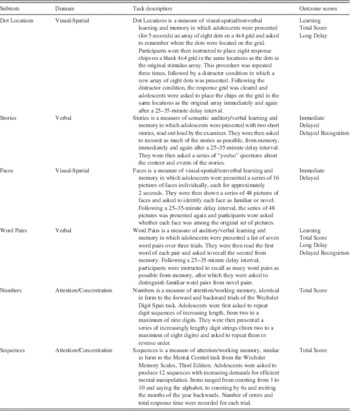
Learning, memory, and attention/concentration abilities were assessed using the CMS (Cohen, Reference Cohen1997). The CMS yields seven index scores (Visual Memory Immediate, Visual Memory Delayed, Verbal Memory Immediate, Verbal Memory Delayed, Learning, Recognition, and Attention/Concentration). Six “core” subtests were administered: Dot Locations, Stories, Faces, Word Pairs, Numbers, and Sequences (see Table 1 for description of subtests). Age-referenced standard scores (M=100; SD=15) and scaled scores (M=10; SD=3) were calculated.
Children’s Memory Scale subtest descriptions

Attention-Deficit/Hyperactivity Disorder Diagnosis
The Schedule for Affective Disorders and Schizophrenia for School-Aged Children—Present and Lifetime Version (K-SADS-PL; Kaufman et al., Reference Kaufman, Birmaher, Brent, Rao, Flynn, Moreci and Ryan1997), a clinician-administered, semi-structured parent and participant interview, was used to assess Diagnostic and Statistical Manual of Mental Disorders, Fourth Edition criteria for current attention-deficit/hyperactivity disorder (ADHD; see DeMaso et al., Reference DeMaso, Labella, Taylor, Forbes, Stopp, Bellinger and Newburger2014, Reference DeMaso, Calderon, Taylor, Holland, Stopp, White and Newburger2017; Holland et al., in press).
Statistical Analysis
Demographic, medical, and surgical variables were compared across CHD subgroups using analysis of variance (ANOVA) for continuous variables and chi-square tests for categorical variables. One-sample t tests and Cohen’s d effect size measures were calculated to compare CMS subtest and index scores to expected population means, and were followed by unadjusted and adjusted ANOVA models to compare performance between CHD subgroups. IQ was not included as a covariate (see Dennis et al., Reference Dennis, Francis, Cirino, Schachar, Barnes and Fletcher2009). There was no adjustment for multiple comparisons. Paired-samples t tests were used to further explore within-subject performance patterns on verbal versus visual-spatial tasks; recall versus recognition tasks; and, retention of meaningful versus more arbitrary information.
Bivariate associations between attention/concentration, ADHD diagnosis, and learning/memory abilities were examined using Pearson product-moment correlations for continuous variables and point-biserial correlations for dichotomous variables. A one-way multivariate ANOVA (MANOVA) was then used to compare learning/memory outcomes of CHD participants who did and did not meet criteria for a current ADHD diagnosis. Linear regression was used to test for moderating effects of attention/concentration ability on associations between CHD status and learning/memory outcomes.
Given prior research demonstrating increased rates of executive function impairment among adolescents with critical CHD despite generally average group means (Cassidy et al., Reference Cassidy, White, DeMaso, Newburger and Bellinger2015), CMS subtest and index scores were then dichotomized using a cutoff score of 1.5 SD below the population mean (i.e., ≤6 for scaled scores; ≤78 for standard scores) to indicate impairment. Odds of impairment relative to the referent group were estimated in univariate and multivariate binary logistic regression models. Multivariate models were built using forward selection procedures to retain significant predictors from a range of potential factors including sex, race, low birth weight (<2500 g), gestational age, family socioeconomic status (SES), age at assessment, post-surgical seizure history as documented clinically and/or via continuous video electroencephalographic evidence of rhythmic epileptiform activity, and CHD subgroup.
Statistical analyses were conducted using IBM SPSS Statistics Version 23.
RESULTS
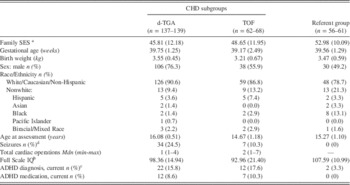
The total sample consisted of 268 adolescents (d-TGA=139; TOF=68; and referents=61). Sample characteristics are presented in Table 2. On average, adolescents in the d-TGA subgroup weighed more at birth, F(1,199)=18.94, p<.001, were older in gestational age, F(1,199)=4.84, p=.03, and age at the time of assessment, F(1,205)=143.10, p<.001, and underwent fewer cardiac operations, F(1,205)=49.07, p<.001, than the TOF subgroup. Full Scale IQ scores did not differ significantly between d-TGA and TOF subgroups (p=.07), although both were lower than referents (ps<.001). Rates of current ADHD diagnosis, χ2 (1)=0.11, p=.74, and family SES, F(1,205)=2.51, p=.11, did not differ significantly between CHD subgroups.
Participant characteristics

Note. CHD=congenital heart disease; d-TGA=dextro-transposition of the great arteries; TOF=tetralogy of Fallot; SES=family socioeconomic status using the Hollingshead Four Factor Index of Social Status (1975); ADHD=attention deficit/hyperactivity disorder. Some demographic data were missing; therefore, sample sizes, which are provided above as min-max, depict valid ns by group. Unless otherwise specified, results are presented as mean (SD).
a Hollingshead, A. A. (1975). Four-factor index of social status. Unpublished manuscript, Yale University, New Haven, CT.
b IQ was not measured concurrently in the d-TGA cohort but was obtained at a previous time point, when participants were approximately 8 years old, using the WISC-III (Wechsler, 1991; see Bellinger et al. Reference Bellinger, Wypij, DuPlessis, Rappaport, Jonas, Wernovsky and Newburger2003). IQ was measured in the TOF and Referent groups using the WISC-IV (Wechsler, 2008).
c The presence/absence of ADHD was determined via structured clinical interview using the Schedule for Affective Disorders and Schizophrenia for School-Aged Children—Present and Lifetime Version (K-SADS-PL; Kaufman et al., Reference Kaufman, Birmaher, Brent, Rao, Flynn, Moreci and Ryan1997); for complete K-SADS-PL results in the d-TGA cohort, see DeMaso et al. (Reference DeMaso, Labella, Taylor, Forbes, Stopp, Bellinger and Newburger2014); a report of K-SADS-PL results in the TOF cohort is currently in press (Holland et al., in press).
d Refers to clinical seizures observed clinically or within 7 days of cardiac surgery in the d-TGA group or the presence of more than 5 seconds of rhythmic epileptiform activity on continuous video electroencephalographic monitoring.
Among adolescents with CHD, males outperformed females on Verbal Memory Immediate, F(1,202)=5.89, p=.02 and Delayed Recognition indexes, F(1,202)=5.34, p=.02, and on Stories: Immediate, F(1,204)=16.65, p<.001, Stories: Delayed, F(1,202)=11.33, p=.001, and Stories: Delayed Recognition subtests, F(1,202)=11.71, p=.001.
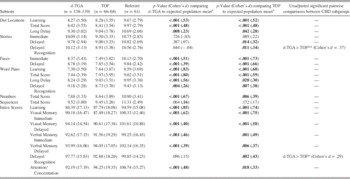
Both d-TGA and TOF subgroups performed below expected population means on most CMS variables, with effect sizes ranging from small (.23) to large (.85), except for the Delayed Recognition Index, Stories: Immediate, Delayed, and Recognition, and Sequences subtests (for the d-TGA subgroup) and Sequences and Stories: Immediate subtests (for the TOF subgroup; Table 3). An unadjusted ANOVA revealed significant differences between CHD subgroups in favor of the d-TGA group on the Delayed Recognition index, F(1,202)=3.92, p=.05, and Stories: Delayed Recognition subtest, F(1,202)=6.38, p=.01. However, these differences were no longer statistically significant in a subsequent model controlling for sex, birth weight, and age at the time of assessment. Due to a moderate bivariate correlation between birth weight and gestational age (r=.52; p<.001), both variables were not included as covariates in the same model; results and associated inferences were identical irrespective of which variable was included in the model.
Children’s Memory Scale performance across CHD subgroups and referents

Note. CHD=congenital heart disease; d-TGA=dextro-transposition of the great arteries; TOF=tetralogy of Fallot; OR=odds ratio. Bolded values indicate significance of p <.05.
a One-sample t-tests comparing CHD subgroups to expected population means (10±3 or 100±15, as appropriate).
*p<.05.
**p=.01.
Memory for Verbal Versus Visual-Spatial Materials
Paired-samples t tests were used to compare memory abilities across verbal and visual-spatial modalities using analogous index scores (i.e., Visual Memory Immediate versus Verbal Memory Immediate; Visual Memory Delayed versus Verbal Memory Delayed). Among participants with CHD, performance on immediate visual-spatial memory tasks was significantly lower than on immediate verbal memory tasks, t(203)=−2.26, p=.03, but did not differ significantly between delayed visual-spatial and delayed verbal memory tasks, t(203)=−0.89, p=.38.
To determine whether this same performance pattern obtained across CHD subgroups, follow-up paired-samples t tests were conducted separately for d-TGA and TOF groups. Neither d-TGA nor TOF comparisons reached statistical significance; however, there was a trend among adolescents with TOF for better performance on verbal than visual-spatial tasks both immediately, t(65)=−1.82; p=.07, and following a delay, t(65)=−1.75, p=.08. Comparisons among adolescents with d-TGA did not approach significance (p-values=.14 and .91 for immediate and delayed index scores, respectively).
Memory Under Free Recall Versus Recognition Conditions
Delayed verbal recall and recognition abilities were then compared, first among all CHD participants and then individually within CHD subgroups, again using paired-samples t tests. In the combined CHD sample, adolescents achieved significantly higher scores on Delayed Recognition than Verbal Memory Delayed indexes, t(203)=−2.32, p=.02, and on Word Pairs: Delayed Recognition than Word Pairs: Long Delay subtests, t(203)=−2.02, p=.04. Scores did not differ significantly between Stories: Delayed and Stories: Delayed Recognition subtests, t(203)=−1.33, p=.18.
Among adolescents with d-TGA, verbal recognition scores were statistically significantly higher than recall scores on two out of three measures: Delayed Recognition index, t(137)=−3.36, p=.001, and Word Pairs: Delayed Recognition, t(137)=−2.90, p=.004, but did not reach significance on the third measure: Stories: Delayed Recognition, t(137)=−1.88, p=.06. Recall and recognition task performances did not differ significantly among adolescents with TOF (all p values>.48).
Memory for Meaningful Versus Arbitrary Materials
We then looked for potential differences in adolescents’ retention of materials as a function of relative meaningfulness. Delayed recognition trials were included in analyses. Paired-samples t tests showed that adolescents with CHD performed significantly better on Stories than Word Pairs, t(203)=2.63, p=.009, and on Dot Locations than Faces, t(204)=−2.57, p=.01.
Looking individually at CHD subgroups, the d-TGA subgroup performed significantly better on Stories (M=10.12; SD=3.13) than Word Pairs (M=9.18; SD=3.28), t(137)=2.89, p=.004, but performed similarly on Faces (M=8.78; SD=3.19) and Dot Locations (M=9.30; SD=3.02), t(137)=−1.55, p=.12. In contrast, the TOF subgroup performed significantly better on Dot Locations (M=9.04; SD=3.78) than Faces (M=7.85; SD=3.54), t(66)=−2.19, p=.03, but performed similarly on Stories (M=8.91; SD=3.38) and Word Pairs (M=8.73; SD=3.70), t(65)=0.41, p=.69.
Attention/Concentration and Memory
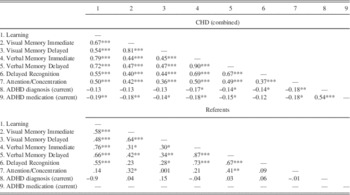
To explore associations between learning/memory and attention, we first examined current ADHD diagnosis and its influence(s) on CMS task performance among adolescents with CHD. Correlations between ADHD diagnosis and CMS Index scores are presented in Table 4. In an unadjusted MANOVA, adolescents with CHD who also met criteria for a current diagnosis of ADHD (n=34) achieved lower scores than those who did not meet criteria for ADHD (n=173) on Verbal Memory Immediate, F(1,202)=6.25, p=.01, Verbal Memory Delayed, F(1,202)=3.94, p=.05, Delayed Recognition, F(1,202)=4.08, p=.05, and Attention/Concentration indexes, F(1,202)=6.86, p=.009, as well as on Stories: Delayed, F(1,202)=7.57, p=.006, Stories: Delayed Recognition, F(1,202)=5.69, p=.02, Faces: Immediate, F(1,205)=4.40, p=.04, Faces: Delayed, F(1,202)=5.81, p=.02, Word Pairs: Learning, F(1,202)=5.30, p=.02, Word Pairs: Total Score, F(1,202)=5.05, p=.03, and Sequences subtests, F(1,202)=8.44, p=.004. Performance was comparable between adolescents with or without ADHD on all other measures.
Correlations between CMS index scores, current ADHD diagnosis, and current use of ADHD medication among adolescents with CHD

* p<.05.
** p<.01.
*** p<.001.
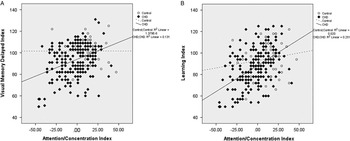
We then conducted a series of linear regression analyses to examine attention/concentration as a potential moderator of CHD status on learning and memory outcomes. CMS Index scores were included in analyses. Of particular relevance to the question of moderation was the CHD status × Attention/Concentration Index interaction term. Two significant interactions were found: Visual Memory Delayed Index, F(3,262)=17.35, p<.001, adj. R 2 =.16, and Learning Index, F(3,261)=27.13, p<.001, adj. R 2=.23 (Figure 1). In both cases, adolescents with CHD and better attention/concentration abilities tended to achieve higher delayed visual memory (r=.36; p<.001) and learning scores (r=.50; p<.001) than those with lower attention/concentration abilities. Referents’ scores on the Visual Memory Delayed Index and Learning Index were not significantly associated with their Attention/Concentration Index scores (r=.001; p=.99 and r=.14; p=.28, respectively). Attention/concentration was not a significant moderator of CHD status on any other CMS index scores.
Associations between CHD status and (A) delayed visual memory and (B) learning as a function of attention/concentration ability. Attention/Concentration Index score has been mean-centered for ease of interpretation.

Predictors of Learning and Memory Impairment
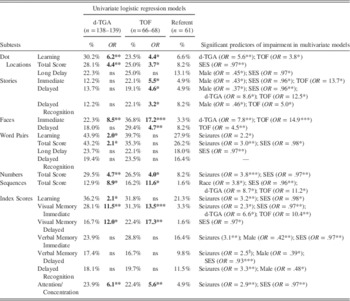
Finally, rates and predictors of impaired performance on CMS index and subtest scores were examined (Table 5). In the univariate binary logistic regression models, which examined the unadjusted odds of impairment relative to healthy referents on CMS subtest and index variables, adolescents with CHD were significantly more likely to perform within the impaired range across most tests, with some exceptions. Most notably, despite having greater odds of impairment overall on immediate and delayed visual-spatial memory indexes, adolescents in both the d-TGA and TOF subgroups were not significantly more likely to demonstrate impaired verbal memory performances than healthy referents, suggesting a sparing of immediate and delayed verbal memory recall and delayed verbal recognition abilities among adolescents with biventricular CHD.
Frequency, odds, and predictors of impaired performance on CMS measures by CHD subgroup as compared to referents

Note. CHD=congenital heart disease; d-TGA=dextro-transposition of the great arteries; TOF=tetralogy of Fallot; OR=odds ratio; ns=non-significant. Bolded values indicate significance of p <.05. Multivariate binary logistic regression used forward selection procedures to identify significant predictors from the following: sex, race (white vs. nonwhite), low birth weight (<2500g vs. ≥2500g), family SES, age at assessment, seizure history (yes vs. no), and CHD subgroup (d-TGA/TOF vs. referent).
*p<.05.
**p<.01.
***p<.001.
§ p=.05.
In the multivariate models, CHD subgroup, SES, sex, and seizure history were among the most frequent predictors of impairment across tasks. Male sex and higher SES were generally (mildly) protective against memory impairment. A history of seizures was associated with two- to three-fold increase in odds of impaired performance on several CMS indexes and subtests.
DISCUSSION
Our findings highlight an increased risk of learning and memory impairment among adolescents with critical biventricular CHD. Whereas immediate and delayed visual-spatial memory deficits were found in both d-TGA and TOF subgroups, immediate and delayed verbal memory was relatively preserved. Although overall verbal learning and memory abilities among d-TGA and TOF subgroups were significantly lower than expected population means, the weaknesses were modest in magnitude.
This relative sparing of verbal learning and memory abilities suggests preservation of the dominant-hemisphere memory network among adolescents with critical biventricular CHD. Although visual-spatial memory as measured by the CMS and many other standard assessment batteries does not reliably lateralize in clinical populations (e.g., Puka & Smith, Reference Puka and Smith2016), the fact that both subgroups showed significant deficits in this domain may suggest greater vulnerability of neural systems supporting visual-spatial processing to disruption by CHD-related risk factors.
White matter injury, in particular, is recognized as the most common type of neurological injury among children with critical CHD (Beca et al., Reference Beca, Gunn, Coleman, Hope, Reed, Hunt and Shekerdemian2013). Resulting, in part, from in utero alterations in blood flow (Sun et al., Reference Sun, Macgowan, Sled, Yoo, Manlhiot, Porayette and Seed2015) during third trimester periods of heightened vulnerability for premyelinating oligodendrocytes and subplate neurons (Volpe, Reference Volpe2014; Volpe, Kinney, Jensen, & Rosenberg, Reference Volpe, Kinney, Jensen and Rosenberg2011), white matter injury may be considered a primary contributor to neurobehavioral outcomes in this population (Rollins et al., Reference Rollins, Watson, Asaro, Wypij, Vajapeyam, Bellinger and Rivkin2014, Reference Rollins, Asaro, Akhondi-Asl, Kussman, Rivkin, Bellinger and Soul2016). White matter microstructural integrity (fractional anisotropy) within the right frontal lobe has been linked to visual-spatial processing among adolescents with d-TGA (Rollins et al., Reference Rollins, Watson, Asaro, Wypij, Vajapeyam, Bellinger and Rivkin2014), and within the uncinate fasciculus to verbal memory in a sample of adolescents and emerging adults with mixed cardiac lesions (Brewster, King, Burns, Drossner, & Mahle, Reference Brewster, King, Burns, Drossner and Mahle2015).
Among healthy individuals, memory for visual-spatial materials has been linked to white matter integrity across a range of locations (Begré, Frommer, von Känel, Kiefer, & Federspiel, Reference Begré, Frommer, von Känel, Kiefer and Federspiel2007), including aspects of the inferior longitudinal fasciculus and inferior fronto-occipital fasciculus (Unger, Alm, Collins, O’Leary, & Olson Reference Unger, Alm, Collins, O’Leary and Olson2016); however, further research is needed to examine the implications of white matter microstructure for visual-spatial memory in CHD.
We also looked at memory performance as a function of meaningfulness. Adolescents with CHD earned higher scores on Stories than Word Pairs but were more successful in remembering Dot Locations than Faces. It seems that, while meaningfulness was beneficial for supporting retention of verbal information, it may have been disadvantageous for retaining visual-spatial information, perhaps reflecting the sensitivity of adolescents with CHD to becoming overwhelmed by increases in visual-spatial load/complexity (Bean Jaworski et al., Reference Bean Jaworski, White, DeMaso, Newburger, Bellinger and Cassidy2017).
Of interest, deficits in aspects of social cognition, specifically, perceiving and identifying emotions in facial expressions, have also been documented in adolescents with critical CHD (Bellinger, Rivkin, et al., Reference Bellinger, Rivkin, DeMaso, Robertson, Stopp, Dunbar-Masterson and Newburger2015; Bellinger, Watson, et al., Reference Bellinger, Watson, Rivkin, Robertson, Roberts, Stopp and Newburger2015; Bellinger et al., Reference Bellinger, Wypij, Rivkin, DeMaso, Robertson, Dunbar-Masterson and Newburger2011) and, in conjunction with our findings, suggest that problems not only processing the complexity inherent in human faces but also remembering salient facial information may be contributing to the increased rates of psychosocial struggles reported among CHD survivors (Bellinger & Newburger, Reference Bellinger and Newburger2010). Deficits in social cognition may also make it harder for these children to encode and/or retain facial details, which might explain their relatively greater difficulty with memory for faces than non-social visual-spatial information.
Alternatively, differences in task parameters (other than meaningfulness/complexity) may be driving these findings. In particular, duration and frequency of exposure to stimuli should be considered. Whereas the Dot Locations task involves repeated 5-s exposures to the target visual array, Faces involves a one-trial, 2-s exposure to target stimuli and thus may be more sensitive to momentary lapses in attention or task engagement. Nevertheless, it should be noted that Word Pairs also involves repeated exposures to target stimuli, potentially mitigating the risk that participants will become distracted or disengaged, yet this task ultimately proved more difficult for adolescents with CHD than Stories, which were presented to them only once.
Moreover, if attention deficits were the primary drivers of these effects, then adolescents with CHD and ADHD might be expected to perform more poorly than those without ADHD on delayed memory for faces but not stories; however, our results indicate that they performed more poorly than their non-ADHD peers on both tasks. Therefore, while our findings suggest that the relative benefit of meaningfulness for promoting memory retention differs for adolescents with CHD depending on modality, additional studies using more tightly controlled experimental paradigms are needed before drawing firm conclusions.
Our use of the core CMS battery, one of the most widely administered learning and memory batteries among pediatric neuropsychologists in the United States, allowed us to examine a range of relevant processes (e.g., encoding, retrieval, and recognition) that may be differentially impacted by CHD. Adolescents in the d-TGA subgroup performed significantly better on verbal recognition than recall tasks. This was not true of adolescents in the TOF subgroup who did not demonstrate any obvious benefit of recognition cues to boost their retrieval of previously encountered information.
Deficits in retrieval versus encoding processes bear important implications for clinical management. Whereas retrieval-based deficits suggest a “search-and-find” problem that may be compensated for with reminders or cues, encoding deficits suggest a more fundamental problem in how information is processed and stored in terms of the quality of the memory trace itself. A filing cabinet analogy, although debatable from a systems neuroscience perspective, may nonetheless be useful in talking about this distinction with parents and teachers.
Children with retrieval-based memory difficulties have the file they need but may not be able to find it when they need it without prompting as to where to look. For these children, gauging what they have learned/retained may require careful consideration of not only what questions to ask but also how those questions are asked. Relying solely on free-/open-response question formats, for instance, may yield false estimates of how much the child has actually learned, which may be more accurately gauged by structured questioning (e.g., multiple choice, fill-in-the-blank). Classic strategies such as chunking (e.g., “186319452016”=“1863 1945 2016”), naming (e.g., “ROY G BIV” for the colors of the rainbow), and expression mnemonics (e.g., “Please Excuse My Dear Aunt Sally” for the mathematical order of operations) remain relevant. Executive function supports, particularly aimed at organization and planning, are also likely to be beneficial for adolescents with CHD who may be at risk in this domain (Cassidy et al., Reference Cassidy, White, DeMaso, Newburger and Bellinger2015), especially when approached from a solution-oriented framework that emphasizes generalization and independence in applying strategies across situations.
Conversely, for children with encoding- or storage-based memory difficulties, the file is simply missing. These children may have been unable to discern meaning or relevance from the to-be-remembered materials, or perhaps were overwhelmed by the sheer amount or complexity of the information. In these instances, the most useful clinical recommendations may be ones that emphasize meaningfulness, highly explicit connections between new and previously encountered knowledge, simplification, and deliberate pacing of learning expectations. There is not a one-size-fits-all solution for making information meaningful; and, depending on the unique interests of the child as well as the particular academic subject or content area, doing so may require creativity. Technology and the Internet make it possible for students to investigate concepts with video, audio, and interactive experiences that can augment text-based learning and enhance the personal relevance of the information.
The strongest predictor of memory impairment in this study, aside from CHD subtype, was seizure history. Adolescents with a history of seizures had 2- to 3-times greater odds of impairment on learning, memory, and recognition indices than healthy referents. Prior reports from our group have shown an increased risk for neurodevelopmental impairment in infants, children, and adolescent survivors of critical CHD who experience seizures (Rappaport et al., Reference Rappaport, Wypij, Bellinger, Helmers, Holmes, Barnes and Newburger1998; Bellinger et al., Reference Bellinger, Wypij, Kuban, Rappaport, Hickey, Wernovsky and Newburger1999, Reference Bellinger, Wypij, Rivkin, DeMaso, Robertson, Dunbar-Masterson and Newburger2011; Bellinger, Rivkin, et al., Reference Bellinger, Rivkin, DeMaso, Robertson, Stopp, Dunbar-Masterson and Newburger2015; cf. Gaynor et al., Reference Gaynor, Stopp, Wypij, Andropoulos, Atallah, Atz and Newburger2016; Gunn, Beca, Hunt, Olischar, & Shekerdemian, Reference Gunn, Beca, Hunt, Olischar and Shekerdemian2012).
Notably, among the adolescent participants in the current study, seizures did not emerge as a significant predictor of memory outcomes as measured by a single, composite “General Memory Index” score (Bellinger, Rivkin, et al., Reference Bellinger, Rivkin, DeMaso, Robertson, Stopp, Dunbar-Masterson and Newburger2015; Bellinger et al., Reference Bellinger, Wypij, Rivkin, DeMaso, Robertson, Dunbar-Masterson and Newburger2011), a score which was later found to correlate with white matter microstructure in the right posterior limb of the internal capsule (Rollins et al., Reference Rollins, Watson, Asaro, Wypij, Vajapeyam, Bellinger and Rivkin2014), an area of the brain not typically recognized as part of the memory network. Taken together, these findings suggest caution in using a multi-component memory composite variable as an indicator of learning and memory function in individuals with CHD. Declarative memory is not a unitary construct and, as demonstrated, is not uniformly disrupted among adolescents with critical biventricular CHD.
Our findings should be interpreted considering some limitations. First, not all participants underwent genetic testing or evaluation by a geneticist; therefore, it is possible that some adolescents with an unidentified genetic or chromosomal abnormality were classified inappropriately. Second, given that participants were drawn from two single-center studies of largely white/Caucasian adolescents with critical biventricular CHD, further research is needed to establish the generalizability of our results to more diverse samples, including adolescents with other forms of CHD. Third, because infants with low birth weight (LBW) were excluded from participating in the Boston Circulatory Arrest Study, we are limited in our ability to evaluate the impact of LBW as a predictor of learning/memory outcomes among adolescents with d-TGA. Fourth, although we would expect IQ to have remained relatively stable between 8 and 16 years of age, the lack of concurrent WISC-IV IQ data in the d-TGA group is a limitation. Fifth, because our healthy referents were screened according to stringent guidelines used in the NIH MRI Study of Normal Brain Development to exclude individuals with conditions affecting brain development, they may justifiably be considered a “super-normal” rather than “typical” comparison group (Waber et al., Reference Waber, De Moor, Forbes, Almli, Botteron, Leonard and Rumsey2007). Finally, advances in medical/surgical techniques over the years since our adolescent sample was born may result in more favorable outcomes among those born more recently.
In summary, adolescents with critical biventricular CHD are at risk for deficits in aspects of declarative memory. Consistent with recent American Heart Association guidelines (Marino et al., Reference Marino, Lipkin, Newburger, Peacock, Gerdes, Gaynor and Mahle2012), careful examination of verbal and visual-spatial memory should be included routinely as part of comprehensive neuropsychological assessment of children and adolescents with CHD.
ACKNOWLEDGMENTS
This research was supported in part by grants from the National Heart, Lung, and Blood Institute (HL77681 and HL74734), the Farb Family Fund, and the National Center for Research Resources (RR02172). The authors have no conflicts of interest to declare. The authors thank the adolescents and parents who participated in this study. The authors also thank Jane Holmes Bernstein, PhD, Debbie Waber, PhD, and Christian Stopp, MS, for their assistance in the preparation of this manuscript.