


The East Flanders Prospective Twin Survey (EFPTS) is a multiple-birth registry, founded in 1964 at Ghent University by Robert Derom and Michel Thiery (C. Derom et al., Reference Derom, Thiery, Rutten, Peeters, Gielen, Bijnens, Vlietinck and Weyers2019). Currently, the EFPTS is managed by ‘Fund Twins,’ a nonprofit academic consortium committed to advancing research on multiple births. The consortium operates under the governance of a scientific board composed of experts from multiple academic institutions, including the Department of Obstetrics and Gynaecology at Ghent University Hospital (Belgium), the Department of Human Genetics at the University of Leuven (Belgium), the Centre for Environmental Sciences at the University of Hasselt (Belgium), and the Research Institute for Mental Health and Neuroscience at Maastricht University (the Netherlands). The executive board oversees operational, administrative, and financial management, and the scientific board ensures research integrity, coordinates collaborations, and defines principles for the use of data and biological samples.
Furthermore, the scientific board decides on submitted research proposals, asking permission to have access to the EFPTS data or biological samples. Following approval by both the scientific board and the appropriate ethics committee, a clinical trial agreement is established. This agreement outlines the terms of data and, if applicable, biological sample sharing.
The main aims of the EFPTS have remained the same since its origin (C. Derom et al., Reference Derom, Thiery, Rutten, Peeters, Gielen, Bijnens, Vlietinck and Weyers2019):
-
1. to assess the prevalence of multiple births within a clearly defined geographic region and to systematically document obstetric factors, including gestational age, pregnancy and birth complications, birth weight, mode of conception, chorion type, and umbilical cord insertion, as well as pediatric outcomes, such as congenital anomalies, and both perinatal and infant morbidity and mortality.
-
2. to examine the etiology of multiple births, with a specific focus on the impact of zygosity and the timing of zygotic division on various traits observed later in life, including behavioral patterns, cognitive development, intelligence, infant growth, cardiovascular phenotypes, stress responses, (sub)clinical depression, and manifestations of psychotic symptoms.
-
3. to investigate the genetic predisposition associated with the studied phenotypes and to evaluate the influence of environmental factors, particularly prenatal environmental conditions, on individual-specific and shared developmental outcomes.
Broad Informed Consent Form
The methodology of the EFPTS received formal approval from the ethical committees of all participating maternity hospitals in 2020 (registration number: B670201942482). This approval encompasses both the retrospective use of previously collected data and samples (1964–2020), as well as the prospective application of the methodology from the point of approval onward. It includes a broad informed consent form (ICF), which asks parental authorization for the utilization of collected perinatal data and placental samples in any ethically approved future scientific research concerning multiple births. Should additional data or other biological samples be required for future research studies, a separate ICF must be obtained, either from the parents or directly from the multiples themselves upon reaching the age of 18.
Data Collection
Recruitment and data collection at birth are standardized through predefined methodological protocols and uniform training provided to each participating maternity hospital by the coordinating centre, Ghent University Hospital. All of the 13 maternity hospitals in East-Flanders, Belgium, actively participate in the EFPTS, ensuring its population-based nature.
The data collection process at birth follows a structured methodology: (1) expectant mothers carrying multiples are informed about the EFPTS during pregnancy; (2) informed consent is obtained from both parents and the attending obstetrician; (3) upon birth, the placentas of the first and second child are labelled and preserved under refrigerated conditions (2-8°C) until collection by the coordinating centre; (4) perinatal data is systematically recorded by midwives using preprinted worksheets; (5) midwives notify the EFPTS study team of the multiple birth; (6) the EFPTS study team oversees the transportation of the placental samples (via cooled transport); complete perinatal records, and sign informed consent forms to Ghent University Hospital; and (7) upon receipt, the study team verifies the completeness and integrity of the collected samples and documentation.
Zygosity is determined through a stepwise approach. Opposite-sex twins are classified as dizygotic (DZ), while monochorionic twins are considered monozygotic (MZ). For same-sex dichorionic diamniotic twins, blood group typing is performed first, including ABO and Rhesus factor, as well as Rhesus subgroups. If both twins share the same blood group and subgroups, DNA fingerprinting is conducted to further assess zygosity.
Between 1964 and 2023, 10,787 twin pairs and 318 triplet sets were registered, with 30.4% of twins and 74.5% of triplets conceived via assisted reproductive techniques. Among twins, 75.9% were dichorionic and 21% monochorionic; 59.3% were dizygous and 31.9% monozygous. The remaining twins have an unknown chorionicity or zygosity. Among triplets, 63.9% were trichorionic, 15.2% dichorionic, and 0,63% monochorionic, with zygosity distributed as 44.97% trizygous, 16.98% dizygous, and 3.14% monozygous.
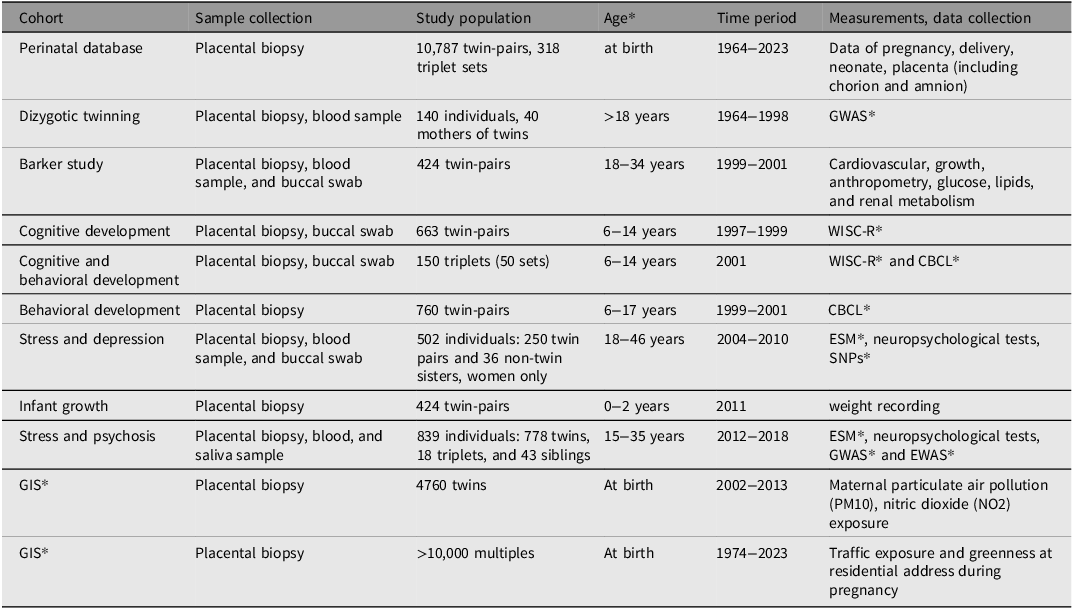
Beyond birth, the EFPTS enables prospective data collection across the lifespan of registered multiples (Table 1). Its unique strength lies in linking early-life biological and clinical data with long-term outcomes (Bijnens et al., Reference Bijnens, Derom, Gielen, Winckelmans, Fierens, Vlietinck, Zeegers and Nawrot2016; Jacobs et al., Reference Jacobs, Van Os, Derom, Thiery, Delespaul and Wichers2011; Loos et al., Reference Loos, Beunen, Fagard, Derom and Vlietinck2002; Pries et al., Reference Pries, Snijders, Menne-Lothmann, Decoster, Van Winkel, Collip, Delespaul, De Hert, Derom, Thiery, Jacobs, Wichers, Guloksuz, Van Os and Rutten2019). This framework has supported numerous large-scale longitudinal studies, providing critical insights into developmental, behavioral, and health trajectories of twins (Antoniou et al., Reference Antoniou, Fowler, Thiery, Southwood, Van Gestel, Jacobs, Vlietinck, Van Os, Rijsdijk, Derom and Zeegers2013; Bijnens et al., Reference Bijnens, Derom, Weyers, Janssen, Thiery and Nawrot2019; C. Derom et al., Reference Derom, Jawaheer, Chen, McBride, Xiao, Amos, Gregersen and Vlietinck2006; C. Derom et al., Reference Derom, Thiery, Rutten, Peeters, Gielen, Bijnens, Vlietinck and Weyers2019; Gielen et al., Reference Gielen, Pinto-Sietsma, Zeegers, Loos, Fagard, De Leeuw, Beunen, Derom and Vlietinck2005; Jacobs et al., Reference Jacobs, Gestel, Derom, Thiery, Vernon, Derom and Vlietinck2001, Reference Jacobs, Rijsdijk, Derom, Danckaerts, Thiery, Derom, Vlietinck and Van Os2002; Loos et al., Reference Loos, Beunen, Fagard, Derom and Vlietinck2001; Os et al., Reference Os, Wichers, Danckaerts, Van Gestel, Derom and Vlietinck2001; Souren et al., Reference Souren, Lutsik, Gasparoni, Tierling, Gries, Riemenschneider, Fryns, Derom, Zeegers and Walter2013).
The largest data cohorts of the EFPTS

Table 1 Long description
A table with 11 rows and 6 columns detailing various cohorts of the EFPTS. Columns include Cohort, Sample collection, Study population, Age, Time period, and Measurements, data collection. Row 1: Perinatal database, Placental biopsy, 10,787 twin-pairs, 318 triplet sets, at birth, 1964–2023, Data of pregnancy, delivery, neonate, placenta (including chorion and amnion). Row 2: Dizygotic twinning, Placental biopsy, blood sample, 140 individuals, 40 mothers of twins, >18 years, 1964–1998, GWAS. Row 3: Barker study, Placental biopsy, blood sample, and buccal swab, 424 twin-pairs, 18–34 years, 1999–2001, Cardiovascular, growth, anthropometry, glucose, lipids, and renal metabolism. Row 4: Cognitive development, Placental biopsy, buccal swab, 663 twin-pairs, 6–14 years, 1997–1999, WISC-R. Row 5: Cognitive and behavioral development, Placental biopsy, buccal swab, 150 triplets (50 sets), 6–14 years, 2001, WISC-R and CBCL. Row 6: Behavioral development, Placental biopsy, 760 twin-pairs, 6–17 years, 1999–2001, CBCL. Row 7: Stress and depression, Placental biopsy, blood sample, and buccal swab, 502 individuals: 250 twin pairs and 36 non-twin sisters, women only, 18–46 years, 2004–2010, ESM, neuropsychological tests, SNPs. Row 8: Infant growth, Placental biopsy, 424 twin-pairs, 0–2 years, 2011, weight recording. Row 9: Stress and psychosis, Placental biopsy, blood, and saliva sample, 839 individuals: 778 twins, 18 triplets, and 43 siblings, 15–35 years, 2012–2018, ESM, neuropsychological tests, GWAS and EWAS. Row 10: GIS, Placental biopsy, 4760 twins, at birth, 2002–2013, Maternal particulate air pollution (PM10), nitric dioxide (NO2) exposure. Row 11: GIS, Placental biopsy, >10,000 multiples, at birth, 1974–2023, Traffic exposure and greenness at residential address during pregnancy.
Note: *Age at time of measurement; GWAS, genomewide association study; WISC-R, Wechsler Intelligence Scale for Children-Revised; CBCL, Child Behaviour Checklist; ESM, experience sampling method; EWAS, epigenomewide association study;, GIS, geographic information system; SNPs, single nucleotide polymorphisms.
Placenta Examination
One of the unique features of the EFPTS is the systematic determination of chorion type through the examination of placentas from all included multiple births since 1969. To date, over 16,000 placental biopsies have been collected, making EFPTS the only active twin registry with standardized placental analysis.
Placental examinations are centralized at Ghent University Hospital and follow a standardized protocol based on Corney et al. (Reference Corney, MacGillivray, Campbell, Thompson and Little1983), ensuring methodological consistency (Corney et al., Reference Corney, MacGillivray, Campbell, Thompson and Little1983). The methodology of our placental examination is described before by R. Derom et al. (Reference Derom, Derom and Vlietinck1995). The placenta collected at any of the 12 participating sites is transported to Ghent University Hospital for centralized analysis.
This standardized methodology ensures high-quality data and reproducible analysis of placental characteristics, while also preserving the suitability of placental biopsies for subsequent (epi)genetic analyses. These biopsies have been successfully used for the determination of the zygosity and in studies investigating DNA methylation patterns, telomere length, epigenetic regulation, and mitochondrial DNA (Bijnens et al., Reference Bijnens, Derom, Gielen, Winckelmans, Fierens, Vlietinck, Zeegers and Nawrot2016; Bijnens et al., Reference Bijnens, Derom, Weyers, Janssen, Thiery and Nawrot2019; Bijnens et al., Reference Bijnens, Zeegers, Derom, Martens, Gielen, Hageman, Plusquin, Thiery, Vlietinck and Nawrot2017; Bijnens et al., Reference Bijnens, Zeegers, Gielen, Kicinski, Hageman, Pachen, Derom, Vlietinck and Nawrot2015).
The EFPTS biobank operates under strict quality standards (ISO 9001:2015, ISBER, OECD, ISO 20387:2018), supported by detailed Standard operating procedures.
Data Processing and Management
The EFPTS maintains a data framework designed to ensure the secure storage, systematic processing, and responsible use of all collected information and biological samples. Given the longitudinal nature of the study and its extensive dataset, the EFPTS follows stringent protocols to safeguard data quality and participant confidentiality.
Perinatal data, initially recorded by midwives on standardized paper forms, are systematically digitized by the coordinating centre. This includes entry checks and double-data verification to ensure accuracy, completeness, and consistency of the data.
Biological samples such as placental biopsies are labelled using unique identifiers that link them to corresponding clinical records. To preserve participant anonymity, personal identifiers are removed, and linkage is maintained through coded reference systems accessible only to authorized personnel.
All digital records are stored on encrypted servers within a secure network environment managed by Ghent University Hospital. Regular backups and data integrity checks are implemented to prevent data loss and unauthorized access.
Linkage to Nationwide Data Collections
In addition to its dedicated follow-up efforts, the EFPTS dataset was enriched through linkage with national databases, such as the Study Centre for Perinatal Epidemiology (SPE), the Child and Family registry, and nationwide cohorts on environmental exposures, the Belgian National Institute of Statistics, and the Belgian National register.
The SPE collects perinatal data on all births (singletons and multiples) in Flanders (Goemaes et al., Reference Goemaes, Fomenko, Laubach, De Coen, Roelens and Bogaerts2024). Linking EFPTS data to the SPE database enables the analysis of additional parameters (e.g., pregnancy-related complications, admission to neonatal intensive care) not originally included in EFPTS, facilitates comparisons with twin births across Flanders, and allows for comparisons with singleton births from the same population. The datasets were linked using a unique combination of the mother’s date of birth and the twins’ date of birth. Using these enriched datasets, Bijnens et al. (Reference Bijnens, Derom, Gielen, Winckelmans, Fierens, Vlietinck, Zeegers and Nawrot2016) and Meireson et al. (Reference Meireson, De Rycke, Bijnens, Dehaene, De Bock, Derom and Roelens2024) calculated Belgian-specific growth reference values, allowing for a representative assessment of small for gestational age. Meireson et al. analyzed perinatal outcomes of 85 reduced triplet pregnancies (170 neonates) and compared them with 5093 primary dichorionic twin pregnancies (10,186 neonates) and 104 trichorionic triplet pregnancies (309 neonates). Multifetal pregnancy reduction from trichorionic triplets to twins significantly improved birth outcomes. However, primary twins delivered before 32 weeks of gestation still had better outcomes than reduced triplets(Meireson et al., Reference Meireson, De Rycke, Bijnens, Dehaene, De Bock, Derom and Roelens2024).
Child and Family centers provide routine health check-ups, including weight measurements, for children from birth to 2 years. Linkage with EFPTS data was achieved by matching birth date, family name, and first name of the twins. This integration has yielded valuable insights into the determinants and heritability of infant growth (Touwslager, Gielen, Derom et al., Reference Touwslager, Gielen, Derom, Mulder, Gerver, Zimmermann, Houben, Stehouwer, Vlietinck, Loos and Zeegers2011; Touwslager, Gielen, Mulder et al., Reference Touwslager, Gielen, Mulder, Gerver, Zimmermann, Fowler, Houben, Stehouwer, Derom, Vlietinck, Loos and Zeegers2011). Touwslager et al. described the infant growth of 424 twins during four time periods (0−6 months, 6−12 months, 12−24 months). Birth weight showed a growth-demoting effect during the first 6 months, meaning heavier newborns grew more slowly relative to lighter ones. Interestingly, the chorion type was not a determinant of growth in the first month of life (Touwslager Gielen, Derom et al., Reference Touwslager, Gielen, Derom, Mulder, Gerver, Zimmermann, Houben, Stehouwer, Vlietinck, Loos and Zeegers2011). In a subsequent analysis of the same cohort, the authors observed that heritability did not influence early infant growth (0–1 month); however, it had a strong effect after the first month of age (Touwslager, Gielen, Mulder et al., Reference Touwslager, Gielen, Mulder, Gerver, Zimmermann, Fowler, Houben, Stehouwer, Derom, Vlietinck, Loos and Zeegers2011).
The Environment Agency in Flanders, the Brussels Institute for Environmental Management, the Institute for Public Service, and the Ministry of the Environment manage a telemetric network in Belgium containing multiple monitoring stations that measure air quality (PM10 and NO2) in real time. Applying the spatial–temporal interpolation method (Kriging), which uses land-cover data, in combination with monitoring station measurements, air pollution levels can be estimated at specific residential addresses (Janssen et al., Reference Janssen, Dumont, Fierens and Mensink2008). Second, the use of Geographic Information System (GIS) functions with ArcGIS 10 software gave the EFPTS the opportunity to categorize residential addresses into urban, suburban, and rural based on a map. By incorporating geocoded maternal addresses during pregnancy, EFPTS linked air pollution exposure (PM10 and NO2) to its dataset, enabling research on the association between prenatal air pollution exposure and perinatal outcomes (Bijnens et al., Reference Bijnens, Derom, Gielen, Winckelmans, Fierens, Vlietinck, Zeegers and Nawrot2016; Ziemendorff et al., Reference Ziemendorff, Böhm-González, Meireson, Weyers, Nawrot, Bijnens and Gielen2025) and long-term developmental measures, such as cognition and behavior (Bijnens et al., Reference Bijnens, Derom, Thiery, Weyers and Nawrot2020). Bijnens et al. (Reference Bijnens, Derom, Gielen, Winckelmans, Fierens, Vlietinck, Zeegers and Nawrot2016) examined 4760 twin pairs and reported that birth weight is negatively associated with exposure to PM10 and NO2 in the third trimester. Furthermore, Ziemendorff et al. (Reference Ziemendorff, Böhm-González, Meireson, Weyers, Nawrot, Bijnens and Gielen2025) explored the role of the placenta as a potential mediator in the relationship between prenatal exposure to air pollution and birth weight. The study used estimated levels of PM10 and NO2 at maternal residential addresses, combined with the perinatal and placental data of 3340 twins (born 2002−2013) within the EFPTS. They concluded that the placenta functions both as moderator and mediator in the association between air pollution and birth weight (Ziemendorff et al., Reference Ziemendorff, Böhm-González, Meireson, Weyers, Nawrot, Bijnens and Gielen2025). Additionally, Bijnens et al. (Reference Bijnens, Derom, Thiery, Weyers and Nawrot2020) examined 620 twins aged 7–15 years and found that greater residential green space during pregnancy and childhood was associated with higher intelligence and fewer behavioral problems, particularly in urban environments.
Statbel, the Belgian National Institute of Statistics (NIS), is the official authority responsible for collecting, processing, and publishing statistical information in Belgium. It provides reliable and comprehensive data on demographics, economy, labor market, prices, housing, health, and social indicators of the Belgian population (Belgian National Institute of Statistics, n.d.). EFPTS linked its database to the NIS based on residential address. This linkage made it possible to gather information on neighborhood socio-economic status based on the annual household income (in 2005) of 2409 mothers of twins. The household income served as a covariate in the mixed model analysis to investigate the association between birth weight and air pollution exposure in the study of Bijnens et al. discussed above (Bijnens et al., Reference Bijnens, Derom, Gielen, Winckelmans, Fierens, Vlietinck, Zeegers and Nawrot2016).
As EFPTS registers data for more than 60 years, for a part of the multiples who did not participate in the follow-up studies, the contact details are outdated. In 2025, the EFPTS obtained up-to-date residential addresses of all registered mothers from the Belgian National Register. This register is a centralized database that stores personal information on all residents of Belgium, including residential address, date of birth, date of death, nationality, and marital status. The linkage between the two datasets was performed using a specific identifier composed of the following elements: (1) last name, (2) first name, (3) second given name (if available), (4) date of birth (formatted as century-year-month-day), (5) age, and (6) sex. Accurate residential addresses are essential for maintaining the register, as they form the basis for communication regarding follow-up studies and completion of missing data. Furthermore, it is important for research activities such as estimating the level of air pollution and other exposome variables based on the residential address.
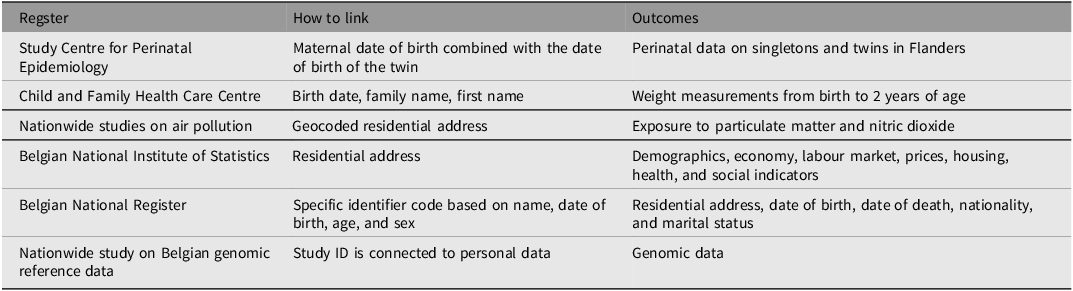
EFPTS is partnering in the Belgian Genome Library, a nationwide initiative within the Genome of Europe project to establish a reference genome for the Belgian population (Table 2). The project aims to build a cohort of over 10,000 individuals with corresponding genomic data (The Belgian Genome Library, 2025). As part of this initiative, EFPTS will provide placental tissue for whole genome sequencing, generating genomic data for a subset of the EFPTS cohort. The EFPTS aims to collect informed consent to sequence the DNA from approximately 500 individuals. This collaboration opens opportunities for future research, such as association studies linking the genomic data to the phenotypic data available in the EFPTS or studies on geneticF causes and (risk) factors for human traits and diseases.
Data linkage to the EFPTS database

Table 2 Long description
A table with three columns and six rows detailing data linkage to the EFPTS database. The columns are labeled 'Register', 'How to link', and 'Outcomes'. Row 1: Study Centre for Perinatal Epidemiology, Maternal date of birth combined with the date of birth of the twin, Perinatal data on singletons and twins in Flanders. Row 2: Child and Family Health Care Centre, Birth date, family name, first name, Weight measurements from birth to 2 years of age. Row 3: Nationwide studies on air pollution, Geocoded residential address, Exposure to particulate matter and nitric dioxide. Row 4: Belgian National Institute of Statistics, Residential address, Demographics, economy, labour market, prices, housing, health, and social indicators. Row 5: Belgian National Register, Specific identifier code based on name, date of birth, age, and sex, Residential address, date of birth, date of death, nationality, and marital status. Row 6: Nationwide study on Belgian genomic reference data, Study ID is connected to personal data, Genomic data.
Additionally, EFPTS participates in international consortia such as CODATwins, as well as in multi-cohort meta-analyses focusing on topics like dizygotic twinning and environmental influences on blood pressure (Mbarek et al., Reference Mbarek, Gordon, Duffy, Hubers, Mortlock, Beck, Hottenga, Pool, Dolan, Actkins, Gerring, Van Dongen, Ehli, Iacono, Mcgue, Chasman, Gallagher, Schilit, Morton and Martin2024; Silventoinen et al., Reference Silventoinen, Jelenkovic, Yokoyama, Sund, Sugawara, Tanaka, Matsumoto, Bogl, Freitas, Maia, Hjelmborg, Aaltonen, Piirtola, Latvala, Calais-Ferreira, Oliveira, Ferreira, Ji, Ning and Kaprio2019; Xu et al., Reference Xu, Ding, Zhang, Su, Treiber, Vlietinck, Fagard, Derom, Gielen, Loos, Snieder and Wang2013). The COllaborative project of Development of Anthropometrical measures in Twins (CODATwins) project is a large international consortium of different twin cohorts, which aims to analyze individual-level phenotype data from twins in multiple cohorts from different environments. The EFPTS collaborated in this consortium by providing data on 804 twins on gestational age at birth, birth weight, zygosity, sex, socio-economic status, and body mass index of adult twins (Silventoinen et al., Reference Silventoinen, Jelenkovic, Yokoyama, Sund, Sugawara, Tanaka, Matsumoto, Bogl, Freitas, Maia, Hjelmborg, Aaltonen, Piirtola, Latvala, Calais-Ferreira, Oliveira, Ferreira, Ji, Ning and Kaprio2019). In a large meta-analysis, Mbarek et al. identified new loci that are associated with spontaneous dizygotic twinning. The EFPTS collaborated in this large meta-analysis by providing samples of 40 mothers of dizygotic twins from 13 multiplex families collected in the 1990s (Mbarek et al., Reference Mbarek, Gordon, Duffy, Hubers, Mortlock, Beck, Hottenga, Pool, Dolan, Actkins, Gerring, Van Dongen, Ehli, Iacono, Mcgue, Chasman, Gallagher, Schilit, Morton and Martin2024). Furthermore, Xu et al. (Reference Xu, Ding, Zhang, Su, Treiber, Vlietinck, Fagard, Derom, Gielen, Loos, Snieder and Wang2013) investigated environmental factors influencing blood pressure in two twin cohorts: 703 twins aged 18–34 years and 360 twins aged 12–18 years. The EFPTS contributed perinatal and cardiovascular data for the 703 young adult twins. Their findings indicate that variability in blood pressure is primarily driven by unique environmental influences during adolescence and early adulthood. However, familial factors also accounted for approximately 25% of the variance in blood pressure variability (Xu et al., Reference Xu, Ding, Zhang, Su, Treiber, Vlietinck, Fagard, Derom, Gielen, Loos, Snieder and Wang2013). Furthermore, Xu et al. (Reference Xu, Su, Treiber, Vlietinck, Fagard, Derom, Gielen, Loos, Snieder and Wang2015). reported that, beyond genes affecting both daytime and nighttime blood pressure, heritability is primarily driven by genetic factors that specifically influence blood pressure at night
Reflections on 60 Years of Experience
Throughout its six decades of operation, the EFPTS has encountered various challenges. One of the primary difficulties has been securing financial resources to sustain daily operations, particularly in covering personnel costs. Funding shortages, particularly affecting personnel costs, led to a temporary reduction in recruitment activities between 2018 and 2020, limiting participation to hospitals located in Ghent. Notably, these maternities account for approximately 50% of all multiples born in East Flanders. Fortunately, since 2020, EFPTS has been able to resume recruitment across all 13 maternities in the region. Additionally, since 2021, DNA fingerprinting, part of the zygosity analysis, is not conducted standardly anymore. Another challenge of the EFPTS was the implementation of informed consent in 2020, introduced to comply with Belgian patient rights legislation and the General Data Protection Regulation (GDPR). The implementation of the ICF led to a decrease in participant enrolment, dropping from 98% to 70% of registered multiples. Furthermore, linking the EFPTS dataset with other cohorts requires approval from the ethics committee, and in some cases, an additional informed consent must be obtained from participants, depending on the ethics committee’s advice. Another ongoing challenge has been adapting to digital communication methods. Since the first multiples were registered back in 1964, there has been a wide variety in ages, and maintaining engagement with older multiples has become more difficult.
Despite these obstacles, EFPTS has made substantial advancements in its operational framework. A comprehensive reassessment of perinatal data collected over the years has resulted in the incorporation of additional variables related to pregnancy pathology. Furthermore, in 2021, a newly structured electronic database (REDCap) was developed to optimize data management and streamline collection processes (Harris et al., Reference Harris, Taylor, Thielke, Payne, Gonzalez and Conde2009). Moving forward, EFPTS aims to conduct a systematic quality assessment of placental biopsies dating back to 1969.
What Have We Learned?
Over time, the EFPTS has generated valuable insights into the effective management of a longitudinal birth registry. First, the importance of a dedicated and well-supported research team, which ensures the smooth functioning of daily operations. Second, clear and transparent communication with prospective participants — highlighting the scientific relevance of their contribution — has proven essential in encouraging participation and fostering long-term engagement. This is further strengthened by transparency regarding the use of collected data and biological samples. Third, the availability of a well-structured and detailed electronic database is critical for ensuring data accessibility and supporting robust, comprehensive analyses. Fourth, maintaining high-quality datasets requires periodic reassessment and refinement of data collection protocols to adapt to evolving research standards. At last, the scientific value of data collection is maximized when embedded within ongoing research projects. Sustaining the registry’s relevance and impact thus depends on the continuous pursuit and identification of novel research opportunities.
Future Prospects
After 60 years, the EFPTS remains committed to prospectively collecting perinatal and biological data at birth while systematically linking this information to later-life phenotypic outcomes. Thanks to the unique features of the EFPTS (e.g., information on placentation, mode of conception, challenges in identifying multiples after ovulation induction without IVF), the register prioritizes investigating the impact of chorion type, pregnancy origin, and epigenetic factors on later-life phenotypes.
Looking ahead, the EFPTS is uniquely positioned to investigate the complex interplay between genetic and epigenetic factors, the intrauterine environment, and external exposures—such as air pollution — in shaping health trajectories. In the coming years, the study aims to incorporate technologies such as multi-omics platforms (e.g., genomics, transcriptomics, epigenomics, and metabolomics). These advancements will allow for more insights into the biological pathways linking prenatal conditions with adult health.
Data availability
All data generated or analyzed during this study are included in this article. Further enquiries can be directed to the corresponding author.
Acknowledgments
We want to thank all the parents and multiples registered in the EFPTS. Their participation enables the collection of valuable data and samples, which are of great scientific importance. Since its start, the East Flanders Prospective Twin Survey has been partly supported by grants from the Fund of Scientific Research Flanders, Marguerite-Marie Delacroix Foundation, and Fund Twins, a nonprofit Association for Scientific Research in Multiple Births (Belgium). TwinssCan project was part of the European Community’s Seventh Framework Program under grant agreement No. HEALTH-F2-2009-241909 (Project EU-GEI).
Funding statement
The EFPTS has been partly supported by grants from the Fund of Scientific Research Flanders, Marguerite-Marie Delacroix Foundation, and Fund TWINS. TwinssCan project was part of the European Community’s Seventh Framework Program under grant agreement No. HEALTH-F2-2009-241909 (Project EU-GEI).
Ethical statement
Ethical approval for this registry was obtained from the Coordinating Ethics Committee of Ghent University, Belgium (Reference: BC-04342), as well as from the ethics committees of all participating centers.