Introduction
Carex nigra subsp. drukyulensis Noltie (Cyperaceae) was described on the basis of three herbarium sheets from Bhutan (Noltie, Reference Noltie1993; see imaged material at RBGE, continuously updated). Its morphological features pointed to Carex sect. Phacocystis Dumort., and the characters of its moderate size (stems up to 30 cm), reddish brown basal sheaths, narrow leaves (1.6–2.6 mm), possession of a male terminal spike, and conspicuously veined utricles suggested a close resemblance to Carex nigra (L.) Reichard (see Chater, Reference Chater, Tutin, Heywood, Burges, Valentine, Walters and Webb1980; Egorova, Reference Egorova1999; Ball & Reznicek, Reference Ball and Reznicek2002; Luceño & Jiménez-Mejías, Reference Luceño, Jiménez-Mejías, Castroviejo, Luceño, Galán, Jiménez-Mejías, Cabezas and Medina2008). At the time, this morphological affinity justified its description as a subspecies of Carex nigra, despite a great disjunction with the other known populations of that species (Noltie, Reference Noltie1993; Jiménez-Mejías et al., Reference Jiménez-Mejías, Luceño, Lye, Brochmann and Gussarova2012).
However, the inclusion of a sample of one of the paratype specimens (Grierson & Long 119) in a recent molecular study (Global Carex Group, 2016) showed that this taxon was not closely related to Carex nigra but was recovered in a well-supported clade with two species from northern Asia: the mainly Siberian Carex eleusinoides Turcz. ex Kunth (also present in northern China and western North America) and the Korean Carex humbertiana Ohwi (Ohwi, Reference Ohwi1933). This led us to compare Carex nigra subsp. drukyulensis with these and other similar taxa in order to ascertain if it merited raising to specific rank.
Materials and Methods
The type specimens of Carex nigra subsp. drukyulensis housed at E (Noltie, Reference Noltie1993) were studied. These plants were compared with the four taxa with which we considered it to have the closest morphological and phylogenetic affinities:
-
• typical Carex nigra from the western Palaearctic
-
• Carex eleusinoides and C. humbertiana, the species found to be closely related to C. nigra subsp. drukyulensis in the Global Carex Group (2016) phylogeny
-
• Carex minxianica Y.C.Yang, a recently described endemic from southern Gansu, to which the Bhutanese specimens key out in the Flora of China (Dai et al., Reference Dai, Liang, Zhang, Tang, Koyama, Tucker, Wu, Raven and Hong2010).
Representative material of Carex eleusinoides and C. nigra (housed at NY and E, respectively) was studied, as was the type material of C. humbertiana at NY. Additional variation reported in reference treatments for these taxa was also considered (Ohwi, Reference Ohwi1933; Chater, Reference Chater, Tutin, Heywood, Burges, Valentine, Walters and Webb1980; Egorova, Reference Egorova1999; Ball & Reznicek, Reference Ball and Reznicek2002; Luceño & Jiménez-Mejías, Reference Luceño, Jiménez-Mejías, Castroviejo, Luceño, Galán, Jiménez-Mejías, Cabezas and Medina2008; Dai et al., Reference Dai, Liang, Zhang, Tang, Koyama, Tucker, Wu, Raven and Hong2010; Jiménez-Mejías et al., Reference Jiménez-Mejías, Rodríguez-Palacios, Amini-Rad and Martín-Bravo2015). Attempts to obtain a loan, or images, of the type material of Carex minxianica failed, so comparisons were limited to the descriptions provided in its protologue (Yang, Reference Yang1984) and in the Flora of China (Dai et al., Reference Dai, Liang, Zhang, Tang, Koyama, Tucker, Wu, Raven and Hong2010).
Results and Discussion
Morphological limits between species of Carex sect. Phacocystis are small, which has led to the frequent treatment of certain species as subspecies, or varieties, of other taxa. Some recent molecular work has, however, revealed that such treatments, based solely on morphology, have been unfounded, resulting in the raising of some of these infraspecific taxa to specific rank (e.g. Dragon & Barrington, Reference Dragon and Barrington2009; Jiménez-Mejías et al., Reference Jiménez-Mejías, Escudero, Guerra-Cárdenas, Lye and Luceño2011).
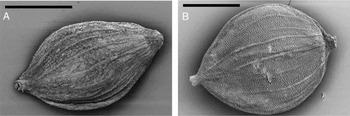
As noted above, the striking similarity between Carex nigra subsp. drukyulensis and more typical forms of C. nigra, especially regarding utricle morphology, explain the initial description of the taxon as a subspecies of the latter. The utricles of Carex nigra subsp. drukyulensis are elliptical to elliptical-obovate (Fig. 1A), whereas in C. nigra they range from ovate (Fig. 1B) to elliptical-obovate (Chater, Reference Chater, Tutin, Heywood, Burges, Valentine, Walters and Webb1980; Egorova, Reference Egorova1999; Ball & Reznicek, Reference Ball and Reznicek2002; Luceño & Jiménez-Mejías, Reference Luceño, Jiménez-Mejías, Castroviejo, Luceño, Galán, Jiménez-Mejías, Cabezas and Medina2008; Jiménez-Mejías et al., Reference Jiménez-Mejías, Rodríguez-Palacios, Amini-Rad and Martín-Bravo2015). Utricles of both species share papillose ornamentation and conspicuous nerves. Among the subtle differences between the two taxa, the most prominent are the glumes, which equal the utricles in Carex nigra subsp. drukyulensis, whereas in C. nigra they are typically shorter (Chater, Reference Chater, Tutin, Heywood, Burges, Valentine, Walters and Webb1980; Egorova, Reference Egorova1999; Ball & Reznicek, Reference Ball and Reznicek2002; Luceño & Jiménez-Mejías, Reference Luceño, Jiménez-Mejías, Castroviejo, Luceño, Galán, Jiménez-Mejías, Cabezas and Medina2008).
Scanning electron microscope photographs of utricles of A, Carex nigra subsp. drukyulensis (from Holotype, Grierson & Long 1764); and B, C. nigra subsp. nigra (Scotland, Isle of Eigg; P.H. Davis 695 GB 1955). Scale bar, 1 mm.

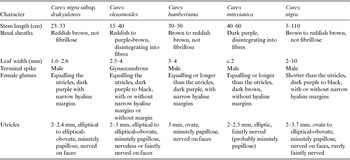
The two taxa found to be related to Carex nigra subsp. drukyulensis, C. eleusinoides and C. humbertiana, display clear-cut differential characters with it. The terminal spike of Carex eleusinoides is gynaecandrous rather than male-only (Egorova, Reference Egorova1999; Ball & Reznicek, Reference Ball and Reznicek2002). Carex humbertiana is larger in overall size (stems 30–50 cm), with wider leaves (3–4 mm) and ovate utricles (Ohwi, Reference Ohwi1933).
Apart from the taxa included in the Global Carex Group (2016) phylogeny, Carex nigra subsp. drukyulensis does not seem to be a good match for any other species described from Bhutan or neighbouring areas. From descriptions of Carex minxianica (Yang, Reference Yang1984; Dai et al., Reference Dai, Liang, Zhang, Tang, Koyama, Tucker, Wu, Raven and Hong2010), C. nigra subsp. drukyulensis can be distinguished by its shorter stems (23–33 cm versus 40–60 cm in C. minxianica), basal sheaths (reddish brown, not fibrillose versus dark purple, disintegrating into fibres), female glumes (with narrow hyaline margins versus without hyaline margins) and utricle nerves (conspicuously versus faintly nerved).
The differential characters between Carex nigra subsp. drukyulensis and the taxa cited above are summarised in Table 1.
Comparison of the main differential characters between Carex nigra subsp. drukyulensis and the species considered in this study

Conclusion and Taxonomic Treatment
The combination of the previous molecular results (Global Carex Group, 2016) and our comparison with related taxa support the recognition of Carex nigra subsp. drukyulensis as a distinct species.
Carex drukyulensis (Noltie) Jim.Mejías & Noltie, comb. et stat. nov.
Carex nigra subsp. drukyulensis Noltie, Edinburgh J. Bot. 50: 189 (Reference Noltie1993) [basionym] – Holotype: Bhutan, Bumthang district, Byakar, 2750 m, 9 vi 1979, Grierson & Long 1764 (E!; image at RBGE, continuously updated).
The following morphological and ecological summary is based largely on Noltie (Reference Noltie1993). No new specimens of this species have become available since this publication, so the measurements and main characteristics remain essentially the same. Given the small number of populations on which our observations are based, greater morphological and ecological variation might be expected in nature.
Herb, rhizomatous, stems apparently tufted. Basal sheaths few, short, acute, reddish brown, not fibrillose. Flowering stems 23–33 cm, trigonous, scabrid on angles. Leaves basal, shorter than to equalling flowering stems, 1.6–2.6 mm wide, epistomatic. Bracts leaf-like, not sheathing, with inconspicuously or minute dark auricles at their insertion, lowermost one longer than its spike but shorter to almost equalling the entire inflorescence. Inflorescence racemose, with usually 4 spikes, lateral ones pistillate or shortly androgynous, the terminal one staminate, all erect. Staminate spike 2.2–4.2 cm × 3–4 mm, cylindrical to narrowly oblanceolate, on a peduncle 1–3.5 cm. Pistillate spikes 1–5.5 cm × 2.5–4 mm, narrowly cylindric to oblong, overlapping, sessile or on peduncles up to 1 cm, lowermost sometimes sub-basal and then on a long peduncle up to 12 cm. Staminate glumes c.3.5–4 × 0.9–1 mm, rounded at apex, purplish brown, with a light-coloured midrib and sometimes very narrowly hyaline margins towards the apex. Pistillate glumes 1.9–2.6 × 1–1.2 mm, narrowly oblong-lanceolate, apex rounded, dark purplish brown, midrib greenish, margins very narrowly hyaline. Stigmas 2. Utricles 2–2.4 × 1–1.2 mm, elliptic to elliptic-obovate, narrowly biconvex, greyish green, minutely papillose, with 5–9 nerves per face, ± attenuated at the apex into an inconspicuous c.0.1- to 0.2-mm beak, slightly contracted proximally into a stipitate base c.0.5 mm long. Achenes biconvex.
Paratypes (as indicated in Reference Noltie Noltie, 1993 )
Bhutan, Bumthang district, Chunkar, 9500 ft, 12 vi 1949, Ludlow, Sherriff & Hicks 20100 (BM!); 6 km N of Thimphu Dzong, 2450 m, 9 vi 1975, Grierson & Long 119 (E!).
Ecology
Wet and moist meadows, between c.2450 and 2900 m.
Etymology
The specific epithet refers to the Bhutanese name of Bhutan, which is Druk yul.
Key to Bhutanese species of Carex sect. Phacocystis
The following artificial identification key is abstracted largely from Noltie's (Reference Noltie1994) generic key to Carex. It allows the distinguishing of the Bhutanese species of Carex sect. Phacocystis from all the other members of the genus in this area.
-
1a. Stigmas 3________________________________Other species of Carex
-
1b. Stigmas 2_______________________________________2
-
2a. Spikes all androgynous or gynaecandrous, all sessile or subsessile Other species of Carex
-
2b. Terminal spike usually male, lateral spikes female or androgynous, spikes sessile or conspicuously pedunculate________________________________3
-
3a. Female dark purplish brown or pale brownish, with midrib long-excurrent into a conspicuously scabrid awn, if glumes not awned and tip acute then the colour is pale brown________________________________sect. Praelongae
-
3b. Female glumes blackish-purple to dark purplish-brown, rounded to acute, not awned, sometimes tipped by a minute non-scabrid mucro___4. sect. Phacocystis
-
4a. Utricles widely elliptic to suborbicular, dark-coloured on at least its upper third when ripe, rounded at the apex and abruptly constricted into a 0.1- to 0.2-mm beak; mature pistillate spikes with utricles erect or patent_______________C. orbicularis
-
4b. Utricles narrowly elliptic, elliptic-obovate or lanceolate, not dark-coloured above or only at the beak, attenuated or constricted at the apex into a 0.1- to 1-mm beak, or utricles almost beakless; mature pistillate spikes with utricles erect__________5
-
5a. Utricles elliptic to elliptic-obovate, attenuated at the apex into a minute inconspicuous 0.1- to 0.2-mm beak; terminal staminate spike conspicuously overtopping the lateral ones, giving to the inflorescence an elongated appearance at the top________________________________C. drukyulensis
-
5b. Utricles elliptic to lanceolate, attenuated or more or less contracted at the apex into a conspicuous cylindrical 0.3- to 1-mm beak; terminal staminate spike long overlapping with the lateral ones, giving to the inflorescence a corymbose appearance at the top________________________________6
-
6a. Utricles up to 2.1–2.9 mm long, abruptly contracted at the apex into a beak 0.3–0.6 mm long, conspicuously bifid at the apex; glumes dark purplish brown C. notha
-
6b. Utricles (3–)3.5–4.6 mm long, attenuated at the apex into a beak up to 1 mm long and truncate at the apex; glumes black___________________________C. fucata
Acknowledgements
We thank the curator and staff of the Royal Botanic Garden Edinburgh (E) for facilities in studying the materials; we also would like to thank an anonymous reviewer whose helpful comments allowed improvement of the manuscript.