


INTRODUCTION
Common bean (Phaseolus vulgaris L.) is produced primarily in tropical low-income countries by small farmers, and is considered a very important staple food legume crop in the developing world. In Venezuela, common bean is grown mainly on erosion-prone slopes of limited fertility at altitudes ranging between 1200 and 2200 m above sea level, without irrigation and using little or no fertilizers. In the highlands, plants are nodulated by native rhizobial populations and, due to cloudiness, are exposed to medium ranges of solar PPFD ≥900 ≤1200 μmol m−2 s−1 with average air temperatures of 26±2 °C at midday. In recent years, however, severe landslides due to excessive rainfall over mountain areas have forced farmers to shift common bean crops to lower altitudes. Field observations reveal poor growth and scanty nodulation on the local common bean cultivars sown in the lowland savannas, low-fertility sandy soils, probably a consequence of the high PPFD (HI) up to 2000 μmol m−2 s−1 and high air temperatures (HT) up to 38 °C to which plants are exposed at midday. Common bean crops that are dependent on symbiosis with rhizobia for their nitrogen (N) supply seem to be especially sensitive to those environmental conditions (Shamseldin, Reference Shamseldin2007) that prevail in sun-exposed savannas.
To ensure survival under HI, plants are known to display several strategies such as activation of oxidative metabolism (Takahashi and Badger, Reference Takahashi and Badger2011; Wang et al., Reference Wang, Yu, Zhu and Yu2011), and synthesis of carotenoids associated with reduced concentrations of chlorophyll to avoid photoinhibition (Jahns and Holzwarth, Reference Jahns and Holzwarth2012; Zhan et al., Reference Zhan, Su, Chen, Zeng, Sun and Peng2012). Previous reports have also shown the importance of the nutrient-status on the capacity of Rhizobium-nodulated (+Rh) legumes to tolerate HI (Izaguirre-Mayoral and Sinclair, Reference Izaguirre-Mayoral and Sinclair2009). Among all the nutrients required for plant growth, Ca is considered a signal molecule (Brownlee and Hetherington, Reference Brownlee and Hetherington2011; Cho et al., Reference Cho, Chao and Kao2012; Huang et al., Reference Huang, Chen, Dong, Patton, Pei and Zheng2012; Sarwat et al., Reference Sarwat, Ahmad, Nabi and Hu2013) that triggers defence mechanisms for tolerance to HI (Chen et al., Reference Chen, Li and Gao2007; Luo et al., Reference Luo, He and Lee2009; Snider et al., Reference Snider, Oosterhuis and Kawakami2011; Zhao and Tan, Reference Zhao and Tan2005). On the other hand, deficiency of P in leaf tissues depresses net photosynthesis which results in an accumulation of photon energy that aggravates the deleterious effects of HI on plants (Nilsson et al., Reference Nilsson, Lundmark, Jensen and Nielsen2012; Weng et al., Reference Weng, Xu, Yang and Peng2008). Moreover, P and Ca are key macronutrients for the effective establishment of symbiosis in +Rh legumes (Abdi et al., Reference Abdi, Bargaz, Bouraoui, Ltaief, Ghoulam and Sifi2012; Banath et al., Reference Banath, Greewood and Loneragan1996; Bargaz et al., Reference Bargaz, Faghire, Farissi, Drevon and Ghoulam2013; Izaguirre-Mayoral et al., Reference Izaguirre-Mayoral, Carballo, Carreño and Mejía2000; Kang et al., Reference Kang, Zhu, Chu, Yang, Yuan, Yu, Wang, Hong and Zhang2011; Kouas et al., Reference Kouas, Louche, Debez, Plassard, Drevon and Abdelly2009; Lazali et al., Reference Lazali, Bargaz, Carlsson, Ounane and Drevon2014; Leide and Rodriguez-Navarro, Reference Leidi and Rodriguez-Navarro2000; Miller and Sirois, Reference Miller and Sirois1983; Pelaez et al., Reference Pelaez, Olivares, Cuenca and Izaguirre-Mayoral2010; Tanga et al., Reference Tanga, Hinsinger, Drevon and Jaillard2001; Zaman-Allah et al., Reference Zaman-Allah, Sifi, L’Taief, El Aouni and Drevon2007). Positive interactions between Ca and P uptake were recently reported in green beans (Salinas et al., Reference Salinas, Sanchez, Ruiz, Lao and Romero2013). The survival of soil free-living rhizobia also requires an optimal supply of Ca and P (O’Hara, Reference O’Hara2001).
The negative effects of HI on the physiology of plants have been investigated intensively (Greer and Weedon, Reference Greer and Weedon2012; Keren and Krieger-Liszkay, Reference Keren and Krieger-Liszkay2011; Raven, Reference Raven2011). However, a detailed review of the literature revealed limited data on the physiology of common bean under HI. Studies conducted in temperature-controlled growth chambers where N-fertilized (+N) plants were under low PPFD <300 μmol m−2 s−1 before being subjected to HI>1000 μmol m−2 s−1 for short periods of time (Ferreira et al., Reference Ferreira, Bressan-Smith, Elias, Silva, Viana and Oliveira2007; Lambreva et al., Reference Lambreva, Stoyanova-Koleva, Baldjiev and Tsonev2005; Marschner and Cakmak, Reference Marschner and Cakmak1989). Overall information indicates limited antioxidant capacity and basal thermotolerance in +N common bean for minimising oxidative damage caused by HI/HT (Guidi et al., Reference Guidi, Tonini and Soldatini2000; Shainberg et al., Reference Shainberg, Baruch, Rabinowitch, Libal-Weksler and Tel-Or1999; Tsai and Hsu, Reference Tsai and Hsu2009). In N2-fixing common bean, temperatures above 30 °C hampered nodulation and nodule functioning (Hungria and Kaschuk, Reference Hungria and Kaschuk2014). Concomitantly, prolonged exposure to HT increased chlorophyll content but reduced leaf thickness and growth in +N common bean (Lin and Markhart, Reference Lin and Markhart1990; Peet et al., Reference Peet, Ozbun and Wallace1977).
In Venezuela, local common bean cultivars are selected under mild environmental conditions and large inputs of N fertilizer. Adoption of Rhizobium inoculant technology by small farmers is, however, becoming a necessity to reduce the cost of the crops and the contamination of ground water with nitrates. Nevertheless, the poor performance of +Rh common bean in Venezuelan lowlands (unpublished results) does not encourage farmers to adopt this technology. Therefore, the main objective of the present research on common bean was to elucidate the interactions between P:Ca nutrition levels and PPFD, as well as the capacity of Pg, a potent free-radical scavenger (Izaguirre-Mayoral and Garrido, Reference Izaguirre-Mayoral and Garrido2010), to counteract the negative effects of HI/HT on the growth and physiological performance of +Rh and +N plants. Our hypotheses were that: (i) applications of an optimal P:Ca ratio would improve the symbiotic performance of +Rh and +N plants under HI/HT, and (ii) exogenous applications of Pg would increase the antioxidative capacity of +Rh and +N plants which should allow plants to survive and grow under HI/HT conditions typical of Venezuelan lowlands.
The impacts of two contrasting PPFD/air temperature treatment combinations on +Rh and +N plants were evaluated by changes in the shoot mass, chlorophyll, carotenoids and ureide concentrations in leaves as well as chlorophyll a/b ratio and nitrate concentration in shoots. In +Rh plants, the nodule mass as well as the ureide concentration in leaves and nodules were determined as indicators of the efficiency of symbiosis. The analysis presented here is, to our knowledge, the first of this kind, investigating the complex long term influence of HI/HT and the source of N on common bean grown in varying Ca and P concentrations and treated with an antioxidant.
MATERIALS AND METHODS
Plant material and plant treatments
Seeds of common bean (P. vulgaris L. var. Magdaleno), an early flowering cultivar, were surfaced-sterilized with ethanol:water (70% v/v) for 5 min, rinsed six times with sterile distilled water, and sown in sterilized Leonard jars (one seed per jar) containing 1 kg of sand and 0.8 L of a nutrient solution in the upper and lower compartments, respectively. The basic nutrient solution contained 1 mM MgSO4, 4 μM H3BO3, 2 μM MnSO4, 2 μM Fe-EDTA 1.6 μM ZnSO4, 1.6 μM CuSO4 and 0.1 μM NaMoO4. Half of the plants were pre-inoculated with a peat based inoculum of Rhizobium leguminosarum biovar phaseoli strains 127K44, 127K89, and 127K105 (Novozymes BioAg, Milwaukee, WI) (+Rh), previously proved to be highly efficient on this Magdaleno cultivar; while the other half were fertilized with 6 mM KNO3 (+N). Based on previous assays, the concentrations of MnSO4 and Fe-EDTA in the nutrient solution for +Rh plants were increased up to 60 and 6 μM, respectively, to ensure nodulation (unpublished observations). The effect of varying concentrations of P and Ca was achieved by adding to the nutrient solutions 1, 2, 3 or 4 mM KH2PO4 in combination with 1 or 4 mM CaSO4. All solutions were adjusted to a pH 6.2 with HCl. To study the effects of a free radical scavenger, a group of +N and +Rh plants were treated with 2 mM (3,4,5-trihydroxybenzoic acid propyl ester) Pg aqueous solution containing 0.01% Tween 20. The Pg solution was sprayed twice a day at 09:00 and 16:00 h local time on the lower surface of all leaves avoiding run-off, throughout the experimental duration. Control plants were mock-sprayed with an aqueous 0.01% Tween 20 solution.
The appropriate nutrient solution was added daily to each Leonard jar to compensate for transpirational losses, and replaced every four days. The upper compartment of each Leonard jar was surrounded with a double layer of aluminium foil previously wrinkled to improve convective heat dissipation and the surface of the sand was covered with white foam beans to avoid overheating by direct sunlight. Plants were placed at a distance of 20 cm between jars to avoid shadowing. This growth system has been proven to be suitable to assay Rhizobium-nodulated and N-fertilized common bean under contrasting nutrient conditions. For the present investigation, the use of Leonard jars eliminated the interference of the physico-chemical properties of soils, as well as of the great biodiversity of indigenous soil rhizobial populations from high and lowlands on the responses of plants to varying PPFD and increasing P and Ca concentrations.
Solar photosynthetic photon flux density (PPFD) conditions
Experiments at HI/HT were carried out in a greenhouse located at 10 ° 15′ north latitude, 67 ° 37′ west longitude and 445 m above sea level at the Faculty of Agronomy, Central University of Venezuela, Maracay. Seeds were sown in April 2011 to take advantage of the high solar irradiance resulting from a cloudless sky on many days during the April–May period. At this low altitude, plants were exposed at midday hours to a HI ≥1650 and ≤1800 μmol m−2 s−1 and a HT of 37±2 °C for 90% of the total duration of the experiment. For MI/MT conditions, plants were sown in a greenhouse located at 10 ° 22′ north latitude, 66 ° 58′ west longitude and 1600 m above sea level at the Venezuelan Scientific Research Institute, Caracas, in July–August 2011 when there was substantial cloud formation on most days. At this altitude, plants were exposed to a MI ≥850 and ≤1100 μmol m−2 s−1 and a MT at noon of 26±2 °C for 60% of the days. The PPFD and air temperatures at the plant level were monitored with a HOBO Micro Station H21–002 data logger (MicroDAQ, Ltd, USA). Data of soil temperature measured with a thermometer placed 3 cm deep into the sand indicated a 28±1 °C and 23±2 °C for HI/HT and MI/MT plants, respectively.
Plant analyses
A total of six replicates of each treatment combination were harvested at 30 days after emergence (preflowering). Carotenoid, chlorophyll a and b concentrations were measured at 470, 645 and 663 nm, respectively, in 1 cm2 discs removed from the central area of each of the three leaflets of the topmost fully expanded leaf (Izaguirre-Mayoral et al., Reference Izaguirre-Mayoral, Carballo, Sicardi de Mallorca, Marys and Gil1994). Plants were then separated into leaves, shoots, roots, and nodules, and the components were individually oven-dried at 80 °C until a constant weight. Subsamples of the leaves and nodules were used to measure ureides colorimetrically (Izaguirre-Mayoral et al., Reference Izaguirre-Mayoral, Carballo, Sicardi de Mallorca, Marys and Gil1994). Nitrate concentration in the first internode was extracted and measured as in Cataldo et al. (Reference Cataldo, Harron, Schrader and Young1975). Colorimetric measurements were carried out in Beckman model 7400 spectrophotometer.
Statistics
Results were expressed as the statistical mean of six replicates per treatment combination ± standard error of the mean. Values in percentage were transformed to degrees by angular transformation. Data were statistically analysed using a one-way analysis of variance on the basis of which LSD values (P <0.05 for n = 6) were calculated. Statistical differences between means were determined using a two-sample F-test for variance followed by a Student´s t-test at p ≤0.05 level of significance. The analyses were performed with the software SigmaStat 3.1.
RESULTS
Effect of varying PPFD and increasing Ca and P concentrations
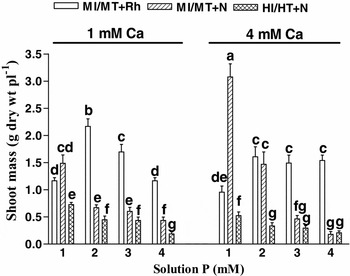
Growth of common bean in a greenhouse at two contrasting altitudes was successful in subjecting the plants to differing PPFD, substantially altering the shoot masses of all plants among treatment combinations (Figure 1). Under HI/HT conditions, the +Rh plants did not survive the juvenile stage of growth. Only HI/HT+N plants reached the pre-flowering stage, although with shoot masses smaller than that of MI/MT+N plants. The negative effects of HI/HT on HI/HT +N plants were exacerbated at P≥2 mM, mainly at 4 mM Ca, and all plants had leathery and brittle leaves that displayed paraheliotropism at noon. Maximum growth of +Rh plants occurred at MI/MT conditions in combination with 2 mM P and 1 mM Ca. Note that 1 mM P was insufficient for all +Rh plants supplied with 1 or 4 mM Ca, and that at P>2 mM the growth of MI/MT+Rh plants was greater than of MI/MT+N plants, regardless of the Ca concentration in the nutrient solution. Among all PPFD and N source treatment combinations, the greater growth was observed in the MI/MT+N plants grown in solutions containing 1 mM P combined with 4 mM Ca. At both Ca concentrations, the growth of MI/MT+N plants was hindered at P>2 mM. For all treatment combinations, the root mass followed the same trend as the shoot mass (data not shown).
Shoot mass of 30-d-old Rhizobium-nodulated (+Rh) and N-supplied (+N) P. vulgaris plants grown in 4 or 1 mM Ca combined with increased P concentrations under high PPFD/high air temperature (HI/HT) or medium PPFD/medium air temperature (MI/MT) in greenhouses. Means of six replicates (±SE) in columns labelled with the same letter(s) are not significantly different (LSD, p < 0.05).

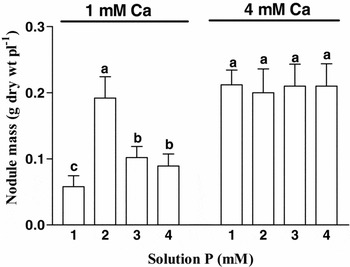
The greatest nodule mass occurred in all MI/MT+Rh plants grown in 4 mM Ca, or in 1mM Ca combined with 2 mM P (Figure 2). The combination of 1 mM Ca with P <2 mM or ≥3 mM triggered minimum nodulation in MI/MT+Rh plants.
Nodule mass of 30-d old Rhizobium-nodulated (+Rh) P. vulgaris plants grown in 4 or 1 mM Ca combined with increased P concentrations under medium PPFD/medium air temperature (MI/MT) in a greenhouse. Means of six replicates (±SE) in columns labelled with the same letter(s) are not significantly different (LSD, p < 0.05).

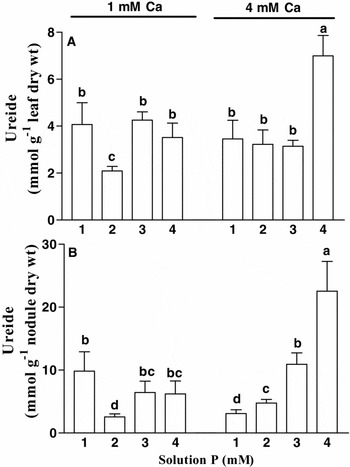
A massive accumulation of ureides was detected in leaves of MI/MT+Rh plants supplied with 4 mM P and 4 mM Ca (Figure 3A). Whereas, the lowest ureide concentration was observed in MI/MT+Rh plants supplied with 2 mM P and 1 mM Ca. Ureides were below detectable levels in leaves of +N plants. A similar situation was observed in nodules, with the lowest concentration of ureides detected in nodules from MI/MT+Rh plants grown in 1 mM Ca and 2 mM P (Figure 3B). In contrast, increasing P was associated to increasing ureide concentrations in nodules of MI/MT+Rh plants grown in 4 mM Ca.
Ureide concentrations in leaves (A) and nodules (B) of 30-d old Rhizobium-nodulated (+Rh) P. vulgaris plants grown in 4 or 1 mM Ca combined with increased P concentrations under medium PPFD/medium air temperature (MI/MT) in greenhouses. Means of six replicates (±SE) in columns labelled with the same letter(s) are not significantly different (LSD, p < 0.05).

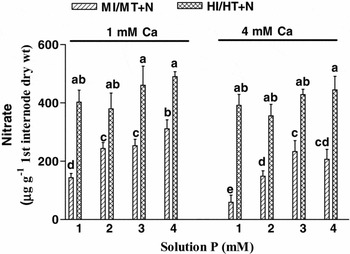
The highest nitrate concentrations occurred in all plants subjected to HI/HT, regardless of the P and Ca concentrations in the nutrient solution (Figure 4); whereas, the lowest nitrate concentrations occurred in MI/MT+N plants grown in 1 mM Ca and 1 mM P. Nitrate was below detectable values in all +Rh plants.
Nitrate concentration in the first internode of 30-d old N-supplied (+N) P. vulgaris plants grown in 4 or 1 mM Ca combined with increased P concentrations under high PPFD/high air temperature (HI/HT) or medium PPFD/medium air temperature (MI/MT) in greenhouses. Means of six replicates (±SE) in columns labelled with the same letter(s) are not significantly different (LSD, p < 0.05).

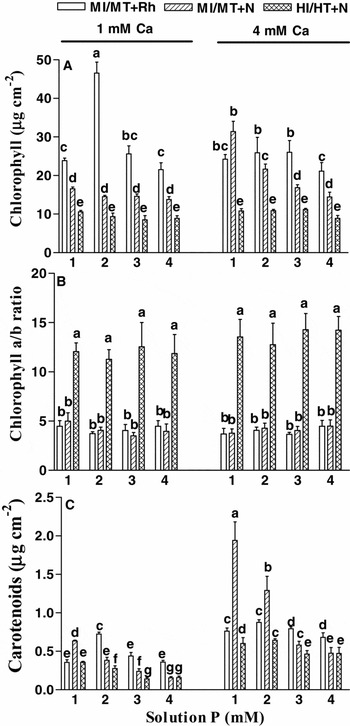
In general, the chlorophyll concentrations matched the growth of the +Rh and +N plants (Figure 5A). That is, the highest chlorophyll concentrations occurred in MI/MT+Rh plants grown in 2 mM P and 1 mM Ca, as well as in MI/MT+N plants grown in 1 mM P and 4 mM Ca; while the lowest chlorophyll concentrations were detected in HI/HT+N plants at all levels of Ca and P. The calculated chlorophyll a/b ratios were not altered by increasing P or Ca concentrations in the nutrient solutions, and values were unusually high in all HI/HT+N plants (Figure 5B). Concentrations of carotenoids in leaves also matched the growth of the +Rh and +N plants (Figure 5C). However, concentrations of carotenoids were lower in all plants grown in 1 mM Ca, when compared to those supplied with 4 mM Ca.
Total chlorophyll concentrations (A), chlorophyll a/b ratios (B), and carotenoid concentrations (C) in the three upper most mature trifoliolate leaves of 30-d old Rhizobium-nodulated (+Rh) and N-supplied (+N) P. vulgaris plants grown in 4 or 1 mM Ca combined with increased P concentrations under high PPFD/high air temperature (HI/HT) or medium PPFD/medium air temperature (MI/MT) in greenhouses. Means of six replicates (±SE) in columns labelled with the same letter(s) are not significantly different (LSD, p < 0.05).

Effect of propyl gallate (Pg)
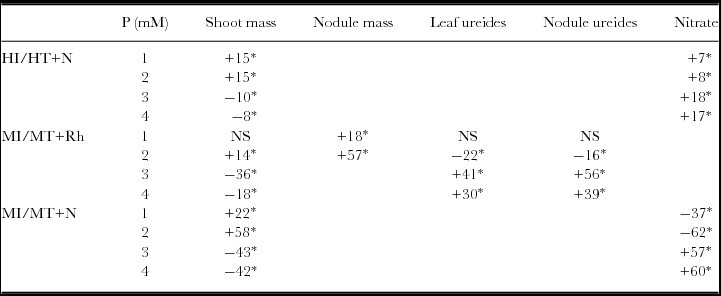
The magnitude of the response of +Rh and +N plants to Pg was not modified by the concentration of Ca in the nutrient solution. To save space, data in Table 1 correspond only to plants growing in 1 mM Ca. The Pg treatment did not counteract any of the negative effects elicited by HI/HT on the growth of +Rh. In contrast, Pg enhanced the growth and reduced the nitrate concentration in all HI/HT+N plants grown at P≤2 mM, but decreased both growth concentration of nitrates in HI/HT+N plants grown in P≥3 mM. A positive response to Pg was evidenced only in +Rh and +N plants grown under MI/MT conditions. Addition of Pg markedly increased the shoot and nodule masses, and concomitantly decreased the concentrations of ureides in leaves and nodules of MI/MT+Rh plants grown in 2 mM P. At 1 mM P, MI/MT +Rh plants showed an enhancement, albeit weak, in the nodule mass. However, at P≥3 mM, Pg did not favour nodulation and hindered the growth of the MI/MT+Rh plants causing a marked accumulation of ureides in leaves and nodules. In MI/MT+N plants grown in P≤2 mM, Pg increased the growth and reduced the nitrate concentrations in the shoots, with the higher effects recorded in the plants grown in 2 mM P. At P≥3 mM, Pg hindered the growth and elicited an accumulation of nitrates in the MI/MT+N plants. Pg did not alter the chlorophyll and carotenoid concentrations in any of the plants subjected to the different treatment combinations (not shown).
Effects of 2 mM propyl gallate (Pg) on several physiological parameters of 30-d old Rhizobium-nodulated (+Rh) and N-fertilized (+N) P. vulgaris grown in increasing P concentrations and 1 mM Ca, under high PPFD/high temperature (HI/HT) or medium PPFD/medium temperature (MI/MT) conditions. Results are expressed as the changes in% on the values of individual plant parameters in plants treated with Pg with respect to values in non-treated ones, grown in similar nutrient concentrations. For calculation of the% of variation, data of non-sprayed Pg plants were extracted from individual figures.
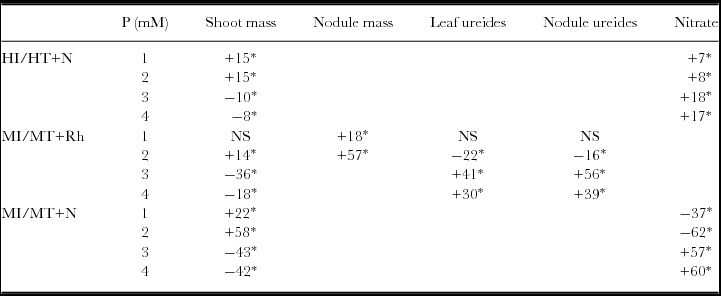
*Difference between means statistically significant at p < 0.05. NS, difference between means non-significant at p < 0.05. +Above values in non-Pg spread plants; −, below values in non-Pg spread plants.
DISCUSSION
The analysis presented here is, to our knowledge, the first of its kind investigating, at a whole plant level, the long term effects of two contrasting PPFD and their intrinsically linked average air and root temperatures on +Rh and +N common bean supplied with increasing P and Ca concentrations and treated with Pg. As observed from the results, it is possible to assume that hindered nodulation brought about by HI/HT conditions, was the main factor responsible for the 100% mortality of all HI/HT+Rh plants at the juvenile stage of growth. As shown by Hungria and Franco (Reference Hungria and Franco1993), nodules harbouring strains of R. leguminosarum bv. phaseoli formed under high root temperatures are ineffective causing N-starvation. In contrast, the activation of various mechanisms such as dissipation of the excess of light via an unusually high chlorophyll a/b ratio, lower chlorophyll content per unit leaf (Vaz and Sharma, Reference Vaz and Sharma2009), and the paraheliotropism of mature expanded leaves (Pastenes et al., Reference Pastenes, Pimentel and Lillo2005) helped HI/HT+N plants to avoid photo and leaf thermodamages. It is also possible that the mitochondrial alternative oxidase pathway, reported in Rumex K-1 leaves (Zhang et al., Reference Zhang, Zhang, Gao, Xue, Yang, Meng and Meng2011), partially alleviated photoinhibition in the HI/HT+N plants. Those mechanisms, however, failed to promote the growth of HI/HT+N up to that of MI/MT+N plants, probably as a consequence of reduced nitrate reductase activity in mature leaves (Mata et al., Reference Mata, Cabello, Haba and Agueera2013), resulting in the observed accumulation of nitrates in the first internode of HI/HT+N plants. The products of nitrate reduction are known to function as oxidants in N-fertilized plants (Chikov and Bakirova, Reference Chikov and Bakirova1999). Therefore, it is possible to postulate a diminished oxidative protection in mature leaves of HI/HT+N plants. Foliar spray with Pg further aggravated the poor oxidative status in HI/HT+N plants by hindering their exiguous defence mechanisms against HI/HT, increasing their susceptibility to HI/HT conditions.
The growth of +Rh and +N plants was favoured only under MI/MT conditions. The benefits of the MI/MT on plant growth were ascertained by the lower chlorophyll concentrations, lower chlorophyll a/b ratios and higher carotenoid concentrations in all plants subjected to those milder environmental conditions. At MI/MT, however, the responses of the plants to varying Ca and P concentrations in the nutrient solution depended on the source of N. For MI/MT+N plants, the maximum growth and the lowest concentration of nitrates in the first internode took place in 4 mM Ca combined with 1 mM P. In contrast, the combination of 1 mM Ca and 2 mM P promoted maximum growth of MI/MT+Rh plants. The positive effects of high Ca on +N plants were recognized before (Fageria, Reference Fageria2008). It was, however, surprising to observe the low requirement of Ca by +Rh plants considering that nodule formation has a much greater requirement for Ca than root and shoot growths (Lowther and Loneragan, Reference Lowther and Loneragan1968). On the other hand, it was not surprising that the MI/MT+Rh and MI/MT+N plants showed relatively low P requirements when we take into consideration the low P in tropical soils where the Magdaleno genotype, used in this research, was selected. It is interesting to note that this genotype has four to five large basal root whorls, an important genetic trait for improved P acquisition in common bean (Miguel et al., Reference Miguel, Widrig, Vieira, Brown and Lynch2013). Concomitantly, the greater positive responses of all MI/MT plants to Pg only when grown at P≤2 mM confirm previous reports on the low anti-oxidative activity in bean subjected to low P (Russo et al., Reference Russo, Verde, Belligno and Malusa2011). A more active anti-oxidative metabolism with increasing P would explain the reverse effect of Pg in all MI/MT plants grown at P>2 mM. As previously indicated, greenhouse experiments were carried out under natural conditions of PPFD and air temperature, therefore, it is impossible at present to attribute the effects observed to either HI or to HT individually. Although PPFD and air temperatures are climatologically connected, previous publications suggest that HT is a bigger problem for tropical N2-fixing common bean cultivars than is HI (Boote et al., Reference Boote, Allen, Prasad, Baker, Gesch, Snyder, Pan and Thomas2005).
The complexities underlying the interactions between Ca and P at the plant level were further emphasized by the observation that nodulation in MI/MT+Rh plants was affected by the concentration of P in the nutrient solution only at low Ca. Even more, under MI/MT conditions, all plants exhibited lower concentrations of carotenoids when grown at 1 mM Ca in agreement with a previous report in soybean (Milivojevic and Stojanovic, Reference Milivojevic and Stojanovic2003). Nevertheless, at optimal Ca and P concentrations the growth of MI/MT+Rh was 1.5 fold smaller than that of MI/MT+N plants. The lack of a direct relationship between nodule mass and dry weight of the shoot mass of MI/MT+Rh plants did not support the strong sink strength of nodules as the main reason for this observation. Rather, the slow rates of ureide catabolism in leaves seem to be the main factor responsible for the small size of MI/MT+Rh plants (Izaguirre-Mayoral et al., Reference Izaguirre-Mayoral, Carballo, Sicardi de Mallorca, Marys and Gil1994). It is also possible that higher growths of MI/MT+N plants at the corresponding optimal P:Ca ratio were related to their highest concentrations of carotenoids that provided them with an enhanced efficiency for thermal energy dissipation under natural conditions, a situation not available in +Rh plants.
CONCLUSIONS
From the present results two main conclusions can be drawn: (1) the local common bean variety Magdaleno, in symbiosis with rhizobia, is intolerant to HI/HT conditions. Furthermore, increasing concentrations of Ca and P as well as a treatment with a free radical scavenger failed to promote nodulation and protect the symbiotic and photosynthetic apparatus against tropical HI/HT conditions in +Rh plants. Therefore, in absence of cultivars tolerant to HI/HT, inoculation of common bean with efficient rhizobial strains should be only recommended to farmers located in highlands of Venezuela; and, (2) agronomic recommendations should also include fertilization of MI/MT+Rh plants with sufficient P to ensure an efficient symbiosis with Rhizobium. Low P availability is especially problematic for common bean, since the symbiotic N2 fixation is a highly P demanding process, and application of P fertilizer is only a partial solution since they are costly, non-renewable and also marginally effective because of immobilization by the soil. Therefore, genetic improvement for P efficiency in common bean would be more economical and practical than chemical P fertilizer. The determination of genetic variability for plant tolerance to HI/HT conditions will also help identify new varieties better adapted to HI/HT and low P soil conditions characteristic of tropical lowland regions. Emphasis must be focused on breeding and selection of new HI/HT tolerant varieties in association with Rhizobium-inoculation field practices. The possibility that individual indigenous lowland strains are more resistant to high soil temperatures should also be explored.
Acknowledgements
We thank Prof. Dr. L.H. Allen Jr. (USDA Gainesville, Fl) for his critical reading of the manuscript and Dr. Abeda Daewood for language editing. Results are part of the under graduate thesis of J. Silvera and M. Rodriguez carried out at IVIC, under the supervision of M.L. Izaguirre-Mayoral.