The concept of allostasis refers to the attainment of stability through physiological and/or behavioral change (Schulkin, Reference Schulkin2003; Sterling & Eyer, Reference Sterling, Eyer, Fisher and Reason1988). Allostasis is a vital process by which organisms actively respond to predictable and unpredictable challenging events to achieve stability (i.e., homeostasis) through being variable (McEwen & Wingfield, Reference McEwen and Wingfield2003; Sterling & Eyer, Reference Sterling, Eyer, Fisher and Reason1988). These dynamic set-point alterations can be conceived as a reflection of the natural adaptive readjustment of regulatory systems and the multiple interacting mechanisms and their modulatory influences that take place in response to altering physiological demands (Berntson & Cacioppo, Reference Berntson, Cacioppo, Cacioppo, Tassinary and Berntson2007; Cicchetti & Tucker, Reference Cicchetti and Tucker1994; Davies, Sturge-Apple, & Cicchetti, Reference Davies, Sturge-Apple and Cicchetti2011; McEwen, Reference McEwen1998). Adaptation in response to changing life span developmental stage transitions and to evolving environmental requirements involves the activation of neural, neuroendocrine, and neuroendocrine-immune mechanisms (Ganzel & Morris, Reference Ganzel and Morris2011; McEwen, Reference McEwen2000).
The processes of allostasis and allostatic load can be conceptualized as embodying a general biological principle, namely, that the same systems that aid in the body's adaptation to stress and serve a protective function in the short term also may promote pathophysiological processes when overused or managed inefficiently (Lupien et al., Reference Lupien, Ouellet-Morin, Hupbach, Tu, Buss, Walker, Cicchetti and Cohen2006). Specifically, although the hormonal and physiological processes that mediate the impacts that stress exerts on the mind and body help to produce protective and adaptive consequences for the organism, these biological processes also can exact a toll, termed allostatic load, that can accelerate pathophysiological processes (McEwen, Reference McEwen2000).
Allostatic load refers to the price the body pays when confronted with repeated major stressors and the resultant physiological sequelae of chronic exposure to heightened and sustained neural and neuroendocrine responsiveness (Ganzel, Morris, & Wethington, Reference Ganzel, Morris and Wethington2010; Juster et al., Reference Juster, Bizik, Picard, Arsenault-Lapierre, Sindi and Trepanier2011; Juster, McEwen, & Lupien, Reference Juster, McEwen and Lupien2010; McEwen & Stellar, Reference McEwen and Stellar1993). Whenever adaptive interconnected biological systems become chronically dysregulated over long time intervals, then maladaptive physiological and psychological consequences are likely to ensue that may persist across the life span (Juster et al., Reference Juster, McEwen and Lupien2010, Reference Juster, Bizik, Picard, Arsenault-Lapierre, Sindi and Trepanier2011). Because these biological systems are interconnected and interacting, alterations in the functioning of one adaptive system can cascade or spread its effects across other systems (Cicchetti & Tucker, Reference Cicchetti and Tucker1994; Masten & Cicchetti, Reference Masten and Cicchetti2010).
Child maltreatment is a stressful and threatening experience for children that poses ongoing adaptational challenges for vulnerable children. The experience of maltreatment during childhood sets in motion a probabilistic path of epigenesis for abused and neglected children that is characterized by an increased likelihood of repeated disruptions in developmental processes that may create a cascade of maladaptation across diverse domains of neurobiological, socioemotional, and cognitive development (Cicchetti, Reference Cicchetti, Cicchetti and Carlson1989; Cicchetti & Toth, Reference Cicchetti and Toth2005; Cicchetti & Tucker, Reference Cicchetti and Tucker1994).
Thus, allostatic load processes may be unfolding very early in the development of maltreated children, setting up the potential for life-long difficulties in the regulation of physiological stress systems. The experience of maltreatment during childhood has been found to increase allostatic load in later life, resulting in a number of emotional and physical problems, including hostility, personality disorders, social isolation, aggression, and depression, as well as obesity, inflammation, cardiovascular disease, and telomere shortening (Caspi et al., Reference Caspi, McClay, Moffitt, Mill, Martin and Craig2002, Reference Caspi, Sugden, Moffitt, Taylor, Craig and Harrington2003; Cicchetti & Valentino, Reference Cicchetti, Valentino, Cicchetti and Cohen2006; Danese et al., Reference Danese, Moffitt, Pariante, Ambler, Poulton and Caspi2008; Felitti et al., Reference Felitti, Anda, Nordenberg, Williamson, Spitz and Edwards1998; Kim-Cohen et al., Reference Kim-Cohen, Caspi, Taylor, Williams, Newcombe and Craig2006; McEwen, Reference McEwen2000; Tyrka et al., Reference Tyrka, Price, Kao, Porter, Marsella and Carpenter2010).
A major psychopathological outcome of dysfunction in the caregiving system early in life is an increased risk for developing depression in maltreated children and adults (Cicchetti & Valentino, Reference Cicchetti, Valentino, Cicchetti and Cohen2006; Kaplow & Widom, Reference Kaplow and Widom2007; Toth, Manly, & Cicchetti, Reference Toth, Manly and Cicchetti1992; Widom, DuMont, & Czaja, Reference Widom, DuMont and Czaja2007). Deriving from the animal literature, it has been postulated that individuals who experience caregiving aberrations such as early child maltreatment are more likely to develop depression if they are genetically vulnerable (Brown & Harris, Reference Brown and Harris2008; Grabe et al., Reference Grabe, Schwahn, Appel, Mahler, Schulz and Spitzer2010; Heim & Nemeroff, Reference Heim and Nemeroff2001). Elevations in stress hormones during episodes of maltreatment also have been theorized to shape the development of more reactive fear and neuroendocrine systems, thereby increasing the risk of internalizing disorders developing in maltreated children and adults (Cicchetti, Rogosch, Gunnar, & Toth, Reference Cicchetti, Rogosch, Gunnar and Toth2010; Heim, Newport, Bonsall, Miller, & Nemeroff, Reference Heim, Newport, Mletzko, Miller and Nemeroff2008).
Animal research has demonstrated that adverse parental care during early development increases fearful, anxious behavior and shapes heightened reactivity in neurobiological systems involved in defensive behavior and physiological stress reactions (for reviews, see Gunnar & Quevedo, Reference Gunnar and Quevedo2007; and Gunnar & Vazquez, Reference Gunnar, Vazquez, Cicchetti and Cohen2006). Likewise, investigations with rodents and nonhuman primates suggest that inadequate or abusive parenting during the early period of life persistently sensitizes the neural circuitry involved in the regulation of stress and emotion. Heightened fear and activation of the hypothalamic–pituitary–adrenal (HPA) system as a function of early adverse care may produce an increase in allostatic load in maltreated children over the life course (Carpenter, Shattuck, Tyrka, Geracioti, & Price, Reference Carpenter, Shattuck, Tyrka, Geracioti and Price2010; Cicchetti et al., Reference Cicchetti, Rogosch, Gunnar and Toth2010; Trickett, Noll, Susman, Shenk, & Putnam, Reference Trickett, Noll, Susman, Shenk and Putnam2010), increasing vulnerability to mood disorders in response to stressors experienced later in development (McEwen, Reference McEwen2000).
In keeping with the dynamic systems concepts of equifinality and multifinality (Cicchetti & Rogosch, Reference Cicchetti and Rogosch1996), not all children who experience abuse and neglect as young children grow up to develop depression; moreover, not all maltreated children exhibit patterns of HPA axis dysregulation (Cicchetti & Rogosch, Reference Cicchetti and Rogosch2001a, Reference Cicchetti and Rogosch2001b; Tarullo & Gunnar, Reference Tarullo and Gunnar2006). Adults who retrospectively report experiencing maltreatment in childhood evidence HPA axis dysregulation and depression (Heim et al., Reference Heim, Newport, Mletzko, Miller and Nemeroff2008). Furthermore, prospective investigations have found that maltreated children suffering from depression evince HPA axis dysregulation (see, e.g., Cicchetti & Rogosch, Reference Cicchetti and Rogosch2001b; Dahl & Ryan, Reference Dahl, Ryan, Cicchetti and Toth1996; DeBellis, Baum, et al., Reference DeBellis, Baum, Birmaher, Keshavan, Eccard and Boring1999; Hart, Gunnar, & Cicchetti, Reference Hart, Gunnar and Cicchetti1996; Kaufman, Reference Kaufman1991; Kaufman et al., Reference Kaufman, Birmaher, Perel, Dahl, Moreci and Nelson1997). In contrast, nonmaltreated children with early-onset depression rarely display evidence of regulatory dysfunction of the HPA axis (Cicchetti & Rogosch, Reference Cicchetti and Rogosch2001b; Feder et al., Reference Feder, Coplan, Goetz, Mathew, Pine and Dahl2004).
In fact, variation in timing and subtype of maltreatment have been shown to influence HPA axis functioning in depressed children. A recent study conducted in our laboratory investigated the impact of early physical abuse and sexual abuse (EPA/SA) occurring in the first 5 years of life in relation to depressive and internalizing symptomatology and diurnal cortisol regulation. In a summer camp context, school-aged maltreated and nonmaltreated children provided morning (9 a.m.) and later afternoon (4 p.m.) saliva samples on 5 consecutive days. Children who experienced EPA/SA and had high depressive or internalizing symptoms uniquely exhibited an attenuated diurnal increase in cortisol due to a slight lowering of cortisol in the a.m. and a slight increase in p.m. cortisol levels. These results, indicative of neuroendocrine dysregulation, were specific to EPA/SA rather than later onset physical or sexual abuse or early occurring neglect or emotional maltreatment (NEPA/SA; Cicchetti et al., Reference Cicchetti, Rogosch, Gunnar and Toth2010). Furthermore, nonmaltreated comparison (NC) children with high levels of depressive or internalizing symptomatology did not exhibit atypical cortisol regulation.
In addition, we discovered that not all of the EPA/SA children had high depressive or internalizing symptoms. This finding led us to question why the HPA axis functioning of this group of early abused children had a better regulated HPA axis than did the group of early abused and depressed children with the attenuated diurnal decrease in cortisol (Cicchetti et al., Reference Cicchetti, Rogosch, Gunnar and Toth2010). We reasoned that it is likely that there are genes that increase the probability of depression and internalizing problems developing under conditions of early high stress such as that experienced by EPA/SA children. Likewise, there are genes that contribute to individual differences in HPA axis regulation, such as the corticotropin releasing hormone receptor 1 (CRHR1; Wüst et al., Reference Wüst, van Rossum, Federenko, Koper, Kumsta and Hellhammer2004).
In the present paper we were able to incorporate molecular genetic variation as another level of analysis after collecting DNA on the Cicchetti et al. (Reference Cicchetti, Rogosch, Gunnar and Toth2010) sample and conducting genotyping of the serotonin transporter linked polymorphic region gene (5-HTTLPR) and the corticotropin releasing hormone 1 receptor gene (CRHR1) in our molecular biology laboratory. Including molecular genetic variation enables us to expand upon our findings involving the effects of early abuse and depression on neuroendocrine dysregulation reported in our earlier paper (Cicchetti et al., Reference Cicchetti, Rogosch, Gunnar and Toth2010).
Genes involved in biological stress systems are important candidates for studies of the genetic sources of HPA axis regulation, as well as for investigations of genetic moderation of the effects of major stressors such as child maltreatment. Corticotropin-releasing hormone (CRH) is the key activator of the HPA axis, binding to receptors that initiate the stress response, culminating with release of cortisol from the adrenal cortex (Gunnar & Vazquez, Reference Gunnar, Vazquez, Cicchetti and Cohen2006). CRH receptors occupy widespread areas of the primate brain (Chrousos, Reference Chrousos1998; Lupien, McEwen, Gunnar, & Heim, Reference Lupien, McEwen, Gunnar and Heim2009; Sanchez, Young, Plotsky, & Insel, Reference Sanchez, Young, Plotsky and Insel1999). CRH receptors may function as transcription factors and thereby serve as regulators of gene transcription (Lupien et al., 2010). Variation in CRHR1 has been linked to HPA axis dysregulation in adults who reported having been maltreated in childhood (Tykra et al., Reference Tyrka, Price, Gelernter, Schepker, Anderson and Carpenter2009) and to risk for depression (Bradley et al., Reference Bradley, Binder, Epstein, Tang, Nair and Liu2008; Polanczyk et al., Reference Polanczyk, Caspi, Williams, Price, Danese and Sugden2009).
The studies conducted by Bradley et al. (Reference Bradley, Binder, Epstein, Tang, Nair and Liu2008) and Polanczyk et al. (Reference Polanczyk, Caspi, Williams, Price, Danese and Sugden2009), in which adults retrospectively reported having been maltreated during childhood, found moderation of the effects of maltreatment on depression by a three-allele haplotype of CRHR1, involving the single nucleotide polymorphisms (SNPs) rs7209436, rs110402, and rs24924. In each of these investigations, the TAT haplotype was protective against depression for individuals who were severely maltreated.
In a recent study conducted in our laboratory, DeYoung, Cicchetti, and Rogosch (Reference DeYoung, Cicchetti and Rogosch2011) found that the CRHR1 genotype moderated the association of childhood maltreatment with neuroticism, but none of the other Big Five personality traits assessed (John, Caspi, Robin, Moffit, & Stouthamer-Loeber, Reference John, Caspi, Robins, Moffitt and Stouthamer-Loeber1994). The tendency to experience depressed mood is one facet of neuroticism (Costa & McCrae, Reference Costa and McCrae1992); moreover, neuroticism poses a major risk for the development of depressive disorder (Griffith et al., Reference Griffith, Uliaszek, Hauner, Zinbarg, Craske and Mineka2009). DeYoung et al. (Reference DeYoung, Cicchetti and Rogosch2011) found that physically abused, emotionally abused, and neglected children who had two copies of the TAT haplotype of CRHR1 had significantly higher levels of neuroticism than nonmaltreated comparison who also possessed two copies of the TAT haplotype. In contrast, sexually abused children who possessed two copies of the TAT haplotype appeared to be protected, as they had lower levels of neuroticism than other types of maltreated children (DeYoung et al., Reference DeYoung, Cicchetti and Rogosch2011). The effect of CRHR1 variation on neuroticism in maltreated children is consistent with the hypothesis that the HPA axis is an important biological substrate for depression and other internalizing disorders (DeYoung et al., Reference DeYoung, Cicchetti and Rogosch2011).
The serotonin transporter gene (5-HTT), one of the major genes involved with serotonergic neurotransmission, has been shown to play a pivotal role in the emergence of individual differences in mood and emotion regulation (Caspi, Hariri, Holmes, Uher, & Moffitt, Reference Caspi, Hariri, Holmes, Uher and Moffitt2010). The 5-HTT gene has a polymorphism in the linked polymorphic region (5-HTTLPR) in the 5′-regulatory region due to a 44-base pair deletion that eventuates in either the short (s) or long (l) allele (Lesch et al., Reference Lesch, Bengel, Heils, Sabol, Greenberg and Petri1996). Because the short variant of 5-HTTLPR appears to be dominant heterozygous (s/l) individuals can be functionally categorized with individuals who possess the homozygous (s/s) genotype. In vitro research has revealed that the long allelic variant has two to three times the transcriptional activity than the short variant (Caspi et al., Reference Caspi, Hariri, Holmes, Uher and Moffitt2010; Lesch et al., Reference Lesch, Bengel, Heils, Sabol, Greenberg and Petri1996).
Although there is some disagreement in the literature (Risch et al., Reference Risch, Herrell, Lehner, Liang, Eaves and Hoh2009), variation in the promoter region of the 5-HTT gene has been linked to stress sensitivity (e.g., maltreatment) in humans (Caspi et al., Reference Caspi, Hariri, Holmes, Uher and Moffitt2010; Karg, Burmeister, Shedden, & Sen, Reference Karg, Burmeister, Shedden and Sen2011). Observational Gene × Environment (G × E) research on 5-HTTLPR in humans conducted to date has predominantly focused on depression; however, there is growing evidence for a broader range of phenotypes that are reactive to stress other than maltreatment (Caspi et al., Reference Caspi, Hariri, Holmes, Uher and Moffitt2010). Similar to genetic variation in CRHR1, 5-HTTLPR short allele carriers are characterized by negative affectivity that develops into depression only under particular stress sensitive conditions. This stress sensitivity may result in the development of excitable anxiety and fear neural circuitry (Hariri & Holmes, Reference Hariri and Holmes2006), and an attentional bias toward negative emotions, and a sensitivity to potential threat (Caspi et al., Reference Caspi, Hariri, Holmes, Uher and Moffitt2010; Watson & Clark, Reference Watson and Clark1984). Of interest, maltreated children demonstrate a hypervigilance to aggression (Rieder & Cicchetti, Reference Rieder and Cicchetti1989) and anger (Cicchetti & Curtis, Reference Cicchetti and Curtis2005; Curtis & Cicchetti, Reference Curtis and Cicchetti2011; Pollak, Cicchetti, Hornung, & Reed, Reference Pollak, Cicchetti, Hornung and Reed2000; Pollak, Cicchetti, Klorman, & Brumaghim, Reference Pollak, Cicchetti, Klorman and Brumaghim1997; Pollak & Tolley-Schell, Reference Pollak and Tolley-Schell2003) and an overall negativity bias (Ayoub et al., Reference Ayoub, O'Connor, Rappolt-Schlichtmann, Fischer, Rogosch and Toth2006). The confluence of these findings strongly validates the inclusion of 5-HTTLPR in this investigation.
Hypotheses and Research Questions
Predicting HPA axis dysregulation
• Children who experienced physical and/or sexual abuse and have high internalizing/depressive symptoms will evince cortisol dysregulation in the form of a flattening of the diurnal rhythm of cortisol.
• Children who experienced early physical and/or sexual abuse and who have the CRHR1 two-copy haplotype will exhibit cortisol dysregulation (i.e., flattening of diurnal change in cortisol).
• Is this G × E effect on HPA axis regulation specific to children who have experienced early abuse or is it applicable more broadly among maltreated children?
Predicting internalizing symptomatology
• Does variation in 5-HTTLPR moderate the linkage between child maltreatment and internalizing symptoms?
• Does variation in CRHR1 moderate the linkage between maltreatment and internalizing symptoms?
• Do 5-HTTLPR and CRHR1 interact with child maltreatment (i.e., G × G × E) in predicting internalizing symptoms?
Method
Participants
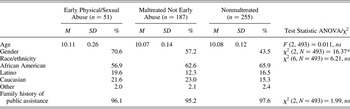
Participants included 493 children aged 7 to 13 (M age = 10.08, SD = 1.87) who attended a summer day camp research program designed for school-aged low-income children. The sample included both maltreated children (n = 238) and nonmaltreated children (n = 255). All of the children were in their first year of camp attendance. The children were not in foster care placements and were residing with their biological mothers. Demographic characteristics are presented in Table 1 for the EPA/SA, NEPA/SA, and NC groups. The proportion of boys differed between the NC and both the EPA/SA and NEPA/SA groups, χ2 (2) = 16.37, p < .001; thus, gender was controlled in analyses. The groups did not differ in age, race/ethnicity, or in family history of receiving welfare benefits. The sample constitutes 89.2% of the sample in Cicchetti et al. (Reference Cicchetti, Rogosch, Gunnar and Toth2010) from whom DNA samples were collected. Those children with DNA samples versus those without did not differ significantly on demographic variables, depressive and internalizing symptoms, or cortisol assay results.
Demographic characteristics

Note: ANOVA, analysis of variance. *p < .05.
Recruitment and classification procedures
Parents of all children provided informed consent for their child's participation, as well as for examination of Department of Human Services (DHS) records pertaining to the family. Children in the maltreated group had been identified by the county DHS as having experienced child abuse or neglect, and the sample was representative of the children in families receiving services from the DHS. A recruitment liaison from DHS contacted eligible maltreating families, explained the study, and if parents were interested, then their names were released to the project team for recruitment. Families were free to choose whether or not to participate. Comprehensive searches of DHS records were completed and maltreatment information was coded utilizing operational criteria from the maltreatment nosology specified in the Maltreatment Classification System (MCS; Barnett, Manly, & Cicchetti, Reference Barnett, Manly, Cicchetti, Cicchetti and Toth1993), as discussed below.
Consistent with national demographic characteristics of maltreating families (Sedlak et al., Reference Sedlak, Mettenburg, Basena, Petta, McPherson and Greene2010), the maltreated children were predominantly from low socioeconomic status (SES) families. Consequently, demographically comparable nonmaltreated children were recruited from families receiving Temporary Assistance for Needy Families. A DHS recruitment liaison contacted eligible nonmaltreating families, described the project, and if interested, parents signed a release for their names to be given to the project for recruitment. DHS record searches were completed for these families to verify the absence of any record of child maltreatment. Trained research assistants also interviewed mothers of children recruited for the nonmaltreatment group to confirm a lack of DHS involvement and prior maltreatment experiences utilizing the Maternal Maltreatment Classification Interview (Cicchetti, Toth, & Manly, Reference Cicchetti, Toth and Manly2003). Subsequently, record searches were conducted in the year following camp attendance to verify that all available information had been accessed. Only children from families without any history of documented abuse or neglect were retained in the nonmaltreatment group. In addition, families who had received preventive services through DHS due to concerns over risk for maltreatment were excluded from the sample to reduce the potential for unidentified maltreatment existing within this group.
Classification into maltreatment subgroups was accomplished through use of the MCS (Barnett et al., Reference Barnett, Manly, Cicchetti, Cicchetti and Toth1993). The MCS is a reliable and valid method for classifying maltreatment (Manly, Reference Manly2005) that utilizes DHS records detailing investigations and findings involving maltreatment in identified families over time. Rather than relying on official designations and case dispositions, the MCS codes all available information from DHS records, making independent determinations of maltreatment experiences. Based on operational criteria, the MCS designates all of the subtypes of maltreatment children have experienced (i.e., neglect, emotional maltreatment, physical abuse, sexual abuse) and the severity of each type on scales that range from 1 (least) to 5 (most) severe. Based on documented records, the MCS also determines when in the course of development maltreatment events occurred, providing indices of timing. Events were coded as occurring during five developmental periods, including infancy (0–12 months), toddlerhood (13–36 months), preschool (36–60 months), early school age (age 5–7), and later school age (age 8–12). The timing information allows for the determination of whether maltreatment occurred within each of the developmental periods. The developmental period of onset of maltreatment and the recency of maltreatment can be determined, and the number of developmental periods of maltreatment serves as an index of chronicity. Moreover, the developmental timing of each of the maltreatment subtypes also can be specified.
Coding of the DHS records was conducted by trained research assistants, doctoral students, and clinical psychologists. Coders were required to meet acceptable reliability with criterion standards before coding actual records for the study. Coders demonstrated acceptable reliability (weighted κs with the criterion ranging from 0.86 to 0.98). Reliabilities for the presence versus absence of maltreatment subtypes (κs = 0.90 to 1.00) and for individual subtypes severities (weighted κs of 0.75 to 1.00) also were established.
In terms of the subtypes of maltreatment, neglect involves failure to provide for the child's basic physical needs for adequate food, clothing, shelter, and medical treatment. In addition to inadequate attention to physical needs, forms of this subtype include lack of supervision, moral–legal neglect, and education neglect. Emotional maltreatment involves extreme thwarting of children's basic emotional needs for psychological safety and security, acceptance, and self-esteem, and age-appropriate autonomy. Examples of emotional maltreatment of increasing severity include belittling and ridiculing the child, extreme negativity and hostility, exposure to severe marital violence, abandoning the child, and suicidal or homicidal threats. Physical abuse involves the nonaccidental infliction of physical injury on the child (e.g., bruises, welts, burns, choking, broken bones). Injuries range from minor and temporary to permanently disfiguring. Finally, sexual abuse involves attempted or actual sexual contact between the child and a family member or person caring for the child for purposes of that person's sexual satisfaction or financial benefit. Events range from exposure to pornography or adult sexual activity, to sexual touching and fondling, to forced intercourse with the child.
Children in the maltreatment group all had histories of abuse, neglect, or both occurring in their families according to DHS records. Among the maltreated children, 78.9% had experienced neglect (M neglect severity for those with neglect = 3.41, SD = 1.11), 66.8% had experienced emotional maltreatment (M severity = 3.43, SD = 1.24), 31.5% had experienced physical abuse (M severity = 2.44, SD = .98), and 8.4% (M severity = 2.85, SD = 0.99) had experienced sexual abuse. The majority of children had experienced multiple subtypes of maltreatment. Specifically, 64.3% of the maltreated children had experienced two or more maltreatment subtypes, and 13 of the 15 possible combinations of presence versus absence of each of the four maltreatment subtypes were observed in the sample. On average, the maltreated children had experienced 1.87 (SD = 0.78) subtypes of maltreatment. The number of subtypes of maltreatment provides an index of maltreatment diversity.
Based on the MCS, we identified a group of children (n = 51) who had experienced early abuse, that is, physical or sexual abuse or both occurring prior to age 5 in the infancy, toddler, or preschool developmental periods (EPA/SA). In primary analyses, these children were contrasted with the remaining maltreated children (n = 187) who had not experienced early physical or sexual abuse (NEPA/SA), for example, experienced neglect or emotional maltreatment only or later onset of physical or sexual abuse, and the NC children (n = 255).
Day camp procedures
Children attended a week-long day camp program and participated in research assessments (for detailed descriptions of camp procedures, see Cicchetti & Manly, Reference Cicchetti, Manly, Brody and Sigel1990). Children were transported by bus to the camp each day, with travel time averaging 45 min. At the camp, children were assigned to groups of eight (four maltreatment, four control) same-age and same-sex peers. Each group was led by three trained camp counselors, who were unaware of the maltreatment status of children and the hypotheses of the study. Camp lasted 7 hr/day for 5 days, providing 35 hr of interaction between children and counselors. In addition to the recreational activities, after providing assent, children participated in various research assessments and provided morning and afternoon saliva samples. Trained research assistants, who also were unaware of research hypotheses and maltreatment status, conducted individual research sessions with children, in which questionnaires and other research measures were administered. Clinical consultation and intervention occurred if any concerns over danger to self or others emerged during research sessions. The counselors, who had been trained extensively for 2 weeks prior to the camp, also completed assessment measures on individual children, based on their 35 hr of observations and interactions with children in their respective groups. Counselors were unaware of the research hypotheses and children's maltreatment status.
Measures
Saliva collection and preparation
The camp context allowed for a setting where a consistent collection of saliva samples could occur at uniform times across the camp week. Each day upon arrival to the camp at 9:00 a.m., trained research assistants obtained saliva samples from each child. Given the approximate 45-min transportation time and the time spent being greeted by camp staff, children had been awake at least 1 hr prior to providing the morning saliva samples, thus avoiding the period of the dynamic cortisol awakening response (cf. Susman et al., Reference Susman, Dockray, Dorn, Schiefelbein, Herwehe and Heaton2007). Samples also were obtained each day prior to the children's departure from the camp at 4:00 p.m.
The children had not consumed food or drink for at least 30 min before each saliva sample was obtained. Samples were collected following the method recommended by Granger, Schwartz, Booth, Curran, and Zakaria (Reference Granger, Schwartz, Booth, Curran and Zakaria1999). The children were asked to chew Trident® sugarless original flavor gum to stimulate saliva flow and then passively drool though a short drinking straw into a 20-ml plastic vial. The samples were immediately frozen and stored at –40°C. Each week, the samples were shipped overnight on dry ice for next day delivery to Salimetrics Laboratories (State College, PA) for assay. Cortisol was assayed in duplicate by Salimetrics, Inc. using an enzyme immunoassay. This assay has a lower limit of sensitivity of 0.007 µg/dl (range up to 1.8 µg/dl), and average intra- and interassay coefficients of variation less than 5.0% and 10.0%, respectively. Units of cortisol are expressed in micrograms per deciliter (μg/dl). Across camp days, the mean morning cortisol level was 0.19 (SD = 0.11), and the mean late afternoon level was 0.11 (SD = 0.07). As cortisol values were positively skewed and leptokurtotic, logarithmic transformations (log10) of cortisol values were used for all statistical analyses. Values were averaged across days to yield one morning and one afternoon cortisol measure for each child.
DNA collection, extraction, and genotyping
Using an established protocol, trained research assistants obtained DNA samples from participants by collecting buccal cells with the Epicentre Catch-All Collection Swabs. Subsequently, using the conventional method, DNA was extracted with the Epicentre BuccalAmp DNA Extraction Kit, in order to prepare DNA for PCR amplification. Genotyping was conducted following previously published protocols.
DNA was whole-genome amplified using the Repli-g kit (Qiagen, Chatsworth, CA, Catalog No. 150043) per the kit instructions to ensure the availability of data over the long term for this valuable sample. Amplified samples were then diluted to a working concentration.
CRHR1 was genotyped using assays for SNPs rs110402, rs242924, and rs7209436 purchased from Applied Biosystems, Inc. (ABI, Bedford, MA) as C2544843 10, C2257689 10, and C1570087 10, respectively. Individual allele discriminations were made using Taq Man Genotyping Master Mix (ABI Catalog No. 4371357) with amplification in an ABI 9700 thermal cycler and analyzing the endpoint fluorescence using a Tecan M200.
5-HTTLPR samples were genotyped for fragment length polymorphisms of 5-HTTLPR with Hot Star Taq PCR Mix (Qiagen, Catalog No. 203205) and previously described primers (Gelernter, Kranzler, & Cubells, Reference Gelernter, Kranzler and Cubells1997), followed by fragment analysis using a CEQ8000 (Beckman-Coulter, Inc., Fullerton, CA).
If a genotype for either gene or SNP could not be determined after the first run, then it was repeated up to four times. If the null result persisted, then a genotype was not assigned to that individual.
The call rates for the three SNPs for CRHR1 were as follows: rs7209436 = 99.98%, rs1104202 = 100%, and rs242924 = 99.98%. For two individuals, we could not confidently determine the genotype of one SNP of CRHR1. For one individual, rs7209436 was indeterminate, whereas for another it was rs242924. Because the remaining two CRHR1 SNPs for these two individuals were able to be genotyped, all participants in this study had a haplotype for each of the three CRHR1 SNPs. The call rate for 5-HTTLPR was 100%.
Haplotypes for the three CRHR1 SNPs were determined using GeneticsBase (Warnes, Reference Warnes2003). Because the three SNPs were very strongly related (all r > .92), GeneticsBase was able to estimate haplotypes for every participant with a posterior probability higher than 0.98, which allowed us to assign a score of zero, one, or two copies of the TAT haplotype to participants with a high degree of certainty. The TAT haplotype accounted for 32.5% of all haplotypes in the sample, with its complement, CGG, accounting for 59.8%. The number of TAT haplotypes was used in analyses to predict diurnal cortisol and internalizing symptoms from haplotype score in interaction with maltreatment status or early abuse status.
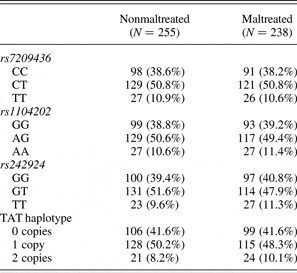
Table 2 presents allele and haplotype frequencies for the sample, comparing maltreated and nonmaltreated children. The two groups did not differ by genotype (number of TAT haplotype copies), χ2 (2, N = 493) = .55, p = .76, which indicates absence of gene–environment correlation (rGE). In other words, CRHR1 genotype did not influence the likelihood that children would be maltreated.
Genotype and haplotype frequencies for three corticotrophin releasing hormone receptor 1 single nucleotide polymorphisms by maltreatment status

All DNA samples were genotyped in duplicate for quality control. In addition, human DNA from cell lines was purchased from Coriell Cell Repositories for all representative genotypes in duplicate and genotypes confirmed by sequencing using DTCS chemistry on an ABI 3130x1. These and a no template control were run alongside study samples representing 9% of the total data output. Any samples that were not able to be genotyped to a 95% or greater confidence level were repeated under the same conditions.
Internalizing and depressive symptoms
Children's Depression Inventory (CDI)
The CDI (Kovacs, Reference Kovacs1982, Reference Kovacs2004) is a widely used self-report questionnaire to assess depressive symptomatology in school-age children. For each item, children chose from among three option statements, depicting increasing levels of depressive symptoms, in order characterize their experiences in the past 2 weeks. Kovacs (Reference Kovacs2004) reports that internal consistency for the total scale has ranged from 0.71 to 0.89, and validity has been well established. In the current investigation, internal consistency was 0.85. A total score of 19 and above has been established as a cutpoint for clinical level depressive symptoms (Kovacs, Reference Kovacs2004). In the current sample, 11.6% (n = 57) of the children reported clinical level depressive symptoms.
Teacher Report Form (TRF)
Behavioral symptomatology was evaluated at the end of each week by counselors' completion of the TRF (Achenbach, Reference Achenbach1991). The TRF is a widely used and validated instrument to assess behavioral disturbance from the perspective of teachers, and the measure was used in the present study, because camp counselors are able to observe similar behaviors to that of teachers. The TRF, containing 118 items rated for frequency, assesses two broadband dimensions of child symptomatology, internalizing and externalizing, as well as total behavior problems. In the present investigation, we focus on the internalizing dimension, which includes subscales of withdrawn, somatic problems, and anxiety/depression. Interrater reliability for the internalizing scale was based on average intraclass correlations among pairs of raters. Across the years, reliabilities for internalizing ranged from 0.56 to 0.84 (M = 0.68), consistent with the greater difficulty in observers rating internalizing symptoms (Achenbach, Reference Achenbach1991). Internal consistency was 0.84. The counselors' scores for each child were averaged to obtain individual child scores for the internalizing dimension. Utilizing the T scores for the internalizing scale, a cutpoint of 60T was used to designate the presence or absence of high internalizing symptoms (Achenbach, Reference Achenbach1991). In the sample, 10.1% of the participants (n = 50) were classified as having high level internalizing problems.
Summary measure of internalizing
To yield a multiinformant index of children displaying high depressive and internalizing symptomatology, child and counselor measures were combined. Overall, the CDI and TRF internalizing scores were significantly but not strongly correlated (r = .21, p < .001). Similarly, the high symptom level groups for the CDI and TRF were significantly but weakly associated, χ2 (1, N = 493) = 3.88, p = .05. This level of correspondence is consistent with the degree of agreement typically found between different sources of report for child internalizing symptoms. To combine both perspectives, the presence of high symptoms on either the CDI or the TRF was determined and used as an index of high depressive and internalizing symptomatology, resulting in 19.7% of the children being classified as symptomatic.
Results
The primary data analytic strategy utilized in the current investigation involved univariate and repeated measures analyses of covariance (ANCOVAs). In these analyses gender and age were controlled as covariates in all models, whereas a categorical race/ethnicity variable was included as a main effect to control for race influences. The first set of analyses examined the effects of early abuse and high levels of internalizing/depressive symptoms on diurnal regulation of cortisol. These analyses represent a confirmation of previous findings (Cicchetti et al., Reference Cicchetti, Rogosch, Gunnar and Toth2010), with a reduced sample of children from whom we had been able to obtain genetic samples. Next, the role of genetic variation on cortisol regulation is examined, using the CRHR1 and 5-HTTLPR genes. We evaluate evidence for (rGE). Then, we considered the influence of genetic variation as a moderator of the effects of early abuse, specifically, and maltreatment status more generally, on diurnal cortisol regulation. In the last set of analyses, we examine whether genetic variation in 5-HTTLPR and CRHR1 individually moderates the association of maltreatment on internalizing symptoms; further, we investigate evidence for the joint effects of these two genes and maltreatment history in a G × G × E interaction predicting internalizing symptoms.
Diurnal cortisol regulation: The interaction of early abuse and high internalizing/depressive symptomatology
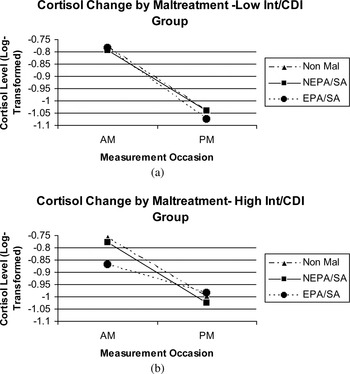
Differences in diurnal change in cortisol among the early abuse status groups and children with high internalizing/depressive symptomatology were examined. Specifically, a repeated-measures ANCOVA was conducted with morning and afternoon cortisol levels as the within subjects repeated outcome factor, and early abuse status (EPA/SA, NEPA/SA, NC) and symptom level (high vs. low internalizing/depressive symptoms) as between-subject factors. In addition to significant gender, age, and race effects, a significant main effect was found for symptom level, F (1, 482) = 7.029, p = .008. However, this main effect was qualified by a significant interaction among early abuse group, symptom level, and a.m./p.m. diurnal cortisol change, F (2, 482) = 4.94, p = .008. Specifically, children from the EPA/SA group who were high on depression/internalizing symptoms showed flatter slope from morning to afternoon in cortisol level compared to the maltreated children who did not experience early abuse and to nonmaltreated children, whereas these early abuse status groups did not differ in cortisol change when children had low levels of internalizing/depressive symptoms (see Figure 1a and b). These findings are consistent with those reported by Cicchetti et al. (Reference Cicchetti, Rogosch, Gunnar and Toth2010) on the larger sample. It was not feasible to include genotype groups as an additional factor in this analysis because the distributions of the CRHR1 haplotypes and the 5-HTTLRP genotypes resulted in cell-size constraints (ns < 10).
The interaction effect of early abuse and internalizing/depression symptoms on diurnal change in cortisol. Non-Mal, nonmaltreated; NEPA/SA, not early physical/sexual abuse; EPA/SA, early physical/sexual abuse; Int/CDI, internalizing/depressive symptoms.

Diurnal cortisol regulation. The interaction of early abuse and CRHR1 haplotype groups
Our initial examination of the role of CRHR1 and 5-HTTLPR determined whether there was evidence of rGE. In the analyses to follow, CRHR1 haplotypes were grouped as zero or one versus two TAT copies, whereas for 5-HTTLPR, the presence of a short allele (ss or sl) was differentiated from the homozygous long (ll) genotype. The early abuse groups were contrasted on their distribution across these respective genotype groups. No significant differences in the proportion of children in the early abuse groups (EPA/SA, NEPA/SA, NC) with CRHR1 haplotype variation, χ2 (2, N = 493) = 2.96, p = .23, or 5-HTTLPR genotype group, χ2 (2, N = 492) = 2.54, p = .28, were observed. Thus, support for a rGE for each of these genes and early abuse status was not obtained.
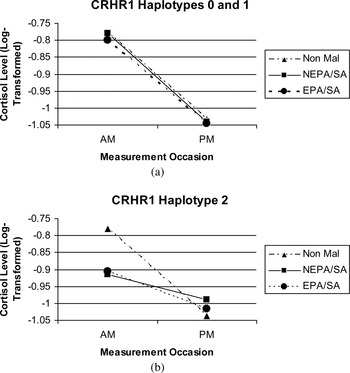
A repeated-measures ANCOVA was conducted to examine mean differences of diurnal change in cortisol level from the morning to late afternoon among the EPA/SA, NEPA/SA, and NC groups of children. Gender and age were significant covariates, whereas the main effect of race/ethnicity was not. Significant main effects were obtained for early abuse status, F (2, 482) = 4.087, p = .017, and for the CRHR1 haplotype group (zero and one vs. two copies), F (1, 482) = 8.065, p = .005. However, these results were clarified by a significant two-way CRHR1 × Early Abuse Status (G × E) interaction, F (2, 482) = 5.788, p = .003. Specifically, children with zero or one copies of the CRHR1 TAT haplotype evinced no variation in the slope of diurnal cortisol production across the day depending on membership in the EPA/SA, NEPA/SA, or nonmaltreated groups (see Figure 2a). In contrast, variation in diurnal cortisol regulation was observed among children with the CRHR1 TAT two-copy haplotype. In particular, children from both the EPA/SA and the NEPA/SA groups with the haplotype two-copy variation of CRHR1 showed an attenuated slope of diurnal cortisol change (see Figure 2b). Thus, the flattening of the diurnal cortisol change was observed in both the maltreated children who had experienced early abuse, as well as the other maltreated children who had not experienced early abuse, relative to the nonmaltreated children. The moderation by the CRHR1 haplotype grouping was not restricted to the early abused group, but was seen across the maltreated group.
The interaction effect of corticotropin releasing hormone receptor 1 haplotype groups and early abuse on diurnal change in cortisol. Non-Mal, nonmaltreated; NEPA/SA, not early physical/sexual abuse; EPA/SA, early physical/sexual abuse.

Diurnal cortisol regulation and CRHR1 haplotype (zero and one vs. two copies) in maltreated and nonmaltreated children
Given the comparability of results for the EPA/SA and the NEPA/SA groups in the above analysis, we sought further verification of the effects for the maltreated group in general. Accordingly, a repeated-measures ANCOVA was conducted to compare change in mean cortisol level from the morning to late afternoon for maltreated and nonmaltreated children. As previously, the covariates of gender and age were significant, whereas the main effect of race/ethnicity was not. Significant main effects were found for maltreatment status, F (1, 484) = 7.903, p = .005, and CRHR1, F (1, 484) = 4.964, p = .026. Subsequently, a significant two-way interaction was obtained between CRHR1 and maltreatment (G × E) in relation to diurnal change of cortisol, F (1, 484) = 11.344, p = .001. Specifically, the findings show that among nonmaltreated comparison children, haplotype variation in CRHR1 has no effect on morning to afternoon diurnal change in cortisol. In contrast, CRHR1 haplotype variation was related to differences in diurnal cortisol regulation in maltreated children. The results show that maltreated children having the two-copy TAT haplotype of CRHR1 have an attenuated diurnal slope in cortisol, whereas maltreated children with a zero or one-copy TAT haplotype were not different from the nonmaltreated children. Thus, the CRHR1 haplotype significantly moderated the pattern of diurnal decrease in cortisol (i.e., a flatter slope). We also evaluated whether adding 5-HTTLPR to the model, along with the observed interaction detected between maltreatment and CRHR1 and time of cortisol measurement, would contribute to additional effects. However, no significant G × G × E interaction (CRHR1 × 5-HTTLPR × Maltreatment) on diurnal cortisol regulation was detected. As noted earlier, given cell-size constraints, we were not able to add high versus low depression/internalizing symptoms as an additional factor to the ANCOVA model.
Gene variation and maltreatment in the prediction of internalizing symptoms
The influences of child maltreatment and variants of both 5-HTTLPR and CRHR1 were examined in relation to internalizing symptomatology. Significant findings did not emerge for the CDI, and thus only results for TRF internalizing symptoms are reported herein.
5-HTTLPR
To determine if variation in 5-HTTLPR moderated the relation of maltreatment status on internalizing symptoms, an ANCOVA was conducted with maltreatment status and 5-HTTLPR genotype groups (ss or sl vs. ll). The main effect of maltreatment on internalizing symptoms was significant, F (1, 483) = 7.13, p = .008. However, the main effect of 5-HTTLPR, F (1, 483) = 1.24, p = .267, and its interaction with maltreatment status, F (1, 483) = 1.19, p = .276, were not significant. Thus, evidence for a G × E effect was not found.
CRHR1
Similarly, we evaluated whether CRHR1 haplotype groups (zero or one copy vs. two copies) moderated the relation of child maltreatment on internalizing symptoms. ANCOVA results indicated that the main effect of maltreatment on internalizing symptoms was significant, F (1, 483) = 3.98, p = .047, whereas the main effect of CRHR1 haplotype groups, F (1, 483) = 1.24, p = .267, and its interaction with maltreatment status, F (1, 483) = 1.19, p = .276, were not. Thus, a G × E effect for CRHR1 was not supported.
Interaction of 5-HTTLPR, CRHR1, and maltreatment for internalizing symptoms
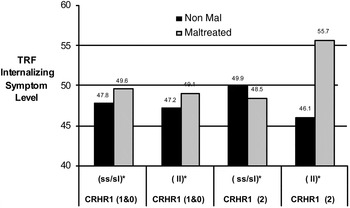
We next examined whether variations of 5-HTTLPR and the CRHR1 haplotypes interact significantly with maltreatment status in predicting TRF internalizing symptoms. In the ANCOVA, we incorporated 5-HTTLPR and CRHR1 as main effects along with maltreatment status. The covariates of gender and age were nonsignificant, as was the main effect of race/ethnicity. A significant main effect was found for maltreatment status, F (1, 484) = 6.634, p = .01. Maltreated children were rated as having significantly higher TRF internalizing symptoms. Significant main effects on internalizing symptoms were not obtained for the 5-HTTLPR allelic groups (ss or sl vs. ll) F (1, 481) = 0.189, p = .664, or for the CRHR1 haplotype groups (zero and one vs. two copies), F (1, 481) = 2.453, p = .118. However, a significant two-way interaction effect for internalizing symptoms was found for 5-HTTLPR and maltreatment status, F (1, 479) = 4.169, p = .04, although this interaction had not been found in the ANCOVA without CRHR1. This effect was further clarified by a significant three-way interaction among 5-HTTLPR, CRHR1 (zero to one vs. two copies), and maltreatment status, F (1, 479) = 4.359, p = .04 on TRF internalizing symptoms, demonstrating a G × G × E effect.
As shown in Figure 3, among children in the CRHR1 zero or one haplotype group, no differences were observed for maltreated versus nonmaltreated children, depending on the variation in the 5-HTTLPR genotype. In contrast, differences were found for children in the CRHR1 two-copy haplotype group. Maltreated children with the CRHR1 two-copy haplotype and the 5HTTLPR ll genotype stood out, having higher internalizing symptoms than nonmaltreated children with the same combination of gene variants. No statistically significant differences were observed between maltreated and nonmaltreated children with the CRHR1 two-copy haplotype and 5-HTTLPR short alleles.
The interaction effect of corticotropin releasing hormone receptor 1 haplotype and serotonin transporter linked polymorphic region (5-HTTLPR) genotype groups and maltreatment status on internalizing symptoms. *5-HTTLPR genotype group; Non-Mal, nonmaltreated.

We also evaluated whether maltreated children with the 5-HTTLPR ll genotype and the CRHR1 two-copy haplotype had higher TRF internalizing symptoms compared to maltreated children with different genotype combinations. A follow-up ANCOVA among children in the maltreated group revealed that those with the CRHR1 two-copy TAT haplotype and the 5-HTTLPR homozygous long allele combination scored significantly higher on the TRF (M = 55.77, SD = 8.83) compared to other maltreated children (M = 49.35, SD = 8.22) with different genotype combinations, F (1, 237) = 6.333, p = .013. Among nonmaltreated children, different genotype combinations did not influence internalizing symptom scores, F (1, 245) = 0.38, p = .54.
Discussion
This investigation examined how the effects of two interrelated domains, HPA axis regulation and G × E interaction, are involved in the vulnerability imposed by child maltreatment and early abuse on internalizing/depressive symptomatology in childhood. Within an allostatic load framework, we examined how co-occurring early abuse and high internalizing/depressive symptoms are related to a flattening of the diurnal cortisol rhythm. We then considered how variation in the CRHR1 gene and the experience of early abuse, and maltreatment more generally, function in a G × E interaction to predict attenuation in the diurnal pattern of cortisol change. Finally, we also established the existence of a G × G × E interaction involving CRHR1, 5-HTTLPR, and child maltreatment, in relation to higher levels of internalizing symptomatology.
Thus, from multiple perspectives, we advance understanding of how early abuse is related to cortisol dysregulation, a primary mediator of allostatic load. We observed differential effects in this process based on the presence of high internalizing symptoms and based on variation in the CRHR1 gene. We also demonstrated the interactive role of two targeted genes (one related to HPA axis function, the other to sensitivity to stress) in identifying which maltreated children are the most vulnerable to exhibiting high internalizing symptomatology.
Consistent with our earlier results with a larger sample (Cicchetti et al., Reference Cicchetti, Rogosch, Gunnar and Toth2010), we replicated the finding that maltreated children who experienced EPA/SA and had high internalizing symptomatology evinced a flatter diurnal cortisol slope from a.m. to late afternoon than maltreated children who did not experience early abuse (NEPA/SA) and nonmaltreated comparison children (NC). Because of sample size constraints, cell size limitations due to the frequency distributions of rare genotypes, and the lower rates of high internalizing symptoms and of early abuse, we could not consider whether there is an EA × High Internalizing Symptoms × CRHR1 three-way interaction effect on cortisol dysregulation.
Maltreated children who experienced EPA/SA, as well as those whose history of maltreatment did not include early abuse (NEPA/SA), and who possessed two copies of the TAT haplotype of CRHR1, both exhibited an attenuated slope of diurnal cortisol change. In contrast, NC children who had two copies of the TAT haplotype did not manifest the attenuation in the diurnal cortisol slope. Likewise, EPA/SA, NEPA/SA, and NC children who had either zero or one copies of the CRHR1 TAT haplotype evinced no between-group variation in diurnal cortisol regulation. Because no significant differences were obtained between the EPA/SA and NEPA/SA groups, we combined all maltreated children and examined the relation between CRHR1 haplotype and variation and diurnal cortisol regulation.
Regardless of their number of TAT haplotype copies of CRHR1, NC children did not differ in their pattern of diurnal cortisol change from a.m. to later afternoon. In contrast, maltreated children with two copies of the CRHR1 TAT haplotype evinced an attenuated or flattened slope in cortisol across the day, whereas the a.m. to p.m. cortisol slope of maltreated children possessing zero or one copy of the TAT haplotype was not different from the NC children. These findings suggest that the presence of a two-copy TAT haplotype of CRHR1 in maltreated children contributes to the flattened cortisol slope across the day, a sign of allostatic load.
This is the first empirical study to demonstrate G × E effects of CRHR1 and maltreatment (and early abuse) on cortisol dysregulation in childhood; moreover, these findings suggest that allostatic load processes may be unfolding early in the development of maltreated children. We also discovered that the G × E effect of CRHR1 and maltreatment on cortisol dysregulation is not moderated further by 5-HTTLPR.
In addition, an analysis for G × E interaction examining the effect of gene variation and maltreatment on internalizing symptomatology was conducted separately for CRHR1 and for 5-HTTLPR. Neither G × E was significantly related to internalizing symptoms. In contrast, an analysis for G × G × E, among CRHR1, 5-HTTLPR, and maltreatment on internalizing symptomatology revealed a significant G × E interaction for 5-HTTLPR on depressive symptoms, as well as a significant G × G × E. Specifically, maltreated children who had two copies of the TAT haplotype of CRHR1 and the l/l genotype of 5-HTTLPR had higher levels of internalizing symptomatology than NC children who had the same combination of gene variants. No statistically significant differences on levels of internalizing symptoms were obtained between maltreated and nonmaltreated comparison children who had two copies of the TAT haplotype of CRHR1 and the s/s or s/l genotype of 5-HTTLPR. Moreover, maltreated and nonmaltreated children with zero or one copy of the TAT haplotype did not differ in internalizing symptoms depending on their 5-HTTLPR genotypes. Thus, the interaction of genes that are linked to the HPA axis and cortisol regulation (CRHR1) and to stress sensitivity (5-HTTLPR) contributed to increased levels of internalizing symptoms, an illustration of the multiple paths to allostatic load in maltreated children.
This study also is the first research investigation to establish a G × G × E interaction involving CRHR1 and 5-HTTLPR and maltreatment on internalizing symptomatology in childhood. Ressler and colleagues (Reference Ressler, Bradley, Mercer, Deveau, Smith and Gillespie2010) have conducted a similar study to the one reported herein. In our investigation, internalizing symptoms were based on other report and maltreatment was independently ascertained via documented DHS records, whereas in the Ressler et al. (Reference Ressler, Bradley, Mercer, Deveau, Smith and Gillespie2010) study, adults provided self-report of their depressive symptoms and retrospectively recalled their history of maltreatment. Moreover, whereas both our study and the Ressler et al. (Reference Ressler, Bradley, Mercer, Deveau, Smith and Gillespie2010) investigation examined the G × G × E (CRHR1 × 5-HTTLPR × Maltreatment) interaction on depressive symptoms, in the present study we also examined how these genes moderate cortisol dysregulation. It appears that maltreatment and CRHR1 genetic variation are needed to affect cortisol regulation, whereas maltreatment and the joint effects of CRHR1 and 5-HTTLPR are needed to affect internalizing symptoms.
It is important to keep in mind that the findings in our study, as in all investigations that examine the interplay between genes and environmental pathogens, are probabilistic in nature. Consistent with the concept of equifinality (Cicchetti & Rogosch, Reference Cicchetti and Rogosch1996), not all maltreated children who had two copies of the CRHR1 TAT haplotype displayed attenuated slopes of diurnal cortisol regulation. Likewise, not every maltreated child who possessed the two-copy CRHR1 TAT haplotype and the l/l genotype of 5-HTTLPR evinced high levels of internalizing symptomatology. Clearly, there are multiple pathways to attenuated cortisol regulation and to high levels of internalizing symptoms and, by association, to allostatic load, in maltreated children. Furthermore, other factors besides genetic variation are involved in developmental paths to cortisol dysregulation and to elevated levels of depressive symptoms in maltreated children. For example, it is likely that various environmental and epigenetic factors contribute to the large interindividual variability that characterizes HPA axis regulation and internalizing symptoms (McGowan & Szyf, Reference McGowan and Szyf2010; Meaney, Reference Meaney2010).
Despite our demonstration that genetic variation interacts with child maltreatment to produce alterations in cortisol regulation and increased levels of internalizing symptoms, signs of physiological and physical health consequences of allostatic load, there are limitations that exist in our investigation. In particular, in our earlier paper (Cicchetti et al., Reference Cicchetti, Rogosch, Gunnar and Toth2010), in the absence of measures of genetic variation, we found that EPA/SA children with high depressive symptoms differed from NEPA/SA and NC children in their patterns of cortisol regulation characterized by a flattened diurnal slope from a.m. to p.m. (late afternoon). In the present study among maltreated children, there were no differences between EPA/SA and NEPA/SA children with two copies of the TAT haplotype of CRHR1 in cortisol regulation as both groups of children exhibited attenuated diurnal cortisol. Why did developmental timing of abuse not play a role in the neuroendocrine findings in this study? Did any factors other than sample size constraints, rare genotype frequencies, and lower rates of high internalizing symptoms and EA contribute to the absence of timing effects in the present study? Recruiting a larger sample of maltreated and nonmaltreated children will enable us to conduct the four-way interaction needed to fully address the question we posed in this investigation, namely, whether there is an EA × High Internalizing Symptoms × CRHR1 × 5-HTTLPR interaction on cortisol regulation.
We also do not know how the processes suggestive of allostatic load discovered in this investigation may operate in nonlow-SES maltreated and nonmaltreated children. Many of the stressful experiences encountered by maltreated and nonmaltreated children from the low SES would differ from those residing in the middle or upper SES; however, the majority of maltreated children reside in poverty environments. It is important that future research is conducted on the multilevel processes investigated in this study in maltreated children from other socioeconomic backgrounds.
Given the deleterious impacts that child maltreatment has on both physical and mental health, in part through allostatic load processes, several important prescriptions assume ascendance. Interventions that can prevent the occurrence or recidivism of child abuse and neglect must be conducted and evaluated at multiple levels of analysis (Cicchetti & Gunnar, Reference Cicchetti and Gunnar2008; Cicchetti, Rogosch, & Toth, Reference Cicchetti, Rogosch and Toth2006; Cicchetti, Rogosch, Toth, & Sturge-Apple, Reference Cicchetti, Rogosch, Toth and Sturge-Apple2011). In addition, such theoretically informed multilevel interventions should be implemented as close as possible to the onset of the trauma that often are sequelae of child maltreatment.